Specs are compiled from manufacturer listings and verified buyer reviews and can change over time — please confirm the key details on the product page before buying.
Buying a wooden compost bin is really a choice between two jobs: how much kitchen and yard waste you need to break down, and how much bending and lifting you want to do while it happens. The short answer is this — a big open-bottom cedar frame holds the most, drains the best, and costs you nothing in electricity or repairs. The only real question is which of the two sizes fits your yard and your weekly scraps.
This guide is built by comparing the manufacturers’ published specifications and the patterns across verified customer reviews, so you get each pick’s real strengths and trade-offs instead of marketing spin.
Both bins here are 3/4-inch cedar from the same maker, so the choice depends on footprint and capacity. Read on for a plain-English breakdown of the wooden compost bin sizes and which one fits your garden.
Quick Picks
- Greenes Fence Premium Cedar Wood Composter — Best Overall
- Greenes Fence Premium Cedar Wood Composter — Compact Pick
How To Choose The Best Wooden Compost Bin
A wooden compost bin is a frame, not a machine. It has no lid crank, no motor, and no electricity — just slatted cedar walls that hold your scraps in a pile while air and rain get at it. So your buying decision depends on three things: volume, board thickness, and how the panels hold together.
Start with volume, because it decides your turning schedule
A pile needs roughly a cubic yard of material before it holds heat and breaks down quickly. Anything smaller works fine, but you will be adding to it longer before you get finished compost out the bottom. If you cook most nights and rake leaves every fall, a larger frame saves you from running two piles at once. If you are composting coffee grounds and vegetable peels for a small plot, a compact frame keeps the pile concentrated and turned more easily.
Board thickness is the number that predicts how long it lasts
Cedar resists rot on its own, so thickness is the real durability spec. Boards at 3/4 inch are the stout end of what you will find in a garden bin — thick enough that the slats stay straight when a full load pushes out against them. Thinner boards can bow over a season or two of wet material pressing on the walls.
Look at how the corners lock together
The best designs slide their boards into routed corner posts, so the frame stays square and you can lift a board out to turn the pile. That is the feature to check first. A frame you can open up means you actually keep the material aerated, which is the single biggest factor in whether you get compost this season or next spring.
Decide if you want room to grow
Composting tends to expand. If the maker sells add-on kits that convert one bin into a two- or three-bin system, you can start small and add a bay later for turning material from one bin into the next. Buying that capability up front usually costs less than replacing a whole frame when you outgrow it.
Side-by-Side Comparison
Detailed Reviews
1. Greenes Fence Premium Cedar Wood Composter 36″ x 36″ x 31″

The big-bay cedar frame that swallows a whole autumn’s worth of leaves without blinking.
Start with the number that decides everything else: 173.92 gallons of usable volume, held inside a 36″L x 36″W x 31″H footprint. That is 173.92 gallons against the smaller Greenes bin’s 77.3 gallons, and that gap in capacity is the difference between a pile you feed all season and a pile you fill before the leaves are done falling. For a household that generates steady kitchen scraps plus yard waste, this is the volume that actually keeps up.
What wins people over is how it goes together. Owners talk about assembly more than any other single thing, and it is the same story every time: quick, tool-light, done before lunch. The sanded North American cedar boards arrive 3/4 inch thick, which is the stout end of garden-bin construction, and the open-bottom design drains excess moisture better than a sealed compost tumbler that traps water inside a drum.
Then there is the growth path. Greenes sells add-on kits that turn this single bay into a two- or three-bin system, so you can start with one frame and add a turning bay later instead of buying a whole second composter. The one honest caveat is at the board ends — some corner pieces can splinter where they are cut. It is a cosmetic rough edge rather than a structural failure, and a quick sanding settles it. At 46 pounds the frame is hefty enough to stay put in wind.
Why this one leads the list
- 173.92 gallons holds a full season of yard waste in one bay
- Locks together with 4 posts, 24 boards, and 40 spacers using only a mallet
- 3/4″ sanded North American cedar, made in the USA
- Add-on kits expand it into a two- or three-bin system
- Open bottom drains excess moisture better than a tumbler
Where it asks for patience
- Some corner-piece ends arrive splintered and want a light sanding
- At 46 pounds, moving it to a new spot is a two-person job
The right buyer: Anyone with a real yard to feed — leaves, grass clippings, kitchen scraps — who wants one generous bay that drains itself.
Think twice if: Your garden is a balcony or a narrow strip, because a 36-inch square footprint needs open ground.
2. Greenes Fence Premium Cedar Wood Composter 24″ x 24″ x 31″
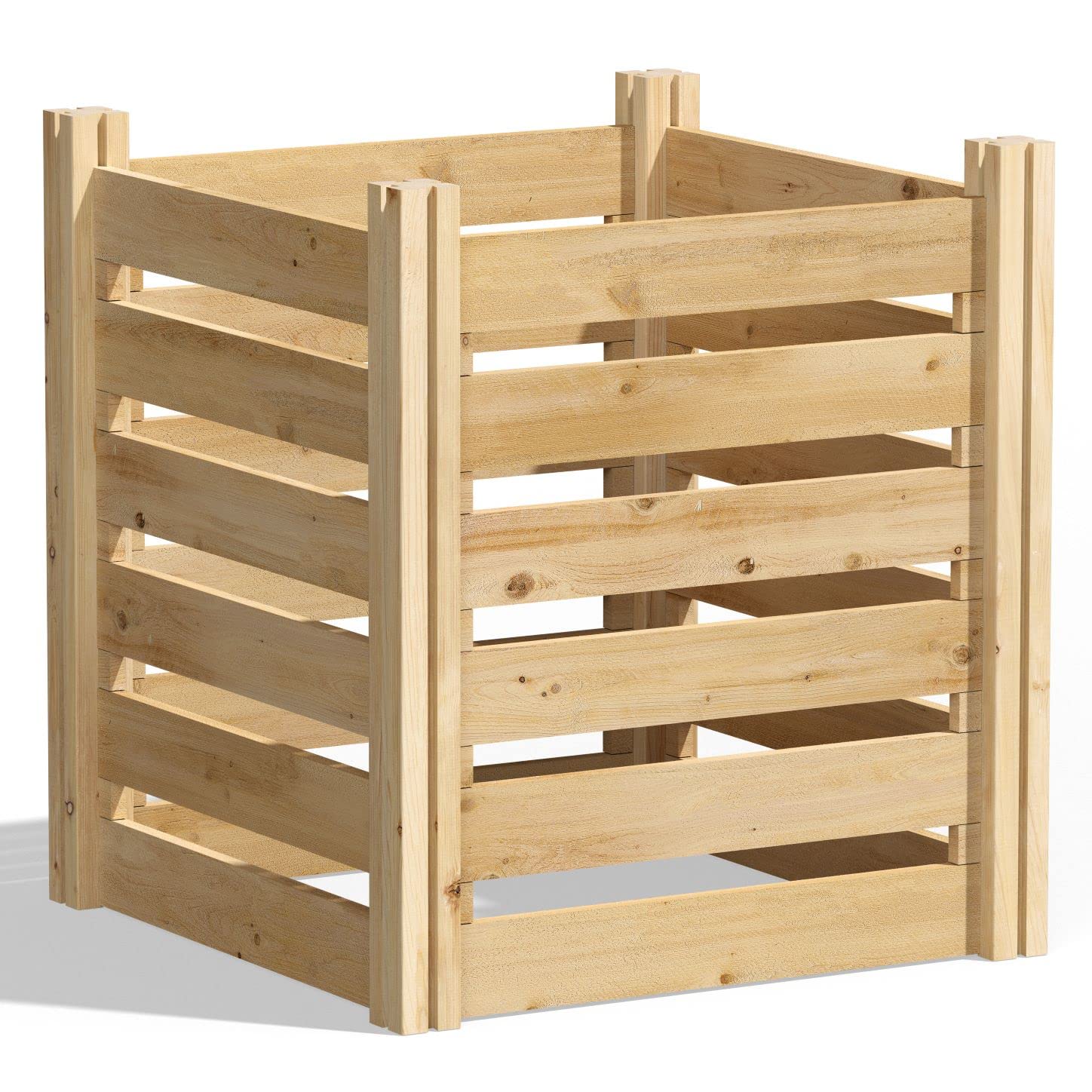
Same cedar, same mallet-only build, cut down to a two-foot square that fits a small plot.
The 36-inch bin up top and this one share a maker, a 3/4-inch cedar board, and a 31-inch height. The only real split is width: this frame measures 24″L x 24″W against the larger bin’s 36″L x 36″W, which drops capacity from 173.92 gallons to 77.3 gallons. In a garden bed that is the difference between a bin that occupies a corner and one that takes over a raised bed’s worth of ground. If your plot is a few raised beds and a fence line, this is the size that disappears into the layout.
Composting performance is what carries this one — the open, slatted design lets air move through the pile so you can turn waste regularly without pulling a lid off. Boards slide into routed corner posts with no tools, and the frame is open at the bottom so it sits directly on soil and worms come up into the material. Greenes also tucks in a copy of Organic Gardening writer Mike McGrath’s Book of Garden Beds & Composting, which is genuinely useful if this is your first pile.
Be clear-eyed about the trade-offs here, because the smaller bin draws more divided feedback than its bigger sibling. Nothing about the 3/4-inch cedar or the routed posts is flimsy, but a 77.3-gallon bay fills faster, so you will be turning it more often. That is the honest arithmetic of a compact bin, not a defect.
The size calculation: A 24-inch square by 31-inch tall frame gives you 77.3 gallons — enough for a steady kitchen-scrap habit and a modest leaf drop, not enough to bury a whole yard’s autumn haul in one go.
What to weigh first: The included composting book earns its place for a first-timer. Just go in expecting to turn the pile more frequently than you would with the 173.92-gallon bay, and expect to pay closer to the big bin’s going rate for a good deal less volume.
Best fit: Small gardens, raised-bed setups, and anyone who wants a cedar frame that hides in a corner rather than dominating the yard.
Look at the larger bin instead if: You rake a lot of leaves each fall, since the same footprint height buys you far less material room here.
Know the Specs
Capacity in Gallons
The gallon figure tells you how much material the frame holds before it is full. A compost pile tends to break down faster once it has bulk to hold heat, so a larger capacity usually means you reach finished compost sooner. Smaller bins are easier to turn and fit tighter spaces, but you will be adding to them for longer before you have anything to spread. Match the number to how much waste your household actually produces in a week, not to how big your yard looks on a map.
Board Thickness
Measured in inches, board thickness is the durability number that matters outdoors. Cedar resists rot and insects on its own, so the question is how much material is doing that work. Boards at 3/4 inch are on the sturdy side for a garden compost frame — thick enough to resist bowing when wet material presses against the walls. Thinner slats save weight but tend to warp sooner in a damp pile.
Corner Post Construction
Routed corner posts are channels cut into the uprights so the side boards slide in and stay square. That design has two payoffs: the frame holds its shape without fasteners, and you can lift a single board out to reach in and turn the pile. On both bins here the posts are 2.5-inch square, with boards 3.5 inches high and spacers 1 15/16 inches high, so the gaps let air move through the stack.
Open-Bottom Design
An open bottom means the bin sits straight on soil with no floor panel. Two things happen as a result: excess moisture drains away instead of pooling, and soil life can move up into the material. It also means you can lift the whole frame off a finished pile and relocate it, leaving the compost behind to shovel out. A sealed tumbler drums the waste in a container — different method, different result.
Common Questions
Do I need a lid on an open-top cedar compost bin?
What tools do I need to put these bins together?
How often do I have to turn the pile in a wooden compost bin?
Will the cedar rot or need treatment?
Can I expand a single bin into a two-bin or three-bin system later?
Is 77.3 gallons too small for a family that cooks every day?
Does an open-bottom bin attract pests?
How is a cedar frame different from a plastic compost tumbler?
What do I get in the box with each bin?
Where should I place the bin in my yard?
The Bottom Line
The stronger buy of the two is the Greenes Fence 36″ Cedar Composter, and the reason is capacity per dollar. At 173.92 gallons against the 77.3-gallon frame, it gives you far more capacity for roughly the same money, plus Greenes’ add-on kits that expand it into a two- or three-bin system. Buyers back it too: 4.5+ stars across 360+ ratings beats the compact bin’s review record.
Reach for the 24″ Cedar Composter when a 36-inch square footprint won’t fit your beds. A 24-inch square tucks into a bed corner where a 36-inch box would eat a season’s planting room, and the bundled composting book is a fair bonus for a first pile. Just size your expectations with it — same 31-inch height and 3/4-inch cedar, but 77.3 gallons instead of 173.92.
How we choose
We do not accept paid placement. Every pick is matched to a real buyer and a real use-case; we do not hands-on test units.
Sources
Specifications: manufacturer listings and product documentation. Review insights: verified customer reviews, as of November 2026. Pricing: not shown on this page (it changes often); check the current price via the retailer link.
As an Amazon Associate, Tactical Gear Guy earns from qualifying purchases. This does not affect which products we feature.