Specs are compiled from manufacturer listings and verified buyer reviews and can change over time — please confirm the key details on the product page before buying.
If you are sheltering a stray or giving an indoor cat a safe spot on the porch, the right wooden cat house is the one that stays dry inside, opens up for cleaning, and has a second way out so a scared cat never feels trapped. Wood beats plastic here for one simple reason: fir and pine panels with an asphalt-shingle roof handle rain and sun without turning brittle. The picks below are all real wood shelters, sorted so you can match one to your yard and your cat in a few minutes.
This guide is built by comparing the manufacturers’ published specifications and the patterns across verified customer reviews, so you get each pick’s real strengths and trade-offs instead of marketing spin.
Wood type, roof material, and whether the floor lifts out for cleaning decide most of the experience. Elevation matters just as much, because a shelter sitting flat on wet ground wicks moisture upward. Here is how each wooden cat house actually performs once the rain starts.
Every pick below is a wood-built shelter with a liftable roof or floor, which makes the right wooden cat house easier to spot than the listings suggest.
Top Picks

How To Choose The Best Wooden Cat House
A cat shelter lives outside all year, so the wood and the roof carry the whole job. Start with the panel material, then work outward to the roof, the floor, and the openings. Everything else is comfort.
Wood type and finish
Fir and pine are the common woods here because they are light and take a water-based stain well. A stained panel sheds water instead of soaking it, which is the difference between a shelter that lasts and one that swells. Untreated bare wood will draw moisture, so check that the listing names a finish.
The roof is your first defense
Asphalt shingles or an asphalt-coated roof are what actually keep rain out. A sloped roof sheds water sideways, and an asphalt awning over the door blocks the rain that blows in at an angle. A flat untreated lid is the weak point on a cheap shelter.
Raised floor and removable base
Raised feet lift the shelter off damp ground so moisture cannot crawl up through the floor. Inside, a floor that slides out or a roof that hinges open lets you scoop out bedding and wipe down corners without squeezing through the doorway. Odor control depends almost entirely on being able to reach every corner.
Doors, escapes, and drafts
A PVC flap or curtain cuts the cold wind at the entrance while still letting the cat push through. A second escape door gives a nervous cat an exit if it feels cornered. Both matter more for feral cats than for a pet that only visits the porch.
Side-by-Side Comparison
| Model | Best For | Material | Dimensions (D x W x H) | Roof / Floor | Amazon |
|---|---|---|---|---|---|
| Gowoodhut Outdoor Cat House (P14)★ Best Overall | 2-story feral shelter with escape routes | Fir wood, asphalt roof | 29.5″D x 33″W x 22″H | Weatherproof asphalt roof, removable floor | Amazon |
| PetsCosset Two Story Cat HouseMost Room to Share | Feeding station plus separate resting level | Solid fir wood | 27.3″D x 23.5″W x 38″H | Asphalt roof, pull-out lower floor | Amazon |
| Rockever Large Outdoor Cat HouseRoomiest Single Level | Wide single-level shelter with a mat | Wood, asphalt shingles | 25.4″D x 20.5″W x 25.2″H | Asphalt shingle roof, removable bottom | Amazon |
| GUTINNEEN Cat House with Door (AIR09-BS) | Cats that need a stair and a top deck | Finnish spruce wood | 22.5″D x 33″W x 30.4″H | Asphalt shingle roof, raised floor | Amazon |
| VEVOR Outdoor Cat House | Insulated multi-pet shelter | Fir wood, asphalt, foam | 34.25″D x 21.65″W x 27.17″H | Asphalt sloped roof, open roof / removable bottom | Amazon |
| GUTINNEEN Cat House (AIR12-G) | Compact insulated single-cat shelter | Fir wood, asphalt shingles | 21.7″D x 23.6″W x 18.3″H | Asphalt shingle roof, openable roof / removable board | Amazon |
| GEGURI Outdoor Cat House | Small-yard ventilation-focused shelter | Wood | 16.54″D x 20.28″W x 16.93″H | Asphalt roof, removable bottom floor | Amazon |
| Trixie Outdoor Cat House | One-cat porch shelter with hinged roof | Pine wood, asphalt shingles | 15.75″D x 16.5″W x 20″H | Asphalt shingle roof, hinged roof / removable floor | Amazon |
Detailed Reviews
1. Gowoodhut Outdoor Cat House (P14)
Our pick — 4.5+★ from 300+ verified ratings; the strongest balance of quality and price.
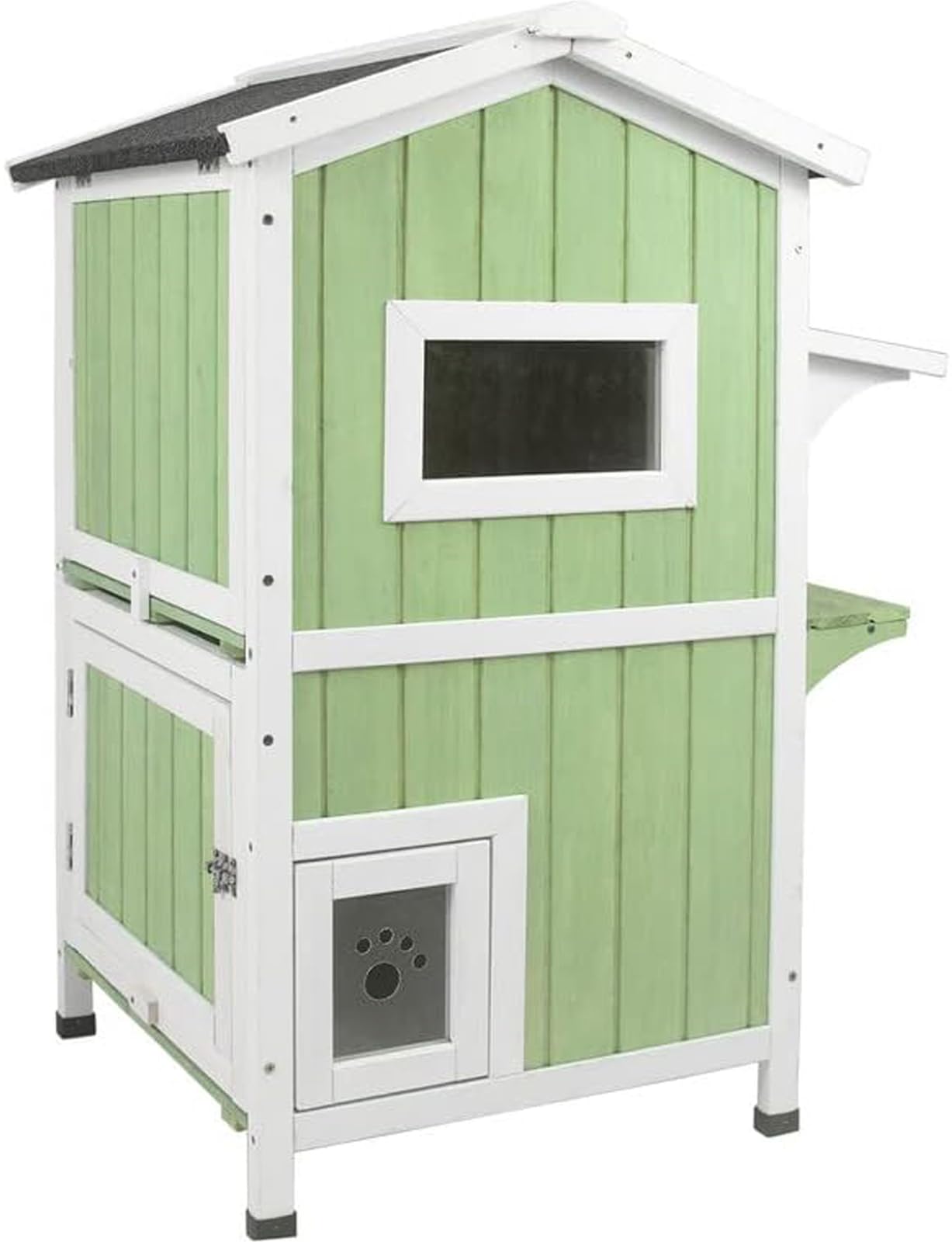
Two floors, two doors, and a balcony — a second exit for a cornered feral cat.
The thing that wins people over on this shelter is how solid it feels once you get it up. Quality carries the most weight with buyers, and the build backs that up with water-based fir wood, a weatherproof asphalt roof, and raised feet with covers. That roof is the part you notice first — a genuine shingle-style surface rather than a painted lid, so rain runs off instead of soaking in.
Where it earns its top spot is the layout. Two levels give cats a jumping platform, a balcony for sun, and a private room to retreat into. The escape doors mean a cornered cat can bolt out a second route, which is the single most useful feature for strays and neighborhood cats that share a yard. For winter, there is room to add an extra insulated liner inside the wooden layers.
The honest catch is size and weight. It measures 29.5″D x 33″W x 22″H and weighs 21.5 kg, so plan for two people to move it and a clear spot to set it down. Compared with the GEGURI shelter’s 5 kg, this one is far heavier to shift — that heft is exactly why it feels stable, but it is not something you relocate on a whim. Some owners also find the interior smaller than the photos suggest, so check the space against your cat before you commit.
What Buyers Praise Most
- Build quality comes up more than any other point, with assembly ease close behind.
- Two levels give cats a play platform, a sun balcony, and a private rest room.
- Escape doors offer a second exit route for feral cats and visiting strays.
- Removable floor between levels and an openable roof make cleaning simple.
- Claimed space for 1–2 cats, roughly 20–40 lbs.
Where It Gives You Pause
- 21.5 kg of shelter is a two-person job to move.
- Some owners find the inside smaller than expected.
- Odor comes up as the recurring gripe — bedding needs regular swapping.
Reach for this if: you are sheltering a stray or two and want two floors, two exits, and a real asphalt roof in a mid-range shelter.
Look elsewhere if: you need something you can pick up and carry — this one plants itself.
2. PetsCosset Two Story Cat House
An upper feeding deck over a lower sleeping room — food stays off the bedding.
Most outdoor shelters ask a cat to eat and sleep in one box. This one splits the job. The upper level is set up as a feeding station, the lower level is a resting area, and that separation keeps food away from bedding — which matters when multiple visiting cats cycle through the same shelter at different hours. Each level gives about 2.4 sq. ft. of usable floor, for 4.8 sq. ft. total across 27.3″L x 23.5″W x 38″H.
Weather handling is thoughtful for the price tier. The asphalt roof sheds rain and snow, and a 2.95″ raised base keeps the lower floor clear of damp ground. Flexible PVC door curtains cut the draft at the entrance while still letting a cat push straight through, which is the detail that matters on a windy fall evening. There is also an escape door plus an exterior perch platform with reinforced supports underneath.
What buyers talk about most is how straightforward the build is, and the quality backs it up. Keep expectations honest on durability, though — a portion of owners question how many outdoor seasons the wood will survive, so sealing it and keeping it off direct splashback extends its life. The other thing to plan around is the height: at 38″H this is the tallest tower here, and it needs a stable, level spot.
The feeding-first design: separate dining and resting levels plus a 2.95″ raised base make this the pick for a porch where several cats eat on a schedule.
What to watch: outdoor longevity is the open question, and the 38″H frame wants level ground so it sits square.
Best fit: anyone feeding a rotating crowd of outdoor cats who wants the food bowl away from the sleeping box.
Second thought: if you would rather have a low, wide shelter than a tall tower, look at the Rockever below.
3. Rockever Large Outdoor Cat House
A single wide room with a sunny balcony, a supply shelf, and a mat included.
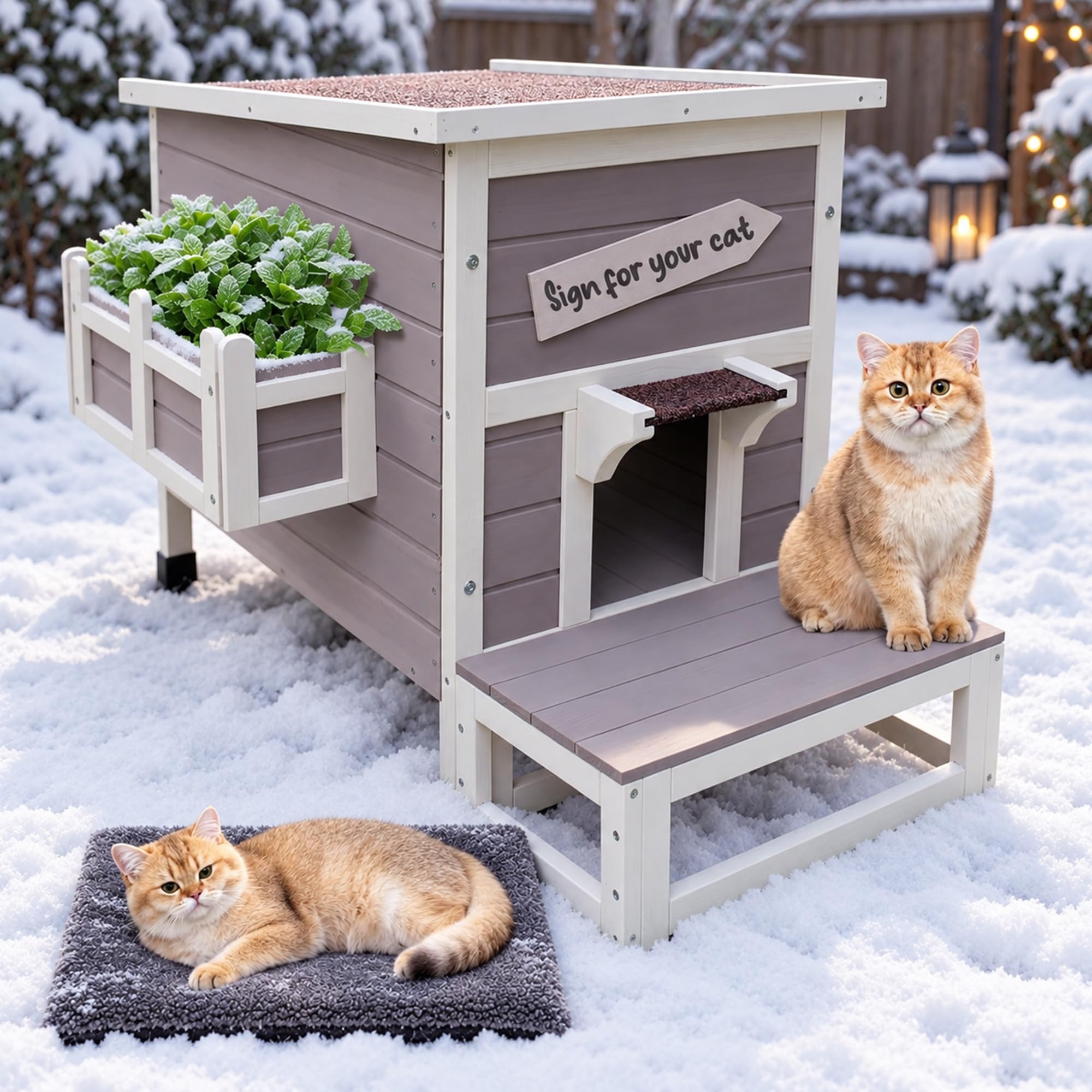
This is the one to pick if your cat ignores boxes and only settles into something with floor space. The single-level room measures 25.4″D x 20.5″W x 25.2″H and arrives with a soft mat, so it is usable the day you build it. A side storage shelf keeps food and brushes out of the rain, and a three-hole design on the right side provides ventilation in summer and doubles as a cable port for an electric heating pad in winter.
Safety-wise it runs a main door plus a dedicated emergency escape door, so a cat that feels cornered has a second route. The weather side is fully dressed: a sloped roof finished with asphalt shingles, an asphalt awning over the front entrance, a windproof PVC curtain, and a transparent acrylic flap on the rear exit. The hinged roof opens fully and the bottom floor lifts out, so a deep clean takes seconds rather than a contortion act.
Setup is genuinely easy — all parts are pre-drilled and the only tool you need is a Phillips screwdriver. Assembly is the aspect owners bring up most, with looks close behind. The fair caveat is durability: some units have arrived with broken pieces, and not everyone stays dry through a hard rainstorm, so seal the panels and check the roof edges when it lands. At 12.7 kg it is manageable to move, unlike the Gowoodhut’s 21.5 kg.
Why It Works
- Single-level room plus balcony, mat, and storage shelf in one unit.
- Main door plus emergency escape door for cornered-cat safety.
- Asphalt shingle sloped roof, awning, PVC curtain, and acrylic rear flap.
- Pre-drilled parts and a Phillips screwdriver are all the assembly needs.
- Hinged roof and removable bottom make cleaning fast.
What To Plan Around
- Some units have shown up with broken pieces.
- Heavy rain can find its way inside for some owners.
- Only one story — cats that love height may prefer a two-level house.
Pick this one: for an indoor cat that gets porch time but wants a single sunlit room with everything in reach.
Skip the height: if your cat climbs, the two-story Gowoodhut gives it platforms this one does not.
4. GUTINNEEN Cat House with Door (AIR09-BS)

A castle-shaped two-level condo with side stairs — a top deck for climbing cats.
Anyone who has watched a cat ignore a perfectly good ground-level box will understand this design. The top-level deck is made for lounging and watching, while the downstairs enclosure is the sleeping room for cold, rainy, windy, or snowy nights. A stair on the side gives cats a way up that doubles as exercise — and it is the detail owners compare to a castle for cats.
The structure is 100% Finnish spruce wood with a water-based coating, and the panels are thicker than the norm for this category, which is what lets it hold up in weather. The roof is treated with real asphalt shingles, and the front opening is sheltered by an asphalt rain stoop, so the doorway itself gets protection. A raised floor and the asphalt roof work together to keep the interior dry. Dimensions run 22.5″D x 33″W x 30.4″H.
Assembly is the standout — clear directions that get cats inside fast, with some owners noting their cats work out the layout in about a day. The mixed report is on the timber itself: while the structure holds up once built, some units arrive with damaged wood pieces, so inspect the panels before you start screwing. The value question is the other honest note, since it is priced above several two-story rivals.
The climbing advantage: a side stair and a top deck turn a basic shelter into a small activity tower, which is why cats take to it quickly.
The timber caveat: check every panel on arrival — damaged pieces are the recurring report, and the raised price means the finish should be right.
Well suited to: a cat that loves vertical space and an owner who wants spruce panels with an asphalt rain stoop over the door.
Think twice: if you want the lowest-risk timber on arrival, the VEVOR below is a steadier bet on materials.
5. VEVOR Outdoor Cat House

Foam insulation on six sides and removable PVC flaps — the cold-weather pick.
If your winters bite, this is the pick built for it. Foam insulation is sandwiched between the wooden panels on six sides, giving cold and heat protection all around rather than just a token liner. The waterproof asphalt sloped roof and asphalt eaves at the door keep rain out, and improve feet lift the whole thing clear of rain and snow. It measures a roomy 34.25″D x 21.65″W x 27.17″H and is rated for 1 to 3 cats, with rabbits and guinea pigs also listed as suitable.
The door system adapts to the season. The thickened PVC flaps are removable, so you pull them in summer for airflow and refit them in winter for wind protection — during the rainy season they shield the entrance. The roof opens and the bottom lifts out, which makes cleaning far easier than a fixed-lid shelter. Fir wood construction resists cracking and warping, and the maker notes that a natural fir smell on arrival is normal.
Build quality is what buyers bring up most, and it holds up. Two honest notes, though. A natural fir smell lingers for a while, and some owners have found mold growth inside — so keep the flaps adjusted for airflow rather than sealed shut year-round. Size also reads smaller than the photos for a few buyers, so measure your intended spot before ordering.
The winter case: six-sided foam sandwiched between fir panels plus removable PVC flaps makes this the most cold-focused shelter here.
The ventilation caution: mold has shown up inside for some owners — leave the flap off in mild weather rather than sealed all year.
Go for this: if your cat shelters outdoors through freezing nights and you want real insulation on all six sides.
Hold off: if the space you have is tight — this is a 34″-long footprint and it wants room.
6. GUTINNEEN Cat House (AIR12-G)
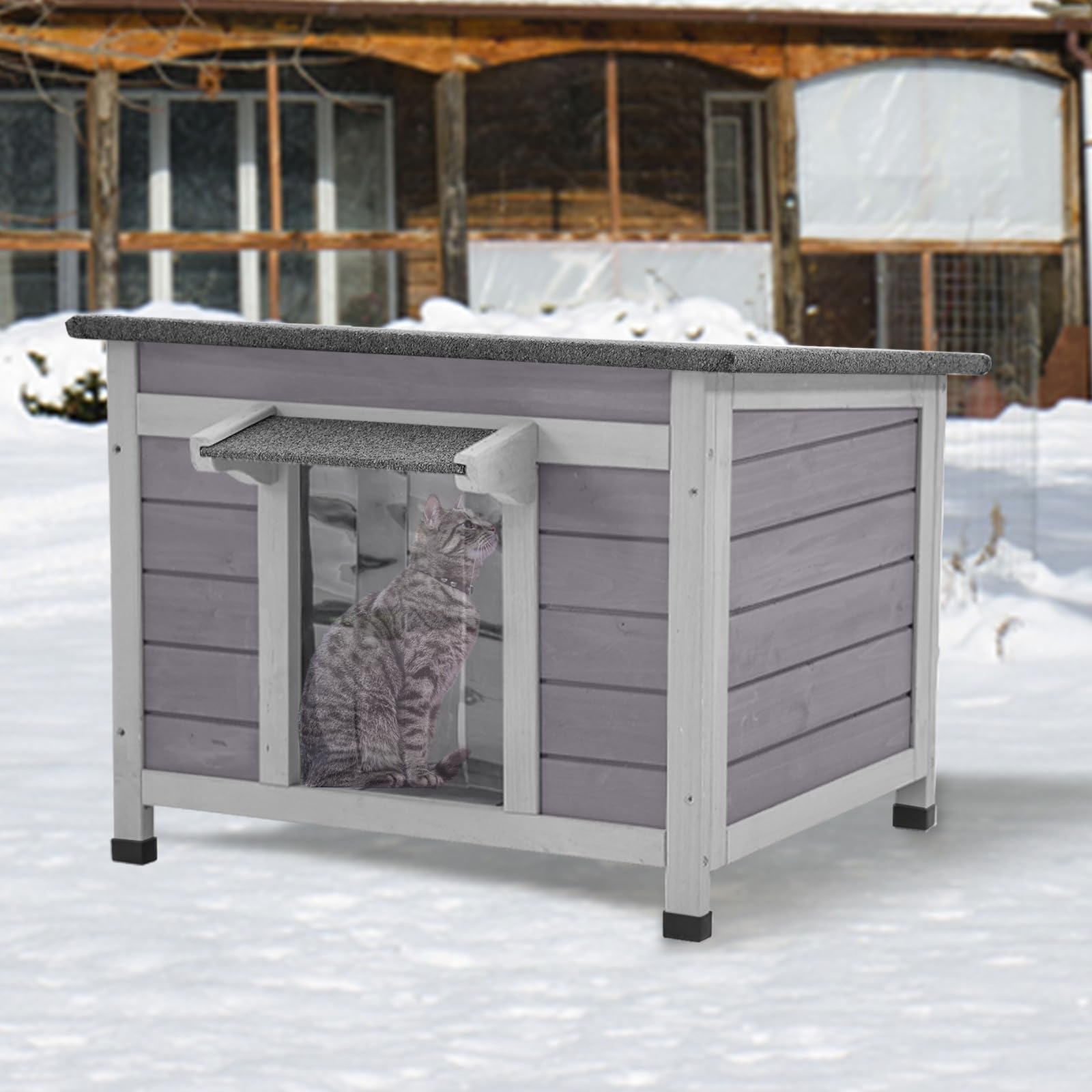
A small-footprint fir shelter with an insulated interior, openable roof, and two-year warranty.
For a patio with limited floor space, this is the sensible size. It measures 21.7″L x 18.5″W x 18.3″H and is rated for one cat, yet it still packs in the features that matter: fir wood with a weatherproof water-based stain, asphalt shingles on top, and a tongue-and-groove exterior that adds structural rigidity. The roof opens for ventilation and access, and a removable bottom board makes deep cleaning quick.
What draws cats to it is the main story — pet attraction is the aspect owners bring up most, with insulation close behind. That insulated interior is the reason it works year-round, blocking rain, wind, and harsh sun while holding warmth in winter and shade in summer. Add the two-year warranty and it is the most reassuring build promise of the compact group.
The trade-off is durability over the long haul. A portion of buyers report the unit coming apart within months, and the value question splits opinion, so sheltering it under an overhang or eave rather than in open weather extends its life. Assembly instructions are generally easy to follow. If you want a small shelter with a genuine warranty to lean on, this is the one.
What Earns Its Place
- Compact 21.7″L x 18.5″W x 18.3″H footprint fits tight patios.
- Fir wood with weatherproof stain and asphalt shingle roof.
- Insulated interior rated for one cat year-round.
- Two-year warranty backs the build.
- Openable roof and removable bottom board for easy cleaning.
Where It Falls Short
- Durability over months is the mixed report.
- Only sized for one cat.
- Value is debated, so sheltering it from direct weather helps.
Ideal for: a single cat on a small porch where a two-year warranty and a compact footprint matter most.
Not for: multi-cat yards — this one is built around one resident.
7. GEGURI Outdoor Cat House
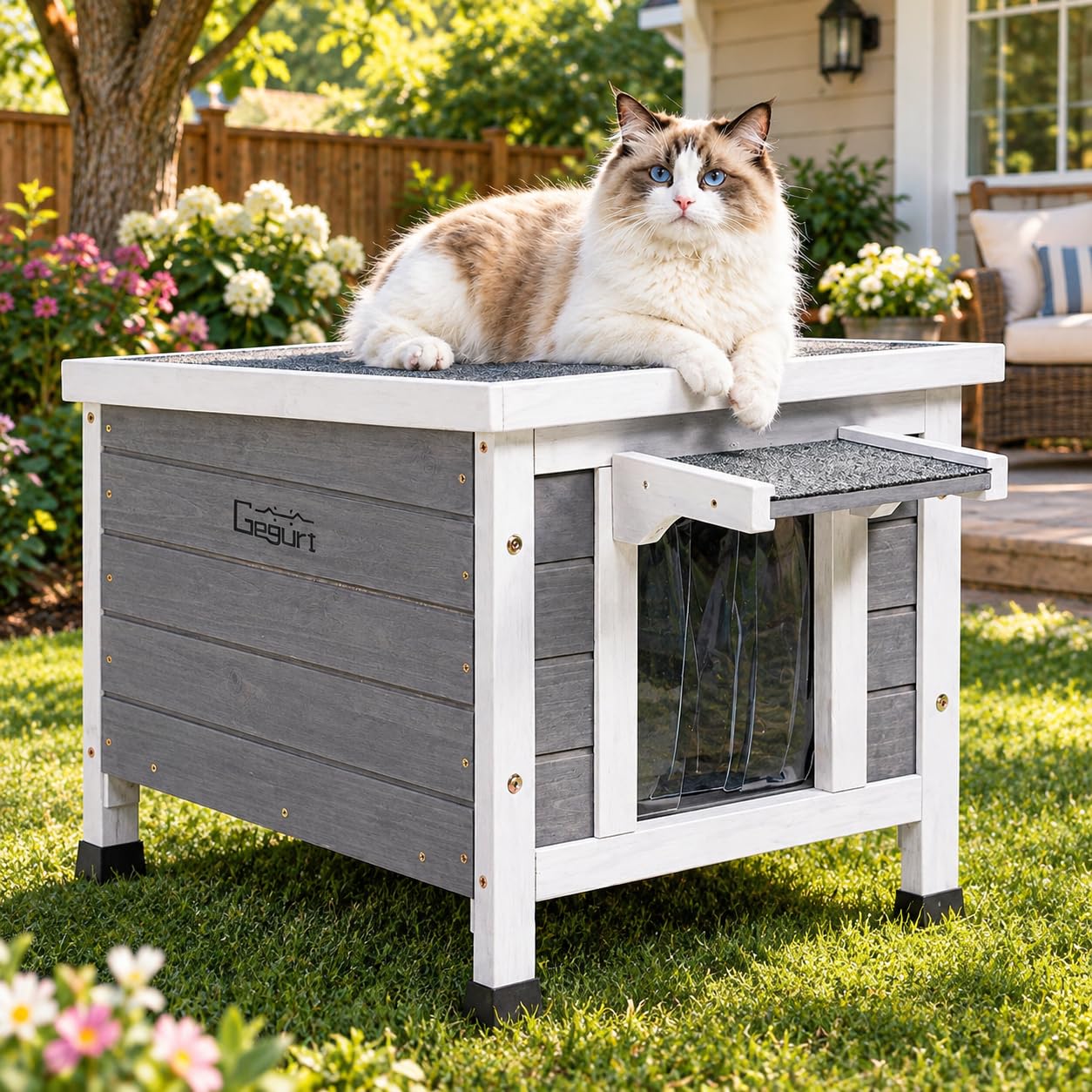
Three vents and a clear PVC flap — the airiest small shelter, with a removable floor.
This is the smallest shelter here, and it leans into ventilation as its defining idea. Three strategic ventilation openings keep fresh air moving, while a clear PVC door flap blocks wind and rain at the entrance. A removable bottom floor and an accessible layout make the wipe-down quick — no special tools needed. It measures 16.54″D x 20.28″W x 16.93″H and weighs 5 kg, so it is light enough to shift alone and easy to tuck into a corner. Compared with the Gowoodhut’s 21.5 kg, this one moves with one pair of hands.
The appearance and build are what people comment on most positively, and the size works out well — it is cited as big enough for two cats. Assembly is straightforward and the wood construction feels well put together. The clear flap is the feature that makes it usable outdoors rather than just decorative.
Be realistic about weather protection, though. Owners note it does not offer much defense from the elements, so it works best on a covered porch or under an eave rather than in open rain. It is also rated for small pets and small animals, so a large cat may find the interior tight. Treat it as a fair-weather shelter that handles a bit of drizzle, not a full winter bunker.
The airflow angle: three vents plus a clear PVC flap make this the airiest small shelter in the group.
The honest limit: weather protection is light, so a covered spot is where it belongs.
Suits you: if you have a covered porch and want a light, well-ventilated wooden shelter you can reposition easily.
Look up the list: for a shelter that faces open rain, the VEVOR or Gowoodhut is the safer choice.
8. Trixie Outdoor Cat House

A one-cat pine shelter with a hinged roof — the smallest and lightest build here.
For a single cat and a modest porch, this is the entry point. It measures 15.75″D x 16.5″W x 20″H and weighs 15 pounds, so it is the lightest and smallest build here — measured against the Gowoodhut’s 29.5″D x 33″W x 22″H, it is a fraction of the footprint. Pet-friendly pine wood with a weatherproof water-based stain keeps it from soaking up rain, and asphalt shingles on top handle the weather overhead.
The details that punch above the price are the hinged roof with a locking arm and the removable floor. Lift the roof to clean, lock it down to seal, and slide out the floor for a proper scrub. The tongue-and-groove exterior adds rigidity, and a raised floor keeps the base clear of damp. Heavy-duty plastic flaps over the entrance add extra wind and rain protection, and the small entrance keeps out unwanted guests.
Assembly is straightforward with pre-drilled holes and included hardware, and the custom-built look is what owners appreciate most. The clear trade-off is capacity — it is ideal for one cat, not a colony, and smaller than two-story shelters by design. If you are sheltering a single stray on a budget, this does the job without overspending.
Why It Makes The List
- Lightest unit here at 15 pounds, easy to lift into place.
- Hinged roof with locking arm and a removable floor for easy cleaning.
- Weatherproof-stained pine and asphalt shingles for overhead protection.
- Heavy-duty plastic flaps and a small entrance.
- Pre-drilled holes and hardware included.
Know Before You Buy
- Built for one cat, not a group.
- Smaller than the two-story rivals by a wide margin.
- Minimal floor space for a cat that likes to stretch out.
Reach for it: when one cat needs a dry, hinged-roof shelter and you want the lightest build to carry.
Don’t pick it: for a feral colony — there is room for one, and the 16.5″W frame shows it.
Know the Specs
Wood type and finish
Fir and pine are the usual woods in this category. Look for a water-based stain or weatherproof coating — bare wood draws moisture. Finnish spruce and fir both resist cracking and warping when finished. A finished panel sheds water instead of soaking it, which is what keeps a shelter usable across seasons.
Roof material
Asphalt shingles or an asphalt-coated sloped roof are the weather line. A sloped roof moves rain sideways, and asphalt eaves or an awning over the door block wind-driven rain at the entrance. A flat untreated lid is the weak point on a budget shelter.
Elevation and removable floors
Raised feet lift the shelter off damp ground so moisture cannot wick up through the base. A removable floor or a hinged roof lets you reach every corner for cleaning, which is where odor control actually happens. A 2.95″ raised base is one example of how much lift a shelter can carry.
Doors, flaps, and escape routes
PVC flaps or clear curtains cut drafts at the entrance while letting a cat push through. A second escape door matters for feral cats that feel cornered. Removable flaps let you tune ventilation by season — off in summer, refitted for winter.
Common Questions
Will a wooden cat house really keep a feral cat dry through winter?
How many cats will fit in a two-story wooden cat house?
Can I put a heating pad inside an outdoor cat house?
Is fir wood better than pine for an outdoor cat shelter?
How hard is assembly on a wooden cat house?
Do I need to raise the cat house off the ground?
Why does a new wooden cat house smell?
Will the paint or stain be safe for my cat?
How long will a wooden cat house last outdoors?
Can a two-story house be too high for a small porch?
The Bottom Line
For most people sheltering a stray or a porch-loving indoor cat, the wooden cat house worth starting with is the Gowoodhut P14 — two floors, an asphalt roof, and escape doors cover both the weather and a nervous cat’s instinct to bolt. If feeding a rotating crowd matters, the PetsCosset puts dinner and sleep on separate levels. And when the cold is the whole problem, the VEVOR with six-sided foam insulation is the one to bring home.
How we choose
We do not accept paid placement. Every pick is matched to a real buyer and a real use-case; we do not hands-on test units.
Sources
Specifications: manufacturer listings and product documentation. Review insights: verified customer reviews, as of November 2026. Pricing: not shown on this page (it changes often); check the current price via the retailer link.
As an Amazon Associate, Tactical Gear Guy earns from qualifying purchases. This does not affect which products we feature.