Specs are compiled from manufacturer listings and verified buyer reviews and can change over time — please confirm the key details on the product page before buying.
You want one wooden board that slices a crusty loaf cleanly, wipes down without drama, and still looks good enough to leave on the counter. That is the whole job. The trouble is that a board sold as a bread board can be anything from a decorative plaque to a genuine work surface, and the listings rarely tell you which one you are getting. Below are nine boards that hold up, sorted by what each one actually does best — slicing, serving, gifting, or surviving a busy family kitchen.
This guide is built by comparing the manufacturers’ published specifications and the patterns across verified customer reviews, so you get each pick’s real strengths and trade-offs instead of marketing spin.
Some boards here are built for the daily loaf, others for a party platter, and a couple for little more than display. Read the spec that matters for your counter, skip the rest. For a wooden bread board you will actually leave on the counter, the wood species, thickness, and crumb details below are what decide it.
Top Picks


How To Choose The Best Wooden Bread Board
A bread board has to do two jobs at once: give a sharp knife a surface that will not dull it, and look presentable enough that you leave it sitting out. Get the wood species and the thickness right and both jobs are handled.
Wood Species Decides How It Ages
Acacia is the workhorse wood you will see most often — a dense hardwood that resists scratching and holds up to daily slicing. Walnut is softer and warmer in tone, and edge-grain construction (strips of wood glued side by side) keeps it stable against warping. Rubberwood sits in between and is a common choice for built-in cabinet boards because it stays light.
Thickness and Weight Go Together
A thin 0.55″ board is light enough to move around one-handed but can slide or flex under a heavy cleaver. A 1.5″ board stays planted on the counter and feels substantial, but you will notice the weight when you lift it. Match the thickness to how you will use it — a carving surface needs mass, a serving board does not.
The Handle, Groove, and Crumb Details
A cut-in handle lets you carry the board to the table loaded with bread or cheese. A juice groove catches liquid from meat or fruit before it reaches the counter. A crumb catcher tray is the detail specifically for bread, keeping the slice mess off your countertop. None of these are essential, but each solves a real annoyance.
Side-by-Side Comparison
| Model | Best For | Wood | Size (L x W) | Thickness | Amazon |
|---|---|---|---|---|---|
| 16.6″ Large Wood Cutting Board with Handle★ Best Overall | Daily slicing and serving | Acacia | 16.6″ x 13″ | 0.8″ | Amazon |
| SynHHergyx 2 Pcs Wood Cutting Board SetBest Value | Matching pair for prep and display | Acacia | 16″ x 12″ & 15.75″ x 11.81″ | 0.6″ | Amazon |
| BILL.F Acacia Wood Cutting Board with HandleMost Portable | Small serving and pizza board | Acacia | 15″ x 7.5″ | 0.6″ | Amazon |
| muso wood Walnut Cutting Board with Handle | Knife-friendly everyday prep | Walnut | 15.2″ x 7.3″ | 0.8″ | Amazon |
| FANICHI End Grain Cutting Board | Heavy prep and carving | End Grain Wood | 13″ x 13″ | 1.5″ | Amazon |
| Omega National Rubberwood Bread Board | Deep countertop bread station | Rubberwood | 23.5″ x 12″ | 0.75″ | Amazon |
| XL Acacia Wood Cutting Board | Big-batch chopping and serving | Acacia | 20″ x 15″ | 1.5″ | Amazon |
| Ironwood Nesting Bread Cutting Board | Clean-counter bread slicing | Acacia | 14.75″ x 10.25″ | 0.75″ | Amazon |
| Nuenen 10 Pcs Wood Cutting Board Set | Gifts, engraving, and bulk prep | Acacia | 15.75″ x 7.87″ | 0.55″ | Amazon |
Detailed Reviews
1. Ayiaren 16.6″ Acacia Wood Cutting Board with Handle
Our pick — 4.5+★ from 300+ verified ratings; the strongest balance of quality and price.
A big acacia slab that slices bread and then carries it to the table.
This board measures 16.6 inches long by 13 inches wide at 0.8 inches thick, which is enough flat space to line up a whole baguette without overhanging the edge. Acacia is a dense hardwood that stands up to a serrated bread knife far better than softer woods. Weight comes in at 2.7 pounds, so it stays put on the counter while you cut but is not a two-handed lift.
The build quality is the thing that wins people over. Buyers consistently describe a thick, sturdy board with a nice grain, and they still call it easy to clean. One side doubles as a charcuterie or cheese spread for a weeknight plate. A cut-out handle means you can carry the whole loaded board from counter to table rather than shuttling slices plate by plate.
Here is the honest caveat. A few owners have scratched the surface with heavy cutting and some question how well the wood will take years of real carving work. So treat it as a bread and cheese board that can handle normal chopping, not as a butcher block. Hand wash only, and a monthly oil rub keeps the grain sealed.
What the board does well
- 16.6″ x 13″ of flat space — a whole loaf fits with room to spare
- Dense acacia resists scratching better than softer walnut under a serrated bread knife
- Handle turns it into a serving tray for cheese and charcuterie
- 2.7 pounds sits stable on the counter without being heavy
Where it asks for care
- Surface can take scratch marks under heavy cutting
- Hand wash only — it will not survive a dishwasher cycle
Reach for this if: you want one board that slices a daily loaf and then looks good enough to serve on, without giving up counter space.
Think twice if: you want a permanent carving block for heavy cleaver work — the 0.8″ surface is not built for that.
2. SynHHergyx 2-Piece Acacia Wood Cutting Board Set
Two boards, one rectangular and one round, so prep and presentation never collide.
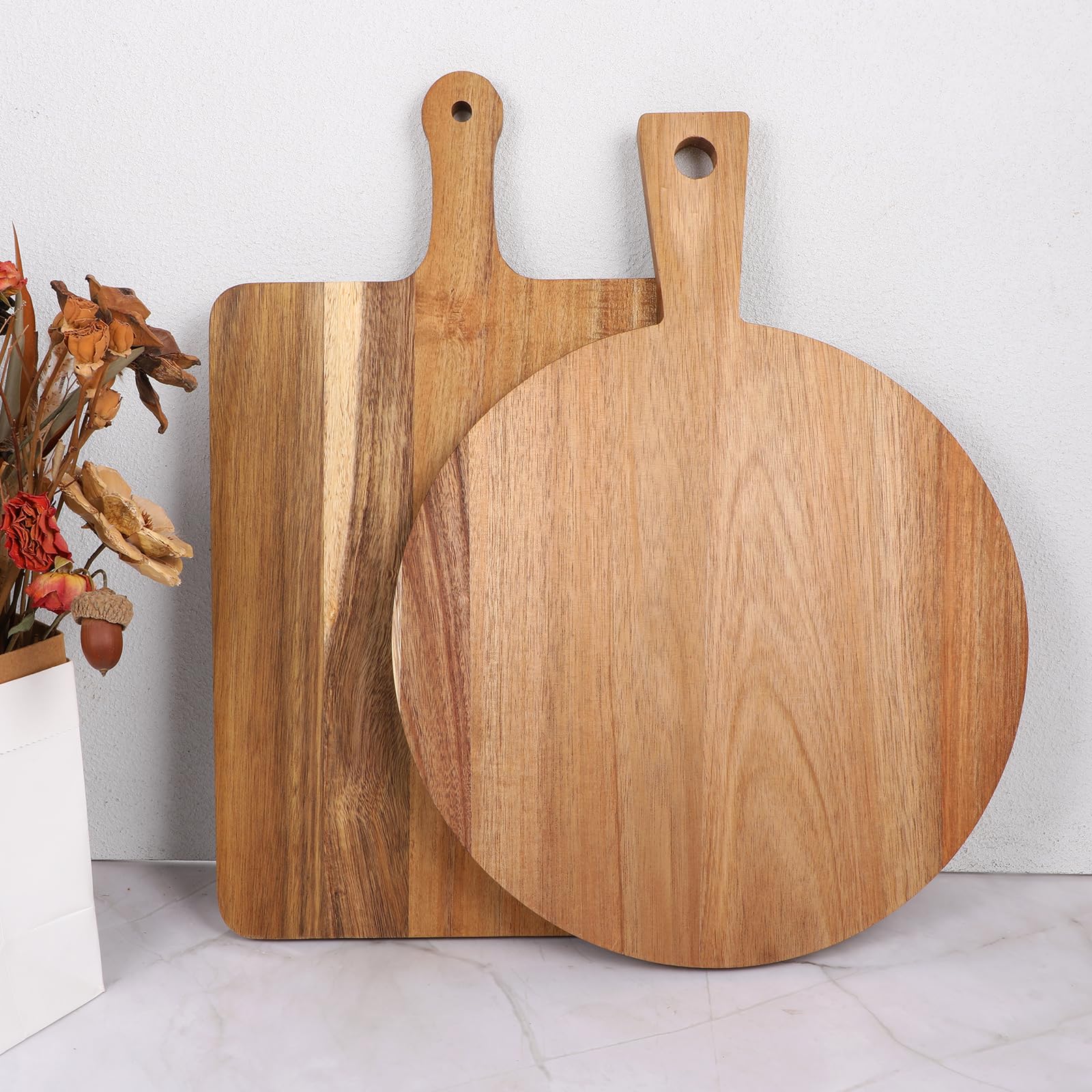
You get a rectangular board at 16 x 12 inches and a round one at 15.75 x 11.81 inches, both 0.6 inches thick with a handle and a lanyard on each. That is a practical split: chop on one while the other sits out with bread and cheese. Acacia construction gives both boards the same durable hardwood surface.
What buyers respond to is how the set looks. The rich acacia grain makes these decorative enough that they read as serving pieces, not just utility boards. Being reversible, each board gives you a fresh face for chopping on one side and a clean face for serving on the other. Hand wash only applies to both.
The honest trade-off: 0.6 inches is slim. For bread, cheese, and vegetable prep they do the job comfortably.
The set that covers both jobs: a prep board and a serving board in one purchase, matched in the same acacia grain.
Not for you if: you only ever slice bread and would rather put the space toward one larger board.
3. BILL.F Acacia Wood Cutting Board with Handle
The narrow paddle board that slides under a pizza and onto a party table.
At 15 inches long by 7.5 inches wide and 0.6 inches thick, this is the slimmest board on the list — and the lightest at 0.78 kg. That size makes it a natural pizza peel: slide it under a crust to pull it from the oven, then set it down as the serving platter. The easy-grip handle and felt non-slip feet keep it steady on the counter and stop the base from scratching.
The acacia is treated to resist food stains, so a wipe-down and a monthly oil rub keep it looking right. The board also works as a cheese or charcuterie platter and can hang or stand on display between uses.
The 15-inch length is the compromise. Slicing a long sourdough boule means working in two passes, and buyers do split on whether the size is right for them. For pizza, cheese, and single-serve bread duty it lands exactly right.
Where it earns its keep: that headline 15 x 7.5-inch footprint. It tucks beside the stove, hangs out of the way, and still has enough length for a baguette cut at a slight angle.
Pick this for: a compact pizza-and-bread board that goes from oven to table in one move.
Look elsewhere if: you want a large carving surface for big loaves or a holiday roast.
4. muso wood Walnut Cutting Board with Handle

Walnut edge-grain that pampers a knife edge and hangs out of the way.
This is a 15.2 x 7.3-inch board at 0.8 inches thick, built from multiple walnut strips bonded edge to edge with a food-safe adhesive. That construction keeps it stable against warping. At 1.5 pounds it is noticeably lighter than the Ayiaren board above at 2.7 pounds, so it lifts one-handed and hangs by its handle hole without a fight.
Walnut is the softer, gentler surface here, and the polish is smoothed and treated with wood wax oil before it ships. The shape of the handle follows the curve of the hand, which makes the board easy to grip even loaded with sliced bread.
The trade-off worth knowing: walnut cuts deeper than dense acacia, and some buyers do find the surface showing cut marks sooner than they expected. Keep it as a slicing and serving board rather than a heavy cleaver target, and oil it once or twice a month to keep the wood sealed.
The wood is the story: a rich walnut strip build that reads premium on the counter. If you care as much about how a board looks on display as how it cuts, this one delivers.
Best matched to: a bread-and-veg slicer who wants a lighter board that protects knife edges and looks the part.
skip it if: you expect zero marks on the surface after months of daily chopping.
5. FANICHI End Grain Cutting Board, 13 x 13 Inches

A 5-pound end-grain block with a juice canal and compartments built into the wood.
The defining number here is the mass: 13 x 13 inches at 1.5 inches thick, 5 pounds. End grain turns the wood fibers up toward the blade, which is easier on a knife edge than edge grain and resists deep scratches. That thickness also keeps the board planted while you work.
Two features stand out for bread duty. A carved juice groove around the front catches liquid from meat, fruit, or vegetables before it hits the counter. The reverse side adds built-in compartments for holding diced vegetables, herbs, or snacks while you prep. Inner side handles let you lift it to the table without disturbing the pile.
Some buyers report their board cracking over time, so go in aware of that flaw. Keep it out of standing water, dry it fully on edge, and oil it regularly to give it the best chance. At 1.5 inches and 5 pounds, it is the most sturdy surface on this list.
Worth it for: anyone who wants a serious, anchored prep surface with compartments and a juice canal in one piece of wood.
Bear in mind: at 5 pounds plus a 1.5-inch end-grain build, it is the heaviest board here and wants careful drying.
6. Omega National Rubberwood Bread Board

A long, shallow bread board shaped like a dedicated dough station.
Look at the footprint first: 23.5 inches long by 12 inches wide at 0.75 inches thick. That depth is what makes this board different from every other pick. It gives you a long runway for slicing a whole loaf, a baguette, or a pile of rolls without the work creeping off the ends.
Rubberwood holds up as a light hardwood, and at 3 pounds this board is not a strain to lift in and out of a cabinet. Construction quality is where it wins approval — the board is described as well-made and cleanly finished, and it holds up neatly as a replacement for worn cutting surfaces. At 3 pounds in rubberwood, it lifts easily in and out of a cabinet for daily bread duty.
One caution on fit. Buyers split on how closely it matches a given cabinet or frame opening, so measure your space before you commit. That is the only recurring snag in an otherwise well-liked board.
Measure first: a 23.5-inch length is a specific commitment. If it fits your counter depth, you get the longest slicing surface here. If it does not, no number of good reviews rescues the fit.
Right for you when: you want a long, purpose-shaped bread board and have the counter depth to take it.
Not the one for: a compact kitchen where a long board would live leaning in a corner.
7. FANICHI XL Acacia Wood Cutting Board, 20 x 15 Inches
Twenty by fifteen inches of acacia that turns the whole counter into a prep zone.
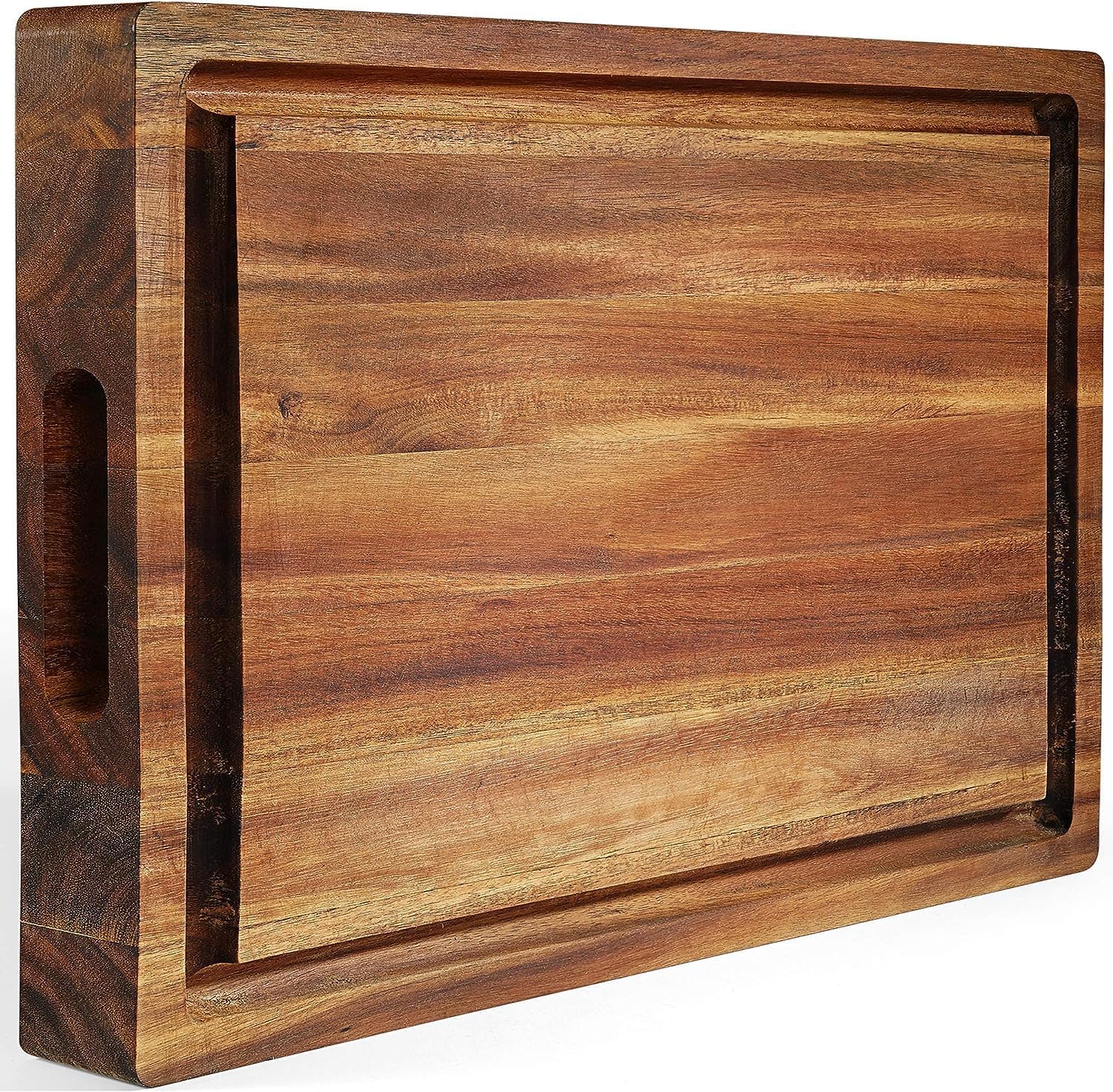
At 20 x 15 inches and 1.5 inches thick, this is the largest surface in the roundup — and heavier than it sounds at 3.9 kg. If you lay out a batch of bread, charcuterie, and sliced vegetables together, that extra area pays off. The juice groove runs along one edge to catch liquid, and the reverse side has a long holder designed for cutting breads and cheeses.
Acacia in a natural color means no paint, so there is no coating between your food and the wood. Inner side handles let you lift the board loaded without smearing the counter. The dark grain pattern is what owners rave about most — it earns its place on the counter as decor as much as a cutting surface.
The thing to know before you buy: acacia this large and thick can warp if it sits in water or rests unevenly, and a portion of buyers have run into exactly that. Dry it fully, oil it regularly, and keep it stored flat. It is also a heavy board to wash by hand — a sink that cannot fit a 20-inch plank makes cleanup awkward.
Where it pulls ahead
- 20″ x 15″ gives you the most room to work of any board here
- 1.5″ of acacia keeps the board planted under pressure
- Reversible with a juice groove on one side and a bread holder on the other
- Natural, unpainted acacia you can leave on display
The catch to plan around
- Large acacia boards can warp without careful drying
- Hand washing a 20-inch board needs a deep sink
The one to grab for: entertaining and holiday bread spreads where real estate matters most.
Check your sink first: a board this long demands a basin that can take it, plus a flat storage spot.
8. Ironwood Nesting Bread Cutting Board with Crumb Catcher

The board that catches the crumbs instead of leaving them across your counter.
You get a purpose-built bread board that measures 14.75 x 10.25 inches and 0.75 inches thick, weighs 2.2 pounds, and is made of acacia. what separates it is the nesting tray built into the wood: as you slice, the crumbs drop into the tray underneath rather than scattering across the countertop. That detail alone is worth it if you slice a loaf fresh every morning.
Beyond bread it crosses over as a cheese or charcuterie board for cured meats, crackers, and fruit, and sustainably sourced acacia gives each board its own one-of-a-kind grain. Hand washing and regular oiling keep the wood rich over time.
Here is what to weigh carefully. The crumb tray works for some and not others — a share of buyers find crumbs still slip off the edge. A portion also run into cracking over time, a common strain for a board built with a cut-out tray. It is a smart design for daily bread duty, but not the pick if you want an indestructible workhorse.
The detail that decides it: that built-in crumb tray. If your counter getting dusted in breadcrumbs drives you up the wall, this is the design that addresses it directly.
Made for: the daily bread slicer who wants the mess contained in one labeled spot.
Consider the alternative if: you want a board that doubles as a heavyweight chopping block — this one is a bread specialist.
9. Nuenen 10-Piece Acacia Wood Cutting Board Set

Ten matching acacia boards — a party’s worth of serving platters in one box.
Each board here measures roughly 15.75 x 7.87 inches at 0.55 inches thick, and you get ten of them, 10.6 pounds total. The slim profile and handle let you hang them anywhere, which makes storage easy when you are not using them all. Acacia wood, polished with smooth edges, holds up to regular kitchen use.
Engraving and gifting are where this set makes its case. The boards take custom engraving well, and the range of grain tones across ten pieces lets you hand out matched sets as gifts or give each guest their own platter at a party. They work as pizza boards, bread boards, cheese boards, or serving trays.
At 0.55 inches these are the thinnest boards in the roundup, and thin acacia can split at the grain over time — a handful of buyers have found exactly that after real use. Buy the set for the volume and the gifting, not as a heavy chopping surface.
Who this is really for: anyone outfitting a party, a craft project, or a run of engraved gifts. Ten boards at this price point make more sense as a matching collection than any single board does.
Buy this set if: you need a stack of matching boards for serving, engraving, or gifting.
One board is enough instead: if you only slice bread for the family and want the durability of a thicker cut.
Know the Specs
Wood Species: Acacia vs. Walnut vs. Rubberwood
Acacia is a dense hardwood, harder than bamboo and oak, so it resists scratches and takes daily bread-slicing without gouging. Walnut is softer and warmer, which is kinder to a knife blade but shows cut marks sooner. Rubberwood is a light hardwood that keeps a large board easy to lift. None of these is “best” — match the wood to whether you prioritize durability (acacia) or knife edge (walnut).
Edge Grain vs. End Grain
Edge grain means the wood strips are glued side by side so the surface faces you flat — stable and warp-resistant. End grain turns the fibers up toward the blade, which is gentler on knives and resists deep scoring, but it drinks in moisture faster if left wet. End-grain boards need careful drying on edge and regular oiling. Edge-grain boards are the easier daily-care choice.
Thickness and Weight
A 0.55-inch board is light and easy to move, but flexes and can be more prone to splitting at the grain. A 1.5-inch board is heavy and stays planted, which suits carving and heavy prep. In between, 0.75-inch and 0.8-inch boards are the all-purpose middle ground. More thickness means more weight, and more weight means a board that is harder to hand wash in a shallow sink.
Juice Groove, Crumb Catcher, and Handles
A juice groove is a channel carved around an edge to catch runoff from meat or fruit. A crumb catcher is a nesting tray under the cutting surface that gathers bread scraps as you slice. A handle — cut into the board or as a raised grip — turns the board into a serving tray and lets you lift it loaded. Buy the feature that solves the mess you actually deal with.
Common Questions
Can a wooden bread board go in the dishwasher?
Do I need a crumb catcher on a bread board?
Which wood is better for bread — acacia or walnut?
How thick should a bread board be?
How do I stop a large acacia board from warping?
How often should I oil a wooden bread board?
Is an end-grain board better than an edge-grain board?
Can I use a wooden bread board for raw meat?
Will a small 15-inch board fit a whole loaf of bread?
The Bottom Line
For most kitchens, the best all-around pick is the Ayiaren 16.6″ Acacia Cutting Board — enough surface for a full loaf, dense hardwood that stands up to a bread knife, and a handle that turns it into a serving tray. If you want a lighter, knife-friendly board with a premium grain, the muso wood Walnut is the call. And if keeping crumbs off the counter is your daily battle, the Ironwood Nesting Board with Crumb Catcher was built for exactly that. Buy the one that fits your counter and your mess, then oil it monthly and hand wash it — those two habits keep any of these boards for years.
How we choose
We do not accept paid placement. Every pick is matched to a real buyer and a real use-case; we do not hands-on test units.
Sources
Specifications: manufacturer listings and product documentation. Review insights: verified customer reviews, as of November 2026. Pricing: not shown on this page (it changes often); check the current price via the retailer link.
As an Amazon Associate, Tactical Gear Guy earns from qualifying purchases. This does not affect which products we feature.