Specs are compiled from manufacturer listings and verified buyer reviews and can change over time — please confirm the key details on the product page before buying.
Buy the platform feeder if you want the cleanest refills and the widest view of your birds; buy a hanging cedar house if you want cardinals and finches out of the reach of ground feeders. That is the short answer. Everything below explains which wooden feeder fits which yard, which seed, and which birds — and where the cheap cedar cuts corners. A wooden feeder is not complicated, but the wrong one either dumps seed on the lawn or rots through its first wet winter.
This guide is built by comparing the manufacturers’ published specifications and the patterns across verified customer reviews, so you get each pick’s real strengths and trade-offs instead of marketing spin.
Wood matters more than any feature badge here: reforested inland red cedar resists cracking, while thin fir trays warp after a season of rain. The picks below cover both, so you can match the feeder to your yard instead of guessing from a photo. These are the wooden bird feeders worth hanging this season.
Top Picks


How To Choose The Best Wooden Bird Feeders
Start with the wood, not the shape. A feeder is outside every day of the year, so the timber decides whether you get two seasons or ten. Everything else — capacity, mounting, drainage — is a close second.
Cedar Beats Fir, Every Time
Red cedar carries natural oils that help it resist cracking when the weather swings. The Woodlink feeders here use reforested, kiln dried, inland red cedar, which is the standard most other brands are measured against. Thin wood trays and light fir bodies are cheaper, and they are also the ones that swell, split, and start dropping seed through the seams.
Capacity Decides Your Refill Routine
A 2-pound feeder is a weekend hobby; an 11-pound feeder is a once-a-fortnight job. If you have a busy yard with cardinals, jays, and finches, the bigger hopper wins. If you feed a small balcony or want birds close to the window, a compact tray keeps seed fresh and stops it going stale in the rain.
Platform, Fly-Thru, Or Hanging House
A platform is an open tray — easy to see into, easy to clean, and it suits almost any seed. A fly-thru has open sides so birds land, grab a seed, and leave, which suits larger birds like jays. A hanging house with a roof and baffle keeps seed drier and makes it harder for squirrels to get a clean run at it.
Check The Hanger Before You Hang It
The rope or wire is the weak point on most wooden feeders, and it is the first thing to give out. Cotton rope can rot, twine can fray, and thin wire can snap at the crimp. Look for a metal screen bottom for drainage, a removable tray or hinged roof for cleaning, and a hanger with some real thickness to it.
Side-by-Side Comparison
| Model | Best For | Seed Capacity | Mounting | Wood | Amazon |
|---|---|---|---|---|---|
| Woodlink 3 in 1 Platform Bird Feeder★ Best Overall | Widest view, easiest cleaning | 3 pounds | Pole Mount | Reforested inland red cedar | Amazon |
| Platform Squirrel & Bird Feeders, Cedar TrayBest for Squirrels | Feeding squirrels and birds together | 96 cubic inches | Hanging Mount | Finnish white pine | Amazon |
| BalterFF Wooden Seed FeederHandmade Pick | Handmade look on a wall or fence | Not listed | Wall Mount | Solid wood | Amazon |
| Kaytee Cedar Seed and Suet Feeder | Seed plus suet in one hanger | Not listed | Hanging | Cedar | Amazon |
| STARSWR Wooden Hanging Feeder | Pulling in cardinals and finches | Not listed | Hanging Mount | Wood | Amazon |
| Zeqeey Large Capacity Hanging Feeder | Big seed loads with 360-degree perching | 2 liters | Hanging Mount | Light wood | Amazon |
| Liawm Red Cedar Roof Feeder with Suet Cages | Weatherproof roof plus suet feeding | 2.3 liters | Hanging Mount | Red cedar | Amazon |
| Woodlink PRO4 Premier Cedar Feeder | High-volume yards, minimal refills | 11 pounds | Hanging | Reforested inland red cedar | Amazon |
Detailed Reviews
1. Woodlink 3 in 1 Platform Bird Feeder
Our pick — 4.5+★ from 750+ verified ratings; the strongest balance of quality and price.
A wide cedar tray whose whole floor lifts out, so cleaning stops being a chore.
You get a 3-pound platform built from reforested, kiln dried, inland red cedar — the timber that resists cracking, so the feeder keeps its shape through wet winters instead of swelling apart. The payoff is a tray that stays flat and a roof that still seats after a soaking. The measurements here are the telling part: 16.38″ by 13.25″ across, against 8.46″ by 6.96″ on the little BalterFF wall feeder. That is close to double the footprint, which is exactly why the big birds and the small ones can share a single landing zone without shoving each other off.
Cleaning is what wins people over, and it is not an accident. The powder-coated metal screen floor is removable, so you lift the whole bottom out and shake it over the bin rather than scraping around corners. The screen also drains, which stops seed sitting in a puddle and turning to mush. Its 3-pound seed tray suits a steady rotation of cardinals and finches without a daily refill.
It is built for a pole. Woodlink recommends its own HDPOLE pole system or the STMOUNT post hardware, and both are sold separately — so budget for the mount, not just the tray. Some buyers report the feeder coming apart over time, so set it where you can check the joints each season.
What Buyers Keep Praising
- Slide-out metal screen makes the weekly clean a two-minute job
- The roomy 16.38″ x 13.25″ tray draws a mixed crowd of birds at once
- Drainage holes in the screen keep seed from sitting in rainwater
- Reforested, kiln dried inland red cedar holds its shape in wet weather
What To Plan Around
- Pole and post mount are sold separately, so the tray is not a complete setup
- Value and long-term durability split opinion among owners
- Open tray means no roof to shield seed from heavy rain
Reach for it if: you want birds at eye level on a pole, with the easiest clean of anything on this list.
Think twice if: you want a hanging feeder with a roof — this one is a pole-mounted open tray by design.
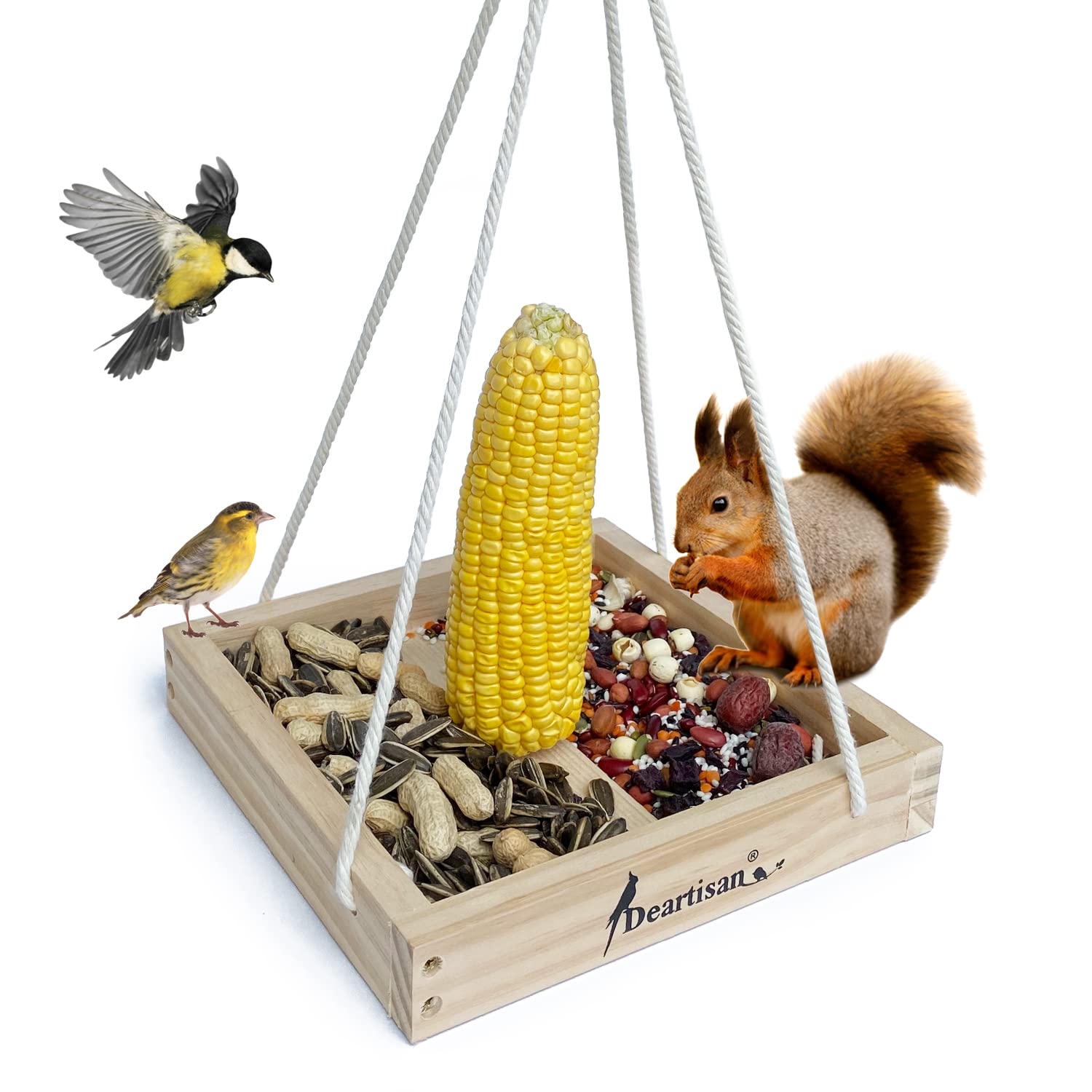
2. Platform Squirrel & Bird Feeders Cedar Wood Tray
A featherlight hanging tray built for the whole yard — squirrels included.
At 0.39 kg, this is the lightest feeder in the lineup, and that is deliberate. All four frame corners are tied with cotton rope instead of metal, so there is no rusty wire to snap and nothing to roll the tray over. The maker rates the cotton-rope frame to 20 pounds, enough for squirrels and a flock of birds sharing the tray. The tray runs a 96 cubic inch capacity, and the floor is a fine 304 plastic-coated metal mesh — small enough that even tiny seeds and nuts do not fall through, while air still moves so seed stays dry.
What wins people over is the sheer enjoyment of it. Squirrels and birds both use it, and it is a genuinely good viewing post for kids and grandkids watching from a window. Assembly is quick — the frame arrives ready to tie and hang rather than needing a screwdriver session. The cotton rope attachment is also a neat solution to the usual weak point on wooden trays.
The honest catch is longevity. Durability and build quality draw a split response, with some owners finding it sturdy and others reporting the construction loosens over time. It is Finnish white pine rather than red cedar, so treat it as a fair-weather feeder and bring it in during the worst storms. For a light, low-cost tray that does double duty for squirrels, that trade is reasonable.
Weight and rope build: at 0.39 kg it hangs without strain on a branch, and the all-cotton frame corners remove the rusty-wire failure that plagues metal-strung trays.
Mesh that holds small seed: the 304 plastic-coated metal floor is fine enough for small seeds and nuts yet still breathes, so moisture does not build up under the seed.
Best fit: yards where squirrels are part of the show and a light hanging tray suits the branch.
Not the pick for: a feeder that needs to survive years of hard weather — this is white pine with a split reputation on build.
3. BalterFF Bird Feeders Wooden Seed Sunflower
The handmade solid-wood feeder that looks like a little garden gazebo on your fence.
Quality is the headline here, and it is the thing people rave about. Every unit is handmade from solid wood with a carbonized finish, and the design keeps the food fresh and dry. The appearance draws its own share of attention too — this is the feeder you put where guests will see it. It measures 8.46″ long by 6.96″ wide by 7.4″ high, a compact footprint next to the 16.38″ Woodlink tray, which suits a fence post or a balcony rail better than a big open lawn.
It mounts to a wall, so it suits a fence, a shed, or the side of a house where you can watch from a window. The whole family can see birds eat through the glass, which is the kind of thing that turns a yard into a daily stop. It also works as a gift for bird lovers, children, parents, or a neighbor who already has everything.
Two real limits. The size runs smaller than a lot of buyers expect, and refilling is genuinely fiddly — the opening is tight, so pouring seed in takes more patience than it should. If you are feeding a busy yard every day, that wear will show. For a decorative window feeder on a small patch, it earns its place.
The look of it: handmade solid wood with a carbonized finish means it reads as garden decor, not a plastic tub bolted to a fence.
The daily annoyance: both size and refillability draw heavy criticism — measure your seed scoop before you commit.
Pick this one if: the feeder sits on a fence or wall where looks count and you top it up by hand.
Look elsewhere if: you want a large, quick-fill hopper for a high-traffic yard.
4. Kaytee Cedar Seed and Suet Feeder

One hanger, two food types — seed on one side, suet cake on the other.
At 3 pounds, this cedar feeder sits close to the Woodlink tray, and the weight tells you it is a real timber build rather than a thin shell. It measures 11.8″ long by 6.9″ wide by 8″ high, so it hangs neatly without swamping a branch. The natural oils in the cedar help resist cracking, and it arrives hand-crafted — a finish you can feel in the joints rather than just read on the label.
The draw here is the suet. Most cedar houses are seed-only, which means you miss the woodpeckers and the clinging birds that come for fat cakes. This one lets you hang both, so your feeder pulls a wider species mix out of the same spot. Mid-size and small birds take to it well, and the fill and clean routine is straightforward.
The recurring gripe is the wire hanger — owners mention issues with it breaking after two months, and they are not wrong to flag it. Check the wire crimp when it arrives and swap it for a sturdier hanger if you have one. A second honest note: value draws a split response, with some finding it overpriced for the size. As cedar houses go, it is a solid mid-range buy made better by its own hand-crafted finish.
What the suet adds: a second feeding station in the same footprint, which welcomes the fat-cake birds a seed-only cedar house never pulls in.
The wire to watch: the hanger is the known weak link, so upgrade it on day one rather than wait for the snap.
A smart buy for: anyone who wants to feed suet and seed from one hanging cedar house.
One honest caveat: if the wire hanger gives out early, that is a small fix — swap in a metal hanger before the first hang.
5. STARSWR Bird Feeders Wild Bird Feeder House

A sloping-roof platform house that gets cardinals and finches at close range.
Bird attraction is the thing this feeder is known for, and the reasons are structural. The sloping roof and open platform let you see the birds up close, and the design pulls in finches, cardinals, and chickadees by the half-dozen. It measures 10.5″ long by 7.5″ wide by 7.5″ high, so it is bigger than the little BalterFF wall feeder but does not need the footprint of a pole tray. It hangs on a sturdy hemp rope, and the whole body runs 0.88 kg — heaviest of the hanging feeders here, which is reassuring when it is swinging in the wind.
Weekend cleaning is not a sudden chore. The platform lifts the mess out at the edges, so a quick shake clears most of it. It handles mealworms as well as seed, which is the way to pull bluebirds and the insect-eaters off the lawn. The sloping roof keeps most rain off the seed, and if you leave the shell off in summer you get a platform feeder with shade.
The hanger is the honest weak point — customers note the hanging twine frays within a couple of weeks. Check it after a wet week and swap the twine for a metal chain if it starts to show. For a gift or a first cedar house, it is an easy pick, and it is the feeder that gets the most consistent bird traffic on this list.
Where It Shines
- Sloping roof and open platform let you watch birds up close from the window
- Works equally well with mealworms as with seed, so it pulls insect-eaters in
- Sturdy hemp rope handle and a substantial 0.88 kg body that hangs steady in wind
- Pulls cardinals and finches reliably into a small yard
The Catch
- Hanging twine frays within a couple of weeks and needs a replacement
- Durability gets mixed feedback once it has been out through a season
- Open platform means seed needs to be topped up after wet weather
Hang this one to: get cardinals and finches landing close enough to see without binoculars.
Swap the hanger first: the twine is the weak link, and a metal chain fixes the one clear flaw.
6. Hanging Wooden Bird Feeder Large Capacity
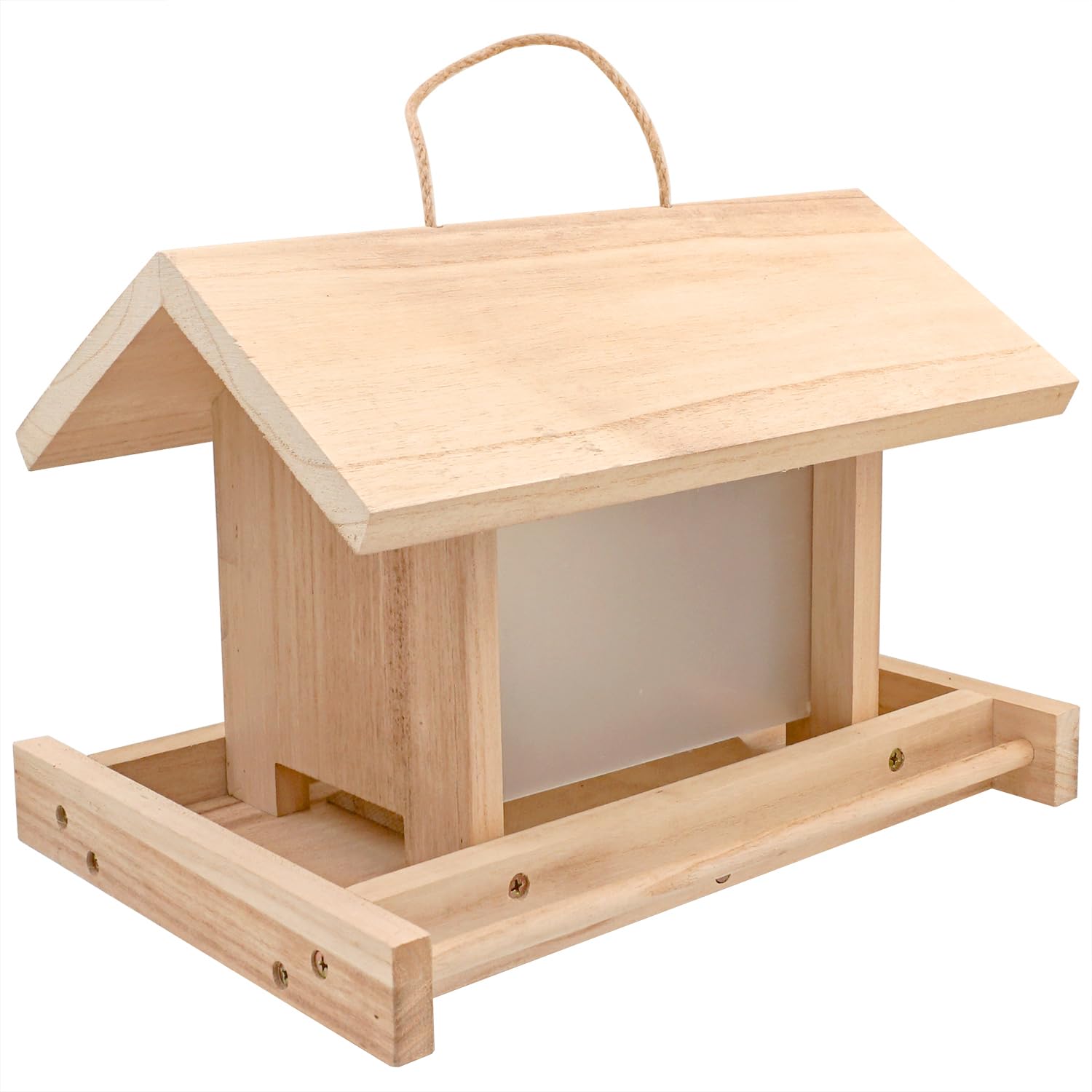
A hanging hopper that takes about 2 liters of seed and lets birds look in from every side.
The 2-liter hopper is the reason to buy this one — it holds roughly twice the seed of a small cedar house, so you are not topping up after every wet afternoon. Open feeding windows on four sides meet the birds coming from whatever direction your garden gives them, and the tray space around the bottom catches the spill before it hits the grass. The 360-degree perch lets several birds feed at once without a fight.
This feeder requires assembly, though the tools and detailed instructions come in the box, and the screws and screwdriver make the job easy enough for a first-timer. The top lid lifts straight off for a seed top-up, and the acrylic side panels pop out so you can clear leftover seed from inside. Peel the protective film off those panels first — otherwise your clear view of the seed is a cloudy haze.
The build is where owners differ. Some find it durable, and others report the hanging rope breaking after a week and call it cheaply made. Check the rope before you hang it and swap it if it looks thin, and read the assembly manual carefully so the frame goes together square. For a high-capacity hanging hopper at a mid-range price, it is a strong pick — just confirm the hanger before the first load.
Where It Wins Out
- A 2-liter hopper means a real break between refills
- Four open feeding windows pull birds from every direction
- Top lid opens for quick refills, and acrylic panels pop out for cleaning
- Screws and screwdriver included, so the first build is painless
What To Expect
- Comes flat-packed and needs assembly before it hangs
- Hanging rope draws criticism for breaking in the first week
- Reported as cheaply made by a share of owners
Pick this for: a hanging feeder that lets the whole garden feed from four sides at once.
Not the one for: a no-assembly, out-of-the-box hang — this arrives needing tools.
7. Wooden Bird Feeder Red Cedar 2 Suet Cages
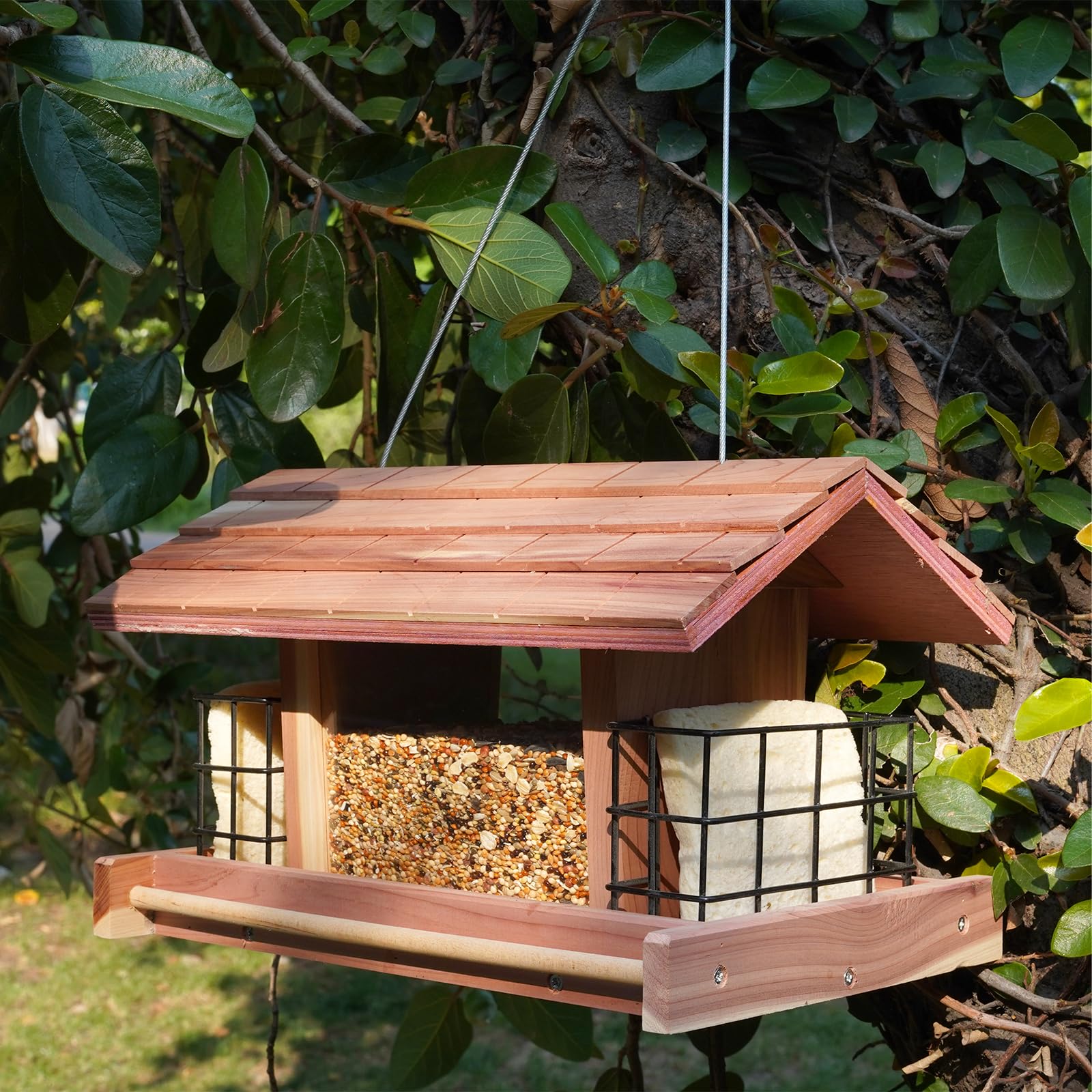
Natural red cedar with a roof, a see-through baffle, and two suet cages on the side.
Build quality is what people rave about here, and the material backs it up. This is natural premium red cedar, put together to take whatever the weather throws at it. The roof is wood, and the transparent baffle in front keeps rain off the seed while letting the birds see what is on offer. That combination is why it stands up to strong winds where thinner houses wobble.
At 11″ by 7.5″ by 7″, it holds up to 2.3 pounds of seed — sunflower, peanuts, quinoa, and corn kernels all fit. The two suet cages on the sides are the extra: hang fat cakes in them and you pull woodpeckers and clinging birds in alongside the seed eaters. The roof opens for filling, and you can wash the whole feeder under a tap to keep it hygienic.
The honest catch is the fit. Size draws complaints from buyers who expected a bigger feeder, and seed capacity from those feeding a busy yard — it is a compact house, not a bulk hopper. A share of owners also report the frame coming apart after a few months, so check the joints each season. Fill it up, hang it from the eaves, and treat it as a mid-sized feeder that suits a small to middling garden.
Material and roof: premium red cedar with a wood roof and see-through baffle is the combination that keeps seed dry through a soaking.
Suet cages on both sides: two hanging cages turn one feeder into a seed station and a woodpecker stop.
Best for: a garden where you want seed and suet up at once, under a roof that takes the rain.
Know before you buy: it is a compact house — a high-traffic yard will want more seed room than this offers.
8. Woodlink PRO4 Premier Cedar Bird Feeder, Brown

An 11-pound ranch-style cedar feeder for yards that empty a hopper in a week.
The 11-pound seed hopper is the whole reason to buy this ranch-style cedar feeder. That is the largest hopper here by a wide margin, so one fill lasts a busy yard for days instead of a single afternoon. The ranch-style body gives you a long run of perches and great bird visibility — you see the whole flock spread out across the front rather than crammed into one small window. It is built in the USA from reforested, kiln dried, inland red cedar, with chromate screws that resist rust at the joints.
The roof is hinged, so a fill is a lift and a pour, not a disassembly. At 17.88″ by 13.75″ by 12.25″, it needs a sturdy branch or hook with real clearance, not a balcony rail. Cedar construction and chromate screws are the long-game details that let a big feeder stay sturdy through wet winters.
The honest note is durability and value, which split owner opinion — some find it well worth it, others say it falls apart or runs overpriced for what it is. A big hopper full of seed is heavy, so check the hanger and the branch before you load it up. For a busy yard where the birds are already emptying a smaller feeder, the PRO4 is the pick that settles the routine.
Capacity that changes the chore: 11 pounds of seed in one fill is the reason to choose this over every compact house here.
Cedar and chromate screws: the joints are the weak point on a heavy hopper, so rust-resistant screws and reforested cedar are the right combination.
Go for it if: a high-traffic yard is emptying your current feeder faster than you can refill it.
Look at a smaller house if: you feed one quiet corner, or want a feeder that hangs from a light branch without strain.
Know the Specs
Seed Capacity (Pounds vs Liters)
Capacity is measured two ways on wooden feeders: pounds of mixed seed, or liters of volume. The Woodlink PRO4 lists 11 pounds, while the Zeqeey and Liawm feeders list 2 liters and 2.3 as volume. A bigger number means fewer refills, but only if you can reach the feeder and the hanging point can carry the weight. For a high-traffic yard, aim for the larger hopper. For a small balcony, a compact 2- to 3-pound feeder keeps the seed fresh.
The Hanging Rope Or Wire
On almost every wooden feeder the hanger fails first — cotton rope rots, hemp twine frays, and wire snaps at the crimp. Rope can rot, twine can fray, and wire can snap at the crimp. Check the hanger on arrival and swap it for a metal chain or a thicker wire before you hang a full load. This is a two-minute fix that keeps a good feeder from ending up on the lawn after a wet week.
Mounting Type
Pole-mounted feeders like the Woodlink platform need a pole sold separately, so budget for the mount as well as the tray. Hanging feeders need a branch, hook, or eaves fitting with enough clearance. Wall-mounted feeders like the BalterFF suit a fence, shed, or window view. Freestanding and tabletop mounts give you flexibility to move the feeder around the yard as the season changes. Match the mount to where you actually stand and look.
Drainage And Cleaning
A feeder with a metal screen floor and a removable tray is easier to keep clean and dries faster. The Woodlink platform uses a removable powder-coated screen so you can lift it out and shake it. Fly-thru and fixed-tray designs are harder to clean because you reach in rather than lift out. Drainage matters because seed sitting in water turns to mush and spoils — a screen bottom lets rain pass through instead of pooling.
Common Questions
Will a wooden bird feeder hold up through a wet winter?
Will cedar bird feeders attract squirrels?
How much seed should a wooden bird feeder hold?
Can I hang a wooden bird feeder from a tree branch?
How do I clean a wooden bird feeder without damaging the cedar?
Do squirrel and bird feeders work for both animals?
Is a platform feeder or a hanging house better for cardinals?
Do wooden bird feeders fit suet as well as seed?
Will a wooden bird feeder rot after a season?
How do I stop seed falling out of an open platform feeder?
The Bottom Line
For most yards, the wooden bird feeders pick is the Woodlink 3 in 1 Platform Bird Feeder — a reforested inland red cedar tray with a removable powder-coated screen that lets you clean it in a couple of minutes, and a 16.38″ by 13.25″ footprint that gives mixed-size birds room to share. If you want cardinals and finches up close, the STARSWR hanging house pulls them in with a hemp rope hanger and a sloping roof. And if a busy yard is emptying your feeder too fast, the Woodlink PRO4 holds 11 pounds of mixed seed and cuts the refill routine down. Buy cedar, check the hanger, and match the capacity to the crowd at your window.
How we choose
We do not accept paid placement. Every pick is matched to a real buyer and a real use-case; we do not hands-on test units.
Sources
Specifications: manufacturer listings and product documentation. Review insights: verified customer reviews, as of November 2026. Pricing: not shown on this page (it changes often); check the current price via the retailer link.
As an Amazon Associate, Tactical Gear Guy earns from qualifying purchases. This does not affect which products we feature.