Specs are compiled from manufacturer listings and verified buyer reviews and can change over time — please confirm the key details on the product page before buying.
Here is the short answer before you read another word: buy for the wood and the weight rating, not the shape. Most wooden balance boards look nearly identical on a listing page, yet one holds a grown adult at 485 pounds while another is a 19-inch toddler board that small kids cannot even stand on properly. That single difference decides whether your board survives a year of daily rocking or splits in the first week.
This guide is built by comparing the manufacturers’ published specifications and the patterns across verified customer reviews, so you get each pick’s real strengths and trade-offs instead of marketing spin.
You will see exactly which board suits a two-year-old, which one takes an adult doing yoga, and where the cracking complaints actually cluster. By the end you can match a board to your room, your kids and your own workout, and this breakdown of the best wooden balance board options keeps every pick honest about its limits.
Top Picks


How To Choose The Best Wooden Balance Board
A wooden balance board is one curved plank of wood that rocks on its arc so you steady yourself with your feet, your core and your ankles. That is the whole product. Everything that separates a good one from a frustrating one hides in the wood, the curve and the stated weight limit.
Start with the weight rating, not the look
The weight recommendation is the fastest filter you have. Boards in this group range from a 250-pound limit up to 488 pounds, and that number tells you who the board was genuinely engineered for. A 250-pound board is a child’s toy in practice. A board rated past 400 pounds can take an adult standing, rocking and stretching without the arc flattening under load.
Wood species and layer count decide stiffness
Solid beech is dense and springy, which is why the heavier-duty boards here use it. Multi-layer construction — one listing spells out 11 layers of birch plus 2 layers of beech — is how makers build a thin board that resists cracking along the curve. A single thin plank with no layer description is the one to question, because the curve is exactly where stress concentrates.
Length and width set the age range
A 19-inch board and a 37-inch board are different products wearing the same name. Short boards suit toddlers sitting and rocking. Boards around 35 to 37 inches long give a child room to stand, and they give an adult enough length to lie back for a supported stretch or balance in a yoga pose. Width matters too: a wider deck gives small feet more landing room.
Think about where it will live
Water-based lacquer finishes are what let a board move between the living room and the garden. A wood-oil finish wants a clean, dry cloth and no direct sunlight or damp, so that board belongs indoors. If the board will sit on a patio or in a yard, check the finish wording before you commit.
Side-by-Side Comparison
| Model | Best For | Weight Limit | Board Length | Material | Amazon |
|---|---|---|---|---|---|
| Kinderfeets Kinderboard★ Best Overall | Whole-family daily rocking | 485 lb | 32″ | German beechwood | Amazon |
| NUTTY TOYS Montessori Wobble BoardBest Big-Kid Capacity | Two kids or parent plus child | 488 lb | 35″ | Beech wood | Amazon |
| WOOD CITY Wobble BoardBest For Adult Workouts | Yoga and adult balance work | 480 lb | 35″ | Wood | Amazon |
| CHIMPISH Finger-Safe Board | Homes with fearless toddlers | 330 lb | 37″ | Wood | Amazon |
| PLAY-IN-JOY 35″ Board | Indoor rainy-day play | 330 lb | 42″ (listed) | Birch and beech layers | Amazon |
| Fisher-Price Rockin’ Balance Board | Preschoolers with guided play | — | 31.7″ | FSC-certified wood | Amazon |
| PLAY-IN-JOY 36.6″ Board | Kids who abandon toys fast | 390 lb | 36.6″ | Beech wood | Amazon |
| Bodo Maze Balance Board | Focused balance training | Over 400 lb (200 kg) | 23″ | Solid beech | Amazon |
| WALIKI Wood Balance Board | Toddlers starting out | 250 lb | 19″ | Wood | Amazon |
Detailed Reviews
1. Kinderfeets Kinderboard
Our pick — 4.5+★ from 950+ verified ratings; the strongest balance of quality and price.
A hand-finished German beechwood board rated to 485 pounds, sized at 32 by 12 inches for toddlers through teens.
This is the board you buy when you want one that a three-year-old and a grown adult can both climb on without a second thought. The 485-pound recommendation is among the highest ceilings in this group, so an adult can stand and rock on it without the arc flattening. At 32 inches long and 12 inches wide, it is long enough for a child to stand and rock and short enough to tuck against a wall.
What wins people over is the construction. Dutch design and German beechwood, hand-finished and sealed with a water-based lacquer that handles damp grass and patio use.
The honest trade-off: durability draws mixed notes, and some boards have cracked within a few days of use, while many others run for years without a mark. That tells you the wood grain and the arc take real load, so store it flat and dry and do not leave it outside overnight. At 8.8 pounds it is the heaviest board here versus the 4.6 pounds of the WOOD CITY board, which makes it feel substantial rather than portable.
The Case For Beech
- Supports up to 485 pounds, so adults can ride it too
- Water-based lacquer means indoor and outdoor use without damage from damp
- 32″ x 12″ footprint suits toddlers through teens without dominating a room
Where It Asks For Care
- Cracking has been reported on a small number of boards after only a few days of use
- At 8.8 pounds it is the heaviest pick here and not something you sling in a bag
Go for it when: the board has to serve a toddler today and a teenager in five years, and you want a single purchase that covers both.
Worth weighing: store it flat and away from heat — the beech arc is the part that takes all the stress.
2. NUTTY TOYS Montessori Wooden Wobble Board
The widest party deck in the lineup — a parent and a child can rock on it side by side.
If two kids fight over one board in your house, this is the one that ends the argument. That headroom is what lets a grown adult hop on beside a preschooler.
The open-ended angle is where it earns its keep. It becomes a slide, a stepping stone, a bridge, a cradle, a toy-car racetrack — the sort of toy a child keeps rediscovering rather than abandoning. Owners rate the open-ended play higher than any spec on the listing, and sturdiness comes up next. All edges are finished smooth and free of splinters, and the non-toxic coating is a sensible choice for a product that gets chewed on and dropped.
Here is the catch worth knowing: a minority of buyers report the board cracking after a few uses, so overloading it past the rating or leaving it in a hot shed is not wise. Treat the 488-pound figure as a ceiling, not a daily target, and this board will take everything a normal family throws at it.
What it solves: the 35″ x 11.8″ surface is a genuine two-person play space, and the 0.7-inch thickness carries that load without flexing under a wiggly pair of kids.
What to know: it is designed for ages three and up, so it is not the first board for a two-year-old still finding their feet.
Pick this one if: siblings share the board or you want to climb on with your child.
Leave it for later if: your little one is under three and needs a shorter, lower board.
3. WOOD CITY Wobble Board for Toddlers and Adults
At 4.6 pounds it is the lightest full-size board here, yet it still rates to 480 pounds.
The 480-pound rating means it still takes an adult standing and rocking on it.
This is the pick for the adult who wants to actually train on it. The board is designed to challenge your balance with a raised centre of gravity, which works the muscles that hold your posture, and it doubles as a back-stretch seat for yoga sessions. Owners describe it as sturdy and usable on either side, with a raised centre of gravity that works the muscles holding your posture. Each board carries its own grain and mineral pattern, so no two look the same on the floor.
A couple of practical notes. It is a 35-inch board, so it is a shared piece rather than a fully adult-sized deck. And at 0.66 inches thick it is thinner than the heavier beech boards, which is exactly why it sheds all that weight — the trade is that you store it flat rather than leaning it against a radiator.
Light enough to move: 4.6 pounds is the standout figure here, and it means the board actually gets used instead of staying in a cupboard because it is too heavy to drag out.
The honest caveat: a rivet-thin 0.66-inch profile is what buys the lightness, so keep it out of damp and direct heat.
Built for: an adult who wants balance work and back stretching without a heavy plank to haul around.
Think twice if: you want a big, thick heirloom board — this one prioritises carrying ease over mass.
4. CHIMPISH 37-Inch Finger-Safe Wobble Board
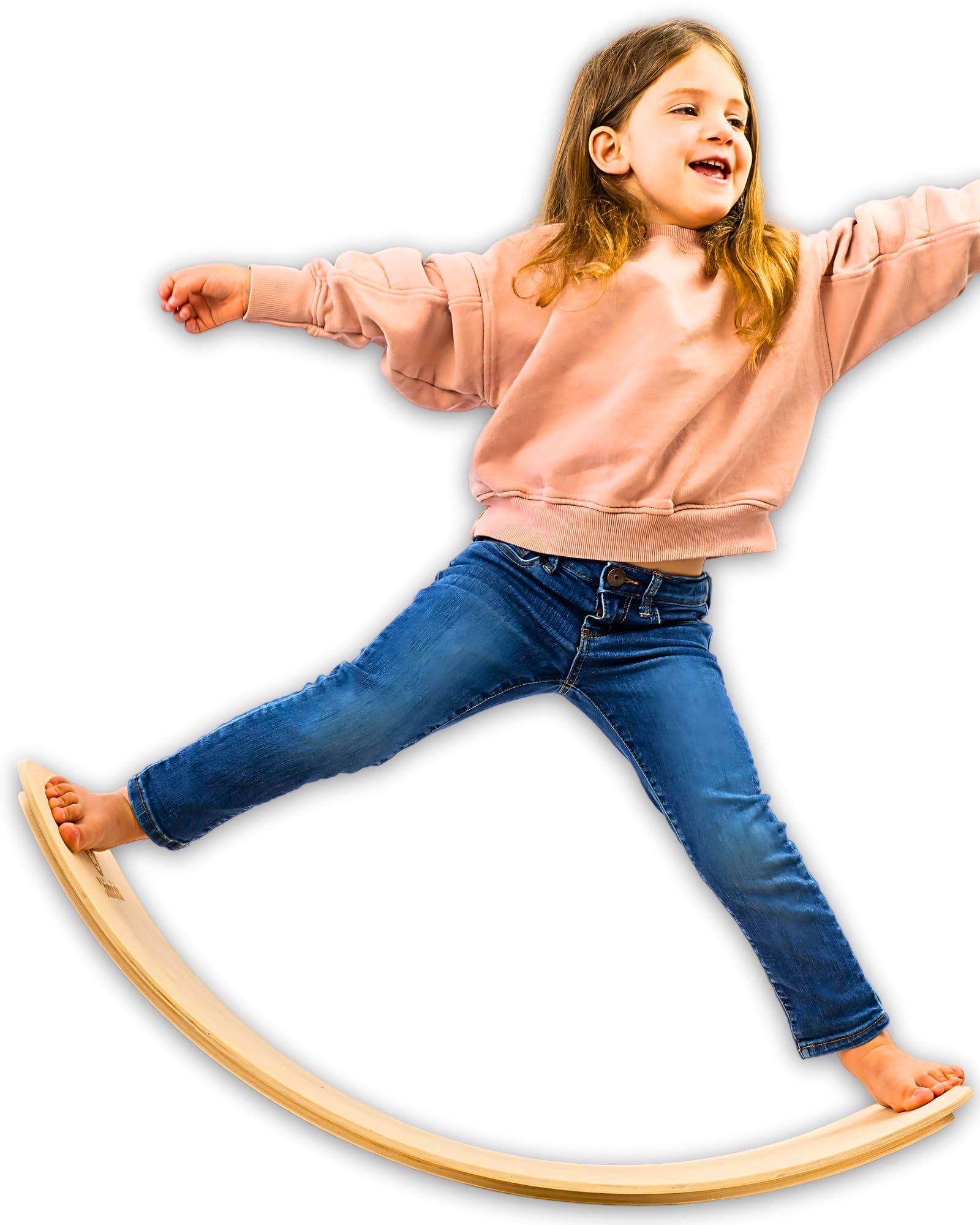
A 37-inch board with a recessed space on every side, so small fingers never get pinched underneath.
Picture the classic wobble board injury: a child tips the board up and the edge comes down on a fingertip. This board is the direct answer to that. It has a safe space for fingers on all sides, so you can let a toddler pretend-surf without hovering over them. The 37-inch length is the longest deck in this lineup, giving bigger kids and adults room to stand and stretch properly.
Parents keep their kids’ fingers safe on this board, and that is why many pick it over a plain curved plank. The wood is solid with a nice thickness and smooth rounded edges. Kids who climb the furniture use it as a slide, a rocker, a racetrack and a bridge. Adults use the same board for balance training and a tougher yoga session.
The catch: durability gets mixed feedback, with some boards holding up well and others developing a crack. And the weight recommendation sits at 330 pounds — well under the 485 pounds the Kinderfeets board will take — so this is a family board for children and average adults rather than a heavy-duty one. That is the trade for the longer deck and the finger recesses.
The safety detail that matters: recessed finger space on every side means your child keeps ten fingers while the board keeps its momentum.
Worth knowing: the 330-pound ceiling and mixed durability notes mean it suits kids and light adult use, not a full-grown heavy rider.
Reach for this if: you have a fearless toddler or a sensory seeker and you want a board that respects fingers.
Look elsewhere if: a heavy adult will be the primary user — the weight ceiling here is lower than the top picks.
5. PLAY-IN-JOY 35″ Montessori Wobble Board

Thirteen bonded wood layers under an eco-friendly water-based paint finish — a board built to bend, not snap.
The layer count is the whole story with this one. The deck is made from 11 layers of birch plus 2 layers of beech, bonded into one plank and finished with an eco-friendly water-based paint. Stacked layers are how thin wood resists splitting along a curve, which is exactly the failure point on cheaper single-plank boards. It holds up to 330 pounds.
The 11.81-inch width is the other thing to notice — that extra surface gives a child more room to shift position, kneel, sit and spin without sliding off the edge. Owners describe it as versatile enough for daily kid play and for adults running yoga flows on the same deck. When rain or cold keeps everyone inside, it is the toy that replaces a screen without anyone complaining.
One listing wrinkle to flag: the size field and the dimensions field disagree, so check the actual product page before you plan around an exact length. Beyond that, this is a balanced indoor board — the water-based paint finish is not described for outdoor weather, so keep it on the playroom floor.
What the build buys you: 13 layers of birch and beech are the reason this board can flex under a rocking child without separating at the arc.
The catch: the paint finish is an indoor proposition, and the listing’s stated sizes do not match up, so confirm the length you are getting.
Suits: a playroom that needs a rainy-day activity for toddlers and a yoga prop for the adults in the house.
Not for: patio or garden use — the water-based paint wants dry indoor conditions.
6. Fisher-Price Wood Montessori Rockin’ Balance Board

The only board here that arrives with a tip card from a child-development play lab.
If you have ever unboxed a balance board and wondered what on earth to do with it beyond rocking, this is your pick. Fisher-Price includes a guided play tip card from the child development experts at the Fisher-Price Play Lab, which turns the board from a novelty into a set of activities. It is built for ages three and up, and it is the board that most plainly reads as a preschool tool rather than a family gadget.
The wood comes from Forest Stewardship Council-certified sources (FSC-N004566) and is decorated with non-toxic, water-based paint. It carries the AMS Montessori Seal of Excellence from the American Montessori Society, and at 5.4 pounds it is light enough for a parent to shift around the room one-handed. Kids rock, balance and push their limits on it while building body awareness and confidence.
The limitation is the ceiling. There is no published weight recommendation in the specs, and it is designed around preschool kids at 31.7 inches long, so this is not a board an adult will get a real workout from. Buy it for the three-to-five-year-old and the activity ideas; buy a longer board for the grown-ups.
Why Parents Like It
- Comes with guided play tips from the Fisher-Price Play Lab, so you know what to do with it
- FSC-certified wood sources and non-toxic water-based paint
- 5.4 pounds is light enough to move room to room with one hand
Where It Stops Short
- Built around preschoolers at 31.7 inches, so it does not scale up to teen or adult use
- No published weight recommendation to plan heavy use around
Buy it for: a three-to-five-year-old and a parent who wants a starting point, not a blank plank.
Skip it for: older kids or adult balance training — the length and the age design don’t stretch that far.
7. PLAY-IN-JOY 36.6″ Wooden Wobble Board

A natural beech deck with a 390-pound limit and a twelve-month warranty behind it.
This is the board for the “my kid gets bored of everything” complaint. Today it is a swing, tomorrow a stage, the next day a boat or a reading nook. The shape gives a child room to invent, and owners describe it as a toy kids keep coming back to. The natural beech wood deck runs 36.6 inches along the outer arc at 10.23 inches wide, with smooth surfaces and rounded edges.
Build quality is what carries it. Durability is described in positive terms on the whole, and the 390-pound capacity means a bigger kid or an adult can rock on it for a leg workout. There is a twelve-month warranty backing the board, which is more protection than most of this lineup offers. No batteries, no screens, no setup — it just works when the weather traps everyone indoors.
The honest note is the finish: some boards arrive with a rougher surface than expected, so give it a quick feel from the start and a light sanding if a patch bothers a barefoot child. That aside, this is a solid mid-size option that sits between the toddler boards and the heavy beech picks.
Why it earns its spot: beech construction, a 390-pound capacity and a twelve-month warranty together make it one of the more reassuring buys in this group.
The one snag: finish quality varies board to board, so a rough patch is possible.
Right for: a household that wants one board that survives kids who cycle through hobbies.
Check first if: a perfectly smooth finish from the start is non-negotiable for you.
8. Bodo Maze Balance Board

A rocking disc with two balls and a maze target, turning balance work into an actual game.
Every other board here asks you to rock and steady yourself. This one gives you a job while you do it: roll two balls toward the centre of the labyrinth without dropping them, and suddenly your ankles, core and concentration are all working at once. The solid beech disc is rated to hold up to 200 kg (over 400 lbs.), so it takes the whole family — kids, teens and adults, for exercise training, bodyweight fitness and board-sport practice.
Owners praise the two-ball labyrinth design and the solid 12-ply beech construction. The challenge is the point, not the problem: it is described as an enjoyable way to build balance for people whose sense of balance has slipped over time. It demands focus and concentration in a way a plain wobble board does not. The surface is polished fully smooth to prevent splinters, and a wood oil layer protects it.
The follow-up question most buyers have is care and storage. The oiled finish wants only a clean, dry cloth — no soap and no harsh chemicals — and the maker says to keep it out of direct sunlight and moisture. It also ships in a sturdy box with a separate jute bag for the 12mm and 20mm balls, and at 23 inches across it is a compact disc rather than a long plank.
The draw: the two-ball labyrinth turns a balance drill into something kids ask to play, and the 12-ply beech build carries over 400 pounds of user.
The caveat: it is a small 23-inch disc, so it is for balance and focus training rather than full-body stretching.
Choose it when: you want balance training that feels like a challenge instead of a stretch session.
Know going in: the oiled finish needs a dry cloth and a home away from sun and damp.
9. WALIKI Wood Balance Board

A short, pint-sized rocker designed to be a two-year-old’s very first balance toy.
Not every family needs a 35-inch plank. If your child is just past two, a big board is intimidating and the smaller one is easier to mount. This board is built for ages 24 months and up, measures 19 inches by 19 inches by 9 inches, and takes up to 250 pounds. That weight limit signals it is a child’s toy rather than a shared family piece. The cheerful colour and simple surf-and-rock shape keep it inviting.
What parents like is the sturdiness and how well it suits little kids — Owners say it builds coordination and stability, with toddlers rocking it like a surfboard on the living room floor.. WALIKI has been making these since 2005, so the design has had plenty of time to settle into a shape toddlers can handle.
The real limitation is the size, and it is worth being blunt about it: the deck is small enough that older children can outgrow standing on it, which is a fit question rather than a fault. Assembly also divides opinion, with some finding it easy and others struggling, so set aside a few minutes rather than expecting instant play. If your child is heading toward school age, a longer board serves longer.
What it does best: a genuinely toddler-scale rocker for ages 24 months and up, built sturdy and simple.
What to plan around: the 19-inch deck and 250-pound limit mean it tops out around the preschool years, and assembly can take patience.
Ideal when: a two or three-year-old needs a first balance toy that isn’t overwhelming.
Heads up: expect to outgrow it — bigger children will want a longer deck.
Know the Specs
Maximum Weight Recommendation
This is the load the maker says the board is built to carry. It is the single most useful number on the listing, because it tells you who the board was designed for. A board rated at 250 pounds is a toddler toy in practice, while one rated past 480 pounds will take an adult standing and rocking. Read it as a ceiling for occasional use, not a target for daily abuse, and never stack two heavy riders on a board rated for one.
Material and Layer Construction
Solid beech is dense, springy and holds a curve well, which is why the heavy-duty picks here use it. Layered construction — one board lists 11 layers of birch plus 2 layers of beech — is how makers build a thin deck that flexes without splitting at the arc. When a listing only says “wood” with no species or layer count, treat that as an open question and lean on the weight rating instead.
Board Length and Width
Length decides who can use it. Around 19 inches is a sitting-and-rocking toddler size. From roughly 32 inches up, a child can stand, and past 35 inches an adult has room to stretch and balance. Width works the same way: a wider deck gives small feet more landing space and lets two children share. Check both numbers against the youngest and oldest person who will actually use the board.
Finish and Where It Can Go
The finish decides indoor versus outdoor use. Water-based lacquer is what lets a board go into the garden or onto a patio without soaking up damp. A water-based paint finish is described for indoor play, so keep it on a dry floor. A wood-oil finish wants a clean, dry cloth with no soap and no direct sunlight or moisture. Match the finish to the room you plan to leave the board in.
Common Questions
What is the difference between a wobble board and a balance board?
Will a wooden balance board hold an adult?
What age can a child start using a balance board?
Can you use a wooden balance board outside on grass or a patio?
Why do some wooden balance boards crack along the curve?
How do you clean a wooden balance board?
Is a wider balance board better for toddlers?
Can you do yoga on a wooden balance board?
Do wooden balance boards need assembly?
How long should a wooden balance board last?
The Bottom Line
The winner for most families is the Kinderfeets Kinderboard, because its 485-pound rating and hand-finished German beechwood let one board serve a toddler today and an adult tomorrow. If you want the lowest weight-to-strength trade, the WOOD CITY board does the same job at 4.6 pounds. And for the child whose fingers need protecting, the CHIMPISH finger-safe board is the one to reach for.
One last nudge: the Kinderfeets holds the highest score in this lineup at 4.5+, and the crowd favorite reputation backs it — a board you buy once and pass down beats a cheaper one you replace twice. Just store it flat and dry, and it will keep rocking long after the novelty fades on everything else in the toy box.
How we choose
We do not accept paid placement. Every pick is matched to a real buyer and a real use-case; we do not hands-on test units.
Sources
Specifications: manufacturer listings and product documentation. Review insights: verified customer reviews, as of November 2026. Pricing: not shown on this page (it changes often); check the current price via the retailer link.
As an Amazon Associate, Tactical Gear Guy earns from qualifying purchases. This does not affect which products we feature.