Specs are compiled from manufacturer listings and verified buyer reviews and can change over time — please confirm the key details on the product page before buying.
Your toddler does not need pedals to learn to ride — they need a wooden frame light enough to pick up after a tumble and a seat height that actually reaches their legs. Seat height and frame weight decide everything: a 12-month-old or a four-year-old can push off, glide, and stop with their own feet only when both numbers fit. Get it wrong and the bike sits in the garage. The three picks below cover the smallest starter riders, the taller toddlers who outgrow everything fast, and the vintage-styled scooter for older preschoolers.
This guide is built by comparing the manufacturers’ published specifications and the patterns across verified customer reviews, so you get each pick’s real strengths and trade-offs instead of marketing spin.
You will see how seat height, wheel size and frame weight decide which child fits which bike — and where the honest trade-offs sit. Read on for three wooden balance bikes matched to inseam and weight, not to the age on the box.
Top Picks

How To Choose The Best Wooden Balance Bike
The mistake almost every first-time buyer makes is shopping by the age printed on the box. Age ranges on wooden balance bikes are broad and loose — a bike marked for 12 to 24 months can fit a tall 30-month-old and swallow a small 12-month-old. Buy by two numbers instead: the seat’s lowest setting in inches, and the frame’s weight in kilograms. Your child’s inseam, measured from crotch to floor in their shoes, needs to clear that lowest seat setting with both feet flat.
Seat height is the whole fit question
A balance bike works only when your child can plant both feet flat on the ground while sitting on the saddle. An inch too high and they cannot push off confidently, and the bike sits unused in the garage. Look for an adjustable seat with a lowest setting your child clears today — not one they will grow into next year. The three picks here bottom out at 8.5 inches, 10 inches and 12.6 inches, which spreads them across a genuinely wide range of toddler leg lengths.
Airless tires or inflatable tires
Airless foam tires never go flat and take scuffs from pavement and hallway floors without complaint, which is why they dominate the toddler end of this category. Inflatable rubber tires grip loose gravel and grass better and ride softer, but they need air and can puncture. For a child riding mostly on a driveway or inside the house, airless is the lower-maintenance call. For a preschooler who will be off-road on park paths, rubber is worth the extra attention.
Frame weight your child has to manage
Wooden balance bikes are not automatically lighter than metal ones — birchwood and bamboo builds often land heavier than an aluminium frame of the same size. That matters the first time your toddler tips over sideways and has to free a leg from under the bike. A frame at 2.3 kg is noticeably easier for a small rider to handle than one at 3 kg, and the difference shows up in how quickly they get back on.
What the safety testing labels actually tell you
Look for explicit mentions of safety testing to named standards — CE for Europe, ASTM for North America, EN71 for toy safety, and AS/NZS 8124 for Australia and New Zealand. These labels tell you the bike was tested against published rules, not that it is impossible to fall off. A wooden frame with water-based lacquers and non-toxic grips also means less worry when a teething toddler chews the handlebar.
Side-by-Side Comparison
| Model | Best For | Seat Height | Wheel Size | Frame Weight | Amazon |
|---|---|---|---|---|---|
| Kinderfeets Tiny Tot 2-in-1★ Best Overall | Smallest first-time riders, 12–24 months | 8.5 to 11 inches | 7 inch airless | 2.3 kg | Amazon |
| Kinderfeets Balance-Bike (Tiny Tot PLUS) | Toddlers who need room to grow, 18 months–4 years | 10 to 13 inches | 9-inch airless | 3 kg | Amazon |
| Janod Wooden Scooter Balance Bike | Vintage-styled riding for kids aged 3 and up | 12.6 to 13.4 inches | Inflatable rubber | 8.9 pounds | Amazon |
Detailed Reviews
1. Kinderfeets Tiny Tot Wooden 2-in-1 Trike and Balance Bike
Our pick — 4.5+★ from 600+ verified ratings; the strongest balance of quality and price.
Two bikes in one frame — a tricycle for a one-year-old, a balance bike for the toddler who outgrows it.
The seat drops to 8.5 inches, which is the lowest starting point in this lineup and the reason it suits a child from 12 months. At that height a newly walking toddler can sit with both feet flat and shuffle forward. When they are ready, the same frame converts from a three-wheel tricycle to a two-wheel balance bike, so you are buying two riding stages with one frame instead of replacing the trike a year later. It weighs 2.3 kg, and if you swap it for the larger balance bike below at 3 kg, the smaller frame is the one a wobbly beginner can pick up off themselves.
The wheels are 7 inch airless tires — solid foam that cannot go flat — on an extra-wide base. That width is what stops the trike tipping during those first unsteady pushes. The rest of the build is honest about materials: birchwood frame, water-based lacquers, non-toxic padded grips. Kinderfeets states the bike is safety tested to CE, ASTM, EN71 and AS/NZS 8124 standards, and it is rated for riders up to 44 lb.
What wins people over most is how the bike is made — the quality of the build is the thing owners single out far more than anything else, with the good looks second. It assembles without a fight. The honest catch is the back wheels: on the tricycle setup and in early two-wheel riding, small feet can catch against that rear axle area and stick momentarily. That rear-axle snag is a learning-stage quirk, not a defect, and it fades once your child learns where to put their feet. One more thing to check — the listing appears under both a bamboo and a birchwood material label, and some colourway names read differently in different listings, so confirm the finish you want before ordering.
Where It Earns Its Place
- Converts from tricycle to balance bike — two riding stages on one frame.
- Lowest seat setting here at 8.5 inches, so the smallest riders clear the ground.
- 2.3 kg frame, lighter than the larger Kinderfeets at 3 kg.
- 7 inch airless tires that cannot go flat, on an extra-wide stable base.
- Adjustable seat grows to 11 inches, rated up to 44 lb.
What To Weigh Up
- Rear wheels can snag small feet during the early learning stage.
- Riders outgrow it before the larger model’s four-year ceiling.
Buy it for: a first birthday or a child just starting to walk who needs the lowest possible seat and a stable third wheel.
Think twice if: your toddler is already tall for their age — jump to the bigger Kinderfeets for the extra seat height.
2. Kinderfeets Balance-Bike
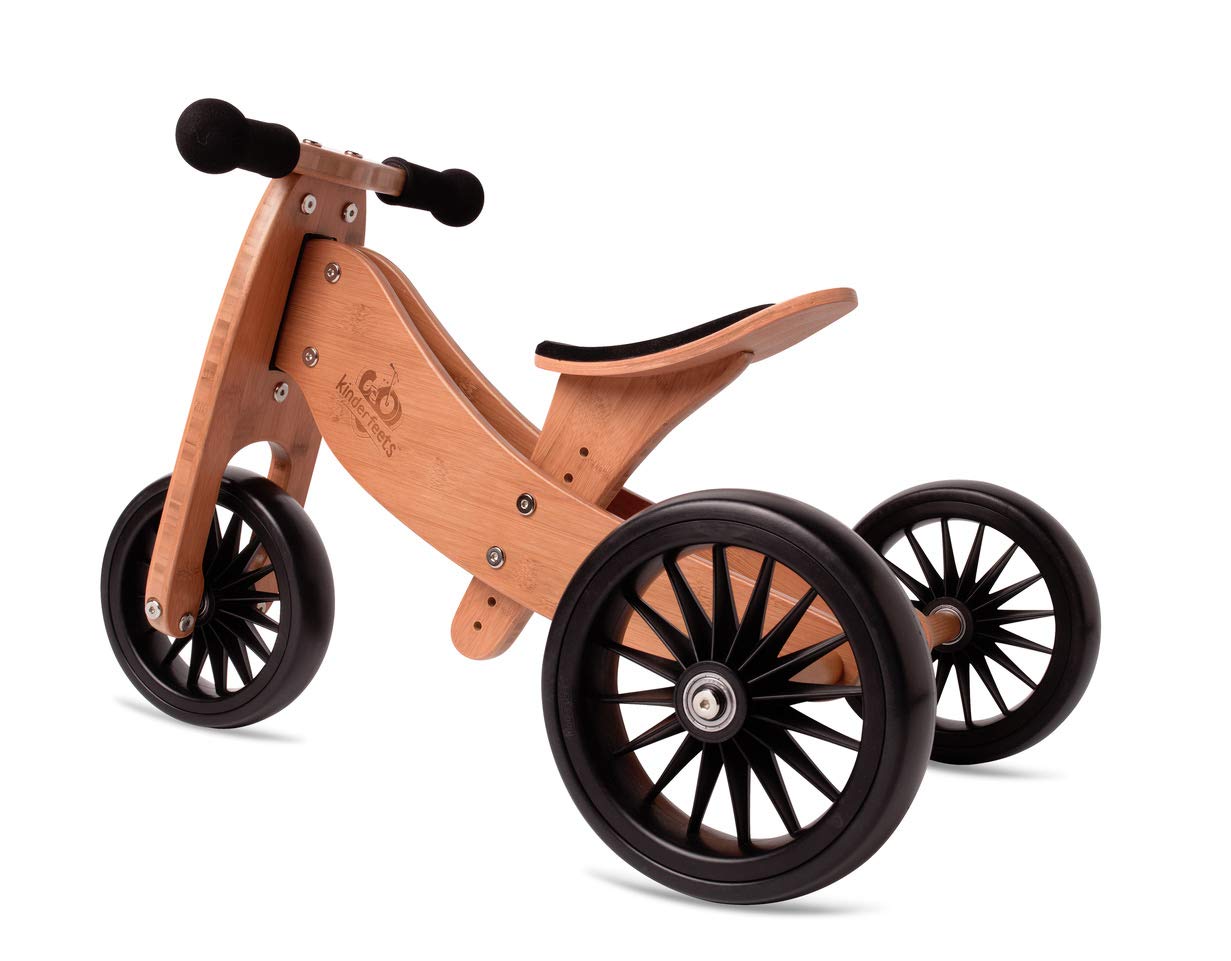
The same 2-in-1 idea stretched taller, with bigger wheels and a seat that climbs to 13 inches.
This is the Tiny Tot PLUS — the larger sibling of the pick above — and the numbers tell you exactly where the extra room comes from. The seat adjusts from 10 to 13 inches versus 8.5 to 11 inches on the smaller model. The wheels step up to 9-inch airless instead of 7 inch, which rides over sidewalk cracks and patchy pavement with less jolt. Frame weight rises to 3 kg against the smaller bike’s 2.3 kg, and that extra heft is the price of the longer wheelbase. It is rated for ages 18 months to 4 years and a weight limit of 55 lb.
If you are deciding between this and the Janod scooter further down, the split is straightforward. This one has a seat that starts lower (10 inches versus 12.6 inches), so it fits a much younger rider, and it runs airless tires that need no upkeep. The Janod has inflatable rubber for better grip on grass and gravel but starts at a higher seat. For a two-year-old who will ride the driveway and the living room, the Kinderfeets fits earlier and stays simple.
The build is birchwood from an FSC-certified supplier, with non-toxic handlebar grips and water-based lacquers, and the packaging is recycled paper with water-based inks. Kinderfeets lists safety testing to CE, ASTM, EN71 and AS/NZS 8124. What you trade for that range is weight and a fewer-track-record fan base — this larger model has a thinner review history than its smaller sibling, so you are partly buying the same proven design at a bigger size. Check the seat position before first ride, because a loose clamp on any adjustable-seat bike turns a glide into a wobble.
The growth math: a 10-to-13-inch seat range plus a 55 lb weight limit means this is a bike a single child can genuinely ride from 18 months into their fourth year — which is exactly what you want if you plan to skip the two-bike route.
The honest note: 3 kg is more than your toddler will thank you for on the first few tips. It evens out once they learn to lean and step, but the lighter 2.3 kg Tiny Tot is the friendlier frame for a very new rider.
Reach for this if: your child is a taller toddler who has already outgrown the smallest seat settings, and you want one wooden bike that stretches to age four.
Pass it over if: your rider is still under two and tiny — the 8.5-inch seat on the Tiny Tot gets them riding sooner.
3. Janod Wooden Scooter Balance Bike

A scooter-styled wooden ride for the preschooler who wants the coolest bike on the block.
This one is built for a different, older kid than the two Kinderfeets bikes. It is recommended for ages 3 and up, and the seat sits between 12.6 and 13.4 inches — meaning your child needs noticeably longer legs before this bike makes sense. For a confident three- or four-year-old, that higher saddle translates to a more grown-up riding posture. It also runs inflatable rubber tires rather than foam, so it grips park grass and gravel paths where airless tires start to skitter.
The look is the star here. Appearance is the thing owners praise most on this bike, with the overall retro styling drawing the second-biggest share of positive remarks. Ergonomic rubber handles and a vintage wooden frame give it a character the foam-tired toddler bikes do not have. Assembly is reported as straightforward. Janod has been making heirloom-style toys since 1970, and the bike is recommended for ages 3 to 5 with no manufacturer warranty stated.
Here is where you have to read carefully: the durability picture is the honest weak spot. Wheels are the recurring complaint on this one, with a cluster of reports about them breaking early. Plenty of families ride it happily, but the wheel reports make this the pick for a gentler rider on smooth pavement, not a kerb-hammering one. The high seat setting also means it is simply the wrong first bike for a brand-new walker. If your child is under three or still wobbly, start with the Tiny Tot.
The case for it: inflatable tires plus a vintage wooden frame give this the most character and the best off-pavement grip of the three, for a preschooler ready for a bigger ride.
The caveat to size up: wheel durability is the most-discussed soft spot, so keep it on smooth paths and park grass, where the inflatable tires and vintage frame earn their keep.
Best matched to: a confident three-to-five-year-old riding smooth paths and park grass who wants a bike with real vintage looks.
Not the one for: a first-time toddler rider or a kid who treats every kerb like a jump — the higher seat and wheel reports make it a gentler-ground pick.
Know the Specs
Seat Height Range
The seat height range — lowest to highest saddle setting in inches — is the number that decides who can actually ride a wooden balance bike. Measure your child’s inseam in their shoes, then check it clears the lowest setting so both feet sit flat. A lower start like 8.5 inches fits a 12-month-old; a higher start like 12.6 inches needs a preschooler. The top of the range tells you how many growth spurts the bike will survive before it is outgrown.
Airless vs Inflatable Tires
Airless tires are solid foam that cannot puncture or lose pressure — ideal for driveways, hallways and pavement, with zero upkeep. Inflatable rubber tires hold air and grip loose gravel and grass better with a softer ride, but they can go flat and need occasional pumping. Match the tire to where your child actually rides: solid for smooth ground, rubber for off-road park paths.
Frame Weight in Kilograms
Frame weight is what your child has to lift off themselves after a tip-over. Lower is friendlier for a new rider — a 2.3 kg frame is meaningfully easier for a small toddler to handle than a 3 kg one. Wooden frames are not always lighter than metal; birchwood and bamboo builds vary, so check the stated weight rather than assuming wood means featherweight.
Age and Weight Limits
The recommended age range on the box is a rough guide, but the weight limit is the harder cap to respect. A bike rated to 44 lb and one rated to 55 lb suit different-sized kids, and pairing a heavy child with a lower weight limit strains the frame. Always cross-check your child’s weight against the stated limit before you buy.
Common Questions
What age is a wooden balance bike suitable for?
How do I know if the seat height will fit my child?
Are airless tires better than inflatable tires on a wooden balance bike?
What is a 2-in-1 trike and balance bike and why does it matter?
How much does a wooden balance bike weigh and does it matter?
Is a wooden balance bike safe for my toddler?
How long will my child ride a wooden balance bike before outgrowing it?
Do wooden balance bikes have pedals or a chain?
What should I check before my child’s first ride?
Can a wooden balance bike be used indoors?
The Bottom Line
For most families, the winning wooden balance bike is the Kinderfeets Tiny Tot because its 8.5-inch lowest seat gets the smallest riders riding first, and the tricycle-to-bike conversion means one frame carries them through two riding stages. If your toddler is taller and you want a bike that stretches to age four, the larger Kinderfeets gives you the 10-to-13-inch seat range and 9-inch airless tires. And for a confident preschooler who wants vintage looks and inflatable rubber for park paths, the Janod scooter is the one to reach for — just keep it on smoother ground. The smallest Kinderfeets earns its 4.5+ star rating from hundreds of families on its 8.5-inch lowest seat, which gets the shortest riders rolling first.
How we choose
We do not accept paid placement. Every pick is matched to a real buyer and a real use-case; we do not hands-on test units.
Sources
Specifications: manufacturer listings and product documentation. Review insights: verified customer reviews, as of November 2026. Pricing: not shown on this page (it changes often); check the current price via the retailer link.
As an Amazon Associate, Tactical Gear Guy earns from qualifying purchases. This does not affect which products we feature.