Specs are compiled from manufacturer listings and verified buyer reviews and can change over time — please confirm the key details on the product page before buying.
If your foam block squashes under your palm in Triangle pose, you already know the problem: soft props give you a vague, wobbly support instead of a real ledge. Solid wood fixes that. It gives you a firm, unyielding surface that holds its height under your full weight, which is why Iyengar-style practitioners reach for it. Below are three wooden blocks worth putting next to your mat, sorted by what each one actually does best.
This guide is built by comparing the manufacturers’ published specifications and the patterns across verified customer reviews, so you get each pick’s real strengths and trade-offs instead of marketing spin.
The short version: match the block’s footprint and base grip to the poses you actually do. This breakdown of Wood Yoga Blocks covers the stand-up handstand pair and the classic bamboo brick so you know which fits.
Top Picks

How To Choose The Best Wood Yoga Blocks
Wood blocks are not interchangeable, and the differences that matter are simple to check. You want to know how firm the face feels under your palm, how tall the block sits when you turn it, and whether it will slide on your studio floor. Those three checks narrow the field to one or two blocks.
Firmness first, because foam is the thing you are escaping
A solid wood block does not compress. That rigidity is what keeps your hands at a consistent height. When you press down in a standing forward fold, the block stays exactly where you put it, so your hands get a steady ledge instead of sinking. Soft exercise blocks squish under load, and that squish is what makes your reach feel inconsistent from one breath to the next. Solid beech, pine or bamboo all deliver that rigid feel; the wood species mostly changes the look and the weight in your bag.
Height and face placement change your reach
Most wooden blocks are rectangular, which means you get more than one height from the same block. Set it on the flat face and it sits low; stand it on an edge and it lifts you higher. Turning the block onto another face is how you adapt support in Triangle, Half Moon or a supported bridge. Measure the thickness of your own block before you buy, because a block that is too tall will not fit where a shorter one does.
Grip on the floor, not just on the wood
Bare wood on a smooth studio floor can skate. Look for a block with a silicone pad or similar non-slip base if you practice on a hard surface. A grippy base holds the block still so you can lean into it without it creeping away mid-pose. The buffed, rounded edges matter too: they keep the corners from digging into your palm during long holds.
Side-by-Side Comparison
| Model | Best For | Material | Item Weight | Count | Amazon |
|---|---|---|---|---|---|
| WOODPOWER BalanceBlocks★ Best Overall | Handstand and travel practice | Wood (beechwood) | 1.7 pounds | 2 Count | Amazon |
| Hugger Mugger Bamboo Yoga Block | Restorative and supported poses | Bamboo | 2.2 pounds | 1 Count | Amazon |
| Yogikuti Solid Wooden Yoga Block | Alignment-focused home studio work | Pine Wood | 1 kg | 2 Count | Amazon |
Detailed Reviews
1. WOODPOWER BalanceBlocks (Pack of 2)
Our pick — 4.5+★ from 150+ verified ratings; the strongest balance of quality and price.
Two beechwood handstand blocks that hide in a back pocket and still stay put under load.
Here is the number that tells you what these are: each block measures 3.5″L x 5.5″W x 2.4″Th. Versus the Yogikuti pine blocks at 8.46″L x 2.76″W x 4.72″Th, these are small, hand-sized platforms, not the long rectangular brick you tuck under your ribs in a supported fish pose. The payoff is portability. The blocks are built from organic beechwood with a buffed, rounded edge, small enough that the maker says they fit in a back pocket, so you can carry them to a park, a hotel room or a class without a separate bag.
What wins people over on the floor is the grip. Each block has a silicone base pad, so it holds still while you press into a handstand or an arm balance rather than sliding out from under you. That grip is why they make sense for calisthenics and bodyweight training as much as yoga. You get a pair in every pack, which is convenient if you train both hands at once — the pine pick below ships two as well, but the Hugger Mugger arrives as a single block.
The catch: at 3.5″ by 5.5″, they are too small for under-hip support in restorative poses. These are handstand and balance props first, not full-size stretch blocks, and the compact footprint means they will not give you the long flat ledge you want under your hips in a deep restorative pose. If your practice is mostly supported bridge and reclined shapes, the larger bamboo block fits that job better. Also plan on wiping them with a dry cloth to keep the wood clean rather than washing them.
Where the BalanceBlocks Pull Ahead
- Beechwood with a silicone base pad that keeps the block from sliding mid-handstand
- Pair in every pack, so both hands are covered out of one order
- Hand-sized, with the pack listed at 1.7 pounds for the pair, easy to toss in a bag for travel practice
- Buffed rounded edges stay kind to your palms during long arm-balance holds
Where They Will Not Suit Everyone
- Compact footprint is too small for broad restorative support under the hips
- Dry-cloth care only — no washing the wood
Grab these if: you train handstands, calisthenics or arm balances and want a pair that travels light and grips the floor.
Pass if: your practice runs on big restorative shapes that need a long, wide ledge.
2. Hugger Mugger Bamboo Yoga Block

A full-size bamboo brick that feels weighted and grounded under a supported bridge.
The big draw here is stability in slow, held shapes. This is a bamboo block built with a hollow core, which keeps it light enough to travel with while the weight still helps it feel planted. The solid feel is what does the work: when you set your hands or your sacrum on it, the block does not waver, and that steadiness is the reason it holds up in bridge and restorative postures where you stay put for a while.
The size is the trade-off: 6″ by 10″ is broad under the hips but too wide for tight spaces. At 6″L x 10″W x 4″Th it is a genuinely broad block, well past the compact handstand pairs above. That width is an asset when you want a wide ledge under your hips; it becomes a liability if you expected a small block to fit into a narrow space against a mat or a bolster. A few owners also feel the bamboo finish sits at a premium price rather than a bargain one, so go in knowing you are paying for the material and the feel, not just raw volume.
This one weighs 2.2 pounds for the single block, while the WOODPOWER pack is listed at 1.7 pounds for both blocks. That extra mass is exactly what makes it feel settled on the mat in a long hold, and it is also why it is the block you leave by the mat rather than carry to the park. If you want one heavy, planted brick for supported work, this is it.
The settled choice: for restorative and supported poses, the broad bamboo surface and the weight combine to give you a stable, grounded feel that small blocks cannot match.
Plan around the size: check your own setup before assuming it will tuck into a tight spot — the 6″ by 10″ face is generous.
The right fit: a home practice built on supported, restorative shapes where a wide, weighty block earns its place beside the mat.
Think twice if: you want a pocketable block for class or travel — the compact pair above does that job better.
3. Yogikuti Solid Wooden Yoga Block (2 Count)
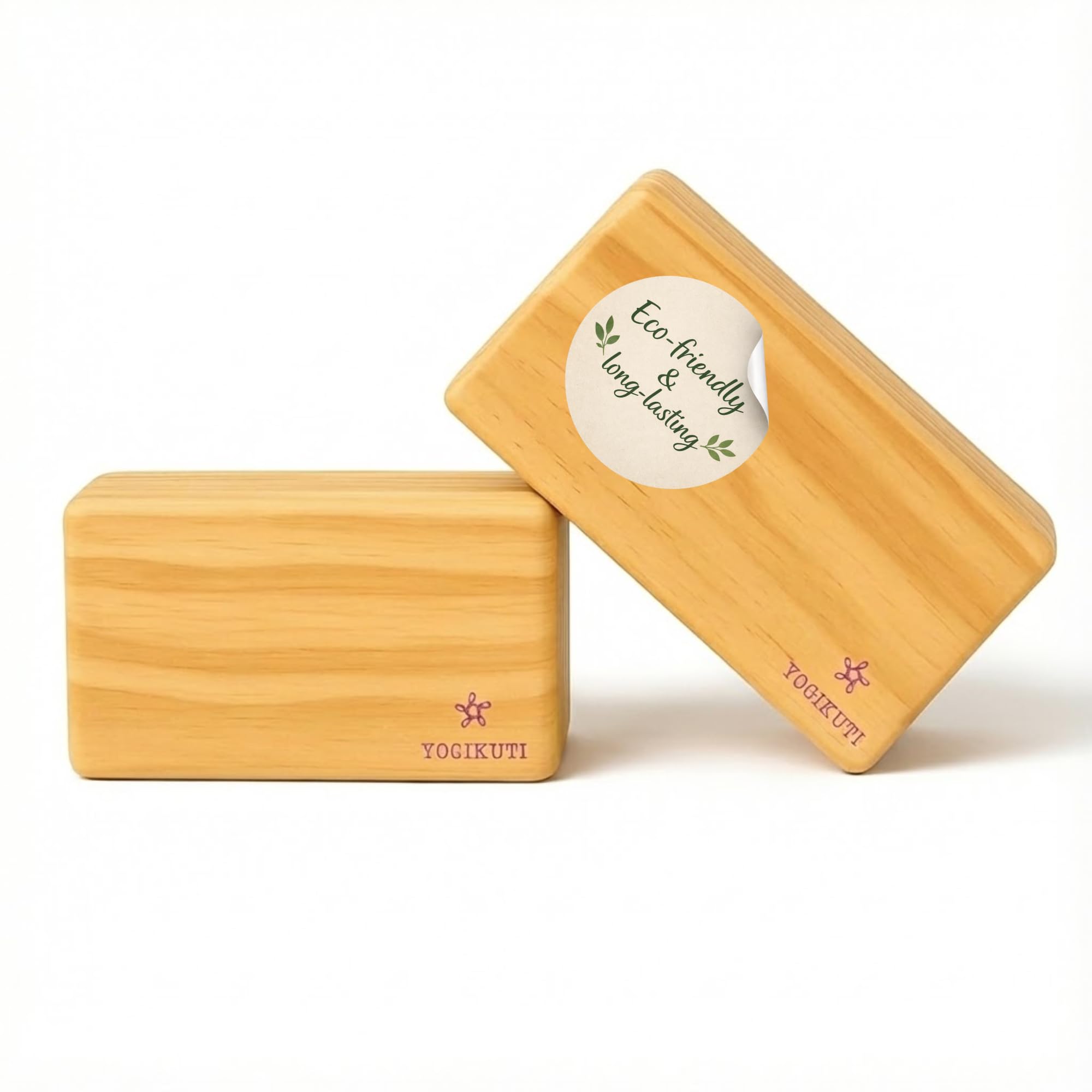
A firm pine brick for standing folds, where a rigid ledge brings the floor closer.
If your practice leans on alignment and standing stretches, the surface here is the story. It is solid pine wood, and that means a rigid prop that does not give when you press into it — the exact opposite of a soft, compressible exercise block. You set your hands on it in a forward fold and it holds its height, so your reach stays consistent breath after breath. The rectangular shape lets you change support height just by turning it onto another face, which is how you adapt placement between poses.
You get a pair in every order, which is the convenient part. Two blocks means you can support both hands or both sides of a setup without buying a second one. The maker lists a weight of 1 kg and cuts smooth rounded corners into each block so the edges stay comfortable to handle as you shift between poses. Keep a dry cloth nearby for cleaning and it stays looking sharp.
Check the size before you commit: these run smaller than a standard block. These run smaller than a standard block, and that compact build is the honest limitation — fine for a hand ledge, less forgiving if you want a big flat surface under your hips or spine. If broad support is your priority, the bamboo block above gives you a far wider face at 6″ by 10″. If you want a pair of solid pine blocks for standing work and alignment cues, this pair does that cleanly.
Firm and consistent: the solid pine surface stays rigid under your palms, so your reach in standing folds does not shift as you hold. The rounded corners keep handling comfortable between poses.
The size to weigh: smaller than a standard block, so it suits a hand ledge more than a broad under-hip support.
Reach for this pair: when your sessions center on standing folds, alignment and stretches where two firm pine blocks under your hands do the most good.
Better elsewhere if: you need a wide, flat surface for restorative support — the bamboo block is the broader tool.
Know the Specs
Material: Wood, Bamboo and Pine
A wood block gives you a firm, unyielding surface, which is what you want when you are pressing into it for balance or reach. Beechwood, bamboo and pine all deliver that rigid feel; the species changes the look, the density in your hand, and the weight. Softer foam blocks compress under load, so your height shifts as you press — the reason many practitioners trade up to wood. Match the material to how you practice: small and light for travel, broad and heavy for supported work.
Weight and Count
Weight tells you whether a block stays planted or travels easily. Heavier blocks feel grounded on the mat in long holds, while lighter ones slip into a bag for class. Check the count too: some packs ship two blocks, some ship one. Two blocks let you support both hands at once without a second order, which matters for standing work and for setups that use a block under each side.
Dimensions and Faces
A rectangular block gives you more than one height. Set it on the flat face and it sits low; turn it onto an edge and it lifts you higher. Measure the thickness of your own block before buying, since a taller block will not fit where a shorter one does. Footprint matters just as much — a compact block is a hand ledge, while a broad one gives you a wide surface under the hips. Pick the footprint that matches the poses you actually do.
Grip and Edges
Bare wood can slide on a smooth studio floor, so a non-slip base pad — like the silicone pads on a handstand block — keeps it still while you lean into it. Rounded, buffed edges keep the corners from digging into your palm during long holds. Both details are small, but they decide whether a block feels secure or fussy in use.
Common Questions
Are wooden yoga blocks better than foam blocks?
How do I choose the right height for a wood yoga block?
Will a wood block slide on a smooth studio floor?
Can I use wood yoga blocks for handstands and calisthenics?
How should I clean and care for a wood yoga block?
Is bamboo as strong as solid wood for a yoga block?
Do wooden blocks come as a single block or a pair?
Are wood yoga blocks too heavy to carry to class?
Can beginners use solid wood blocks instead of foam?
What size wood yoga block fits most practices?
The Bottom Line
For most people, the strongest pick is the WOODPOWER BalanceBlocks, because it pairs organic beechwood with silicone base pads and ships as a pair — a light, grippy setup for handstands and arm balances that travels without a bag. If your practice runs on supported, restorative shapes, the Hugger Mugger Bamboo Yoga Block gives you a wide, weighty brick that stays planted through a long bridge hold. And for standing folds and alignment cues where you want two firm pine blocks under your hands, the Yogikuti Solid Wooden Yoga Block is the one to reach for. Pick the one whose footprint matches the poses you actually do.
How we choose
We do not accept paid placement. Every pick is matched to a real buyer and a real use-case; we do not hands-on test units.
Sources
Specifications: manufacturer listings and product documentation. Review insights: verified customer reviews, as of November 2026. Pricing: not shown on this page (it changes often); check the current price via the retailer link.
As an Amazon Associate, Tactical Gear Guy earns from qualifying purchases. This does not affect which products we feature.