Specs are compiled from manufacturer listings and verified buyer reviews and can change over time — please confirm the key details on the product page before buying.
If your rip cuts wander a hair off the line, the saw is rarely the problem — the fence is. A table saw earns its space when the fence locks down square and stays square cut after cut. Below you’ll find the saws that hold that line, sorted by who they actually suit: the rolling jobsite workhorses, the mid-size hybrids, and the cast-iron cabinet machines that never move again.
This guide is built by comparing the manufacturers’ published specifications and the patterns across verified customer reviews, so you get each pick’s real strengths and trade-offs instead of marketing spin.
Sorting through a crowded shelf of saws depends on matching motor, rip capacity, and stand to the material you actually cut. These picks cover the serious contenders for a wood working table saw.
Top Picks


How To Choose The Best Wood Working Table Saw
Two saws can look identical on the shelf and cut nothing alike once a board goes through them. The difference usually depends on three things: how far the fence rips (the distance from blade to fence), how deep the blade cuts, and whether the stand lets you move the machine without throwing your back out.
Start with rip capacity, not horsepower
Rip capacity is the widest board you can cut with the fence set to the far right of the blade. A 26-inch capacity handles most shelving and trim. A 32-inch capacity opens up full sheet goods and wider panels. For cabinet work, a 36-inch fence and up gives you room to break down plywood without reaching for a circular saw first. More capacity usually means longer rails, so measure your shop wall before you commit.
Check the fence system before anything else
A rack and pinion fence moves on a geared rail rather than sliding free, so it holds its setting once you lock it. That mechanism is what keeps repeated rips the same width all afternoon. On a cheaper saw a fence can flex under load and drift a hair, and you only notice when joints start gapping.
Depth of cut sets your material ceiling
Depth of cut is how tall a board you can sever in one pass. A 3-1/8-inch depth at 90 degrees clears a standard 2×4 on edge. When you tilt the blade to 45 degrees, that number usually drops by roughly an inch, so check the bevel figure too. Dado capacity is the other number to find, since it tells you whether you can cut grooves and rabbits for shelves and joinery.
Side-by-Side Comparison
| Model | Best For | Rip Capacity | Weight | Depth of Cut (90°) | Amazon |
|---|---|---|---|---|---|
| DEWALT DWE7491RS★ Best Overall | Rolling jobsite rips | 32-1/2 in. | 110 lbs | 3-1/8 in. | Amazon |
| Evolution R10TSMost Versatile | Multi-material cutting | 26 in. | — | 3-3/8 in. | Amazon |
| Delta 36-6023Widest Rips for the Money | Wide-rip value | 32.5 in. | 77 lbs | — | Amazon |
| BOSCH GTS15-10 | Jobsite mobility | — | 103 lbs | — | Amazon |
| SKIL SPT99-11 | Worm drive power | 30-1/2 in. | 94.3 lbs | 3-5/8 in. | Amazon |
| DEWALT DWE7491X | Scissor stand portability | 32-1/2 in. | 87 lbs | — | Amazon |
| Laguna F2 Fusion | Hybrid cabinet accuracy | 36 in. | 359 lbs | 3-1/8 in. | Amazon |
| Powermatic PM1000 | Shop-anchored cabinet work | 52 in. | 393.8 lbs | 3-1/8 in. | Amazon |
Detailed Reviews
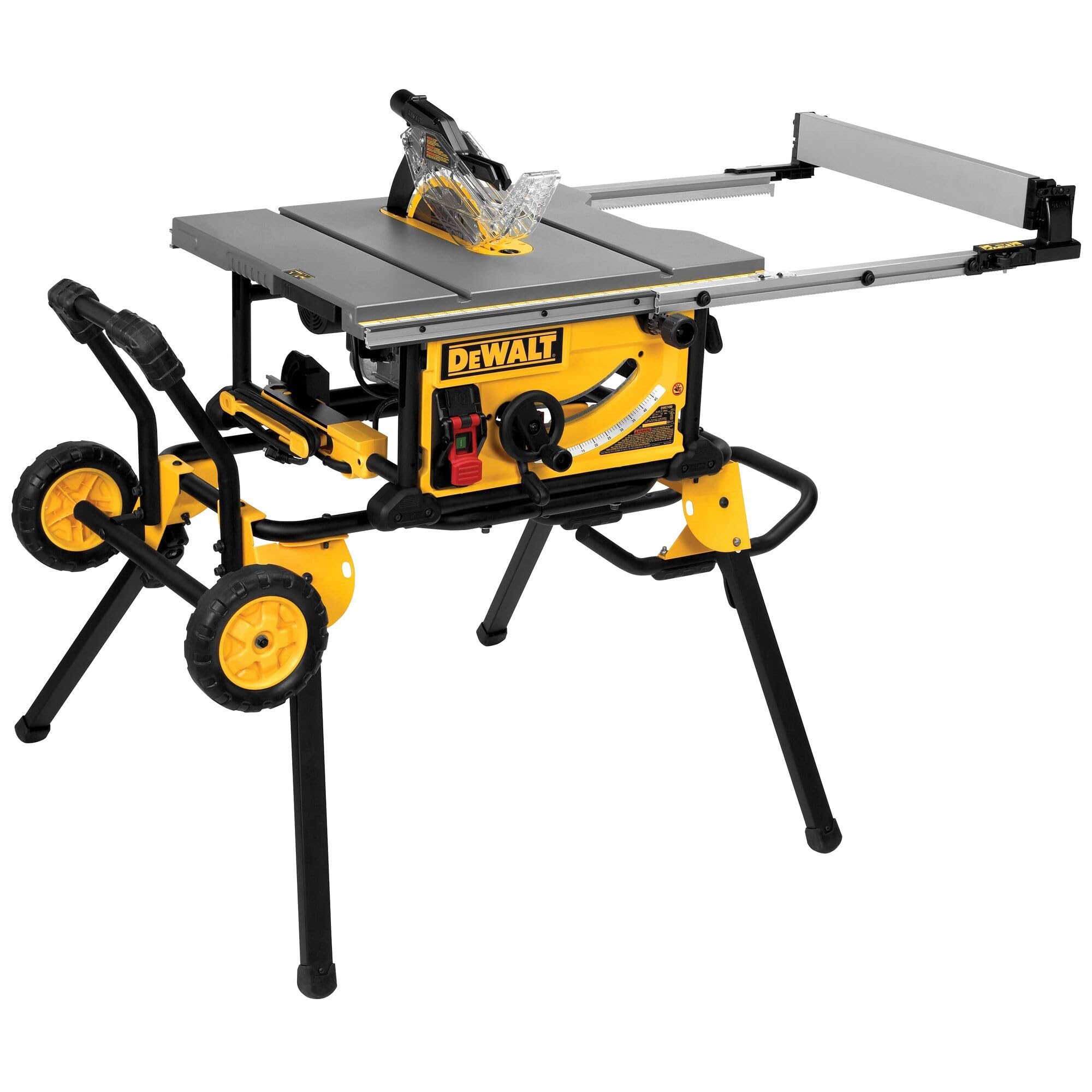
1. DEWALT DWE7491RS Table Saw
Our pick — 4.5+★ from 5,500+ verified ratings; the strongest balance of quality and price.
The rolling jobsite saw that turns a driveway into a cabinet shop.
Here’s the number that sells this saw: 32-1/2 inches of rip capacity on a machine you can wheel out of a garage and flip over in seconds. That wide a fence means you can break down full sheets of plywood and crosscut long shelving without dragging in a helper. The telescoping fence rails retract into a compact package when the day is done, and the flip-over ripping fence handles narrow rip cuts so you’re not fighting the blade with your fingers.
You get plenty of power for hardwoods from the 15 amp motor, with headroom to spare. The rack and pinion fence system (a geared rail that moves the fence) is the real star — it glides and locks down square, then stays there for the next forty cuts. A 3-1/8-inch depth of cut at 90 degrees and 2-1/4 inches at 45 degrees clears most stock you’ll feed it. There’s a 2-1/2-inch dust port that drops straight onto a shop vac, plus onboard storage for the blade guard, miter gauge, push stick, and both wrenches so nothing walks off between jobs.
The catch is weight. At 110 pounds this is a heavy machine, and while the folding stand rolls it easily on flat ground, stairs and gravel are a different story. Compare it to the Delta 36-6023 below at 77 pounds and you’re giving up shoulder-friendliness for that wider fence and a stouter build. Performance is what wins people over — it draws more praise than anything else in its class — and 5,000+ owners rate it 4.5+ stars.
What earns the top spot
- 32-1/2-inch rip capacity handles sheet goods and long trim in one pass
- Rack and pinion fence locks square and repeats cut after cut
- 3-1/8-inch depth at 90 degrees clears a 2×4 on edge
- Rolling stand folds down for a genuinely portable package
- Onboard storage keeps the guard, fence, and wrenches together
Where it asks more of you
- 110 pounds makes stairs and rough ground a two-person job
- Fence adjustability draws mixed reactions — expect a setup session to dial it in
Worth it for: anyone who needs a wide-rip saw that travels between a garage, a job site, and a friend’s deck.
Think twice if: the machine lives in one spot and you’d rather trade that rolling stand for a lighter frame.
2. Evolution R10TS 10″ Jobsite Table Saw
One saw that will chew through aluminum and hardwood on the same afternoon.
Most table saws are wood-only machines, and that’s fine until you need to cut a length of aluminum channel or trim a piece of composite decking. This one runs a high-torque 15 amp motor with soft start and ships with a premium 10-inch TCT blade meant to handle wood, mild steel, aluminum, and composites. A 3-3/8-inch maximum cut depth gives it a touch more reach than several saws here, and the 26-inch rip capacity covers most everyday ripping.
The zero-clearance throat plate is the detail that separates it from the pack — it sits tight around the blade so tear-out on the underside of your cut is reduced and edges come out cleaner. There’s a rack and pinion fence for repeatable settings, a geared 0–45 degree bevel for accuracy, and a dado plate included in the box so you can cut grooves and joinery without buying extras. Safety gear is thorough: an electronic blade brake, anti-kickback pawls, a quick-release riving knife, and a large paddle switch for fast shutoff.
Where it stumbles is fit and finish in spots. The assembly instructions for the stand draw criticism, and the safety guard feels less sturdy than the rest of the machine. Sizing that honestly: the saw itself is solid and the setup gripes center on the stand, not the cutting. The frame is lightweight steel with carry handles and onboard storage, and it’s backed by a 3-year warranty. If you routinely cut metal alongside wood, nothing else here does both.
Versatility payoff: The multi-material motor and included dado plate mean one machine covers framing, trim, and light metal work — a real space-saver in a small shop.
Honest limit: Plan to spend extra time on the stand assembly, and expect the guard to feel flimsier than the saw it sits on.
Reach for this if: your projects mix wood with aluminum or composite and you want clean edges without a second saw.
Look elsewhere if: you only ever cut hardwood and want the stoutest guard bolted to your table.
3. Delta 36-6023 10 Inch Table Saw with 32.5 Inch Rip Capacity
A contractor-grade ripper that folds up and stores against the wall.
At 77 pounds this is the lightest saw in the whole lineup — and it still carries 32.5 inches of rip capacity, matching the DEWALT up top and beating the Evolution’s 26 inches by a wide margin. A 15 amp contractor-grade motor handles treated lumber and hardwoods without bogging, and the rack and pinion fence rails make adjustments fast and accurate. There’s 13/16-inch by 8-inch stacked dado capacity for cutting grooves, which many saws at this size skip entirely.
Build quality is what buyers keep coming back to — quality control is the single most praised aspect of this machine, and the fence arrives square from the start. It folds up easily for storage, which matters if your shop is a corner of a garage. The 5-year professional-grade warranty is the longest coverage of any saw here.
Honest trade-off: assembly takes work for some owners, and the durability and performance marks come back mixed rather than glowing. That’s a fair caveat, not a red flag — this is a value-forward saw and it asks you to spend an afternoon getting it dialed in. Deepen the picture with the numbers: it stands 35 inches tall on a footprint of 27 by 19 inches, so it tucks into tight corners that a wider machine won’t.
Best measured value: 32.5 inches of rip and stacked dado capability at 77 pounds is the tightest power-to-portability equation in this group.
Suits you when: wide rips and a compact footprint matter more than the last word in precision.
Second thought needed if: you want a saw that arrives ready to cut with zero fiddling.
4. BOSCH GTS15-10 Table Saw
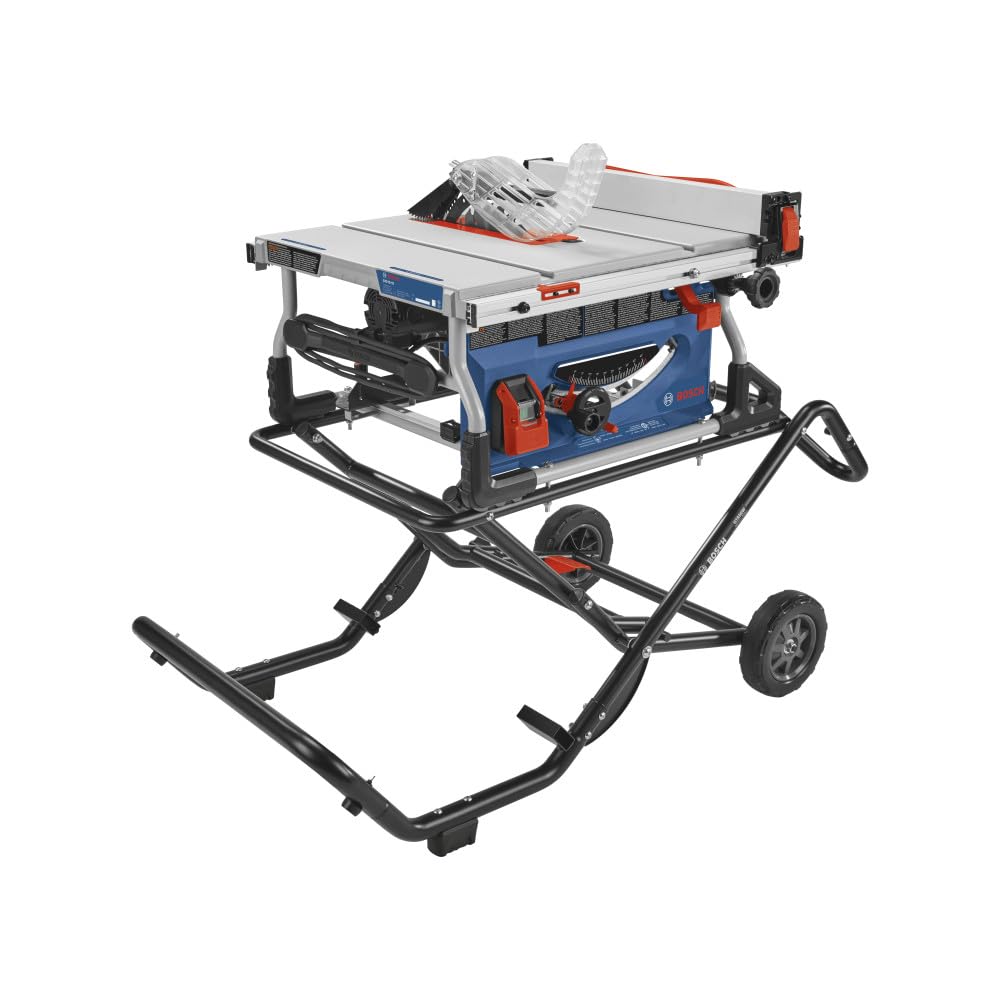
The saw that stops its blade in about three seconds and won’t trip your breaker.
Two features make this BOSCH stand out from the mob. The first is soft-start circuitry — the motor ramps up instead of slamming on, which reduces the chance of tripping a circuit breaker. The second is the convenience brake, which brings the blade to a stop in approximately three seconds so you’re not standing there waiting between cuts. The 15 amp motor runs at 3,800 rpm for ripping and crosscutting fine and hard woods.
Where the DEWALT spins at 4,800 rpm, this one turns at 3,800 rpm and leans on electronically regulated speed to hold its pace under load. That’s the difference between raw speed and steady speed, and for hardwood it’s a trade many prefer. The rack and pinion rip fence uses color-coded index pins matched to a color-coded scale, so you dial in a setting by hand and see it align. The Smart Guard System pairs a riving knife with anti-kickback pawls, and a clear guard gives you an unobstructed view of the cut.
The open frame roll bar design and lightweight build are meant for job sites, and it pairs with the included GTA50W Gravity-Rise Wheeled Stand for single-action setup and takedown. ClampZone areas let the tabletop double as a light-duty secondary work surface, and onboard storage holds the fence, miter gauge, guard, hex wrench, blade wrench, and push stick. Build quality and adjustability come back mixed, so budget a session to true the fence. At 103 pounds it’s lighter than the DEWALT and heavier than the Delta, sitting neatly between.
Where this saw shines
- Soft-start circuitry eases motor start-up and lowers breaker-trip risk
- Blade brake halts the blade in roughly three seconds
- Color-coded rack and pinion fence makes hand adjustments quick
- Gravity-Rise stand sets up and folds in a single action
- ClampZone turns the tabletop into a secondary work surface
What to plan around
- Build quality and adjustability get mixed feedback — expect to true the fence
- 3,800 rpm is slower than the 4,800 rpm DEWALT in the same category
Point it at: a home shop on a shared circuit where a soft start and a fast blade brake are worth paying for.
Steer away if: you need raw blade speed for production ripping.
5. SKIL SPT99-11 Table Saw

Worm drive torque that eats red oak without a wheeze.
No other saw here cuts as deep in a single pass. Worm drive gearing delivers a 3-5/8-inch depth of cut, which is the tallest blade reach of the group and enough to sever thick stock without flipping it and cutting twice. The 30-1/2-inch rip capacity handles large panels, and the precision rack and pinion fence adjusts quickly and smoothly for accurate results.
Power is what this machine is built around, and performance draws the most consistent praise of any trait here, followed closely by raw power. It’s the saw you reach for when the board is thick and gnarly. Dust control is thought through too: a dust port elbow corrals debris into one area for easy cleanup. Outfeed and left support let one person manage larger cuts solo, which is a bigger deal than it sounds when nobody’s around to catch the offcut.
Mobility leans on a rugged rolling stand with 16-inch wheels and easy-load handles. That’s a big wheel, and it’s what makes the 94.3-pound frame manageable over uneven ground. Adjustability and blade durability come back mixed, so plan on fine-tuning the settings after assembly. Setup itself takes about 20 minutes by most accounts, which is quick for a saw with this much going on. The dimensions run 39.76 by 30.2 by 20.08 inches, a footprint worth measuring against your bench.
The deep-cut advantage: 3-5/8 inches of blade reach is more than any competitor in this lineup — if your work means thick stock, that number decides it.
Set expectations: adjustability and blade durability are the softer spots, so budget break-in time and a spare blade.
Pick it when: thick hardwood is your daily bread and you want worm-gear torque to carry the load.
Pass it over if: you want the lightest possible rig to carry up stairs.
6. DEWALT Table Saw, 10 Inch, 15 Amp, Scissor Stand (DWE7491X)

The same trusted ripping core, dressed down into a lighter frame.
If the DEWALT up top is the rolling workhorse, this is the trimmer sibling. It keeps the rack and pinion telescoping fence system that makes adjustments fast, smooth, and accurate, plus the 32-1/2-inch rip capacity for larger shelving and trim stock. The two-position flip-over rip fence handles narrow rip cuts and adds material support so long boards don’t sag off the edge. A 2-1/2-inch dust collection port takes a vacuum connection without adapters.
What changes is the stand. Instead of the foldable rolling base, this one comes on a scissor stand, and that’s a different kind of setup rhythm — you raise and lower it rather than wheel it around. The frame drops to 87 pounds, making it the lighter of the two DEWALTs and the easier one to muscle into a truck bed alone. A 15 amp motor turns the same 10-inch blade. The Site-Pro modular guarding system lets you swap guarding components without tools for each application, and an onboard storage arrangement keeps the blade, wrenches, and miter gauge squared away.
Build quality is what this saw trades on — reviewers consistently call it a pleasure to work with. Blade, dado insert, and dust collector sell separately on some listings, so check what’s in the box before you plan a joinery project. If you want the rolling convenience of position one, the DWE7491RS earns it; if you’d rather save a few dozen pounds and the scissor lift suits your workflow, this is the call.
Where the money goes: A proven rack and pinion fence and 32-1/2-inch rip at 87 pounds — the lighter package here rewards anyone who lifts the saw alone.
Go this way if: you want the familiar DEWALT fence precision in a frame easier to hoist.
Hold off if: you truly need to wheel the saw around — the scissor stand lifts rather than rolls.
7. Laguna 10″ Table Saw, 36″ Rip, 1.75 HP, 110V (F2 Fusion)
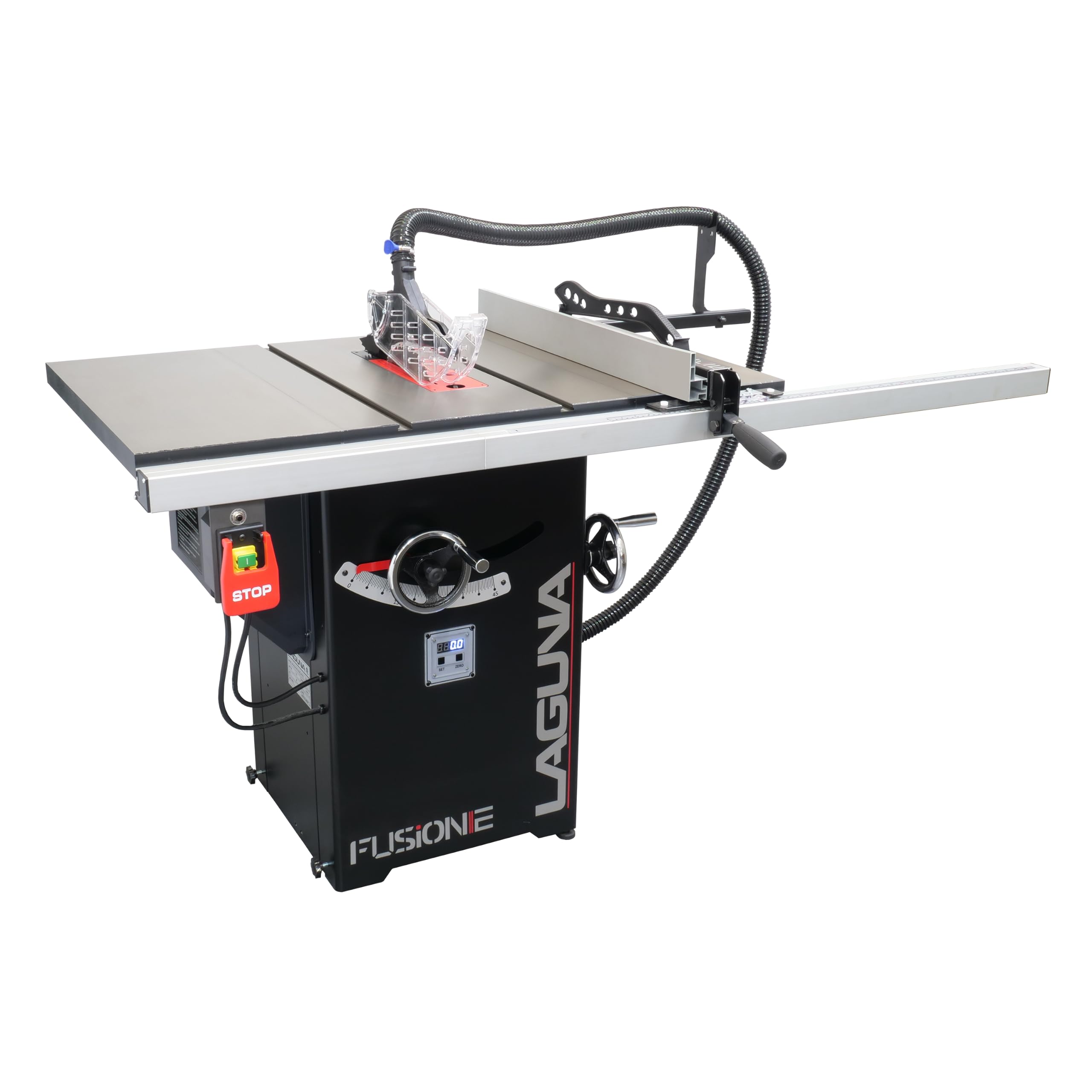
A cast-iron table you set once and stop thinking about.
This saw marks the jump from portability to permanence. A cast iron table and both cast iron wings create a stable, flat surface, and the body-mounted trunnion plus premium arbor and motor bearings hold everything ridged. That rigidity is what keeps cuts consistent board after board.
A 1.75-HP TEFC motor runs on standard 110V household power and stays cool under load, and it cuts to 3-1/8 inches deep at 90 degrees and 2-1/8 inches at 45 degrees. Dust collection is sealed off well: the cabinet bottom is enclosed, there’s a 4-inch dust port, and pickup sits both over and under the blade to capture sawdust rather than scatter it. The 10-inch carbide-tipped blade is included, along with a riving knife, blade guard, splitter, miter gauge, push stick, and integrated mobility.
Build quality is the headline here — the trait review pages lead with — and the setup dials in easily. Just know what a cabinet machine means in practice: this saw weighs 359 pounds, so it wants a spot in your shop and staying there. It’s not a saw you carry, and the two-year manufacturer warranty is the shorter end of the range. If you’ve outgrown jobsite saws and want a stationary machine without rewiring for 230V, this is the natural step up.
Build to lean on: Cast iron table and wings, a 36-inch rip fence on steel rails, and over-and-under dust pickup — a serious stationary saw that still plugs into 110V.
Weigh the settling: 359 pounds means it stays where you put it, and the two-year warranty is shorter than the competitors’ coverage.
For the shop that’s done moving: home and small pro shops wanting cabinet-grade precision on standard household power.
Not for the road: if the saw needs to travel, look at a rolling jobsite machine instead.
8. Powermatic PM1000 10″ Cabinet Table Saw, 52″ Accu-Fence
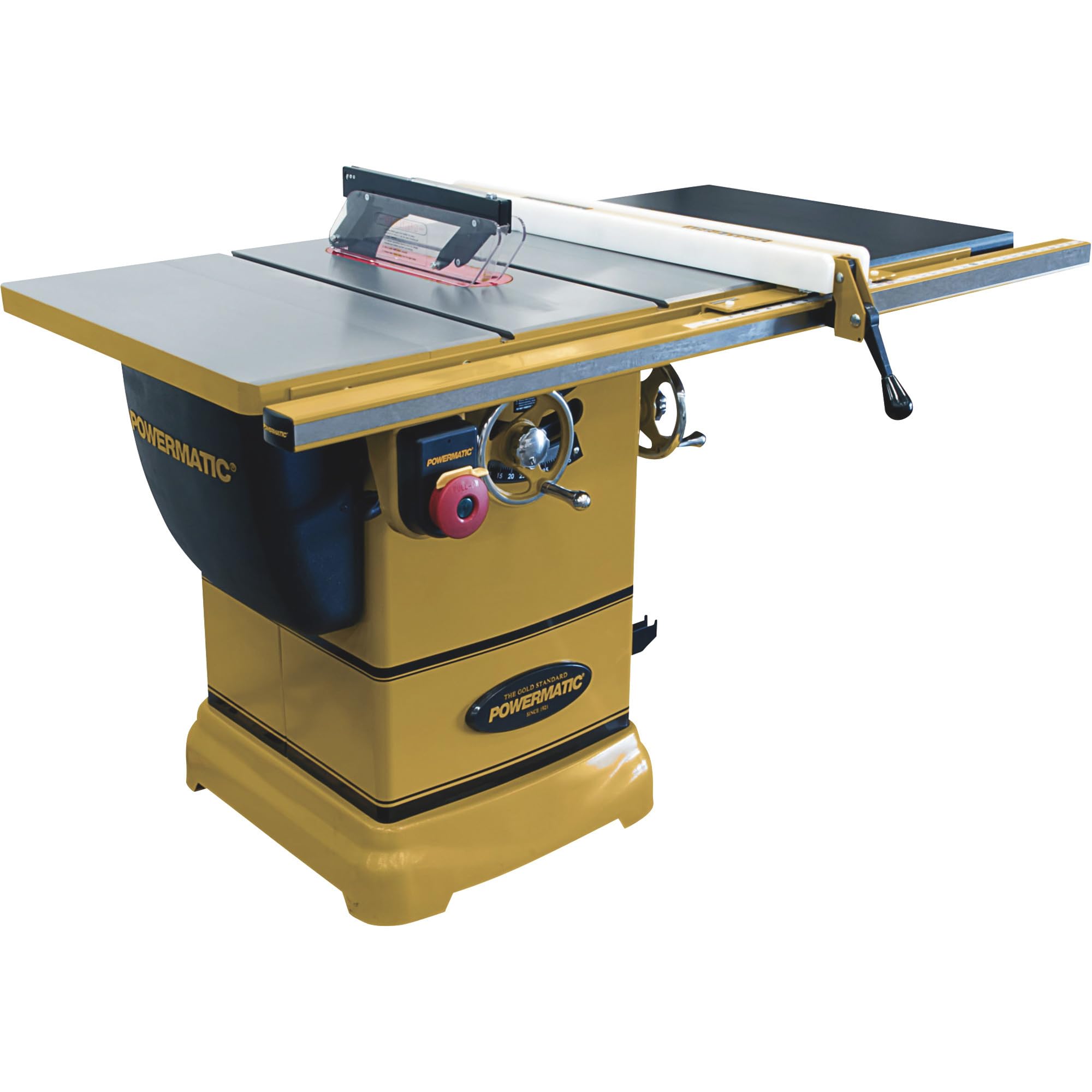
Fifty-two inches of rip and a cast iron top that does not flinch.
You can rip a full sheet of plywood in half and still have room for the fence to run its full travel, thanks to 52 inches of rip capacity to the right of the blade plus 12 inches to the left. The Accu-Fence rides a steel guide tube on a 2×2-inch front rail with a three-position lock lever — up to lift off, middle to slide, down to lock — and a cursor reads the scale right on the tube. Clamping pressure is adjustable, so the fence stays square as the machine ages.
The top is ground cast iron, both wings included, forming a 40×27-inch surface with a beveled front edge and two 3/4-inch miter slots. A cast iron trunnion sits inside an enclosed steel cabinet, and the 1-3/4 HP TEFC motor drives the arbor through a poly-V belt. It comes prewired for 115V, ready for a dedicated 20-amp circuit, and can be rewired for 230V later. Cut depth runs 3-1/8 inches at 90 degrees and 2-1/8 inches at 45 degrees, matching the Laguna. Where the Laguna stops at 36 inches of rip, this Powermatic pushes to 52.
Safety and setup are complete: a riving knife plus a low-profile riving knife for non-through cuts, a tool-free blade guard with independent clear side leaves, and anti-kickback pawls. The magnetic push-button switch has a removable safety key, and there’s an arbor lock for one-wrench blade changes. What you’ll live with: 393.8 pounds, an assembled footprint of 43 inches wide by 83 inches long by 44 inches tall, and a 350 CFM dust collector requirement. Plan the shop layout before it arrives — and note the blade and dado insert sell separately.
The case for going big
- 52-inch rip right of the blade plus 12 inches left — full-sheet work without cutting twice
- Accu-Fence with adjustable clamping pressure keeps square over time
- Cast iron top, wings, and enclosed trunnion for stability
- Pre-wired for 115V on a dedicated 20-amp circuit, rewirable to 230V
- 5-year warranty, two years for commercial use
The honest cost
- 393.8 pounds and an 83-inch length demand a permanent, planned footprint
- Blade, dado insert, and dust collector sell separately
For the permanent shop: a dedicated cabinet saw you build a workflow around, not a machine you move.
Skip the commitment if: your shop shares a wall with the car and needs to pack away.
Know the Specs
Rip Capacity
Rip capacity is the widest board the fence can cut to the right of the blade. It sets how large a sheet you can break down without grabbing a circular saw. A 26-inch capacity covers general trim; a 32-inch capacity opens up full sheet goods; anything past 36 inches lets you rip full plywood panels in one pass. Bigger capacity means longer rails and a wider footprint, so match it to your shop wall, not just your ambition.
Rack and Pinion Fence
A rack and pinion fence rides a geared rail instead of sliding free, so the setting locks down square and repeats. That mechanism is why a saw with a tuned fence holds the same cut width all afternoon. A simpler fence can flex under load and drift a hair, and you only find out when a joint gaps. Look for adjustable clamping pressure if you want the fence to stay true as the saw ages.
Depth of Cut and Bevel
Depth of cut tells you how tall a board you can sever in one pass. A 3-1/8-inch depth at 90 degrees clears a standard 2×4 on edge; the SKIL reaches 3-5/8 inches. Tilt the blade to 45 degrees and the number usually drops by about an inch, which is why you check the bevel figure too. If you cut grooves for shelves, dado capacity is the other number to hunt for.
Motor Amp and Voltage
Amperage tells you how much grunt the motor has for hardwoods, and most saws here run a 15 amp motor. Voltage decides where you can plug in. A 1.75-HP motor on 110V can run from household power, while cabinet saws above that usually want 230V. Some machines, like the Powermatic, come prewired for 115V but can be rewired later — a useful bridge if you plan to upgrade your shop power.
Common Questions
Will a 10-inch table saw cut a 2×4 on edge in one pass?
What rip capacity do I need to cut plywood sheets?
Is a rack and pinion fence better than a plain sliding fence?
Can a jobsite table saw cut aluminum or composite materials?
How much space do I need for a cabinet table saw like the Powermatic?
Does a table saw need a dedicated circuit?
What does dado capacity mean on a table saw?
How do I move a heavy table saw around the shop?
Is a hybrid saw like the Laguna as accurate as a full cabinet saw?
The Bottom Line
For most shops, the wood working table saw that earns its place is the DEWALT DWE7491RS — 32-1/2 inches of rip, a rack and pinion fence that holds square, and a folding stand that lets it travel. If you want the deepest one-pass cut available, grab the SKIL SPT99-11 with its 3-5/8-inch worm drive reach. And for a permanent shop that needs the widest rips, the Powermatic PM1000 is the machine you build the room around.
One honest nudge before you click buy: decide whether the saw travels or stays. Save weight and add capacity by matching the machine to your space, and let the fence and the rip capacity make the choice for you.
How we choose
We do not accept paid placement. Every pick is matched to a real buyer and a real use-case; we do not hands-on test units.
Sources
Specifications: manufacturer listings and product documentation. Review insights: verified customer reviews, as of November 2026. Pricing: not shown on this page (it changes often); check the current price via the retailer link.
As an Amazon Associate, Tactical Gear Guy earns from qualifying purchases. This does not affect which products we feature.