Specs are compiled from manufacturer listings and verified buyer reviews and can change over time — please confirm the key details on the product page before buying.
Lean over a bench that’s too low and your back rounds, the saw drifts off your line, and your lower back aches by the end of the cut. A woodworking stool fixes that by putting your hips at the right height for the work — and the two best options here solve it in two very different ways. One is a light beech-wood artist stool you can swing from job to job, the other a pair of steel shop stools that never move unless you want them to.
This guide is built by comparing the manufacturers’ published specifications and the patterns across verified customer reviews, so you get each pick’s real strengths and trade-offs instead of marketing spin.
The quick answer: pick the beech stool if you sit at an easel or drafting table, and pick the steel pair if you want shop-floor seating that never needs assembling. Below are both, sorted so you can decide in one read — and that is the whole job of this wood working stool comparison.
Quick Picks
- Adjustable Drafting Stool — Best Overall
- OEF Furnishings OEF6218H/2 Preassembled — Commercial Grade
How To Choose The Best Wood Working Stool
Most people pick workshop seating on looks, then regret it after a few long sessions at the bench. The right stool puts your hips at the height your bench top demands, so you are not rounding your back to reach the work.
Start with the height range, not the seat
A stool is only useful if it lands you at a comfortable working height. The beech artist stool in this list adjusts from 19″ to 26″ by rotating the seat up and down, which suits a drafting table or a tall desk. The steel OEF pair is made for 19–27 inch seating, which covers a standard workbench. Measure from the floor to the top of your bench first, then check the stool’s range against that number.
Swivel or fixed changes how you work
A swiveling seat lets you turn from the vise to the saw without standing up, and it is the reason the beech stool earns its keep in a studio. A fixed seat is steadier when you are leaning into a plane or a chisel. Neither is wrong: swivel suits a workspace you move around, fixed suits a spot where you plant yourself.
Frame material and the daily load
Beech wood with a triangle base keeps a workshop stool light enough to carry from room to room. A welded alloy steel frame with a reinforced foot ring is the opposite bet: heavier to shift, but built to stay rigid through constant repositioning. Decide whether the stool stays put beside one bench or travels with you between stations.
Side-by-Side Comparison
Detailed Reviews
1. Adjustable Drafting Stool Beech Wood

A light beech swivel stool that follows you around the studio instead of the other way round.
For anyone who works at a drafting table, an easel, or a standing desk, this is the pick that makes the most sense. It rises from 19″ to 26″ by rotating the seat up and down, so you can drop your hips low for detail work and raise them for a long pass at a canvas. And it weighs 8.8 pounds, so carrying it from the bench to the kitchen island takes one hand.
You get it built without a headache, and that is what wins people over. The kit ships with a detailed manual, labeled parts, and all the tools you need, and buyers report assembly as the topic they mention most — far more than any other single subject in the feedback. It also handles real studio life: German beech wood with a protective finish that resists fading, a triangle base for stability, and rust-proofed screws (coated so they do not corrode).
The honest catch sits in the hardware. A few buyers have found the bolts barely fit into the triangle, and that frustration spills into how the stool functions for them. It does not affect every unit — most people get it together and get on with it — but if you are not comfortable nudging hardware into place, plan to take that step slowly. The 176 lbs capacity also caps who this suits, so check that number against the person using it.
Why it earns the top slot
- Swivel seat adjusts 19″ to 26″ with a simple rotation
- German beech wood with a protective, fade-resistant finish
- Light at 8.8 pounds — easy to carry between rooms
- Tool kit, labeled parts, and manual included for setup
Where it asks for patience
- Some units arrive with bolts that need a firm hand to seat
- Supports up to 176 lbs, so heavier users should look elsewhere
- 12.2 x 12.2 inches of footprint is compact — steady, but not wide
Made for the studio: the best fit for a painter, drafter, or maker who moves between stations and wants height that changes in a second.
Check the spec first: if you are near or above the 176 lbs limit, this is not the stool to buy.
2. OEF6218H/2 Height-Adjustable Steel Round Stool
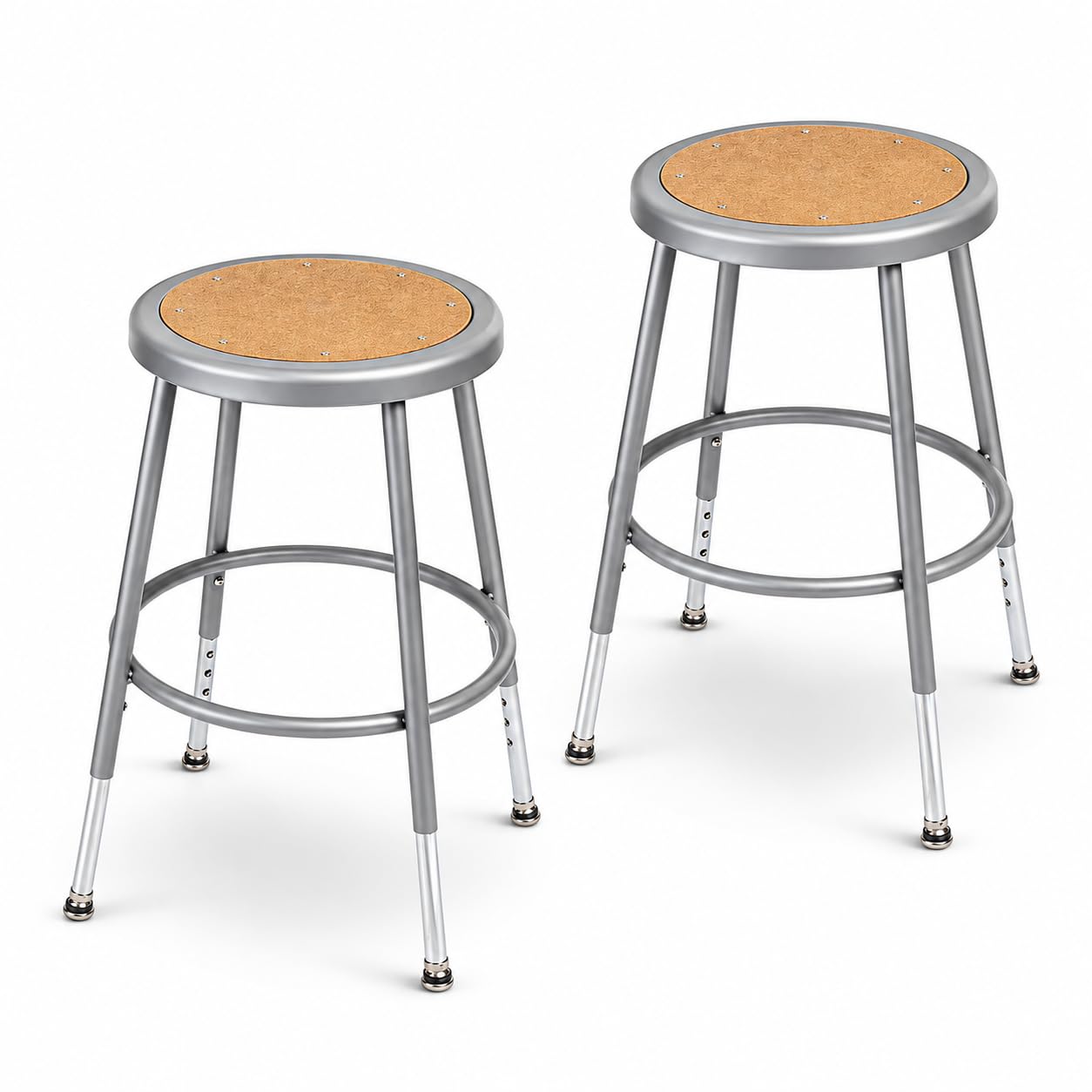
Two steel shop stools that show up assembled and refuse to budge on the workshop floor.
If your stool lives beside a workbench and never travels, this is the one to reach for. It lands in the 19–27 inch seating range, which puts you alongside most standing workbenches and tall counters, and it comes as a two-pack so you can seat a helper or split the pair between bench and garage.
The build is where the money went. You get a heavy-duty alloy steel frame with a welded foot ring that keeps the base rigid, chrome insert legs, and a riveted Masonite wood seat built for daily wear. Self-leveling glides keep the stool balanced on an uneven shop floor. It is also UL Solutions tested to ANSI/BIFMA strength and safety standards and carries a 5-year limited warranty. What buyers consistently notice is the quality of the build — it is the single thing the feedback keeps coming back to.
Value is the one point that splits opinion: some buyers call these stools terrific for the money, others feel the price is high. Since it is a two-pack, the real question is whether you actually need a second stool. And at 18 x 18 x 26.5 inches and 10 pounds, it is heavier and bulkier to shift than the beech option up top — the assembly is already done, but moving it takes two hands.
The real selling point: “No Assembly Required” is not a footnote here — you pull them from the start and sit down, which is a different experience from the screw-and-tool setup the beech stool asks of you.
Who should hesitate: the fixed seat does not swivel, so if you like turning from the vise to the saw without standing, the artist stool fits that rhythm better.
Right fit if you plant and work: a dedicated shop, lab, or garage where the stool stays in one spot and needs to survive constant leaning.
Think again if you need portability: heavier and fixed in place, so it is not the stool to cart between rooms.
Know the Specs
Seat Height Range
This is the number that decides whether a stool fits your bench. The beech stool covers 19″ to 26″; the OEF pair is built for a 19–27 inch range. Measure floor to bench top and match the stool’s range to it — a stool outside your range forces you to reach or slouch.
Frame Material and Weight Capacity
Beech wood keeps a stool light enough to carry, while an alloy steel frame with a welded foot ring (a metal bar fused to the legs, not screwed on) keeps it rigid when you lean on it. The beech stools here support up to 176 lbs — check that figure against the person using it, and decide if you need one stool or a pair before buying.
Common Questions
How do I know which stool height fits my workbench?
Does the beech drafting stool swivel?
Is the OEF steel stool really preassembled?
Can I use an artist stool at a workbench instead of a drafting table?
How much weight can the beech stool hold?
Do the OEF stools mark up an uneven garage floor?
What is the Masonite seat on the OEF stool like?
Which stool is better for someone who moves around the shop?
Is the beech stool hard to put together?
Can the OEF stools be used at a kitchen island as well as a bench?
The Bottom Line
For most people hunting the wood working stool, the Adjustable Drafting Stool is the one to get: its swivel seat adjusts 19″ to 26″, it weighs 8.8 pounds, and it moves from studio to kitchen in a way most workshop seating cannot. If your stool stays beside a bench and you want a two-pack that arrives ready to sit on, the OEF Furnishings pair is the sturdier, warranty-backed choice with its welded steel frame and 5-year limited coverage.
How we choose
We do not accept paid placement. Every pick is matched to a real buyer and a real use-case; we do not hands-on test units.
Sources
Specifications: manufacturer listings and product documentation. Review insights: verified customer reviews, as of November 2026. Pricing: not shown on this page (it changes often); check the current price via the retailer link.
As an Amazon Associate, Tactical Gear Guy earns from qualifying purchases. This does not affect which products we feature.