Specs are compiled from manufacturer listings and verified buyer reviews and can change over time — please confirm the key details on the product page before buying.
Short answer: buy the Narex Bevel Edge Chisel Set with Wooden Handles first. It holds a 4.5+ star rating, and the most-praised point in the feedback is how sharp the blades arrive and how well they hold that edge. Every other set here depends on the same choice — how much flattening work you will do yourself, and if you want a set ready to cut or one that needs lapping on a stone first.
This guide is built by comparing the manufacturers’ published specifications and the patterns across verified customer reviews, so you get each pick’s real strengths and trade-offs instead of marketing spin.
Chisels are the plainest tool in the shop and the one most often bought badly, so this page sticks to steel hardness, bevel angles, and handle shapes you can actually feel. The short version of wood working hand tools is that edge geometry beats brand names every time.
Top Picks


How To Choose The Best Wood Working Hand Tools
Most first-time buyers treat a chisel set as decoration and pick it by handle colour and case. A chisel is a wedge of hardened steel you hit with a mallet, and three numbers decide whether it works: how hard the steel is, what angle the edge is ground at (the bevel), and whether the back of the blade is flat enough to sit true against your work.
Steel hardness and what Rc really tells you
Hardness is written as Rc or HRC — a Rockwell scale reading of how hard the steel is. A blade hardened to Rc 59 takes and holds a fine edge but is a little more forgiving of the odd knock. A blade tempered into the HRC 60–64 range holds an edge longer but chips more easily if you lever it sideways. Neither is wrong; they are different trades. Softer steel sharpens faster in the field, harder steel stays in the cut longer at the bench.
Bevel edge, flat back, and why the back matters
A bevel edge means the blade tapers to the cutting edge on one side only, so you can lay the flat back against a surface and pare flush. That flatness is the spec most buyers never check and the one that decides whether a chisel can clean up a hinge recess cleanly. Japanese chisels often use a hollow-ground back instead — the centre of the back is slightly dished so you only have to polish a thin rim on a whetstone. That saves sharpening time, but it also means less surface registering against the wood.
Handle material decides how you can hit it
Hornbeam and red oak take mallet blows and stay put in the hand; acetate and rubber handles are lighter and shrug off workshop abuse. What matters is the ferrule or strike cap — the metal ring or cap at the top of the handle. A chisel without one will eventually split when you hit it, and every set here with a strike cap is designed for hammer work rather than hand pressure alone.
Side-by-Side Comparison
| Model | Best For | Piece Count | Blade Steel | Handle Material | Amazon |
|---|---|---|---|---|---|
| Narex Bevel Edge Chisel Set★ Best Overall | First serious set | 4 | Cr-Mn alloy steel, Rc 59 | Wood (oval) | Amazon |
| ENERTWIST 13pcs Wood Chisel SetMost Complete Kit | Starter kit with sharpening gear | 13 | Drop-forged alloy steel | Plastic / rubber | Amazon |
| Jorgensen 4-Piece Wood Chisel SetHardened Edge | Mallet work on a budget | 4 | Chromium alloy steel, HRC 60–64 | Hardwood with ferrule | Amazon |
| IRWIN 4-Pack Chisel Set | Hammer abuse | 4 | Hardened alloy steel | Acetate | Amazon |
| KAKURI Japanese Wood Chisel Set | Detail and joinery | 3 | Laminated high carbon steel | Japanese red oak | Amazon |
| Narex Czech Steel Premium 4 pc | Bench work in hardwoods | 4 | Chrome-manganese steel, Rc 59 | European hornbeam | Amazon |
| Milwaukee Beveled Edge Chisels 4pc | Jobsite and cold weather | 4 | High carbon steel | Metal | Amazon |
| IRWIN Marples 5-Piece with Wallet | Whole-shop coverage | 5 | Chromium-vanadium steel | Acetate | Amazon |
| KAKURI Japanese Woodworking Hand Tool Set | Starting Japanese joinery | 7 | High carbon steel | Oak / cane | Amazon |
Detailed Reviews
1. Narex Bevel Edge Chisel Set Set of 4 pcs
Our pick — 4.5+★ from 950+ verified ratings; the strongest balance of quality and price.
Four Czech chisels with an oval handle you grip without fighting it.
The defining number here is Rc 59 — the hardness the blades are taken to after hardening from highly alloyed Cr-Mn steel (chrome-manganese, a tough steel blend that resists wear). That is a deliberate choice over maximum hardness. You get an edge that sharpens up quickly on a stone and holds through a session of paring, without the brittleness that bites you when a harder blade meets a hidden knot. The whole set is built to DIN 5139, a German standard for wood chisels, and it is made in the Czech Republic.
Sharpness is the most-discussed point in the feedback, with well over a hundred and fifty mentions, and buyers keep saying the edge holds up next to far pricier brands. Cutting performance lands second. The oval handle matters too: a round handle rotates in your palm under pressure, while an oval one sits at a consistent angle, so your grip stays steady through a long paring cut.
The four widths — 6 mm (1/4″), 12 mm (1/2″), 20 mm (13/16″) and 26 mm (1 1/32″) — cover paring, hinge sinking, and light chopping, but skip the narrow 3 mm paring chisel. As packaged, the set measures 6.37 inches long by 13.5 inches wide, so it stores flat in a drawer. The honest catch is flatness: the backs get the most mixed feedback of any aspect, and some arrive needing lapping before they will lie dead flat. Budget an evening with wet paper on glass and this set rewards you.
What Earns The Top Slot
- Rc 59 Cr-Mn steel sharpens fast and holds through a session
- Oval handle keeps a consistent angle in the palm
- DIN 5139 build standard, made in the Czech Republic
- Four sizes from 6 mm to 26 mm cover most bench work
Where It Asks More Of You
- Backs are the most-MIXED aspect — expect to flatten some
- No narrow 3 mm paring chisel in the set
Reach for this if: you want one set that is ready to cut joinery and will still be on the bench in a decade.
Think twice if: you want zero setup — the backs will want lapping before flush paring.
2. ENERTWIST 13pcs Wood Chisel Set
Thirteen pieces in one hard case, including the sharpening gear most sets leave out.
Count is the whole argument: 13 items versus the 3 in the KAKURI long-handle set further down. Inside the case sit eight drop-forged chisels running 1/4″, 3/8″, 1/2″, 5/8″, 3/4″, 1″, 1-1/4″ and 1-1/2″, plus a sharpening stone, a honing guide, two carpenter pencils and a sharpener. That is a full bench setup for someone starting from nothing, because the honing guide lets you sharpen at a repeatable 25 or 30 degree angle instead of guessing by eye.
Quality is the point buyers land on most, and the case gets its own share of credit for keeping the tools upright and organised. Each blade ships with a protection cap, which matters when eight sharp edges live in one box. The case measures 13.5 inches long by 11.6 inches wide, so it wants a shelf rather than a drawer.
The trade-off sits in the handles — plastic and rubber rather than wood — and in sharpness, which draws mixed feedback. Most blades cut cleanly straight from the box, but the cutting edges occasionally arrive with burrs that need dressing on the included stone. Compare it directly with the Jorgensen set below: the Enertwist gives you eight sizes and a sharpening system, while the Jorgensen gives you four sizes in harder HRC 60–64 steel. Buy this one for the breadth; buy that one for the metallurgy.
Kit math lesson: a honing guide is the piece beginners underestimate. It converts a freehand skill you do not have yet into an angle you can repeat every time, and the 25 and 30 degree settings here also work on plane irons.
Steel honesty: drop-forged alloy steel is tough and forgiving, but it will not hold an edge like the chromium alloy in the Jorgensen blades. Plan to touch up more often.
Good fit for: the first-timer who owns nothing yet and wants a case, eight sizes, and sharpening instruction in one box.
Not your set if: you already own stones and guides and want harder steel instead of more accessories.
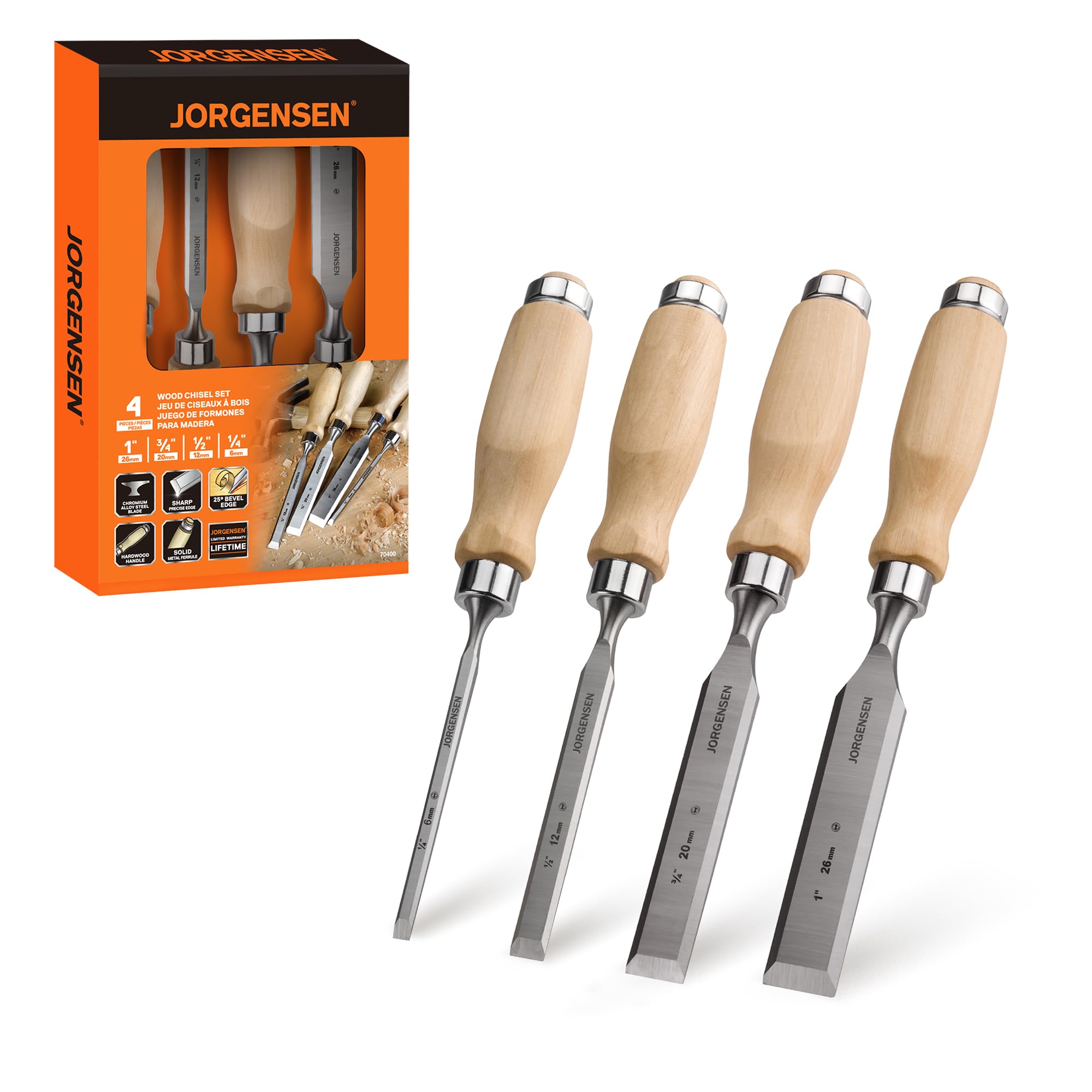
3. Jorgensen 4-Piece Wood Chisel Set, 1/4″, 1/2″, 3/4″, 1″
Chromium alloy steel tempered into the HRC 60–64 range, ground at a precise 25 degrees.
Those two figures are the reason to look at this set. HRC 60–64 is a harder band than the Rc 59 of the Narex picks, forged from chromium alloy steel and tempered to keep an edge through both hardwood and softwood. The blades arrive with a precision-ground 25-degree bevel, a balance point that leaves you enough edge strength for trimming while still paring cleanly. Fine paring and detail work are where that geometry earns its keep, because a shallower angle cuts more freely and a steeper one survives more abuse.
Quality is the aspect that gets praised most in the feedback, with value for money close behind and a small heap of notes about how easy the chisels are to bring back to sharp. The four widths — 1/4″, 1/2″, 3/4″ and 1″ — split sensible jobs: wide blades clear material fast and flatten broad faces, while the narrow ones get into corners and small workpieces. The hardwood handle has a metal ferrule at the strike end, which is what stops it splitting when you reach for a mallet instead of your palm.
The one thing to know before ordering is that it is a compact list: four sizes only, with roughly a dozen aspects of buyer commentary behind it, so this is a focused set rather than a reviewed-to-death one. There is no 3/8″ and no 1-1/4″ in the box, which may matter if you are cutting standard mortises. It is the strongest steel-per-piece of the four-size sets here, and for hobbyists and DIY work that trade is usually the right one.
Why the angle matters: a 25-degree bevel is where sharpness and strength meet for general bench work. It trims end grain and pares a hinge recess without folding, as long as you keep the edge out of nails.
Pick this one for: hardwood joinery on a modest bench, where hardest-wearing steel beats a bigger piece count.
Look elsewhere if: your work calls for 3/8″ or 1-1/4″ in the same set.
4. IRWIN Chisel Set, Woodworking, 4-Pack, Extra-Long Strike Cap

A strike cap you can hit from several angles without the handle paying for it.
The fully-forged steel core runs the whole length of the tool rather than stopping at the bolster, which is why the extra-large strike cap can take repeated hammer blows from multiple directions. That geometry is built for someone who drives a chisel with a mallet all day rather than tapping it by hand. The handle is acetate, chosen for split resistance — a plastic that flexes rather than fractures on a missed hit.
Buyers rate quality highest, with sharpness a firm second, and the practical note is that the blades come fairly sharp and sharpen up easily from there. The hardened steel blade is specced for edge retention, so the working edge does not go blunt halfway through a run of mortises. Against the Jorgensen pick the split is simple: the Jorgensen brings HRC 60–64 blades (a hardness scale reading) and a 25-degree bevel for finest paring, while this IRWIN set brings the oversized strike cap and forged core for heavy mallet duty.
Watch the sizing. The listed range reads 1/2 to 2 inches, yet the spec sheet records 0.75 inches for both the length and width dimensions — a listing quirk, so confirm the exact sizes before you commit to a specific joint. Buy it for the impact resistance; check the widths first if a 1-1/4″ mortise chisel is what you had in mind.
The Hammer-Tolerant Build
- Fully-forged steel core runs the full length
- Extra-large strike cap takes hits from multiple angles
- Acetate handle resists splitting on a missed blow
- Blades arrive fairly sharp and sharpen easily
Check Before You Buy
- Size listing is inconsistent — confirm widths for your joints
- Acetate handles feel less refined than wood in hand
Right tool for: mallet-driven chopping where the handle takes real punishment.
Wrong tool for: a buyer who wants a classic wood handle and a predictable size chart.
5. KAKURI Japanese Wood Chisel Set 3-Piece

Three chisels forged in Japan, with a 4-inch handle roomy enough for large hands.
The blade construction is the story: high carbon steel laminated to softer iron, with a hollow-ground back. Laminating means a hard cutting layer backed by a forgiving one — great sharpness and durability, and much quicker work on a whetstone because you only polish the rim rather than a whole face. Each side of the blade is chamfered, which lowers cutting resistance so you chisel with less force. The overall length is 9 inches; the three widths are 9 mm (3/8″), 15 mm (5/8″) and 24 mm (15/16″).
Quality draws the most praise, with sharpness right behind it. The Japanese red oak handle — denser and more durable than white oak, and used only on higher-grade chisels in Japan — is set with a KATSURA hoop (a metal ring driven onto the handle end) driven deep for quick setup. English instructions come in the box, which genuinely matters on a tool with Japanese sharpening conventions. The chamfered sides (flattened edges) also make this the pick for dovetails and fine detailing, where cleaner walls matter more than brute material removal.
Two honest limits. It is a 3-piece set, and the smallest chisel is the one that draws the recurring gripe — chipped corners on that blade. Handle it as delicate until you have your own technique dialled in. Performance and value both come back mixed, so this is a set you buy for the sharpening experience and the handle feel, not for a full size ladder.
The sharpening advantage: a hollow-ground back is a genuine time saver. Instead of flattening a full face you work a narrow band, so a dull edge comes back fast at the bench.
Best for: dovetails, fine detailing, and anyone with larger hands who wants a long handle to tap.
One caveat: the smallest blade in the trio will chip if you are rough with it early on.
6. Narex Czech Steel Premium 4 pc set with Hornbeam Handles

Fine-grained chrome-manganese steel at Rc 59, hung on super-hard hornbeam.
This is the same 6 mm, 12 mm, 20 mm and 26 mm ladder as the bevel-edge Narex at the top of this list, but with a different build intent. The blades are chrome-manganese steel, finely grained and tempered, then hardened to Rc 59 and ground at a 25-degree bevel. The handles come from European hornbeam — a wood chosen for hardness rather than looks. The whole set weighs 1.6 pounds and is built by a small tool manufacturer in the Czech Republic.
Quality is what owners talk about most, with sharpness a clear second, and the benchmark that comes out of the feedback is end grain: these blades will take fine shavings off hard maple. That is the real test of a chisel, because end grain punishes any weakness in the edge. Working performance and hand feel both read positive, and for bench work in dense hardwoods this is a set that keeps pace with tools from far bigger names.
The mixed side is durability, and the specific recurring point is the brass collar cracking. Treat the ferrules as the weak link rather than the blade. Flatness also draws some mixed notes, so check the backs when they land. Against the bevel-edge Narex above, the split is subtle: same size ladder, same Rc 59 hardness, different steel recipe and a hornbeam handle instead of the oval wood grip.
End-grain test: chrome-manganese steel at Rc 59 is a known recipe for clean paring. If hard maple shavings curl instead of crushing, the blade is doing its job.
Watch the ferrules: brass collars are the part that draws complaints, not the cutting edge.
Suits you if: the bench is your main workspace and you want blades that hold up on end grain.
Pass if: you want a bombproof handle and would rather tap with a mallet than pare by hand.
7. Milwaukee Beveled Edge Chisels Set 4pc
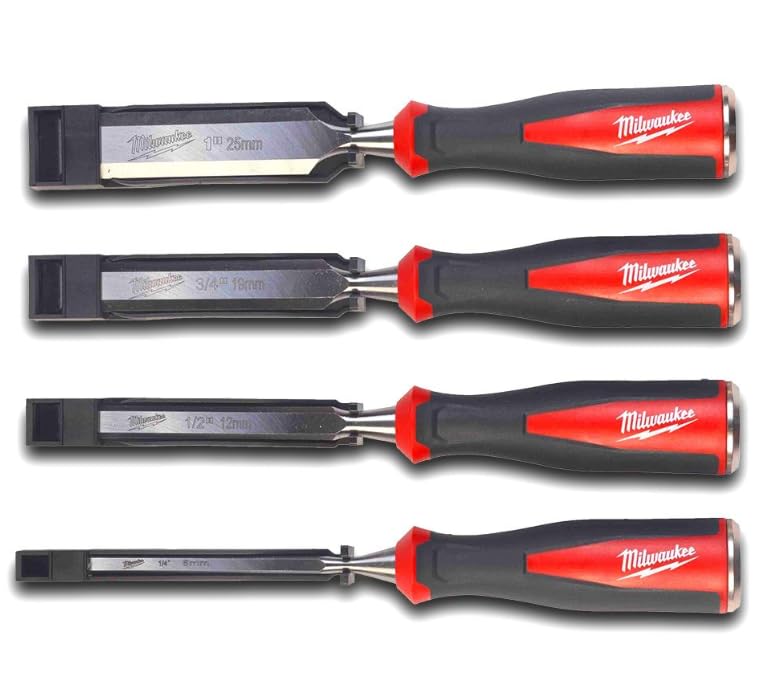
A four-piece bevel-edge set specced for cold, with a metal handle that shrugs off the workshop.
Cold-resistant is an unusual line on a chisel spec sheet, and it is the detail that separates this set from everything else here. Most of these picks are bench tools; this one is stamped for outdoor use in low temperatures, where plastic and acetate handles can turn brittle. The metal handle backs that up, and the four-piece set is described as medium-sized for versatility. Blade steel is high carbon with a bevel edge, and the whole set weighs 3 pounds — the heaviest single set on this page apart from the full KAKURI kit.
Feedback centres on quality. Value for money reads mixed rather than glowing, so the case for buying rests on the build and the cold-weather spec, not on getting a bargain. If your chisel work happens in a cold shop, a cold shed, or on a site where the temperature drops below comfort, the metal handle and cold rating are why you pay for this over a wooden-handled set.
The listing itself is thin — four pieces, medium size, no published width chart — so measure what you need before ordering. The metal handle also transfers cold to your hand faster than hornbeam or oak, and that is the fair trade for the durability. Compared with the IRWIN 4-pack above, this one is built for weather rather than for hammer blows.
Why It Made The List
- Specced cold-resistant for outdoor work
- Metal handle resists the brittleness cold brings
- High carbon bevel-edge blades in a 4-piece set
What To Weigh Up
- Metal handles feel cold in the hand on a winter day
- No published width chart — confirm sizes first
Choose it if: your chisels live in a cold workshop or travel to outdoor site work.
Skip the trade-off if: you want warm wood in the palm and a documented size ladder.
8. IRWIN Marples Chisel Set with Wallet, High-Impact, 5-Piece

Five chisels in a roll-up wallet, forged right through the core.
Five pieces is the widest single-brand spread here short of the ENERTWIST kit. The fully forged steel core works like the smaller IRWIN 4-pack above — the steel runs the length of the tool, so the extra-large strike cap can take repeated hammer hits from multiple angles. The blade is chromium-vanadium steel (an alloy built to hold an edge), hardened for edge retention, and the acetate handle is split-proof by design. The wallet rolls rather than boxes, so it lives in a tool bag instead of on a shelf; the package measures 15 inches long by 8.5 inches wide.
Workmanship is the theme in the feedback — quality draws the most support by a wide margin, with durability next and sharpness behind that. The long-service claim that comes through is the point of a forged chisel: buy it once, keep it honed, and it stays with you. Value reads positive here too, which is note since this sits in the higher tier of the list.
One spec to flag plainly: there is no manufacturer warranty listed on this set. That is not a reason to avoid it, but if backup matters to you, it is worth knowing before you buy. The wallet also does less protection than a hard case against a dropped toolbox — the ENERTWIST case wins on that count. What you get instead is forged strength across five sizes in a bag you can carry to a job.
Forged versus stamped: a fully forged core is one continuous piece of steel, so there is no joint to fail under a hammer. That is why this build is the one specced for repetitive strikes.
Worth grabbing if: you want five forged chisels in a carry wallet and never want to think about replacing them.
Bear in mind: no stated warranty, and a soft wallet offers less drop protection than a hard case.
9. KAKURI Japanese Woodworking Hand Tool Set

Not just chisels — a pull saw, plane, hammer, and marking gauge in one bag.
Seven items, all made in Japan, and the only full tool kit on this page. You get a 9.5″ Ryoba Japanese saw, a 3/8″ Japanese mortise chisel, a 1″ Japanese wood chisel, a 42 mm Japanese hand plane, a 13.2 oz Japanese hammer, a 90 mm marking gauge, and a canvas carry bag. The whole kit weighs 3.5 pounds and packs into 14.7 inches long by 7.4 inches wide by 4.1 inches high. The chisel blades run high carbon steel with a rectangular blade shape, and the handles are oak and cane.
This is the pick for someone who wants to try Japanese joinery as a system rather than collect chisels one width at a time. A pull saw cuts on the back stroke and leaves a finer kerf than a Western push saw, a marking gauge scores a line instead of pencil-marking one, and the genno-style hammer drives a chisel straight down. Buying those as one kit means the tools were chosen to work together rather than fitted to each other afterwards.
The catch is that this is a starter set, and the listing says so plainly — it is designed for beginners just starting out with Japanese tools. Nothing here is specced at the level of the laminated, hollow-ground chisels in the KAKURI 3-piece set above. If your only goal is chisels, four dedicated chisels from Narex will take you further. If your goal is to learn how Japanese woodworking actually functions as a method, this box gets you there in one order.
The Case For The Kit
- Seven matched tools, all made in Japan
- Pull saw, plane, hammer, and marking gauge included
- Canvas bag keeps the set together
- 3.5 pounds — genuinely portable
The Case Against
- Beginner-grade tools, not bench-grade chisels
- Only two chisel widths in the box
The one to buy if: you are starting down the Japanese joinery path and want a matched set rather than a single tool.
Buy chisels separately if: you already own a saw and plane and only need cutting edges.
Know the Specs
Rockwell Hardness (Rc and HRC)
This is a measure of how hard the steel is, written as Rc 59 or HRC 60–64. Think of it as how much a blade resists scratching and dulling. Higher numbers hold an edge longer; lower numbers sharpen faster and take knocks better. A chisel at Rc 59 is a practical middle — it will pare end grain and still survive a session of chopping. A blade tempered into the HRC 60–64 band leans toward edge retention, which helps on hardwoods but asks more care around knots.
Bevel Angle and Bevel Edge
The bevel is the angled face that tapers to the cutting edge. A bevel edge means only one side is ground, so the flat back can lay dead against a surface — that is how you pare a hinge recess flush. A 25-degree bevel is the common bench angle, where sharpness and edge strength balance. Shallower angles cut more freely and suit fine paring; steeper angles survive more abuse. A hollow-ground back, common on Japanese chisels, dished the middle of the blade so you polish a narrow band instead of a full face on a whetstone.
Common Questions
What does Rc 59 mean on a wood chisel?
Is a 25-degree bevel better than 30 degrees for chisels?
What is the difference between a bevel edge and a flat back chisel?
Do I need a strike cap to hit a chisel with a mallet?
How do I flatten the back of a new chisel?
Which sizes should a starter chisel set include?
Is Japanese steel better for woodworking chisels?
How do I stop a chisel handle from splitting?
Can I use a chisel on both hardwood and softwood?
Does a tool bag protect chisels as well as a hard case?
The Bottom Line
For most buyers, the wood working hand tools winner is the Narex Bevel Edge Chisel Set because it pairs Rc 59 steel (a hardness rating) with an oval handle that keeps its angle — and a 4.5+ star score across 900+ ratings backs that up. Want a complete starter kit with sharpening gear in the box? Grab the ENERTWIST 13-Piece Set. And for learning Japanese joinery as a full system, reach for the KAKURI Woodworking Hand Tool Set.
One last nudge: if you are buying once and the bench is your main workspace, commit to the Narex set. Sharpness and cutting performance are the two things buyers raise more than anything else, and that is exactly what a chisel is for.
How we choose
We do not accept paid placement. Every pick is matched to a real buyer and a real use-case; we do not hands-on test units.
Sources
Specifications: manufacturer listings and product documentation. Review insights: verified customer reviews, as of November 2026. Pricing: not shown on this page (it changes often); check the current price via the retailer link.
As an Amazon Associate, Tactical Gear Guy earns from qualifying purchases. This does not affect which products we feature.