Specs are compiled from manufacturer listings and verified buyer reviews and can change over time — please confirm the key details on the product page before buying.
You want to hang a shelf or a TV, and the wall keeps lying to you. A cheap stud finder beeps, you drill, and you hit air — then a row of patched holes. It is a detector with enough sensors to see the whole stud instead of one narrow slice of it, and the ability to keep reading when the wall has two layers instead of one. This guide covers the models that do that reliably, and the ones that only work on a plain painted wall.
This guide is built by comparing the manufacturers’ published specifications and the patterns across verified customer reviews, so you get each pick’s real strengths and trade-offs instead of marketing spin.
Sensor count, detection depth in inches, and how easy the thing is to calibrate separate the real tools from the toys, which is exactly what this breakdown of the wood wall stud finder covers.
Top Picks


How To Choose The Best Wood Wall Stud Finder
A stud finder is a wall scanner that reads density changes behind drywall to locate the wood framing. The single hardest part of buying one is that almost every listing promises accuracy, and almost none of them tell you how many sensors the thing actually has. That number is the one that matters, because each sensor reads a narrow strip of wall, and the tool stitches those strips together into a picture. Two sensors give you two strips and a lot of guesswork. Thirteen sensors give you the whole stud width, which is why you can mark the center on the first try.
What sensor count actually buys you
More sensors means fewer passes and a clearer read of where a stud starts and stops. A one- or two-sensor unit forces you to scan repeatedly and hope the beep lines up. A multi-sensor panel lights up a row of indicators, so you see the stud body and the double-stud cases where two boards sit side by side. If you are mounting a TV bracket that needs two anchor points, that full-width view is the difference between hitting both studs and hitting one.
Detection depth and the walls you actually have
Depth rating is stated in inches, and it tells you how much material the scanner can push through. A standard scan typically handles around 3/4 inch, which covers one layer of half-inch drywall. If your wall is plaster over lath, double drywall, tile, or plywood sheathing, you need a deep mode — usually up to 1 1/2 inches — or a dedicated deep-scan model. Scan a wall you know has extra layers with a shallow-only tool and you will get silence, not a stud.
Calibration, live wire alerts, and the small stuff
Auto calibration means the tool zeroes itself against the wall when you press the button, so you can start anywhere instead of hunting for a blank patch. Live AC detection is the safety feature — it warns you when unshielded electrical wire sits behind the surface, so you do not drive a screw through a cable. A built-in bubble level helps you keep a row of anchors straight without reaching for a second tool, and battery type matters more than people expect: several models here run on standard alkaline cells and are not designed for rechargeables.
Side-by-Side Comparison
| Model | Best For | Sensors | Max Depth | Weight | Amazon |
|---|---|---|---|---|---|
| Franklin Sensors ProSensor 710+★ Best Overall | Most buyers, most walls | 13 | 1.6 in | 6.4 oz | Amazon |
| HART Professional 9-SensorBest Sensor Tech Budget | First-timers on a tight budget | 9 | — | 5.28 oz | Amazon |
| RYOBI Whole Stud Finder ESF5002Best for Drywall | Clean single-layer drywall | — | — | 9.12 oz | Amazon |
| FNIRSI WD-01 6-in-1 | Metal, pipe, and wire hunting | — | 1.5 in | 9.3 oz | Amazon |
| Zircon StudSensor A100 | Simple edge finding | — | 1 1/2 in | 8.4 oz | Amazon |
| Zircon MultiScanner A200 | Metal plus wire detection | — | 1 1/2 in | 0.37 kg | Amazon |
| Franklin Sensors ProSensor MAX | Thick and layered walls | 13 | 2.5 in | 1.1 lb | Amazon |
| CRAFTSMAN CMHT77620 | Light, thin, occasional jobs | — | 3/4 in | 4.6 oz | Amazon |
Detailed Reviews
1. Franklin Sensors ProSensor 710+ Stud Finder
Our pick — 4.5+★ from 10,500+ verified ratings; the strongest balance of quality and price.
Thirteen sensors press against the wall and show you the whole stud, not a single beep.
Most electronic stud finders carry one or two sensors. This one carries 13, and that changes the entire experience of scanning a wall. Instead of sweeping repeatedly and waiting for a tone, you press and hold the button and a row of LEDs lights up over the stud body. The middle light turns green at the center, so your mark is already decided by the time you lift the tool. Nothing here needs calibrating — you can start the scan directly over a stud and still get a clean read.
The depth is where this pull ahead of the budget crowd. Deep scan detection runs up to 1.6 inches and is always on, so one mode handles both wood and metal studs without you toggling anything. Compare that to the CRAFTSMAN CMHT77620, which reaches 3/4 inch — the Franklin gets you more than twice the reach through the same wall. The Zircon A250c stops at 1 1/2 inches on deep scan, so the Franklin edges it on paper as well. It holds a 4.5+ star rating across thousands of owners, and the reviews keep coming back to the same point: it finds the stud.
What wins people over is the reading itself — it locks onto framing through drywall, plaster, and thin walls instead of dropping out mid-scan. It has a built-in bubble level and an integrated ruler on the face, both small conveniences you notice when you are already up a ladder. The catch is battery discipline: it needs standard batteries and is not compatible with rechargeables, so keep a spare set in the toolbox and swap them before a big mounting job rather than mid-drill.
13 sensors at once
- 13 sensors light up the full width of the stud, including double-stud cases
- Deep scan to 1.6 in stays on across both wood and metal detection
- No calibration step — start the scan anywhere on the wall
- Bubble level and ruler built into the body
bulky body
- Runs on standard batteries only — rechargeables are not supported
- Batteries are not included in the box
- The one-mode reading style takes a pass or two to trust if you are used to beeps
wide wall scans: you mount things on real walls regularly and want the stud center right the first time.
tight corners: your walls are two or more layers thick — the ProSensor MAX is built for that.
2. HART Professional Stud Finder
Nine sensors show center and edges in one press, at a price most DIYers can justify.
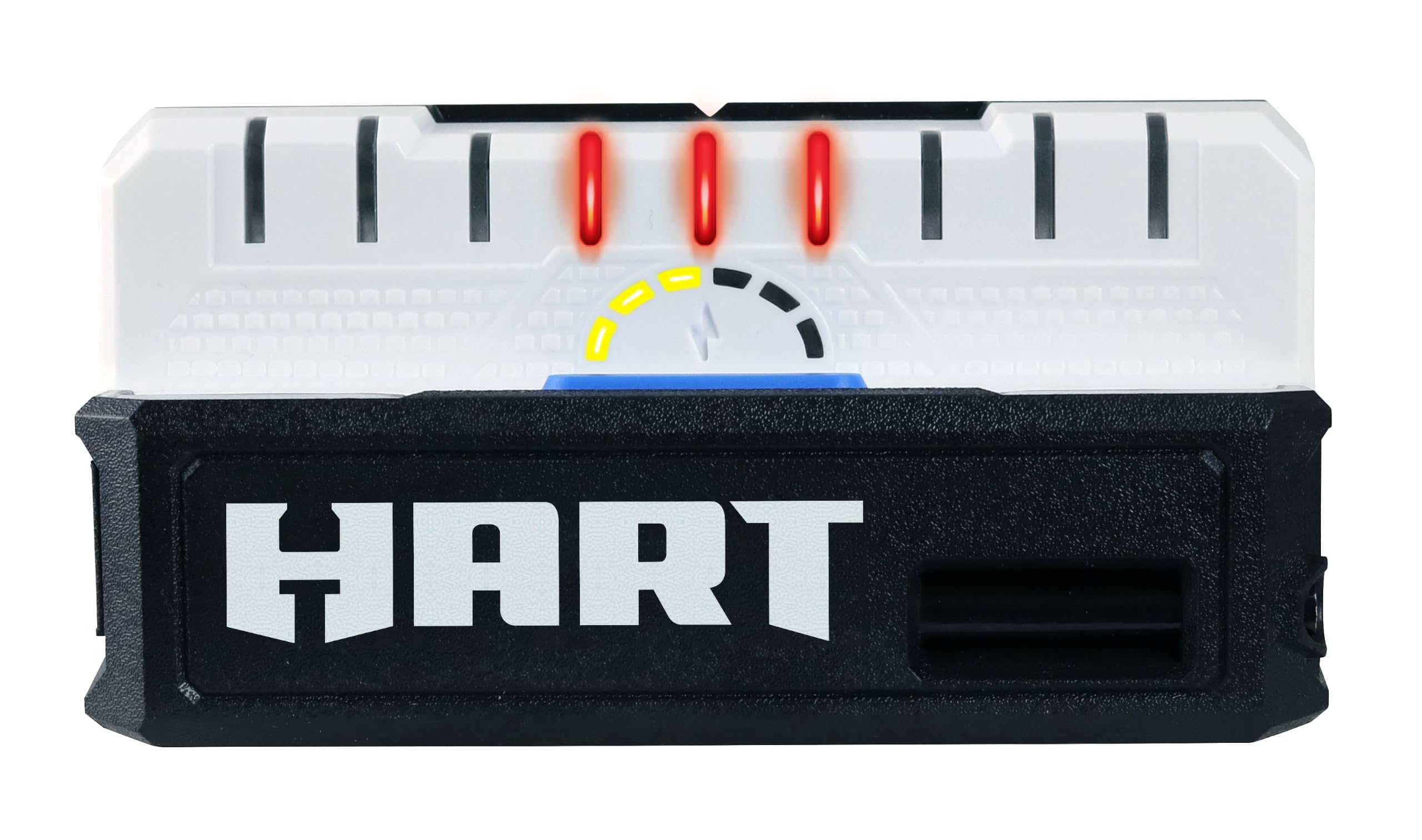
If you want nine sensors showing center and both edges without paying flagship money, this is the pick. Nine sensors is a big step up from the one or two that conventional electronic finders carry, and they display the center and both edges of a stud simultaneously. It adjusts for different depths, materials, and textures on its own — no calibration step, and you can begin the scan right over a stud. The Franklin 710+ carries 13 sensors against these 9, so the Franklin gives you a wider read, while the HART keeps the cost down.
What you get beyond the sensors is thoughtful. There is a pencil caddy built into the body, which sounds trivial until you are holding the tool in one hand and hunting for a marker with the other. Live wire detection is included as well. Power comes from standard AAA batteries, and like the Franklin it is not compatible with rechargeables — that is a small but real habit to plan around. The chrome-polished finish looks closer to a pro tool than the price suggests.
The honest trade-off shows up in stud tracking, which is the one area where opinions split. Most buyers find it works great, but a few reports of it failing to lock onto framing mean you should verify your mark with a second pass or a thin nail before you commit to a full bracket install. On a simple drywall wall with a clear path, though, it does the job without drama.
nine sensors budget: nine sensors, live wire detection, and a pencil caddy for a budget-tier outlay is the strongest feature-per-dollar spread in this group.
fewer features: treat it as a tool that wants a confirming second scan, especially on plaster or older walls.
thrifty buyers: you are outfitting a first toolkit and want multi-sensor readings without spending much.
pro demands: you mount heavy brackets weekly and want a reading you never have to double-check.
3. RYOBI Whole Stud Finder ESF5002
A whole-stud scanner that makes a plain painted wall easy and a plaster wall less so.
RYOBI built this around the whole-stud concept — you see the board, not just a beep. The housing is on the large side at 9.65 x 5.59 x 1.57 inches, versus something like the CRAFTSMAN CMHT77620 at 4.88 x 0.3 x 8 inches, so this one takes up real drawer space and works better as a bench or toolbox resident than a pocket tool. It weighs 9.12 ounces, which is fine in the hand while you slide it along a wall.
Where it wins ground is whole-stud scanning on standard single-layer drywall. It earns praise for being easy to use, and TV mounting on drywall is exactly the job it was designed around. Output is digital, so the reading shows rather than just sounding. For hanging a shelf or bolting a bracket into a clean single-layer wall, it will get you there without fuss.
Accuracy and reliability are the split here. Some users find it great and consistent; the recurring note is calibration drift and intermittent operation on certain walls. That points to fit rather than a flaw — on ordinary drywall it behaves, and on old plaster or a wall with unexpected layers it can lose the thread. If your home is a newer build with standard board, this is a sensible middle-market choice.
simple framing: modern single-layer drywall and a Saturday of TV mounting.
metal hunting: you own an older plaster home where readings need to stay stable across difficult surfaces.
4. FNIRSI WD-01 Stud Finder

Six scan modes, a rechargeable battery, and an LCD that reads out what it found.
This is the pick for someone who is chasing more than wood studs. The exact scan mode finds the center and edges of wood and metal studs up to 0.75 inches deep, and the depth scan mode reaches up to 1.5 inches. Beyond that, the non-ferrous metal mode picks up copper to 3.9 inches, the ferrous mode finds iron to 4.7 inches, and the AC mode reads live unshielded wiring to 2 inches. Copper wire detection reaches 1.6 inches. Six modes, an LCD readout, and a rechargeable cell in a 9.3-ounce body.
The positioning hole is the practical touch — you slide until the reading locks, then mark through the hole so your screw lands exactly where the scanner pointed. Auto calibration lets you zero it anywhere on the wall in one step. The rechargeable lithium-ion battery saves you from buying alkaline cells, which no other pick in this group can claim. At 9.3 ounces it is a touch heavier than the CRAFTSMAN at 4.6 ounces, but that extra mass comes with a display and a battery inside.
Here is the honest side. Quality and accuracy are genuinely mixed in the feedback — some users call it very accurate, and others report readings that are not usable at all. That spread suggests the tool is sensitive to technique and wall surface. If you need a single reliable answer for wood framing, the Franklin 710+ is the safer read. If you want one device that also sniffs pipes and wiring, this earns its spot in the drawer — just practise the slow scan before you trust a mark.
six tools in one: six detection modes covering wood, ferrous and non-ferrous metal, live AC, and copper wire, all with a rechargeable cell and a readable LCD.
recharge quirks: results track closely with how slowly and carefully you scan, and inconsistent readings are the main thing to prepare for.
multitask scans: a remodeler who needs metal and pipe detection alongside stud location.
quick checks: anyone who wants the simplest possible wood-only read and nothing to fuss with.
5. Zircon® StudSensor™ A100 Stud Finder w/ Live Wire Detection
Two scan modes and a live-wire warning in a body that fits flat against the wall.
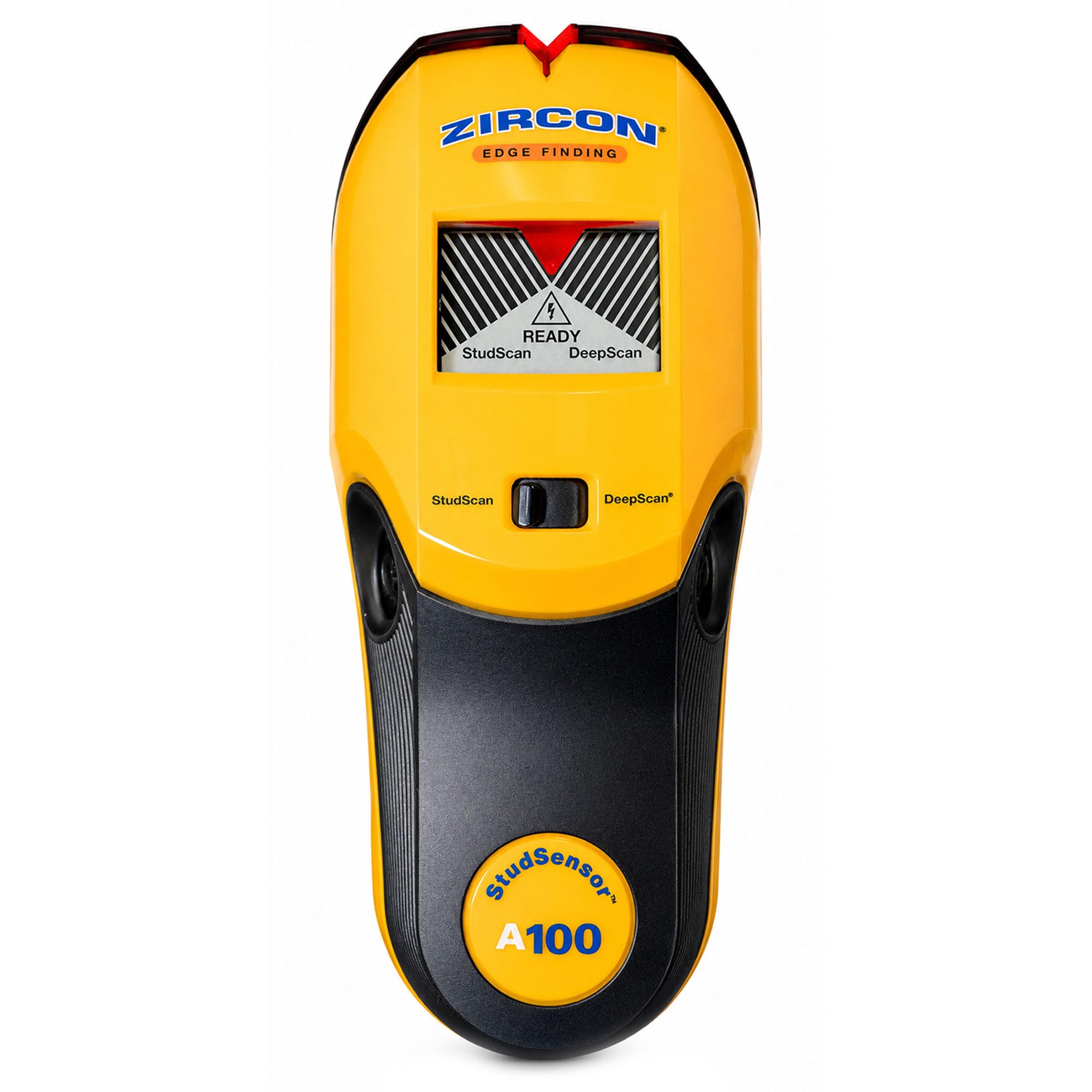
The A100 keeps the job simple: find the edges of wood and metal studs, then mark. StudScan mode reaches up to 3/4 inch deep for a standard wall, and DeepScan reaches up to 1 1/2 inches when the surface has extra layers in front of the framing. That is the same two-step depth logic the MultiScanner range uses, in a stripped-down form. Live wire detection operates in both modes, reading unshielded AC wiring up to 2 inches deep — useful before you put a drill bit anywhere near a switch.
Calibration is by the book, and the book is printed on the tool in spirit: lay it flat, grip it, press and hold power until you hear a single beep, then slide slowly. Do that and it behaves. The LCD screen, audio tone, and SpotLite pointer all work together to show both stud edges before you mount a TV, hang a shelf, or bolt up a mirror. It weighs 8.4 ounces, which sits between the light CRAFTSMAN and the heavier MultiScanner models.
The catch with Zircon’s entry model is calibration discipline. Skip the flat press or start moving during the beep and readings turn erratic — that is the recurring complaint, and it is almost always a technique issue rather than a dead tool. It also runs on a single 9V alkaline battery, which is not included, and it wants a fresh cell with an extended expiration date. Bring the battery and follow the sequence and you get solid edge finding.
safe drilling: edge finding on standard drywall with a live-wire safety check built in.
thick walls: you want to press a button and scan immediately with no calibration ritual.
6. Zircon MultiScanner A200 Stud Finder
Three modes for studs, metal, and live wiring, in a housing rated against dust and splashes.
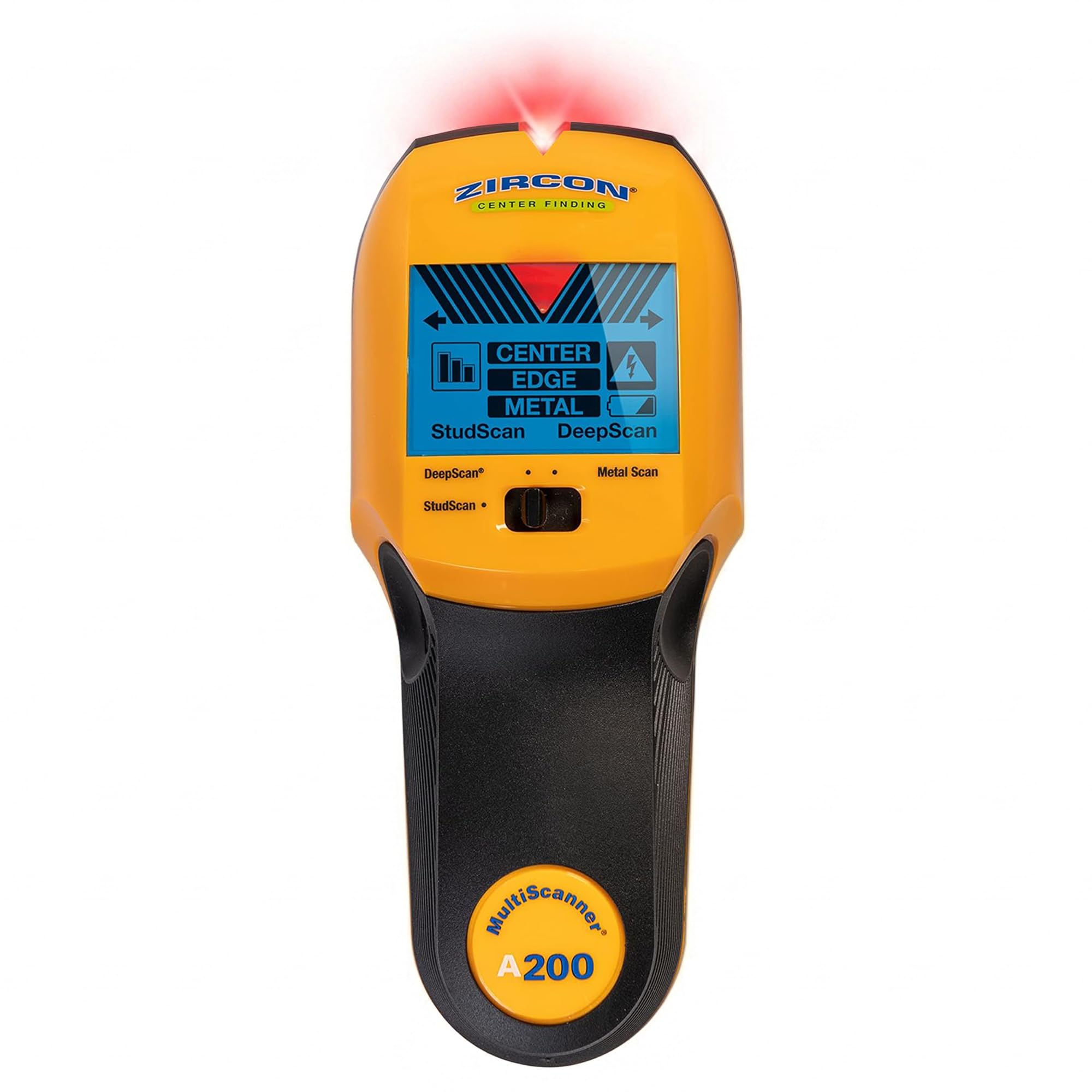
The A200 is the first step up from Zircon’s basic detector, and the extra mode is what you are paying for. StudScan finds wood or metal stud edges and centers up to 3/4 inch deep. DeepScan pushes that to 1 1/2 inches. Metal Scan looks for metal behind the wall before you drill — the job that matters when you are hanging a cabinet and do not want to hit a nail plate or a pipe strap. WireWarning detection sits alongside it, alerting you to hot wiring in the wall.
The IP54 rating is unusual in this category, meaning the housing is protected against dust ingress and splashing water — a small but useful detail if the tool lives in a garage or travels to job sites. Display is digital with a SpotLite pointer, and the read is legible in dim lighting, which matters in a basement or a closed closet. Calibration is press-and-hold with a one-to-two-second wait for the beep; do not move the scanner until that beep finishes. The 0.37 kg weight is steady in the hand without being tiring.
What wins people over is the handling — the three-mode controls are intuitive and the IP54 housing holds up to garage and job-site use. Accuracy is the split, and it is the biggest theme in the feedback: some find it mostly accurate, and some report false readings or a missed copper pipe. Expect to run a second confirming pass on anything load-bearing, and treat metal detection as a guide that needs manual verification before you cut into a wall.
metal and live: an IP54 housing with an LCD that stays readable in dim spaces, plus three distinct modes instead of one.
menu learning: false readings on some walls mean every metal hit deserves a double-check before drilling.
mixed materials: you want stud and metal detection in one mid-market tool that shrugs off a dusty garage.
plain wood: you only ever hang things on plain drywall and want one mode that never argues.
7. Franklin Sensors ProSensor MAX Stud Finder
Thirteen sensors with 2.5 inches of reach, built for walls with layers in the way.
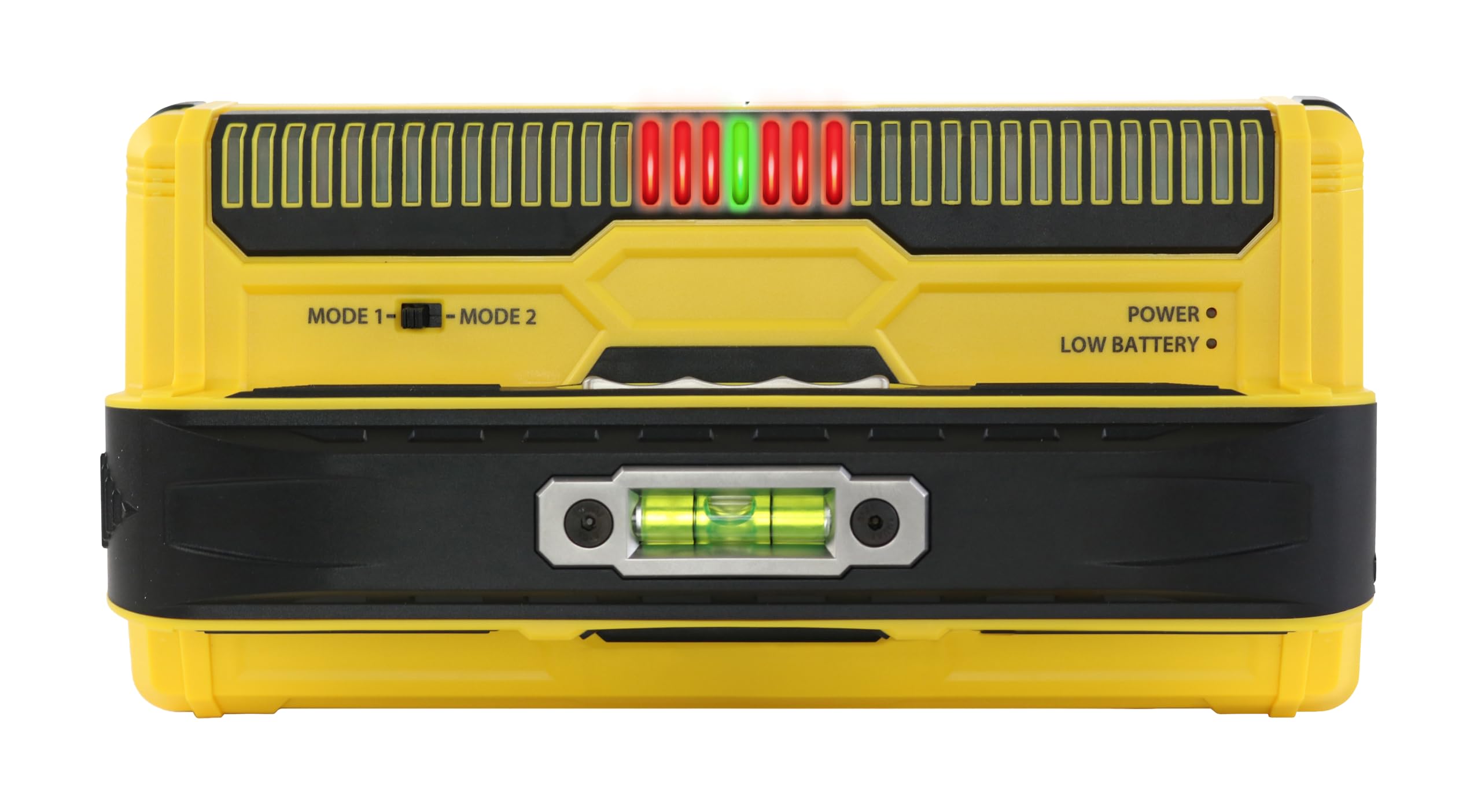
This is the answer for the wall that defeats everything else. Where the standard Franklin 710+ reaches 1.6 inches, the MAX pushes to 2.5 inches and scans through two or more layers of drywall, plaster, OSB, plywood, MDF, and large tile. It carries the same 13 sensors as the 710+, but larger — which is the difference that lets it keep reading through extra material while a standard scanner goes quiet. If your garage is sheathed in OSB, this is the tool that finds the framing behind it.
Two modes split the job cleanly. Mode 1 works as a normal stud finder for drywall. Mode 2 steps up for deep scanning through thick or tough walls. There is no calibration — press and hold and start scanning anywhere, even directly over a stud. The LED display shows single or double studs, and the middle light turns green at center. Franklin’s comparison is blunt: other electronic finders carry one or two sensors, and this one carries 13.
What you pay for that reach is bulk. It weighs 1.1 pounds, the heaviest pick here, and the feedback names both the size and the heft as the main drawback. There is a limited lifetime warranty on the tool, and it arrives ready to scan once you add batteries. Use it when the wall demands it — for a single layer of drywall, the lighter 710+ handles the same job in a handier body.
extra wide scan
- 2.5 in max detection depth goes through two or more layers of drywall, plaster, OSB, plywood, MDF, and large tile
- 13 larger sensors show the full stud width and double studs
- Two modes — standard drywall and deep scanning — with no calibration
- Limited lifetime warranty
large frame
- 1.1 lb makes it the heaviest tool in this group
- Its bulk means it is not a pocket tool for quick jobs
- Deep reach is wasted on a simple single-layer wall
big projects: OSB sheathing, plaster over lath, tile, and any wall with real thickness.
small spaces: your walls are plain drywall and you want something that fits in a drawer.
8. CRAFTSMAN Stud Finder CMHT77620

A thin, light, easy-carry finder for the occasional job on a standard wall.
At 4.6 ounces, this is the lightest detector in the group by a wide margin — versus 9.3 ounces for the FNIRSI WD-01. Its 4.88 x 0.3 x 8 inch body is about as thick as a pencil, which makes it the easiest to store and carry of anything here. If it lives in a kitchen drawer and comes out twice a year for a picture frame, that small footprint is the whole point.
For that size it still does the important things. It detects wood and metal studs up to 3/4 inch deep, finds the center of a stud rather than just an edge, and screens for live AC. Auto calibration keeps readings consistent from pass to pass, and LED arrows plus an audible tone guide you to the target. Batteries are included in the box, so it works out of the package without a shopping trip.
The limitation is depth plus speed. A 3/4 inch rating means it handles a single layer of drywall and no more; put it against tile, plaster, or double board and it will not see the stud at all. Accuracy also draws mixed notes at times, so this is a tool for drywall and nothing else — treat it as a starter finder and step up to a multi-sensor model when the walls get harder.
basic studs: a slim, light finder that handles standard drywall and disappears into a drawer.
deep scanning: thick, layered, or tiled walls — the 3/4 in reach cannot get there.
Know the Specs
Sensor count
A sensor is a small element that reads the density of the wall directly under it. Each sensor covers a narrow strip. A finder with one or two sensors has to be swept back and forth until an indicator lines up. A finder with 13 sensors reads a wide band at once, so you see the whole stud body and the middle light marks the center. More sensors usually means fewer passes and fewer wrong marks — the Franklin 710+ and ProSensor MAX both carry 13, and the HART Professional carries 9.
Detection depth in inches
Depth is how much material the scanner can read through. Around 3/4 inch covers a single layer of half-inch drywall. If your wall is plaster over lath, tile, double drywall, or OSB sheathing, you need a deep mode that reaches further — commonly up to 1 1/2 inches. The ProSensor MAX reaches 2.5 inches for walls with two or more layers. Match the rating to your wall, or the tool will read nothing and you will think the wall has no framing.
Live AC detection
AC detection warns you when unshielded electrical wire is behind the surface. On most models that reach is 2 inches deep, and on some it runs in every mode. This is a safety feature, not a locating feature — it tells you where not to drill. Treat any alert as a stop signal and turn off the circuit before you do anything further.
Battery type and calibration
Calibration is the setup step where the tool zeroes itself against the wall. Auto calibration lets you start anywhere; manual calibration requires a flat press and holding still for the beep. Battery type matters for upkeep — some models take standard alkaline cells and are not compatible with rechargeables, while the FNIRSI WD-01 runs on a built-in rechargeable lithium-ion battery and needs no cells at all.
Common Questions
Will a stud finder work through plaster over lath?
How many sensors do I need to find a stud accurately?
Can a stud finder detect live electrical wires behind drywall?
Is a 13-sensor stud finder better than a magnetic one?
Can I use rechargeable batteries in a stud finder?
Why does my stud finder give a false reading?
How deep can a stud finder reach through a wall?
Does a stud finder detect metal studs as well as wood?
Can a stud finder locate a stud on a ceiling?
Do I need to calibrate a stud finder every time I use it?
The Bottom Line
For most wall jobs, the wood wall stud finder to buy is the Franklin Sensors ProSensor 710+, because 13 sensors show the whole stud and the 1.6 inch deep scan stays on without you switching modes. If the wall is thick, sheathed in OSB, or layered with plaster or tile, the Franklin Sensors ProSensor MAX takes you to 2.5 inches where the 710+ cannot follow. And for a slim, light finder that handles plain drywall and tucks into a drawer, the CRAFTSMAN CMHT77620 at 4.6 ounces is the one to grab.
How we choose
We do not accept paid placement. Every pick is matched to a real buyer and a real use-case; we do not hands-on test units.
Sources
Specifications: manufacturer listings and product documentation. Review insights: verified customer reviews, as of November 2026. Pricing: not shown on this page (it changes often); check the current price via the retailer link.
As an Amazon Associate, Tactical Gear Guy earns from qualifying purchases. This does not affect which products we feature.