Specs are compiled from manufacturer listings and verified buyer reviews and can change over time — please confirm the key details on the product page before buying.
If your garage fills with fine sanding dust every time you touch a board, the fix is not more suction — it is a vacuum built to send that dust somewhere sealed. Most wood cleanup problems come down to filtration and bag capacity, not horsepower, and the picks below split between shop-style wet/dry vacuums and true dust collectors. Start with the DEWALT DXV06G if you want one machine for the whole garage, and reach for a collector like the WEN DC1300 when your table saw or planer is the real dust source.
This guide is built by comparing the manufacturers’ published specifications and the patterns across verified customer reviews, so you get each pick’s real strengths and trade-offs instead of marketing spin.
Wood dust is lighter and clingier than household dirt, and fine particles stay airborne long after you stop sweeping.
Top Picks


How To Choose The Best Wood Vacuum Cleaner
The question that actually decides your purchase is simple: is the dust being picked off a floor, or is it being pulled out of a running power tool? A floor-and-bench vacuum needs strong suction and a big tank. A tool-extraction setup needs air volume, a sealed filter, and an inlet that matches your sander, router or saw. Get that split wrong and you end up with a machine that either chokes on its own bag or cannot keep up with a planer.
Filtration first, motor second
A cartridge or bag filter rating is written in microns — one micron being a millionth of a meter, roughly the size of the finest dust you see floating in a sunbeam. Fine sanding dust is the stuff that coats every surface in the shop, so a filter that lets it pass just sprays it back into the room. The POWERTEC DC5371 ships a 1 micron bag for exactly this reason, and the Fein Turbo I Set takes it further with a HEPA filter (a filter graded to trap the very smallest particles). A high peak-horsepower rating paired with an open cloth bag just recirculates fine dust into the room.
Reach is hose plus cord, not just hose
You want to clean around a bench without unplugging and dragging the machine every few feet. Add the hose length to the cord length and you get your real working radius. The DEWALT DXV05S pairs a 7 ft hose with a 10 ft cord for a total 17 ft cleaning reach, so one outlet can cover a wide stretch of floor. The STANLEY SL18191P does the same sum with a 6 ft hose and a 10 ft cord for over 16 feet. Picture each corner of your shop and ask whether one outlet reaches it.
Tank size versus how often you empty
Capacity is a convenience spec, not a performance one, and it shows up most when you are planing or thicknessing and the shavings arrive fast. A 5 gallon tank like the DEWALT DXV05S means frequent trips to the bin. The WEN DC1300’s 50 gallon collection bag means you can work for a long stretch before you touch it. Mid-size tanks around 6 to 10 gallons are the common compromise for a one-car garage.
Noise, because you will be standing next to it
Shop vacuums run loud, and hours of sanding beside one is fatiguing. The numbers that matter here are decibels (dB, the standard loudness scale) — the Fein Turbo I Set runs at 66 dB and the POWERTEC DC5371 at 80 dB. Some models use noise-reduction airflow design instead of quoting a figure, which is the RIDGID RT0600’s approach with its Scroll Noise Reduction technology.
Side-by-Side Comparison
| Model | Best For | Capacity | Hose Length | Amperage | Amazon |
|---|---|---|---|---|---|
| DEWALT DXV06G★ Best Overall | Garage wall mount with remote | 6 gallons | 20 feet | 9 A | Amazon |
| Vacmaster VDK611PF 0201Best Value | Self-cleaning fine dust work | 6 gallons | 2.1 meters | 11 A | Amazon |
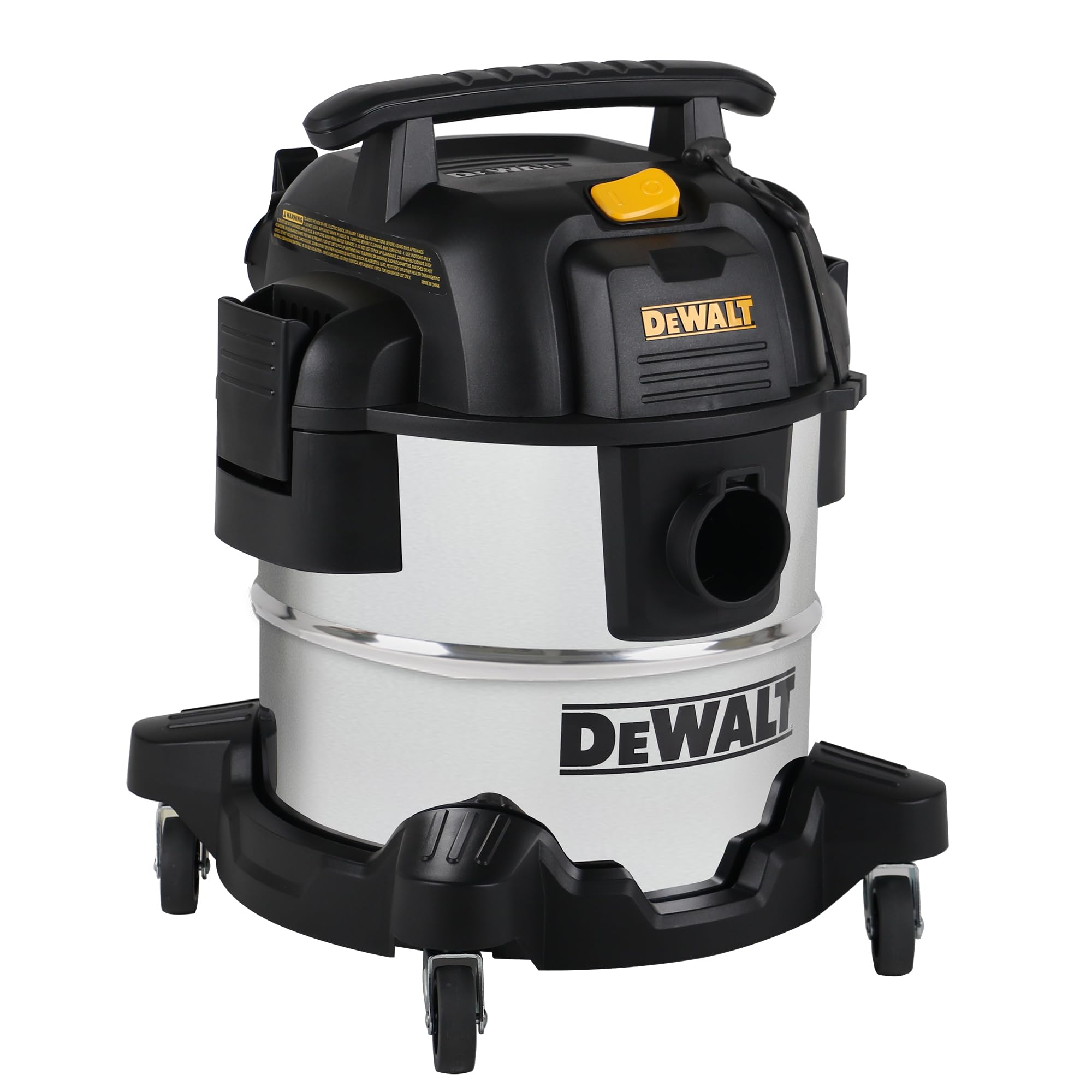
| DEWALT DXV05SStainless Tank Pick | Stainless tank, small shop | 5 gallons | 7 feet | 6 A | Amazon |
| Vacmaster VOC812SF 1101 | Bigger messes on hard floors | 8 gallons | 7 feet | 11.5 A | Amazon |
| RIDGID RT0600 NXT | Quieter running shop vac | 6 gallons | 2.4 meters | 8.3 A | Amazon |
| STANLEY SL18191P | Long reach, roomy tank | 10 gallons | 6 feet | 10 A | Amazon |
| CRAFTSMAN CMXEVBE17155 | Heavy-duty bulk cleanup | 10 gallons | 7 feet | — | Amazon |
| POWERTEC DC5371 | Wall mount tool extraction | — | — | 12 A at 120V | Amazon |
| Fein Turbo I Set | Quiet HEPA extraction | 5.8 gallons | 13 feet | 9 A | Amazon |
| WEN DC1300 | High airflow, big bags | 50 gallons | — | 14 A | Amazon |
| Bosch VAC090AH | Silica-conscious concrete and wood | 9 gallons | — | — | Amazon |
Detailed Reviews
1. DEWALT DXV06G Wet Dry Vacuum
Our pick — 4.5+★ from 900+ verified ratings; the strongest balance of quality and price.
Hangs on the garage wall, then reaches across it with a 20-foot hose.
The feature that earns this wall-mounted DEWALT the top slot is the hose: 20 feet of 1-7/8-inch flexible line. That is roughly triple the 7 ft hose on the DEWALT DXV05S below, which means you can park the canister on a bracket near the door and still pull suction around a full car bay without unclipping anything. A 6 gallon tank holds a respectable pile of planer shavings before you stop to empty it.
A 5 peak horsepower motor does the pulling, and the 9 A draw is the sort of load a normal garage circuit handles. What wins people over most is plain performance — the machine simply does the work across dust, pet hair, and spills, and the 34 mentions of the hose length back up that reach claim. The remote control watch is the sleeper feature: clip it on, press, and the vacuum fires up from across the shop without a trip back to the switch.
The balance of the build is portability — at 21 pounds with a top carry handle, it comes off the bracket and goes outside easily when you want to blow leaves off the drive. It also blows, and it takes both a cartridge filter and a foam wet filter, so you can switch between dry wood dust and a wet spill. The catch is the size of the thing: the housing measures 21″ long by 16″ wide by 18″ high, so plan the wall space before you drill.
What earns it first place
- 20 ft hose plus wall bracket keeps the canister out of the walkway
- Remote control watch controls operation from wherever you are standing
- Three functions in one: wet pickup, dry pickup, and a blower port
- 21 pounds with a large top handle, so it leaves the wall easily
What to plan around
- The 21″L x 16″W x 18″H body needs real wall real estate
- 6 gallon tank means regular emptying under heavy planing
- 9 A startup load is worth knowing before you share a circuit
Mount it if: you clean a whole garage floor from one spot and want the vac off the ground.
Measure first: the 21-inch length takes more wall than a small shelf allows.
2. Vacmaster VDK611PF 0201 Wet/Dry Vac
The one that shakes its own filter clean while you keep sanding.
Sanding is where shop vacuums usually give up. Fine powder packs the pleats (the folded filter surface), airflow drops, and you end up knocking the cartridge against the bin every twenty minutes. This Vacmaster attacks that directly with a self-cleaning filter system that keeps airflow up and suction steady through a long session. It pairs that with a cartridge and dust bag rated to capture particles down to 1 micron (a micron is one millionth of a meter), so fine sanding dust stays out of the air.
The motor delivers 84 inches of water lift — a measure of how hard the machine can pull a column of water, which translates to stubborn grip on debris rather than just open airflow. Quality is what people talk about first here, and the 75 suction mentions confirm the pull lives up to the spec sheet. Eleven accessories come in the box, including a locking hose that stays put when you drag the canister by it.
Where this sits against the DEWALT DXV05S is instructive: the Vacmaster draws 11 A against the DEWALT’s 6 A, so it works the circuit harder in exchange for that extra pull. The body is compact at 13.38″L x 13.2″W x 21.85″H, and the 2.1 meter hose is shorter than the 2.4 meters on the RIDGID. Some find the run louder than they expected, and the wheel layout needs a firm push on thick carpet. If you want a mid-size canister that handles fine wood dust without constant filter maintenance, this is the value play.
Filter that keeps working: the self-cleaning cycle is the whole point — it protects suction over a long sanding run rather than letting it sag.
Sound and swivel: noise is a fair criticism here, and the non-marring rear wheels plus front casters roll best on hard shop floors.
Reach for this if: fine dust and clogged filters are your routine frustration.
Look elsewhere if: you need maximum hose length to cover a wide bay in one pass.
3. DEWALT DXV05S Shop Vacuum
A stainless drum that shrugs off shavings, glass, and sawdust odors.
Most shop vacs around this tier are plastic, and plastic holds onto the smell of whatever you last sucked up. This DEWALT wears a heavy-duty stainless steel tank instead, with a smooth surface that wipes clean and does not keep stubborn odors. That matters in a woodshop where you might follow a wet spill with a bag of fresh shavings.
The motor is a 4.0 peak HP unit moving 85 CFM of airflow — cubic feet per minute, the volume of air it can shift, which is what clears a wide floor nozzle in one pass. It ships with a 7 ft hose and a 10 ft cord for a total 17 ft cleaning reach, and that shorter hose is the direct cost of the stainless build. Where the DEWALT DXV06G above stretches to 20 feet of hose, this one gives you 7 feet — a big step down if you like to work far from the canister.
Four identical rubberized casters swivel for easy movement across a shop floor, and a large water-resistant on/off switch is easy to find with a dusty glove. Suction and power are honestly the split opinion on this model — plenty of owners call the pull strong, others find it merely adequate for their job. That makes it a good fit for benches and floors where you are not tormenting it with planer output. The 3-year warranty is the quiet reassurance.
The stainless argument: a metal drum that resists scratches, odors, and stains is the reason to pick this over a plastic tank.
Know the reach limit: 7 ft of hose plus 10 ft of cord is 17 ft total, so plan outlets accordingly.
Suits you if: you want a metal tank that stays clean-smelling and rolls on four casters.
Think twice if: you need long hose reach — the 20-foot DEWALT above is the one for that.
4. Vacmaster VOC812SF 1101 Wet/Dry Vac

Eight gallons of stainless steel for the mess that keeps coming.
Capacity is the headline here. The high-performance motor delivers 83 inches of water lift, and 11.5 A of current draw is the trade for that pulling power.
Around a woodstove and across hard floors is where this Vacmaster draws its praise; performance is the aspect that leads by a wide margin. The 7 ft hose plus power cord gives 17 feet of cleaning reach, and onboard storage for hose, cord, and accessories keeps it tidy between jobs. It also converts to a blower, which helps clear sawdust off a bench top before you sand.
The honest friction is durability — this is a working tool, and some owners have found it does not stand up as long as they hoped over years of hard use. Noise is the other split: some find it quieter than expected, others say it howls. Weigh that against the size and the suction on floors and around a stove, and it is a capable mid-size machine for the money.
Room to work: 8 gallons of stainless means fewer emptying trips than the smaller DEWALTs on this list.
Lifespan caution: reports on long-term durability are mixed, so treat it as a working tool and store it dry.
Made for: hard floors, stove surrounds, and jobs where the debris keeps arriving.
Fair warning: it is a tool you will eventually wear out, so buy it for serious volume.
5. RIDGID RT0600 NXT Wet Dry Shop Vacuum
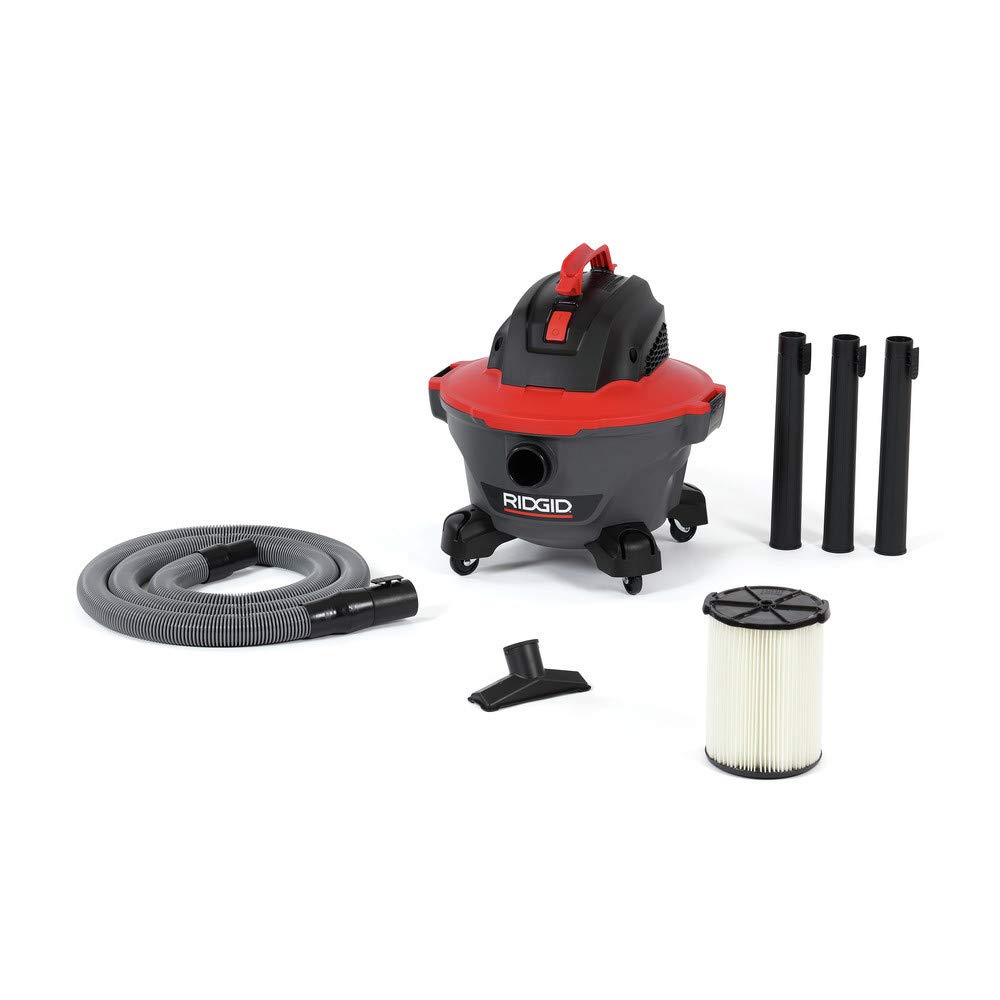
Built to keep the noise down and the hose clamped on tight.
The 4.25 peak horsepower motor is the muscle, but the design story is quieter: patented Scroll Noise Reduction technology shapes airflow to keep operating noise low rather than just bolting on a muffler. For anyone sanding in a garage attached to the house, that is a practical spec, not a marketing line.
The hose is 2.4 meters — slightly longer than the 2.1 meters on the Vacmaster VDK611PF 0201 above. It is also a locking hose that will not pull loose mid-job, with a smooth interior to reduce clogging. Quick-work reach is partly a hose-plus-dragging issue, and the 360-degree casters let you roll the canister along with you. The Qwik Lock filter system lets you pop a cartridge out for cleaning without a single fastener or tool.
A significant group of owners has found the hose connection is the weak spot, with the hose working loose over time — worth knowing if you lean on the hose to pull the vac around. Power and performance are otherwise the reasons people keep it, and a 6 gallon tank holds a fair load. Otherwise it does the job it was bought for; just handle the hose coupling gently.
Sound engineering: noise-reduction airflow design plus 360-degree casters makes this a low-drama machine to live with.
Hose connection: it is the most-discussed gripe in the review mix, so treat the coupling gently.
Pick this for: a quieter, smoother-running vac you roll along the bench.
Pass if: you want the longest possible hose and are hard on fittings.
6. STANLEY SL18191P Wet/Dry Vacuum
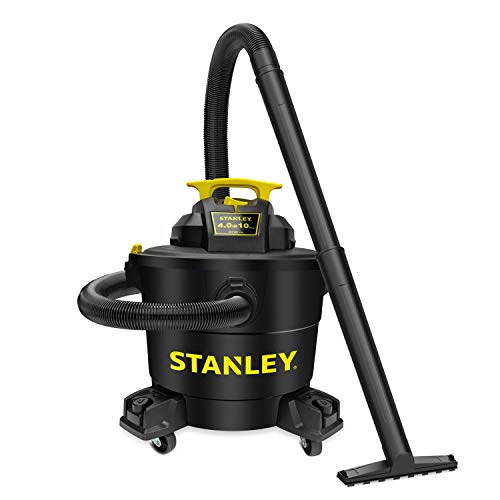
A big black canister that swallows a whole bench of wood dust.
Ten gallons of collection tank is a lot of shavings before you hit the bin, and that alone makes this STANLEY a reasonable pick for a garage where planing and sanding happen back to back. A 4 HP motor does the pulling, and a rear blower port converts the vacuum to a blower so you can clear dust off a surface before you finish it.
Cleaning reach is the number to note: a 10 ft power cord plus a 6 ft safety hose plus two extension wands add up to over 16 feet. The cleaning performance is what owners talk about most — cleaning up after woodworking in the garage is the exact use case this machine was bought for. Four swiveling casters and a wide base keep it planted while you drag the hose around.
Two honest notes. Durability reviews are split, with some finding it does not last as long as they would like; treat it as an appliance rather than a lifetime tool. And the cord-to-reach ratio leans on the extension wands rather than a long hose. For home garage cleanup, its suction and pickup keep it on the shortlist.
Space to fill: 10 gallons means a long session before you have to stop, and 16 feet of total reach keeps you moving.
Built for the garage: the on-board cord storage and a waterproof switch suit a shop where sawdust gets everywhere.
Best match for: a home garage where you want a tall tank and long cleaning range.
Keep in mind: the 6 ft hose needs the extension wands to hit that 16-foot figure.
7. CRAFTSMAN CMXEVBE17155 Wet Dry Vac

Six peak horsepower in a stainless drum for the mess that fights back.
This CRAFTSMAN reads like a jobsite tool first and a garage vac second. A 6.0 peak horsepower motor pulls hard, and the stainless steel drum is built to take the knocks of renovation work. The 2-1/2-inch hose is the widest on this list, and a wider hose moves bigger chips from a planer or jointer without jamming at the nozzle.
Big cleanups are covered by the 10 gallon drum and 7 ft hose, so you empty the bin less often. Two locking extension wands plus a utility nozzle and car nozzle handle the usual jobs. Filter changes run through the Qwik Lock Fastening System, so you can swap a cartridge without hunting for fasteners. The machine also lists compatible genuine CRAFTSMAN filters and dust bags if you want to run bagged. Buyers praise performance most — it simply does the work on larger messes.
The trade-offs are physical. At 15.7 pounds in a 25.13-inch-tall body, it is the sort of canister you bump into rather than glide past, and size and maneuverability both draw mixed notes. Durability is the other honest caveat: some owners have found it does not last as long as advertised. For a renovation phase where you need raw pickup, it is a solid tool.
Where it delivers
- 2-1/2-inch hose handles chips a smaller hose would choke on
- 6.0 peak HP motor and 10 gallon stainless drum for heavy pickup
- Qwik Lock filter system means no tools for a filter change
- 3 year limited warranty on the vac
Where it asks for room
- 25.13-inch height and 15.7 pounds make it awkward to move often
- Some report durability shorter than expected
- Size draws mixed notes in a small garage
The heavy hauler: buy it for renovation mess and planer chips, not for sliding under a workbench.
Skip if: your shop is tight and you move the vac every few minutes.
8. POWERTEC DC5371 Dust Collector

A 1-micron bag on the wall, pulling 560 CFM off your table saw.
This is a different class of tool from the shop vacs above. A 1 HP induction motor spins a blower at 3450 RPM and moves up to 560 CFM of airflow, and the 4-inch inlet port is sized to attach a dust-collector hose straight to a machine. That combination is what pulls dust from a running saw or router instead of just cleaning the floor afterward. A reusable 1 micron bag with a window to check the level and a zipper for easy disposal is the filtration half of that job.
Buyers hook this to table saws, sanders, and routers, and efficiency is what they highlight most — it handles the chips and dust a small shop generates. The Vortex Base design guides airflow to reduce turbulence, which the maker says improves efficiency by up to 10% over a comparative model. Noise comes in at 80 dB (decibels, a measure of loudness), quieter than many shop vacs, so you can talk over it. The wall bracket saves floor space in a one-car garage.
A couple of things to know. The dual-voltage motor runs 12 amp at 120V or 6 amp at 240V, so you can wire it either way. And the 4-inch port has a built-in grate to stop large debris from hitting the impeller — the company notes you should pull the hose and check the port regularly, because collected debris cuts the flow. Wall-mounting it frees floor space but puts the bag high where you will service it.
The airflow case: 560 CFM at a 4-inch inlet is the spec that matters when the dust comes off a running tool, not a floor nozzle.
Maintenance point: the port grate that protects the impeller needs clearing, so build a hose-check into your routine.
Buy it for: a small pro or hobby shop where the table saw and sander are the main dust sources.
Know the limit: it saves floor space but pushes bag service up on the wall.
9. Fein Turbo I Set Wet/Dry Dust Extractor 5.8-Gallon Capacity
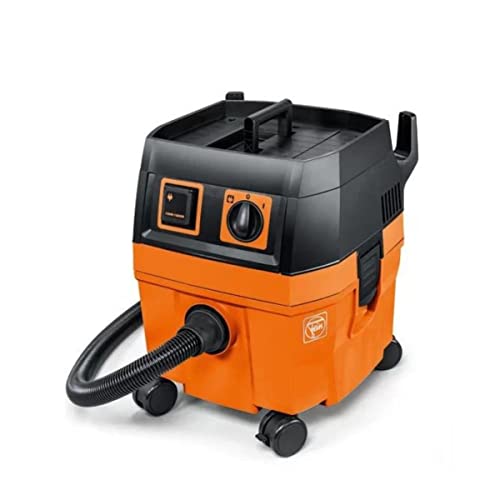
Runs at a whisper for a workshop, then wakes up with your sander.
The number that sets this Fein apart is 66 dB. That is quiet enough to work beside all afternoon, and it comes from a 1100W turbine producing 151 CFM and 98 inches of water lift. For a small shop or an attached garage, low noise plus strong pull in one machine is rare.
The tool-activated suction is the function that makes it a dust extractor rather than a shop vac. An autostart outlet with a built-in power-on delay prevents current spikes and syncs the vacuum to your power tool, so it starts with the sander and stops with it. A 19 ft heavy-duty power cord and a flexible 13 ft hose give a lot of working range without hunting for outlets. HEPA filtration covers the fine dust.
Where it earns its money is indoor, noise-sensitive work — engraving machines, sanding inside, small-shop table work. The compact body sits on large 360-degree swivel wheels for tight spaces. Value is the honest debate: some find the price steep for the capacity, and durability reports are split, with some owners noting it holds up well and others finding it does not.
What makes it worth the outlay
- 66 dB operation is the quietest spec on this list
- Tool-activated outlet syncs suction to the running tool
- HEPA filter plus 151 CFM and 98 inches of water lift
- 13 ft hose and 19 ft cord give long reach
What to weigh honestly
- 5.8 gallons means more emptying than the 10 gallon tanks
- A meaningful premium price for the capacity
- Long-term durability reports are mixed
The quiet one: best for indoor sanding where noise and fine dust both have to be handled.
Look elsewhere for: big shavings volume — the 10 gallon machines above hold far more.
10. WEN DC1300 Dust Collector

Moves 1,300 cubic feet of air a minute and dumps it in a 50-gallon bag.
This WEN is a full dust-collection system for a small shop, not a cleanup tool. The 14-amp motor turns a 10-inch steel impeller up to 3450 RPM and circulates up to 1,300 cubic feet of air per minute, the highest airflow on this list. That volume is the whole point of a collector: it moves enough air to catch dust at the source off a running saw or planer. The vertical collection bag holds up to 50 gallons of dust, so you rarely touch it.
Two 4-inch air inlets let you hook up two tools at once, which is a real convenience in a shop with a table saw and a planer side by side. A mobile base with four swivel casters lets you roll it where the work is. Quality is the aspect that leads, and being quiet enough to be barely heard with the garage door shut is a pleasant surprise; assembly and airflow both draw praise.
The honest questions are the 5-micron bag rating — coarser than the 1 micron bags elsewhere — and durability, where reports are split. Instructions also draw mixed notes, so plan for a slow first assembly. If your shop runs one big tool at a time and you want real air volume with minimal bag emptying, this is the pick.
The volume story: 1,300 CFM at two 4-inch inlets is what separates it from the shop vacs — it is built to keep pace with production tools.
Bag rating: 5 microns is fine for chips and shavings but not the finest sanding dust, so pair it with a finer filter if that is your job.
For the small production shop: two tools, one big airflow machine, almost no bag trips.
Not for: fine-dust work where a 1-micron rating is the requirement.
11. Bosch VAC090AH Dust Extractor

Cleans its own filter every 15 seconds so the suction never sags.
If you sand or grind a lot, dust that packs the filter is the enemy of sustained suction. The Bosch VAC090AH answers that with automatic filter cleaning, running a cycle every 15 seconds to keep maximum pull going through a long session. A HEPA filter captures 99.97 percent of particles at 0.3 microns or larger, and the fleece filter bag protects the filter and holds the dry debris. That spec combination is the whole reason this tops the filtration ranking.
Airflow runs to a maximum 150 cubic feet per minute with a sustainable maximum 97 inches of static water lift, and power tool activation lets the tool’s switch turn the vacuum on and off. The Power Broker dial matches suction force to the application, so a delicate sanding pass and a heavy grinding pass each get the right pull. It sits in the middle of the pack on noise, and compatibility draws mixed notes — worth checking your tool’s port size before you buy.
Bosch also frames the machine as part of a PRO plus GUARD system aimed at moving users toward OSHA Silica Table 1 dust compliance (OSHA is the US workplace safety agency; Table 1 lists dust-control methods). That is a jobsite-framing claim from the maker, not a guarantee of anything in your shop. The practical takeaway: concrete dust, drywall dust, and fine wood powder are all handled the same way here — sealed, filter-cleaned, and kept out of the air. Value is a bright spot in the review mix for a machine this capable.
Filter that never loads up: the 15-second auto-clean cycle protects suction on long sanding and grinding runs, and the HEPA filter catches 99.97 percent of particles at 0.3 microns.
Check compatibility: mixed feedback on tool fit means confirming the port size for your grinder or sander before ordering.
The fine-dust specialist: reach for it when sanding, grinding, or concrete dust is the job.
Verify first: your tool’s port and the Power Broker dial’s settings need to line up for the best result.
Know the Specs
Micron ratings on filters and bags
A micron is a millionth of a meter, and a filter’s micron rating is the size of particle it is built to catch. A 1 micron bag like the one on the POWERTEC DC5371 traps fine wood dust that would otherwise settle on every surface in the shop. A 5 micron bag like the WEN DC1300’s is fine for chips and shavings but not the finest powder. For anything involving sanding, lean toward the finer rating, and remember a cartridge or bag filter is doing the real work here — not the motor.
CFM versus water lift
CFM (cubic feet per minute) measures airflow volume — how much air the machine moves, which is what clears a wide floor nozzle or feeds a dust collector. Water lift (usually in inches) measures pulling force — how hard it grips stubborn debris. The two trade against each other: a dust collector typically runs high CFM for volume, while a shop vac leans on water lift for grip. Match the number to your task, since a high-CFM machine with a tiny inlet will not move what a wide-hose collector will.
Peak horsepower and amperage
Peak horsepower is a marketing-friendly measure of the motor’s maximum output on a short burst, not its continuous power. Amperage tells you how much current the machine draws from the circuit — a figure worth knowing if you share a garage outlet with a table saw. A 9 A machine and an 11.5 A machine both run on a normal household circuit, but not alongside a big tool starting up. Match the vacuum to the circuit you have, especially if it will run at the same time as your saw.
Tool activation and autostart outlets
Tool-activated suction, or an autostart outlet, syncs the vacuum to a power tool: the vac starts when the tool starts and stops when it stops. Some, like the Fein Turbo I Set, adda power-on delay to stop current spikes when both start together. That hands-free behavior matters on a sander or track saw, where you want suction the moment the tool bites. It is a feature of dust extractors, not typical shop vacs, so check for it if you plan to hook the machine to a power tool. A machine without it means reaching for a separate switch every time.
Common Questions
Can a shop vacuum handle fine sanding dust or do I need a dust collector?
What does a 1 micron filter actually stop in wood dust?
How much hose and cord reach do I need for a one-car garage?
Will a wood vacuum also pick up wet spills?
Is a quieter vacuum worth it for indoor sanding?
What is tool-activated suction and why does it matter?
How often do I need to empty the tank or bag on a wood vacuum?
Do I need a HEPA filter for wood dust cleanup?
Can a dust collector run two tools at the same time?
What voltage and amperage does a wall-mounted dust collector need?
The Bottom Line
For most garages, the wood vacuum cleaner that earns its place on the wall is the DEWALT DXV06G. Its 20-foot hose plus wall bracket let you clean a whole bay from one spot without moving the canister. If fine sanding dust is your daily enemy, grab the Vacmaster VDK611PF 0201 with its self-cleaning filter and 1 micron cartridge. For genuine dust-collection duty at the table saw, reach for the WEN DC1300 with its 1,300 CFM airflow (cubic feet per minute, a measure of air volume moved) and 50 gallon bag. Whichever you pick, one nudge is worth acting on: the top-rated option here, the DXV06G, carries 4.5+ stars across 900+ ratings — a strong sign the wall-mount concept works as advertised in real garages.
How we choose
We do not accept paid placement. Every pick is matched to a real buyer and a real use-case; we do not hands-on test units.
Sources
Specifications: manufacturer listings and product documentation. Review insights: verified customer reviews, as of November 2026. Pricing: not shown on this page (it changes often); check the current price via the retailer link.
As an Amazon Associate, Tactical Gear Guy earns from qualifying purchases. This does not affect which products we feature.