Specs are compiled from manufacturer listings and verified buyer reviews and can change over time — please confirm the key details on the product page before buying.
Here is the short answer: if you want one lathe that handles pens, bowls and spindles without fighting you, buy on swing and speed range first, then on weight and motor. Swing is the widest bowl you can turn, and speed range decides whether a lopsided blank starts safely or rattles your bench apart. Get those two numbers right before you compare badges or prices.
This guide is built by comparing the manufacturers’ published specifications and the patterns across verified customer reviews, so you get each pick’s real strengths and trade-offs instead of marketing spin.
Below you will find nine lathes sorted by what they realistically handle, from benchtop starters to cast-iron floor machines. Every pick notes its real swing, speed range, taper and weight so you can match one to your bench and your budget — the practical way to narrow down the best wood turning lathes.
Top Picks


How To Choose The Best Wood Turning Lathes
Most first-time buyers assume horsepower is the whole story. It is not. A lathe is a balance of swing, speed range, weight and spindle compatibility, and a weak link in any one of them shows up the moment you mount a real blank.
Start with swing and distance between centers
Swing over bed is how wide a bowl you can spin — a 12-inch swing means bowls up to roughly 12 inches across. Distance between centers is the longest spindle you can turn between the headstock and tailstock. Write down the biggest project you actually plan to make, then pick a lathe with room above that. Buying a 12-inch swing when your largest planned bowl is 12 inches leaves no room for a platter later.
Look hard at the slowest speed, not the fastest
Top speed gets the headlines, but the low end keeps you safe. A rough, unbalanced blank wants a slow start — think 60 RPM or 250 RPM — so it wobbles gently while you true it up. A lathe whose slowest setting is several hundred RPM will shake hard on that first cut. The best range for a home shop dips low and still climbs high enough for pens and small spindles.
Understand the taper and spindle thread
The headstock taper (MT2 is the common mid-size standard) and the spindle thread (1″ x 8 TPI is typical) decide which chucks, faceplates and centers bolt on. Match these to the accessories you already own or plan to buy. A lathe with the standard MT2 taper and 1″ x 8 TPI thread gives you the widest choice of add-ons.
Weigh bench-top convenience against floor stability
Benchtop lathes are lighter and easier to move, but less mass means more vibration on big, out-of-round blanks. Cast-iron floor lathes damp that vibration and turn smoother, yet they are heavy enough to need two people and a plan for getting them into the shop. Measure your bench and doorway first, then decide if you want a 70-pound benchtop or a 400-pound floor lathe.
Side-by-Side Comparison
| Model | Best For | Swing / Capacity | Speed Range | Motor & Weight | Amazon |
|---|---|---|---|---|---|
| WEN LA3424★ Best Overall | First lathe on a bench | 12″ swing / 18″ between centers | 520–3400 RPM (5 speeds) | 4.5 A, 0.5 hp / 70.3 lb | Amazon |
| PSI Turncrafter KWL-1218VSVariable Speed Value | Variable speed on a budget | 12″ swing / 18″ between centers | 500–1800 & 1950–3800 RPM | 1 hp / 106 lb | Amazon |
| WEN 34035Widest Speed Band | Bigger bowls, bench footprint | 14″ swing / 20″ between centers | 250–3550 RPM | 6 A / — | Amazon |
| Delta 46-460 MIDI | Quiet mid-size workhorse | 12-1/2″ swing / 16-1/2″ between centers | 250–4000 RPM (3 ranges) | 1 HP, 12 A / — | Amazon |
| JET JWL-1221VS | All-round home shop lathe | 12-1/2″ swing / 20-1/4″ between centers | 60–3600 RPM (3 ranges) | 1 HP, 6 A / 121 lb | Amazon |
| JET JWL-1640EVS | Serious bowl turning | 16″ swing / 40″ between centers | 40–3200 RPM | 1-1/2 HP / 377 lb | Amazon |
| Laguna Revo 18|36 | Large-format turning | 18″ swing / 36″ between centers | 50–1300 & 135–3500 RPM | 2 hp, 15 A / 427 lb | Amazon |
| Powermatic PM2014 | Home shop with adjustable stand | 14-1/4″ swing / 19-1/4″ between centers | 15–3600 RPM (3 ranges) | 1 HP / 183 lb + 55 lb stand | Amazon |
| Powermatic 3520C | Full-size production turning | 20″ swing / 35″ between centers | 15–3200 RPM | 2 HP, 20 A / 726 lb | Amazon |
Detailed Reviews
1. WEN LA3424 Benchtop Wood Lathe
Our pick — 4.5+★ from 250+ verified ratings; the strongest balance of quality and price.
The bench lathe that turns bowls and pens without asking for a whole workshop.
If your projects live between pen blanks and a 12-inch bowl, this is where most home turners should start. The WEN LA3424 swings a workpiece up to 12 inches wide and 18 inches long — in plain terms, a mixing-bowl-sized blank or a table-leg spindle fits comfortably between the centers. It runs on a 4.5 A motor rated at 0.5 hp and weighs 70.3 pounds, so one person can heave it onto a benchtop and bolt it down.
Power-wise it is the modest pick of the group. Compare it with the Delta 46-460 and the gap is clear: 4.5 A versus 12 A, and 0.5 hp versus 1 HP. The Delta also tops out at 4000 rpm against this lathe’s 3400 rpm. That matters when you sand a pen at high speed, but for bowls and cups the WEN has plenty. What owners keep coming back to is build quality — it is the thing praised most, and it sits at 4.5+ stars across a deep pool of buyers.
The honest trade-off is speed changes. There are five settings — 520, 900, 1400, 2150 and 3400 RPM — and you shift the belt to move between them, which is the grip that shows up most in the negatives. It is not a dial you nudge mid-cut. The other consideration is durability in a mixed light; a heavy-handed pass on a big blank is where a lighter lathe shows its limits. As a first lathe that includes a 3-1/8 inch faceplate, an 8-inch tool rest and MT2 tapers on both ends, it does the job for a very fair outlay.
Where the LA3424 pulls ahead
- 12-inch swing and 18-inch capacity cover bowls, cups and spindles
- MT2 headstock and tailstock tapers take common accessories
- Includes a 3-1/8 inch faceplate and 8-inch tool rest from the start
- 70.3 pounds is light enough to set on a bench alone
What you give up
- Five fixed speeds mean a belt change to shift RPM
- 0.5 hp is the least power here — heavy hogging cuts slow down
- Durability feedback is mixed on hard, sustained use
Reach for this if: you are turning pens, small bowls and cups on a bench and want standard MT2 accessories to fit.
Look elsewhere if: you need to nudge speed up and down mid-project — a variable-speed dial serves you better.
2. PSI Woodworking KWL-1218VS Midi Lathe
A cast-iron midi that gives you a speed dial and a full horsepower.
The Turncrafter is aimed at turners who have outgrown a fixed-speed bench lathe but are not ready to give up floor space. Its 1 hp induction motor runs on 120V and pairs with an SBC microprocessor for true variable speed, so you twist a control instead of swapping belts for every small adjustment. Two belt positions split the range: 500–1800 RPM and 1950–3800 RPM. You pick the band by belt, then dial within it.
The body is cast iron, and at 106 pounds it has real mass to soak up vibration — noticeably more heft than the 70.3-pound WEN above. Swing over bed is 12 inches and distance between centers is 18 inches, with a 1″ x 8 TPI headstock thread and #2 MT tapers top and tail. There are 24 indexing positions with a spindle lock for fluting and layout. Owners rate the quality as the standout, and it holds 4.0+ stars.
Set your expectations on the details. Functionality feedback lands mixed, and some units have been reported breaking on first use, so inspect yours the day it arrives and lean on the 3-year warranty if anything feels off. The 1 hp motor and variable dial are the reasons to pick it over a five-speed belt lathe, provided you want that power in a midi footprint.
Why it earns its place: 1 hp plus a variable-speed dial in a 12-inch cast-iron midi is a strong pairing for pen, cup and small-bowl work, and 24 indexing stops handle fluting layouts.
Best matched to: a turner who wants power and a speed dial without a floor lathe footprint.
Check first: inspect on arrival and keep the paperwork — build breakage has been reported on a few units.
3. WEN 34035 Benchtop Wood Lathe
Fourteen inches of swing and a true variable dial, still on a bench.
Here is the upgrade that matters if your bowl ambitions grew past a 12-inch blank. The WEN 34035 swings work up to 14 inches wide and 20 inches long, and its 6 A motor dials anywhere from 250 to 3550 rotations per minute. That continuous range is the point: unlike the five-speed WEN LA3424 above, you turn a control and the speed moves with it. No belt shuffle between cuts.
Owners are clearly happy here — it holds 4.0+ stars and the praise centers on solid construction, with build quality and speed control both ranking among the top things buyers call out. Power gets favorable mention too, and the quick, easy range adjustment earns its share of credit. The belt adjustment itself is straightforward when you do need to reposition it.
The caveat to weigh: durability feedback is the negative that surfaces, with a few machines reported failing early, so buy deliberately and keep your receipt. Otherwise the package is generous — a 4-inch faceplate, MT2 tapers on both ends, a 1″ x 8 spindle thread, an 8-inch tool rest and an onboard accessory holder. If 14 inches of swing fits your bench and budget, this is a strong step up from the starter tier.
What makes it a step up
- 250–3550 RPM variable dial beats a fixed five-speed belt setup
- 14-inch swing handles bigger bowls than any 12-inch midi here
- 1″ x 8 spindle thread and MT2 tapers widen your accessory options
- 4-inch faceplate, 8-inch tool rest and onboard holder all included
The honest caveats
- Durability is the weak spot on record, with early failures reported
- A benchtop 6 A lathe still lacks the mass of a cast-iron floor model
Pick it for: bigger bowls on a bench with a genuine variable-speed dial.
Weigh before buying: durability is the one soft spot — inspect and register the machine promptly.
4. Delta Industrial 46-460 MIDI Lathe
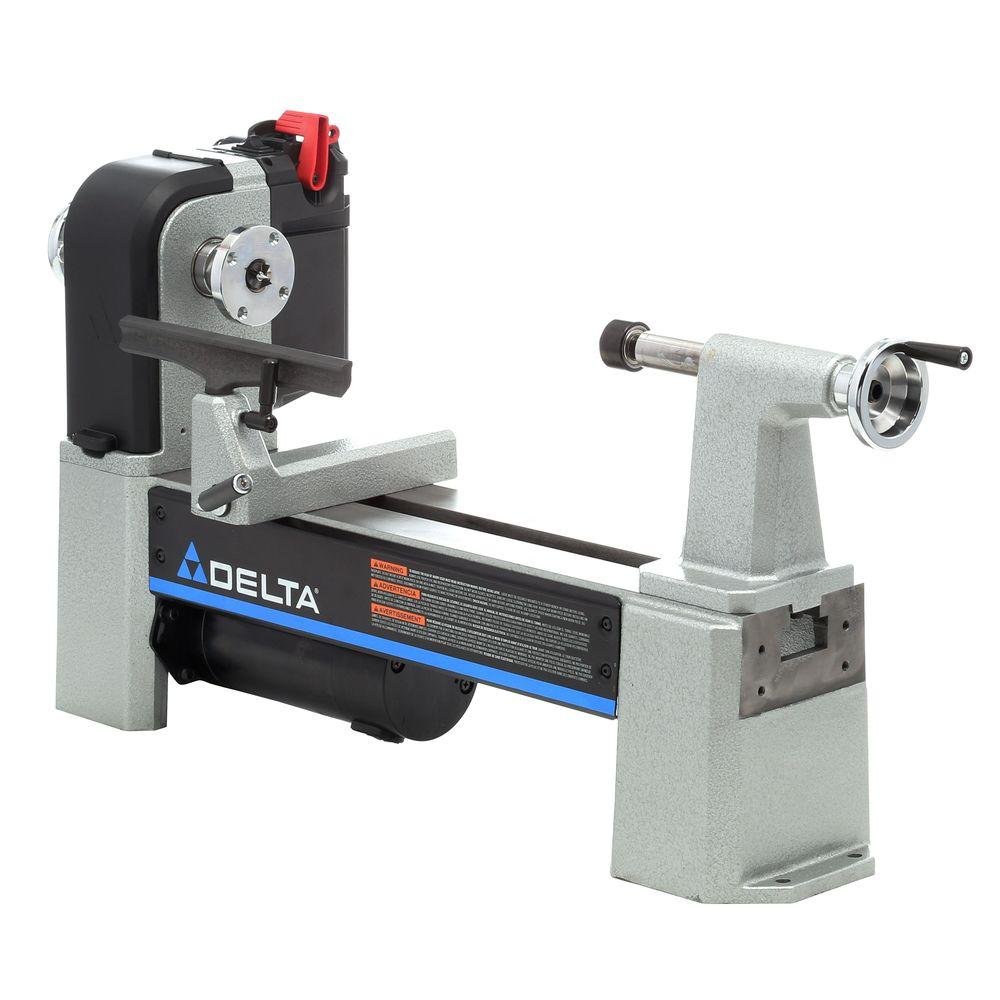
The 12-amp midi that turns down to a whisper and pulls through tough cuts.
The number that defines this lathe is 12 amps. That is the highest amperage among the midi lathes here — versus 4.5 A on the WEN LA3424 — and it drives a 1 HP motor through a maximum 4000 rpm. It tops out higher than any other lathe on this list except the JET JWL-1221VS’s equal peak, so sanding and finishing small spindles go fast. Swing is 12-1/2 inches and distance between centers is 16-1/2 inches.
Speed comes in three pulley ranges — 250–700, 600–1,800 and 1,350–4,000 RPM — which means you pick a band and then use electronic variable speed within it rather than changing belts for every tweak. A patented belt tensioner sets the correct tension automatically. The all-cast-iron build gives it stability, and quiet operation is one of the qualities turners single out. It runs at 4.0+ stars and includes 6-inch and 10-inch tool rests.
The trade-off worth noting: with just 16-1/2 inches between centers, long spindles need a longer tool rest or repeated repositioning. Speed control and belt adjustment both draw mixed feedback, so expect to learn the band changes. For a midi that turns bowls quietly and pulls hard, the 12 A motor is the reason it stays on the short list.
The defining spec: 12 amps and 1 HP through a 4000 rpm top end give this midi real grunt for its size.
One thing to plan for: 16-1/2 inches between centers is the shortest on this list, so factor in a longer tool rest for tall spindles.
Right for: a quiet cast-iron midi with the amperage to power through stubborn cuts.
Think twice if: you regularly turn long spindles — the short center distance will bite.
5. JET JWL-1221VS Woodworking Lathe

The one that starts at a crawl so a rough blank never gets away from you.
What makes the JWL-1221VS click for home shops is the bottom of its speed range: 60 RPM. That lets you start a lopsided, out-of-round blank spinning slowly while you true it up. From there it climbs through three belt ranges — 60–900, 110–1,800 and 220–3,600 RPM — with a dial for speed inside each band and a digital readout so you always know your spindle speed. A 1 HP DC motor runs it on standard 115V household power.
The mass is the other half of the story. At 121 pounds it is 72% heavier than the 70.3-pound WEN LA3424, and the cast-iron bed, tool support and base soak up vibration for smoother cuts. That weight is also the recurring gripe — it is a two-person lift onto a bench or the optional stand. A removable safety key and a no-auto-restart after power loss round out the safety side, and it carries a 5-year warranty.
Owners clearly lean toward it — it sits at 4.0+ stars with the quality praised most, followed closely by speed control, and the quiet, smooth operation earns steady credit. Forward/reverse switchable while running helps with sanding, and 24 indexing positions hold work for fluting. The stability feedback is mixed and the durability chatter is negative, so seat it solidly on a sturdy bench and you get the best of it.
Why it leads the midi field
- 60 RPM low end makes starting rough blanks safe and calm
- 121 pounds of cast-iron mass dampens vibration for smooth cuts
- Digital RPM readout plus three belt ranges from 60–3,600 RPM
- 5-year warranty and forward/reverse for sanding and finishing
What to plan around
- 121 pounds needs two people to set on a bench or stand
- Stability and durability both draw some mixed-to-negative feedback
- Belt range changes need the pulley doors opened
Go here if: you want a low 60 RPM start and real cast-iron weight in a 12-inch lathe.
Line up help first: at 121 pounds, get a second set of hands for setup.
6. JET JWL-1640EVS Woodworking Lathe

Sixteen inches of swing and a 40-inch bed for the turner going big.
This is where the class changes from midi to full floor lathe. Swing jumps to 16 inches and distance between centers to 40 inches, so platters, large bowls and long spindles stop being a squeeze. A 1-1/2 HP motor drives electronic infinitely-variable speed from 40 to 3200 RPM — no belt band to pick, just a dial across the whole range. The 40 RPM low end keeps a heavy, out-of-round blank controllable.
The engineering details favor bowl work. An extended spindle nose houses dual headstock spindle bearings, the tailstock quill uses an anti-rotation key, and the banjo holds the tool post with a non-marring positive locking wedge. A spindle lock frees both hands, and 36 integrated indexing positions cover fluting and layout. Owners rank quality as the top strength and find it smooth and easy to set up, holding 4.5+ stars. An enclosed inverter adds protection.
Two things to expect. At 377 pounds it is a serious install — plan the move and the footing. Weight and the headstock rotation both get mixed feedback, so dial in the rotation before you commit to a project. For a turner moving past 12-inch work, the 16-inch swing and 40-inch bed are the reasons this earns the step up.
What sells it: 16-inch swing, 40-inch capacity and 40 RPM low end combine to make big, unbalanced bowl blanks feel tame.
Choose it when: your projects have outgrown a 12-inch midi and you want a full 40-inch bed.
Mind the install: 377 pounds is a floor-machine move, and check the headstock rotation on arrival.
7. Laguna Revo 18|36 Wood Lathe
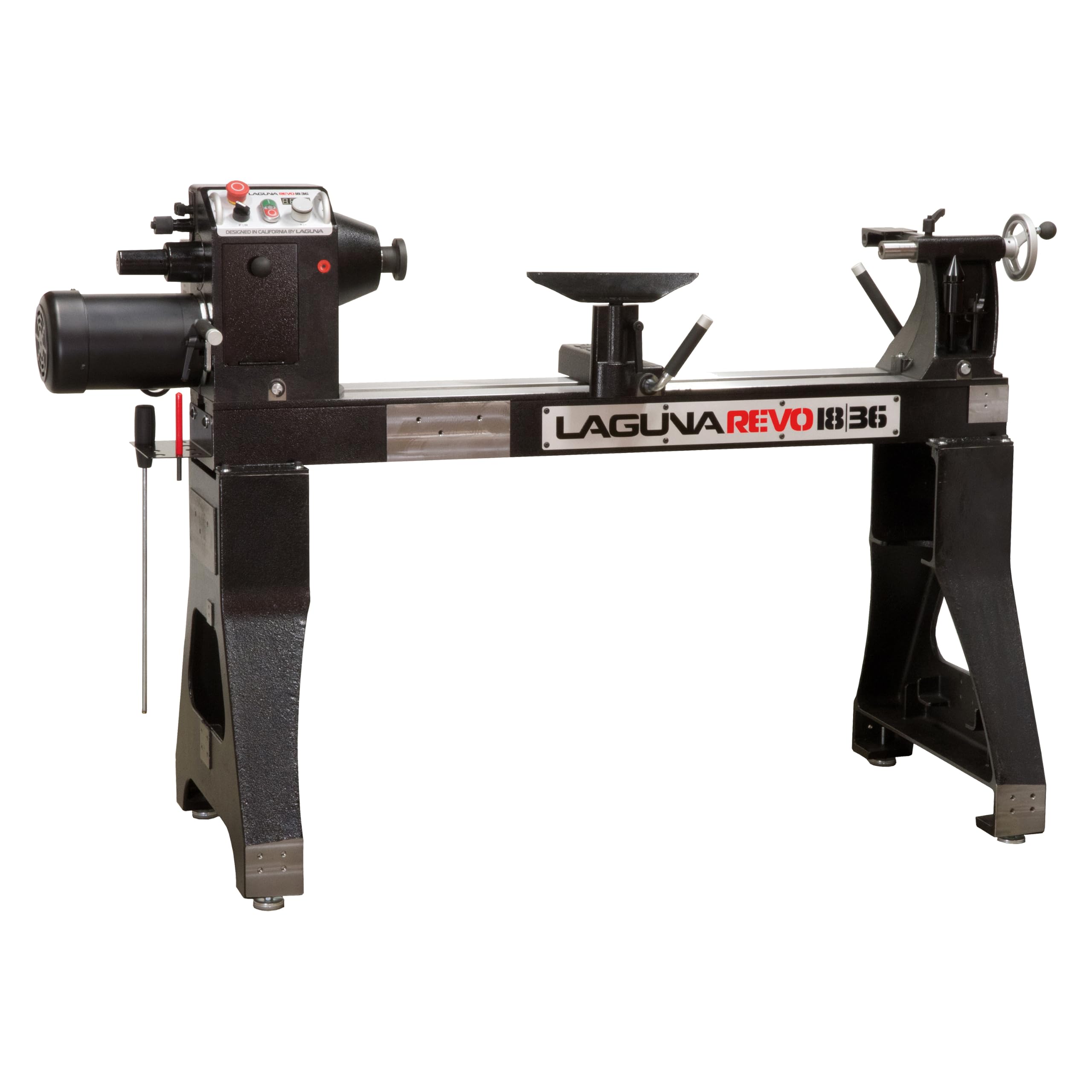
An 18-inch swing and a 2-HP motor built for big, heavy turning sessions.
The Revo 18|36 is a floor machine for turners who regularly work large stock. An 18-inch swing over bed and 36 inches between centers let you spin substantial bowls and platters, while a 2 HP 220V induction motor with a Delta S1 VFD delivers torque that holds up under a big, unbalanced blank. Speed runs 50–1300 RPM in the low range and 135–3500 RPM in the high range, with a digital RPM display for precise settings.
The frame is built to stay calm under that load: an ASTM A36 steel bed and a cast-iron headstock give it the stability to keep cuts clean, with the mass to match — 427 pounds. The control panel is angled so you read it without leaning over, and cam-lock handles plus a rubber-grip adjustment knob speed up your workflow. Owners describe the performance as exceeding expectations and rate assembly and build quality as strengths, landing at 4.5+ stars.
Two practical facts to weigh. It needs a 220V circuit at 15 A, not a standard household outlet, so confirm your shop power before you buy. And 427 pounds is a genuine floor installation. If large bowls and platters are your focus and you have 220V available, this is a production-capable lathe.
Power-first verdict: 2 HP on 220V with an 18-inch swing puts this in a different league from the midi lathes above.
Best for: turners working large bowls and platters who have a 220V shop circuit.
Check your power: it runs on 220V at 15 A, so a standard outlet will not do.
8. Powermatic PM2014 Wood Lathe
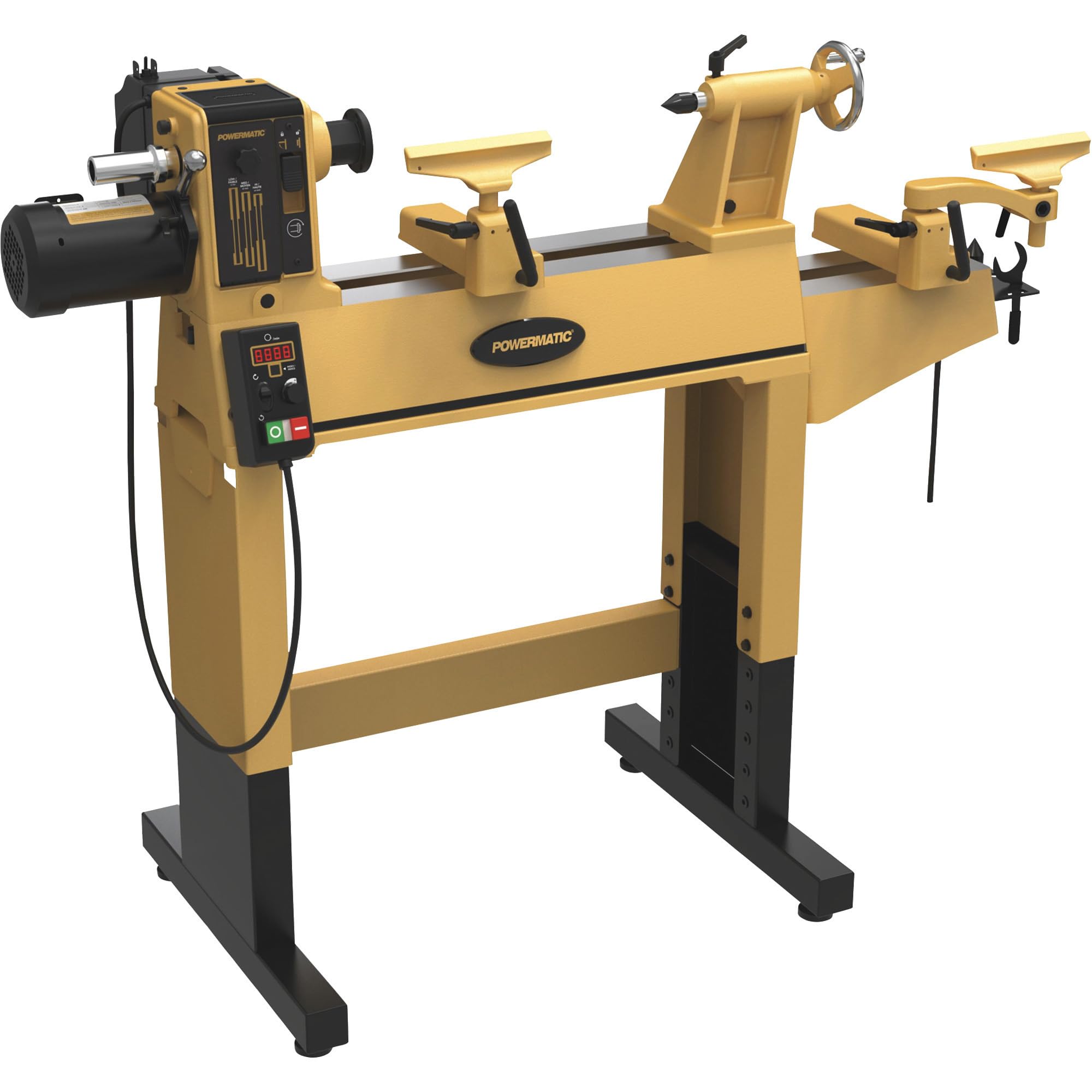
A 120V floor lathe that lets you set turning height standing or seated.
The PM2014 solves a problem the other floor lathes leave open: turning height. The included stand sets the spindle centerline anywhere from 34 to 44-1/2 inches off the floor, so you can stand or pull up a stool and work comfortably. An inverter turns standard 120V single-phase power into 3-phase for a 1 HP totally enclosed, fan-cooled motor, and it plugs into a 15A circuit — most VFD lathes will not run on a GFCI outlet, so check your setup.
Swing is 14-1/4 inches over the bed (10-3/4 inches over the tool rest base), and distance between centers is 19-1/4 inches — 20-1/4 inches with the stop bolt removed. Three belt positions give 15–900, 30–1,800 and 60–3,600 RPM, with a dial for exact speed and a digital RPM display. The cast-iron bed, headstock and tailstock damp vibration, and the headstock slides to the end of the bed for outboard turning. There are 24 positive-locking index positions.
One handy extra is the magnetic control box — it sits anywhere on the lathe and shows speed or index position on its LED readout. The lathe weighs 183 pounds plus a 55-pound stand, and it disassembles for moving, which eases getting it into a home shop. A 5-year warranty backs it. The main thing to confirm is your outlet type, since the GFCI note catches some shops.
What stands out
- Adjustable stand sets spindle height from 34 to 44-1/2 inches
- Runs 3-phase motor on 120V, 15A standard household power
- 15–3,600 RPM across three ranges with digital readout
- Magnetic control box, 24 index stops and 5-year warranty
Before you commit
- Will not run on most GFCI outlets — check your shop wiring
- 183 pounds plus a 55-pound stand is still a two-person job
Fits you if: turning height matters and you want a floor lathe on 120V power.
Verify first: your outlet is not GFCI-protected, since these VFD lathes typically will not run on one.
9. Powermatic 3520C Woodworking Lathe
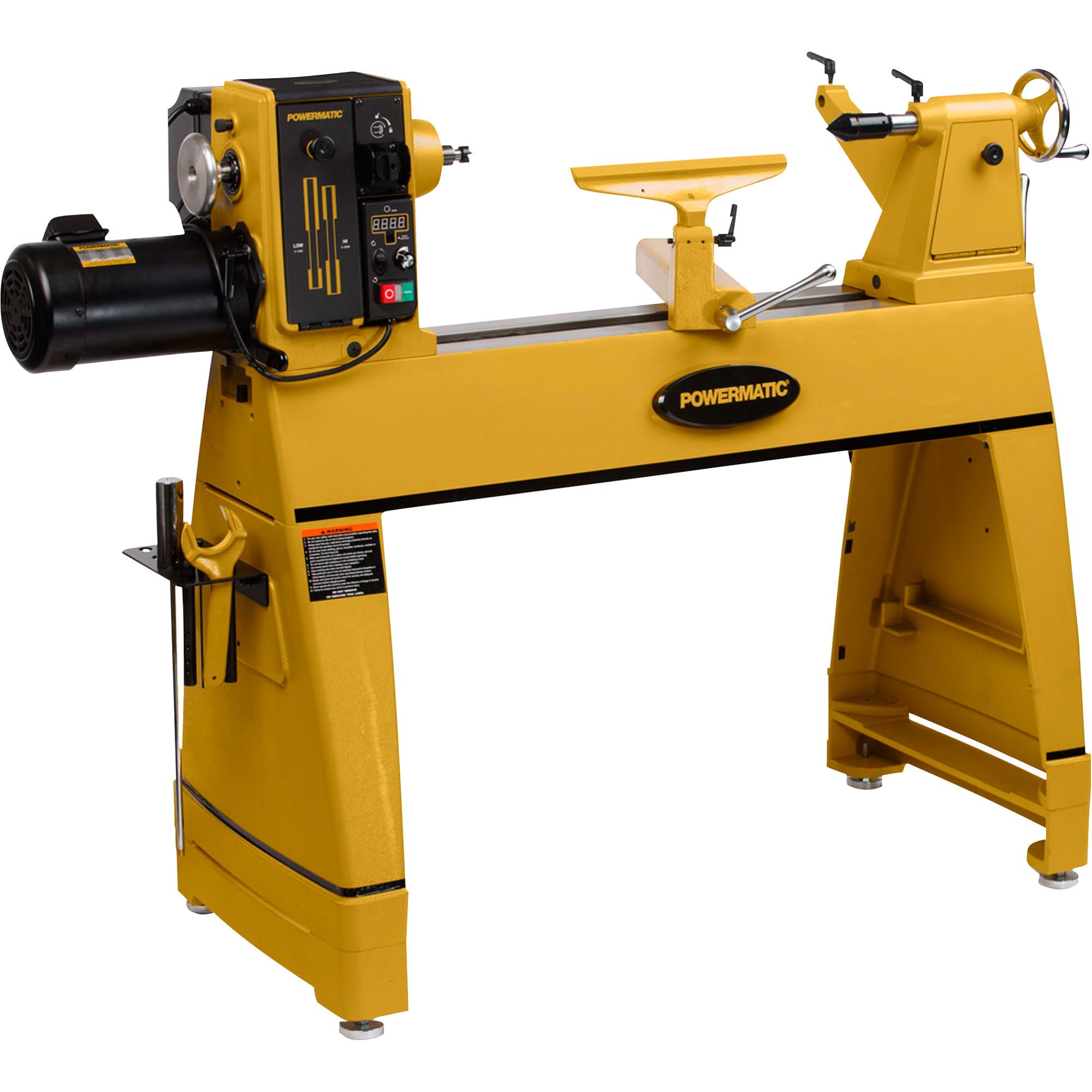
Twenty inches of swing and 726 pounds of cast iron for full-size turning.
The 3520C is the biggest machine here — a 20-inch swing and 35 inches between centers, driven by a 2 HP motor on 220V at 20 A. Variable speed holds as low as 15 RPM and as high as 3200 RPM, so a raw, uneven blank starts gently and small spindles still spin fast. A fully enclosed VFD adds user protection, and a digital indexing readout simplifies setup for fluting and layout.
The build is pure production shop. Cast iron throughout, at 726 pounds, gives it the mass to stay planted under heavy stock. Riser blocks offer 4 inches of height adjustment for comfort, an upgraded banjo uses a non-marring pinch-style clamp for solid tool-rest placement, and an extended spindle nose improves access to the workpiece. The magnetic-backed control box moves where you need it.
Owners call it a beast and rate its construction and performance highly — quality is praised most, with durability close behind — landing at 4.5+ stars. The weight draws mixed feedback, and at this number it is a permanent floor installation rather than something you shift around. Power it needs: 220V at 20 A. If you turn large production work and can meet the electrical demands, this is the top of the range.
Top of the heap: 20-inch swing, 15 RPM low end and 2 HP make this the most capable lathe on the list for large stock.
For the production turner: large work, heavy stock and a permanent shop spot.
Know your limits: 726 pounds and a 220V, 20 A circuit mean this is a floor commitment, not a bench drop-in.
Know the Specs
Swing Over Bed
Swing is the largest diameter a lathe can turn over its bed — a 12-inch swing means bowls up to roughly 12 inches across. This single number sets your ceiling on bowl and platter size. Distance between centers sets the longest spindle you can turn. Size swing and center distance to your largest planned bowl or spindle, plus an inch or two of headroom.
RPM Range
RPM is how fast the spindle spins. A low floor — 60 or 250 RPM — lets you start a rough, unbalanced blank gently and true it up before speed climbs. The top end speeds up sanding and finishing on small spindles. A 60–3600 RPM range with a 60 RPM floor beats a lathe that only advertises a 4000 RPM top end.
Tapers and Spindle Thread
The taper (MT2 is the common mid-size standard) and the spindle thread (1″ x 8 TPI is typical) decide which chucks, faceplates and centers mount on your lathe. Check for MT2 tapers and a 1″ x 8 TPI thread so your existing chucks and faceplates bolt straight on.
Motor, Amperage and Horsepower
Horsepower and amperage tell you how hard the lathe can pull through a heavy cut. A bigger motor handles larger, heavier blanks with less bogging. On floor machines, the power source matters too — some run on 220V at 15 A or 20 A, which affects what circuit you need in the shop.
Common Questions
Can a 12-inch swing lathe turn a large bowl?
What is the difference between a MIDI lathe and a full-size lathe?
Do I need a 220V outlet for a large lathe?
What does MT2 taper mean for my accessories?
Why does a low RPM setting matter on a lathe?
Can I turn pens on a full-size lathe?
How heavy is too heavy for a benchtop install?
What spindle thread is standard for wood lathes?
Is a variable-speed dial better than a fixed-speed belt lathe?
Do wood lathes come with a warranty?
The Bottom Line
For most home turners, the wood turning lathes winner is the WEN LA3424 because its 12-inch swing, 18-inch capacity and MT2 tapers cover bowls, cups and spindles with a very fair outlay — and it stands at 4.5+ stars. If you want a speed dial and more power in a midi footprint, reach for the PSI Turncrafter KWL-1218VS and its 1 hp variable motor. And for a low-RPM, heavy cast-iron start in a 12-inch machine, the JET JWL-1221VS with its 60 RPM floor and 5-year warranty is the one to reach for. Whichever you pick, match swing and low-end RPM to the bowls and spindles you actually plan to turn.
How we choose
We do not accept paid placement. Every pick is matched to a real buyer and a real use-case; we do not hands-on test units.
Sources
Specifications: manufacturer listings and product documentation. Review insights: verified customer reviews, as of November 2026. Pricing: not shown on this page (it changes often); check the current price via the retailer link.
As an Amazon Associate, Tactical Gear Guy earns from qualifying purchases. This does not affect which products we feature.