Specs are compiled from manufacturer listings and verified buyer reviews and can change over time — please confirm the key details on the product page before buying.
You want bass you can feel in your chest, not a trunk lid buzzing over every note. The single biggest factor in getting there is the wood box your subwoofer sits in — the material, the thickness, and whether the panel joints are actually sealed. Get that right and a modest sub sounds deep and clean. Get it wrong and even an expensive driver turns to mush.
This guide is built by comparing the manufacturers’ published specifications and the patterns across verified customer reviews, so you get each pick’s real strengths and trade-offs instead of marketing spin.
You get sealed and vented boxes here in 10, 12 and 15-inch sizes, with the airspace and tuning numbers spelled out so you can match one to your sub and your vehicle. Picking the right wood subwoofer box depends on two things: airspace (the internal volume of the box) and mounting depth (how deep a sub the box can hold) fitting your driver and your trunk.
Top Picks


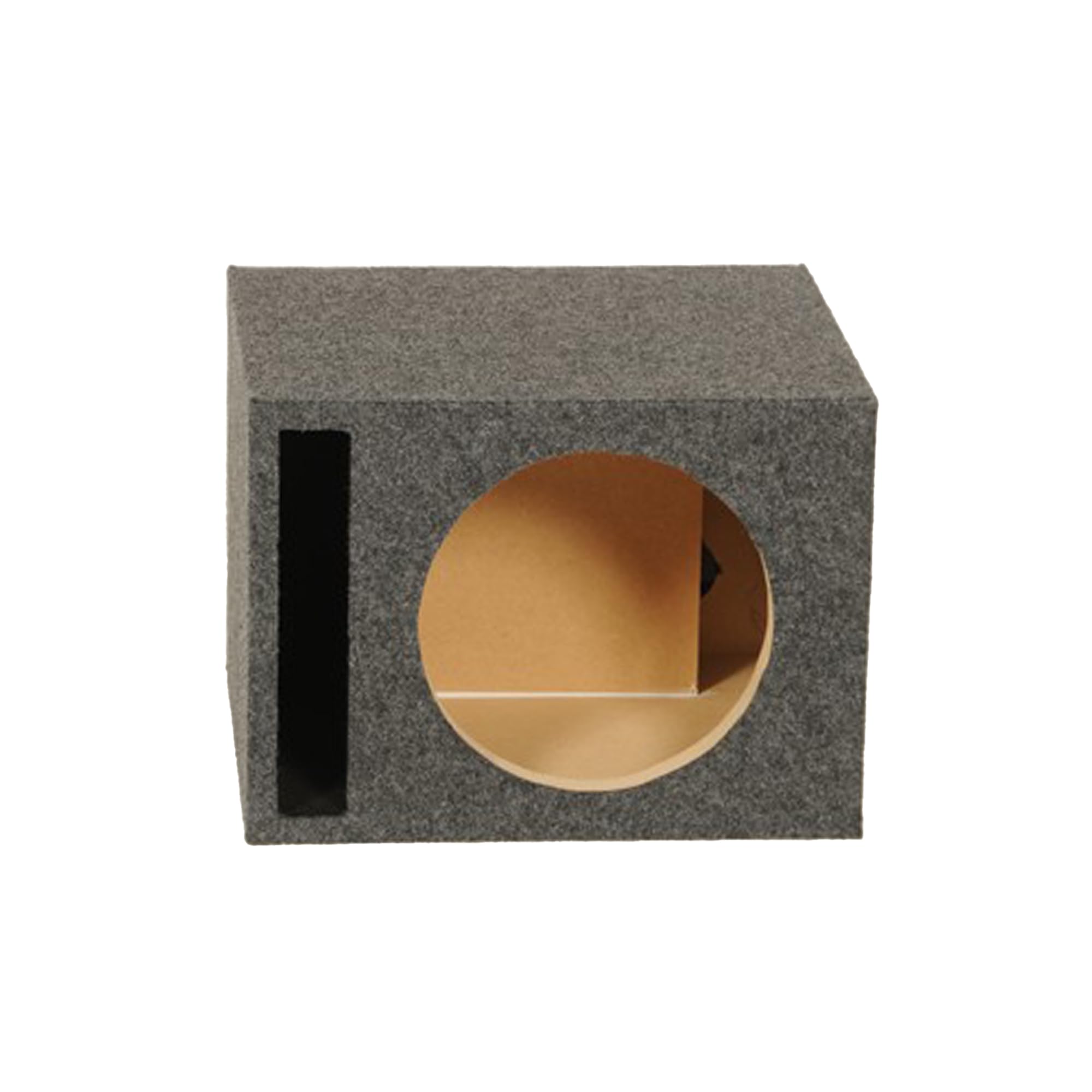
How To Choose The Best Wood Subwoofer Box
A subwoofer box is not a passive accessory. It is a tuned air chamber, and the wood it is built from holds that chamber rigid while the driver hammers against it. Your shopping job is simple: match the box to your subwoofer and to the space you actually have.
Match the airspace to your driver
Airspace is the internal volume of the box, measured in cubic feet. Too little air and a sub sounds choked and boomy; too much and it loses control. Each listing here states its own figure, so check yours against your subwoofer maker’s recommendation before you buy. The QPower two-pack of 10-inch sealed boxes runs 0.9 cubic feet per box, while the QPower HD115 single 15-inch vented box runs 2.7 cubic feet — very different chambers for very different drivers.
Sealed or vented changes the character
A sealed box traps air behind the driver, which tightens the punch and keeps bass accurate. A vented box adds a tuned port that lets that air escape in a controlled way, trading some accuracy for more output at the tuning frequency. If you want hard-hitting, precise kick drums, sealed is the safer bet. If you want volume, vented wins.
Check thickness, depth and cut-out before you commit
Thicker MDF resists flex, and flex is what muddies your bass. Most boxes here use 5/8-inch MDF, while the QPower single 12-inch vented box steps up to a 1-inch MDF face with 3/4-inch panels. Two more numbers decide whether your driver physically fits: mounting depth and the sub cut-out diameter. Measure both against your subwoofer’s spec sheet — a shallow box will not swallow a deep-magnet driver.
Side-by-Side Comparison
| Model | Best For | Driver Size | Airspace | Design | Amazon |
|---|---|---|---|---|---|
| QPower 2-Pack Single 10″ Sealed★ Best Overall | Twin-sub symmetry on a budget | 10 inches | 0.9 cu. ft. per box | Sealed, 5/8″ MDF | Amazon |
| ASC Single 12″ Truck BoxTruck Fit | Regular cab trucks | 12 inches | 0.80 cu. ft. | Sealed, 5/8″ MDF | Amazon |
| Q Power Single 12″ VentedThick-Wall Build | Thick-wall build | 12 inches | 1.5 cu. ft. | Vented, 38 Hz | Amazon |
| QPower HD115 15″ Vented | Big-output builds | 15 inches | 2.7 cu. ft. | Vented, 32 Hz | Amazon |
| ASC Dual 10″ Vented | Dual 10″ punch | 10 inches | 1.22 cu. ft. | Vented, 5/8″ MDF | Amazon |
| BELVA 1SV12B Single 12″ | Polyfil-lined smoothness | 12 inches | 1.8 cu. ft. | Vented, 36 Hz | Amazon |
| Atrend Bbox 12SVSC Single 12″ | Airtight glued joints | 12 inches | — | Vented, 40 Hz | Amazon |
| BELVA MDFD12 Dual 12″ | A full-width dual setup | 12 inches | — | Sealed, 3/4″ MDF | Amazon |
Detailed Reviews
1. QPower Pack of 2 Single 10-Inch Sealed Subwoofer Boxes
Our pick — 4.5+★ from 600+ verified ratings; the strongest balance of quality and price.
Two matching chambers in one order, so your dual-sub build comes out symmetrical from day one.
Building a balanced stereo sub stage usually means measuring and buying twice. This pair removes that step: two identical sealed 10-inch enclosures, each carrying its own terminal cup connector for a quick, secure hookup. You cut and wire once and end up with two chambers that behave the same way.
The wood here is 5/8-inch MDF (medium-density fiberboard — pressed wood fiber that stays stiff under bass pressure), finished in charcoal carpet that knocks down flex and vibration. Each enclosure measures 7.5″ deep, 20″ wide and 15″ high with 0.9 cu. ft. of internal airspace. Compared with the QPower HD115’s 2.7 cubic feet, this is the opposite end of the spectrum — 0.9 cu. ft. against 2.7 cu. ft., sized for tight 10-inch drivers rather than big-output 15s. The sealed alignment sharpens punch and accuracy, so kick drums land cleanly instead of smearing.
Buyers keep calling this a finished product, not a rough kit — build quality and carpet finish both come up again and again. Buyers report running 500W RMS subs through them without trouble. The low end reaches deeper than the size suggests: review pages describe response down to 22 Hz and bass you feel through your body, not just hear. That real-world depth is why it takes the top spot.
What earns it the crown
- Two matched 0.9 cu. ft. chambers in one order for a symmetrical dual setup.
- 5/8-inch MDF with charcoal carpet that damps flex and vibration.
- Terminal cup connectors on each box keep wiring quick and secure.
- Sealed design keeps bass tight and accurate rather than loose.
The honest trade-offs
- Size draws split opinions — some find plenty of room, others want more.
- The wire connectors are the least-loved detail, so check seating carefully.
- 0.9 cu. ft. per box is tight; not every beefy 10-inch sub will suit it.
Go for it if: you are running — or plan to run — two 10-inch subs and want a matched pair that bolts straight in.
Look past it if: your driver needs a big chamber or a deep magnet, since 0.9 cu. ft. and the shallow dimensions are the ceiling here.
2. ASC Single 12 Inch Truck Sub Box Regular Cab Enclosure
Shaped for the sliver of space behind a regular cab seat, where a standard box simply won’t go.
Regular cab truck owners get the worst of the space problem. There is no roomy trunk, only a shallow pocket behind the seat. This enclosure is built for that pocket specifically: it measures 20″ wide, 15″ high, 5″ deep on one side and 7-1/2″ deep on the other, and it holds a single 12-inch driver in 0.80 cubic feet.
Put that against the QPower HD115, which carries 2.7 cubic feet — this box is the compact one in the pair, and that is the whole point. A 5-3/4-inch mounting depth means the majority of 12-inch subwoofers will drop in, and the 5/8-inch MDF shell stays solid under load.
Fit is the draw here, and not just for pickups: drivers are running it in small sports cars and specific trucks like a 2004 Sierra 1500 Extended Cab. An occasional 12-inch sub turns out a little shallow for the chamber, so measure your driver’s mounting depth first — that is the one spec that will decide it for you.
The standout number: 0.80 cubic feet of airspace inside a box only 5 inches deep on the narrow side — that is how it slips behind a regular cab seat while still holding a full 12.
The measurement to make: a few owners with chunky 12-inch subs find the depth snug, so check your driver against the 5-3/4-inch mounting depth before ordering.
Your box if: you drive a regular cab pickup or a compact car and need a 12 to fit where nothing else will.
Not your box if: you want a large air chamber for a big-output driver — 0.80 cu. ft. is deliberately tight.
3. Q Power Single 12-Inch Vented Heavy Duty Enclosure
A one-inch-thick MDF face on a single 12 chamber — the wall thickness is the headline.
Where most boxes on this list settle for 5/8-inch MDF, this one puts a full 1-inch thick MDF front on the driver side, then backs it with 3/4-inch panels. That front baffle is the panel a subwoofer pounds against hardest, so it is the right place to add meat. Less vibration means the bass stays tight instead of turning to rattle.
The chamber holds 1.5 cubic feet with a vent tuned to 38 Hz (hertz — cycles per second, the frequency where a ported box does its heaviest work). Compare that with the QPower HD115’s 32 Hz, and this box is tuned noticeably higher — 38 Hz versus 32 Hz — so it hits with more snap in the upper-bass range rather than digging into the ultra-low. It comes wrapped in charcoal grey carpet, and gold-tipped spring-loaded terminals give a secure, high-conductivity hookup that takes a few seconds rather than a few minutes of fiddling.
Why the numbers work: 1.5 cu. ft. of air and a 38 Hz tune give a single 12 room to breathe and land punchy, while the 1-inch MDF face holds the driver steady.
Worth knowing: it is a well-finished, thicker-walled option with a smaller pool of feedback behind it than the big-volume boxes here — solid build, but check that 38 Hz tuning suits the music you play.
Reach for this if: you want a thicker-walled single 12 ported box and listen to music that lives in the punchy upper-bass range.
Skip the upgrade if: your tracks dig for 30 Hz and below — the higher 38 Hz tune will not go as deep as the 32 Hz QPower HD115.
4. QPower HD115 15″ Heavy-Duty Single Vented Subwoofer Box

2.7 cubic feet of air behind a 15-inch driver — this is the volume champion of the group.
If you are chasing the deepest, loudest bass here, airspace is the number that matters most. This box carries 2.7 cubic feet, the largest chamber in the entire list. Against the 0.9 cu. ft. of a QPower dual 10 box, that is a vast difference in breathing room for a big driver. A 15-inch sub needs a large vented chamber to unload properly, and this one is built for exactly that.
The shell uses heavy-duty MDF with a 1-inch thick front and 3/4-inch body panels, wrapped in charcoal carpet. It is tuned to 32 Hz, the lowest tune on this list, so it digs into the sub-bass regions where a 38 Hz box cannot reach. It also adds circular recessed panels around gold-tipped spring-loaded terminals for a clean-looking install.
Owners describe it running clean with no rumble, and quality is what gets praised most, with functionality and value right behind. The one recurring friction point is the subwoofer hole: some find it a good fit for a 15, others find it a touch oversized, so dry-fit your driver before you finalize anything. Durability reports split the same way — most are happy, a few are not.
The deep-bass pick: 2.7 cu. ft. and a 32 Hz tune make this the one to choose when you want that low, rolling output that smaller sealed boxes simply cannot produce.
Built for you if: you run a 15-inch sub and want the deepest tuning and biggest chamber available here.
Think twice if: your driver is a picky 15 with an odd cut-out spec — dry-fit it first, because the hole size is the one thing owners disagree on.
5. ASC Dual 10 Inch Vented Subwoofer Box Ported Enclosure

Two 10-inch drivers facing forward in one wide, ported cabinet that spans the whole trunk.
A single-sub setup caps your output. This enclosure holds two 10-inch subs in a ported chamber that runs 32-1/4″ wide, 12-1/4″ high and 14-1/2″ deep, with 1.22 cubic feet of airspace and a 13.75-inch mounting depth. That depth swallows the majority of 10-inch subwoofers, including the deeper-magnet ones that shallow boxes reject.
Sound is the clear strength. Owners mention it hitting both hard highs and super-lows, and it is built for stereo output so the audio stays balanced left to right. What draws the most praise, by a wide margin, is the sound quality, with the box quality itself right behind it.
Here is the fair caveat: build quality gets mixed reads, with some finding weak factory glue, and one strand of feedback mentions rattling. Treat that as guidance rather than a dealbreaker — check the joints on arrival and a bead of your own glue on any loose seam settles it. A snug fit in a car trunk confirmed by owners rounds out the picture.
The dual-sub upside: 13.75 inches of mounting depth and 1.22 cu. ft. of air make room for two deep-magnet 10s and real output.
One job on arrival: inspect the seams and re-glue anything loose — that is the piece of feedback that turns up most on this box.
Right for: anyone wanting dual 10-inch output and room for deep drivers in a single wide cabinet.
Shop elsewhere if: you would rather never touch a glue gun — a robotically sealed box may suit you better.
6. BELVA 1SV12B Single 12” Vented Subwoofer Enclosure

A pre-lined 1.8-cubic-foot chamber that takes the guesswork out of stuffing a box.
Lining a box with polyfil (a loose synthetic fill that slows the air inside and makes the chamber behave as if it were larger) is normally a do-it-yourself step. BELVA does it for you. This single 12 vented enclosure arrives at 1.8 cubic feet, already lined, so you get the smoother low end that fill brings without taping polyester to the walls yourself.
The shell is 3/4-inch MDF with durable black carpet, gold terminals and a 36 Hz tune — between the 32 Hz QPower HD115 and the 38 Hz Q Power single 12. That middle tuning lands it well for general music, deep enough for sub-bass but still punchy. The construction quality is what wins people over most, and the sound gets praised right behind it.
It delivers the deep booms and explosions movies and heavy tracks ask for, and it drops snugly into a trunk like a 2010 Camaro’s. The one soft spot is the carpet, which can peel back over time if you drag the box around — treat it with care and that layer stays put.
Why buyers warm to it: the polyfil lining and 3/4-inch MDF together give a fuller, smoother bass than many bare boxes of the same size.
Pick it when: you want a single 12 that sounds bigger than 1.8 cu. ft. suggests, with the interior lining already done for you.
Bear in mind: the carpet can peel if the box is dragged in and out — keep it settled in the trunk.
7. Atrend Bbox 12SVSC Single Vented 12 Inch Subwoofer Box

The box built like furniture — glued, nailed and mitered so the air chamber stays truly sealed.
Most boxes are screwed or stapled together and hope for the best. Atrend builds this one differently. It uses aliphatic wood glue (a strong woodworking glue) on the 5/8-inch MDF (medium-density fiberboard, a dense engineered wood), then adds a second glue pass around all internal joints after assembly. Brad nails from a pneumatic nail gun hold everything while the glue dries, and CNC miter plus dado construction (machine-cut angled and grooved joints) gives a precision fit. The payoff is a rattle-free, no-leak chamber, which is exactly what keeps bass clean instead of buzzy.
Sound quality is the number one thing owners notice, with the box itself and build quality right behind it. That airtight chamber pays off on low-end reproduction, and the 40 Hz tune gives a punchy, tight character. Mounting depth is 13.875 inches with an 11.125-inch sub cut-out, 13.625″ high, 16″ wide and 17.375″ deep.
Two honest notes. The sub cut-out is small for some drivers, so check your sub’s diameter against that 11.125-inch figure before ordering. And while most say it holds up over time, a few flag durability — the trade-off of a very precisely glued box is that you treat the joints kindly.
Where the craftsmanship shows
- Double glue application and brad nails for an airtight, rattle-free chamber.
- CNC miter and dado construction for a precise, tight fit.
- 5/8-inch MDF built for solid low-frequency response.
- Sound quality is the standout in owner feedback.
Measure before you order
- The 11.125-inch sub cut-out reads small for some drivers.
- Size splits opinions — some find it perfect, others want more.
- A few durability notes put this in the handle-with-care camp.
Best matched to: a buyer who values a genuinely sealed, glued chamber over a bare-bones box, and who will measure the cut-out first.
Not the fit if: your sub has an oversized mounting diameter — that 11.125-inch cut-out will not open up for you.
8. BELVA MDFD12 Dual 12-inch Sealed Subwoofer Box
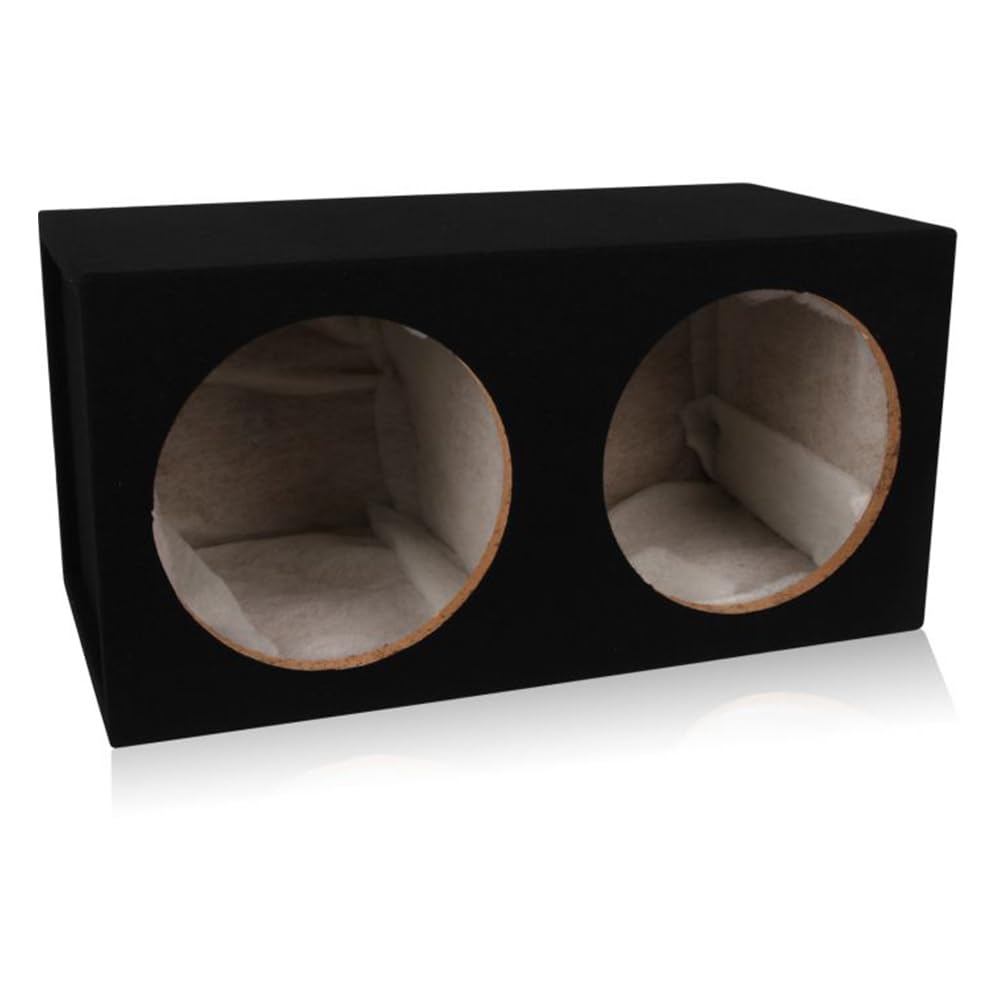
A wide, low dual-12 cabinet that lines up across the trunk floor for a tidy stereo stage.
If you want two 12-inch subs in one sealed home, this is the biggest chamber footprint of the dual options. It runs 28-1/2″ long, 14-1/4″ deep and 14-1/4″ high, so it sits low and wide across a trunk or hatch floor. Two drivers face forward in a single rigid shell for a balanced left-right image.
The build is 3/4-inch MDF throughout — denser and more consistent than thinner board, which is what keeps the sound steady — and it arrives prelined with polyfil for a fuller low end. Gold post terminals give clean, easy wiring access, and the black carpet is both stylish and there to guard against exterior scratches. Owners single out the box itself as the standout, with sound quality close behind.
Bass is judged clear and accurate; the clearer thumps from kick drums in metal music land exactly as they should. The one weak point is the connectors, which several find cheap, plus mixed feedback on the padding. Grab your own terminals if you are fussy, and this dual-12 delivers otherwise.
The dual-12 case: 3/4-inch MDF all round plus a prelined interior makes this a stiff, sealed foundation for two 12s.
Choose it if: you are running two 12-inch subs sealed and want one wide, rigid prelined cabinet.
Factor in: replacing the cheap-feeling terminals if you want a factory-fresh wiring experience.
Know the Specs
Airspace (Cubic Feet)
This is the internal volume of the box, and it has to match your subwoofer. A sealed 10-inch box might run 0.9 cubic feet while a single 15-inch vented box can need 2.7 cubic feet — the driver’s magnet and cone size dictate it. Too little air chokes the bass; too much and it loses control. Always compare a listing’s airspace number to your sub maker’s recommended volume.
Sealed vs Vented
A sealed box traps air behind the driver for tight, accurate punch and a smaller footprint. A vented box adds a tuned port that releases air at a set frequency for more output, but demands a larger chamber. Choose sealed for precise kick drums and rock or metal; choose vented when you want maximum volume and a deeper low-end push.
Tuning Frequency (Hz)
A ported box is tuned to one frequency, measured in hertz (Hz — cycles per second). A lower tune like 32 Hz digs into deep sub-bass; a higher tune like 40 Hz favors punchy upper-bass snap. Match the tune to your music — low for electronic and hip-hop depth, higher for tight, quick-hitting bass.
MDF Thickness and Mounting Depth
Medium-density fiberboard (MDF) is the pressed-wood board these boxes are built from. Thicker is stiffer, and stiffer means less panel flex muddying the bass — 5/8-inch is the common standard, while a 1-inch front face adds real rigidity where the driver pounds hardest. Mounting depth, meanwhile, is how deep a cavity the box provides; your sub’s magnet has to fit inside it or the sub will not seat.
Common Questions
Will a 12-inch sub fit in a box with a shallow mounting depth?
Is a sealed or vented box better for tight, punchy bass?
How much airspace does a subwoofer box actually need?
What does tuning frequency in Hz mean on a vented box?
Will a dual 12-inch box fit in my trunk?
Does the MDF thickness really matter for bass quality?
Should I line or stuff my subwoofer box with polyfill?
What subwoofer cut-out size do I need to check before buying?
Can I use one subwoofer in a dual-subwoofer box?
How do I stop my subwoofer box from rattling?
The Bottom Line
For most people building a bass setup, the wood subwoofer box winner is the QPower two-pack of sealed 10-inch boxes. Two matched 0.9-cubic-foot chambers with terminal cups (the connectors your speaker wire clamps into) give you a balanced stereo stage in one order. It also holds the highest owner confidence here, with 4.5+ stars across 600+ ratings. If you have room for one big driver and want depth, grab the QPower HD115 for its 2.7 cubic feet and 32 Hz tune (the low frequency the port is tuned to boost). For a glued, airtight single 12, reach for the Atrend Bbox 12SVSC. Want the deepest single-sub output here? The HD115’s extra airspace and lower tune are exactly why it takes that job.
How we choose
We do not accept paid placement. Every pick is matched to a real buyer and a real use-case; we do not hands-on test units.
Sources
Specifications: manufacturer listings and product documentation. Review insights: verified customer reviews, as of November 2026. Pricing: not shown on this page (it changes often); check the current price via the retailer link.
As an Amazon Associate, Tactical Gear Guy earns from qualifying purchases. This does not affect which products we feature.