Specs are compiled from manufacturer listings and verified buyer reviews and can change over time — please confirm the key details on the product page before buying.
Your wall is the thing that decides whether your wood stove is a cozy centerpiece or a scorched hazard. A heat shield sits between the two — a non-combustible panel that blocks radiant heat and stops embers, soot and oil from blackening your wall, floor or deck. Get the wrong style and you own an expensive panel that blocks nothing where it matters.
This guide is built by comparing the manufacturers’ published specifications and the patterns across verified customer reviews, so you get each pick’s real strengths and trade-offs instead of marketing spin.
You will see sheets that tie to a railing with zip ties and rigid boards that carry a tested UL1618 rating. Both belong on this list, but they solve completely different problems. The trick is matching the panel to the surface you are protecting, and this guide to the wood stove heat shield lays out each one in plain terms.
Top Picks


How To Choose The Best Wood Stove Heat Shield
The first thing to work out is where the shield is going. A fabric sheet on a deck and a steel board on a hearth are not interchangeable, and buying the wrong style means returning a heavy box.
Decide the surface before the material
A wall behind the stove needs a panel that stands off the surface so air can move behind it. A floor in front of the stove needs a flat board that takes hot coals and ash. A deck or fence outdoors needs something that will not rot or soak up oil.
Flexible fireproof fabric is the outdoor answer. It ties on with hooks or zip ties and rolls up for storage. Rigid boards are the indoor answer, because they hold their shape and carry a tested rating.
Look for the R-Value, not the paint finish
R-Value measures how well a material resists heat passing through it. A board tested to UL1618 — the industry standard for hearth and wall protector boards — publishes that figure so a code inspector or insurer can check it.
Two boards can look identical from the front and behave very differently. The printed steel face is what you see; the fiber board backing is what does the insulating.
Check the size against your actual clearance
Measure the distance from the stove to the nearest combustible surface, then measure again. A shield that leaves an uncovered gap at the edge gives heat a path around it. When in doubt, size up: a panel that covers the full combustible area beats one that just clears the stove.
Side-by-Side Comparison
| Model | Best For | Material | Size | Weight | Amazon |
|---|---|---|---|---|---|
| 4′ X 6′ Grill Heat Shield★ Best Overall | Decks and railings | Glass Fiber | 71″L x 47″H | — | Amazon |
| Imperial Group USA Stove BoardHeaviest Hearth Board | Hearth floors | Non-combustible | 28 x 32 | 10.8 pounds | Amazon |
| T2UL2832WW-1C Stove Board | UL-rated floor or wall | Alloy Steel | 32″L x 28″W x 0.5″Th | 8 pounds | Amazon |
| T2UL2832GT-1C Slate Tile Board | Slate-look walls | Slate over fiber board | 32″L x 28″W x 0.5″Th | — | Amazon |
| Cast Iron Fireback with Feet | Inside the firebox | Cast Iron | 20 inch | — | Amazon |
| 26″ Adjustable Back Plate | Angled wall cover | Iron | 17″L x 13″W (2 panels) | 13 pounds | Amazon |
| US Stove Company Heat Shield | Clearance reduction | Metal | 51in.W x 42in.H | 18 pounds | Amazon |
Detailed Reviews
1. 4′ X 6′ Heat Shield for the Grill
Our pick — 4.5+★ from 250+ verified ratings; the strongest balance of quality and price.
A 47 by 71 inch sheet of coated fiberglass that ties onto a railing in minutes and rolls away when summer ends.
If your stove or grill sits near a wooden fence, a railing or a deck edge, outdoor heat damage is the whole problem you came to solve. This sheet covers a 4′ by 6′ span of it. The fiberglass core is coated on both sides with heat-resistant silicone, and the maker lists a working range of 900F with a 2000F melting point — a generous margin over what a grill throws off.
Grease, sauce and charcoal dust wipe off with a damp towel or rinse off with a hose, and the sheet goes right back up. When winter comes you fold it, store it, and forget it exists until the next season.
Function earns it the top slot — the most-praised trait in its reviews — with protection and build quality close behind, both drawing more positive notes than heat resistance. One phrase in the review pages sticks: it “stays cool to the touch.” It will not protect a floor under a wood stove — this is a hanging barrier, not a hearth board. The copper eyelets along the edge are what the included nylon ties thread through, so pick your tie points before you hang it.
Where this sheet shines
- Ties on with the included nylon ties and copper eyelets — no tools, no drilling
- 900F working range with a 2000F melting point covers live embers and hot oil
- Water-proof and oil-resistant, so soap and a hose handle cleanup
- Folds flat for off-season storage and doubles as a balcony privacy screen
Where it stops short
- It hangs rather than sits — there is no rigid floor protection here
- Nylon ties are the weak link over time versus metal hardware
Reach for this if: your heat problem is a deck railing, fence, gazebo tent or balcony wall that keeps getting blackened.
Look elsewhere if: you need a board lying flat under a wood stove — go rigid instead.
2. Imperial Group USA Stove Board
The dense 10.8-pound board built to sit under a pellet stove and stay put.
Mass is the honest headline here. At 10.8 pounds this board is noticeably heavier than the HY-C 28″ x 32″ board at 8 pounds, and that heft is why it feels planted once you set it down. The panel is non-combustible and carries ASTM compliance, so it is built to a recognized material standard rather than a marketing one.
What it does best is take the daily punishment a pellet stove hands out: ash, dropped embers and heat radiating downward. It also looks better than a plain utility board, and the black finish is a big part of why it lives in a room rather than a basement. The review pages are full of owners running it under pellet stoves and calling the appearance a pleasant surprise — the wood-look surface is frequently compared to real wood.
Here is the part worth knowing before you order a heavy item: it is not the most forgiving board to ship. The most-discussed traits across its reviews run to durability, condition on arrival and edge quality, and cracking or denting in transit does show up. Buying from a seller with straightforward returns is the smart move. Between this and the HY-C board below, this is the one for a setup where the board is visible.
Real-world strength: the combination of dead weight, a non-combustible build and a finish that passes as furniture makes it the easiest board to live with in a visible room.
Fair warning: check the board the day it lands, before you set anything on it — that is the moment a shipping problem is cheapest to fix.
The board for a pellet stove in a finished room: it holds its place and blends in, and that pairing is exactly what most owners are after.
Think twice if: you want a tested R-Value printed on the label — that is the HY-C board’s job.
3. T2UL2832WW-1C Stove Board

The one with a printed number you can hand to an inspector: R-Value 1.56, tested to UL1618.
Nearly every board on this list asks you to trust it. This one hands you a figure. It is tested to UL1618 Type 2 and publishes an R-Value of 1.56, which is the resistance measurement that actually decides whether a wall assembly passes code.
The build is embossed printed steel over a half-inch specially formulated fiber board backing, and it works two jobs: stove board under the appliance or hearth extender on the floor, and wall shield behind it. It is made in the USA and wipes clean easily — hand wash only.
The honest catch is the backer. The single largest theme across its feedback is build quality, and it comes out mixed rather than glowing; durability draws more critical comments than any other trait, with the fiber back crumbling and the corners bending under report. Treat it as a board that protects your floor well but is not built to be dragged around. If you want the same tested protection in a slate finish, the next pick is its sibling.
The case for it: a published R-Value of 1.56 plus a UL1618 test rating is the strongest documented protection story on this entire list, and it costs no more than boards that publish nothing at all.
Handle it like a board, not a shield: lift rather than slide it and the fiber back holds up far better.
Buy this when permitting, insurance or an inspector’s eye is in your future — the R-Value does the talking for you.
Skip the drag-and-drop treatment: the fiber backing rewards a little care.
4. T2UL2832GT-1C Slate Tile Stove Board, 28″ x 32″, Gray

Same tested protection as its wood-grain sibling, dressed in gray slate instead.
If the board is going to be visible in a living room, the finish is not a detail — it is the reason you pick one board over another. This version carries a gray slate tile face over the same half-inch fiber board backing, and it is the same construct as the wood-grain HY-C board above: embossed steel, UL1618 Type 2 testing, R-Value 1.56, made in the USA.
Coverage works out to 6.2 square feet from the 32″ by 28″ footprint, and the square edge lets it butt up neatly against trim or a hearth lip. It installs on the floor or the wall, so it can serve as the board under the appliance or as the shield behind it.
Slate reads cooler and more architectural than wood grain, which is precisely why it lands here at the higher end of the rigid-board group. The trade-off is that the slate-look face shows ash and soot smudges more plainly than a darker wood grain does, so keep a soft cloth nearby.
Pick slate over wood grain if your stove sits against a modern gray wall or tile hearth and you want the board to read as part of the floor.
Pick wood grain instead if you would rather hide ash smudges than show off the finish.
5. Cast Iron Fireback with Feet

This one goes inside the firebox and throws heat back at the room instead of soaking it into the brick.
Most shields on this list are defensive — they stop heat reaching a surface. A cast iron fireback plays offense. It sits at the back of the firebox, absorbs the fire’s radiant energy and bounces it forward into the room, so you get more usable warmth from the same load of wood. The panel measures 21 inches wide by 16 inches high, sized to fit most fireplaces.
Heat retention is the trait that wins people over here, and appearance runs second — owners like looking at it as much as they like what it does. The cast iron is heavy stock that is built to shrug off high temperatures and impacts without warping. Setup is genuinely simple: two brackets are included, you set the fireback onto them, and it is ready.
Size is the number to check twice. That 21 by 16 inch panel is roomy, but if your firebox opening is narrow it will not seat cleanly. It is also the indoor-fireplace answer specifically — a wood stove with a closed firebox door gains nothing from a panel hidden inside it.
Why it earns its place
- Sends radiant heat back into the room rather than letting the firebox swallow it
- Cast iron build resists high heat and heavy impact without warping
- Two brackets included, so it is standing and working in minutes
- 21 by 16 inch face suits most standard fireplace openings
What to measure first
- It needs an open fireplace — a closed wood stove gets no benefit
- Bare cast iron is heavy, so plan how you will lower it into place
For an open hearth that heats the room poorly, this is the pick that changes the math — the fire starts working for you twice.
Not your product if your stove has a sealed door.
6. 26″ Adjustable Fireplace Back Plate, 2 Pack
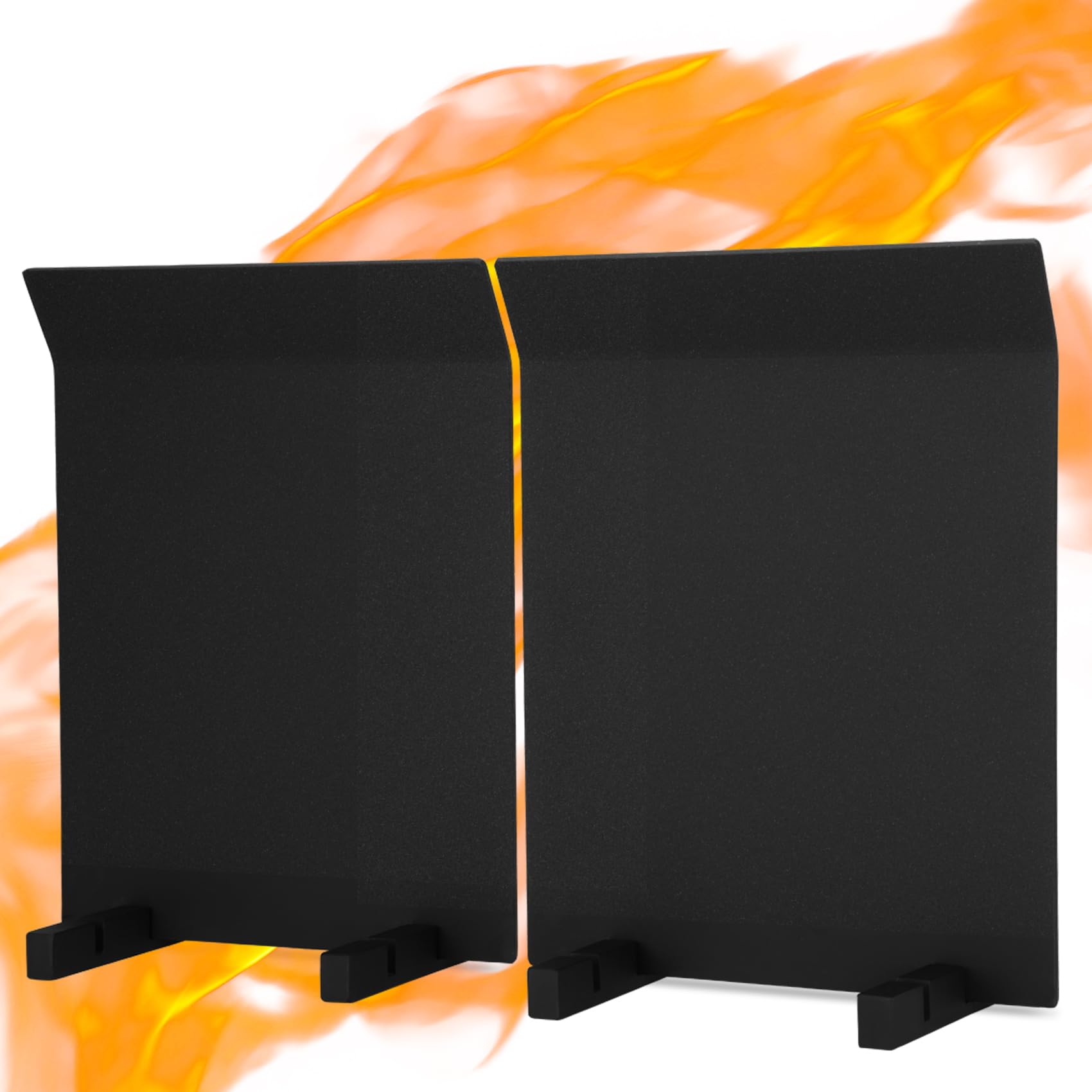
Two hinged iron panels you angle by hand until the heat lands where you want it.
Fixed shields make you work around them. This one works around you. It is a dual-panel design, and each panel swings to aim the reflected heat forward or to concentrate it on one spot, so the same fire can warm the room or a specific corner. Bolt the two together and the combined reflective face reaches 26 inches wide by 17 inches high — versus 21 by 16 inches on the cast iron fireback above, which is the widest coverage gap in this group.
The curved face is not just styling; it is what pushes heat back out into the room rather than letting it wash up the chimney. Four sturdy clip-on feet handle setup with no tools at all, and adjusting it later is just as quick — you lift, angle, and set it back down.
Heat efficiency is what buyers value most in it, and build quality follows right behind. The one thing to know before ordering is that the listing photographs the panels together: the headline 26 inch width is the two panels combined, not a single sheet. Measure a single-panel space and you may be surprised by what arrives.
What makes it different: adjustability. No other shield here lets you steer the reflective angle after installation, which is worth real money in a room where the seating is off to one side.
The measurement to double-check: confirm you are working with the combined 26 by 17 inch face, then plan the footprint accordingly.
Choose this if your fireplace is awkwardly placed and a fixed panel would aim heat at a wall you are trying to protect anyway.
Choose simpler if a straight-on fireplace needs no steering at all.
7. United States Stove Company Heat Shield

A 51 by 42 inch wall of 24-gauge metal whose real job is letting your stove sit closer to the wall.
Most of this list exists to protect a surface. This panel exists to reclaim floor space. It is a powder-coated 24-gauge steel shield that mounts between the stove and the wall, and its purpose is reducing clearance — the required safety gap between a stove and anything combustible. Put one up and the stove can legally sit nearer to the wall, which in a small room is the entire point.
At 51 inches wide by 42 inches high it covers more wall than any other shield here, and the 18-pound steel panel is substantial enough to stay flat. Heat resistance is the trait that gets the most praise after quality and function: owners point out the wall behind it stays cool to the touch, which is the only feedback that actually matters for a shield’s core promise.
The split in opinion is about what it costs relative to how plain it looks — a bare sheet of powder-coated steel does not dress up a room. But if the alternative is moving the stove or losing the clearance you need, a plain panel is a bargain. Confirm your specific stove’s clearance requirements against the panel size before you commit, since the point is the gap it buys you.
Why the size wins
- 51 by 42 inch coverage protects more wall than any other shield on this list
- 24-gauge steel with a powder-coated finish holds its shape
- Built to reduce clearances, so the stove can sit closer to combustibles
- The wall behind it reads cool to the touch after a burn
What you are getting into
- Plain steel styling — this is a safety component, not a decor piece
- At 18 pounds it is a two-person mounting job
The one to buy when clearance is the constraint and a smaller stove-to-wall gap would change how the whole room works.
Not the one to buy for looks — nothing about this panel pretends to be furniture.
Know the Specs
R-Value and UL1618
R-Value is a measure of how strongly a material resists heat moving through it. The higher the number, the harder it is for heat to pass from the fire side to the wall side. UL1618 is the standard test for hearth and wall protector boards, so a board carrying that rating has been checked against a published method. The T2UL2832WW-1C board publishes R-Value 1.56 and a UL1618 Type 2 rating, which is why it suits installations where documentation matters.
Heat resistance in temperature terms
Some shields state a working temperature and a melting point rather than an R-Value. The grill heat shield here lists a 900F working range and a 2000F melting point, which tells you how much heat the coated fiberglass can take before it fails. Rigid steel and cast iron boards do not publish the same figure, because their protection comes from mass and insulation rather than a fabric coating. Match the rating style to the job: temperature ranges for fabric barriers, R-Value for rigid hearth boards.
Common Questions
Can a heat shield let me put my wood stove closer to the wall?
What does R-Value 1.56 actually mean on a stove board?
Will a fireproof fabric sheet work behind a wood stove indoors?
Is a cast iron fireback the same thing as a wall heat shield?
How do I size a heat shield for my stove opening?
Are these shields heavy enough to need two people to install?
How do I clean a heat shield once soot and ash build up?
Can I use an outdoor grill heat shield on a wood stove floor?
Does a stove board need to be mounted to the wall or can it just sit there?
Will a heat shield block the warmth from reaching the room?
The Bottom Line
The wood stove heat shield that covers the widest range of buyers is the 4′ X 6′ Heat Shield for the Grill, because it handles the outdoor and wall-staining problems that send most people looking in the first place. It ties on with no tools, shrugs off 900F, and folds away when the season ends.
If your install has to pass an inspector or satisfy an insurer, take the T2UL2832WW-1C Stove Board instead — R-Value 1.56 and a UL1618 Type 2 rating are the documented protection nothing else here matches. And if the real problem is that your stove sits too close to the wall, the United States Stove Company Heat Shield is the one built to buy back that clearance in 24-gauge steel.
The rule that sorts all seven: match the shield to the surface — fabric for railings, rigid board for hearths — then check the panel size against your measured clearance.
How we choose
We do not accept paid placement. Every pick is matched to a real buyer and a real use-case; we do not hands-on test units.
Sources
Specifications: manufacturer listings and product documentation. Review insights: verified customer reviews, as of November 2026. Pricing: not shown on this page (it changes often); check the current price via the retailer link.
As an Amazon Associate, Tactical Gear Guy earns from qualifying purchases. This does not affect which products we feature.