Specs are compiled from manufacturer listings and verified buyer reviews and can change over time — please confirm the key details on the product page before buying.
Your stove is roaring, the spot right in front of it is too hot, and the sofa across the room is still cold. A heat-powered stove fan fixes that: it sits on the stovetop and pushes warm air out into the room, with no cord, no batteries, and no wall socket. What separates a good fan from a disappointing one is how much air it moves (measured in CFM, or cubic feet per minute) and how quietly it does it, so that is what this ranking is built on.
This guide is built by comparing the manufacturers’ published specifications and the patterns across verified customer reviews, so you get each pick’s real strengths and trade-offs instead of marketing spin.
Some fans start spinning the moment the stovetop warms and top out around 280 CFM, others barely stir the air at all — and the difference decides whether your back room stays chilly. Below you’ll find the wood stove heat fan that matches how you actually heat your home.
Top Picks
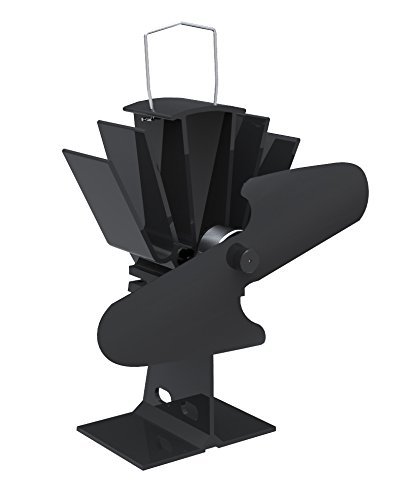


How To Choose The Best Wood Stove Heat Fan
Buying a stove fan is not complicated once you know the three numbers that matter: airflow in CFM, the temperature range the fan is built to survive, and the noise level. Everything else — blade count, finish, whether a thermometer comes in the box — is a bonus layered on top of those.
Start with airflow, not blade count
CFM stands for cubic feet per minute, and it is simply how much air the fan can push in a minute. A fan rated at 280 CFM moves noticeably more warm air than one rated at 100 CFM. Blade count helps, but more blades on a weak motor can still lose to fewer blades on a stronger one, so treat the CFM figure as your first filter.
Match the fan to your stovetop temperature range
Every heat-powered fan has a working temperature window. Below the low end it will not spin; above the high end the motor and the thermoelectric module (the part that turns heat into electricity) can be damaged. Many models build in a bimetallic strip in the base — a small metal strip that bends with heat and lifts the fan slightly off the stovetop to protect it. A magnetic stove thermometer clipped to the flue pipe lets you watch that temperature in real time.
Decide if you need heater compatibility
If you heat with a wood stove only, a plain freestanding fan is enough. If you also run a propane Buddy-style heater in a tent, barn, or ice-fishing shelter, look for a model that ships with a mounting bracket. That bracket is the difference between a fan that works on two heat sources and one that only works on the stovetop.
Side-by-Side Comparison
| Model | Best For | Airflow | Blades | Weight | Amazon |
|---|---|---|---|---|---|
| Caframo Ecofan Original★ Best Overall | Quiet whole-room heat on a wood stove | 100 CFM | 2 | 1.8 lb | Amazon |
| VODA 5-Blade Small FanBudget Starter | Budget-friendly starter fan | 180 cfm | 5 | 532 g | Amazon |
| HIDALIFE 6-Blade with ThermometerCompact Pick | Compact fan with built-in thermometer | — | 6 | 1.7 lb | Amazon |
| Buddy Heater Compatible Fan | Stove plus propane heater in one fan | — | — | — | Amazon |
| XTIMES 12-Blade Dual Motor | Maximum blade count on a budget | — | 12 | 1.6 lb | Amazon |
| Tomersun 16-Blade Dual Motor | Wide airflow in larger rooms | — | 16 | 575 g | Amazon |
| VODA 12-Blade Triple Motor | Highest airflow rating in the lineup | 280 cfm | 12 | 2 lb | Amazon |
| BLFIRE Heat Activated Fan | Dual-motor fan for heat sources beyond the stove | — | — | — | Amazon |
| Ecofan Original 100 CFM | Long-running classic design for wood stoves | 100 cfm | 2 | — | Amazon |
Detailed Reviews
1. Caframo Ecofan Original Heat Powered Stove Fan
Our pick — 4.5+★ from 500+ verified ratings; the strongest balance of quality and price.
Two blades, no cord, and a room that finally warms evenly instead of just near the stove.
Here is the headline for the two-blade Brazilian-built… no, Canadian-built classic: it moves warm air at 100 CFM and it does it without a plug, a battery, or a single decibel you’d notice. That 100 CFM figure is not the biggest in this lineup — the VODA triple-motor fan pushes 280 cfm on paper — but airflow is only half the story. What wins people over with this fan is simply that it works, consistently, whenever the stovetop is hot.
The stovetop range is where it earns its keep: 300F to 650F. Get your fire up into that window and the fan starts turning on its own, pushing heat off the top of the stove and out toward the rest of the room. Buyers report the whole room feels warmer, not just the zone in front of the firebox. It runs on zero electricity, so it keeps going through a power cut, which matters if your stove is your backup heat.
The catch worth knowing: air circulation is the one thing reviewers are split on — some find it moves warm air well and others say it barely stirs a big open room. That is not a defect so much as a fit issue. A 100 CFM fan suits a normal living room; a wide open-plan space wants more grunt. It is also the heavier of the two Ecofan options here at 1.8 pounds, versus 1.6 pounds for the XTIMES, so it sits a touch more solidly on the plate.
Where it shines
- Whisper-quiet operation — no whine competing with the fire
- Zero electricity, so it survives an outage
- Runs on any stovetop between 300F and 650F
- Canadian-made since 1955, with replacement motors and a warranty
What to weigh first
- 100 CFM is modest for a big open-plan room
- Two blades means less raw volume than a 12- or 16-blade fan
Reach for this if: you want a quiet, cordless fan that just works on a standard wood stove and keeps you warm through a power cut.
Look elsewhere if: your stove heats a large open room and you want the most air movement per dollar.
2. VODA Wood Stove Fan 5 Blades
The entry ticket to heat-powered circulation — small, silent, and rated for more airflow than the Ecofan.
If you are testing whether a stove fan is worth having at all, this is the one to start with. The only moving part is the blade assembly, and VODA rates the working noise under 25 dB, so you genuinely forget it is there.
The working window is 85-350°C. It starts spinning around 55°C and runs most efficiently between 200-300°C, which lines up with a well-tended fire. There is an overheating safeguard too: a metallic strip in the base lifts the edge of the fan slightly when you push past the top of its range, protecting the thermoelectric module inside. It recovers on its own as the stovetop cools.
Honest trade-off: durability is where this one has the most to prove. A number of owners find the fan gives out within a couple of months and mention vibration at higher speeds, so treat it as a low-cost trial rather than a lifetime fixture. If your fire runs hot and long every night, step up to a heavier build — otherwise, for occasional evening burns, it does the job.
The value read: 180 cfm and sub-25 dB noise for a budget-fan price, with an overheat strip that protects the module.
The honest caveat: this is a starter fan, not a buy-once fixture — plan for a shorter service life if it runs long and hot.
Best fit: first-time stove-fan buyers on a tight budget who want to see if circulation makes a difference.
Not the match for: anyone burning daily who wants one fan to last for seasons.
3. HIDALIFE Wood Stove Fan with Thermometer, 6 Blades
A compact six-blade fan that starts spinning in half a minute and tells you how hot the stove is.
Small footprint, real output. This fan sits just 2.2″D x 3.5″W x 7.9″H on the stovetop, yet it packs six aluminum blades and ships with a thermometer so you can read your stove’s temperature instead of guessing. The build is anodized aluminum, which resists rust and spreads heat well — that matters because the fan lives in a hot, ashy environment year after year.
What owners mention is a fan that kicks in fast: spinning within 30 seconds, and extremely quiet in use. It suits fireplace inserts especially well, distributing heat fairly evenly and running on nothing but the heat differential between the stove top and the air around it. The package is fan-only, so the thermometer is a helpful add-on rather than a full kit.
Compare it against the Buddy-compatible fan below and you see the trade: the HIDALIFE is the more compact choice for a plain stovetop, while that other model brings a bracket for propane heaters. Airflow is the honest weak spot here — some find it moves less air than they hoped — so if your room is large, temper expectations.
Size advantage: one of the smallest footprints in the lineup, easy to set down on a busy stovetop without crowding the kettle.
Where it falls short: airflow won’t match a big multi-blade fan, so it is best for a standard room.
Pick this when: your stovetop is short on real estate and you want fast startup plus a readable thermometer.
Think twice if: you need to move serious air across a wide open space.
4. Wood Stove Fan Compatible for Buddy Heater
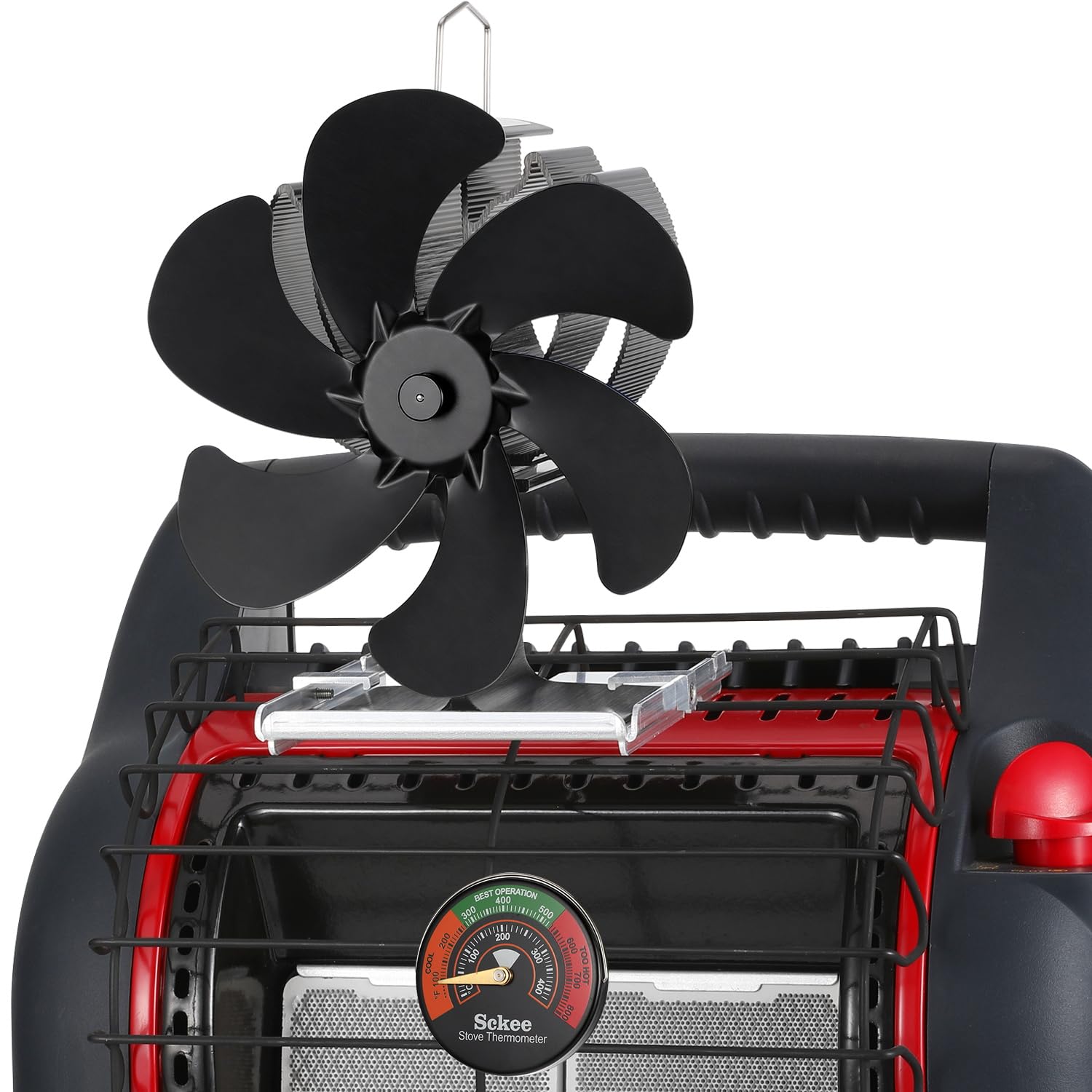
One fan that clips onto a Buddy propane heater as easily as it sits on a wood stove.
This is the fan for the person who heats with whatever is available — a wood stove at home, a propane Buddy heater in the barn, a tent at deer camp. The included bracket lets it mount on a Buddy heater, and without the bracket it drops straight onto a stovetop.
It runs with no cord and no battery, the same way as every fan on this list: a thermoelectric setup with a Stirling-style structure (a design that turns the stove’s heat into its own electricity). Safety is handled too — a bimetallic strip (two metals bonded together that bend as they heat) at the base lifts the fan’s front edge once temperatures pass 644°F/340°C, which guards the motor. A magnetic thermometer in the box lets you watch the fire’s temperature as you go.
Noise stays under 25 decibels, which is quieter than a fridge hum, so it won’t cut through a quiet evening or a night’s sleep. The one thing to size honestly is sturdiness — the build is rated mixed, so treat the bracket mounting with care rather than yanking the fan on and off repeatedly. For the hunting cabin or the emergency-heat kit, that is a fair trade.
Why it earns its place
- Bracket makes it work on a Buddy heater as well as a stove
- Under-25 dB operation for tents and sleeping spaces
- 644°F/340°C overheat guard built into the base
- Magnetic thermometer included
Worth knowing before you buy
- Sturdiness is rated mixed — handle the bracket gently
- Outdoor-rated, but the build won’t feel premium
Built for: campers, ice-fishers, and off-grid owners who run a propane heater as often as a wood stove.
Skip the fuss of this one if: you only ever heat with a single wood stove and want the heaviest build available.
5. XTIMES 12-Blade Dual Motor Heat Powered Fan
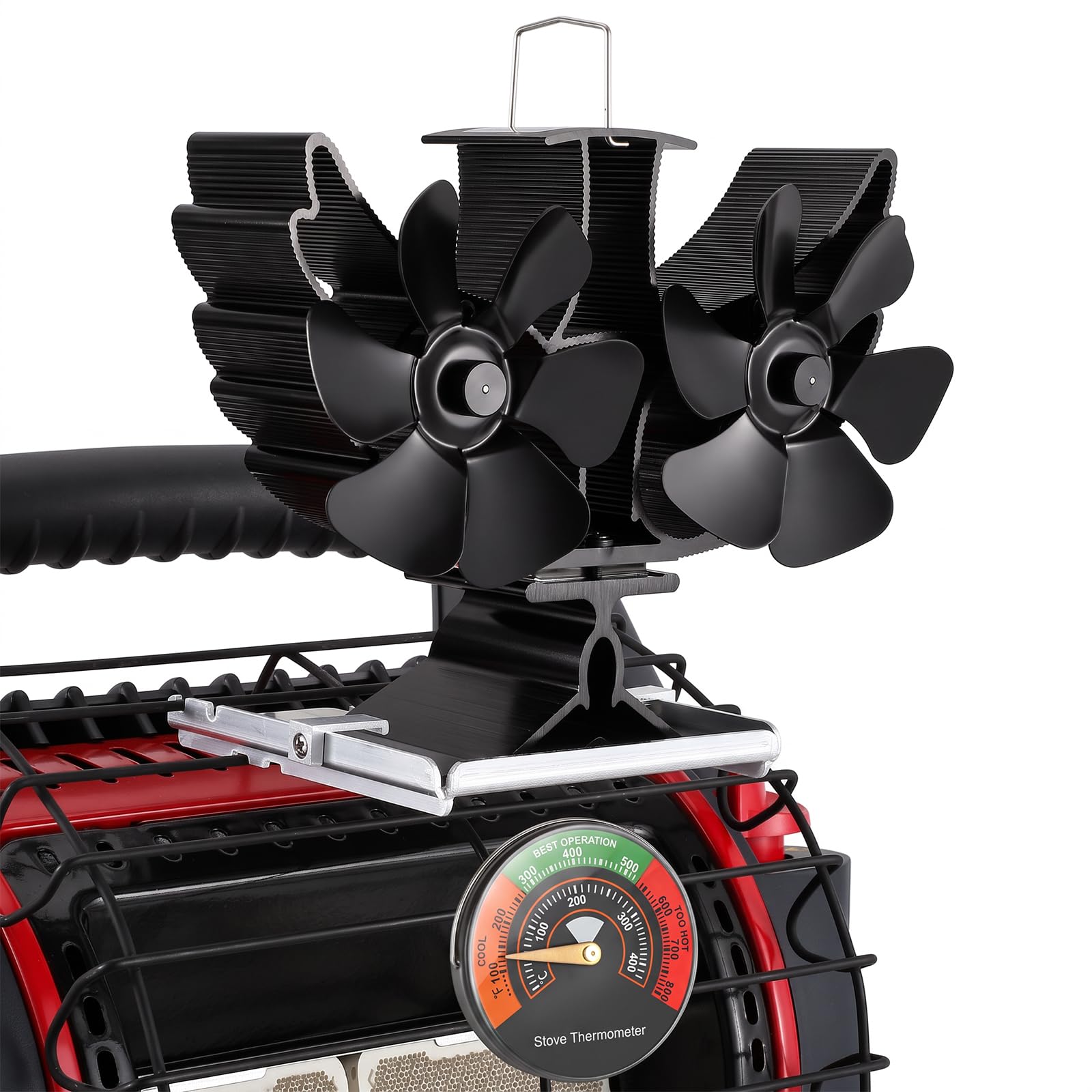
Twelve blades on two motors — the most blade count you’ll find on a heat-powered fan before the premium tier.
Count them: 12 blades driven by two separate motors, versus the two blades on the Ecofan Original, a six-fold gap on paper. That is the pitch here — more blades and more motors pushing air into the room faster than a single-head fan. At 1.6 pounds it is also the lightest fan in this lineup, so shifting it aside to load the stove is no chore.
Build quality is a genuine bright spot. The body is anodized aluminum, so it won’t rust or corrode when hot, and there is a bimetallic strip in the base that lifts the fan’s edge when you near the maximum operating temperature. It works on wood stoves and pellet stoves alike, and the included magnetic thermometer lets you keep an eye on the fire. Under 25 dB, it runs quietly.
Now the honest part. Durability is the split verdict here — some customers note a fan that lasts, others a fan that gives out after a month. And unlike the bigger VODA triple-motor fan with its 280 cfm rating, XTIMES does not publish a CFM number, so you’re trusting blade count over measured output. If you want the safety of a stated airflow rating, that matters.
The standout: you get 12 blades and dual motors in an anodized aluminum body that weighs just 1.6 pounds — tough to top on paper for the blade-per-dollar count.
The trade to note: no published CFM, and durability is a coin flip for a minority of owners.
For the buyer who: wants maximum blade count and a lightweight fan without paying premium-tier money.
Pass on it if: a stated airflow figure is a dealbreaker for your decision.
6. Tomersun Wood Stove Fan, 16 Blades Dual Motor

The highest blade count on the list, aimed at the large room where single-head fans leave cold corners.
The goal is broad, concentrated airflow that spreads heat across a bigger footprint, and it is built for wood burning stoves, pellet stoves, and indoor fireplaces. Each blade measures 5 inches.
The thermometer that comes in the box is more useful than it sounds. It sticks to the stove pipe and lets you watch surface temperature in real time, so you can keep the fan inside the 392°F–482°F (200°C–250°C) sweet range and out of trouble above 572°F (300°C). That guidance comes straight from the maker, and staying inside it protects the thermoelectric module that gives the fan its power.
Zero electricity, zero battery, and a silent motor mean it fits off-grid cabins and tents as neatly as a living room. The durable aluminum body has an electrophoretic coating to resist discoloration under heat. The catch is simply scale: 16 blades on a 575 g frame is a lot of fan for a small hearth, so measure your stove top before committing.
Best-in-lineup blade count: 16 blades and dual heads for wide coverage in larger rooms.
What to check first: it is a bulky fan — confirm your stovetop has the room.
Made for: open-plan rooms and cabins where a small fan leaves the far corners cold.
Look at a smaller unit if: your hearth is compact and you want the fan to leave room for the poker and kettle.
7. VODA 12-Blade Triple Motor Heat Powered Fan
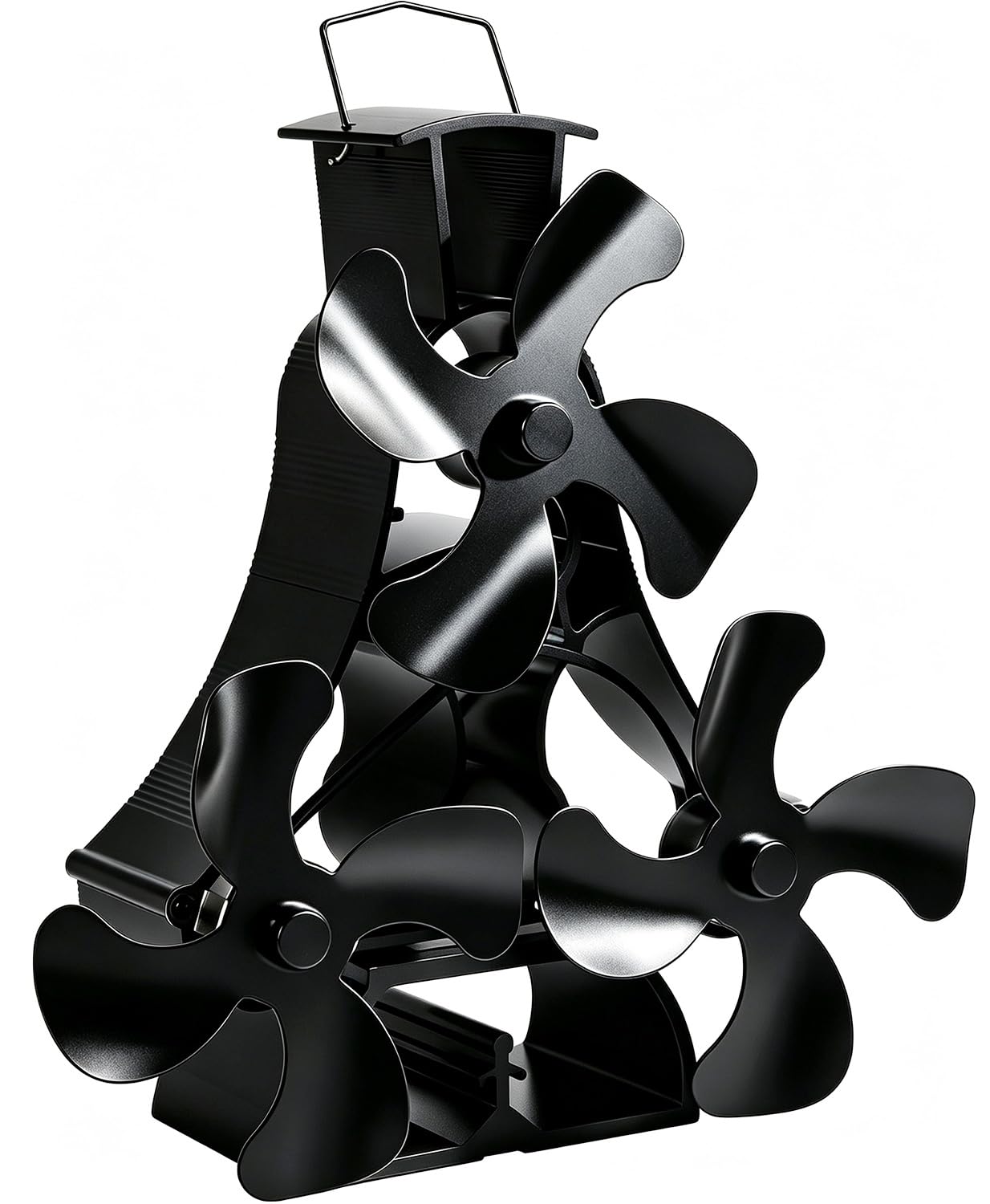
Three motors, twelve blades, and a stated 280 cfm — the airflow king of this lineup.
Here is the number that matters on the top-spec fan: 280 cfm. That is 180 more cubic feet per minute than the Caframo Ecofan Original’s 100 CFM, and it is the highest airflow figure on this entire list. Three fans on three motors are the reason — VODA says the 12-blade triple-motor setup moves more air, at faster speed, than an 8-blade fan.
The working window is wide: 185°F–653°F (85°C–345°C). It spins up around 140°F/60°C and hits peak efficiency at roughly 392°F–482°F. Above 653°F/345°C a bimetallic safety device gently lifts the front of the fan to protect the motor and thermoelectric module. VODA is upfront that a heat-powered fan will not push as much air as a corded electric fan — but for warming the whole room off stove heat alone, 280 cfm is a real step up.
The honest catch lives in the airflow column itself: opinions split cleanly, with some finding it moves tons of air and others finding it moves very little. That is the nature of a heat-dependent fan — output tracks your fire, so a smoldering burn gives you little breeze. At 2 pounds it is the heaviest fan here, so it sits planted rather than skittering.
The case for it
- 280 cfm — highest airflow rating in the lineup
- Triple motors drive twelve blades at speed
- 653°F/345°C overheat protection
- Wide 185°F–653°F working range
The case against
- Output depends entirely on how hot your fire is
- Heaviest fan on the list at 2 pounds
Choose this when: you want the most measured airflow and run a hot, well-loaded stove.
Better to skip if: your burns are low and slow — a smaller fan will feel the same.
8. BLFIRE Heat Activated Wood Stove Fan with Thermometer
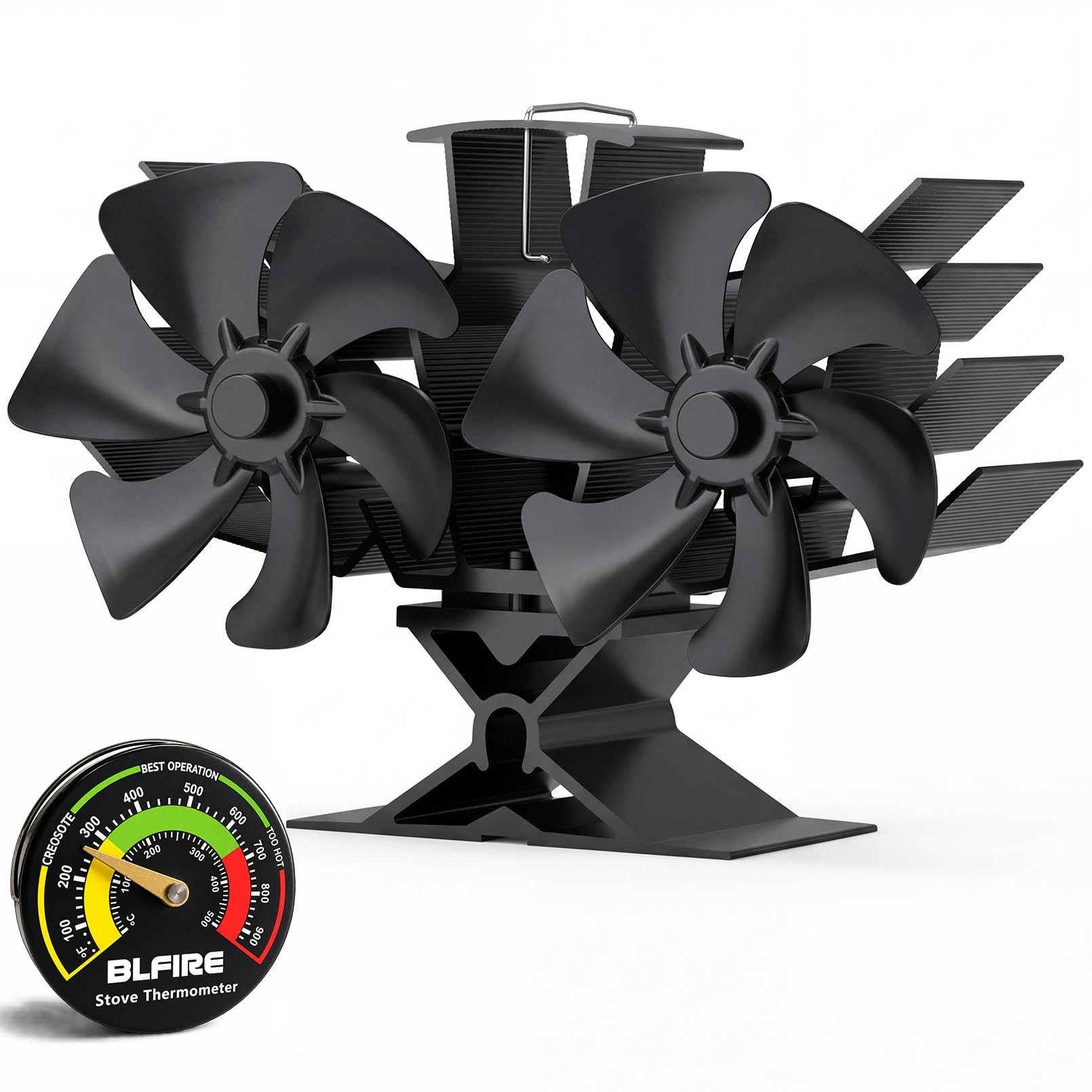
A dual-motor fan that runs quieter than a whisper and hops from wood stove to propane heater.
Twenty decibels — that is the number to lead with. This fan is rated at 20 db, below the 25 db ceiling most of the other fans here quote, so it virtually disappears into the sound of a crackling stove. Two motors drive the blade assembly, and a bracket in the box lets it mount on a Buddy heater for tent camping, ice fishing, or emergency heat when the power is out.
Its real appeal is performance at the low end. It keeps pushing air at low heat settings, and the included thermometer helps you keep the firebox in its working range. A temperature-sensing module at the bottom lifts the fan slightly when things get too hot, protecting it from direct contact with the stove plate. Owners also say it outlasts oscillating fans.
The split opinion is airflow again — some find it pushes warm air well, others say it moves little. Size works in its favor for tight spaces, but if you’re heating a large room and want more air, the VODA triple-motor’s 280 cfm is the stronger play. This fan is about quiet, low-heat performance and versatility over raw volume.
Quietest spec on the list: 20 db dual-motor operation, ideal for sleeping spaces and tents.
One honest limit: airflow is a love-it-or-leave-it trait, so don’t expect a room-filling gust.
Reach for this if: quiet matters most — a bedroom, a tent, a cabin where the fire is the only sound.
Eye a different fan if: you’re chasing maximum air movement in a large room.
9. Ecofan Original 100 CFM Heat Powered Stove Fan

The long-running original — a 7.9-inch blade on a 100 cfm frame that has been heating rooms for decades.
This is the original Ecofan taken to its purest form: a single 7.9-inch aluminum blade pushing 100 cfm, no cord, no battery, designed and made in Canada by Caframo, a company that has been at it since 1955. It starts working at optimal wood stove temperatures and spreads warmth across the space quickly, and the classic silhouette blends in with any stove and interior rather than cluttering it.
The efficiency argument is the real draw. By spreading heat more evenly, the fan pulls more usable warmth from each burn — one owner reported it cut their propane heat expenses in half. Support matters too: replacement motors are available and the fan is backed by a warranty, which is more than most budget fans can say. The blade runs super quiet, and the fan speed increases naturally as the stove gets hotter.
Where it cedes ground: 100 cfm is the lowest airflow rating here alongside the other Ecofan, so a big room will want more. Compare it to the VODA triple-motor and you see the gap clearly — 280 cfm versus 100 cfm. You buy this one for the quiet, the Canadian pedigree, and the parts support, not for maximum air.
The pedigree: Canadian-made since 1955, with replacement motors and a warranty behind it.
Where it’s modest: 100 cfm airflow, so large spaces get less movement than a multi-motor fan.
Pick this when: you want a proven, repairable classic and your stove heats a normal-sized room.
Consider the bigger motor instead if: you need to push air across a large open plan.
Know the Specs
CFM (Cubic Feet Per Minute)
CFM is the volume of air a fan moves in one minute — the single best measure of how much warm air it can push into your room. Fans here range from 100 CFM (the Ecofans) up to 280 cfm (the VODA triple-motor). More CFM means more air, but only if your fire is hot enough to power it.
Working Temperature Range
Each heat-powered fan has a window — cool enough to spin and hot enough to be efficient. The VODA triple-motor, for example, works from 185°F–653°F. Stay inside the maker’s range on the low end to get the fan turning, and below the top end for the motor’s health. A bimetallic strip in the base protects the fan if you overfire.
Decibels (Noise)
A decibel (dB) is how loud the fan is. Most of this lineup quotes under 25 dB, and the BLFIRE goes to 20 db — roughly the sound of a quiet room. Because the only moving part is the blades, these fans tend to be near-silent even at their fastest, so noise is rarely the deciding factor.
Thermoelectric Power
No battery, no cord: these fans use a thermoelectric module to turn the heat from your stovetop directly into electricity to spin the blades. That is why they keep spinning in a power outage — and why a hotter stove means stronger airflow. A cold fire gives you a slow fan.
Common Questions
Will a heat-powered stove fan work during a power outage?
Do stove fans work on all wood stoves?
Can I run a stove fan above the maker’s maximum temperature?
Is 280 cfm a lot for a stove fan?
Do I need a stove thermometer to run a fan?
Will a stove fan really reduce how much wood I burn?
How quiet are heat-powered stove fans?
Do these fans need maintenance or replacement parts?
Can I use one fan on both a wood stove and a propane heater?
How many blades do I actually need on a stove fan?
The Bottom Line
For most stoves, the winner is the Caframo Ecofan Original: it moves warm air at 100 CFM with no cord or battery, runs quiet, and keeps the room comfortable through the fire — even through a power cut. If you want the most air movement backed by a stated figure, grab the VODA triple-motor and its 280 cfm rating. And for camping or emergency heating with a propane Buddy heater, reach for the Buddy-compatible fan, which mounts with its own bracket.
How we choose
We do not accept paid placement. Every pick is matched to a real buyer and a real use-case; we do not hands-on test units.
Sources
Specifications: manufacturer listings and product documentation. Review insights: verified customer reviews, as of November 2026. Pricing: not shown on this page (it changes often); check the current price via the retailer link.
As an Amazon Associate, Tactical Gear Guy earns from qualifying purchases. This does not affect which products we feature.