Specs are compiled from manufacturer listings and verified buyer reviews and can change over time — please confirm the key details on the product page before buying.
Your stove is doing its job — the wall behind it is not. A heat deflector is a barrier that stands between your fire and the surfaces you cannot replace, whether it is a rigid metal panel or a flexible foil-fabric shield. It bounces radiant heat back into the room instead of letting it soak into drywall, log walls, or a painted fence.
This guide is built by comparing the manufacturers’ published specifications and the patterns across verified customer reviews, so you get each pick’s real strengths and trade-offs instead of marketing spin.
Below you’ll find a freestanding steel fireback, a flexible foil shield, an adjustable two-panel reflector, and a heavy-gauge wall shield, sorted by what each one actually protects. My pick for the most balanced wood stove heat deflector is the one that stands on its own. A 20-inch fireback with 30.9 pounds behind it.
Top Picks
How To Choose The Best Wood Stove Heat Deflector
The first thing to settle is what you want the panel to do. Some deflectors bounce radiant heat straight back into the room. Others physically block heat from reaching a wall. Some do both by standing in front of the fire and soaking warmth into their own mass. Decide which problem you have before you buy.
Rigid plate or flexible foil
A rigid steel fireback stands on its own feet in front of the stove or inside the firebox. It takes direct flame exposure and keeps its shape. A flexible foil shield hangs from grommets and works best as a barrier hung slightly away from a wall. The rigid option handles more abuse; the foil option covers a bigger area for less weight.
Weight tells you how much heat it will hold
Thick steel does more than block heat — it soaks up warmth and radiates it back after the fire dies down, so your room stays warmer longer. That is why a 30.9-pound plate and a 13-pound plate are not the same tool. The heavier one keeps giving off warmth; the lighter one is just a barrier. Pick by weight: go heavy if you want stored heat, go light if you want a quick hang-up shield.
Measure the gap you’re protecting
Write down the width and height of the wall area behind your stove before you order anything. Also read your stove’s manual for the required clearance to combustibles. A deflector reduces how much heat reaches that wall, but it does not replace the manufacturer’s clearance figures. Buy a panel that covers the whole hot zone, not just the middle of it.
Side-by-Side Comparison
| Model | Best For | Form | Weight | Coverage | Amazon |
|---|---|---|---|---|---|
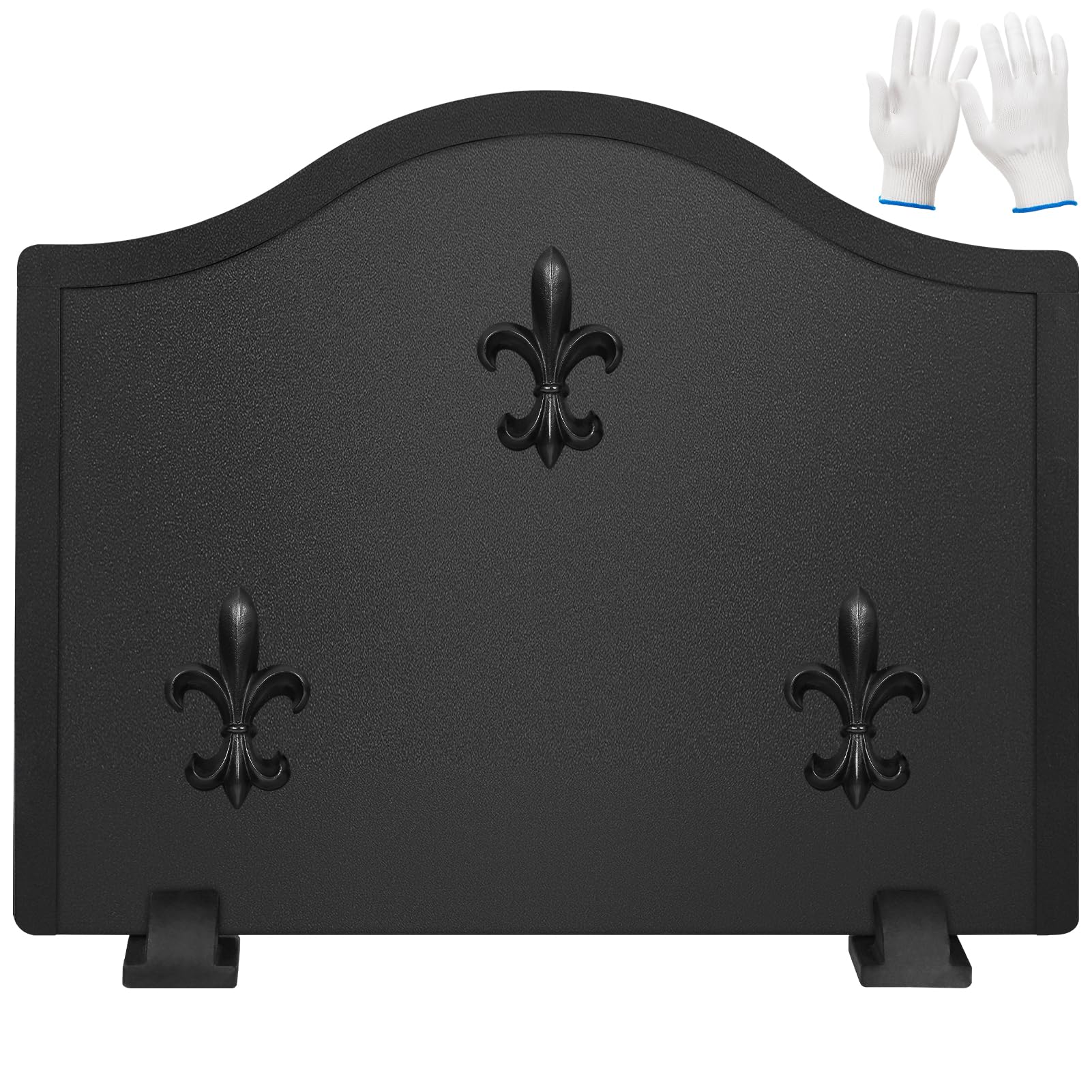
| Firebacks for Fireplace 20 inch with Feet★ Best Overall | Standalone wall protection | Rigid steel plate | 30.9 lb | 19.5 x 15.5 in | Amazon |
| FLASLD Aluminum Heat Shield Mat | Big-area hanging barrier | Flexible foil fabric | — | 48 x 40 in | Amazon |
| 26″ Adjustable Fireplace Back Plate, 2 Pack | Steerable heat direction | Adjustable iron panels | 13 lb | 26 x 17 in combined | Amazon |
| United States Stove Company Heat Shield | Full clearance reduction | 24-gauge metal | 18 lb | 51 x 42 in | Amazon |
Detailed Reviews
1. Firebacks for Fireplace 20 inch
Our pick — 4.5+★ from 50+ verified ratings; the strongest balance of quality and price.
The one that just stands there and takes it — no drilling, no hanging, no fuss.
Here is the single heaviest option in this group at 30.9 pounds, and that mass is the whole point. A plate this thick soaks up heat while the fire is roaring and keeps releasing it into the room afterward. It sits on its own feet, so you set it down behind the stove or inside the firebox and you are done. No grommets, no zip ties, no measuring a wall for hooks.
The wall side is just as useful as the room side. The 19.5 x 15.5 inch steel face takes the radiant blast directly, so your drywall or log wall sits in the steel’s shadow instead of the fire’s. The welded relief pattern means this does not look like a scrap of plate steel sitting behind your stove — it reads as a decorative panel with a job. It comes in four widths — 16, 20, 23, and 25 inches — so a wider hearth can step up to a bigger plate.
Buyers consistently describe the room warming up noticeably once the plate is in place — the heat reflection is the draw. Buyers mention value nearly as often, a fair read for thick steel that should outlast a dozen cheaper barriers. The honest catch sits with the finish. Finish durability splits: a portion of buyers report rust after roughly a month of use. On an indoor hearth that is manageable; in a damp cabin or a covered porch setup, expect to keep it dry and consider a coat of high-heat paint.
Where this plate earns its keep
- 30.9 pounds of steel — it stores heat and keeps radiating it after the flames drop
- Freestanding feet mean zero installation and no wall penetrations
- Welded relief pattern makes it a feature rather than an eyesore
- Four sizes available, from 16 to 25 inches, for different hearth widths
What to keep an eye on
- Finish durability is the split point — some owners mention rust inside a month
- At 30.9 pounds it is a two-hands lift, not something you slide around casually
- Heaviest item here, and it costs the most of the plate-style options
Reach for this if: you want stored warmth plus wall protection with no tools involved.
Look elsewhere if: your hearth is a wet or outdoor setup where the finish will be tested.
2. FLASLD Aluminum Heat Shield Mat, 40 x 48 Inch
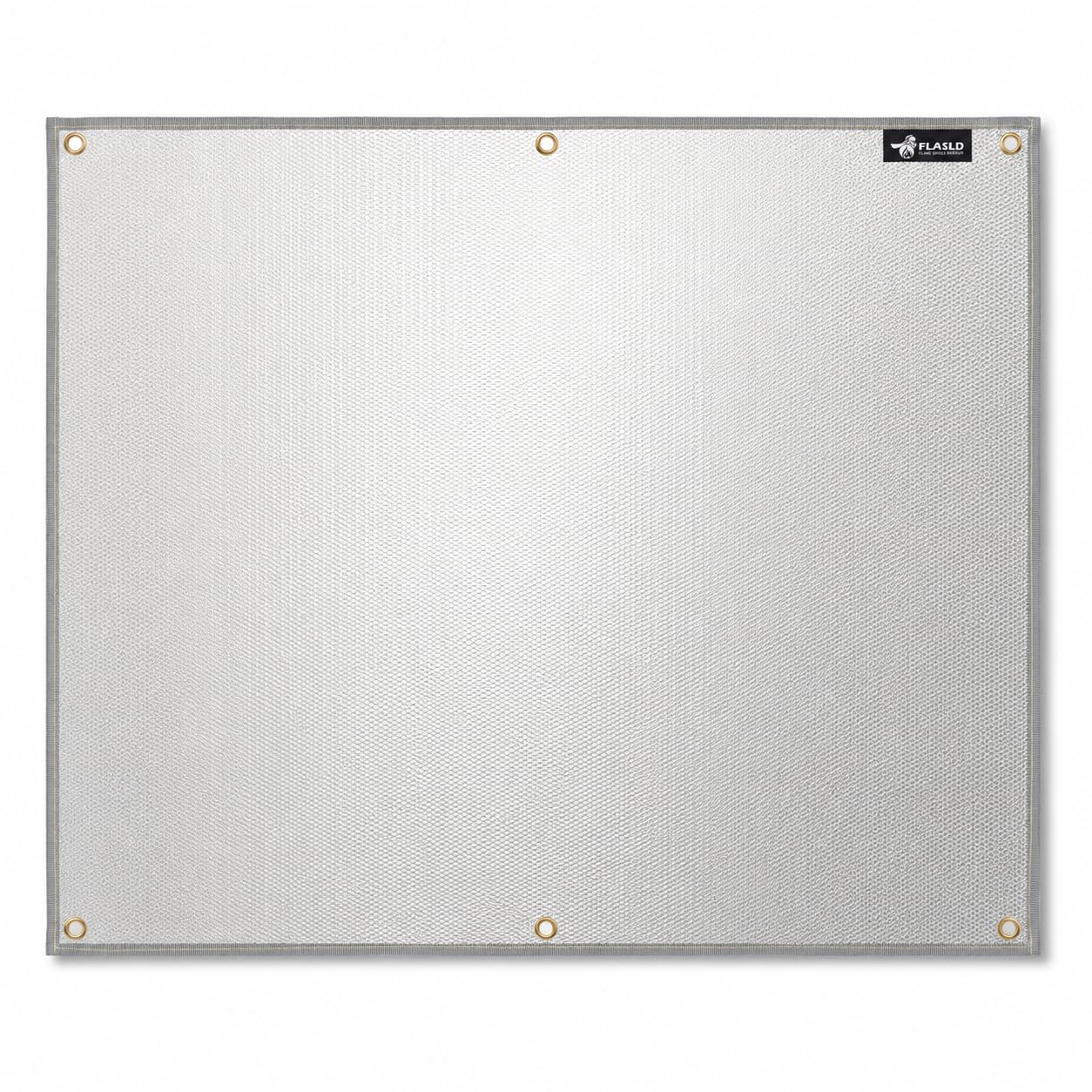
A 40 x 48 inch sheet of reflective barrier you can hang almost anywhere and forget about.
This shield covers a whole stove wall, a deck railing, or the side of a fridge in one sheet — compare that to the 19.5 x 15.5 inch footprint of the heavy steel plate above and the difference is obvious. At 0.04 inches thick, it stays light enough to hang from six reinforced metal grommets (metal rings set into the edge) using zip ties, hooks, or straps. A rigid plate has to stand in one spot; this one goes wherever you point it.
The aluminum-foil face is built to bounce radiant heat off the protected zone, and the maker cites up to 95% reflected. Treat that as the manufacturer’s claim rather than a lab result — the practical read from owners is that it works. Customers note the wall behind the stove staying cool to the touch, and one notes heat from the fireplace reaching 4 feet into the room. The layered foil-fiberglass fabric with bound edges is also easy to wipe down, which matters in a kitchen or behind an oven.
Two things to sort out before you buy. First, the feedback on fire protection and quality is genuinely mixed, and the description accuracy rating is the weakest signal in the data — some buyers expected a stiffer or heavier-duty product than the flexible sheet they received. Second, the maker’s own guidance is explicit: keep the clearance your appliance requires and keep the foil off direct flame. This is a barrier that hangs back and reflects, not a panel that takes a fire head-on. Hang it with a gap and it does its job well.
Where it shines: sheer area on a budget. You get 48 x 40 inches of reflective coverage with six mounting points, which no rigid plate in this group can match for reach across a wide appliance wall.
The honest limit: it is thin and it is flexible — hang it tight against a surface and you lose the air gap that makes a reflector work. Some buyers read “heat shield” and expected something more rigid than a foil-fabric mat.
Suits: anyone covering a large span — behind a full-size grill, along a deck rail, or across a wide stove wall.
Not for: anyone who wants a self-supporting panel that takes direct flame exposure.
3. 26″ Adjustable Fireplace Back Plate, 2 Pack
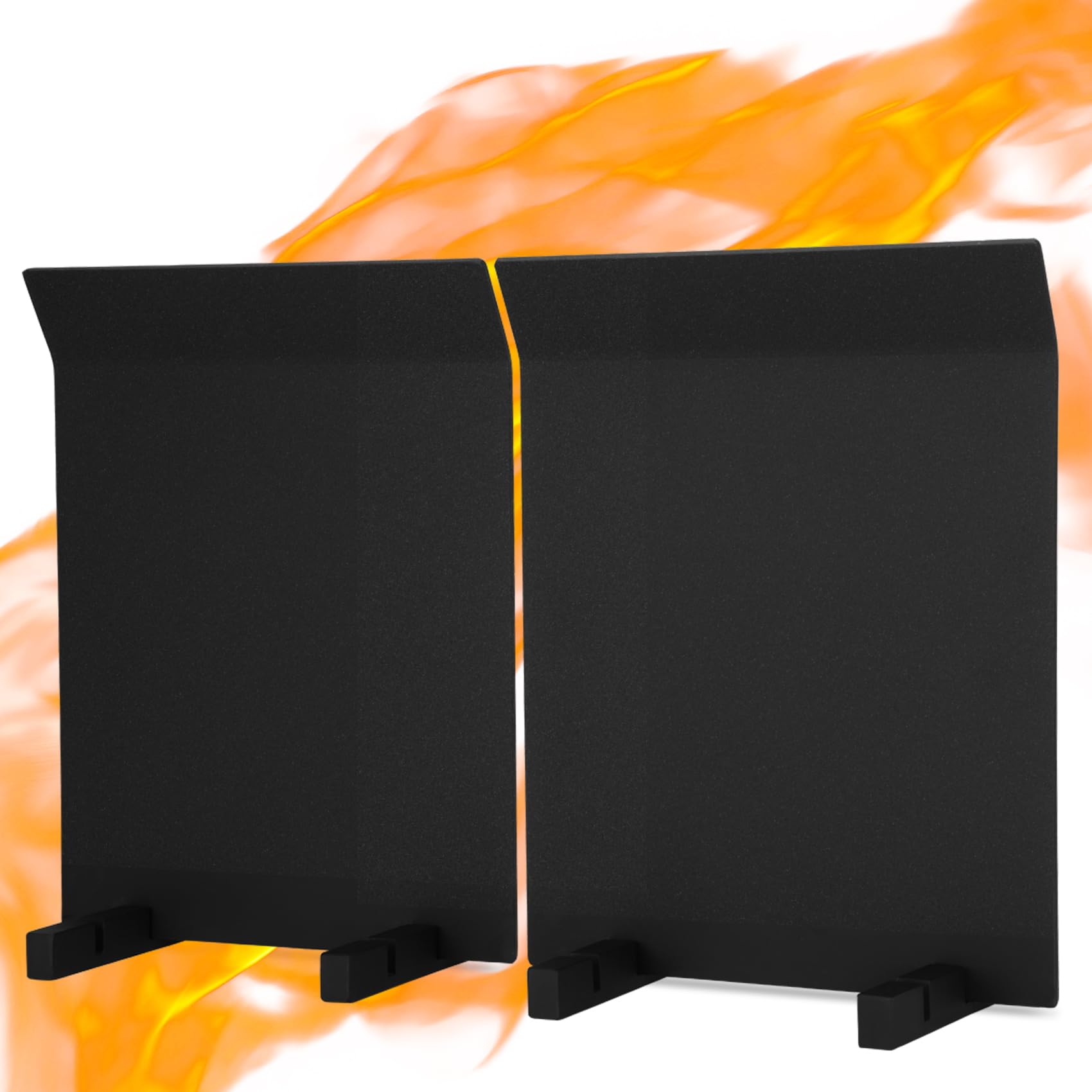
Two curved panels you can angle — the heat goes where you point it, not where it drifts.
Most deflectors are a fixed face. This one splits into two panels that adjust independently, so you can aim the reflection forward into the room or concentrate it on the cold end of the hearth. Combined, the pair forms a reflective surface up to 26 inches wide by 17 inches tall. That is wider than the 20-inch fireback above and taller than its 15.5-inch face, and the curve adds a shape that pushes heat outward rather than straight up.
Setup is the easiest part. Four clip-on feet let you stand the panels up without any tools, and the same feet let you reposition them later without undoing anything. Two panels come in the pack, so you can cover both sides of a firebox or spread them across a wider wall. The lacquered black iron finish and painted styling keep it looking like part of the fireplace rather than an add-on.
Weight is the trade-off here, and the comparison is real. At 13 pounds it is far lighter than the 30.9-pound steel plate — that is roughly 17.9 pounds less metal holding heat. You get aiming and easy handling instead of stored warmth. That is the right call for a lot of hearths, just not for someone who wants the room to stay warm an hour after the fire burns down. Buyers credit the curved face with pushing heat roughly 4 feet into the room, which is what an angled reflector is meant to do.
Why the adjustability matters
- Two independently adjustable panels let you direct heat toward a specific cold spot
- 26 x 17 inches combined — a wider reflective surface than the fixed fireback above
- Four clip-on feet mean tool-free setup and later repositioning
- Two panels per pack covers both sides of a firebox or a wider wall
The part to weigh up
- 13 pounds of iron — it reflects heat but stores very little of it
- Two hinged panels have more joints than one solid plate, so handle them gently
- Highest price of the plate-style firebacks in this group
Pick this one when: your fire heats one end of the room and leaves the rest cold, and you want to redirect it.
Think twice if: you were counting on the deflector itself to hold warmth late into the evening.
4. United States Stove Company Heat Shield, 51 x 42 Inch

Built for the job of cutting clearance to combustibles, not for decoration.
At 51 inches wide by 42 inches high, this is the largest single panel in the group — wider than the FLASLD mat’s 40-inch span and taller than its 40-inch height depending on how you orient it. The 24-gauge metal is a thickness rating on sheet steel, and it is the reason this shield is sold as a way to reduce clearances between a stove and nearby combustibles. That is the phrase that matters: this is a heat shield designed for the wall behind a wood stove, in a role where a foil mat would be undersized.
It comes in at 18 pounds with a powder-coated black finish in a modern style, so it reads as a proper stove wall rather than a bolted-on afterthought. Buyers consistently describe the wall behind it staying cool to the touch, which is the entire point of a clearance shield. Some find the protection worth the outlay; others feel the price sits high for a flat sheet of steel. That split on value is the fairest knock against it, and it is honest — you are paying for the size and the gauge.
The case for it: 51 x 42 inches of 24-gauge metal that reduces clearances between a stove and combustibles. If you are protecting a whole stove wall, nothing else here covers that footprint in one piece.
Best fit: a wood stove install where the wall itself needs a full-size rigid barrier, not a decorative fireback.
Worth knowing: it is the priciest option here, and you are paying for gauge and coverage rather than features.
Know the Specs
Reflect vs. absorb
A reflective surface, like the aluminum foil on the FLASLD mat, bounces radiant heat away. An absorbing surface, like a thick steel plate, takes heat into its own mass and gives it back slowly. Reflective barriers cool a wall fast; absorbing plates keep a room warm longer. Pick based on whether your problem is a hot wall or a cold room.
Gauge and weight
Gauge is the thickness rating of sheet metal — lower numbers mean thicker steel, but that rating only describes the sheet-steel panels here; the FLASLD mat is foil-fabric and is not sold by gauge. Weight is the practical version of the same story. A 30.9-pound plate holds far more heat than a 13-pound one, so the heavier a fireback is, the more warmth it stores and the slower it gives it up. Lighter panels are easier to move and reposition.
Grommets and feet
Grommets are the reinforced metal rings punched through a flexible barrier so you can thread a zip tie or hook through without tearing the fabric. Feet are what let a rigid plate stand on the hearth on its own. One gives you a hang-anywhere sheet, the other gives you a panel that needs no wall at all.
Clearance to combustibles
Clearance is the minimum distance your stove’s manual requires between the appliance and anything that can burn. A heat shield can reduce how much heat reaches that surface, but it is not a substitute for the listed figures. Always check your stove’s documentation and keep a real air gap between the shield and the wall it protects.
Common Questions
Will a heat deflector let me put my stove closer to the wall?
Should I buy a reflective foil shield or a rigid steel fireback?
Is a heat deflector the same thing as a fireback?
Can the FLASLD aluminum mat go directly against a wood wall?
Why does the 20-inch fireback weigh more than the 26-inch adjustable plate?
Will a heat deflector rust if I use it in a damp cabin?
How many panels do I need for a stove set into a fireplace opening?
Do I need to bolt a heat shield to the wall?
Can I use a grill heat mat indoors behind a wood stove?
Does a curved fireback heat a room better than a flat one?
The Bottom Line
For most hearths, the winner is the Firebacks for Fireplace 20 inch with Feet, because 30.9 pounds of steel both shields the wall and keeps giving warmth back after the flames settle — and it needs no drilling. If your stove wall is wide and you would rather hang a barrier than stand one up, the FLASLD Aluminum Heat Shield Mat covers 48 x 40 inches from six grommets, and the heat-isolation feedback is the strongest signal in this entire group. For a cold corner that needs redirecting rather than a warmer room overall, the 26″ Adjustable Fireplace Back Plate lets you aim the reflection where you want it. One last honest note: if you want a full-size rigid barrier for a proper stove install, the United States Stove Company Heat Shield is the one built for that clearance job, at 51 x 42 inches of 24-gauge metal (a standard sheet-metal thickness).
How we choose
We do not accept paid placement. Every pick is matched to a real buyer and a real use-case; we do not hands-on test units.
Sources
Specifications: manufacturer listings and product documentation. Review insights: verified customer reviews, as of November 2026. Pricing: not shown on this page (it changes often); check the current price via the retailer link.
As an Amazon Associate, Tactical Gear Guy earns from qualifying purchases. This does not affect which products we feature.