Specs are compiled from manufacturer listings and verified buyer reviews and can change over time — please confirm the key details on the product page before buying.
A wood stove in a van is a different animal from a tent stove. You have less floor space, tighter clearances to bedding and insulation, and a chimney that has to clear a roof you cannot cut a big hole in. That is why the first thing to check is firebox footprint, not heat rating. The second is whether the chimney sections store inside the stove body, because a bundle of loose pipes rattling around a van is a problem you will feel every mile.
This guide is built by comparing the manufacturers’ published specifications and the patterns across verified customer reviews, so you get each pick’s real strengths and trade-offs instead of marketing spin.
The picks below are all genuinely compact wood burners — small enough to bolt down near a bulkhead and vent through a roof jack or side wall. You will see which ones nest flat for storage, which run a secondary burn that cuts smoke, and which trade portability for real overnight heat. Everything here is chosen against one test: does it actually work in a van-sized space. That makes this the shortlist for the best wood stove for van builds that need heat without a cabin-sized footprint.
Top Picks


How To Choose The Best Wood Stove for Van Builds
The mistake most first-time van builders make is buying a stove sized for a canvas wall tent. A wall tent leaks heat through every seam, so it needs a big firebox. A van is a sealed metal box, so a smaller firebox heats it faster and is easier to control. Start with footprint and chimney diameter, then work backwards to heat output.
Match the firebox to your floor plan first
Measure the spot where the stove will live, then subtract clearances to bedding, curtains, and any insulation. A stove body around 14 to 18 inches deep is the working range for most van layouts. Anything deeper starts eating the walkway between the bed and the galley.
Chimney diameter must match your roof jack
This is the number that stops installs cold. Chimney pipe diameters in this category run from 2.24 inches up to 2.76 inches, and they are not interchangeable with a jack cut for a different size. Buy the stove, then buy the jack that fits its pipe — or confirm your existing jack matches before you commit.
Decide if you want smoke control or maximum heat
Stoves with a secondary burn system and a damper valve burn cleaner and throw less smoke out the seams. Stoves built as simple single-wall burners are cheaper and lighter but need more careful drafting. In a van, where the vent run is short, smoke control matters more than it does in a tall tent chimney.
Check packed storage before you check anything else
A stove that stores its own chimney pipe inside the firebox saves you a separate pipe bag rolling around the van. Fold-flat legs and a flip-up carry handle make the difference between a stove you actually take on trips and one that lives permanently bolted down.
Side-by-Side Comparison
| Model | Best For | Firebox / Body Size | Weight | Chimney | Amazon |
|---|---|---|---|---|---|
| Winnerwell Nomad Medium★ Best Overall | All-round van heater | 800 cu in | 19.4 lb | 5 × 2.5 in sections | Amazon |
| unho Stainless Hot Tent StoveBudget Builder | Budget glass-door pick | 15.75″D × 12.2″W × 7.68″H | 22 lb | 7 pipes | Amazon |
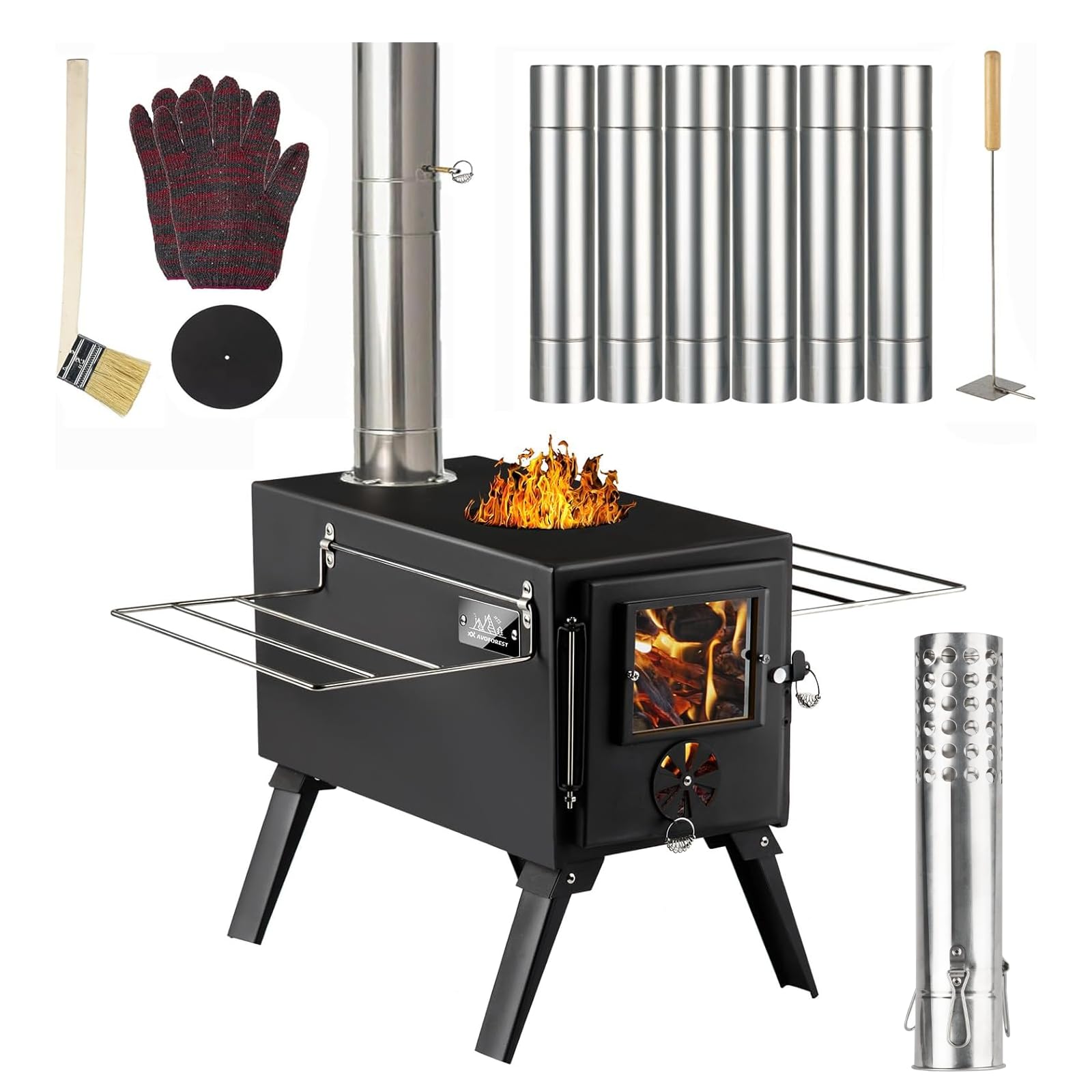
| AVOFOREST Wood Burning StoveCooking Pick | Tight-space cooking | 17.8″L × 11″W × 9.73″H | 6.96 kg | 7 stainless pipes | Amazon |
| KUNGKA Black Tent Stove | Cold-climate output | 14.2″D × 8.7″W × 72″H | 24 lb | 7 sections to 6 ft, 2.24 in | Amazon |
| Gonex Hot Tent Stove | Big firebox on a budget | 16.9″L × 10″W × 9.5″H | 23.8 lb | 72.8 in, 2.76 in dia | Amazon |
| CHANGE MOORE Secondary Burn Stove | Low-smoke burning | 593 cu in | — | Included pipe | Amazon |
| DANCHEL T6 Titanium Stove | Lightest install | 15 L (14″D × 7.8″W × 10.9″H) | 4.4 lb | 7.2 ft × 2.48 in | Amazon |
| POMOLY Dweller Max 3 | Fire view and clean seams | 15.35″D × 14.2″W × 19.3″H | 33.4 lb | Inverted design | Amazon |
| RBM Outdoors Caminus S | Premium glass-wall build | 17.71″L × 12.20″W × 16.14″H | 23.6 lb | 2.76 in dia | Amazon |
Detailed Reviews
1. Winnerwell Nomad Medium Tent Stove
Our pick — 4.5+★ from 350+ verified ratings; the strongest balance of quality and price.
The stove that packs its own chimney inside itself and still holds an 800 cubic inch firebox.
The number van builders should care about here is 800 cubic inches of firebox, because that is enough fuel volume to load real hardwood rather than kindling. It gives you a burn you can actually leave alone for a stretch, instead of feeding it every twenty minutes. The body is 304 stainless steel, which is the grade that resists rust when the stove sits damp in a van through a wet season.
What wins people over is the build, and it shows in how the thing fits together. The four legs nest flat under the stove, the five chimney sections — each 2.5 inches in diameter — stow inside the body, and the side shelves fold up into a carry handle. Packed, you are carrying a 15 by 8 by 8 inch box that weighs 19.4 pounds. In van terms, that is a stove you can lift out with one hand and stow under a bench seat.
The honest catch is cost and the fit question. This stove sits at the premium end of the mid-range, and campers who bought it split on value. Their mixed feelings are about whether the price matches what you get, not about whether it works. Buyers report it warms a 16ft bell tent in about 20 minutes, so a sealed van will heat faster still. Think about if you want to pay the premium for the stainless build and the self-storing chimney, or put that money into roof jack hardware instead.
Where it earns the top spot
- 800 cubic inch firebox holds enough hardwood for a real burn cycle
- All five chimney sections and the legs stow inside the body
- 304 stainless steel resists rust in damp storage
- 19.4 pounds packed, with shelves folding into a carry handle
What to weigh before buying
- Premium price for the build quality — the value split is real
- Chimney sections are 2.5 inches, so your roof jack must match
- Recreational wood burning only, not for residential use
Go for it if: you want one stove that heats, cooks, and stores its own pipe in a van with limited locker space.
Look elsewhere if: your roof jack is already cut for a different chimney diameter — swapping the jack is the real cost.
2. unho Stainless Hot Tent Stove
A glass-front burner that sits flatter and narrower than most of the stoves on this list.
If your van layout gives you a low, wide slot rather than a tall one, this is the shape to look at. It measures 15.75 inches deep by 12.2 inches wide by 7.68 inches tall — a profile that tucks under a bench line far more easily than the taller KUNGKA. Compare that to the KUNGKA at 14.2 by 8.7 by 72 inches and you can see it trades height for floor width. For a van, that usually reads as a better fit against a rear bulkhead.
The day-to-day experience is straightforward: it lights fast, throws heat, and comes with seven chimney pipes that direct the exhaust outside. Because it vents directly, you want a proper jack and clearance. It weighs 22 pounds, which is a bit heavier than some rivals, but that weight sits low and the legs give it a stable stance.
The one thing to go in with your eyes open on is smoke. Airflow is adjustable, but the seal at the door is the weak point in the design. Some campers get a clean burn out of it, and others see smoke drifting out from the door opening rather than going up the pipe. That is a matter of draft and how you load it, not a flaw in every unit. Run it with the vent open until the pipe is hot, then choke it down.
Where it earns its keep: that 7.68 inch height and 12.2 inch width make it the natural choice for a low van install where vertical clearance is tight.
The real-world caveat: smoke can drift from the door seal when the draft is weak, so get the chimney hot before you dial the air down.
The fit: short-height van builds that want a fire view without a tall stove body.
The catch: expect to manage draft carefully — a short chimney run in a van punishes a lazy startup.
3. AVOFOREST Wood Burning Stove
Cast iron heat, a stainless chimney you can lift, and tools that tuck inside the firebox.
Here is a stove that sells itself on the cooking side. The furnace body is cast iron, which holds heat longer than thin steel and gives you a flat cooking surface for coffee or a pan. The chimney’s liftable section is stainless steel, so it stays clean and is easier to handle than raw iron pipe. At 6.96 kg it is one of the lighter stoves here, which makes it simple to lift in and out of a van.
The box contents set it apart from bare-metal stoves. You get fire tongs, a brush for ash, woven gloves, and a drain screen for filtering burnt ash. Everything loads back into the stove body, which is exactly what you want when the stove lives behind a seat. Follow the first-burn instruction: do a full outdoor burn before you install it, then enjoy the warmth without curing smoke filling your van.
The size question is the one to think through before you buy. Several campers describe the firebox as extremely small, and the spec sheet backs that up: at 17.8 by 11 inches and 9.73 inches tall, it is not a long-burn stove. You will reload it more often than a bigger firebox like the Winnerwell’s 800 cubic inch box. Combined with reports of smoke escaping from the top and weaker burn performance, this is a stove for someone who values cooking and portability over all-night fuel capacity.
Best for the cook: if your van trips center on making real food, the cast iron body and included tongs, brush, and gloves make this the natural pick.
Worth thinking about: that small firebox means more reloading, and the top-end smoke needs a hot, well-drafted chimney to behave.
Worth it if: you want a light, cook-ready stove with the cleaning tools included.
Pass if: you want a long unattended burn through a freezing night — the small firebox will have you restocking.
4. KUNGKA Black Wood Burning Tent Stove

The stove built for deep winter, with a glass door and a chimney that tunes to any roof height.
Cold is the reason this one exists, and the maker states it plainly: rated to -20°F, it heats a 200 sq ft space in 15 minutes. A van is far smaller than 200 sq ft, so you are working with headroom. The 2-4 hour burn time per hardwood load is the number that matters for overnight vanning. That is a realistic overnight cycle, not an all-night guarantee, so plan on one reload.
What everyone raves about is the build, and the glass door is the visible part of it. The door is borosilicate glass, the kind that shrugs off heat, so you can watch the flame and the firewood level without opening anything. An adjustable air vent and a chimney damper valve let you dial the burn intensity to the outside temperature. The removable ash tray makes the morning cleanup a two-minute job rather than a full teardown.
The chimney design deserves a specific mention for van installs. Seven stainless sections reach 6 feet, and each one adjusts individually so the total height matches your stove jack. The pipe diameter is 2.24 inches, which fits standard jack openings — confirm yours before you buy. A rain cap and wind ropes keep it steady in gusts. First use produces curing smoke, so burn it outdoors for 60 minutes before it goes anywhere near your bedding.
On weight, it sits at 24 pounds. That is noticeably heavier than the Winnerwell at 19.4 pounds, but buyers find it manageable to move. The trade-off you accept is that this is a real heating appliance, not a featherweight backpacking stove — the extra steel is what makes the winter numbers work.
Why cold-weather van campers pick it
- Rated to -20°F, with a stated 200 sq ft heat area reached in 15 minutes
- 2-4 hour burn time per hardwood load suits one overnight reload
- Borosilicate glass door lets you watch the fire without opening up
- Seven adjustable chimney sections match any jack height
Where it asks for care
- 24 pounds is heavier to lift in and out than the titanium options
- 2.24 inch chimney needs a matching jack opening
- First burn smokes while the paint cures — do it outside
Made for: winter van trips where you want the stove to beat the outside temperature, not just take the edge off.
Measured against: the Winnerwell — you gain a taller burn window and lose some liftability at 24 vs 19.4 pounds.
5. Gonex Hot Tent Stove

A 16.9 inch firebox that swallows standard pre-cut logs and keeps you fed with fuel longer.
Log length is the quiet decider in a van stove. A short firebox forces you to cut or split every piece of wood you carry, and that gets old fast. This one takes a 16.9 by 10 by 9.5 inch firebox, which handles most standard pre-cut logs as they come off the rack. That alone extends your burn time on cold nights, because a fuller box gives you more fuel before you have to open the door.
The chimney is 72.8 inches tall with a 2.76 inch diameter, which is wider than the KUNGKA’s 2.24 inch pipe. It uses a crescent-shaped damper that keeps air moving even when fully closed, which helps stop smoke from backing down into the van. A top cap keeps rain and snow out and cuts down escaping sparks. The 1mm stainless body is rated to 932°F without warping, and at 23.8 pounds it is manageable to lift.
The daily-use touches are where it earns its place. A side glass window lets you check the flame without opening the door, dual air inlets give you fine control over flame size, and a heatproof handle keeps your hand off the hot metal. A rear anti-clogging structure stops debris from choking the burn, and a removable ash drawer lets you clean from the bottom.
The catch is heat management. The whole stove getting red hot is a real possibility on a hard burn in a small van. That is not a defect — it is what 1mm steel rated to 932°F does — but it means clearances and a heat shield matter. Treat the damper as your main control and keep the fire moderate rather than roaring.
The standout: a 16.9 inch firebox lets you load standard pre-cut logs without sawing, which translates directly into longer burn intervals.
Plan for this: the stove body can glow red under a hard burn, so leave clearance and run it moderate in a van.
Reach for this if: you carry standard-cut firewood and want a full box rather than constant reloads.
Look elsewhere if: your firewood is already cut short, in which case a smaller body saves floor space for nothing lost.
6. CHANGE MOORE Hot Tent Wood Stove
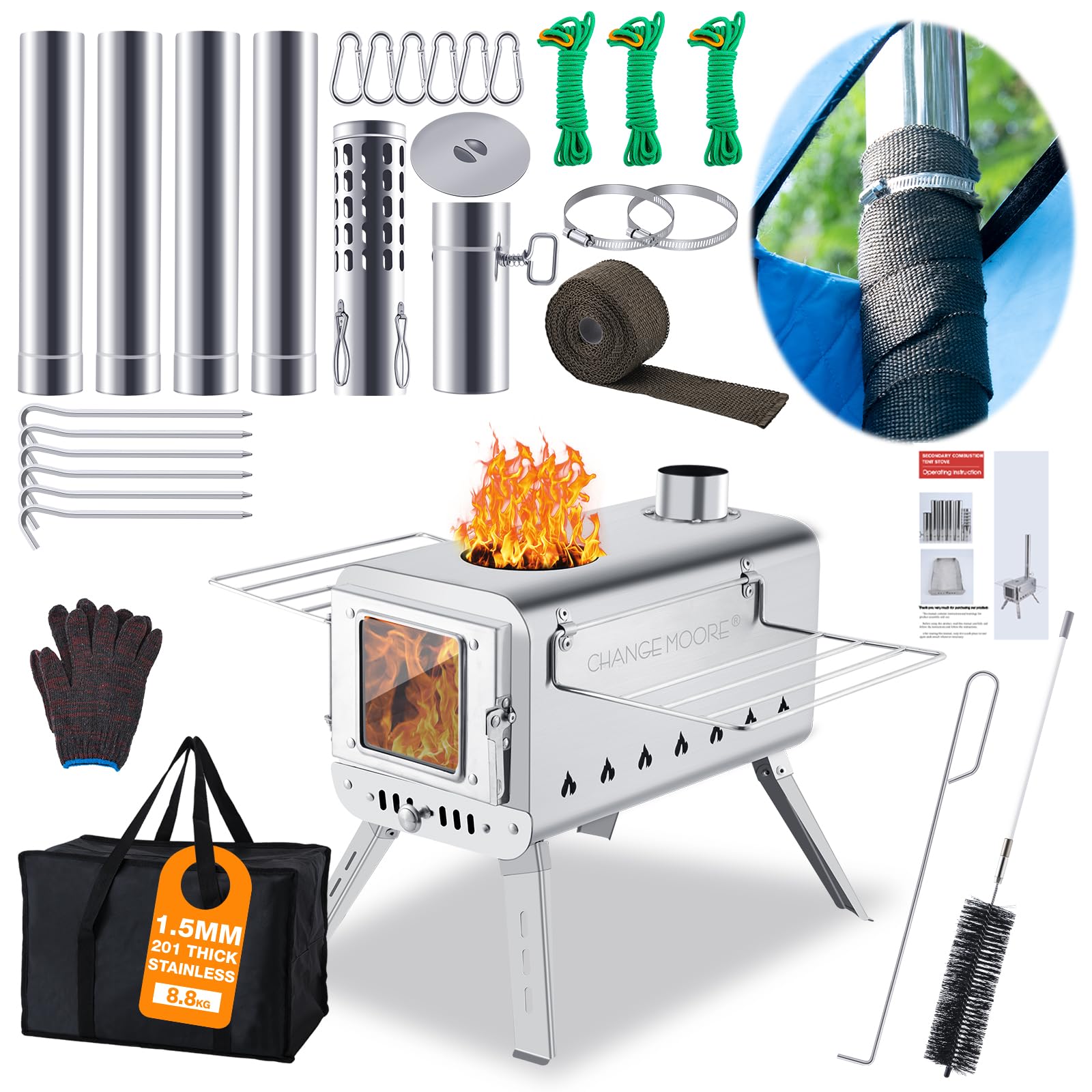
A secondary burn system aimed squarely at the smoke problem that dogs van installs.
Smoke is the biggest frustration in a van stove, and this one targets it directly. A secondary burn system reignites the gases above the fire, which produces a hotter, more consistent flame and less carbon buildup. The maker also claims it handles damp wood and low-quality fuel better than a plain burner.
The build backs the burn design. The body is 1.5mm thick 201 stainless steel, which holds its shape under high heat rather than warping, and the viewing window is SCHOTT glass rated to 1000°C. With 593 cubic inches of interior space, you get an expansive fire view and room for larger wood loads. A removable burn plate makes cleaning quick instead of a scrape-and-scrub job.
Safety hardware is included rather than extra: a secure built-in chimney connection, a heat-resistant wrap to guard against burns, and wind resistance ropes for stability. You adjust the air intake with the ashtray handle to control temperature. There is a dedicated chimney cleaning brush in the set to keep airflow steady, and the guidance is clear — fit the chimney before lighting, skip water cooling after use, and never touch the hot glass.
The one caution is patience at install. You must assemble the chimney before the first light, because heat expansion can make fitting it afterwards a fight. Get that right and the payoff is one of the cleanest-burning stoves here, with a fire view that makes the van feel less like a metal box on a cold night.
The case for it: you want a visible flame and a burn that produces minimal smoke in a small sealed space.
The one hitch: fit the chimney before you light it — heat expansion will not let you do it after.
7. DANCHEL OUTDOOR T6 Titanium Wood Stove
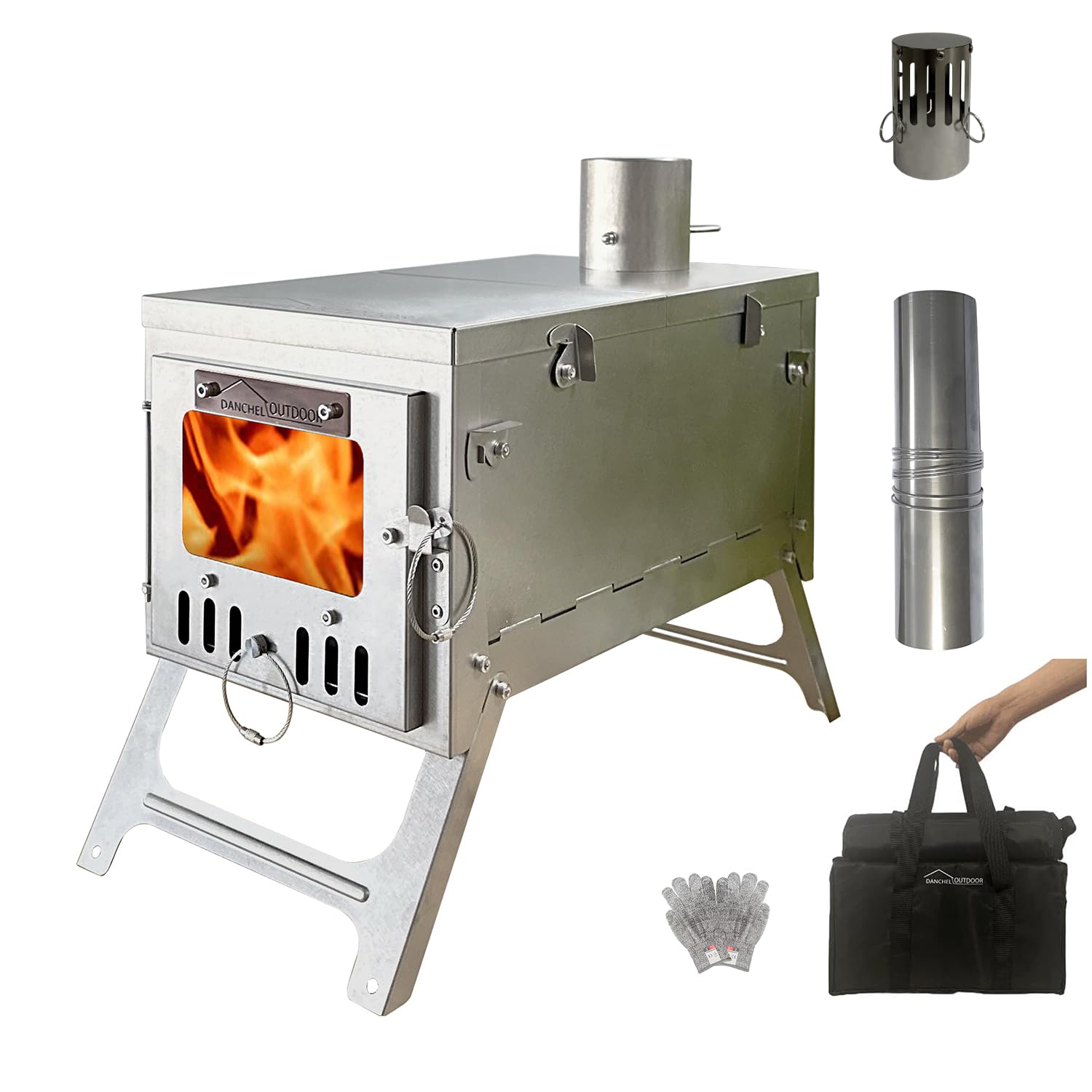
Four point four pounds of titanium that folds into a bag the size of a laptop case.
Weight is the whole story here, and the number is 4.4 pounds. That is a fraction of the 24 pounds the KUNGKA carries, and it changes how you use a stove in a van. You stop thinking of it as a permanent fixture and start treating it as gear you bring out on cold nights and stow when you drive. TA1 titanium is the material doing the work — it resists high temperature and corrosion better than the steel and iron stoves around it. The fasteners and hinge pins are steel, so the frame stays solid where it needs to.
The firebox holds 15 liters, and the compact body measures 14 by 7.8 by 10.9 inches with the legs on. The roll-up chimney is 7.2 feet long and 2.48 inches in diameter. All of it packs into a bag measuring 14.96 by 12.2 by 2.76 inches, which is roughly the footprint of a laptop case. For a van where every inch of storage counts, that is a serious advantage.
Control comes from slidable air intakes and a rotary damper that let you dial the burn rate, and a spark arrestor keeps sparks off your tent fabric or insulation. The top loading bar supports up to 22 pounds, so you can cook on it. Assembly uses rivets rather than welding, with no small screws to lose, and the pipe rolls easier after the first use thanks to titanium’s shape memory.
Set your expectations on firepower, though. It heats up to 100 sq ft, enough for a van cab-and-body but with little to spare on a brutal night. First-time assembly may test your patience, and the thin titanium walls mean you feed it more often than a thick steel body. It is a lightweight tool, not a heat sink.
What makes it different
- 4.4 pounds of TA1 titanium — stowable gear rather than a bolted fixture
- Packs into a bag the size of a laptop case
- Heats up to 100 sq ft from a 15 liter firebox
- Spark arrestor and 22 pound top loading bar for cooking
Where it gives ground
- 100 sq ft coverage is modest for deep cold
- First assembly may need patience before it loosens up
- Thin titanium walls need more frequent reloading
Pick this when: storage and weight are your constraints and you want heat you can pack away.
Skip this when: you need to hold heat through a sub-zero night without constant feeding.
8. POMOLY Dweller Max 3 Wood Stove

Three panels of fire-resistant glass turn the whole fire into the view.
For a van, the stove is not just heat — it is atmosphere on a long winter night. This one leans into that with three panels of high-temp fire-resistant glass, so you get a clear view of the flames from more than one angle. The body is 304 stainless steel, the same rust-resistant grade the Winnerwell uses. Assembled dimensions are 14.2 by 15.35 inches with a total height of 102.4 inches to the spark arrestor, and the unit weighs 33.4 pounds before the stovepipe goes on.
That weight is the first thing to plan around. At 33.4 pounds it is the heaviest stove on this list, so this is a fixture you mount rather than lift in and out. High-precision machining keeps the joints tight and the gaps minimal, which pays off in less smoke sneaking out where it should not. The inverted chimney design, paired with an integrated damper, keeps creosote and residue from weeping out through the seams over time.
Daily operation is friendly. The air intake sits at the bottom with a simple slide control — open it for a roaring fire, choke it down for a slower burn. A drawer-style ash box at the base pulls out so you dump ash without scooping. A fire poker stick comes in the box. Plenty of heat is the consistent report on this stove, and the tight construction is what backs it up.
The thing to know is that this is a premium-priced stove and the size is real. Measure your install bay carefully before you commit, because 15.35 inches of depth plus clearances eats into a van’s walkway. It rewards you with the best fire view here and seams that stay clean.
The buy-in: three glass panels and a 33.4 pound stainless body that stays tight at the seams.
The trade: heaviest and priciest of the mid-range, so measure the bay and plan for a fixed mount.
The right buyer: someone building a fixed stove bay who wants a fire to look at, not just heat to feel.
Not for you if: you want to move the stove between the van and a tent — the 33.4 pound body makes it a permanent install.
9. RBM Outdoors Caminus S Wood Stove

Side walls made of heat-resistant ceramic glass, so the fire glows through the stove itself.
This is the stove that makes a van feel like a cabin with a fireplace. The main body of the Caminus S is built with side walls of heat-resistant ceramic glass, which is a rare design choice in a category full of metal boxes. The burning wood throws a soft golden light through those walls. The stainless steel frame holds the shape, and the assembled stove measures 17.71 inches long, 12.20 inches wide, and 16.14 inches tall at 23.6 pounds.
The engineering behind the glow is worth knowing. A coil-type spark arrestor sits built into the upper side of the firebox and splits it into two zones. The lower main section does the burning and heat emission. The upper section is where the after-burning process happens, which means less unburned fuel straight up the pipe. The smoke pipe diameter is 2.76 inches, so check your jack against that before you commit.
Safety gets unusual attention here. Four protective metal shields guard against accidentally touching hot surfaces, which matters in a cramped van where you move around a small stove. The kit is generous: gloves, a stove shovel, a stove mat, a bag, replacement metal plates, and pipes. The manufacturer lists this as the “Caminus S” model in the title, but the product data also records a model number reading “Stove Caminus M” — worth confirming which you are ordering if the exact size matters to your bay.
Weigh it as a premium purchase. It costs the most on this list, and that money goes into the ceramic glass and the shielding rather than raw firebox volume. If you want a heater with visual character and careful safety detailing, that trade makes sense. If you want maximum heat per unit of floor space, a plainer steel box gives you more.
The character it brings
- Heat-resistant ceramic glass side walls glow with the fire
- Coil spark arrestor splits the firebox into burn and after-burn zones
- Four metal shields guard against accidental contact
- Generous kit — gloves, shovel, mat, bag, and pipes included
Where it costs you
- The highest-priced stove here, with money in glass and shielding rather than firebox volume
- 2.76 inch smoke pipe needs a matching jack
- Model naming on the listing needs confirming before you order
For you if: you want a stove that reads as a fireplace and comes with the shielding and tools sorted.
Think twice if: every inch of firebox volume is what you are buying — plain steel gives more heat for the same floor space.
Know the Specs
Firebox volume and dimensions
Firebox size tells you how much wood the stove holds before you reload. A larger firebox like the Winnerwell’s 800 cubic inches or the CHANGE MOORE’s 593 cubic inches means fewer trips to the woodpile. But dimension matters just as much in a van — a short, wide body fits under a bench line, while a taller body eats vertical clearance. Measure your bay, then pick a firebox that fits it before you look at heat numbers.
Chimney diameter
Chimney diameter decides whether your stove connects to your roof jack or side-wall vent. Diameters in this category run from 2.24 inches on the KUNGKA up to 2.76 inches on the Gonex and the Caminus S. A mismatch means either a new jack or an adapter, so confirm the pipe size on the stove you want before you cut any hole. Each stove’s chimney sections also stow differently — some fit inside the body, others need a separate bag.
Secondary combustion and dampers
A secondary burn system reignites the gases above the fire, giving a hotter, more consistent flame and less smoke and carbon buildup. A damper valve regulates the draft through the pipe. In a van, where the chimney run is short and the space is sealed, these two features do more for comfort than raw firebox size. The CHANGE MOORE builds its whole pitch around secondary combustion, while most of the others rely on an adjustable air intake plus a damper.
Material and weight
Stainless steel resists rust and holds its shape under heat. Titanium, used in the DANCHEL T6, is far lighter at 4.4 pounds but feeds faster. Carbon steel bodies sit in the middle. Weight decides whether the stove is a fixture you bolt down or gear you lift in and out. Heavier bodies like the 33.4 pound POMOLY hold heat longer; lighter ones like the 19.4 pound Winnerwell are easier to move.
Common Questions
Can a wood stove safely heat a van?
What chimney size do I need for a van roof jack?
How long does a load of wood burn in a van stove?
Why does my van stove smoke into the room?
Is titanium better than stainless steel for a van stove?
Do I need a heat shield or clearance around a van stove?
Can I cook on a van wood stove?
How much does a van wood stove weigh?
What is secondary combustion on a wood stove?
Do these stoves rust in damp storage?
The Bottom Line
The Winnerwell Nomad Medium is the safest bet for most vanbuilds. It pairs an 800 cubic inch firebox with a 19.4 pound body that stows its own chimney sections inside, and that combination is hard to argue with when your floor space is fixed. Spend the extra if the stainless build and self-storing pipe matter more to you than the value question.
If cold weather is the whole reason you are installing a stove, the KUNGKA is the one to reach for — tested to -20°F with a 2-4 hour burn per load. And when weight and storage are the real constraints, the DANCHEL T6 at 4.4 pounds folds into a bag the size of a laptop case and goes wherever you do.
One last nudge: check your roof jack diameter before you order anything. The KUNGKA’s 2.24 inch pipe and the Gonex’s 2.76 inch pipe will not swap, and that one measurement is the difference between a weekend install and a stalled build.
How we choose
We do not accept paid placement. Every pick is matched to a real buyer and a real use-case; we do not hands-on test units.
Sources
Specifications: manufacturer listings and product documentation. Review insights: verified customer reviews, as of November 2026. Pricing: not shown on this page (it changes often); check the current price via the retailer link.
As an Amazon Associate, Tactical Gear Guy earns from qualifying purchases. This does not affect which products we feature.