Specs are compiled from manufacturer listings and verified buyer reviews and can change over time — please confirm the key details on the product page before buying.
Your wood stove is doing the hard work already — the problem is all that warm air pooling on the ceiling instead of reaching your chair. A heat-powered stove fan sits on the hot stovetop, spins itself off that heat, and pushes the warm air out into the room, with no cord, no batteries and no outlet. The pick most owners end up happiest with is the Caframo Ecofan Original, a two-blade Canadian design rated 4.5+ stars across 500+ ratings — but the right fan for you depends on how big your room is and whether your stove has a flat top.
This guide is built by comparing the manufacturers’ published specifications and the patterns across verified customer reviews, so you get each pick’s real strengths and trade-offs instead of marketing spin.
Some fans barely stir the air while others genuinely push warmth across a large room, so the pages below sort out which is which. This breakdown of the best wood stove exhaust fan covers airflow, noise, and stove-top fit in plain terms.
Top Picks

How To Choose The Best Wood Stove Exhaust Fan
Buying a stove fan is really a matching job. You are matching a fan’s airflow to your room size, its base to your stovetop, and its working temperature to how hot your stove actually runs. Get those three right and the fan quietly does its job for years; get them wrong and you will wonder why a fan rated for hundreds of cubic feet per minute feels like it is doing nothing.
Match airflow to the room, not to the blade count
Airflow is measured in CFM — cubic feet per minute, meaning how much air the fan moves each minute. A fan in the low hundreds suits an average living room, while a large open-plan space wants the higher end. More blades can help, but the CFM figure is the honest number to compare.
Check that your stovetop is flat
A heat-powered fan depends on direct contact with a hot, flat surface to make its own electricity. If your stove has a curved or ribbed top, the fan’s base will not sit flush, and it will spin weakly or not at all. Measure the flat area before you buy.
Know your safe temperature range
Most of these fans have a working range and a safety cut-off. A bimetallic strip — a small metal strip that bends when it gets hot — lifts the front of the fan off the stove once temperatures climb too high, which protects the motor and the thermoelectric module that makes the power.
Side-by-Side Comparison
| Model | Best For | Airflow | Noise | Weight | Amazon |
|---|---|---|---|---|---|
| Caframo Ecofan Original★ Best Overall | Small to mid rooms, proven reliability | 100 CFM | Quiet | 1.8 pounds | Amazon |
| XTIMES 12 Blade Dual MotorBest Value | Budget buyers wanting dual motors | — | Under 25 dB | 1.6 pounds | Amazon |
| YOSN Dual Motors 900I1Most Versatile | Buddy heaters and stoves | 180 CFM | 25 dB | — | Amazon |
| VODA 12 Blade Triple Motor | Large rooms needing max airflow | 280 CFM | Whisper quiet | 2 pounds | Amazon |
| BLFIRE Wood Stove Fan | Quietest option for tents and cabins | — | 20 dB | — | Amazon |
| HIDALIFE 2 Pack | Two-stove households | — | 25 dB | — | Amazon |
| Ecofan Original Classic | Long-term reliability upgrade | 100 CFM | Super quiet | — | Amazon |
| Freedom Stoves 13″ 4-Blade | Large rooms, highest airflow | 348 CFM | Quiet | — | Amazon |
| Pleasant Hearth Stove Blower | Built-in blower for Pleasant Hearth stoves | — | Variable | — | Amazon |
Detailed Reviews
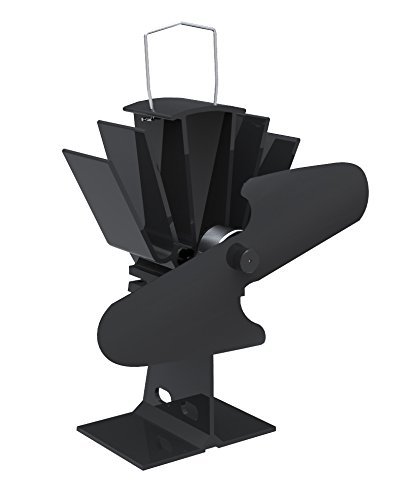
1. Caframo Ecofan Original Heat Powered Stove Fan
Our pick — 4.5+★ from 500+ verified ratings; the strongest balance of quality and price.
The two-blade classic that has quietly earned its reputation across thousands of winter nights.
For a stove in a normal living room, this is the fan to start with. The Caframo Ecofan Original runs on stove heat alone and moves up to 100 CFM — cubic feet per minute, meaning it shuffles about 100 cubic feet of air every minute. That is enough to push warm air off the ceiling and into the seats around the fire without turning your hearth into a wind tunnel.
It is dead simple by design. Set it on a wood stove where the surface runs between 300°F and 650°F, and it starts spinning on its own. No cord, no outlet, no battery to remember. The two-blade head is quiet enough that it fades into the background, and it uses less fuel because the warm air is spread instead of wasted.
Now the honest part. This is a smaller-volume fan. Against the VODA’s 280 cfm, the Ecofan’s 100 CFM shows it is built for a modest room rather than a big open-plan space. If your stove heats a huge room, you will want more airflow. For an average living room or cabin, the balance of quiet operation and real fuel savings is why it tops this list.
Where it earns its keep
- Moves up to 100 CFM with no electricity or batteries.
- Works across a 300°F to 650°F stovetop temperature range.
- Quiet two-blade design that owners find easy to forget about.
Where it asks a little patience
- 100 CFM is modest for large or open-plan rooms.
- Some owners find it does not move as much air as expected.
- Caframo rates it for a specific temperature window, so a cool stovetop won’t spin it.
Reach for this if: your stove warms one good-sized room and you want a proven, quiet fan with no wiring.
Look elsewhere if: you are heating a big open space where airflow volume is the whole point.
2. XTIMES 12 Blade Wood Stove Fan Dual Motor
Twelve blades on two motors, lighter than a bag of sugar and quiet enough to sleep beside.
The XTIMES is for the buyer who wants the biggest blade count and the most features for the money. It pairs a dual-motor, 12-blade head with an anodized aluminum body — a treated aluminum that resists rust and corrosion even when the fan runs hot. It comes with a magnetic stove thermometer so you can watch the temperature climb.
At 1.6 pounds it is lighter than the VODA’s 2 pounds, which makes it easy to lift off and reposition. The only moving part is the blade holder, and the maker rates it at under 25 decibels — decibels being a measure of loudness, so that is quieter than a whisper. You get a bimetal safety strip in the base that lifts the fan’s edge once it hits its top temperature.
The catch is spread heat is what it is good at, and heavy room-filling airflow is not its specialty. It also gets stiff competition from its own sibling picks in the same bracket. If you want a 1.6-pound fan with dual motors and a magnetic thermometer at entry-tier pricing, this is it.
What people love most: the pure performance-to-cost ratio — it circulates warm air efficiently and attaches easily to a home wood stove.
The honest trade: durability is a mixed report, so treat the moving parts gently and keep it clear of knocks.
Good fit: feature-hungry buyers who want the thermometer and dual motors in the entry tier.
Not the one for: a large room that needs a high-volume fan pushing air the whole width.
3. YOSN Dual Motors Heat Powered Fireplace Fan 900I1
The one fan that will also work on a Buddy heater, thanks to a bonus mounting bracket.
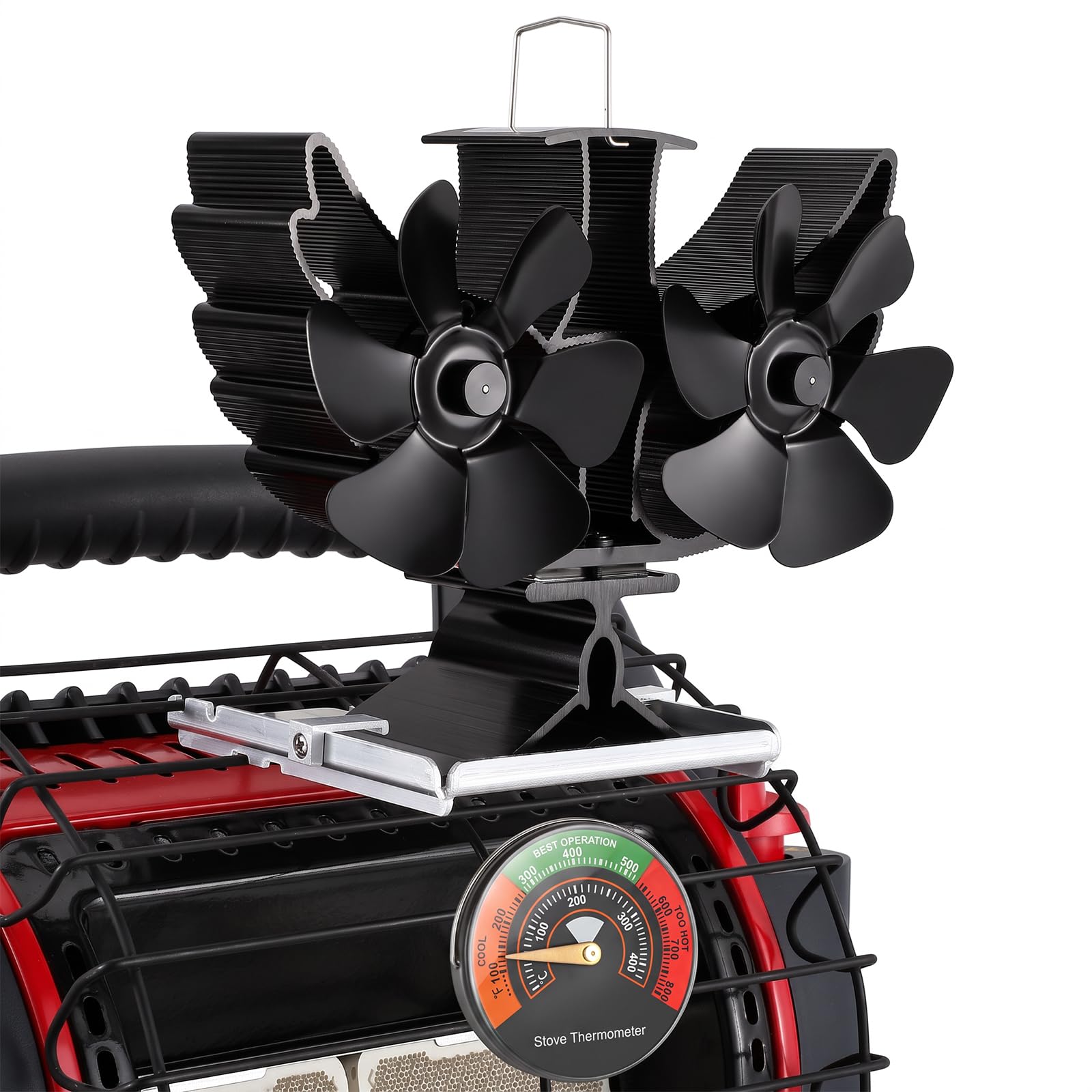
Here is the fan to reach for if you move your heat source around. It comes with a bracket that lets it mount on a heater as well as a wood stove, so the same blower can follow you from the fireplace to a portable propane heater. The stove-top fans above have no bracket and cannot mount on a heater.
It pushes 180 CFM through a dual-motor head — more airflow than the 100-CFM Ecofan — while staying near-silent at under 25 dB. The build is all aluminum with corrosion-resistant blades. It also protects itself: an over-temperature cut-off trips at 650°F, and it runs happily between 392°F and 610°F. When the fire dies down below its range, it simply stops, which is exactly what you want.
The one thing to know is that automatic over-temperature cut-off is a safety net, not a licence to run it against a roaring, red-hot stove. Respect the stated range and the fan will last. For a homeowner heating a cabin or a room who also camps with a propane heater, this is the fan that does both jobs.
Buy this one if: you want a solid 180 CFM fan that also fits a propane buddy heater with the included bracket.
Keep it clear of: stovetops running far above its stated range — it is built to shut off, not to be pushed.
4. VODA 12 Blade Triple Motor Wood Stove Fan
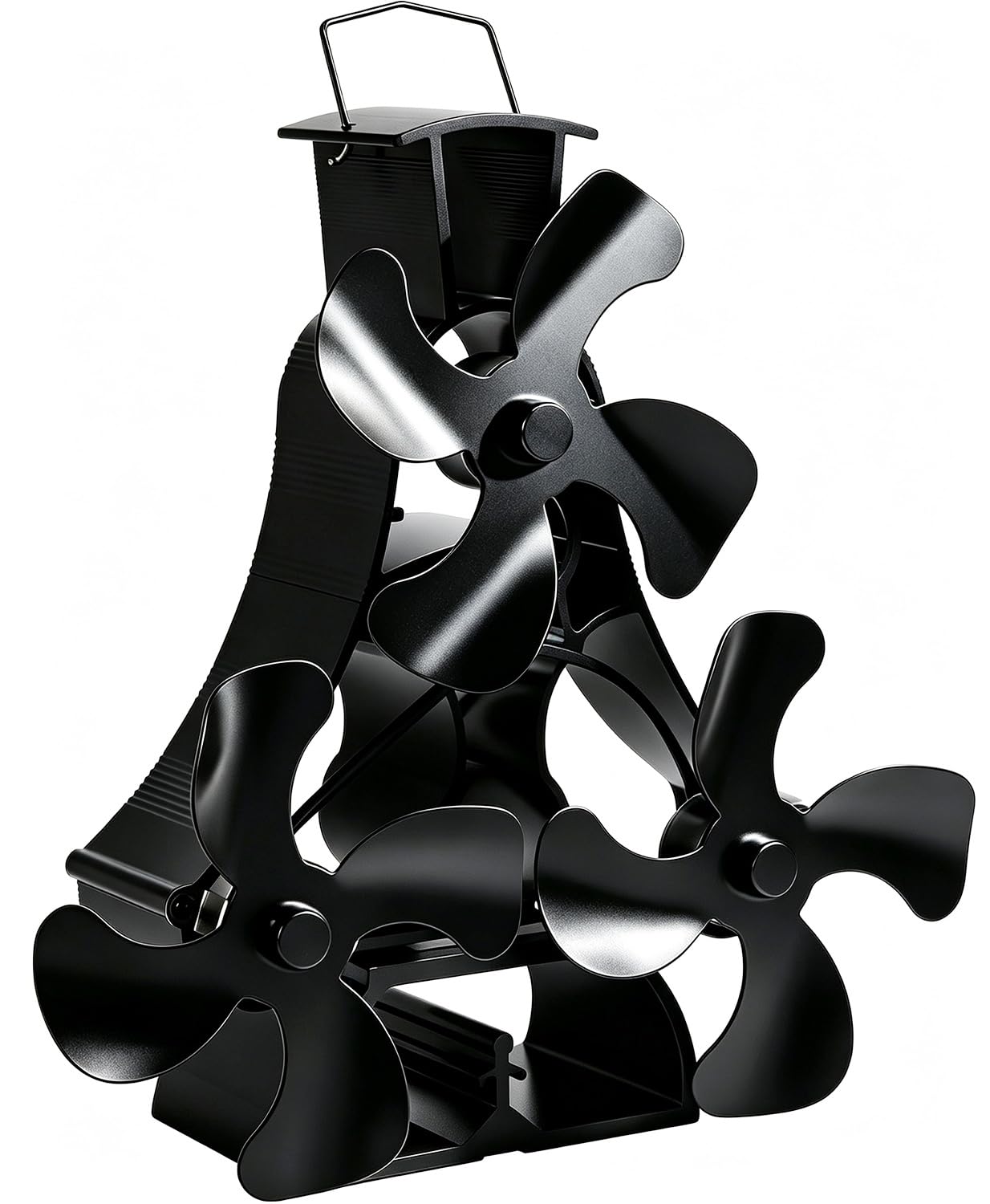
Triple motors and 12 blades that turn a hot stove into a room-wide warm-air mover.
If your living room is big and your only complaint is that the warmth never reaches the far chairs, this is the answer. The maker openly says 12 blades beat 8 blades for speed and air volume, and that extra push is exactly what a wide space needs.
It saves you wiring too. The fan generates its own power from the fire’s heat and needs no battery or outlet, so it runs whenever the stove is hot. There is a bimetallic safety device in the base that lifts the front once the surface passes around 653°F (345°C), protecting the motor and thermoelectric module. It gets spinning at about 140°F and runs most efficiently around 392°F to 482°F.
The honest note is on air movement. It is a real volume mover, but a heat-powered fan still is not an electric blower, and some owners find the airflow from this type of fan underwhelming. For sheer output in a large room, though, this is a strong mid-tier pick.
The airflow case
- 280 CFM from 12 blades and triple motors — built for big rooms.
- No wiring needed; runs entirely off stove heat.
- Overheating protection lifts the fan past 653°F.
Worth knowing before you buy
- Air movement is a mixed report — it will not blast like a plug-in fan.
- At 2 pounds it is heavier than the lighter XTIMES.
- For power, the fire has to be warm enough to start it spinning.
The right room: a large, open living space that needs the most warm-air push the mid-range offers.
Think twice if: you want hurricane-level air — no heat-powered fan delivers that.
5. BLFIRE Wood Stove Fan with Thermometer
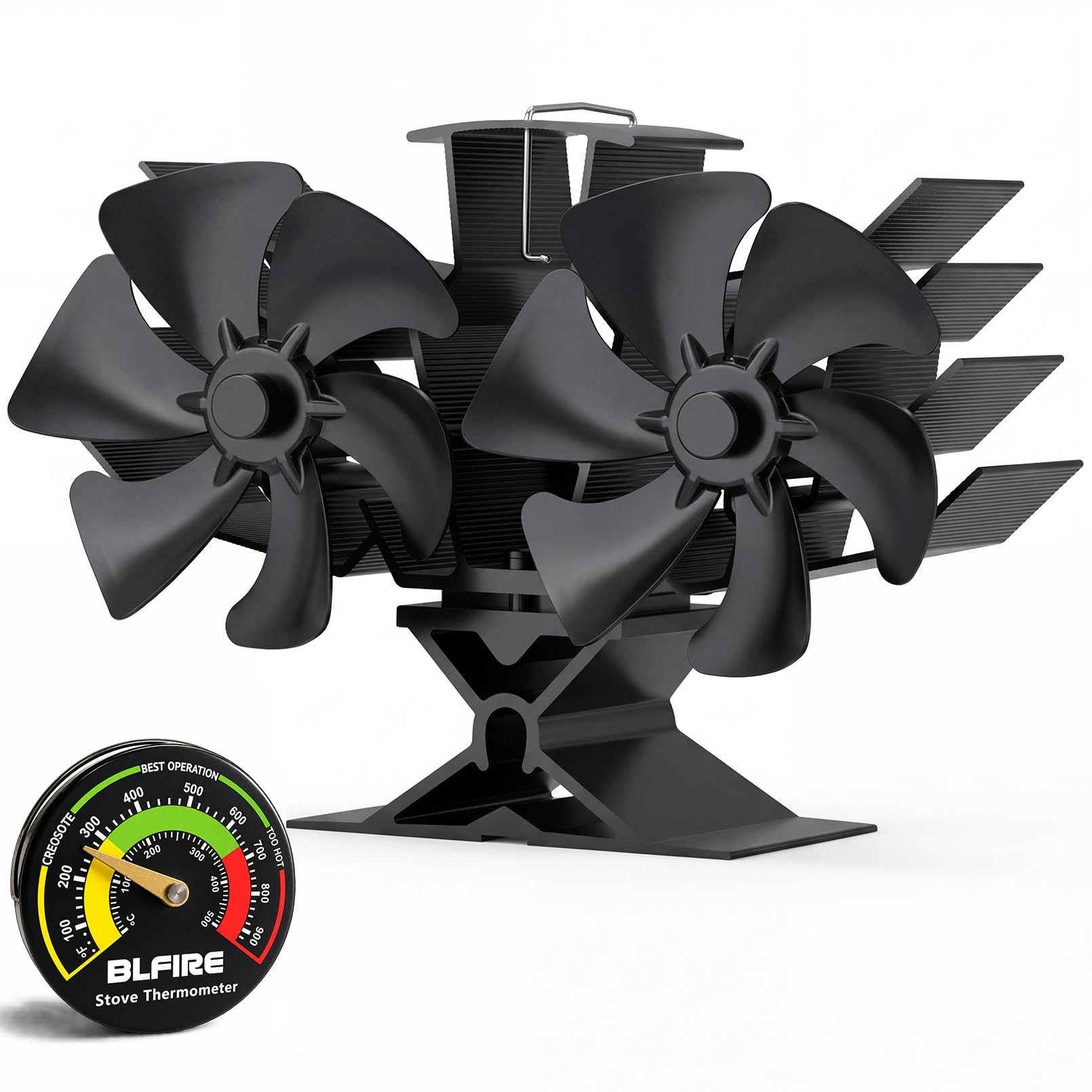
At 20 decibels it is the quietest fan here — quieter than the YOSN’s 25 dB.
For a bedroom stove, a small cabin or a winter ice-fishing setup, noise is the whole ballgame. This BLFIRE fan rates at 20 dB — decibels, a measure of loudness, so that is close to the sound of rustling leaves. It runs on heat alone and keeps working right through a power outage, which is precisely why it earns a spot for remote setups.
The dual-motor head comes with a thermometer so you can read the stove temperature at a glance. A heat-sensing module at the bottom lifts the fan slightly when things get too hot, sparing the unit from direct contact with a blazing stove. The aluminum body and compact design let it slot onto tight flat stovetops and even propane heaters at camp.
What it will not do is move a wall of air. Owners describe the airflow as modest — it warms a small space well but will not push heat across a large room. Its size and quietness are what win people over, and for tent or cabin duty that is the better trade anyway. Bring a big-room expectation and you will be underwhelmed; bring a sleeping bag and it will earn its spot.
The standout spec: a 20 dB noise level, the lowest of any fan on this list, paired with a temperature-sensing base.
The real limit: modest airflow suited to close quarters rather than open-plan spaces.
Best for: quiet sleeping spaces, cabins and camping setups where even a hum is too much.
Skip it for: a large living room that demands high-volume heat distribution.
6. HIDALIFE 2 Pack Wood Stove Fan Heat Powered
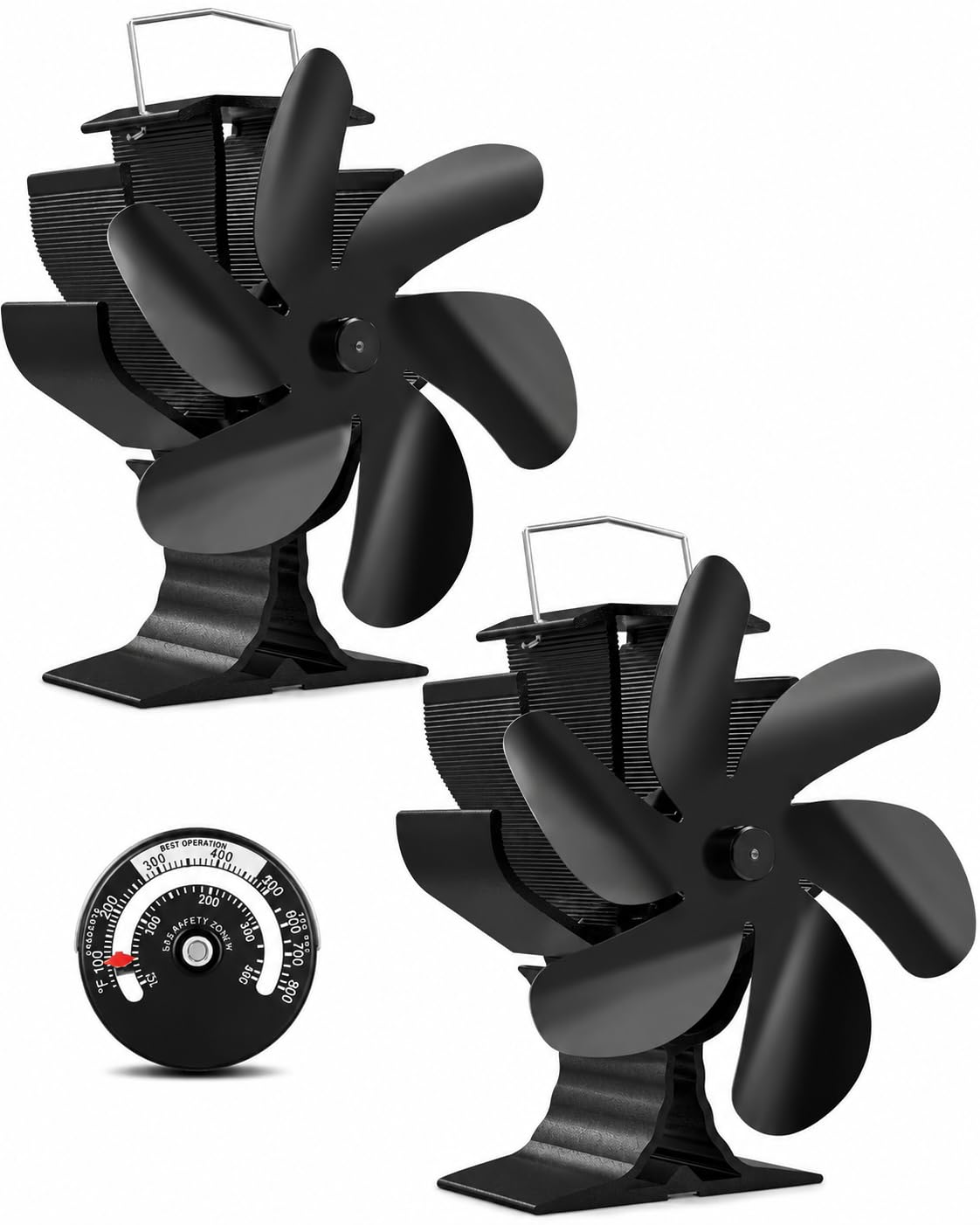
Two modest fans for the price of one — made for the household with a stove on each floor.
Why buy two fans? Because you have two stoves, two cabins, or one fireplace you want to kit out without stretching the budget. The HIDALIFE pack puts a pair of 6-blade heat-powered fans in your hands, built from anodized aluminum — treated aluminum that resists rust and carries heat well. Both run on stove heat with no power supply.
Each fan is small and rated at 25 dB, so it stays out of the way and out of your ears. What makes it genuinely useful is how fast it reacts — owners see it spinning within about 30 seconds of hitting a hot stove. That quick start means you feel the warm air moving sooner rather than waiting for the fire to build. For a camper or a second stove, the pair covers both.
Small is the theme, and it cuts both ways. The airflow is a mixed report — it moves a decent amount of air for its size but will not take over a big room. The compact build also means one fan does one small-to-mid space well. For a household running two stoves, the pair costs less than buying two single fans.
Two-stove owners, this is for you: a matched pair of 6-blade fans with fast start-up and low noise.
Pass if: you need one strong fan for a single large room — a higher-CFM pick serves you better.
7. Ecofan Original Classic Heat Powered Stove Fan

A Canadian-built classic with spare motors on offer — a fan you can keep repairing, not replace.
This is the fan for the buyer who hates throwing things away. It is a Caframo-made, Canadian-built design with a 100-CFM two-blade head, and the maker sells replacement motors plus backs it with a warranty. That repairability is a quiet feature almost no other fan here offers. It generates its own electricity from stove heat, so no batteries or cords are ever needed.
The 7.9-inch aluminum blades spin up as the stove warms and speed up with the temperature, spreading heat evenly. The FingerSafe blade design keeps fingers clear, and the two-blade system is built to minimize motor resistance, which is part of why it starts quickly at optimal stove temperatures. Owners describe it as super quiet and a welcome addition to a stove.
It duplicates the 100-CFM airflow of the Caféramo best overall, so if you are chasing pure volume this is not the upgrade path — the Freedom Stoves’ 348 cfm dwarfs it. What you pay for here is build quality, repairability and a brand that has been making these since 1955. If you want a fan you can repair instead of replace, the replacement motors and warranty make this the pick.
Why it lasts: replacement motors available, a warranty behind it, and a maker that has built these since 1955.
The trade-off: 100 CFM matches the entry-level fan, so large rooms will feel under-served.
For the buy-once crowd: people who want a quiet, repairable fan from a long-standing Canadian maker.
Not for: big-room heating, where more airflow per minute wins the day.
8. Freedom Stoves Heat Powered Stove Fan 13″ 4-Blade
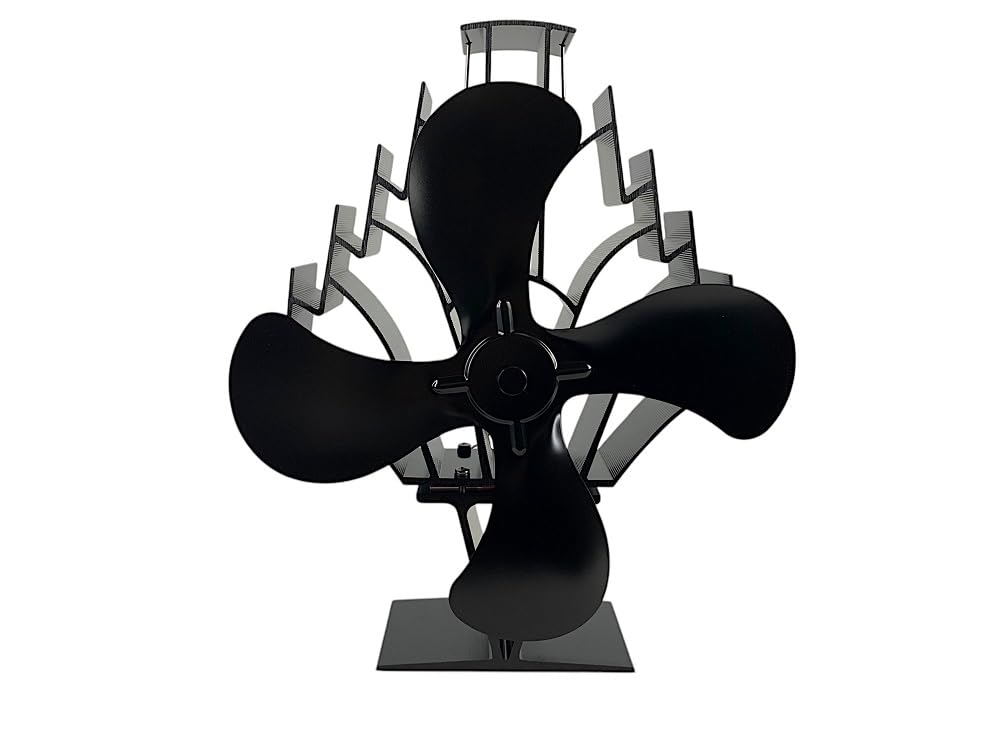
348 cubic feet per minute — the highest airflow on this list, by a wide margin.
When a big, cold room needs warm air pushed all the way to the far wall, the numbers point here. If maximum CFM is your deciding spec, this is the one.
There is a nice piece of logic built in. Fan speed rises as the stovetop warms and slows as it cools, so the output follows the fire’s heat automatically — you set nothing, adjust nothing. It runs entirely on stove heat with no cords or batteries, and it is built to sit on a flat-top wood, pellet or log-burning stove, including most Freedom Stoves models.
The honest check comes before you buy. The maker is clear that you must confirm your stove has a flat top, since the fan needs direct contact to make power. It also carries a mixed value report — some feel it is money well spent, others less sure. For a large room where the airflow number is the deciding factor, it is the high-output pick of the bunch.
The high-output argument
- 348 CFM — the strongest airflow in this roundup.
- Speed tracks the stove temperature, so it self-adjusts.
- No electricity, batteries or outlet required.
The fit-first checklist
- Needs a flat top stove to work — check before buying.
- Value is a mixed verdict for some owners.
- Large footprint takes up more stovetop room.
Choose this if: raw airflow for a large room is your priority and your stove top is flat.
Confirm first: a ribbed or curved stove top will stop this fan from spinning.
9. Pleasant Hearth Stove Blower

Not a stovetop fan at all — a plug-in blower that mounts into the stove body and dials its own speed.
Everything else on this list sits on top of the stove and powers itself. This one is different: it is a corded blower designed to mount into the stove, plugging in with a 6-foot cord and a standard plug. It is built specifically for Pleasant Hearth vent-free or wood-burning stoves, so it is the right pick only if that is the stove you own.
In return you get control a heat-powered fan cannot match. The variable heat control gives you a range of settings, and the adjustable speed lets you tune the airflow. Owners say it warms a room faster and mounts into the stove without fuss. It moves air with a powered blower rather than passive convection off the stovetop.
The trade-offs are real but simple. It is corded, so unlike the heat-powered fans it needs an outlet and will not run in a power cut. It has no thermostat control, and some find it a touch noisy at low speeds. Get it if you own a Pleasant Hearth stove and want speed control; bring a different stove and it will not fit.
What you gain: variable speed control and a corded blower built to mount into a Pleasant Hearth stove.
What you give up: it needs an outlet, so a power cut stops it — the heat-powered fans here keep going.
Made for: Pleasant Hearth wood-burning and vent-free stove owners who want a dialed-in, adjustable blower.
Wrong fit: any other stove brand, or anyone who needs a fan that works without electricity.
Know the Specs
CFM and airflow volume
CFM stands for cubic feet per minute — the amount of air a fan shifts every minute. A higher number spreads more warm air across a wider space. The fans here range from 100 CFM up to 348 CFM, so match the number to your room’s size. A big open room wants the high end; a small cabin is fine in the low hundreds.
Decibels and quiet operation
A decibel is a unit of loudness. Lower means quieter. A fan at 20 dB sits near the sound of rustling leaves, while 25 dB is still whisper-quiet. If the stove is in a bedroom or tent, the lower number is worth protecting. Most of these fans keep their only moving part — the blade — as the source of any sound.
Heat-powered operation
A thermoelectric module converts stove heat into a small amount of electricity, enough to spin the blades. That is why these fans need no battery or cord. They start on their own once the stovetop is hot enough — often around 140°F — and slow to a stop as the fire cools. No outlet, no wiring, no running cost.
Overheating protection and safety range
A bimetallic strip is a metal strip that bends when it gets hot. In these fans it sits in the base and lifts the front edge off the stove once temperatures climb too high, sparing the motor and module. Each fan has a stated working range and cut-off, so keep your stovetop within that window and the fan will protect itself.
Common Questions
Will a wood stove exhaust fan work if my stove top is not flat?
Do heat-powered stove fans need electricity or batteries?
How much airflow do I need for a large room?
Will a stove fan really reduce how much wood I burn?
What is the safe temperature range for a heat-powered stove fan?
Are stove fans loud enough to notice in a quiet room?
Can I use a stove-top fan on a buddy heater or propane heater?
What is the difference between a stove-top fan and a stove blower?
Will a stove fan fit on a pellet stove or log burner?
How do I get the most out of my stove fan?
The Bottom Line
For most rooms, the wood stove exhaust fan winner is the Caframo Ecofan Original — a quiet, energy-free 100-CFM fan that spreads heat without any wiring. If you want a big-room workhorse, the Freedom Stoves 13-inch 4-Blade leads the pack at 348 CFM. And for a quiet cabin or tent setup, the BLFIRE fan at 20 dB is the one to reach for. Whichever you pick, confirm your stove top is flat and your fire runs within the fan’s temperature range before you buy.
How we choose
We do not accept paid placement. Every pick is matched to a real buyer and a real use-case; we do not hands-on test units.
Sources
Specifications: manufacturer listings and product documentation. Review insights: verified customer reviews, as of November 2026. Pricing: not shown on this page (it changes often); check the current price via the retailer link.
As an Amazon Associate, Tactical Gear Guy earns from qualifying purchases. This does not affect which products we feature.