Specs are compiled from manufacturer listings and verified buyer reviews and can change over time — please confirm the key details on the product page before buying.
You avoid a box of unusable stainless steel by getting three things right: match the pipe diameter to your stove’s flue collar (the round opening where smoke exits), pick the length for your chimney height, and choose between a flexible liner that drops inside an existing masonry flue or a rigid triple-wall kit that runs up an outside wall. Get those three right and the install goes smoothly.
This guide is built by comparing the manufacturers’ published specifications and the patterns across verified customer reviews, so you get each pick’s real strengths and trade-offs instead of marketing spin.
You get both routes covered: flexible liners you feed down a masonry chimney and through-the-wall or through-the-ceiling kits for a freestanding stove. Every pick here includes the pipe plus the cap, plate, or tee you need to finish the job, so you are not hunting for one missing adapter. The right wood stove chimney pipe kit depends on matching diameter to your flue collar and length to your actual chimney height.
Top Picks

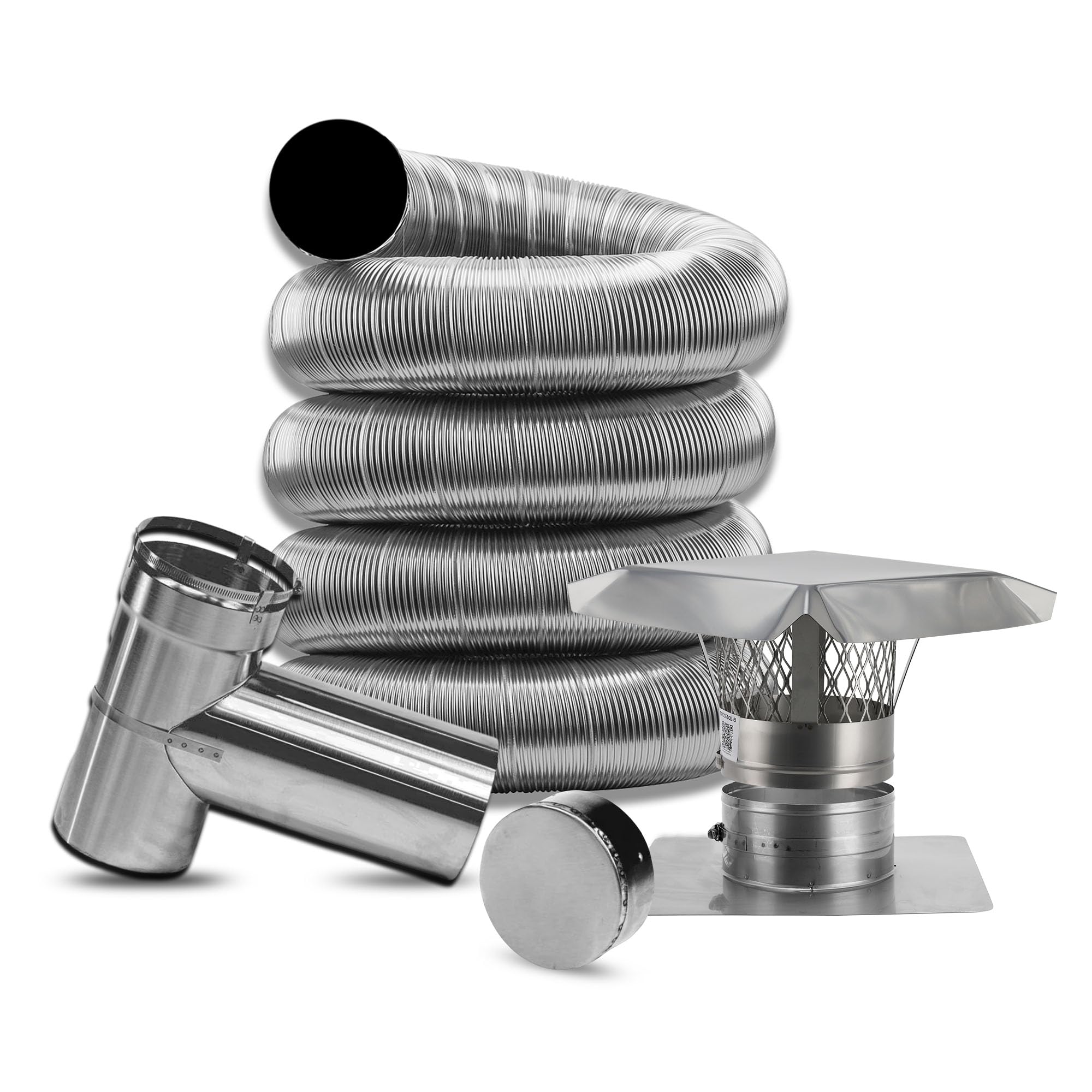

How To Choose The Best Wood Stove Chimney Pipe Kit
A chimney kit is a fitment purchase first and a materials purchase second. The best stainless steel in the world will not draw properly if the diameter is wrong. So work through the size questions before you look at anything else.
Match the diameter to your stove and your flue
The number in the product name — 3 inch, 6 inch, 8 inch — is the inside diameter of the pipe. That figure has to line up with your stove’s flue collar, the round outlet on top or back of the appliance. A flexible liner also has to fit inside your existing masonry chimney with room to spare. A 6-inch liner inside a flue that is barely 6 inches wide will fight you the whole way down.
Smaller 3-inch liners suit pellet stoves and smaller appliances. Six-inch is the common size for most wood stoves and fireplace inserts. Eight-inch kits serve larger appliances and bigger flues.
Flexible liner or rigid through-the-wall kit
These are two different jobs. A flexible liner is a corrugated stainless tube you drop down the inside of an existing masonry chimney to reline it. A through-the-wall kit is a set of rigid triple-wall pipe sections, a wall thimble, a tee, and a cap that carries smoke out through an exterior wall and up. If you have a masonry chimney, you want a liner. If you have a freestanding stove with no chimney, you want a wall or ceiling kit.
Count the length against your actual chimney height
Liner kits are sold in fixed lengths — 20 feet, 25 feet, 30 feet. Measure from the top of the appliance connection to the top of the chimney, then add a little slack. A liner that is too short will not reach the top plate. Too much extra length is easier to deal with than too little, because a flexible liner can usually be trimmed.
Check the clearance rating and the listing
Clearance is the minimum gap between the hot pipe and anything combustible, like wood framing or drywall. Some triple-wall kits list a 1-inch clearance to combustibles. That number comes from the manufacturer’s listing and testing, and it is what an inspector will look for. Look for a UL or ULC listing on the kit you buy — flexible liners are typically listed for installation inside a masonry chimney only.
Side-by-Side Comparison
| Model | Best For | Diameter | Length | Kit Type | Amazon |
|---|---|---|---|---|---|
| 316 Stainless Steel Flexible Chimney Liner Insert Kit★ Best Overall | Pellet stoves and tight masonry flues | 3 inches | 20 feet | Flexible liner | Amazon |
| FireSafe Flexible Chimney Liner with Tee ConnectorBest for Tee Hookups | Horizontal hookups off a wood stove | 3 inches | 20 feet | Flexible liner + tee | Amazon |
| DuraVent DuraPlus Through-The-Wall Chimney KitBest Wall Kit | Freestanding stove vented out a side wall | 6 inches | 9-inch horizontal pipe included | Through-the-wall | Amazon |
| Basic FireSafe Flexible Chimney Liner Insert Kit | Wood stove inserts in tall masonry chimneys | 6 inches | 25 feet | Flexible liner | Amazon |
| SW625SSK SmoothWall Double Ply Liner Kit | Draft-starved wood stoves needing a slick bore | 6 inches | 25 feet | Double-ply flexible liner | Amazon |
| SW630SSK SmoothWall Double Ply Liner Kit | Extra-tall masonry chimneys up to 30 feet | 6 inches | 30 feet | Double-ply flexible liner | Amazon |
| Duravent 6″ DuraPlus Basic Through the Ceiling Kit | Stoves running straight up through the roof | 6 inches | — | Through-the-ceiling | Amazon |
| Selkirk Metalbestos 206622 Complete Stove Thru Wall Kit | 6-inch stoves exiting through a combustible wall | 6 inches | — | Through-the-wall | Amazon |
| Chimney Liner Tee Kit 6″ x 20′ with Insulation | Cold-climate installs that need an insulated flue | 6 inches | 20 feet | Flexible liner + insulation | Amazon |
| Selkirk Metalbestos 208622 8-Inch Thru Wall Kit | Large 8-inch appliances vented through a wall | 8 inches | — | Through-the-wall | Amazon |
Detailed Reviews
1. 316 Stainless Steel Flexible Chimney Liner Insert Kit 3 Inch x 20 Feet
Our pick — 4.5+★ from 450+ verified ratings; the strongest balance of quality and price.
A 3-inch, 20-foot liner that slots down a tight masonry flue without a fight.
Start with the size, because it decides who this kit is for. The 3-inch inside diameter and 20-foot length suit pellet stoves and smaller appliances feeding a narrow masonry flue. If your wood stove has a 6-inch collar, this is the wrong size and you want one of the 6-inch liners below instead. Get the diameter right and everything else about this kit falls into place.
The material is the reason it carries the top pick. The liner is built from 316 stainless steel, which is the grade that holds up to moisture and corrosive flue gases rather than rusting through. The Quick Connect system takes the pain out of assembly: you tighten the clamps and you are done, no custom crimping tools. Flexibility is the whole point of a liner like this — it bends around offsets in an old chimney that rigid pipe could never pass.
Owners commonly note the savings over paying a pro to reline, and the price lands well below many comparable kits. What wins people over is the build quality and the straightforward install. For a 3-inch flexible kit, you get a 316 stainless body (a corrosion-resistant steel grade), a complete set of adapters, and a transferable warranty that stays with the house if you sell. The honest limit is at the flexible end — feeding a long corrugated liner down a rough flue takes patience, and straightening it out afterward is the part that tests tempers.
What earns the top spot
- 316 stainless steel body resists the moisture and acids that chew through cheaper liners.
- Quick Connect clamps mean the joints go together with hand tools, no special crimper.
- Comes with all the adapters, so you are not chasing one missing piece mid-install.
- A transferable warranty that carries to the next homeowner if you sell the place.
Where it asks for patience
- Feeding a 20-foot corrugated liner down a rough masonry flue is slow work.
- Straightening the coil once it is in place is the fiddly part of the job.
- 3-inch sizing narrows the field — it serves pellet and small appliances, not big 6-inch wood stoves.
Reach for this if: you are lining a masonry flue for a pellet stove or smaller appliance and want a complete 316 kit that drops in with clamps instead of crimping.
Look elsewhere if: your stove has a 6-inch flue collar — size up to the 6-inch liners below rather than choking the draft.
2. Stainless Steel Chimney Liner Kit 3 Inch x 20 Feet
The horizontal-hookup liner: a tee takes the smoke sideways out of the stove.
When your wood stove sits in front of a chimney breast and the smoke has to turn a corner, a straight liner drop will not line up. This is the kit that solves that. Along with the liner and the top plate, it includes a tee connector for horizontal hookups, so the flue path can jog sideways at the base.
The barrier quality is the selling point. The liner is 316L stainless steel with 7-ply seams and 10 corrugations, which the maker says forms a gas- and watertight wall. In plain terms: fewer pinholes and gaps for smoke or moisture to slip through, and a smoother path for the draft. The 13″ x 13″ top plate with rain cap closes off the chimney top so water stays out. At 3 inches by 20 feet it feeds a narrow flue, and it is Made in the USA from mill-certified stainless. Weighing in at 15 pounds, it is a one-person carry up the ladder rather than a two-person heave.
Where it shines is function: it goes in, the stove drafts, and the tee makes the horizontal connection clean. The inset here is the same one that comes with any 3-inch liner — it is sized for a narrow flue and a smaller appliance, so it will not fit a 6-inch collar without adapting down. A vertical-only install has no need for the tee, and the 6-inch liner picks below better serve a big wood stove.
Proof in the smoke path: buyers report that function and install are what come up most when they weigh this kit — it lines a narrow flue, the tee makes the horizontal turn, and the stove drafts properly once it is seated.
The honest catch: the 3-inch sizing is the real constraint, not the materials — it wants a small appliance and a tight masonry flue, so measure before you order.
Best matched to: a wood stove or insert that needs a horizontal tee hookup into a narrow masonry flue, with the top plate and rain cap included.
Not the pick for: a 6-inch stove collar or a straight vertical drop where the tee is wasted hardware.
3. DuraVent DuraPlus Through-The-Wall Chimney Kit
Everything to punch a freestanding stove’s flue out a side wall in one box.
If there is no masonry chimney and the stove has to vent sideways through an exterior wall, this is the all-in-one route. The kit includes the wall thimble, one 9 inch x 6 inch horizontal chimney pipe, a tee with a clean-out cap, a tee support, two wall straps, and a chimney cap. That is the full puzzle: the piece that passes through the wall, the piece that turns the corner, the bracket that holds the weight, and the cap that keeps rain out.
The build is a triple-wall design in alloy steel, and it connects with a twist-lock system rather than screws. Twist-lock means the sections seat with a quarter turn and hold — faster than drilling every joint. It supports up to 40 feet of chimney pipe, which is the figure to note if you are running a tall exterior stack above the tee. The 6-inch size fits the matching DuraPlus pipe and a 6-inch stove collar. At 38.4 pounds it is a two-person lift up the ladder, and noticeably heftier than the 15-pound 3-inch liner above.
Owners mention that the quality is solid but the install splits people down the middle — the support bracket that mounts outside the wall is the piece that takes two people and some head-scratching. Set that against the fact that the kit is complete and the twist-lock joints go together cleanly, and it is still the obvious choice for an exterior venting job. Read the support-mounting step twice before you climb the ladder.
Why it holds its position
- One box holds the thimble, horizontal pipe, tee, cap, straps, and tee support.
- Twist-lock joints seat with a quarter turn — no drilling every section.
- Triple-wall design supports up to 40 feet of chimney pipe above the tee.
- Alloy steel build with a metallic finish that suits an exterior stack.
What the job will demand
- Mounting the outside tee support is a two-person task most people underestimate.
- At 38.4 pounds it is a ladder lift that wants help, not a solo job.
- 6-inch sizing only — the wrong fit for a 3-inch appliance.
Go with it when: you are venting a 6-inch freestanding stove through an exterior wall and want the thimble, tee, cap, and support in a single purchase.
Plan for this: rope in a second set of hands for the outside support bracket — it is the step that turns an afternoon into a weekend.
4. Basic FireSafe Flexible Chimney Liner Insert Kit 6 Inch x 25 Feet

Six inches of 316 liner for a wood stove insert in a tall masonry chimney.
This is the workhorse size for a fireplace insert: 6 inches in diameter and 25 feet long, which reaches up most residential masonry chimneys. It is the vertical counterpart to the tee kit above — instead of a horizontal tee, it ships with an appliance connector for a straight-up connection. Same 316 stainless steel build, same 7-ply seams and 10 corrugations, same 13″ x 13″ top plate and rain cap. The.006″ thick liner wall is the spec that tells you it is a real liner and not a thin vent hose.
Quality and ease of assembly carry this one. The material cuts and assembles cleanly, and it is a 6-inch step up in bore and reach from the 3-inch, 20-foot teeline — same quality tier, larger capacity for a bigger firebox. Customers note it cured draft problems on a smoking woodstove, and the kit includes the top plate and rain cap needed to finish the job. At 30 pounds it is heavier than the 3-inch kits but still manageable on a ladder with a helper.
The honest catch sits at the ease-of-work end. Working with a corrugated liner of this length is not as forgiving as the product photos imply — it takes some muscle to feed and straighten. The build is not the issue; the handling is. Shop this one if you want a fresh 316 liner and a complete top-plate set for a 6-inch insert in a mid-height masonry chimney, and budget a weekend and a second pair of hands for the drop.
The materials story: 316 stainless with 7-ply seams and a.006″ liner wall is the spec stack that keeps this kit in the serious-liner category, and it shows in the clean way it cuts and assembles.
The handling reality: 25 feet of corrugated steel is not as cooperative as the photos make it look — feeding and straightening it is the real work.
Suits: a 6-inch wood stove insert in a masonry chimney of up to 25 feet where a vertical appliance connector is all you need.
Think twice if: you want a screwdriver-and-done afternoon — this is a muscle-and-patience install.
5. SW625SSK SmoothWall Double Ply Stainless Steel Chimney Liner Kit, 6-Inch x 25-Feet

The smooth-bore liner for a stove that draws lazily and needs the help.
Corrugated liners create drag on the smoke. SmoothWall is the answer to that: the bore is designed to let flue gas glide instead of tumbling over every ridge. The maker claims the SmoothWall bore boosts draft and energy efficiency by 20%. That is a manufacturer figure, quoted as stated, but it tells you exactly who this kit is for: a stove that has always been a bit sluggish on the draw.
You get a liner wall that is.012″ thick — twice the.006″ thickness of the Basic kit above, which is the real difference between the two lines. The construction is double-ply 316L stainless steel with multiple corrugations. The 13″ x 13″ top plate with integrated rain cap, and the tee, tee cap, fasteners, and tee connector, make this a complete horizontal-hookup kit. At 37.2 pounds it is a substantial coil to wrangle. Same 6-inch by 25-foot dimensions as the Basic kit, so the choice between them depends on that smooth bore and thicker wall.
What owners praise most is exactly what this line is named for: the quality, the corrosion resistance — the SmoothWall finish reportedly resists rusting — and the ease of unrolling. The trade-off is that 37.2 pounds is more coil to manage than the thinner 30-pound Basic kit, and a smooth bore helps draft but does not overcome a badly sized flue. For a mid-height chimney and a stove that needs the help, the smooth bore and the heavier wall justify the step up.
What it does for a lazy draft
- SmoothWall bore cuts drag on flue gas; the maker cites a 20% draft and efficiency gain.
- .012″ wall is twice the thickness of the Basic line’s.006″ liner.
- Double-ply 316L stainless resists rust and corrosion over the long haul.
- Complete horizontal kit with top plate, rain cap, tee, and connector included.
What to weigh
- 37.2 pounds is a heavy coil to feed and straighten up the chimney.
- Smooth bore improves flow but cannot rescue a flue that is the wrong size to begin with.
- Premium build for a midsize chimney — long or tall runs want the 30-foot version.
The right call for: a 6-inch stove that smokes on cold starts or draws weakly, where a smooth bore and a.012″ wall are worth the heft.
Weigh before buying: that same smooth bore still needs a correctly sized flue — a booster helps a healthy chimney, not a mismatched one.
6. SW630SSK SmoothWall Double Ply Stainless Steel Chimney Liner Kit, 6-Inch x 30-Feet
Five extra feet of smooth-bore liner for the chimney that just will not fit 25.
Thirty feet of 6-inch liner is the number that earns this kit its place. If your masonry chimney runs taller than the 25-foot kits can reach, this is the version that gets the top plate up to the crown. It is the SW625’s longer sibling: same double-ply 316L stainless, same SmoothWall bore the maker says boosts draft and energy efficiency by 20%, same 13″ x 13″ top plate with integrated rain cap.
Every spec that made the 25-foot SW625 a draft booster carries over — the smooth bore that lets flue gas glide, the double-ply wall, the 6-inch diameter. The only real difference is the extra five feet of reach, which is what you pay the step up for. The length is listed at 30 feet by 6 inches wide, and the brand is Forever Vent. Nothing about the materials changes; it is the same liner, sized for a taller run.
The honest limit here is the coil itself — 30 feet of corrugated double-ply steel is a lot to feed up a chimney, and it is a two-person job that takes real patience. Beyond that, a smooth bore cannot fix a flue that is undersized or a stove collar that does not match 6 inches. Buy it if your chimney genuinely needs the reach; if 25 feet clears the crown, the shorter kit does the same job for less wrestling.
The reach argument: 30 feet of 6-inch smooth-bore liner is what separates this from the 25-foot version — it exists for the tall chimney, and for the tall chimney only.
The handling cost: 30 feet of double-ply coil is heavy to feed and slow to straighten, so plan the drop with a helper and a clear roof before you start.
Match it to: a masonry chimney taller than 25 feet where a 6-inch smooth-bore liner is the whole point, with the top plate and rain cap included.
Easy to overbuy: if a 25-foot liner clears the crown, the shorter SW625 does the same job with less coil to wrestle.
7. Duravent 6″ DuraPlus Basic Through the Ceiling Kit

Straight up through the roof instead of out the wall — for a centered stove.
Not every stove sits against an exterior wall. When it stands in the middle of the room and the flue runs straight up through the ceiling and roof, this is the kit that carries it. It is a through-the-ceiling installation kit for 6-inch DuraPlus chimney pipe, so it pairs with the same pipe family as the wall kit above but takes the vertical route instead.
The construction is 24-gauge, in a triple-wall design, and it supports up to 35 feet of pipe above it. That 35-foot figure is the gate: check your roofline height against it before you commit. The kit is an all-in-one set, which means the ceiling support pieces and the transition through the roof are covered rather than sold piecemeal. It is a 6-inch kit, built to take the same 6-inch DuraPlus pipe the wall versions use.
Where this one asks you to plan ahead: a ceiling penetration means cutting through the ceiling and roof, so it is a bigger structural commitment than a wall exit and the pipe above the kit is not included. Those are the two things to know before you climb into the attic. Settle the pipe length and the roof height first, and this kit is the clean, centered route to a freestanding stove.
Why the centered stove likes it
- Routes a 6-inch DuraPlus flue straight up through ceiling and roof.
- Triple-wall, 24-gauge build carries the same safety design as the wall version.
- Supports up to 35 feet of pipe above the kit.
- All-in-one set, so the ceiling and roof transition pieces are grouped together.
What it commits you to
- A ceiling and roof penetration is a bigger job than an exterior wall exit.
- The chimney pipe above the kit is sold separately.
- 35-foot support limit — check a tall roofline carefully before ordering.
The pick for: a stove set away from the wall that needs a clean vertical run through the ceiling and roof, using 6-inch DuraPlus pipe.
Plan the whole run: pipe length and roof height decide whether this works — measure both and stay inside the 35-foot support limit.
8. Selkirk Metalbestos Selkirk-206622

The old-name 6-inch wall kit: stainless Ultra-Temp sections that go together easily.
You get the full set of pieces to take a 6-inch flue out through an exterior wall, so you are not hunting for a thimble or a cap on top of the kit. The “complete” in the name is the appeal. The 206622 is a 6-inch complete stove thru-wall kit in stainless steel, in the Ultra-Temp style. Selkirk is the brand many older installs were built around, and this kit keeps that lineage.
The stainless finish suits an exterior stack, and the assembly is straightforward — the sections go together
without a wrestling match, which is the note that keeps coming back around this kit. Owners most often cite the build quality and easy assembly, and several note it holds up over the seasons. Compatibility with common 6-inch hardware is a quieter plus, and it shows up in mixed reports rather than universal cheer.
The honest catch is condition on arrival. Reports split on how the units show up — some arrive with no rust spots, some come with dents on the fitting end. That is a shipping-and-handling story rather than a build story, and the fix is simple: inspect the sections the day they land and flag any dented fitting before you start the install. Buy it for the 6-inch complete set and the familiar Selkirk name; order early enough to swap a damaged section if one shows up.
The familiar name: a 6-inch complete thru-wall kit in the Ultra-Temp style is the straightforward route for anyone relining an install built around Selkirk hardware.
Inspect on arrival: condition at delivery is the uneven part — some arrive spotless, some with a dent on the fitting end, so open the box before install day.
Right for: a 6-inch stove exiting an exterior wall where you want a complete stainless thru-wall kit from a long-standing brand in the style.
Worth checking: the condition of the fittings when the box lands — a quick inspection keeps a dented end from stalling the job.
9. Chimney Liner Tee Kit 6″ x 20′ with Insulation

The cold-climate kit: a 20-foot liner wrapped in an insulation blanket, not just bare steel.
Most liner kits are bare stainless. This one adds the wrap. Inside the box: a.006″ thick 316 stainless liner, a 13″ x 13″ top plate with rain cap, a tee connector with a 10″ snout and clean-out cap for horizontal connections. Then the insulation kit: a Premier Wrap flue insulation blanket, a 16oz can of adhesive, retractable mesh, a 150′ roll of foil tape, and two stainless clamps to secure the blanket at top and bottom.
The insulation is what makes this a different job. The blanket adds about 1 1/2″ to the liner diameter — a 6-inch liner becomes 7 1/2″ once wrapped — which means a roomier masonry flue is required to fit the wrapped liner down. In return, an insulated flue is the cold-weather answer: it keeps flue gas warm, which is what a healthy draft depends on in a cold exterior chimney. The warranty is a lifetime transferable one when used for wood, wood pellet, gas, and oil burning installations.
The trade-off is the fit math. Because the wrap adds diameter, this kit does not drop into the tightest flues where a bare 6-inch liner barely fits. Measure your flue first and confirm you have the extra room for the blanket. The packaging is not its strong point either — the whole reason people note the pre-taped and pre-wrapped setup is that it saves them buying and cutting insulation separately.
Built for a cold chimney: you are not chasing the wrap on your own because the insulation blanket is a separate box of parts — blanket, adhesive, mesh, 150 feet of foil tape, two clamps — bundled with the liner.
Do the diameter math: the blanket adds about 1 1/2 inches to the liner, so a 6-inch liner needs a flue wide enough for 7 1/2.
Choose it for: a cold-climate install where an insulated flue is the point and you want the blanket, tape, mesh, and clamps bundled with the 6-inch liner.
Measure before you order: the insulation adds about 1 1/2 inches to the diameter, so a tight flue that fits bare 6-inch pipe may not fit the wrapped liner.
10. Selkirk Metalbestos 208622 8-Inch Complete Stove Thru Wall Kit
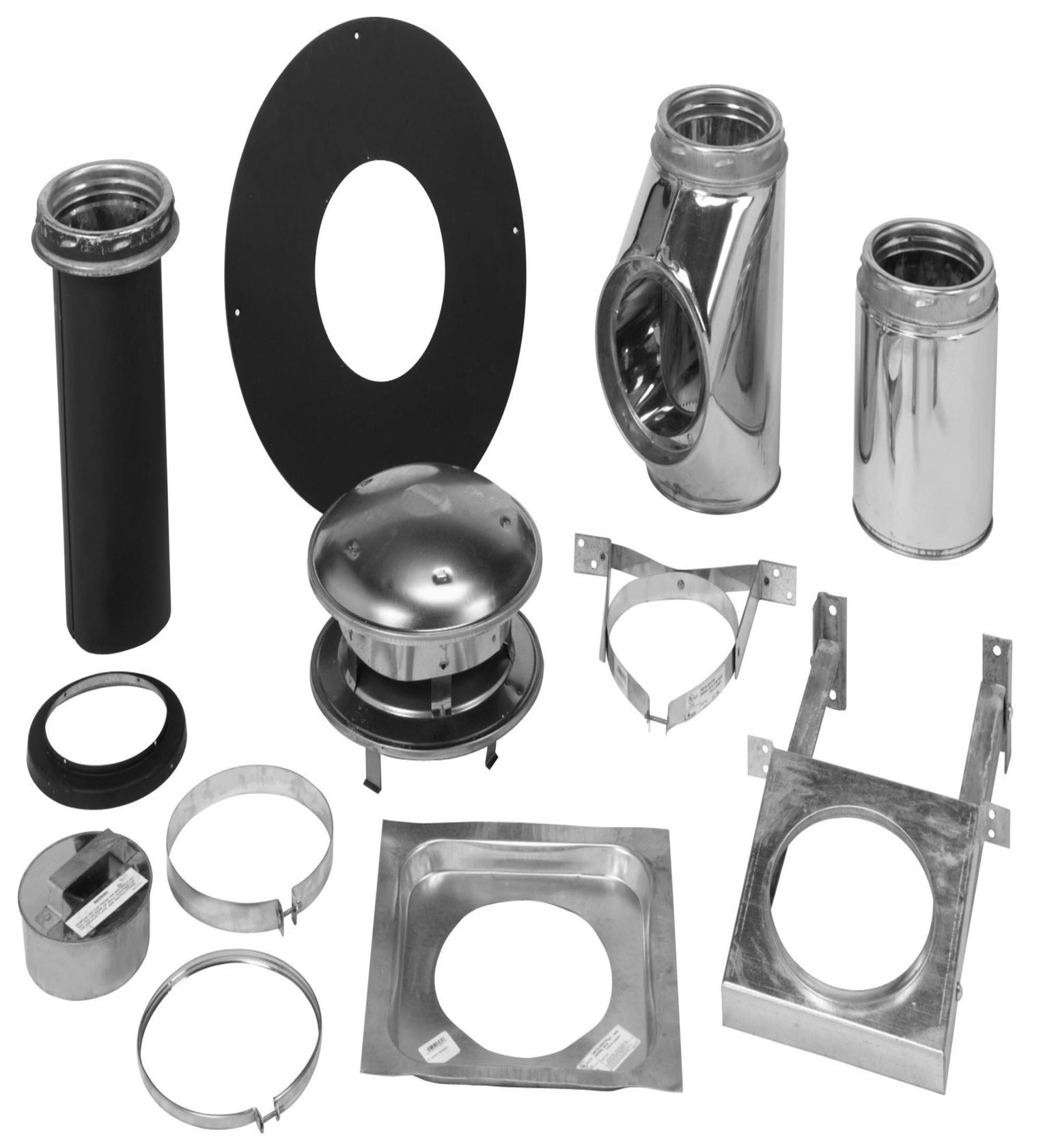
An 8-inch bore for the big appliance the 6-inch kits cannot serve.
Diameter is the whole reason to land on this one. It is an 8-inch complete stove thru-wall kit, so it feeds a larger appliance and a larger flue than every 6-inch kit above. If your stove’s collar is 8 inches, a 6-inch kit simply does not fit, and this is the size that does. The 208622 runs out through an exterior wall in the Ultra-Temp style, in stainless steel, with a wall-mount installation.
You carry the lightest box here up a ladder: this is the heaviest-duty kit in the lineup by size, but it ships at a listed 5.8 pounds. The mount is wall-type, so it takes the flue out through the side of the house rather than the roof. The listing describes it as durable and easy to use. It is manufactured in China and carries the 208622 model number.
You can count on the size — an 8-inch complete thru-wall kit for a big appliance, in stainless, at a weight that is easy to handle. The honest limit is what the listing does not say. It gives the diameter, the wall-mount form, and the Ultra-Temp style, but it does not spell out the clearance rating or the full box contents the way the DuraPlus kits above do. That means a little homework: confirm the 8-inch pipe you plan to run above it and the clearance your inspector will want before you order.
The size argument: 8 inches is the spec that decides this kit — it serves the large appliance and flue that a 6-inch kit cannot, and nothing smaller will substitute.
The homework it asks: the listing is thin on clearance and box contents, so verify both against your install before buying rather than after the box lands.
Go with it when: your appliance’s flue collar is 8 inches and a 6-inch kit is simply the wrong size, and you are venting out an exterior wall.
Do your homework: clearance and box contents are not itemized here, so confirm them against your wall build and pipe run first.
Know the Specs
These are the numbers that decide whether a kit fits your house and passes inspection. Read them once and the rest of the listings make sense.
Diameter and length
The diameter is the inside width of the pipe — 3 inch, 6 inch, 8 inch — and it has to match your stove’s flue collar and fit inside your masonry flue or accept your pipe run. Length is the total reach of a flexible liner in feet, measured to your chimney height with a little slack. A liner that is too short will not reach the top, and too much length is more forgiving than too little.
Wall thickness and ply
A flexible liner’s wall thickness is given in thousandths of an inch, like.006″ or.012″. The.012″ wall is thicker and heavier than the.006″ version, which is the real difference between a basic liner and a premium one. Ply and corrugation count describe how the steel is layered and shaped into a gas- and watertight barrier — more plys and a smoother bore help draft and resist leaks.
Clearance and listing
Clearance is the minimum gap between the hot pipe and anything combustible, and it is the number an inspector checks on a rigid through-the-wall or through-the-ceiling kit. Some triple-wall kits list a 1-inch clearance. The ULC and UL listing stamps confirm the kit is tested for the application, and flexible liners are typically listed for installation inside a masonry chimney only.
Kit contents and support
A complete kit includes the pieces beyond the pipe: a top plate with rain cap, a tee and tee cap, a wall thimble, and straps or a support bracket. The support rating tells you how much pipe the kit can carry above it, like supporting up to 40 feet or up to 35 feet of pipe. Check both the box contents and the support figure before you commit to a tall run.
Common Questions
Will a 6-inch liner fit my stove if its flue collar measures about 6 inches?
What is the difference between a flexible liner kit and a through-the-wall kit?
How do I know what length liner my chimney needs?
Do I need an insulated liner kit for a cold chimney?
What does 1-inch clearance to combustibles actually mean?
Can I install a flexible chimney liner myself?
How much pipe can a through-the-wall or ceiling kit support above it?
Is thicker liner wall better,.006 or.012?
Will an 8-inch kit work where all the others are 6-inch?
What should I check on a thru-wall kit when it arrives?
The Bottom Line
For most people lining a masonry flue, the wood stove chimney pipe kit winner is the 316 Stainless Steel Flexible Chimney Liner Insert Kit because it pairs a corrosion-resistant 316 stainless body with clamp-together Quick Connect joints and a transferable warranty — rated 4.5+ stars across 400+ ratings. If your stove needs a horizontal tee hookup, the FireSafe Flexible Chimney Liner with Tee Connector solves the corner turn. For a freestanding stove with no chimney, go straight to the DuraVent DuraPlus Through-The-Wall Chimney Kit and rope in a helper for the outside support bracket.
How we choose
We do not accept paid placement. Every pick is matched to a real buyer and a real use-case; we do not hands-on test units.
Sources
Specifications: manufacturer listings and product documentation. Review insights: verified customer reviews, as of November 2026. Pricing: not shown on this page (it changes often); check the current price via the retailer link.
As an Amazon Associate, Tactical Gear Guy earns from qualifying purchases. This does not affect which products we feature.