Specs are compiled from manufacturer listings and verified buyer reviews and can change over time — please confirm the key details on the product page before buying.
A wood stove makes a room feel good, but it also makes carbon monoxide — a gas you cannot see, smell, or taste. That is why the CO detector on your wall should never be an afterthought. Below you will find nine real carbon monoxide (CO) alarms that work well near a wood stove, ranked by how they actually perform: sensitivity, alarm volume, power backup, and whether the sensor keeps watch when the power goes out.
This guide is built by comparing the manufacturers’ published specifications and the patterns across verified customer reviews, so you get each pick’s real strengths and trade-offs instead of marketing spin.
Wood stoves push CO into a room when a flue is blocked, a gasket leaks, or a chimney is backdrafting. You want a detector that sounds early and loud, and a backup battery that keeps it alive through a winter outage. The picks below cover that spread, from a plug-in First Alert to a sealed-battery Kidde C3010. Here is what an honest wood stove carbon monoxide detector shortlist looks like.
Top Picks


How To Choose The Best Wood Stove Carbon Monoxide Detector
A wood stove is not a furnace with a sealed heat exchanger. Every burn cycle creates carbon monoxide, and that gas wants out through the flue. If the chimney draws poorly, soot builds up, or a gasket falls apart, that gas gets into your room instead. This is why the sensor inside your detector — not the plastic shell — is what decides whether you get warned in time. Below are the things worth checking before you buy.
Sensor type is the heart of the unit
Almost every serious CO alarm on this list uses an electrochemical sensor — a sensing cell that reacts chemically to carbon monoxide and sends a signal when levels climb. That reaction is what separates a real alarm from a passive color-change patch. A cheap patch only tells you CO was there after the fact. An electrochemical sensor warns you while a burn is still happening.
Placement around a wood stove
Carbon monoxide mixes with room air and rises, so a detector placed at breathing height within a few feet of the stove tends to catch a slow leak sooner than one tucked into a ceiling corner of the same room. A CO detector on each level of the home is the minimum most safety advice recommends. A plug-in model with a foldable plug makes this easy — you can move it between rooms or pack it for a hotel.
Alarm loudness and low-level alert
An 85-decibel alarm is the standard horn level most of these detectors produce. That is about the sound of a smoke alarm going off in the same hallway — enough to wake you from sleep. A separate feature worth paying for is a low-level CO alert that triggers below the standard threshold. Kidde’s COPDLG, for example, alerts at 30–70ppm, so you can act before the alarm hits dangerous levels.
Power and backup matter in winter
A wood-heated home is often a rural home with a grid that flickers in ice storms. A battery-only unit keeps working through outages without effort. A plug-in unit with AA or sealed-lithium backup keeps working during the same outage, but you still need to confirm the backup battery is fresh. The two failure modes to know: a battery that dies while you are asleep, and a plug-in unit that stops monitoring when the power dies.
Side-by-Side Comparison
| Model | Best For | Power | Alarm / Sensor | Warranty | Amazon |
|---|---|---|---|---|---|
| Kidde KN-COB-LP2★ Best Overall | Best Overall | 2 AA batteries | 85 dB / Electrochemical | 10-year limited | Amazon |
| First Alert Plug-InPlug-In Value | Hardwired convenience | Plug-in + 9V backup | 85 dB / Electrochemical | 7-year limited | Amazon |
| Siterlink Plug-InTravel Pick | Travel & hotels | Plug-in + 10-year backup | Electrochemical | — | Amazon |
| Heiman C1-S | Compliance for rentals | 10-year lithium | 85 dB / FIGARO electrochemical | 7-year | Amazon |
| Kidde C3010 | Sealed 10-year battery | Sealed lithium | Audible + LED | 10-year limited | Amazon |
| SITERWELL GS828A | LCD readout | Battery powered | 85 dB / Electrochemical | 3-year limited | Amazon |
| First Alert CO710A | Temperature display | Sealed 10-year lithium | Audible / Electrochemical | — | Amazon |
Detailed Reviews
1. Kidde Carbon Monoxide Detector
Our pick — 4.5+★ from 36,000+ verified ratings; the strongest balance of quality and price.
The plug-free workhorse that runs on two AA batteries and keeps watching through a winter blackout.
If your wood stove sits in a cabin or a rural home that loses power a few times each winter, this is the unit to start with. It runs on two AA batteries (included), so it never depends on the grid to stay awake. And because it is portable, you can set it on a tabletop near the stove or screw it to the wall — the mounting hardware is in the box. The operating cost lands on the value side of the list, which is why it holds the top spot even though several picks below it are pricier.
The detecting itself is handled by an electrochemical sensor, the same style of sensing cell most serious alarms use, so you are not relying on a color-change patch. An 85-decibel alarm plus a red LED tells you when carbon monoxide is present. A green LED confirms the unit has power. An event memory records the last time it detected CO or was last tested — useful for reviewing what happened at a burn you were not present for. At 8 ounces it is the heaviest pick on this list, though the weight is spread out and it hangs or sits with no fuss.
What wins people over here is the low price and the fact that it simply does its job. The honest catch is the power cell. Both the AA battery and overall reliability draw mixed reports — some units arrive with a dead battery, and a few owners do not fully trust the sensor over time. The fix is simple: test it on arrival and replace the AA cells on schedule. If you want to skip battery swaps entirely, the sealed-battery Kidde C3010 lower down solves that.
Where it earns its keep
- Runs on two AA batteries (included), so it keeps detecting through a power outage
- 85-decibel alarm and LED indicators flag a CO event fast
- Event memory records the last CO detection or test
- Tabletop or wall mount, with screws and drywall anchors included
- Backed by a 10-year limited warranty
What to weigh up
- Battery life and long-term reliability draw mixed reports
- At 8 ounces it is the heaviest unit here — fine for a shelf, less ideal packed into a carry-on
- No digital readout, so you see status via LEDs only
Reach for this if: you want a no-wiring CO alarm for a cabin or a wood-stove room and want to keep the spend sensible.
Look elsewhere if: you would rather never touch a battery again — a sealed-lithium model below is the better fit.
2. First Alert Plug in Carbon Monoxide Alarm
Drop it into any outlet and it keeps watching, battery backup included when the lights go out.
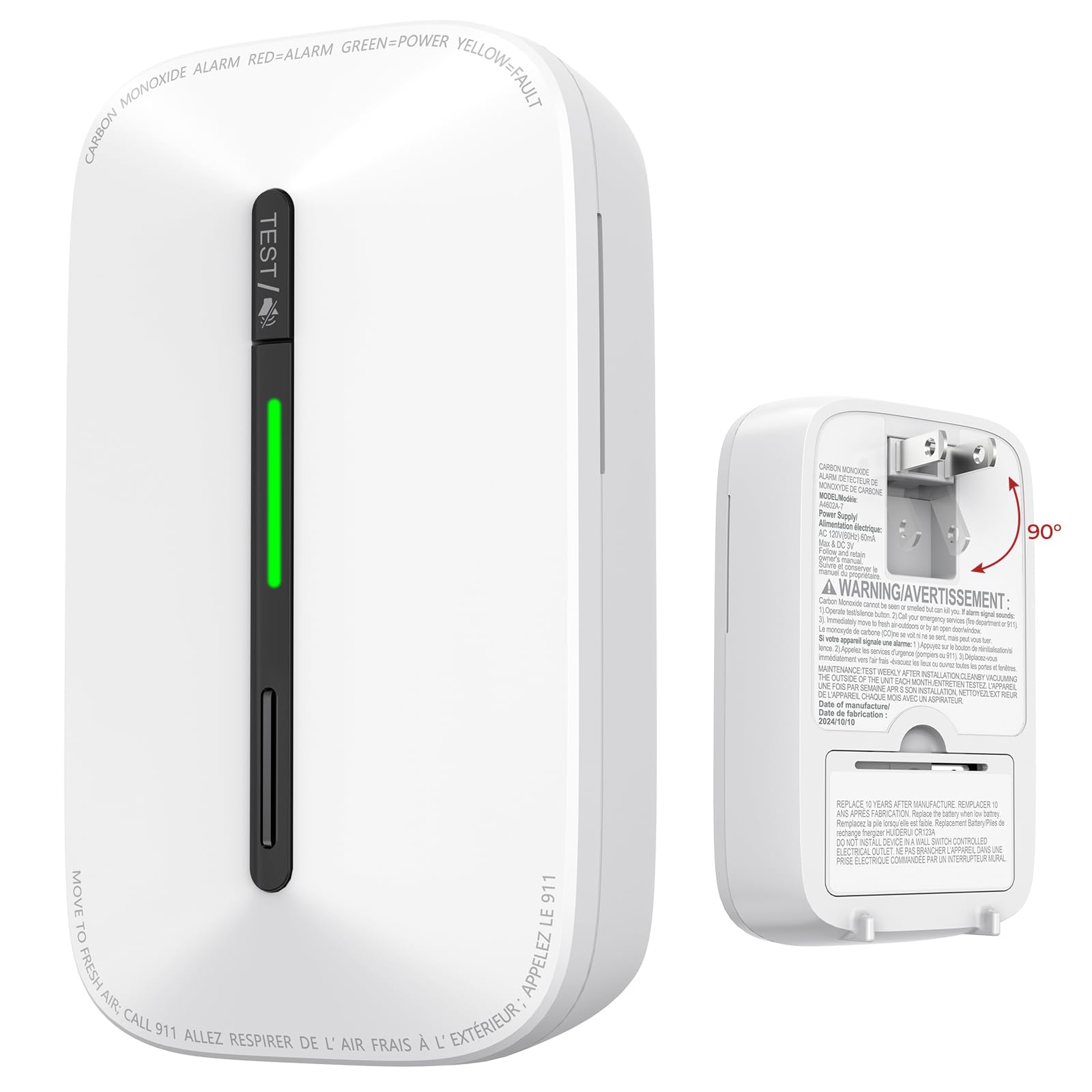
For a wood-stove room that has a wall outlet near the hearth, this is about as simple as CO detection gets. You push it into a standard outlet, it runs off AC power, and a 9-volt backup keeps it monitoring during a power failure. The footprint is small — its housing measures 1.38 by 5 by 3.4 inches, which is a slim profile compared with the boxier Heiman C1-S. It reads well in a hallway where you want CO watched without a stack of gear on a shelf.
Inside is an advanced electrochemical sensor that detects CO no matter where in the room you place the unit. A single test/silence button handles checks and quieting a false chirp. The horn hits 85 decibels when CO climbs to a dangerous level. There is a low-battery mute that silences the chirp for up to 8 hours, so it does not keep you up at 3 a.m. The end-of-life signal chirps when it is time to swap the whole unit, and First Alert puts a 7-year limited warranty on it.
The trade a buyer should know about is the plug itself. You need an outlet where the unit can live permanently and not be bumped loose or covered by furniture — a plug-in is only as reliable as its socket. The 9-volt backup is a real safety net, but it is still a replaceable cell you have to remember. This is a strong pick for anyone who wants CO protection that sits in an outlet and stays put without a battery-only routine.
Why it holds up: a slim plug-in with a 9-volt backup, an 85 dB horn, and an 8-hour low-battery mute is a lot of protection in an easy form factor.
The one wrinkle: it needs a dedicated outlet, and the 9-volt backup is still a cell you have to swap.
Strongest fit for: the wood-stove room with a spare wall outlet near the hearth.
Pass if: your only free sockets sit behind furniture or in a drafty spot you cannot keep clear.
3. Siterlink Carbon Monoxide Detectors Plug in
A foldable plug and a sleep-friendly status light make this the one you pack for a cabin rental.
If you burn wood in a vacation rental or a hunting cabin where you cannot trust the owner to have CO cover, this is the model that travels with you. The plug folds flat, so it goes in a carry-on without a cable tangle, and buyers report it fits easily in a suitcase. You unfold it, push it into any standard outlet, and it starts monitoring — no setup. The 10-year battery backup keeps it alive if the cabin loses power and the outlet dies.
The sensor is electrochemical, and the maker says it is tuned to limit false alarms — useful when a wood stove throws a little smoke on startup. The status light is a soft, breathing-style green that mimics the rhythm of human respiration, so it does not glow hard in a dark bedroom. A steady green LED confirms stable power, which means you can glance at it and know it is awake without pressing anything.
The recurring gripe is battery life. Buyers find the backup battery mixed, with one noting it lasts only a few months rather than the headline number on the box. That is a fit-note, not a deal-breaker, but treat the 10-year backup claim as a best-case figure and test the unit before a trip. As a travel alarm, it is very good; as a permanent whole-home install, a sealed-lithium unit does the no-maintenance job better.
Best use case: pack it for a cabin or hotel and know the CO in that room is being watched.
Worth knowing: the backup battery draws mixed reports, so check it before every trip.
Take it along if: you travel to wood-heated rentals and want a CO alarm in your bag.
Leave it off your list if: you want a single set-and-forget unit for the whole house.
4. Heiman C1-S Carbon Monoxide Detectors
The landlord’s pick: UL 2034 5th Edition certified, CSFM approved, and tiny enough to disappear on the wall.
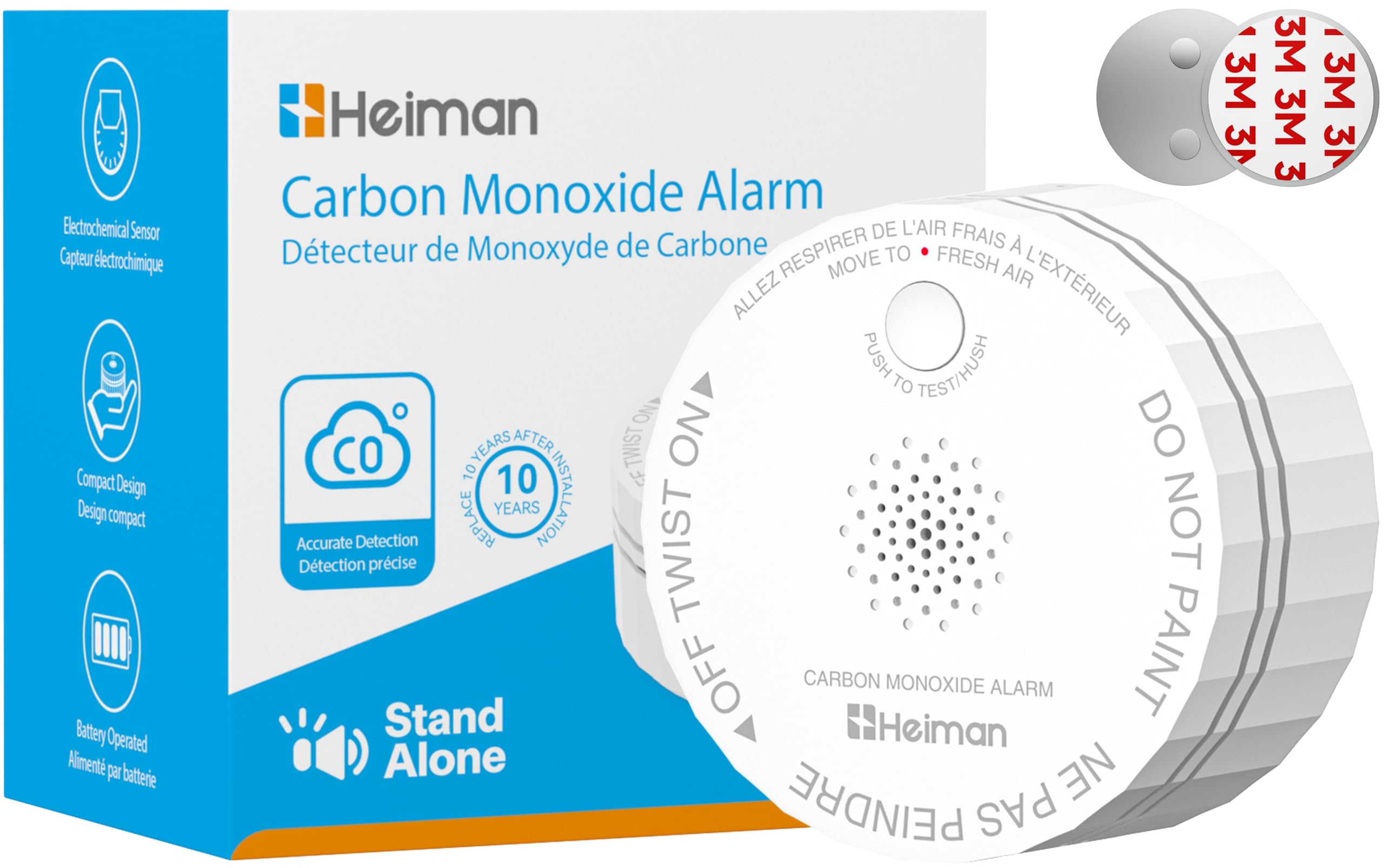
If you rent out a cabin or manage a property with a wood stove, this is the unit that checks a compliance box. It is rigorously tested to meet the latest UL 2034 5th Edition standards, and it is CSFM Approved and enrolled in the CPF using GRS certified materials. That is the language a property manager or contractor wants to hear when an inspection comes up. It does not hurt that at 3.68 ounces it is one of the lightest picks here — markedly lighter than the Kidde KN-COB-LP2 at 8 ounces.
Inside, it runs on a Japan-made FIGARO electrochemical sensor, a branded sensing cell that the maker says tracks CO faster than standard alarms. That responsiveness earns its keep in the high-risk spots this unit was built for: a kitchen near a gas line, a garage, a basement, or the utility room beside a wood stove. When danger hits, an 85 dB audio signal and an LED give you both a sound and a light to react to. One-touch test/silence keeps maintenance simple. A long-lasting lithium battery runs 24/7 without hardwiring.
The mini housing measures 2.75 by 1.45 by 2.75 inches, so it mounts on a ceiling or wall and blends in. The housing is UL94 V-0 rated flame-retardant ABS+PC, which the maker says resists corrosion and heat — a fair consideration next to a heat source. One fair note: it is not the flashiest or most feature-loaded pick, and the warranty is a 7-year limited with free replacement only for non-human-induced damage. But for straightforward certified protection, it earns its place.
The case for it
- UL 2034 5th Edition tested and CSFM Approved
- Japan-made FIGARO electrochemical sensor
- 85 dB audio-visual alarm with one-touch test/silence
- 3.68 oz mini housing, wall or ceiling mount
- 10-year lithium battery life; UL94 V-0 flame-retardant housing
Know before you buy
- 7-year limited warranty covers non-human-induced damage only
- No digital readout — status comes from LEDs only
- A leaner feature set than the Kidde COPDLG
Built for: landlords, contractors, and anyone who needs a documented, certified CO alarm.
Not for: a buyer who wants a display to see live CO levels at a glance.
5. Kidde Carbon Monoxide Detector, AA Battery-Powered, COBD

Sealed lithium power means no battery swaps and no nuisance chirp — the closest thing to set-and-forget.
Wood stove or not, the worst habit a CO detector owner falls into is pulling the battery to stop a midnight chirp. This Kidde removes the temptation. A sealed-in lithium power supply runs the full 10-year life of the alarm with no battery replacement required, and the design specifically eliminates worry about battery removal or unauthorized deactivation. For a rental cabin where a guest might fiddle with the unit, that is a real protection feature, not a gimmick.
The operation is clever in a quiet way. The alarm self-activates when you click it onto the mounting bracket, so there is no separate power switch to fumble. A green LED (a small indicator light) flashes every 30 seconds to confirm it is working. When CO is detected, a red LED pulses and the horn runs a specific pattern: four short beeps, five seconds of silence, then four short beeps with matching LED flashes, which repeats for four minutes before switching to two patterns a minute. It also has an event memory — a red LED flashes every 60 seconds to show a high CO level was detected within the last 14 days.
Installation is the thing buyers like most here — it mounts easily to a wall and the procedure is simple. The battery life is the next most appreciated detail, because the whole point is not having to think about it. At 4 ounces it is the lightest of the two box-style Kidde units on the list, and the housing is a compact 1.5 by 4.5 by 2.75 inches. The trade-off is that this is not a portable or travel unit — it is the one you mount and leave. The 10-year limited warranty matches the battery life.
Why owners relax: the sealed battery means no swap and no removal, and self-activation on the bracket takes the guesswork out of setup.
Where it stops: it is a fixed wall unit, not a portable one — the Siterlink is the travel alternative.
Pick it for: a permanent wall install where you never want to deal with a battery again.
Not ideal if: you swap your detector between houses — this one stays put.
6. SITERWELL Carbon Monoxide Detector
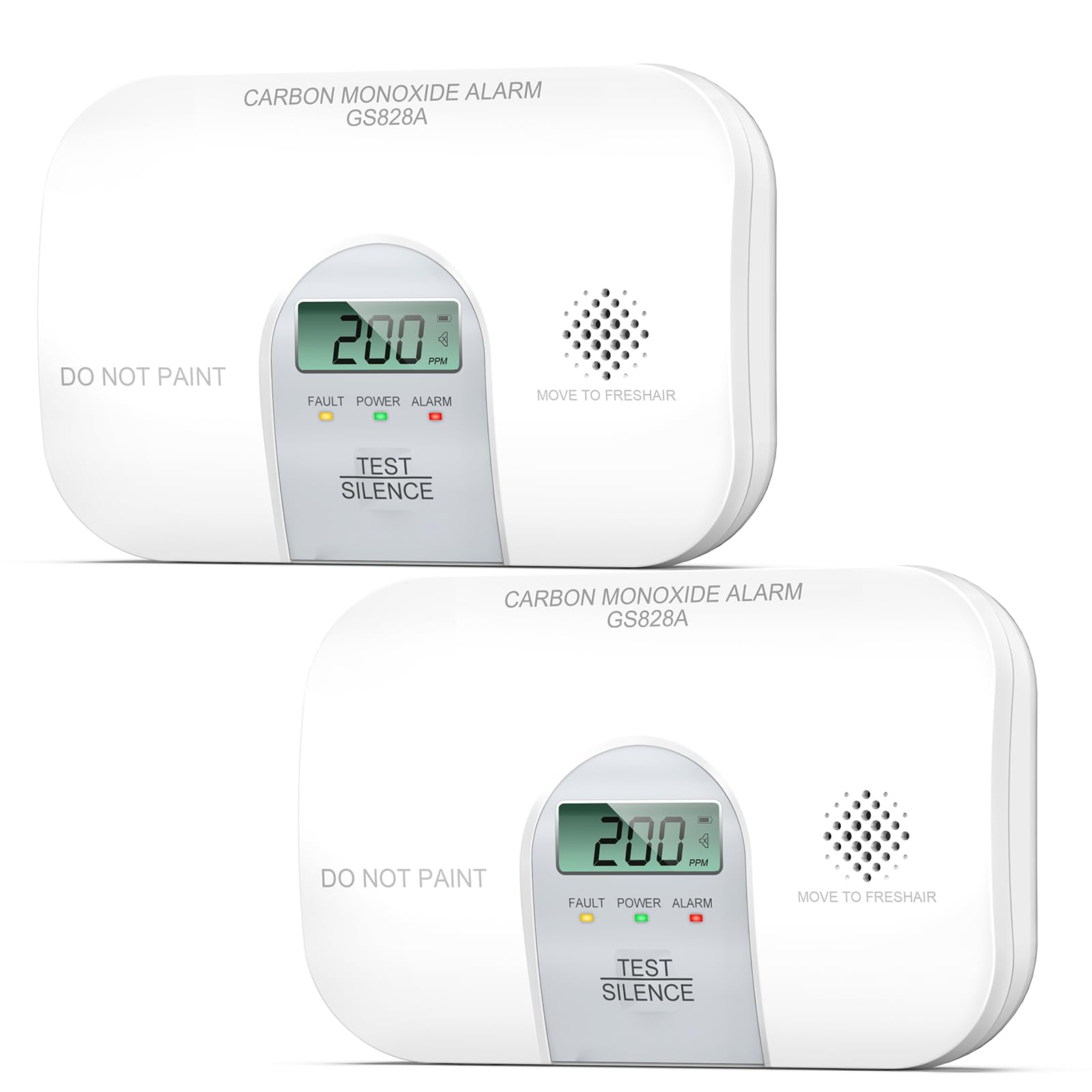
A real-time CO readout and a three-color LED that tells you alarm, power, or fault without a manual.
If you have ever wanted to see the carbon monoxide level in your wood-stove room rather than just wait for an alarm, this is the unit for you. Its LCD screen displays real-time CO levels in numbers, so a slow rise on startup shows up before the horn ever fires. A three-colored LED indicator flashes red, green, or yellow to signal an alarm, power, or a fault — three simple states you can read across the room.
The sensor is electrochemical and conforms to ETL standards. When CO gets dangerous, the alarm produces no less than 85 dB at a distance of 3 meters, which is enough to carry down a hallway or wake a sleeping occupant. Installation is flexible: mount it on the wall or leave it free-standing on a shelf or counter. It suits a family home as well as a school, hotel, or garage — anywhere a wood-burning appliance lives.
The mixed note here is the power. Buyers differ on the battery: some say the units come with batteries installed and ready to run, others say that no battery in this class lasts a full 10 years. That is a fair caution — treat the battery as serviceable rather than eternal. The warranty is 36 months from the date of purchase, shorter than the 10-year limited cover on the Kidde units. If you want live CO numbers on a screen, this earns the pick over a plain LED unit.
Why it stands out
- LCD shows real-time CO levels in numbers
- Three-color LED signals alarm, power, or fault
- Electrochemical sensor, ETL listed
- Wall or free-standing placement
- 85 dB alarm at 3 meters
Before you commit
- Battery life draws mixed reports — expect to service it
- 36-month limited warranty is shorter than the Kidde units
- A display to learn, not a blank-faced alarm
Worth grabbing if: you want to watch live CO numbers from a wood-stove room.
Think twice if: you would rather have a ten-year warranty than a screen.
7. Carbon Monoxide Detector Temperature Display

The wood-stove owner’s dual readout: room temperature on one line, CO level on the other.
Wood-stove people tend to care about two numbers — how hot the room is and whether the air is clean. This First Alert shows both on one backlit digital display: CO levels or ambient room temperature, your choice. A peak-level feature retrieves the highest concentration of carbon monoxide measured, so if you suspect a slow leak after a burn you can check what the sensor actually saw. Power comes from sealed ten-year lithium batteries, so there is no annual battery swap.
The sealed design means continuous protection for ten years without a battery replacement. The compact body mounts on a wall or sits on a tabletop, and the electrochemical sensor inside handles the detecting. It is the only pick here that pairs a working thermometer with a CO alarm, which makes it a natural fit for a living room where the stove lives.
What to weigh: this is a premium-cost unit, and the temperature readout is a convenience rather than a safety feature — you are paying extra for the display. First Alert does not publish a warranty length in the provided data, so confirm that detail at checkout. If a plain alarm and a separate thermometer would do, a simpler model saves money. If you want one device that tells you the room is comfortable and the air is safe, this is the one.
The dual readout: a backlit display shifts between CO level and room temperature, and a peak-level feature recalls the highest CO reading.
The trade: you pay a premium for the thermometer function, and the warranty length is not stated in the listing data.
The pick for you if: you want a CO alarm that doubles as a room thermometer beside the stove.
Save your money if: a plain CO alarm and a separate wall thermometer cover your needs.
Know the Specs
Electrochemical sensor
An electrochemical sensor is a small sensing cell that reacts to carbon monoxide and produces a tiny electrical signal when the gas is present. That signal is what trips the alarm. Wood stoves produce CO on every burn, so this sensor is your early-warning system. A branded cell like the FIGARO sensor in the Heiman C1-S is the type the manufacturer puts forward as tuned for faster response.
Decibel (dB) alarm level
The decibel is a measure of sound loudness. An 85 dB alarm is the horn level most of these detectors produce, and it is loud enough to wake a sleeping occupant in the same part of the house. If you sleep with a fan or a TV on, a louder alarm matters more, and both the Kidde COPDLG and Heiman units hit 85 dB.
Low-level CO alert (ppm)
Parts per million, or ppm, is the concentration of CO in the air. Standard alarms wait until the level crosses a dangerous threshold. A low-level alert fires earlier, at 30–70ppm, and gives you a head start so you can open a window, close the stove damper, and call a chimney sweep. The Kidde COPDLG is the pick that does this.
Battery backup and sealed lithium
A battery backup keeps the detector watching when the outlet loses power — a real concern in a rural wood-heated home during an ice storm. A sealed lithium battery goes further: it is built in and lasts the full life of the alarm with no replacement. A replaceable AA or 9V cell means a swap every year or so, and the risk that a user pulls the cell to stop a chirp.
Common Questions
Will a carbon monoxide detector work near a wood stove if smoke is present?
How far from a wood stove should I mount a CO detector?
Is a plug-in CO alarm better than a battery-powered one for a cabin?
How long does a sealed 10-year battery CO detector actually last?
What does a low-level CO alert at 30–70ppm actually mean for my family?
Will a CO detector go off from a wood stove’s normal startup smoke?
Can the Kidde COPDLG really detect propane and natural gas as well as CO?
How often should I test a wood stove CO detector?
Do I need a CO detector on every floor of a house with a wood stove?
Why does my detector show different status lights, and what do they mean?
The Bottom Line
For most wood-stove owners, the best overall pick is the Kidde KN-COB-LP2 — it runs on two AA batteries so a blackout cannot silence it, it uses an electrochemical sensor (a sensor that reacts to CO gas), and it fires an 85 dB alarm (about as loud as a smoke alarm) with LED indicators. It also holds a 4.5+ star rating across a large pool of owner reviews. If you want a plug-in that stays put, the First Alert Plug-In gives you AC power with a 9-volt backup. And if you want one unit to watch CO, natural gas, and propane, the Kidde COPDLG alerts at 30–70ppm (parts per million, a measure of gas concentration) so you act before danger levels. Whichever you choose, test the unit monthly and keep it within a few feet of the stove at breathing height.
How we choose
We do not accept paid placement. Every pick is matched to a real buyer and a real use-case; we do not hands-on test units.
Sources
Specifications: manufacturer listings and product documentation. Review insights: verified customer reviews. Pricing: not shown on this page (it changes often); check the current price via the retailer link.
As an Amazon Associate, Tactical Gear Guy earns from qualifying purchases. This does not affect which products we feature.