Specs are compiled from manufacturer listings and verified buyer reviews and can change over time — please confirm the key details on the product page before buying.
You want firewood split without a trip to the emergency room. The safest, most forgiving tool here is the Kindling Cracker — a cast iron ring that holds the log so your hands never go near a swinging blade. That one suits most people. But rounds of oak, ash, or hickory still need a proper swinging tool. Pick the wrong weight or handle length and every split feels like punishment. Below you get both paths, and you will see exactly where each tool stops being useful.
This guide is built by comparing the manufacturers’ published specifications and the patterns across verified customer reviews, so you get each pick’s real strengths and trade-offs instead of marketing spin.
Weight, handle length, head steel, and shock control are the four numbers that decide whether a splitting tool feels like help or hard labor. The picks below are matched to real buyers and real wood, so you can find the best wood splitting tools for your own stack.
Top Picks

How To Choose The Best Wood Splitting Tools
Most people buy the biggest maul they can lift, then discover that swing speed and accuracy matter more than raw pounds. The right tool is the one you can swing straight and stop cleanly, not the one that looks most intimidating on the shelf.
Start with your log size, not your ego
A splitting maul (a heavy head with a blunt wedge instead of a slice) works on large rounds because it forces the wood apart rather than slicing it. If your logs are small enough to sit inside a cast iron ring, a fixed-wedge kindling splitter does the job with a mallet instead of a full swing. Match the tool to the rounds you actually haul home, and ignore any spec written for a monster log you never plan to touch.
Weight is a trade-off, not a ranking
A heavier head drives deeper into a dense round, but it costs you swings per session and increases the chance of a sloppy, glancing strike. Fiskars lists its Super Splitting Axe at 6 pounds for medium to large logs, while the Truper maul carries a 12-pound head for stubborn rounds. Neither is wrong; they answer different questions about your firewood.
Handle length decides who gets hurt
A 36-inch handle gives taller users leverage and keeps the head away from their shins, while a 27-inch handle suits shorter users or tight storage. If the handle is too short for your height, you swing harder and control less — a genuine safety issue with any maul. Match handle length to your body before you match it to the price.
Side-by-Side Comparison
| Model | Best For | Head Weight | Handle Length | Handle Material | Amazon |
|---|---|---|---|---|---|
| Kindling Cracker Original★ Best Overall | Safe kindling splitting | 10 pounds | — | Cast Iron | Amazon |
| Estwing 8 lb MaulHeavy Hitter | Heavy rounds on a budget | 8 pounds | 36 inches | Hickory Wood | Amazon |
| Fiskars A-Series Super Splitting AxeBest for Taller Users | Taller users, medium to large logs | — | 36 inches | FiberComp | Amazon |
| Truper 12 lb Splitting Maul | Big, stubborn rounds | 3.63 kg | 27 inches | Rubber, Steel | Amazon |
| Fiskars Pro IsoCore 6 lb Maul | Long sessions, less hand fatigue | 6 pounds | 36 inches | Dual-layer SoftGrip | Amazon |
| Wilton B.A.S.H 36″ Maul | Overstrike abuse and hard work | 3.63 kg | 38 inches | Rubber | Amazon |
| 1844 Helko Werk Saxon Splitter | Craftsmanship and control | 6.3 pounds | 31 inches | Grade A Hickory | Amazon |
| Gränsfors Bruks Splitting Maul | Heirloom-quality splitting | — | 31.5 inches | Wood | Amazon |
Detailed Reviews
1. Kindling Cracker Original Firewood Kindling Splitter
Our pick — 4.5+★ from 14,500+ verified ratings; the strongest balance of quality and price.
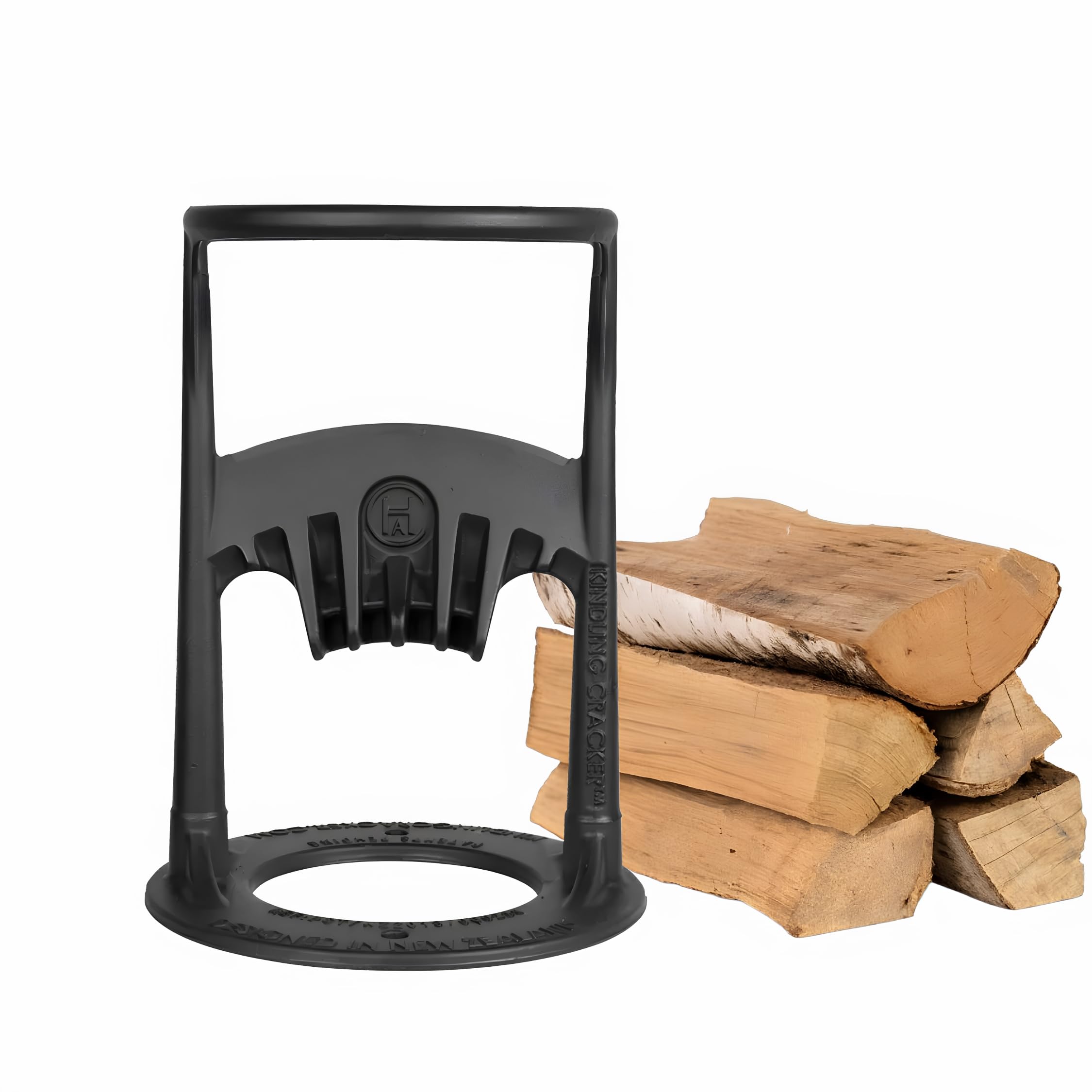
A cast iron ring that holds the kindling so a mallet tap splits it — no swing, no blade near your hands.
This is the pick that takes the fear out of firewood. You drop a piece of kindling into the 6.5-inch opening of the cast iron ring, tap it with a mallet or even a scrap of wood, and a fixed wedge inside does the splitting. Your hands stay on the mallet, not near a blade. That fixed wedge is the whole idea — there is no swing, no follow-through, and no chance of a glancing strike catching your shin.
Nothing on this tool wears out, because it is one smooth piece of Australian cast iron with no welds, no joints, and no moving parts. You never sharpen an edge, and upkeep means keeping it dry. It is rated to work in temperatures as low as -94°F (-70°C), so cold weather does not bother the steel. The rated head weight is 10 pounds, which is why it sits so steadily when you strike — it does not skate. Compare it by heft to the Fiskars Pro IsoCore maul at 6 pounds: the Kindling Cracker is the heavier object even though it never swings.
Where it wins is repeatable, safe output. Production of kindling happens fast because the ring holds the wood upright for you — no balancing act between strikes. Freestanding on its base or bolted to a stump through the built-in holes, it works on a porch, in a shed, or beside a fire pit. The honest catch: it splits kindling and small splits, not big rounds. A full-size oak round will not fit the 6.5-inch ring, so this is a companion tool to a maul rather than a replacement for one.
What you get on your side
- The 6.5-inch cast iron ring keeps hands clear of the cutting edge at every point in the stroke.
- One-piece cast iron with no welds or joints and a fixed wedge that never needs sharpening.
- Works freestanding or bolts to a stump or bench for a permanent, low-effort station.
- Produces a steady supply of kindling with a mallet tap instead of a full swing.
The honest limits
- Capped at kindling and small splits — large rounds simply will not fit the 6.5-inch opening.
- At 10 pounds it is not a tool you carry far into the woods for a campfire.
Reach for this if: you want safe, steady kindling and you are done with the anxiety of swinging an axe near your fingers.
Pair it with something else if: you also process full rounds — the ring’s 6.5-inch opening is the hard ceiling here.
2. Estwing 8 lb Wood Splitting Maul with 36-Inch Hickory Handle
An 8-pound forged head at 50–55 HRC on a 36-inch hickory handle for reach and swing speed.
If your rounds are dense and your budget is tight, this maul answers the first question: will it hit hard enough? An 8-pound forged head hardened to 50–55 HRC (a hardness scale where higher numbers mean the steel resists dents and deformation) gives you a striking face that holds its shape through repeated impact. The 36-inch premium hickory handle gives you reach and swing speed to go with it. At 9.5 pounds total against the Fiskars A-Series axe at 6 pounds, you are carrying a noticeably heavier tool into every swing.
Buyers are taken with the build quality above everything else, and that praise lands on the thick handle construction as much as the head. Functional reliability runs second — people say it does the job and makes quick work of a woodpile. The 36-inch hickory length adds reach for taller users and lets you get the head up to speed without overreaching, and the forged head arrives ready to split.
The honest trade-off is the weight itself. Some owners find the mass tiring over a long session, which is the natural cost of an 8-pound head, so if you split for hours at a stretch, plan on breaks or pick a lighter maul. Head tightness draws a small share of mixed notes too, so check the head seating when it arrives and after your first few sessions. For anyone with a pile of dense rounds and a willingness to use momentum, this is a lot of tool for an entry-level outlay.
Where the money goes: a forged head rated 50–55 HRC on a premium-grade hickory handle — the two parts that decide whether a maul survives a season.
The part to watch: 8 pounds is a real workload, and a small number of buyers notice the head loosening, so seat-check it after delivery.
Go this way if: you have dense rounds and prefer momentum over technique — the 8-pound head does the arguing for you.
Think twice if: you split for long stretches and already know heavy heads wear you out by the third wheelbarrow.
3. Fiskars A-Series Super Splitting Axe 36″
A 36-inch FiberComp handle for tall users, with a convex bevel that releases from the round instead of sticking.
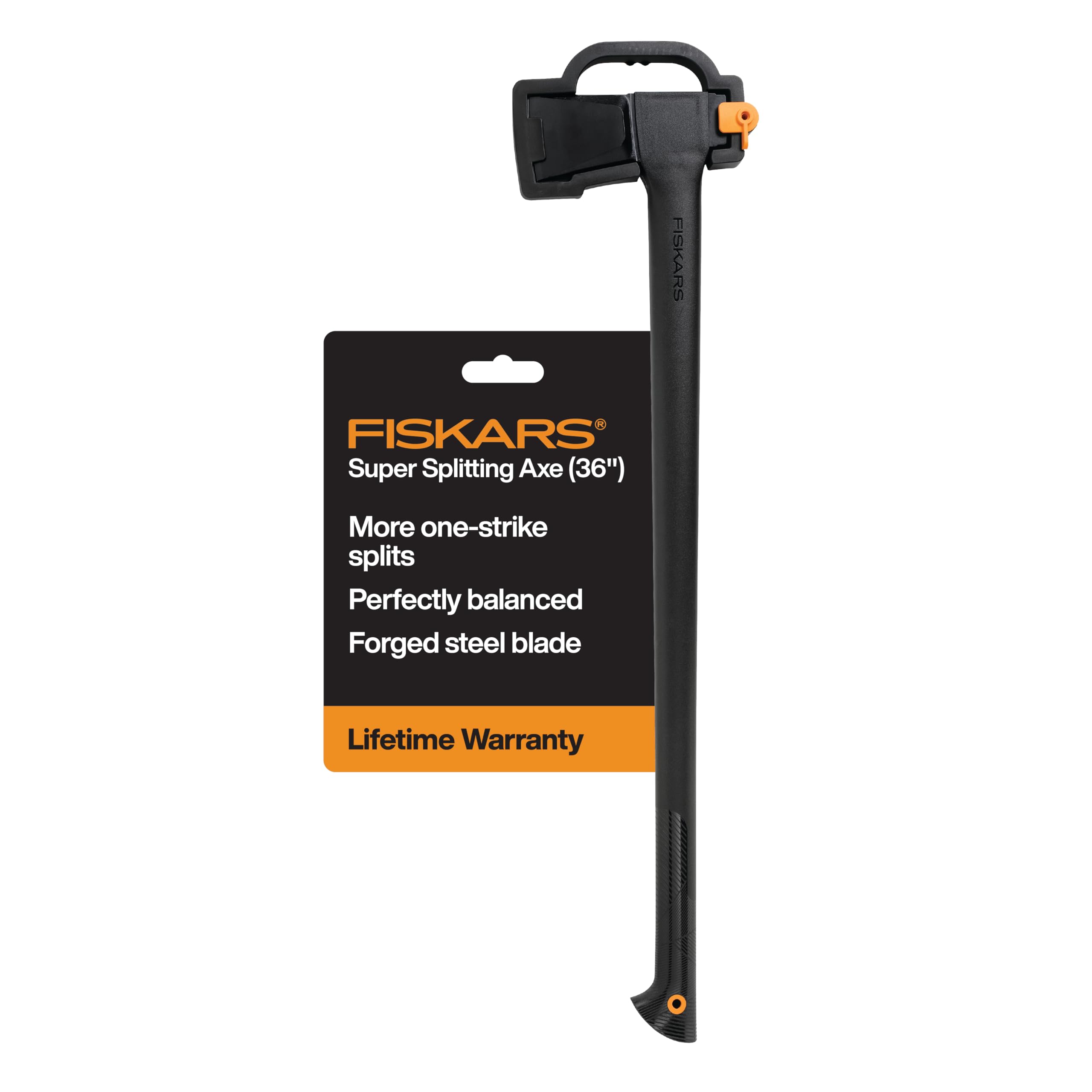
The geometry does the heavy lifting here, not the scale. The blade carries a convex bevel (a curved cutting edge rather than a flat taper) plus a low-friction coating, which helps the head drive into a round and then let go instead of getting pinched. That release is the difference between a rhythm and a wrestling match. At 6 pounds total it is lighter than the Estwing maul at 9.5 pounds, so you can keep swinging with less of the drag that heavy mass brings.
Height is the design brief. The 36-inch FiberComp handle (a fiber-reinforced composite that the maker says is stronger than steel against overstrike damage) gives tall users room to swing without stooping. Owners describe one-strike splits on medium wood and note the lightness lets them keep going through a long session. The shock-absorbing handle also takes the sting out of impact, and the hardened forged steel edge stays sharp season after season. The insert-molded head is built to resist loosening over repeated hits.
The catch is scope. This is an axe for medium to large logs and it rewards a clean, accurate swing — a glancing strike on a badly knotted round wastes the stroke. It is not the pick for splitting an enormous, gnarled stump that demands dead-on mass. If your wood is manageable and your frustration has always been short handles and tired arms, this one fixes both.
The standout spec: a 36-inch FiberComp handle paired with convex bevel geometry — length for leverage, curve for release.
Who should skip it: if you are short-statured, the 36-inch reach can feel long, and a 27-inch maul may control better in your hands.
Best match: taller users working medium to large logs who want an axe that feels like an extension of the arm.
Not the fit: anyone splitting massive, knotted rounds where dead weight matters more than swing speed.
4. Truper 12 lb Splitting Maul, 27-Inch Steel Handle
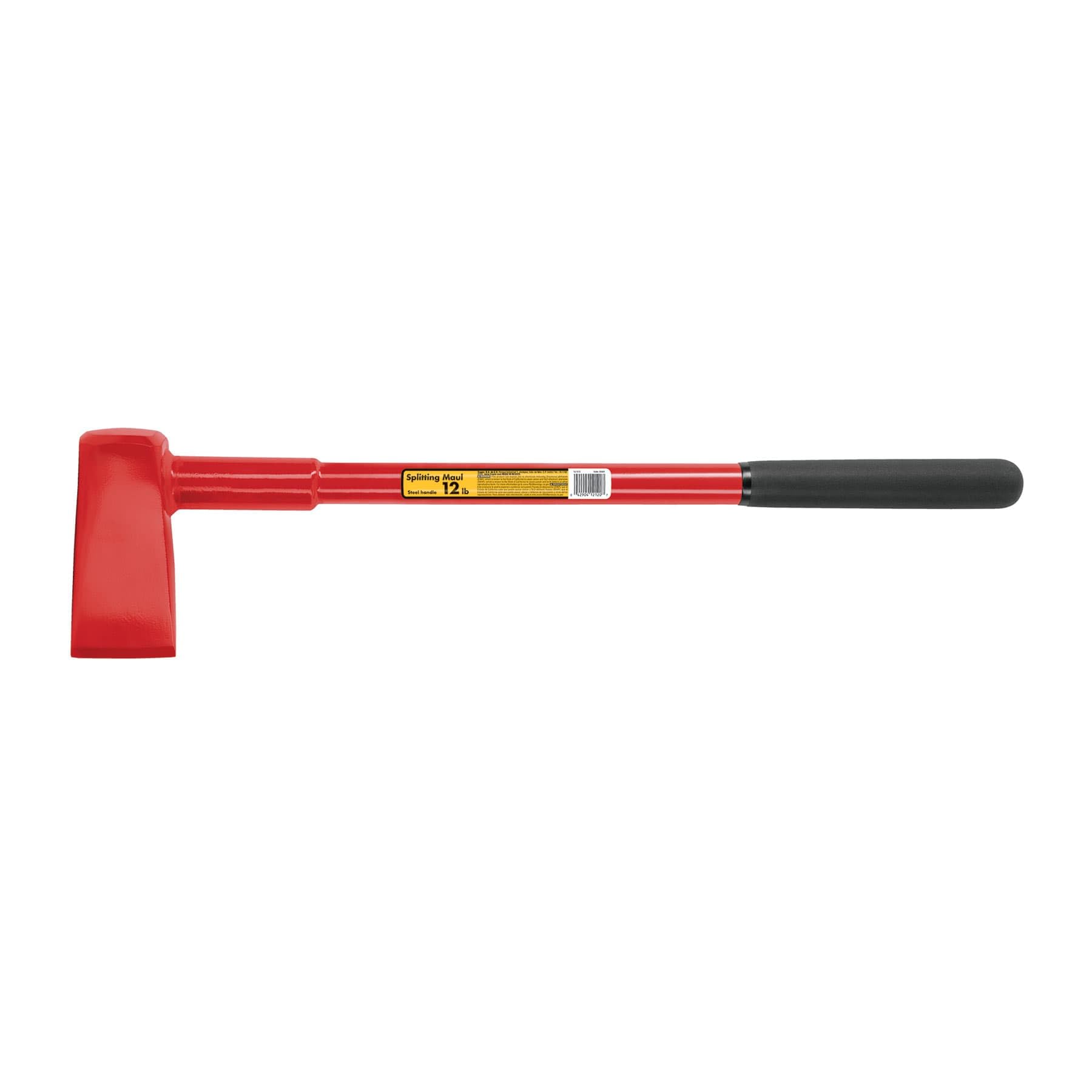
A 12-pound head on a 27-inch steel handle for dense rounds that bounce lighter mauls.
When a round refuses to give, this is the tool you hand the job. A 12-pound head on a 27-inch high-strength steel handle makes its case through sheer mass — you lift it, you let gravity and momentum finish the thought. Truper lists this against ASME Standard B107.54M (an engineering standard for striking tools), which tells you the maker is staking a claim on build quality rather than just selling weight. A 9-inch non-slip cushion grip gives you something to hold when your palms are sweaty and the wood is stubborn.
Splitting performance is what people talk about most after build quality — dense 24-inch logs crack open and the value holds up against far costlier tools. The weight is the whole point: there is enough mass to drive through a big log rather than bounce off it. For a firewood stack full of thick, tough rounds, this maul removes the need to swing three times at one piece.
Now the caveats, and they are real. The 27-inch handle is shorter than most tall users prefer, and that is the most consistent complaint — if you are over average height, the handle length will have you stooping. A few owners also find it comes less sharp than expected, so run a file over the edge before your first session. Weight divides opinion in the usual way: it is exactly the tool for big logs and exactly the wrong one if your back is already tired. Compare the 6.82 kg total against the Kindling Cracker at 4.8 kg and you can feel the difference before you even lift it.
Built for stubborn timber
- The 12-pound head drives through dense rounds that glance off lighter mauls.
- Non-slip cushion grip holds steady when your hands are wet or sweating.
- Listed to meet ASME Standard B107.54M for striking tools.
What you have to accept
- The 27-inch handle is short for tall users and can force an awkward stoop.
- Edge sharpness from the start is inconsistent — plan to touch it up.
Made for: average-height woodcutters with big, dense rounds who would rather apply mass than swing three times.
Look elsewhere if: you are tall — the 27-inch handle will work against you, and a 36-inch maul suits your frame better.
5. Fiskars Pro IsoCore 6 lb Splitting Maul
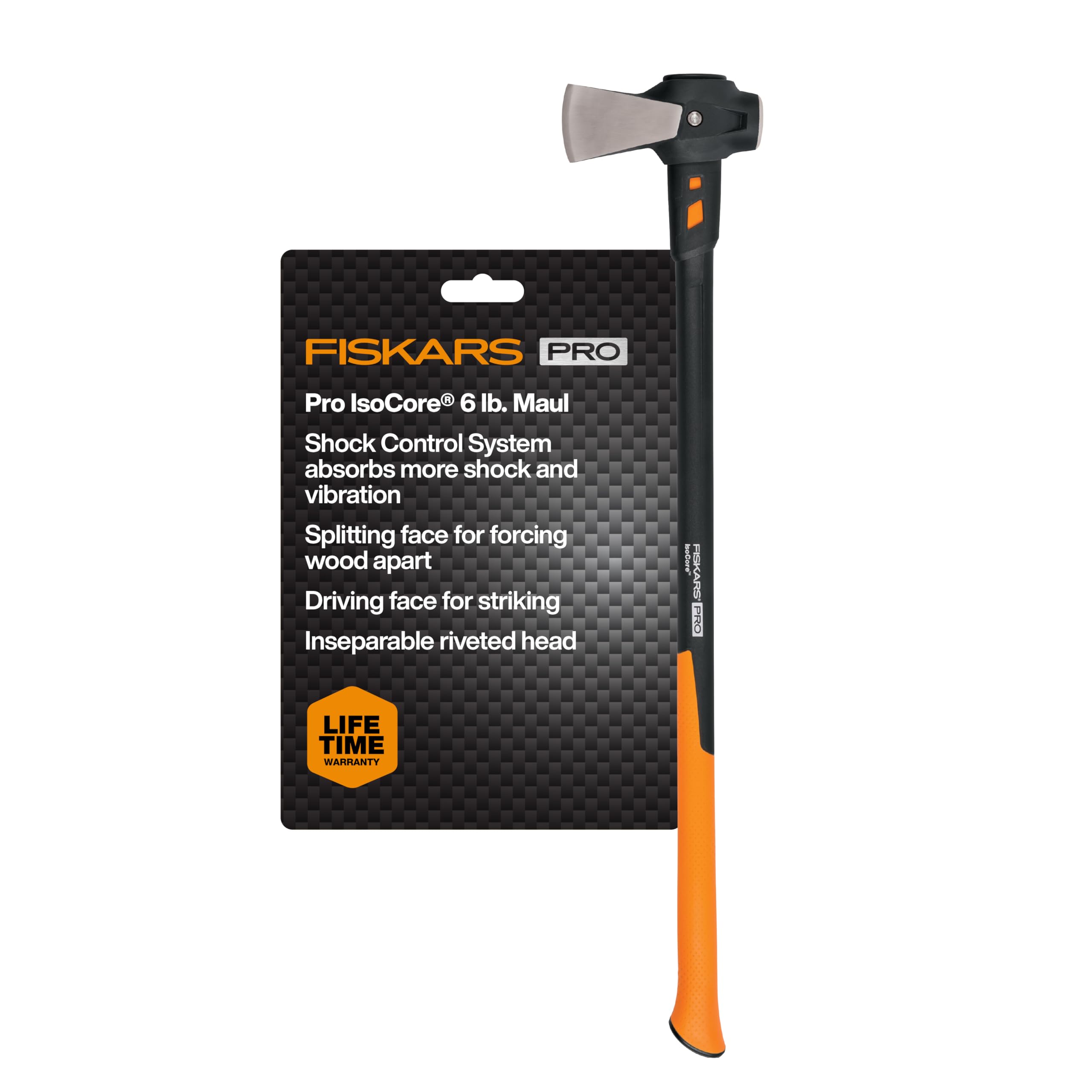
A 6-pound maul with a shock-absorbing handle that cuts hand and joint fatigue over a long splitting day.
Here is the number that separates this from everything above it: the IsoCore Shock Control System is described by the maker as transferring 2X less shock and vibration than wood-handled mauls. That is a manufacturer claim, not a lab result in the box, but it points at the tool’s real purpose — keeping your hands and joints fresh across a long splitting day. The dual-layer handle is what soaks up impact, and the sculpted SoftGrip carries a flared base plus texturing so your grip holds as your palms get slick.
The head is forged, heat-treated steel with a rust-resistant coating and a chisel splitting face. There is also an integrated driving face that lets you use the maul to strike a wedge, or have the maul struck, when a round is too tied up for a direct hit. The riveted head is built to stay put under force, and the steel-reinforced sleeve protects the handle from overstrike damage. A 36-inch length gives leverage and is called out as ideal for taller users, and the whole tool carries a lifetime warranty.
What wins people over is the amount of work one swing returns — buyers describe cutting through white oak, red oak, and hickory, and the shock control is the reason you can keep at it. Light enough to swing freely at 6 pounds, it feels far bigger in the log than its weight suggests. One fair caution: this is a precision splitting tool for medium to large rounds, so a badly aimed overstrike still reminds you to square up. Rated for hardwood and firewood work rather than routine log-cutting, it is a specialty tool that does its specialty well.
The thing everyone raves about: the shock-absorbing handle. It turns a punishing impact into something your elbows can live with.
The honest note: the vibration claim is the maker’s own number, so treat it as a direction to expect rather than a guarantee you can measure.
Pick this up if: you split hardwood regularly and want full-size maul results without your arms paying the bill.
Pass if: you need a wedge-driving or timber-shaping tool — this is built for splitting firewood, and its chisel face is aimed at rounds.
6. Wilton B.A.S.H 36″ Splitting Maul, 8 Lb Head (50836)
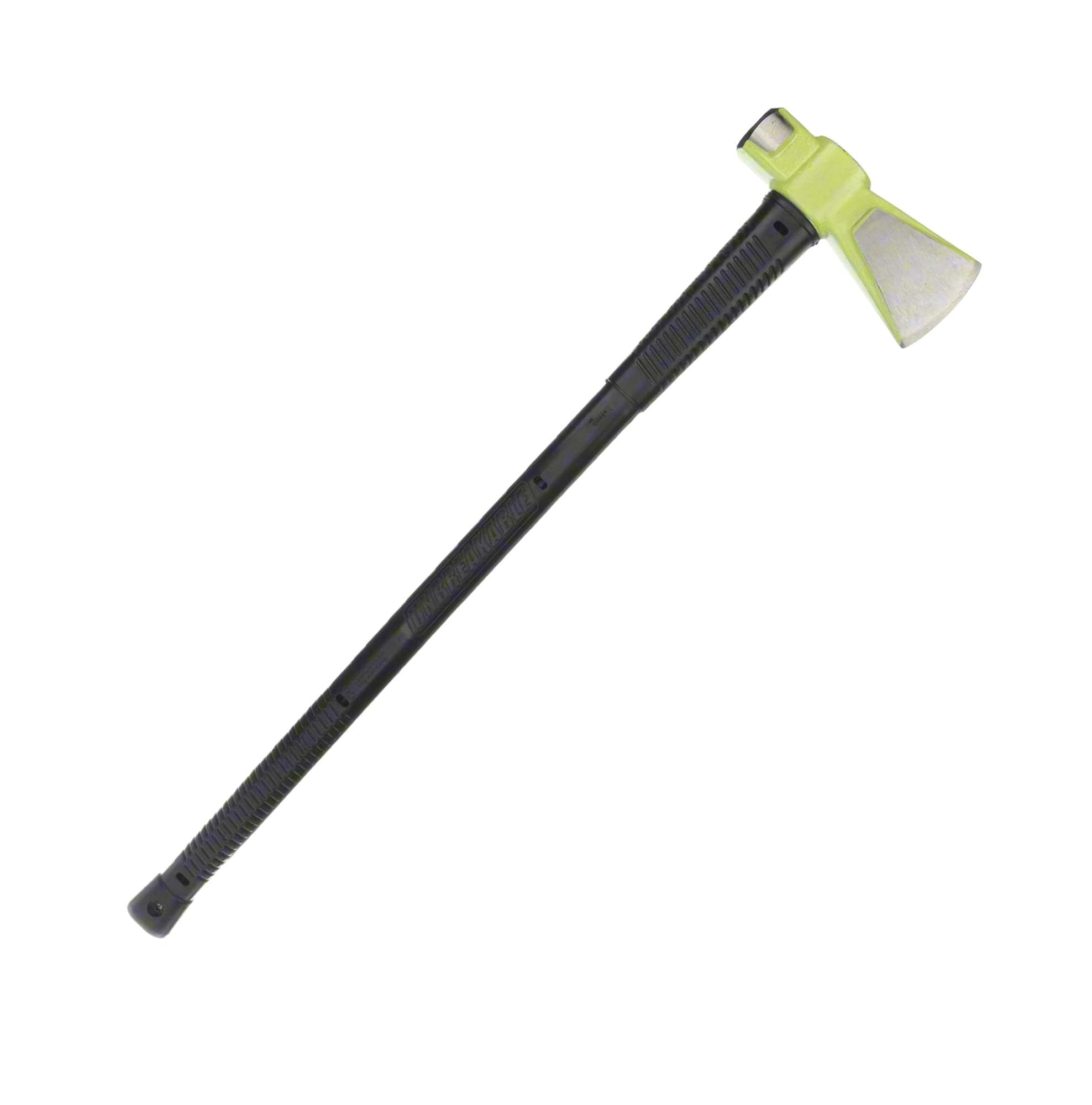
A steel core runs through the handle so an overstrike does not splinter it.
Sloppy overstrikes kill wooden handles, and Wilton built this maul around that fact. Its Unbreakable Handle Technology uses a steel core that the maker says eliminates breaking during overstrikes, which makes it the pick if your swing lands a little low now and then. The head is a patented drop-forged piece rated at 46 HRC, hardened for repeated heavy impact, and a safety plate secures the head to the handle so it cannot work loose. The 38-inch overall length gives generous leverage, and a lanyard hole lets you tether it to a wrist or a fixed point.
Beyond the core, it is designed to be held comfortably. A thick tapered anti-vibe neck absorbs vibration to cut down on fatigue, and the ergonomic handle is shaped and thickened for a more comfortable grip with less shock. The vulcanized rubber handle surface gives a secure no-slip hold while you are striking, which matters the moment your hands get tacky. Owners describe a well-built tool with a good handle and note that it makes splitting firewood easier.
The trade-off is the mass. Some owners find this maul very heavy, which makes sense for an 8-pound head on a 38-inch frame — it is a tired-arm tool as much as a splitting tool. That said, plenty appreciate the weight for the same reason: it drives the head through. Compare it to the Kindling Cracker’s 10-pound listing and you are handling a tool of similar heft, except this one swings. If you have ever watched a hickory handle splinter after an overstrike, the steel core is the feature that matters.
The spec that saves you: a steel core and a head rated 46 HRC, both pointed at surviving overstrikes and hard work.
Buy with eyes open: this is a heavy maul, and the long handle rewards a deliberate swing rather than a frantic one.
For the overstriker: if your swings land low or your wood is never quite where you aimed, the steel core buys you another season.
Not for a tired back: at 8 pounds with a long handle, this rewards strength and punishes fatigue.
7. Helko Werk Traditional Saxon Heavy Log Splitting Axe

A hand-forged C50 steel head at 6-1/4 pounds that owners say splits like an 8-pound maul.
This is a tool you buy with your eyes open and then enjoy. The Saxon’s head is drop forged by hand from German C50 high-grade carbon steel at 53–56 HRC, shaped and tonged by a blacksmith rather than stamped by a machine. The design brief is unusual: Helko sets out to deliver the splitting power of a maul with the balance, feel, and control of an axe. The 31-inch handle is Grade A American hickory, sanded to 150 grit with a boiled linseed oil finish, selected for grain orientation and density.
There is a small turnaround hook on the heel of the blade that helps you move logs around without bending — a detail that seems minor until you are dragging rounds across a yard. The package also includes a full-grain vegetable-tanned leather sheath and a 1 oz bottle of Axe Guard protective oil to help keep the carbon steel from rusting. Total weight is 8-1/2 lb, and the head measures 6-1/4 lb, so it is heavy enough to split seriously without feeling like a sledgehammer with a handle.
The performance reports match the craftsmanship. Buyers describe it splitting large-diameter trees in about three chops, and several swear it outperforms an 8-pound maul despite the lighter head. It arrives sharp, well-balanced, and good-looking by any standard. The honest limit is maintenance — carbon steel wants the included oil, and a hickory handle wants to be kept dry and oiled. If you are willing to look after a fine tool, it will look after your firewood. If you want zero upkeep, a synthetic-handled maul is the easier ownership.
What the blacksmith built
- Hand-forged C50 carbon steel at 53–56 HRC gives the edge life and bite of a serious axe.
- The 31-inch Grade A hickory handle is hand-picked for grain and finished to 150 grit.
- Splitting power that owners say rivals an 8-pound maul in a lighter, better-balanced tool.
- Comes with a full-grain leather sheath and a 1 oz bottle of protective oil.
The upkeep you sign up for
- Carbon steel rusts without care — the included Axe Guard oil becomes routine maintenance.
- A hickory handle needs to be kept dry and oiled, which is more attention than a synthetic handle asks.
For the tool lover: hand-forged German steel and American hickory for the person who wants to enjoy the work.
Skip if you want zero fuss: carbon steel and hickory reward care, and neglect will show up as rust and a dry handle.
8. Gransfors Bruks Splitting Maul 450

A hand-finished Swedish maul with a convex edge that arrives sharper than most buyers expect.
This maul is built to be kept, not used up. Gränsfors Bruks lists a 5 1/2 lb head on a handle that measures 80 cm (31.5 inches), with a wood handle and a convex blade — a curved edge that starts a split and keeps it running. Total weight lands at 3.58 kg, lighter than both the Truper maul at 6.82 kg and the 8-pound Wilton, so you swing less mass all day. A vegetable-tanned leather sheath comes with it, so storage is part of the package rather than an afterthought.
The reputation here is heirloom-grade quality, and the splitting reports back it up. Buyers describe white ash rounds splitting easily, and the maul arrives razor-sharp — sharper than expected, in several accounts. That edge belongs to a blade that stays balanced in the hand, so you are guiding a tool rather than wrestling one. The convex grind resists sticking, which is the whole reason a house-brand maul can feel so much smoother than its mass suggests.
The obvious question is whether the premium is worth it. If you split a few face cords a year and want the tool you reach for with a bit of pride, yes. If you beat your firewood and leave tools in the rain, the wood handle will not forgive you the way a steel-core handle would. It sits at the lowest spread in the group by heft — 3.58 kg against 6.82 kg for the Truper — so this is a precision tool that earns its keep through consistency, not brute mass. Treat it with respect and it will outlast every synthetic-handled maul you have owned.
The defining pair: a 5 1/2 lb head on a 31.5-inch handle, with a convex edge that starts a split and lets go clean.
The real question: wood and steel that fine want shelter and oil, and a shed that leaks is not a friend to either.
The keeper: a hand-finished maul with an edge that comes sharper than expected and a leather sheath to keep it that way.
Consider the alternative if: your tools live outdoors — the wood handle here expects a dry home and a little care.
Know the Specs
Head Weight and How It Splits
Head weight is the mass of the striking end, and it decides how much force arrives in the log. A heavier head, like the 12-pound Truper, drives through dense rounds that shrug off a lighter strike. A lighter head, such as the 6-pound Fiskars Pro IsoCore, lets you swing faster and longer. Watch the number on the box, not the total shipped weight — they are different figures, and it is the head that splits.
Handle Length and Who It Fits
Handle length changes your leverage and your control. A 36-inch handle suits taller users and keeps the head clear of your shins, while a 27-inch handle fits shorter users or tight storage. If the handle is too long for your height, the swing gets sloppy; too short, and you swing harder for less return. Measure against your own stance before you pick a number.
Head Hardness (HRC) Explained
HRC is a hardness scale for metal: higher numbers mean the steel resists dents and rolls. The Estwing head is rated 50–55 HRC, the Helko Werk 53–56 HRC, and the Wilton 46 HRC — all durable striking surfaces. A harder head holds its edge longer under repeated impact. A softer one is easier to file but dents more readily. Neither is wrong; it is a trade between edge retention and how forgiving the steel is to sharpen.
Handle Material and Shock
Wood, forged steel, and composite all absorb shock differently. Hickory is traditional, comfortable, and needs oil and dry storage. FiberComp and dual-layer composite handles are built to blunt vibration, with Fiskars describing its IsoCore system as transferring 2X less shock and vibration than wood-handled mauls. Steel-core handles, like the Wilton, are aimed at surviving overstrikes. Pick the handle that matches your swing and your storage.
Common Questions
Is a splitting maul or a splitting axe better for firewood?
How heavy a maul can I safely swing?
Can the Kindling Cracker split full-size firewood rounds?
Do I need to sharpen a new splitting maul from the start?
What handle length suits a tall user?
How do I keep a hickory or wood handle from drying out and cracking?
What does HRC mean on a splitting tool head?
Is a cast iron kindling splitter safer than an axe for a beginner?
Can I use a splitting maul for felling or limbing a tree?
Do I need a sheath for a splitting maul?
The Bottom Line
For most people, the safest and most useful pick among these wood splitting tools is the Kindling Cracker Original. Its cast iron ring keeps your hands away from the blade while a mallet does the work, so you get kindling without the danger of a swing. Want a swinging tool that handles heavy rounds with less fatigue? Grab the Fiskars Pro IsoCore 6 lb Maul and its shock-absorbing handle. For a hand-forged tool you will keep for years, reach for the 1844 Helko Werk Saxon Splitter. Whichever way you go, buy for the wood you actually split — and if your pile is full of kindling and stubborn rounds both, run two tools rather than forcing one to do everything.
How we choose
We do not accept paid placement. Every pick is matched to a real buyer and a real use-case; we do not hands-on test units.
Sources
Specifications: manufacturer listings and product documentation. Review insights: verified customer reviews, as of November 2026. Pricing: not shown on this page (it changes often); check the current price via the retailer link.
As an Amazon Associate, Tactical Gear Guy earns from qualifying purchases. This does not affect which products we feature.