Specs are compiled from manufacturer listings and verified buyer reviews and can change over time — please confirm the key details on the product page before buying.
If your splitter has stopped biting through rounds, the fix is almost never the whole machine — it is one cheap component that failed. A cracked suction hose, a weeping seal kit, a valve that won’t hold detent: any of these can park a perfectly good splitter for a weekend. Below are seven parts worth keeping on the shelf, ranked so you can match the part to your actual breakdown instead of guessing at the whole assembly.
This guide is built by comparing the manufacturers’ published specifications and the patterns across verified customer reviews, so you get each pick’s real strengths and trade-offs instead of marketing spin.
Replacement parts live or die on fit, so every spec here is spelled out in inches, PSI and GPM. This breakdown of wood splitter parts covers the hose, seal, pump, bracket and valve that get a dead splitter running again.
Top Picks

How To Choose The Best Wood Splitter Parts
Buying a part for a log splitter is a measuring job first and a shopping job second. The machine on your trailer already has a bore size, a rod size, an inlet port and a pump bolt pattern — your job is to match those numbers, not to buy the beefiest-looking item in the category. Get the measurement right and a mid-range part outlasts a premium one that doesn’t fit.
Measure the cylinder before you touch a seal kit
A cylinder rebuild seal kit is cut to two dimensions: the bore (the inside diameter of the cylinder barrel) and the rod (the outside diameter of the chrome rod sliding through it). If your barrel measures 4.5 inches inside and the rod measures 1.75 inches across, a kit built for that pair drops in. Any other combination and you are forcing rubber that was never sized for the groove, which is how leaks start.
Suction hose: inner diameter and length, not outside looks
The suction hose feeds oil from the tank into the pump inlet, so it has to seal on the inside diameter, not just push over a barb. A 1-inch inner diameter mating to a 1-inch pump inlet is the standard pairing. Length matters for routing — a longer hose can loop around an engine without kinking, which is why a 39-inch run and a 36-inch run suit different frame layouts.
Match the pump to the engine, not to the biggest number
Flow rate, measured in GPM (gallons per minute), sets how fast the cylinder extends and retracts. A two-stage pump runs a high-flow, lower-pressure first stage for the approach and a lower-flow, higher-pressure second stage for the actual split. Pressure is measured in PSI (pounds per square inch) — the force the oil pushes with. Too much flow for your engine and valve and you get heat, not speed.
Valve ports and detent: the two things that trip people up
A control valve routes oil to either side of the cylinder and returns it to tank. Port sizes (typically 1/2-inch or 3/4-inch NPT, the tapered thread standard) have to match your hoses. The detent is the mechanism that holds the lever in the return position until the cylinder bottoms out — if the detent pressure is set wrong for your machine, the lever kicks out early or refuses to release.
Side-by-Side Comparison
| Model | Best For | Part Type | Key Rating | Material | Amazon |
|---|---|---|---|---|---|
| Chamixx 39″ Suction Hose★ Best Overall | Collapsed or cracked inlet hose | Suction hose | 30 psi max | PVC | Amazon |
| Jetuplusllc Cylinder Seal KitBest for Rebuilds | Weeping cylinder rebuild | Seal kit | 4.5″ bore x 1.75″ rod | Rubber / Nylon | Amazon |
| Jetuplusllc 36″ Suction Hose | Tight frame routing | Suction hose | 1″ ID x 36″ | Rubber or flexible plastic | Amazon |
| Ezbzyz 31-272 Pump Bracket | Pump re-alignment on 8–15 HP engines | Pump mount bracket | 3-1/2″ engine / 2″ pump bolt pattern | Cast iron | Amazon |
| Nakkaa 11 GPM Two-Stage Pump | Faster cycle on a gas splitter | Hydraulic gear pump | 11 GPM / 3000 PSI | Aluminum | Amazon |
| ZTUOAUMA G5 Valve | Replacing a tired single-spool valve | Control valve | 25 GPM / 3500 PSI | Cast iron | Amazon |
| Tool Tuff Direct A7 Valve | SpeeCo, Huskee and MTD drop-in | Control valve | 25 GPM / 3500 PSI | Cast iron | Amazon |
Detailed Reviews
1. 39″ Length 1″ ID PVC Hose
Our pick — 4.5+★ from 70+ verified ratings; the strongest balance of quality and price.
A soft, collapsing suction hose is the cheapest part here and the one that most often parks a splitter.
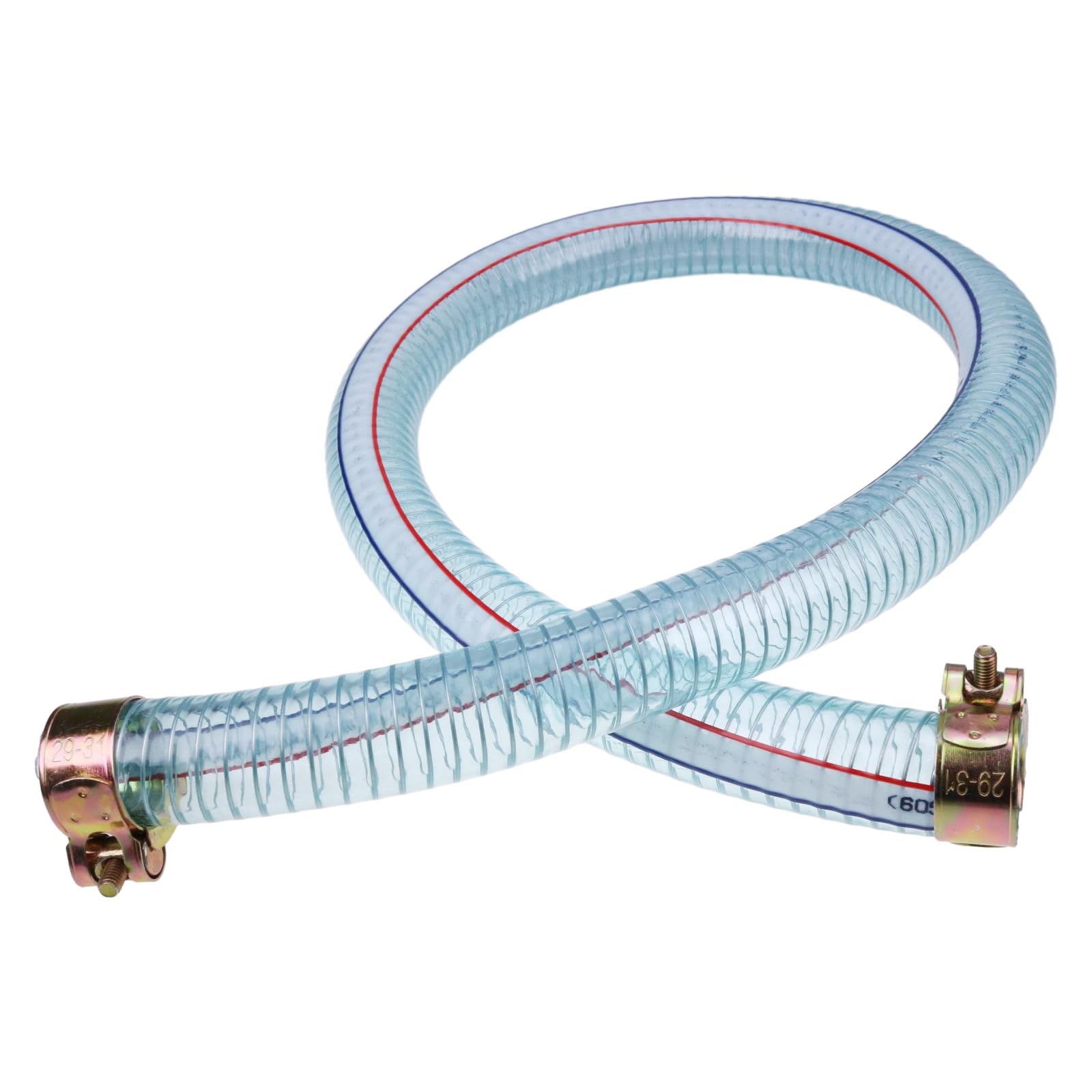
Suction hoses fail quietly. The wall softens, the pump starts pulling air instead of oil, and the cylinder gets spongy before it stops moving altogether. What makes this Chamixx hose the pick to keep on the shelf is the wall itself — PVC with a steel wire spiral inside, rated to a 30 psi working pressure and a 60 bursting pressure. In plain terms, that means the hose resists collapsing under the vacuum the pump creates on the inlet side, which is the exact failure mode a plain rubber tube gives you.
The fit is the other half of the story. At 39 inches long with a 1-inch inner diameter, it runs from a tank to a pump inlet with slack to spare, so you can loop it away from hot engine parts rather than pulling it tight. It also tolerates a temperature range of 25°F to 150°F (-4°C to 66°C) and a firmness of 73a on the shore scale, which is stiff enough that it will not suck flat. Two hose clamps ship in the box, and quality is what wins people over here — the build is the reason this one sits at the top of the list.
The honest caveat is those clamps. They are the weakest link in the package, and a loose clamp on a suction line draws air and foams your oil. Use them, but check them snug after the first heat cycle. This hose is also 39 inches against the 36-inch Jetuplusllc hose below — three extra inches of routing room, if your frame needs it.
Where This Hose Earns Its Keep
- Steel wire reinforcement inside the PVC wall resists the vacuum collapse that flattens plain tubing
- 39-inch length gives routing slack so the hose clears exhaust and moving linkages
- 1-inch inner diameter matches the common pump inlet size for a direct swap
- Two clamps included means you can finish the job without a second order
What To Watch
- The included clamps are the flimsiest part of the package — re-check them after the first run
- 30 psi working pressure suits the suction side only, not a pressure line
Reach for this if: your pump is whining, your oil is foaming, or the old inlet hose has gone soft and flat.
Look elsewhere if: you need a pressure-rated line rather than the suction feed.
2. Hydraulic Cylinder Seal Kit 4.5″ Bore
Oil weeping past the rod is a worn seal, not a scored cylinder, and this kit replaces the rubber and nylon seals cut for a 4.5-inch bore and 1.75-inch rod.
This is a rebuild kit for a cylinder with a 4.5-inch bore (the inside diameter of the barrel) and a 1.75-inch rod (the outside diameter of the chrome plunger). Those two numbers are the entire compatibility question. Measure your barrel across the inside and your rod across the outside with a caliper before you order, and if they read 4.5 and 1.75, this kit drops into the grooves without persuasion. The rubber and nylon components are cut for that specific pair, so a near-miss measurement is the one thing that turns a simple rebuild into a leak you chase all season.
What buyers get out of it is a cylinder that seals again — the leak-proof performance is the point of the kit, and it does the job on machines like a 30-ton splitter when the dimensions line up. Fit is the aspect that earns the most goodwill, which makes sense: a seal kit either goes in or it doesn’t, and there is no middle ground to argue about.
The fair warning is completeness. Some kits arrive short a piece, so open the bag and lay the seals out against the old ones before you pull the cylinder apart. That way a missing O-ring is a return, not a splitter sitting in pieces on the bench.
Measured twice: the bore-and-rod sizing is unusually clear for this category — the listing tells you to verify inside and outside diameter, which is the right instruction.
Bench check: lay the contents out before disassembly; a short kit is easier to spot while the machine is still whole.
Sorted if: your cylinder measures 4.5 inches inside and 1.75 inches on the rod, and you are tired of topping off oil.
Not your part if: your bore or rod reads anything else — this kit is cut for that one pair only.
3. Log Splitter Suction Hose 36″

At 36 inches with a 1-inch ID, this hose takes the short path from tank to pump inlet where a 39-inch run would have to loop and kink.
Same job as the hose above — feed oil from reservoir to pump inlet — but cut to 36 inches with a 1-inch inner diameter. When your pump sits close to the tank, a long hose has to loop, and a loop is where a suction line kinks. This one takes the shorter path. The wall measures 0.0625 inches nominal thickness, which is a real half-inch scale figure worth knowing: thin enough to flex around a tight frame, thick enough to hold shape under vacuum.
Where it differs from the pick above is the clamp hardware. This kit includes worm gear hose clamps — the screw-tightened band type you can cinch with a nut driver — rather than the plain style. For a lot of buyers that alone is worth the swap, because a properly tightened worm gear clamp is easier to verify by feel. The 39-inch Chamixx hose runs three inches longer than this one, so pick by how much slack your frame actually leaves you.
The material is listed as rubber or flexible plastic, so bear in mind this is a suction-side component, not a pressure line. Keep it on the inlet and it does its job quietly for years.
Why it stays on the shortlist: the combination of a 36-inch run and screw-type clamps suits compact frames where a longer hose would have to bend.
The trade-off: no published pressure rating, so treat it strictly as the suction feed it is described as.
Pick this one when: your tank sits near the pump and a 39-inch hose would have to loop.
Pass when: you want the longer run for routing clearance.
4. 31-272 Pump Mount Bracket
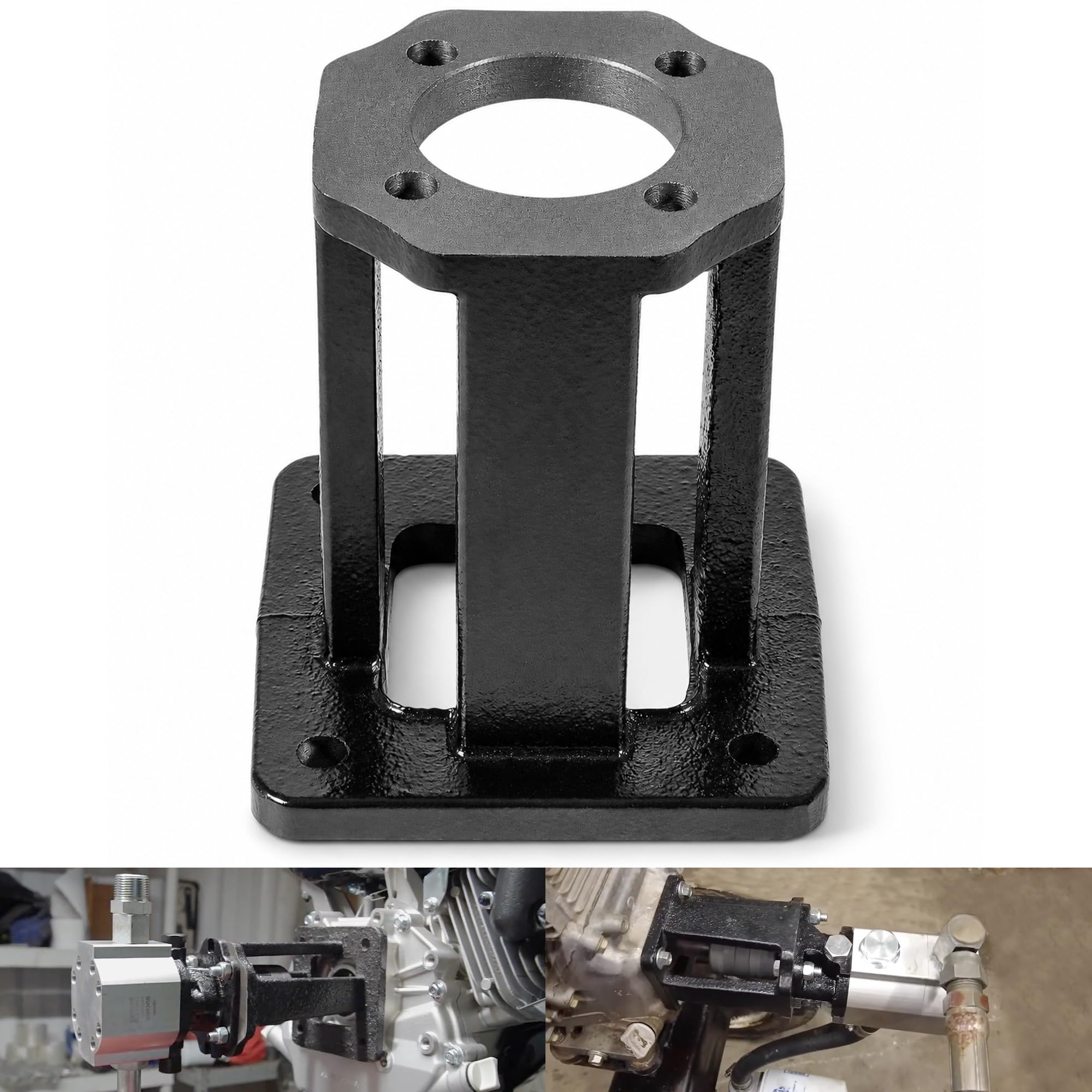
A cast iron bracket holds the pump square to the engine so a loose mount doesn’t chew up the shaft coupling.
This replaces the 31-272 pump mount on selected SpeeCo, SplitMaster, Oregon and Huskee 28, 33, 34 and 35-ton splitters. Two bolt patterns do the work: a 3-1/2-inch square on the engine side and a 2-inch square on the pump side. Those two squares are what you measure before ordering — if your engine and pump both land on those patterns, this bracket bolts straight on.
The reason it matters is alignment. A cast iron body keeps the hydraulic pump rigidly square to the engine, so the shaft, the coupling and the pump shaft stay in line while the machine is under load. It is compatible with selected 8–15 HP engines and 11–16 GPM pumps, with an enclosed center section that shields the coupling assembly.
Heft is the one number that surprises people: at 2.46 kg, this bracket is a substantial chunk of metal compared with a suction hose at 0.62 kg. That weight is the cast iron doing its job, but it also means you want the engine off and supported before you pull the old mount. A 12-month warranty from the purchase date backs it if a casting ever lets you down.
Why It Belongs In A Repair Kit
- Cast iron body with machined mounting faces holds pump-to-engine alignment under load
- 3-1/2-inch engine and 2-inch pump bolt patterns cover a wide spread of machines
- Enclosed center section protects the shaft coupling from debris
- 12-month warranty from the date of purchase
Before You Order
- Fits only the listed engine and pump size ranges — measure both patterns first
- At 2.46 kg it needs supported weight during the swap, not a one-hand job
Buy it for: a splitter where the pump has worked loose or the old mount has cracked.
skip it if: your engine or pump bolt pattern doesn’t match those two square measurements.
5. 11 GPM 2 Stage Hydraulic Pump

At 11 GPM and 3000 PSI, this two-stage pump sets how fast the wedge travels between rounds.
This is a two-stage gear pump: a high-flow first stage that shoots the wedge forward fast, then a high-pressure second stage that does the actual splitting. It runs at 11 GPM with a maximum working pressure of 3000 PSI and a maximum speed of 3600 RPM. The inlet port is 1 inch and the outlet is 1/2-inch NPT — the tapered thread standard — so your suction hose and pressure line have to be sized to those two fittings.
The comparison worth holding in your head is against the suction hoses above. This pump works at 3000 PSI while the Chamixx hose is rated to 30 psi — that is a hundredfold difference in what the two components are built to handle, and it tells you plainly why the hose never goes on the pressure side. Everything in a hydraulic circuit is rated for its own job, and that is the whole reason for buying parts instead of improvising.
The extruded aluminum casing takes knocks and squeezes from real working conditions, and the maker also claims reduced operating noise. It is also listed for presses, log cutters, truck snowplows, machine tools and dump trailer lifts, so it is a general hydraulic pump rather than a splitter-only part. Mounting it correctly is on you — pair it with the cast iron bracket above and the alignment problem is handled.
The core trade: 11 GPM and 3000 PSI in one aluminum body, which is what makes a gas splitter feel quick rather than laboured.
The catch: two stage means two behaviours — if your valve or hoses aren’t sized for the flow, you won’t get the speed the pump is capable of.
Worth it for: a rebuild where you want a faster cycle and your engine, valve and hoses are already sized for 11 GPM.
Think twice if: you are replacing a pump on a small frame without checking your valve’s flow rating first.
6. 25GPM 3500PSI G5 LVA-95NA7 Valve

Adjustable relief and detent screws let you tune this single-spool valve to your machine’s pressure and return stroke.
One spool, open center, cast iron body. The working ports are 1/2-inch NPT and the inlet and outlet are 3/4-inch NPT, so your hose ends have to match those two sizes. The pressure range runs from 1740 PSI (12 MPA) up to 3774 PSI (26 MPA), preset at 3625 PSI (25 MPA) — in everyday terms, that is a valve built to handle the full output of a big splitter with headroom left over.
What makes this version worth picking over a plain replacement is the two adjustable settings. The relief valve is set at 3000 PSI and can be dialled in, and the detent is set at 700 PSI and can also be adjusted by screwing off the end cap. That detent is the mechanism that holds the lever in the return stroke until the cylinder bottoms out — set it right and the lever releases when it should, set it wrong and it kicks out early or hangs on. Being able to tune it to your machine is a genuine advantage.
This is the newer version of the common splitter valve, with the reverse port configuration so the inlet and outlet sit on opposite sides. Before you order, compare your old valve’s port layout side by side — a reversed configuration will not route the same way on every frame. It is listed as compatible with Ariens, Champion, Countyline, Cub Cadet, Energy, SpeeCo, Huskee and more, and the threaded mounting holes are 5/16-inch-18 spaced 1 inch by 2-5/8 inches center to center.
Suits you if: you want a valve you can tune — relief and detent both adjustable — rather than a fixed preset.
Check first: the reverse port layout against your old valve’s diagram, because the hose routing follows it.
7. Hydraulic Log Splitter Valve 25GPM

This A7 valve is the factory-style fit on most SpeeCo, Huskee and MTD splitters, so the hose routing and lever geometry already match your machine.
Tool Tuff Direct’s A7 is the standard fit on most SpeeCo, Huskee and MTD branded splitters, and the maker states this is the valve used on most log splitters generally. That matters because a factory-matched part means the hose routing, the mounting and the lever geometry are already familiar to your machine. It is rated to 25 GPM and 3500 PSI maximum operating pressure, with a 3/4-inch NPT inlet and threaded connections throughout, and the body is cast iron.
Getting a dead splitter back into service mid-season is the whole appeal here. Function is what carries this valve — it does the job it is cut out to do, and it fits County Line splitters well enough that buyers describe it as an exact replacement with straightforward installation. If your valve schematic matches the one shown for this unit, you have found your part and the job is an afternoon, not a weekend.
The honest trade-off is that this is the conservative choice, not the tunable one. The G5 valve above gives you dial-in adjustment on the detent and relief; this one gets you the known-good factory pattern. If your old valve was trouble-free for years, replacing it with the same layout is the lower-risk call. Compare the port diagram either way before you commit.
Why people pick it: a factory-style layout across SpeeCo, Huskee and MTD machines, which shortens the swap considerably.
The limit: match the schematic before ordering — familiar is not universal.
Fits best when: your splitter is a SpeeCo, Huskee or MTD and you want the same valve that was already on it.
Go the other way if: you specifically want adjustable relief and detent settings.
Know the Specs
GPM and PSI on a hydraulic pump
GPM (gallons per minute) is how much oil the pump moves — think of it as cycle speed. PSI (pounds per square inch) is the force that oil delivers — think of it as splitting power. A two-stage pump uses a high-GPM, lower-PSI first stage to close the gap quickly, then switches to a lower-GPM, higher-PSI stage to push through the round. That is why an 11 GPM pump with a 3000 PSI working pressure feels quick on the approach and still has grunt for knotty wood.
Bore and rod on a cylinder seal kit
The bore is the inside diameter of the cylinder barrel; the rod is the outside diameter of the chrome plunger that slides through it. A kit such as the 4.5-inch bore by 1.75-inch rod set is cut for exactly that pairing. Measure both with a caliper before ordering — seals forced into the wrong groove deform and leak, and no amount of tightening will fix a size mismatch.
Port sizes and NPT threads
NPT stands for National Pipe Tapered — a thread that seals by wedging tighter as it screws in. A 1/2-inch NPT work port and a 3/4-inch NPT inlet are common on splitter valves. Buying a valve or hose with a port size that doesn’t match your fittings means adapters at best and leaks at worst. Read both the work port and the inlet/outlet size before you order.
Detent and relief settings on a valve
The detent holds the lever in the return position until the cylinder is fully retracted, then releases it. Relief pressure caps how much force the circuit can build before the oil bypasses to protect the components. On a valve with an adjustable detent and relief, you can set both to suit your machine. A fixed valve works, but a tunable one lets you fix a lever that kicks out early.
Common Questions
How do I know which suction hose fits my log splitter pump?
Will a 4.5 inch by 1.75 inch seal kit fit my cylinder?
What is the difference between the G5 valve and the A7 valve?
Can I put a suction hose on the pressure side of my splitter?
How long should a suction hose be on a log splitter?
Do I need a pump bracket when replacing the hydraulic pump?
What does 11 GPM mean on a log splitter pump?
Why does my splitter lever pop out of detent too early?
What size ports does a log splitter control valve use?
Can I replace a hydraulic valve on a County Line splitter?
The Bottom Line
For most buyers, the smartest move in this category is to keep the inexpensive failure points on the shelf before they fail. The Chamixx 39″ suction hose tops this list because a soft inlet hose is the quietest way a splitter loses power, and the steel wire reinforcement at 30 psi working pressure is exactly what stops that collapse. If you are opening the cylinder instead, the Jetuplusllc seal kit is the match for a 4.5-inch bore by 1.75-inch rod barrel — just measure twice before you pull it apart. And when the lever itself is the problem, the ZTUOAUMA G5 valve gives you adjustable detent and relief, which is the setting you will actually want to change.
The pattern to remember: hydraulic parts are matched by bore, rod, port size and bolt pattern, not universal. Measure your bore, rod, port size and bolt pattern once, write the numbers on the tank with a marker, and every future order becomes a two-minute job instead of a guess.
How we choose
We do not accept paid placement. Every pick is matched to a real buyer and a real use-case; we do not hands-on test units.
Sources
Specifications: manufacturer listings and product documentation. Review insights: verified customer reviews, as of November 2026. Pricing: not shown on this page (it changes often); check the current price via the retailer link.
As an Amazon Associate, Tactical Gear Guy earns from qualifying purchases. This does not affect which products we feature.