Specs are compiled from manufacturer listings and verified buyer reviews and can change over time — please confirm the key details on the product page before buying.
If you split firewood by hand, the tool in your hands decides whether a winter’s woodpile is a weekend job or a season-long grind. The best wood splitter maul is the one that puts real mass behind the strike, keeps your palms and wrists from taking the punishment, and doesn’t snap on a knotty round. This guide walks you through the models that do exactly that, with the handle materials and head weights that actually matter.
This guide is built by comparing the manufacturers’ published specifications and the patterns across verified customer reviews, so you get each pick’s real strengths and trade-offs instead of marketing spin.
Below you’ll find nine swinging mauls sorted by how they actually earn their keep, from a shock-taming hardwood crusher to a stubby steel beast built for the stump. The quick table, the spec breakdown, and the honest trade-offs are all here to help you pick the best wood splitter maul.
Top Picks


How To Choose The Best Wood Splitter Maul
Buying a maul isn’t like buying a hammer. The head weight sets how much force you can put into a round, the handle sets how much of that force comes bouncing back into your hands, and the two have to match your body. Get the pairing wrong and you’ll be tired before the trailer’s half full.
Match the head weight to your swing and your wood
A lighter head like 4.5 or 6 pounds swings faster and suits smaller rounds and kindling. A heavier 8-pound head drives deeper into dense hardwood but asks more of your shoulders. If you’re splitting big, stubborn rounds regularly, the added mass does the work for you, provided you can control it.
Handle material is a shock decision
Hickory handles flex and feel traditional but pass impact through. Fiberglass handles are tougher against overstrikes and weather. Composite or dual-layer handles built with shock-absorbing systems are engineered to reduce what reaches your palms and wrists during long sessions — worth knowing if you split a lot in one sitting.
Look for real overstrike protection and a locked-in head
Overstrike happens when your swing overshoots and the shaft hits the round. A steel-reinforced sleeve or a rubber guard at that spot is the difference between a handle that survives and one that splinters. Equally important is how the head is fixed: riveted, epoxy-sealed, or forged in one piece all resist loosening better than a simple friction fit.
Don’t overlook handle length
A 36-inch handle gives taller users reach and a bigger arc for momentum. Short handles of around 14 inches are for kindling and one-hand work, while a 27-inch steel handle trades reach for close-quarters control. Pick the length that matches your height and the size of the rounds you feed it.
Side-by-Side Comparison
| Model | Best For | Head Weight | Handle Material | Overall Length | Amazon |
|---|---|---|---|---|---|
| Fiskars Pro IsoCore 6 lb★ Best Overall | Best Overall | 6 lb | Dual-layer composite | 36″ | Amazon |
| Estwing 6 lb FiberglassBest for Big Logs | Best for Big Logs | 6 lb | Fiberglass (70%+) | 36″ | Amazon |
| Fiskars Pro IsoCore 2.5 lbBest for Kindling | Best for Kindling | 2.5 lb | Composite | 14.13″ | Amazon |
| Hooyman Splitting Maul | Most Versatile | 8 lb | Fiberglass core | 36″ | Amazon |
| Channellock German Style | Best Traditional Design | 8 lb | Fiberglass, steel | 36″ | Amazon |
| Truper 12 lb Steel Handle | Best Heavy Splitting | 12 lb | Rubber, steel | 27″ | Amazon |
| Estwing 8 lb Hickory | Best Wood Handle | 8 lb | Hickory | 36″ | Amazon |
| Truper 30958 8 lb | Best Value Splitting | 8 lb | Fiberglass, rubber | 36″ | Amazon |
| PRO 34004 4.5 lb | Budget Champion | 4 lb | Fiberglass | — | Amazon |
Detailed Reviews
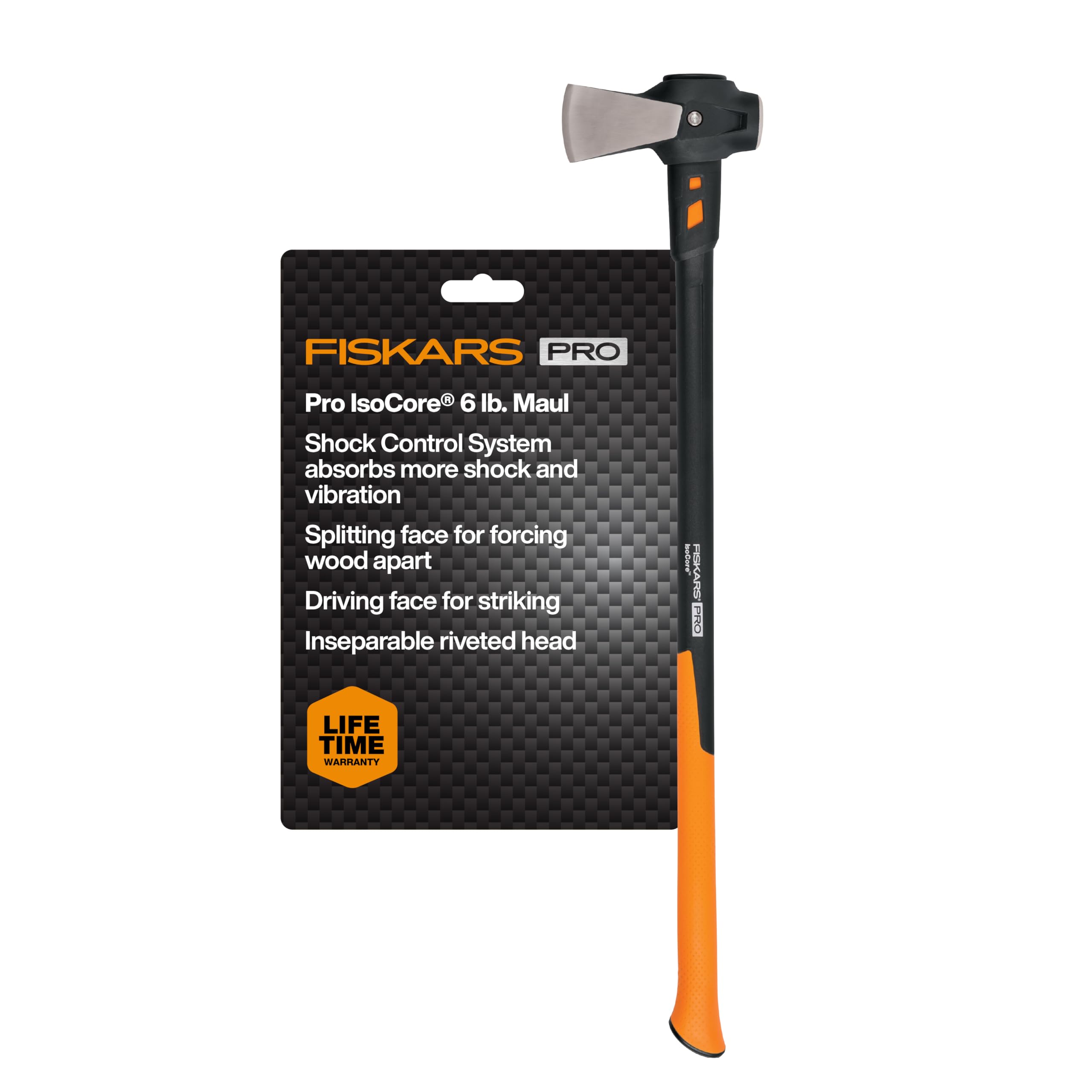
1. Fiskars Pro IsoCore 6 lb Splitting Maul
Our pick — 4.5+★ from 350+ verified ratings; the strongest balance of quality and price.
The shock-taming heavyweight that keeps your hands fresh after a full cord.
Here’s the number that decides this pick: the IsoCore Shock Control System is built to transfer 2X less shock and vibration than wood-handled mauls. That means the jarring kick that normally travels up a hickory handle into your palms and elbows is soaked up by the dual-layer handle instead. On a long splitting session, that difference is what keeps you swinging steadily instead of stopping to shake out your wrists.
The 6-pound forged, heat-treated steel head carries a rust-resistant coating, so it stays ready through damp woodpiles and wet mornings. The chisel edge bites into a round and does the prying for you, which is exactly why it holds up on hard, dense firewood. The integrated driving face is a smart extra: you can strike a wedge or stake to break apart a stubborn round that won’t crack with the maul alone.
The 36-inch length gives taller users a wide arc for real momentum, and the sculpted SoftGrip handle has a flared base so your hand doesn’t slide on the downswing. A riveted head won’t loosen or detach under force, and a steel-reinforced sleeve guards against overstrikes. It backs that up with a 4.5+ star rating across 300+ ratings. The catch is honest: it’s a mid-weight head, so if you’re chasing the deepest bite into massive knotted rounds, a heavier 8-pound maul or the steel-handled brute below will out-drive it.
What earns the top spot
- Hands that stay comfortable because the handle absorbs the majority of the kick
- A driving face that lets you work a wedge without a second tool
- Overstrike sleeve and riveted head that survive a mis-hit
- Many owners rave about the build quality of the forged head
Know before you swing
- A 6-pound head may need more force than some expect on very dense hardwood
- Lighter than the 8-pound heavies if pure mass is your goal
Reach for this if: You want the safest all-round splitter for regular firewood duty with joints you’d like to protect.
Look elsewhere if: You’re routinely attacking massive, stubborn rounds and want maximum head mass.
2. Estwing 6 lb Wood Splitting Maul #62373
A 70% fiberglass shaft with a forged head that takes giant logs in stride.
The handle is the story here: it’s a dual-injection design infused with over 70% fiberglass, which is what makes it so resistant to the repeated impact that wears other handles down. Combined with a forged head hardened to 50–55 HRC on the Rockwell scale (a measure of how hard the steel is), this is a tool built to hold up season after season rather than to be babied.
The special high-force head shape is designed to generate greater force for splitting big logs and stubborn wood. That’s the whole point of a maul — a wide, wedge-like profile that pushes the round apart instead of just slicing into it. And the reach help: the 36-inch length and 6-pound head let you build genuine swing speed. Estwing designed this with fiberglass to be a lighter option than an 8-pound maul, so for buyers who find the heavier 8- and 12-pound mauls punishing on the shoulders, this lands in a comfortable middle.
Owners describe it handling giant logs with ease, and the review pages are consistent about the solid build. What comes through strongest is how well the thing simply works and how sharp it arrives. At 4.5+ stars, it’s a strong value for the money. The trade-off: some buyers find the weight somewhere between forgiving and beastly depending on their own strength, so if pure mass is what you’re after, an 8-pound head might suit you better.
The fiberglass edge: A handle made mostly of fiberglass shrugs off overstrikes and weather that would eventually damage a wood shaft, which is why it survives repeat firewood seasons.
One honest note: A 6-pound head is a compromise — lighter than the dedicated 8-pound heavies, so expect to put a bit more of your own power into ultra-dense knots.
Buy it for: A durable, weatherproof handle and enough head weight to break down large rounds without the full weight of a heavy maul.
Think twice if: You want maximum mass for the absolute toughest hardwood and plan to swing a heavier head regularly.
3. Fiskars Pro IsoCore 2.5 lb Splitting Maul
The short swing you reach for when the logs are small and the kindling bin is empty.
At 14.13 inches long and 3 pounds overall, this is the compact member of the IsoCore family — a one-hand-leaning maul built for kindling and smaller rounds rather than full rounds off a big tree. The 2.5-pound head pairs with the same shock-absorbing handle tech as the flagship above, transferring 2X less shock and vibration than wood-handled mauls, so quick, repeated kindling strikes don’t sting your palms.
The heat-treated steel blade carries a rust-resistant coating and stays sharper longer than a traditional axe, per Fiskars’ design. There’s also overstrike protection built into the handle, which matters more on a short tool than a long one — a shorter handle means a tighter margin for error on a downswing. It’s designed for more one-strike splits on kindling and small logs, and owners back that up: it handles 12 to 14 inch alder without much fuss.
The thing that earns the good reports here is the build — these little mauls feel solid in the hand and serve as a reliable wedge on every strike. It’s rated 4.5+ stars. The honest catch: several buyers find the weight feels heavier than “2.5 pounds” suggests, more like a sledge — which is the intended heft for splitting, but a surprise if you expected a featherweight hatchet.
Where it shines
- Compact enough to keep close at the woodstove for kindling duty
- Shock control that protects hands during fast, repeated strikes
- Rust-resistant blade that holds its edge well
Before you buy
- Not built for full-size firewood rounds — it’s a kindling and small-log tool
- Some find it feels heavier than the 2.5-pound head suggests
Suits you if: You want a compact, shock-taming maul for kindling and small rounds you can swing one-handed near the stove.
Skip if: You’re splitting full rounds off a big tree and need a long-haul 36-inch splitter.
4. Hooyman Splitting Maul with V Grind Blade and H-Grip Handle

A weatherproof-grip maul that turns tacky in your hands exactly when it’s wet out.
One feature stands out from everything else on this list: the H-Grip handle turns tacky when wet, so a damp morning in the woods doesn’t turn your swing into a juggling act. That’s a genuinely useful trait for a tool that lives outdoors and gets used in cold, wet conditions. The handle itself locks into the head with an interlocked, epoxy-sealed fit and a solid fiberglass core for added strength.
The 8-pound head is forged from 1045 high-strength steel with a convex grind and an HRC of 45-60, and it’s built 36 inches long by 8 inches wide. A V-shaped head does the splitting, while the flat poll lets you start cracks in a round or drive a wedge. That two-way capability is what makes it versatile instead of a one-trick splitter. There’s a Limited Lifetime Warranty covering it too.
The positives that come through are sturdiness, weight, and value — it feels heavy and solid, and it splits wood with ease. It holds a 4.5+ star rating. The honest catch: durability and sharpness draw mixed reports, with the best experiences describing it lasting and cutting well, and the worst describing a first-use break and a dull edge. The head can also jam in a round. Treat it as a sturdy tool that rewards clean strikes.
The wet-weather win: A handle that gets grippier as it gets wetter is a rare and practical touch for anyone splitting in rain, snow, or morning dew.
Fair warning: Reports on durability and edge sharpness run both ways, so a clean, controlled strike and a check of the edge on arrival go a long way.
The right call for: A versatile 8-pound splitter with a flat poll for wedges and a grip that holds when conditions turn wet.
Not the best fit if: You want a tool with uniformly easy edges straight from the start — inspect and sharpen on day one.
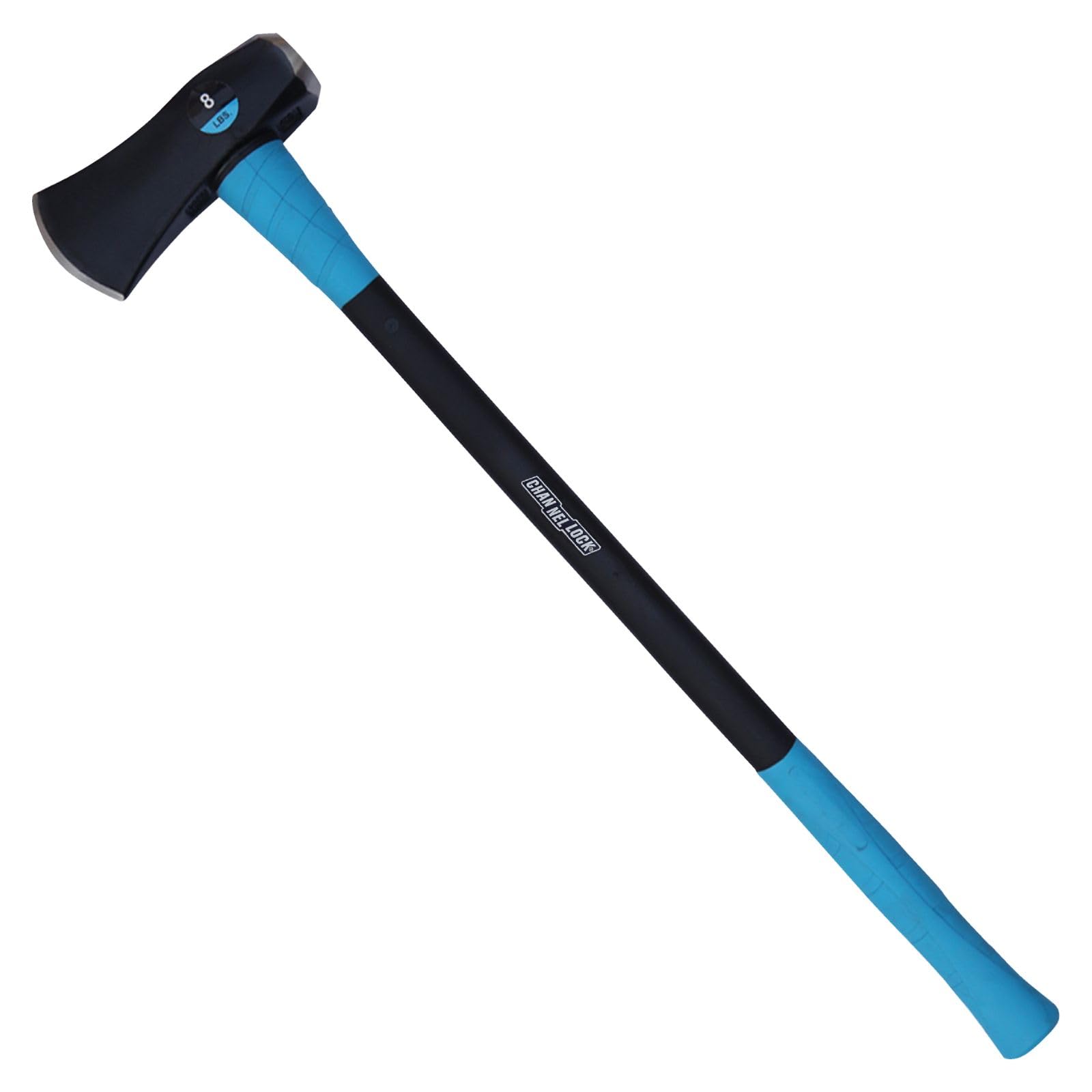
5. Channellock Maul Axe – German Style, 8lb Splitting Maul
Classic German geometry and 8 pounds of carbon steel behind every strike.
This one leans on a traditional design that’s proven itself: a German-style forged head made from high-quality carbon steel, shaped to enhance striking power and control. The 8-pound head provides efficient force for splitting logs and firewood with less effort — that German profile is why it can drive through rounds a lighter maul struggles with. The 36-inch by 8.5-inch footprint gives you real mass at the end of the swing.
The ergonomic handle has a contoured grip that keeps the tool secure during extended sessions and helps with accuracy. At 10.7 pounds total, it’s a substantial tool — noticeably heavier than the 6-pound fiberglass Estwing — so it wants a committed swing rather than a flick. When you bring that commitment, owners find it splits logs that a 6-pound maul couldn’t handle, which is the whole reason to step up to this class.
Build quality comes across clearly, and the tool feels well-made in hand. It’s rated 4.5+ stars. The honest note is the weight: opinions on it run both ways, because a heavy head is exactly the point of a splitting maul but also the source of fatigue on a long day. If you’re splitting a steady stack, the extra mass is a blessing; if you’re hauling it up a hill, you’ll feel every ounce.
Why the classic shape works
- German-style head geometry that boosts striking power and control
- 8-pound carbon steel head that splits rounds a lighter maul can’t
- Contoured grip that stays secure through long sessions
The trade-off to weigh
- At 10.7 pounds total, it’s a heavy tool that tires some users on long jobs
- Wants a full, committed swing rather than a quick flick
Pick it when: You value a proven German profile and want an 8-pound carbon steel head that powers through rounds lighter mauls can’t crack.
Pass when: You’re working steep terrain and need to carry the maul far — the weight becomes a tax.
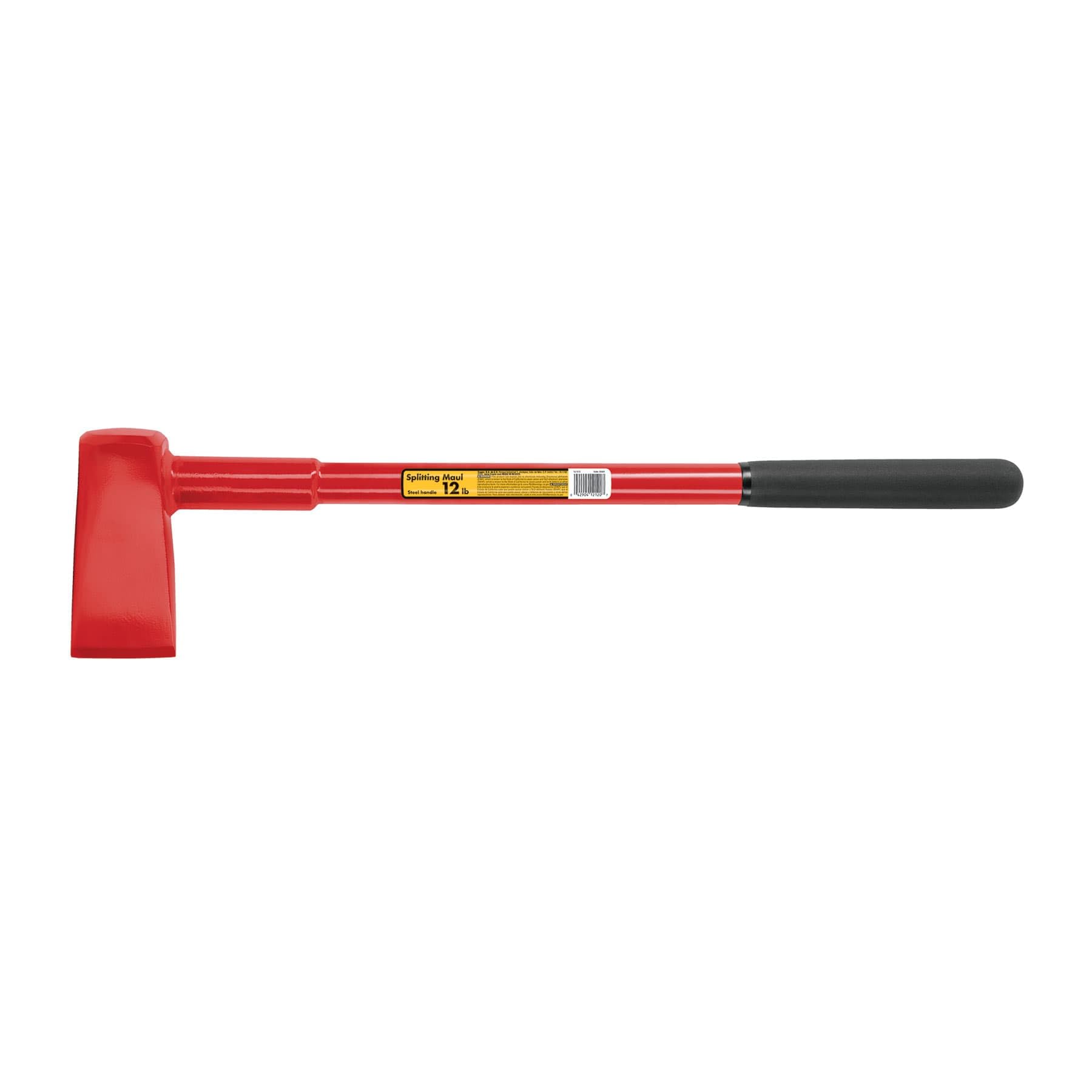
6. Truper 12 lb Splitting Maul TJ-12T
Twelve pounds of steel on a short handle — pure blunt force for heavy logs.
If you’ve got rounds that have laughed at every other maul, this is the answer: a 12-pound head on a 27-inch high-strength steel handle with a 9-inch non-slip cushion grip. The short handle concentrates the force of a massive head and lets you swing with control in tight quarters, and the steel shaft is built to survive the brutal impacts a 12-pound tool delivers. It even meets ASME Standard B107.54M.
The buying logic here is simple. A 12-pound head does more of the breaking work for you, so on big, stubborn logs you need less raw swing speed. The rubber-cushioned grip has a 9-inch span that gives you secure two-handed control. The thing buyers notice is that the mass alone is enough to drive through big logs. It’s rated 4.5+ stars, and it splits 24-inch logs, which is the kind of heavy-feed performance this class is for.
The honest catch is the handle length — several buyers find the 27-inch reach shorter than they’d prefer. You give up some swing arc and stand closer to the round. So it’s superb for dense, heavy splitting at a stump or close workspace, but if you’re used to a long 36-inch handle for big arcs, it’ll feel like a different animal.
Mass as strategy: The 12-pound head lets the tool’s weight break the round, which is why it drives through big logs with less frantic force from you.
The real caveat: The 27-inch handle is shorter than some prefer, so you’ll want to be comfortable working closer to the round rather than with a full long arc.
Best matched to: Heavy, dense logs and a buyer who wants a steel-handled brute that does the breaking for them.
Not for you if: You rely on a long handle for reach and momentum — the short steel shaft changes how you split.
7. Estwing 8 lb Wood Splitting Maul #62444

Old-school hickory and a forged 8-pound head for buyers who trust wood.
Some people just split better with wood in their hands, and this maul is for them. The 36-inch handle is premium-grade hickory — the toughest natural handle wood — contoured for a secure grip and high-density enough to feel lively in the swing. The 8-pound head is forged and hardened to 50–55 HRC, so it holds up to the repeated impact of steady splitting.
At 36 inches long by 7.95 inches wide, it builds real reach and momentum. The hickory shaft gives you that warm, controllable feel that synthetic handles can’t match, and the head is designed for a wide range of tasks — splitting, chopping, trimming, shaping. Owners describe it making quick work of woodpiles and praise the thick, sturdy handle specifically.
What wins people over with this one is the overall quality of the build, and it holds a 4.0+ star rating. The trade-offs are real but sized: the weight draws split opinions — heavier to some, lighter than expected to others — and there are occasional notes about the head sitting less than tight. Wood handles also call for a bit more care than fiberglass, so treat it well and it’ll last.
Why wood lovers pick it
- Premium hickory shaft with a contoured grip for lively control
- Forged head hardened to 50–55 HRC for repeated impact
- 36-inch reach that builds momentum for bigger rounds
A fair heads-up
- Wood handles need more care than fiberglass to stay in shape
- An occasional head-tightness note means check it on arrival
Made for: Traditionalists who want a premium hickory handle and an 8-pound forged head with real reach.
Consider the alternative if: You leave your tools out in the rain and want a handle that needs no maintenance.
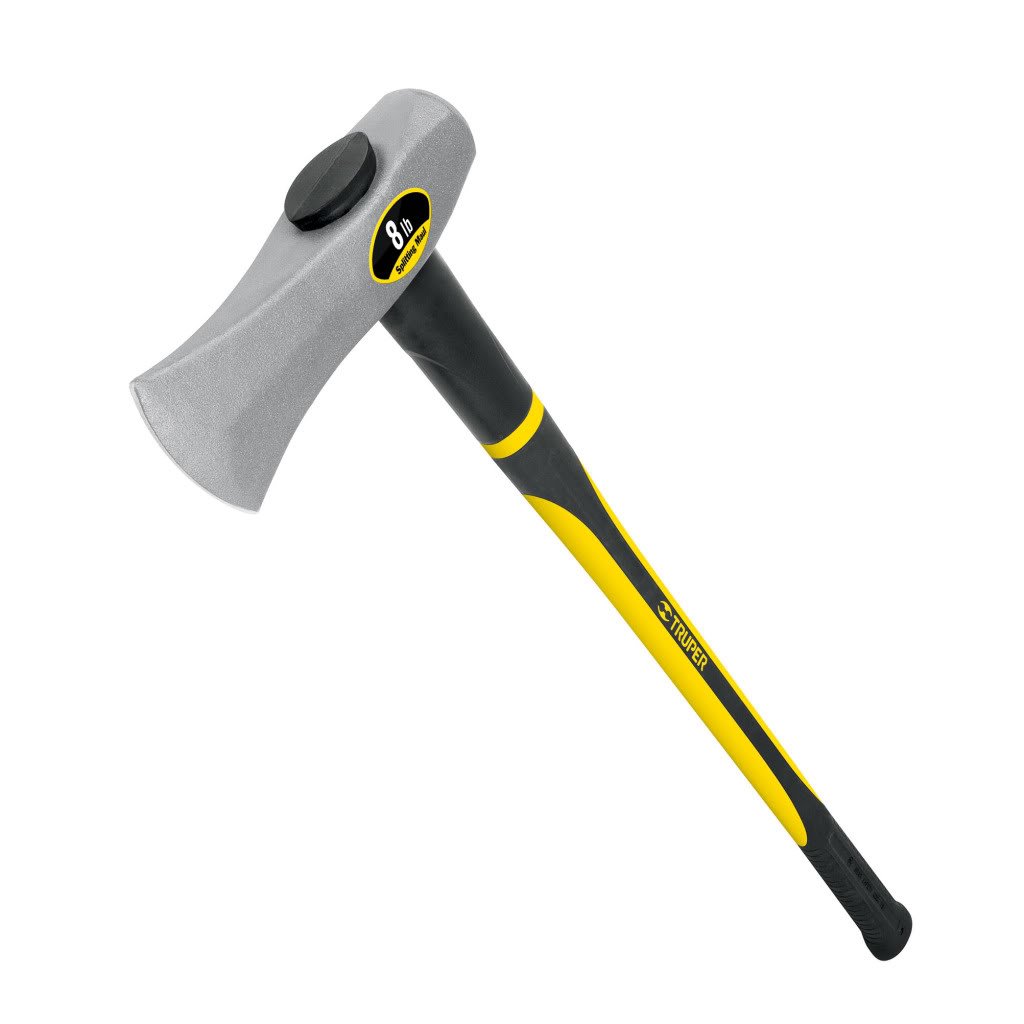
8. Truper 30958 8-Pound Splitting Maul
An 8-pound workhorse that splits a truck-load of pine in short order.
For straight-up firewood production without overspending, this Truper pulls its weight: a drop-forged 8-pound round bevel-edged head on a 36-inch double-injected fiberglass handle. The handle has a rubber grip for control and an overstrike-protected rubber guard at the vulnerable spot. At 36 inches long and 9.1 inches wide, it gives you a broad, beefy profile for driving through rounds.
What it does best is split, and it does it in volume — owners talk about getting through five truck-loads of pine in no time. That’s the whole point of an 8-pound fiberglass maul: enough mass to break down a big stack, a handle that shrugs off weather and mis-hits, and a bevel-edged face that bites. At 4.0+ stars, it earns consistent praise as a value workhorse.
The honest catch is the weight. It’s an 8-pound head, so it draws split opinions — some appreciate the mass, others find it heavier than expected. That’s the nature of the class; a heavier head means more force but more fatigue on a long day. If your arms are ready for the load, it’s a no-nonsense splitter.
Volume splitter: A wide 8-pound head and a weather-beaten fiberglass handle are built for knocking out a big firewood stack fast.
Weigh the mass: The 8-pound head is heavier than some expect, so a buyer with lighter arms should test their stamina before committing to long sessions.
Right for: A budget-conscious buyer who wants a big, tough 8-pound fiberglass maul for high-volume firewood splitting.
Wrong for: Anyone who knows a heavy head tires them out — the mass is the price of the force.
9. PRO 34004 Wood Splitting Maul

The lighter entry point where easy, clean splits come with minimal effort.
If you split smaller rounds or kindling and don’t want to heft a big 8-pounder, this 4-pound head on a fiberglass handle keeps the work light. It’s built for lighter-duty splitting with a sharpened edge that’s designed for easy cutting, and its fiberglass and wood handle balances a firm grip with a bit of give. It’s a sensible first maul or a second for the person who splits modest amounts.
At 6 pounds total with a 4-pound head, it swings fast and rewards accuracy. That’s why buyers report easy and clean splits with minimal effort. For buyers who find a full 8-pound tool punishing, the lighter weight turns a chore into a quick, controlled job. Its 4.5+ star rating is a strong score for a budget maul.
The honest note is the weight itself: it draws split opinions, with some finding it a bit heavy and others finding it comfortable. That’s expected — a middle-weight head sits between the small kindling mauls and the big 8-pound splitters. So if your wood is truly dense and oversized, you’ll want more mass, but for everyday rounds and firewood prep, this keeps it manageable.
Why the light path wins
- A 4-pound head that swings fast and encourages clean, accurate strikes
- Fiberglass handle for a firm, weather-resistant grip
- A manageable tool for smaller rounds and casual firewood duty
Know its limits
- Not enough head mass for massive, knotted rounds
- Weight views run both ways — some want heavier, some lighter
The entry pick for: A lighter-duty splitter who wants minimal effort on everyday rounds and a fast, controlled swing.
Look past it if: Your wood is big and dense — step up to an 8-pound head for the breaking force.
Know the Specs
Head weight in pounds
The head weight sets how much force lands on a round. A 4 to 6-pound head swings faster and suits smaller logs and kindling. An 8-pound or 12-pound head drives deeper into tough hardwood but asks more of your shoulders. Choose the head that matches the wood you actually split and your own ability to control the swing.
Handle material
Hickory is tough natural wood with a lively, traditional feel but needs care and passes more shock through. Fiberglass handles resist weather and overstrikes, and dual-layer or composite handles can be engineered to absorb shock and vibration. If you split a lot in one session, the shock control matters as much as the material name.
Overstrike protection
An overstrike is when your swing overshoots and the shaft hits the round instead of the head. A steel-reinforced sleeve or rubber guard at the lower handle is what saves the tool. This is a small detail that separates a handle that lasts from one that splits.
Head hardness and attachment
The Rockwell hardness rating (HRC) describes how hard the steel is — values in the 50–55 HRC range indicate a forged head built for repeated impact. How the head attaches matters too: riveted, epoxy-sealed, or one-piece forged heads resist loosening better than a simple fit.
Common Questions
How heavy a splitting maul should I buy?
Is a fiberglass handle better than hickory?
What is HRC on a maul head?
Can I use a splitting maul to drive a wedge?
What’s the difference between a splitting maul and a conventional axe?
How long a handle do I need on a splitting maul?
Why does my maul get stuck in the round?
Do splitting mauls need sharpening from the start?
Is a heavier maul easier or harder to use?
The Bottom Line
Your hands take the beating when you split wood, so the tool that spares them is the one worth buying. That is why the Fiskars Pro IsoCore 6 lb tops this list: its shock-absorbing handle (a grip built to soak up impact) takes the punishment off your hands, while the forged 6-pound head keeps splitting steady all day. Breaking down giant logs and want a weatherproof fiberglass shaft (a handle that shrugs off rain and sun)? Grab the Estwing 6 lb Fiberglass. For heavy, stubborn hardwood where you want pure mass doing the breaking, reach for the Truper 12 lb Steel Handle. Its 4.5+ star rating across hundreds of ratings makes it a smart pick for heavy splitting.
How we choose
We do not accept paid placement. Every pick is matched to a real buyer and a real use-case; we do not hands-on test units.
Sources
Specifications: manufacturer listings and product documentation. Review insights: verified customer reviews, as of November 2026. Pricing: not shown on this page (it changes often); check the current price via the retailer link.
As an Amazon Associate, Tactical Gear Guy earns from qualifying purchases. This does not affect which products we feature.