Specs are compiled from manufacturer listings and verified buyer reviews and can change over time — please confirm the key details on the product page before buying.
If your shop looks like a snow globe after ten minutes at the table saw, the fix is not a bigger broom — it is the right dust extractor. This guide covers the ten machines that actually pull fine dust out of the air and into a bag, sorted by what each one does best in a real woodworking shop.
This guide is built by comparing the manufacturers’ published specifications and the patterns across verified customer reviews, so you get each pick’s real strengths and trade-offs instead of marketing spin.
Filtration is the number that separates these picks: a 1-micron bag traps fine dust, while a 5-micron bag lets it float back into the room.
Top Picks


How To Choose The Best Wood Shop Vacuum Systems
Buying for a wood shop is not the same as buying a garage vacuum. You are collecting a mix of heavy chips and fine dust, and the fine dust is the part that floats, settles on every surface, and coats your lungs. The machine that handles chips badly will clog. The machine that handles fine dust badly will just blow it back into the room.
Start with micron rating, not motor size
A micron is a millionth of a meter, and wood dust gets very small. A unit listing a 1-micron bag is stopping much finer particles than one running 5-micron filtration. That 1-micron versus 5-micron gap is the difference between a shop that smells like sawdust and one that does not. If you sand or route indoors, filtration should be the first column you read.
Then check CFM against your biggest machine
CFM, or cubic feet per minute, is how much air the unit moves. A planer throwing wide ribbons needs far more airflow than a random orbit sander. Size the CFM to your planer or drum sander, and the sander and router will have airflow to spare. An underpowered collector connected to a big machine just chokes at the port.
Decide if you need a stationary collector or a walk-along extractor
Stationary collectors hang on a wall or roll on casters with large bags underneath, and they are built for ducting one or two machines. Portable extractors are smaller canisters you bring to the saw, often with tool-triggered start so the vacuum fires up when the tool does. A two-car garage shop with one or two machines is better served by a wall-mount or rolling unit than a ducted collector. Nobody running a cabinet shop will be happy dragging a small canister to every machine.
Check the inlet size and hose before you buy anything
A 4-inch inlet takes a 4-inch hose and mates with most stationary woodworking machines. Portable extractors usually run a smaller hose with a cuff adapter that fits a specific tool brand. Measure your tool’s dust port before buying, because a 4-inch inlet will not fit a 1-1/4-inch sander port without a cuff adapter.
Side-by-Side Comparison
| Model | Best For | Airflow / Power | Capacity | Filtration | Amazon |
|---|---|---|---|---|---|
| Festool 574837 CT Midi I HEPA Bluetooth★ Best Overall | Portable extraction with tool-triggered start | 130 CFM | 3.9 gallons | HEPA cartridge | Amazon |
| POWERTEC DC5371 Wall MountBest Wall Space | Small shop wall space | 560 CFM, 1 HP | 1 micron filter bag | 1 micron bag | Amazon |
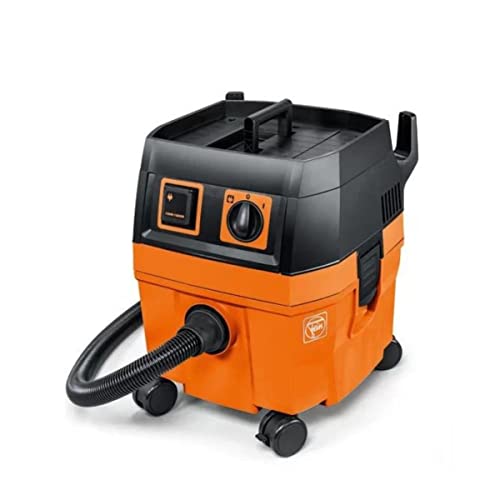
| Fein Turbo I SetQuietest Runner | Quiet wet and dry cleanup | 151 CFM, 1100W | 5.8 gallons | HEPA filter | Amazon |
| WEN DC1300 | High-volume chip collection | 1,300 CFM, 14-Amp | 50 gallons | 5 micron | Amazon |
| Festool 575280 CT SYS HEPA | Carrying to jobsites | 1000W turbine | 0.92 gallons | HEPA cartridge | Amazon |
| SHOP FOX W1727 | Portable 1 HP collection | 800 CFM, 1 HP | 2.5 micron bag | 2.5 micron bag | Amazon |
| Scheppach DC500 Set | Chip-heavy shops on a budget | 550 W, 1150 m3/h | 75 liters | Bag | Amazon |
| Jet Vortex Cone 1-1/2 HP | Filter-friendly chip separation | 1,100 CFM, 1-1/2 HP | 39.6 gallons | 2 micron canister | Amazon |
| Makita VC4210L | High-capacity HEPA wet and dry | HEPA, tool-activated outlet | 11 gallons | HEPA filter | Amazon |
| Bosch VAC140AH | Self-cleaning filter on long jobs | 150 CFM | 14 gallons | HEPA filter | Amazon |
Detailed Reviews
1. Festool 574837 CT Midi I HEPA Bluetooth Dust Extractor
Our pick — 4.5+★ from 500+ verified ratings; the strongest balance of quality and price.
Fires up when your sander does, so you never touch the vacuum switch.
You are sanding a cabinet door and your hand is on the tool, not on a vacuum dial. The CT Midi solves that with Bluetooth auto-start: a Bluetooth battery pack or the remote control wakes the extractor the moment you squeeze the trigger. The 3.9-gallon container is a canister you wheel beside you, not a bag hanging in the corner, and the touch panel runs the suction without hunting for a knob.
What wins people over is the build — this is the most-praised machine in this roundup on overall quality, and it shows in the details you touch every day. The smooth suction hose uses a conical shape that widens toward the tool, which keeps high suction power at the tip and stops the hose snagging on edges mid-cut. A Sys-Dock with T-Loc lets you click a Systainer box straight onto the top, and the internal hose holder keeps the hose tidy for transport. At 24.9 pounds it stays manageable on stairs.
You roll the Midi along and hook it to one tool at a time, and it pulls 130 CFM of airflow (cubic feet per minute — how much air it moves). That is a fraction of what a ducted collector moves, so this is not the unit for a 15-inch planer throwing wide ribbons. The honest fit note is value — the asking tier here is premium, and a fair number of buyers weigh that against what a big-box shop vac costs. What you get for it is dust control fine enough that the machine captures the finest particles, and smooth tool integration if you already run Festool gear.
What earns the top spot
- Bluetooth auto-start kills the walk-back to the switch on every cut
- HEPA cartridge filtration catches the fine dust that shop vacs pass through
- Sys-Dock with T-Loc stacks a Systainer on top for one-trip transport
- Conical smooth hose holds suction high and slides without catching
Where it asks you to compromise
- 3.9 gallons means more frequent bag changes than a big stationary collector
- 130 CFM suits one hand tool at a time, not ducted multi-machine work
- The premium tier is the recurring debate in the reviews
Reach for this if: you sand, route, or finish indoors and want the vacuum to start itself while you keep both hands on the tool.
Think twice if: your shop runs off a ducted stationary system and you need to move a lot of air to several machines.
2. POWERTEC 1 HP, 560 CFM Wall Mount Dust Collector (DC5371)
Hangs on the wall and clears a small shop floor in one afternoon.
Floor space is the first thing a small shop runs out of, and this POWERTEC gives it back. The whole unit mounts on a bracket against the wall, and the 4-inch inlet takes a dust hose straight to whatever machine is running. A 1 HP induction motor spins at 3450 RPM and moves 560 CFM of airflow, which is enough to pull chips from a table saw, sander, or router without ducting a whole room.
The 1-micron bag is the part that matters for air quality. That rating stops fine dust particles from cycling back into the room, and the bag has a built-in window so you can see the fill level before you open it. An easy-disposal zipper keeps the emptying job from becoming a dust storm. The Vortex Base design inside guides airflow in a controlled path to reduce turbulence, and POWERTEC rates that at up to 10% improved efficiency over a comparative model. If you are tracking where the machine earns its keep, performance and effectiveness are what it gets praised for most.
Two things to know before you hang it. The motor is dual voltage, 12 amp at 120V and 6 amp at 240V, so you can wire it to a 240V circuit later if you want. And the 4-inch side port sits behind a built-in grate that keeps large debris from striking the impeller — but debris builds up around that port over time. Pull the hose off regularly and check for clogging, or airflow drops and you will blame the motor. At 35.5 pounds it is a heavy lift onto the bracket, so get a hand for the install.
The wall-mount win: you get 560 CFM of chip movement and 1-micron filtration with zero floor footprint — a combination that fits a one-car garage shop far better than a rolling collector.
Maintenance you own: that grate-protected port needs periodic clearing, and the reviews flag suction as the mixed spot — some buyers want more pull at the tool end than a single 4-inch inlet delivers.
Best fit for: a hobby or small pro shop where every square foot of floor is spoken for.
Look elsewhere if: you run two machines at once or need wet pickup — this one is indoor dry dust only.
3. Fein Turbo I Set Wet/Dry Dust Extractor, 5.8 Gallon
You can hold a conversation next to it while it pulls 151 CFM.
Most shop vacuums announce themselves to the whole neighborhood. This Fein runs at 66 dB, which puts it in the range where you keep working without ear protection and still hear the tool. For a basement shop or a garage with a bedroom above it, that alone changes when you can work.
The numbers behind the quiet are real: a 1100W turbine produces 151 CFM of airflow and 98 inches of water lift, which is the measure of how hard it pulls against a sealed hose. That lift matters on a sander where the port is small and the resistance is high. An autostart outlet powers the vacuum on and off with your tool, and Fein builds in a power-on delay so the startup does not spike the circuit. A 19-foot power cord and a 13-foot hose mean you cross the shop without hunting for an outlet.
Durability is where it asks patience. The machine’s core performance is what carries it — this is one of the strongest performers in this list by owner sentiment — but longevity is the split opinion on the review pages, and build quality comes up as a mixed point. Store it dry, empty the 5.8-gallon canister before it maxes out, and it behaves. Anti-static function with optional accessories helps cut electrostatic buildup (static charge that makes dust cling), and the 360° swivel casters roll it into tight corners.
Why the noise figure sells it
- 66 dB is quiet enough for indoor and shared-wall shops
- 151 CFM and 98 inches of water lift handle tight tool ports
- Autostart outlet synced to your tool with a startup delay
- 19 ft cord plus 13 ft hose covers real shop distance
The honest counterweight
- Durability is a split verdict across the review pages
- Smaller canister than a dedicated stationary collector
- Anti-static protection needs optional accessories to be complete
Pick this one when: noise is your limiting factor and you want wet and dry pickup from a single canister.
Weigh the trade: if you expect decades of daily commercial hammering, a heavier-duty fixed collector is the safer call.
4. WEN DC1300 1,300 CFM 14-Amp Dust Collector

A 50-gallon bag under a 1,300 CFM impeller changes what a weekend looks like.
If your problem is volume — a planer, a jointer, a drum sander all throwing material at once — this is the machine in the list that moves the most air. The 14-amp motor spins a 10-inch steel impeller up to 3450 RPM and circulates up to 1,300 cubic feet of air per minute. Put that next to the Festool CT Midi’s 130 CFM and you see the scale difference instantly: this one is built for chips, not finish sanding.
You get a vertical collection bag that holds up to 50 gallons, compared with the Festool CT SYS’s 0.92 gallons — that difference tells you exactly which machine is for a jobsite and which is for a shop. Two 4-inch air inlets let you keep a pair of machines hooked up so you are not swapping hoses every cut. A mobile base with four swivel casters rolls the whole thing to wherever the work is.
Two things keep it out of the top slot. The 5-micron filtration is coarser than the 1-micron bag on the POWERTEC above, so it handles chips better than it handles fine airborne dust — good for a garage door open, less ideal for a sealed basement. And durability plus the assembly instructions are the mixed feedback on the review pages; most buyers get it together without drama, but the directions are not the strong point. What carries it is raw airflow and the fact that it cannot be heard when the garage door is shut.
The airflow argument: 1,300 CFM and a 50-gallon bag mean you empty it rarely and the planer never starves for air.
The filtration caveat: at 5 microns it is a chip machine first — pair it with good ventilation if you sand in a closed room.
Built for: shops running planers, jointers, and big sanders that need serious air movement.
Not your machine if: you mostly finish-sand indoors and want the finest dust captured at the source.
5. Festool 575280 CLEANTEC CT SYS HEPA Dust Extractor
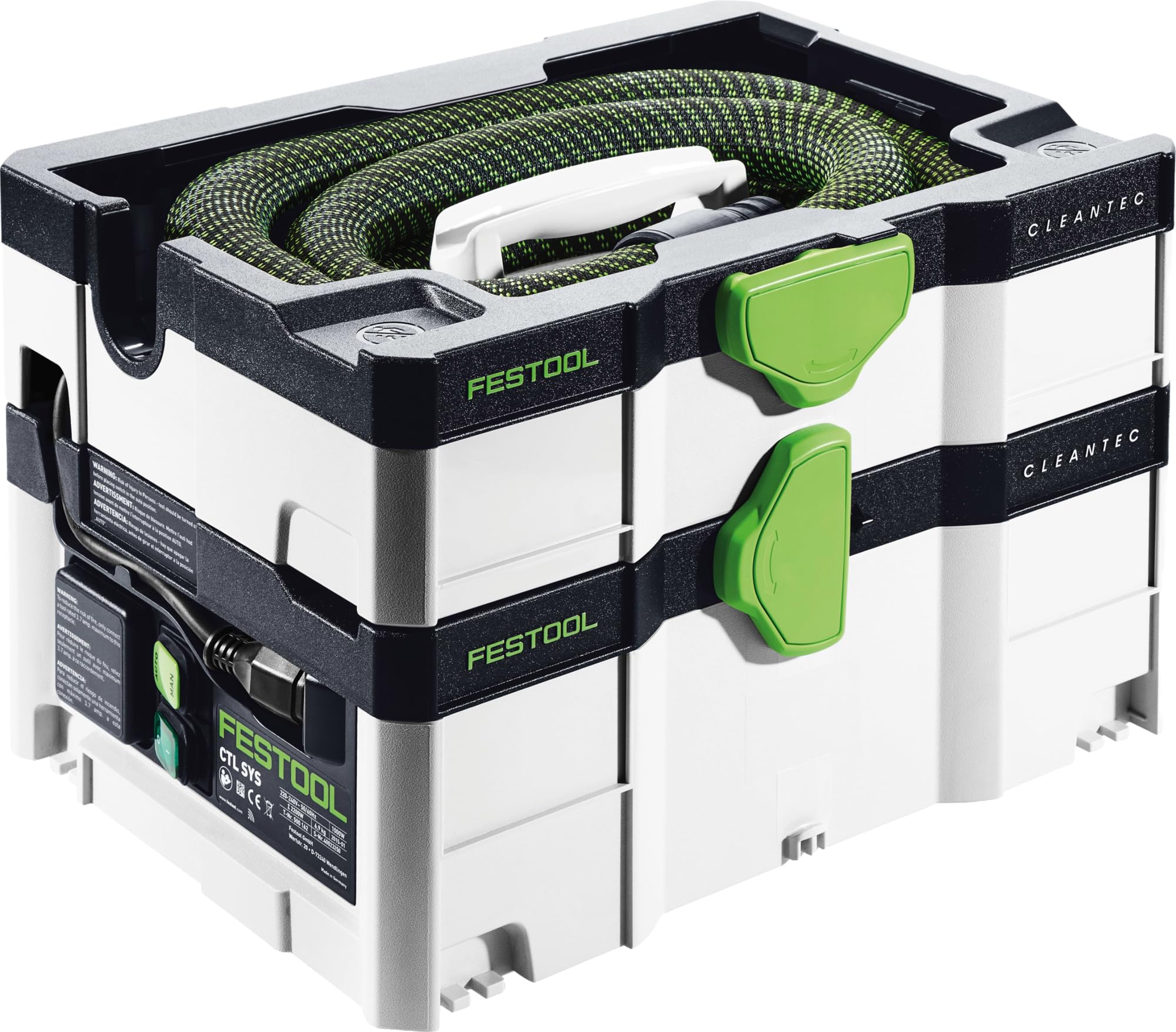
A vacuum that rides like a toolbox and starts with your tool.
This is the machine for the installer who works in someone else’s house. It comes in a Systainer footprint, the same shape as Festool’s stacking tool boxes, so it loads with the rest of your kit. A shoulder strap and integrated hose storage mean you carry it up stairs with one hand free, and the removable hose holder plus onboard accessory storage keep the nozzles from scattering in the truck.
Inside, a 1000W turbine drives HEPA filtration, and the auto start outlet fires the extractor with a connected Festool power tool. For finish work, trim, and remodeling, that combination means dust goes straight into the bag instead of onto the client’s floor. Quiet 67 dB operation keeps it civil in an occupied home, and the integrated crevice and upholstery nozzles cover cleanup after the tool work is done. A 3-year Festool service warranty backs it.
Here is the catch, and it is a big one: 0.92 gallons of capacity. Compare that to the WEN’s 50-gallon bag and the gap is enormous — you will change bags often on a heavy sanding job. That small capacity is what makes the light, stackable body possible, so it is a deliberate trade. Some buyers also weigh the premium tier against what the machine can hold. Buy it for portability and dust capture, not for volume.
What the form factor buys you
- Stacks and carries like a Systainer, with a shoulder strap for stairs
- Auto start outlet ties the vacuum to your Festool tool
- HEPA filtration on finish-sanding dust
- 67 dB keeps it polite in an occupied house
The trade you accept
- 0.92 gallons fills fast on long sanding sessions
- Premium tier pricing draws the usual value debate
- Dust capacity is the clear compromise for the compact body
Suits the installer: trim carpenters, remodelers, and finish crews who haul gear between houses.
Wrong tool for: a fixed shop running long sanding sessions where bag capacity trumps portability.
6. SHOP FOX W1727 1 HP Portable Dust Collector

Eight hundred CFM on a rolling base, prewired for a standard outlet.
A 1 HP motor moving 800 CFM puts this SHOP FOX in a useful middle ground — more air than any portable extractor in this list, less machine than a full stationary collector. It ships prewired for 110V at 9 amps and can be rewired for 240V at 4.5 amps, so it grows with your shop electrical. The portable base measures 15-3/4″ by 39-3/4″, which rolls along a wall and tucks away when the work is done.
Filtration is a 2.5-micron standard bag, so it sits between the coarse 5-micron machine and the 1-micron POWERTEC. For chip-heavy work that is fine. For fine sanding dust in a closed room, a 1-micron bag is the better call. Assembly is straightforward and buyers consistently rate the noise as lower than expected on a machine this size, which is a real bonus in a garage where you also want to hear the radio.
Two practical notes. At 55 pounds it is the heaviest portable option here, so plan its spot before you build it. And it is a chip collector, not a wet/dry vacuum — no liquids, no fine finish-dust duty. The best use is a small shop feeding one or two machines through the standard bag setup.
Where the money goes: 800 CFM, dual-voltage flexibility, and a rolling base for mid-tier money is a solid equation for a hobby shop.
The bag is the limit: 2.5-micron standard filtration means fine dust handling is the step down versus the finer-bagged machines above.
Good match for: a garage shop running a table saw and a planer that wants real airflow without a permanent install.
Skip the idea of: wet pickup or fine finish-dust control — this one is dry chips and moderate dust.
7. Scheppach DC500 Extraction System Set

Seventy-five liters of chip storage for shops that produce by the bucketload.
Emptying a bag is the chore nobody budgets time for, and this Scheppach pushes it out as far as possible. The 75-liter collection bag takes a large amount of dust and chips before it needs attention, and the set ships with 5 chip bags so you have spares on the shelf. A 550W motor drives air output rated at 1150 m3/h, and the suction manifold runs a 100 mm diameter with a 2-metre flexible hose.
The kit is the reason to look at it. A 6-piece adapter set covers small devices so the hose fits more than one tool, and the sturdy metal construction includes a bracket for hanging the filter bag. Two handles and a driving device make it easy to move around a shop floor. Noise is rated at 70 dB.
Be clear-eyed about the rating here, which is the lowest in this roundup. This is a chip and shaving extractor at its core — the bag filtration is built for volume, not for capturing micron-level dust. If you sand indoors all day, spend up the list. If your work is planing, jointing, and routing where the output is chips, the capacity-to-cost equation is hard to argue with.
Worth it for: chip-heavy work and shops that hate emptying bags mid-project.
Not the one if: fine dust capture is your main goal — the bag filtration is built for volume first.
8. Jet Vortex Cone Dust Collector, 2-Micron Canister, 1-1/2 HP
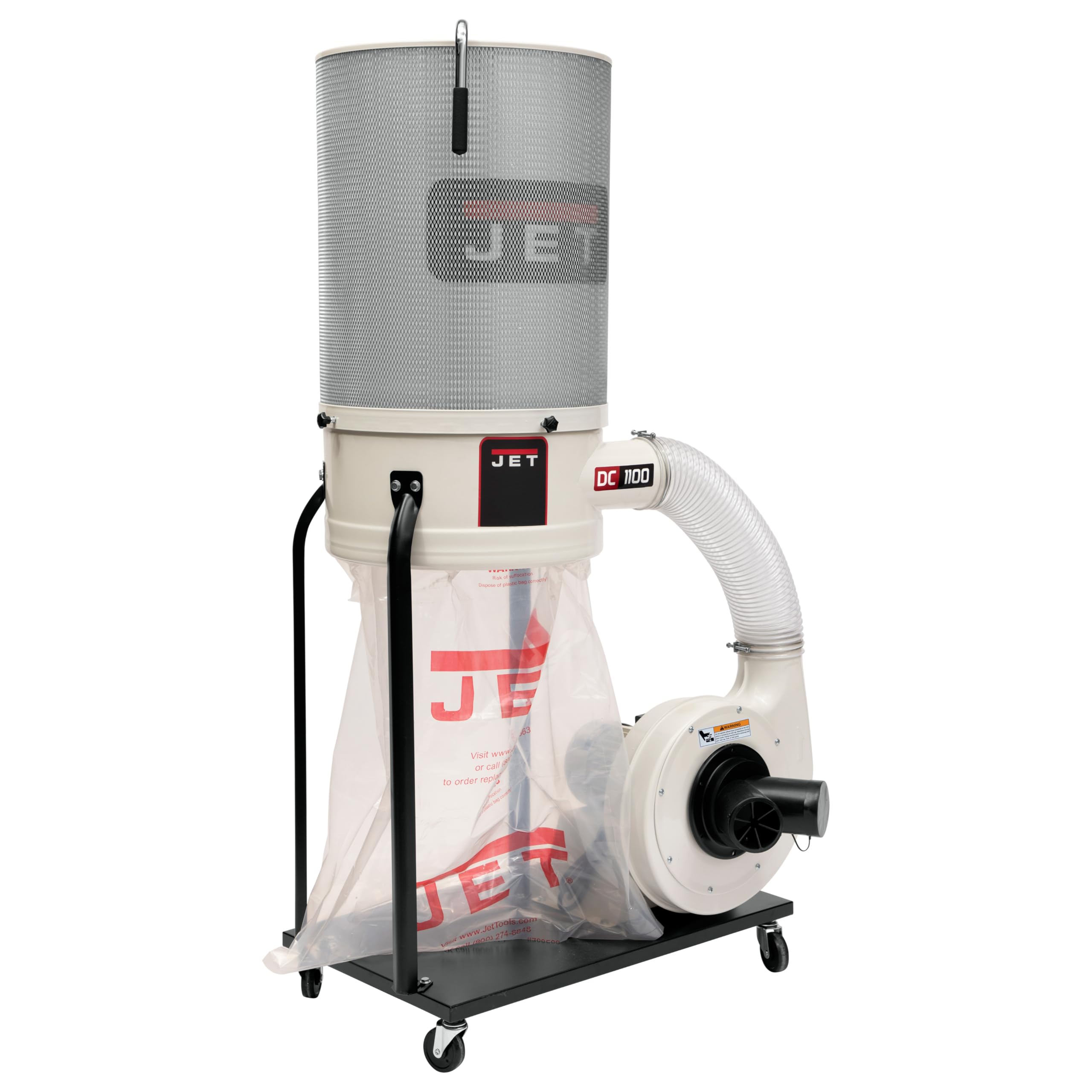
A cone under the filter keeps 98% of wood chips out of the pleats.
Most collectors slow down because the filter loads up with chips. Jet’s answer is the Vortex Cone, which sits below the filter chamber and keeps 98% of wood chips from clogging the filter, dropping them into the collector bag instead. Only fine dust reaches the canister, airflow holds between cleanings, and the bag packs tighter so you change it less.
The 2-micron pleated canister captures 98% of 2-micron and 86% of 1-micron particles. Cleaning it takes a couple of turns of the top handle — internal scrapers knock dust off the pleats into the bag, and you never pull the filter. Rated 1,100 CFM with 10-1/2 inches of static pressure and 8,464 FPM at 4 inches, driven by an 11-inch steel impeller and a continuous-duty 1-1/2 HP motor rated 11A at 115V and 5.5A at 230V. It ships prewired 115V and wants a 20A circuit. Noise runs 70-80 dB at 3 ft.
This is a wood-dust machine only — no metal shavings, no liquids, no glass or plastic. It connects through one 6-inch inlet or two 4-inch inlets, and the 39.6-gallon capacity with five clear collector bags included means you are set up from the start. Assembly is clear and the unit is quieter than expected for its size. The 5-year warranty drops to 2 years under commercial or industrial use, which tells you where Jet expects it to live.
The engineering that pays off
- Vortex Cone keeps 98% of chips off the filter so airflow holds
- Turn-the-handle canister cleaning with no filter removal
- 1,100 CFM from a continuous-duty motor
- Five collector bags included and a 5-year warranty
What to plan around
- Wood dust only — no metal, liquids, glass, or plastic
- Wants a 20A circuit and ships prewired for 115V
- Durability draws some mixed feedback
Right for you if: you run stationary machines in a home or small shop and hate pulling a loaded filter.
Step past it if: you need wet pickup or occasionally grind metal — this one is wood dust only.
9. Makita VC4210L 11 Gallon Wet/Dry HEPA Dust Extractor

Eleven gallons of HEPA capacity with a filter that clears itself.
Long sanding sessions kill suction because the filter loads. Makita’s automatic filter cleaning system works against that on its own, stretching filter life without you stopping to knock dust loose. The two-stage filtration starts with a main flat filter that captures 99.95% of particles 2 microns and larger, then a HEPA filter that captures 99.97% of particulates 0.3 microns and larger.
The 11-gallon canister is the largest wet/dry capacity in this list, which means fewer stops per job than the Fein’s 5.8 gallons or the Festool CT SYS’s 0.92 gallons. An on-board tool-activated outlet starts and stops the vacuum with your tool, plus a 10-second off delay to clear remaining debris from the hose. The kit includes a 1-1/4″ x 13′ anti-static hose, a crevice nozzle, cuff adapters in 1-3/4″ and 15/16″, a fleece filter bag, and an interlocking case adapter plate.
Noise is the split opinion here — some buyers find it quieter than expected, others point to a popping sound during operation. It weighs 35.3 pounds, so it rolls rather than carries. If you want big capacity and hands-off filter maintenance in a wet and dry machine, this delivers both.
what separates it: self-cleaning filtration plus 11 gallons means a full day of sanding without babysitting the filter or the bag.
The sound note: the noise character splits opinion, so hear one in person if your shop shares a wall.
Best for: finish carpenters and remodelers who want HEPA capture and a canister they empty once a day.
Consider another if: quiet operation is the deciding factor on your list.
10. Bosch VAC140AH 14 Gallon Dust Extractor with HEPA Filter
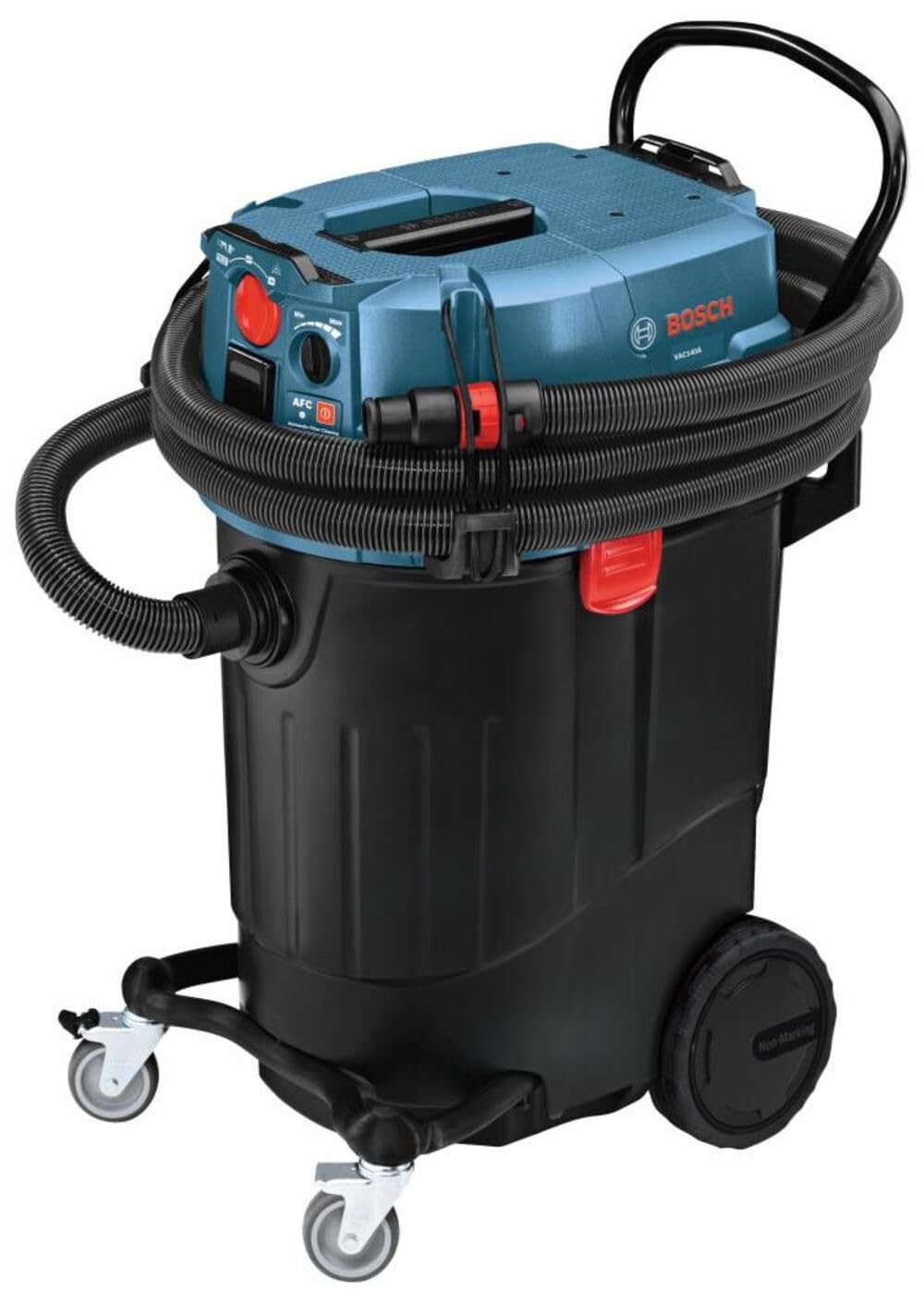
It cleans its own filter every fifteen seconds so suction stays flat.
Suction fade is the quiet killer of long jobs, and Bosch attacks it directly. Automatic filter cleaning runs every 15 seconds to hold maximum suction, so a two-hour sanding session ends at the same pull it started with. Airflow is rated at a maximum 150 cubic feet per minute with a sustainable 97 inches of static water lift.
The HEPA filter captures 99.97% of particles at 0.3 microns or larger, and the included fleece filter bag protects that filter while containing dry dust and debris. A 14-gallon canister gives you more capacity than the Fein and the Festool CT SYS, which shows up as fewer bag swaps. The Power Broker dial matches suction force to the application, and power tool activation lets your tool’s switch run the vacuum. Bosch built it into the PRO+GUARD system aimed at OSHA Silica Table 1 dust compliance.
What people report is effectiveness on sawdust and versatility across work and home use — containing sawdust in a shop is the whole job, and it does that. The noise character splits feedback, with some finding it considerably quieter and others calling it loud. The 9.85-foot hose is shorter than the 13-foot hoses elsewhere in this list, so measure your reach before you commit.
Why the auto-clean matters
- Filter cleaned every 15 seconds holds suction through long jobs
- 150 CFM with 97 inches of static water lift
- HEPA capture at 0.3 microns or larger
- Power Broker dial matches pull to the task
What to weigh
- 9.85 ft hose is shorter than most rivals here
- Noise draws mixed reactions from owners
- Premium tier on a 14-gallon canister
Reach for this if: you run long sanding or grinding sessions and want suction that never sags.
Not ideal if: you work across a wide bay and need a longer hose to get there.
Know the Specs
Micron rating and HEPA filtration
A micron is a millionth of a meter, and the rating tells you the smallest particle the filter reliably holds. A 1-micron bag stops finer dust than a 5-micron bag, so a shop sanding indoors benefits from the tighter number. HEPA is a stricter standard — the Bosch VAC140AH captures 99.97% of particles at 0.3 microns or larger, the Makita VC4210L matches that at 0.3 microns with its HEPA filter. If you sand in a closed basement, put the 1-micron or HEPA rating ahead of motor size on your spec sheet.
CFM and static water lift
CFM is cubic feet of air moved per minute — the volume number. Water lift is how hard the unit pulls against a sealed hose, measured in inches. A planer needs volume, so the WEN’s 1,300 CFM and the Jet’s 1,100 CFM win there. A sander with a tiny port needs pull, which is why the Fein’s 98 inches of water lift and the Bosch’s 97 inches matter on finish tools even though their CFM numbers are far lower.
Bag versus canister capacity
Capacity is how long you work before emptying. A 50-gallon bag on the WEN and a 75-liter bag on the Scheppach mean very few stops. A 0.92-gallon canister on the Festool CT SYS means the opposite, in exchange for a body you can carry. Match capacity to session length: a 0.92-gallon canister suits an hour of trim work, while a full day at a drum sander calls for 11 gallons or more.
Inlet size and hose fit
Stationary machines typically use a 4-inch inlet and hose, which is why the POWERTEC, WEN, SHOP FOX, and Jet all center on that dimension. Portable extractors use smaller hoses and ship cuff adapters to match specific tool ports — the Makita kit includes 1-3/4″ and 15/16″ adapters, and the Scheppach includes a 6-piece adapter set. Measure your tool’s port before ordering a hose, since a 4-inch inlet and a 1-3/4-inch cuff are not interchangeable.
Common Questions
Is a 1-micron dust collector bag really better than a 5-micron bag?
Can a wood shop dust collector handle wet pickup?
What size dust hose fits most woodworking machines?
Do I need HEPA filtration in a wood shop?
How loud is a dust collector compared to a shop vacuum?
Will a 130 CFM extractor keep up with a table saw?
How often do I have to empty a dust collector bag?
Do I need a separate circuit for a 1-1/2 HP dust collector?
What is the difference between a dust collector and a dust extractor?
Can I hook two machines up to one dust collector at the same time?
Is it worth paying more for automatic filter cleaning?
The Bottom Line
For most buyers, the wood shop vacuum systems winner is the Festool 574837 CT Midi I HEPA Bluetooth because it pairs 130 CFM of extraction with Bluetooth auto-start and a HEPA cartridge (a high-efficiency filter that traps fine dust), so the vacuum fires itself while you keep both hands on the tool. If volume is your bottleneck, grab the WEN DC1300 — 1,300 CFM and a 50-gallon bag move chips in a way no canister can match. And for filter maintenance on long jobs, the Jet Vortex Cone is the one to reach for, since its cone keeps 98% of chips out of the pleats so airflow holds between cleanings.
How we choose
We do not accept paid placement. Every pick is matched to a real buyer and a real use-case; we do not hands-on test units.
Sources
Specifications: manufacturer listings and product documentation. Review insights: verified customer reviews, as of November 2026. Pricing: not shown on this page (it changes often); check the current price via the retailer link.
As an Amazon Associate, Tactical Gear Guy earns from qualifying purchases. This does not affect which products we feature.