Specs are compiled from manufacturer listings and verified buyer reviews and can change over time — please confirm the key details on the product page before buying.
You want a finish that looks sprayed on, and you want it without clouds of sawdust in your shop or swirl marks showing up under the stain. Match the machine to the job first: a random orbital palm sander for flat panels and final passes, a belt sander when you need to move material fast. Check motor amperage, orbit behaviour and dust collection before anything else — those three decide whether a sander saves you a weekend or costs you one.
This guide is built by comparing the manufacturers’ published specifications and the patterns across verified customer reviews, so you get each pick’s real strengths and trade-offs instead of marketing spin.
The belt sanders here strip a painted cabinet door in minutes, while the orbital models add counterweights and soft grips to keep vibration off your hands through a long finish pass. Below you’ll find a wood sanding machine pick for every bench and budget, ranked by what actually matters on the wood.
Top Picks


How To Choose The Best Wood Sanding Machine
Start with the surface you actually work on. A flat oak tabletop and a cabinet edge with trim both need sanding, but they need different machines. The machine type fixes most of your decision before you ever read a spec.
Random orbital or belt sander for your work
A random orbital sander moves the pad in a tight spinning loop rather than a straight line. That motion helps stop swirl marks from following the pad path, so you can sand a panel without a cross-grain scratch pattern. A belt sander runs a continuous loop of abrasive at high feet-per-minute, so it removes material far faster. Use the orbital sander for final passes and the belt for stripping paint or flattening a glued-up board.
Motor amperage and speed control
Amperage measures how much current the motor draws, and more of it usually means more torque under load — the motor keeps spinning instead of bogging down when you lean into the wood. A variable speed dial lets you slow the pad for delicate veneer or speed it up for bulk removal. Buyers who skip variable speed often find themselves with a single-speed tool that is too aggressive for a final pass.
Dust collection and switch sealing
Dust is what kills sanders over time. A dust-sealed switch blocks fine sawdust from entering the contacts, and a real port that accepts a vacuum hose keeps your work area clear. Bags catch the coarse material; a micro filter or vacuum connection captures the fine particles that float longest in the air.
Side-by-Side Comparison
| Model | Best For | Power | Speed | Type | Amazon |
|---|---|---|---|---|---|
| DEWALT DWE6421K★ Best Overall | All-around house projects | 3 A corded | 12,000 OPM | Random orbital kit | Amazon |
| WEN HB321V Belt SanderBest Belt Value | Fast material removal | 7.5 A corded | 620–1200 FPM | Belt sander | Amazon |
| AVID POWER CordlessCord-Free Convenience | Portable touch-ups | 2 A battery | 7,000–11,000 RPM | Cordless orbital | Amazon |
| Metabo HPT SV13YST | Long finishing sessions | 2.8 A corded | Variable | Random orbital | Amazon |
| DEWALT DWE6420 | Value-focused flat panels | 3 A corded | 12,000 OPM | PSA orbital | Amazon |
| Woodskil Belt Disc Combo | Shaping and edge work | 4.3 A / 3/4 HP | 3,570 RPM | Benchtop combo | Amazon |
| Metabo HPT SV1813DAQ4 | Cordless pro freedom | 18V battery | 6 speeds | Cordless orbital | Amazon |
| BOSCH ROS20VSK | Swirl-free fine finishes | 2.5 A corded | 7,500–12,000 OPM | Random orbital kit | Amazon |
| VEVOR R7313 Brushless | Two pad sizes, one tool | 350W corded | 4,000–10,000 RPM | Brushless orbital | Amazon |
Detailed Reviews
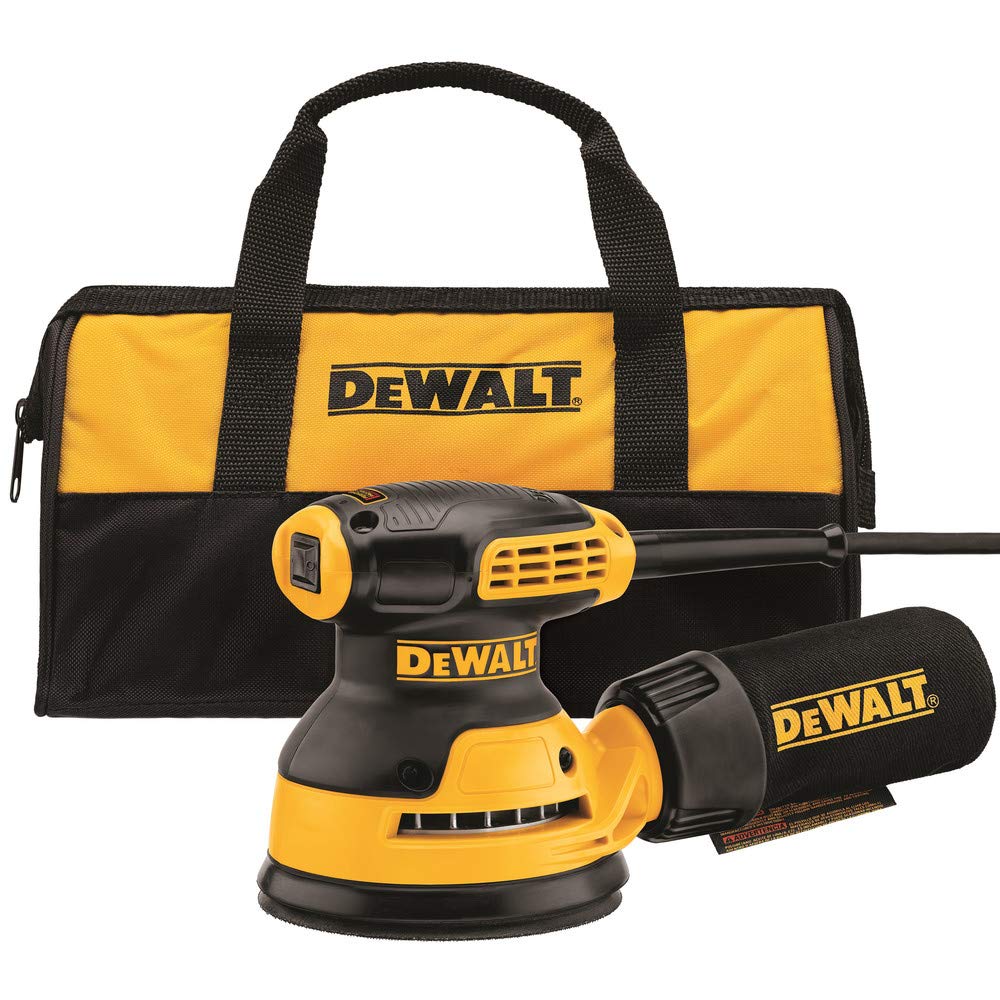
1. DEWALT DWE6421K Orbital Sander Kit
Our pick — 4.5+★ from 5,500+ verified ratings; the strongest balance of quality and price.
A 3.0 amp, 12,000 OPM palm sander that turns a cabinet door’s worth of hand-sanding into a few minutes of guided passes.
This is the sander most people picture when they ask for a wood sanding machine, and the numbers back the reputation. A 3.0 amp motor spins the pad at 12,000 OPM (orbital movements per minute — how many times the pad circles under your hand), so you strip a cabinet door fast without stalling. The shorter body height lets you get your palm closer to the workpiece, which keeps you steady on a tabletop. A separate counterweight cuts the vibration, so a long session doesn’t leave your fingers tingling.
The dust-sealed switch is the detail that quietly extends the tool’s life. Fine sawdust is the usual killer of a power switch, and this one is shielded from it. The one-handed locking dust bag pops off without you needing two hands, and the dust port fits the DWV010 or DWV012 collectors directly; for other vacuum systems with 1-1/4 in. hoses you add the DWV9000 universal quick connector. It ships with the sander, a dust bag and a carrying bag.
Where it earns its top spot is the way owners describe it in real use: whole house projects, sanding down cabinet doors, smoothing DIY furniture. The recurring note is that it simply works for the jobs a home woodworker actually does. This is a corded tool with no soft-start — expect it to jump to speed the instant you flip the switch, which is normal for this class of sander.
What earns it the crown
- 3.0 amp motor and 12,000 OPM make quick work of paint and finish removal.
- Separate counterweight tames vibration during long passes.
- Dust port connects directly to DEWALT dust collectors.
- Shorter body keeps your hand closer to the wood.
Where it asks more of you
- Corded only — you will be managing a cord across the bench.
- No variable speed dial on this model.
- Dust bag fills fast on large panels.
Go for it if: you want one dependable palm sander for cabinets, trim and furniture refinishing and don’t mind a cord.
Hold off if: you need to dial speed down for veneer or want cordless freedom on a ladder.
2. WEN HB321V Belt Sander
The belt sander for anyone who needs to strip a board down fast, not polish it.
This machine eats old finish, paint and glued-up seams, and the motor is why: a 7.5 amp variable speed motor runs the belt anywhere from 620 to 1200 feet per minute (the rate the abrasive travels around the rollers). For comparison, the AVID POWER cordless next in this list draws 2 amps. That amperage gap is exactly why it cuts where an orbital sander politely glides over the surface.
The controls are built for long sessions too. A lock-on power switch keeps the belt running without you holding the trigger down the whole time, and the quick-release tension lever makes swapping grit a matter of flipping a bar. At 6.4 pounds, it isn’t the lightest thing on the bench, but the weight is deliberate for control on large panels. It comes with a detachable dust bag, a 1-1/4-inch dust port and an 80-grit belt, plus a two-year warranty.
Owners describe this as a workhorse that delivers constant power through a pass — the motor doesn’t fade when you press down. The caveat is the belt sanding tax: abrasives wear quicker than orbital paper, and the belt must keep moving to avoid gouging. Treat it as a coarse-work specialist rather than a finishing sander.
Real daily consequence: 620 to 1200 feet per minute means you can feather the belt down for edge work and open it up for stripping, all without changing tools.
What most buyers accept: the cord and the need for consistent technique — a belt that sits still digs a groove, so this rewards the patient hand.
Your pick if: you strip paint, flatten a glued board or shape a joint in one afternoon.
Not your pick if: you only ever need the final smooth pass on a flat panel.
3. AVID POWER 20V Cordless Random Orbital Sander
A palm sander you can carry up a ladder without dragging a cord behind you.
The sales pitch here is freedom: a 20V 2.0 Ah battery, no leash to the wall, and six variable speeds from 7,000 to 11,000 RPM. That speed range matters when you switch from a doorframe you can’t remove to a flat shelf — dial the pad slower for the delicate pass and faster for paint removal. The texturised rubber over-mold grip is designed for long sessions, and the tool weighs 3.3 pounds, so one-handed work is realistic.
On the dust side, eight vacuum holes at the bottom feed a removable collection bag, and the on/off switch has a cover to keep debris out of the contacts. The hook-and-loop pad accepts the included 30 pieces of paper in 60, 80 and 120 grits — ten of each — so you can jump from coarse prep to a fine pass without buying more abrasives. The 2 Ah battery and charger are in the box.
The trade-off is battery power against raw torque: 2 amps from a 20V pack won’t cut like a 3-amp corded motor. It is at its best on small projects, quick touch-ups and furniture where the cord would snag. If you are taking a cabinet door down to bare wood, a corded model will get there faster.
Why the cordless set-up works
- Six speeds spanning 7,000 to 11,000 RPM.
- 30 included sandpapers in three grits.
- Eight vacuum holes plus removable dust bag.
- 3.3 pounds for one-handed control.
What to plan around
- 2 amp draw means less torque than corded sanders.
- Runtime limited by the 2.0 Ah battery.
- Not built for heavy continuous stripping.
Worth it for: small projects, touch-ups and anywhere a cord becomes a nuisance.
Look elsewhere if: you strip whole panels regularly and want maximum cutting speed.
4. Metabo HPT SV13YST Random Orbit Finishing Sander

Built for the long refinishing pass where smoothness beats raw speed.
This is a 5-inch variable speed random orbit finishing sander with a 230W 2.8 amp motor, and the palm-style soft grip is the reason it can be held for an entire afternoon. The variable speed dial controls how aggressively the pad cuts, so you can feather it down for a finish pass on a refinished table.
Dust is handled with a hose connector and adapter included in the box, plus a dust bag. The hook-and-loop pad lets you swap paper quickly, which matters when a long task like furniture refinishing involves several grits in sequence. The dust-sealed rocker switch protects the contacts from debris. It ships with five pieces of 5-inch A-P120 sanding paper, a dust bag, and vacuum and rubber adapters, and it carries a five-year professional tool warranty.
The recurring honest note here is dust collection. The bag and port are workable, but this sander earns its best results hooked to a vacuum rather than relying on the bag alone. Factor in a hose if fine dust is a concern in your shop. Owners consistently describe it as a workhorse that performs well and offers good value for the money.
Where it shines: the soft comfort grip and compact body mean the finish pass is the easy part, not the arm-ache part.
The one thing to know: the bag alone won’t keep a dusty shop clean; a vacuum connection is the real answer.
Best for: carpenters and refinishers who spend hours on a single piece and want less fatigue.
Think twice if: you rarely sand for more than a few minutes at a time.
5. DEWALT Random Orbit Sander, PSA, 5-Inch (DWE6420)

The PSA-pad version of a familiar DEWALT, for buyers who prefer stick-on abrasives.
The 3.0 amp motor spins the pad at 12,000 OPM, and the shorter body height puts your hand closer to the wood the same way the DWE6421K does. What sets this model apart is the PSA — pressure-sensitive adhesive — pad. You press the sanding disc straight onto the backing rather than hooking it on and off, and some woodworkers find that stick-down paper gives a flatter, more consistent contact on flat panels. The separate counterweight keeps vibration in check, and the rubber over-mold covers the critical areas you grip.
Dust management includes the one-handed locking dust bag and a port that fits the DWV010 or DWV012 collectors directly, with the DWV9000 quick connector for 1-1/4 in. hoses. There is no variable speed control here — it runs at its single speed, which is the main reason it sits below the kit version for general use.
Where buyers focus most is value, and this model delivers that with the same motor as the flagship in a simpler package. Durability is the honest mixed point — a share of buyers report it holding up well, while a few say theirs gave out sooner than expected. The trade-off is the PSA pad itself: replacing the backing pad once adhesive loses its grip is an extra step hook-and-loop users never face.
Choose this if: you like stick-on paper and want DEWALT orbital performance without the kit extras.
Skip the PSA route if: you swap grits constantly and want tool-free paper changes.
6. Woodskil 4.3A Belt Disc Sander Combo, 4×36″ Belt, 6″ Disc

A stationary two-in-one that spends its whole life bolted to a bench, not held in your hand.
This is a different animal from everything else here — a benchtop belt and disc combo for shaping and edge work, not a palm sander. The 3/4 HP motor drives the belt up to 3,570 rpm and 1,732 feet per minute, and the 4×36-inch belt pairs with a 6-inch disc for two different working surfaces. A steel base keeps it planted, and a miter gauge lets you square edges on the disc. It is 25 pounds of bench-mounted machinery, so it doesn’t move around while you work.
The dust design is one of its real strengths: two dust exhaust ports, one for the disc and one for the belt, so both functions draw debris away separately. A transparent PC guard lets you watch the belt condition while it runs. A multi-wedge belt drive mechanism extends belt life, and a belt tension adjustment device keeps the belt from slipping. It ships with two sandpapers and a miter gauge, and carries a two-year warranty.
Assembly is where this earns extra credit — owners frequently note it comes together quickly and is easy to set up. The mixed point is durability: most find it sturdy, but a few report motor issues over time. That is a fair fit note for anyone planning heavy continuous use; a stationary combo at this size is happiest with regular, moderate projects rather than all-day production runs.
Where the combo earns its bench space
- 3/4 HP motor at 3,570 rpm and 1,732 FPM.
- Separate dust ports for belt and disc.
- Miter gauge for squaring edges.
- Belt tension adjustment protects the abrasive.
The honest limits
- 25 pounds and bench-mounted — it goes where you build, not where you sand.
- Motor longevity is the mixed point for heavy use.
- Not a substitute for a handheld palm sander on vertical surfaces.
Built for: small-shop woodworkers who shape and square edges at a fixed bench.
Not the answer if: you need to sand installed trim or refinish furniture in place.
7. Metabo HPT SV1813DAQ4 Cordless Random Orbital Sander

The lightest sander in this lineup, and the one that escapes the cord without giving up control.
At 2.6 pounds, this is the featherweight of the group — versus 3.3 pounds for the AVID POWER cordless — and that lightness is the whole point. Six speed settings let you match the cut to the job, and an electric brake stops rotation quickly when you release the trigger, which keeps you from leaving a scratch when you set the tool down mid-pass. It runs on the Metabo HPT MultiVolt 18V/36V battery system, so if you already own those packs you can go lighter with 18V or stretch runtime on the MultiVolt pack.
Dust handling is well thought out for a cordless tool: it includes a dust bag, a 1-3/8-inch dust port, and 1-1/2-inch and 1-3/4-inch collection adapters, so you can hook it to several vacuum hose sizes. Two sanding pads come in the box. The 5-inch pad suits finish work on cabinet doors and trim; the tool is designed for metal as well as wood. It carries a five-year warranty.
One thing to plan for: the box does not include a battery, so factor the cost of a Metabo HPT pack and charger into your budget if you’re starting fresh. The performance is the reason owners keep it — the tool is described as performing well and outdoing competing models. If you work on installed trim or overhead, the cordless freedom and 2.6-pound weight are what sell it.
The standout number: 2.6 pounds and an electric brake make this a genuinely controlled one-handed tool in tight spots.
What to budget for: no battery in the box — this is a smart buy for anyone already on the MultiVolt system, and a bigger commitment for a first-timer.
Reach for this if: you’re on the MultiVolt platform and want a light, braked sander for trim and installed work.
Look at a corded model if: you don’t own Metabo HPT batteries and want everything in the box.
8. BOSCH ROS20VSK Palm Sander
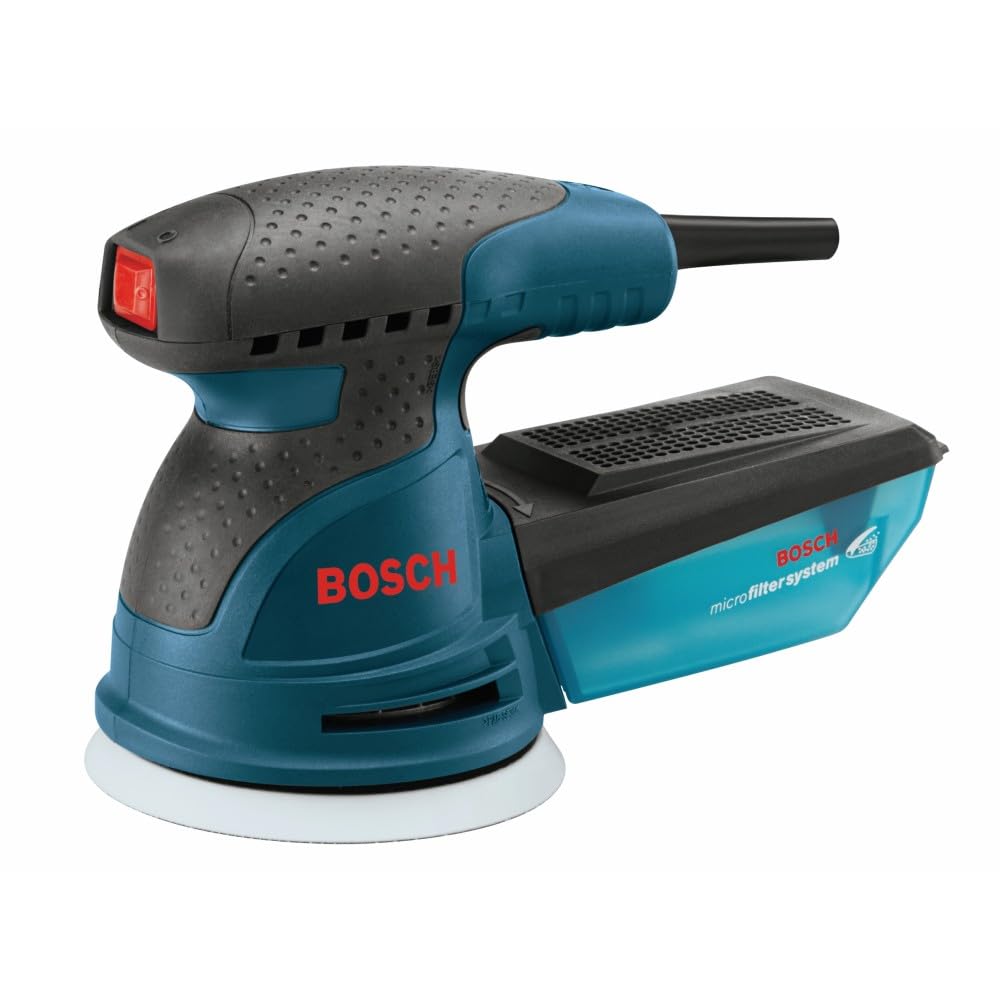
The sander for the final pass, when a stray swirl mark would ruin the whole finish.
The feature that sells this one is the pad dampening system, designed to eliminate swirl marks on both flat and contoured surfaces. On a wide tabletop that means the surface you take to stain looks even, rather than showing the circular tracks that single-motion sanders leave behind. The 2.5 amp motor runs from 7,500 to 12,000 OPM, with a variable speed control so you can slow it for a top coat or speed it up for finish removal.
Dust collection runs through a micro filter system built to trap fine particles as small as a 1/2-micron in diameter, and the compact dust canister shows its fill level before it overflows. The canister detaches for mess-free emptying. The hook-and-loop attachment holds the pad on like Velcro, so disc swaps are quick. The kit includes a soft backing pad, a sanding disc, a dampening ring, a vacuum hose adapter and a hard contractor case.
Owners describe it as a reliable workhorse with quiet operation and an ergonomic shape that fits comfortably in the hand. The one thing to know is that the micro filter is doing the heavy lifting — empty the canister often on large panels or fine dust will clog it and cut collection. If you want a single sander for both rough stripping and the final finish pass, this one is built for the latter.
Why the finish quality wins
- Pad dampening system to fight swirl marks.
- Micro filter traps particles down to 1/2-micron.
- 7,500 to 12,000 OPM variable speed range.
- Hard contractor case for storage and transport.
What to know going in
- 2.5 amp motor is modest for heavy stripping.
- Micro filter canister needs frequent emptying.
- Built for finish work, not coarse material removal.
Matched to: furniture refinishers and anyone chasing a flawless final surface.
Wrong tool if: your work starts from bare, paint-covered lumber and needs aggressive cutting.
9. VEVOR Random Orbital Sander 5 & 6-Inch
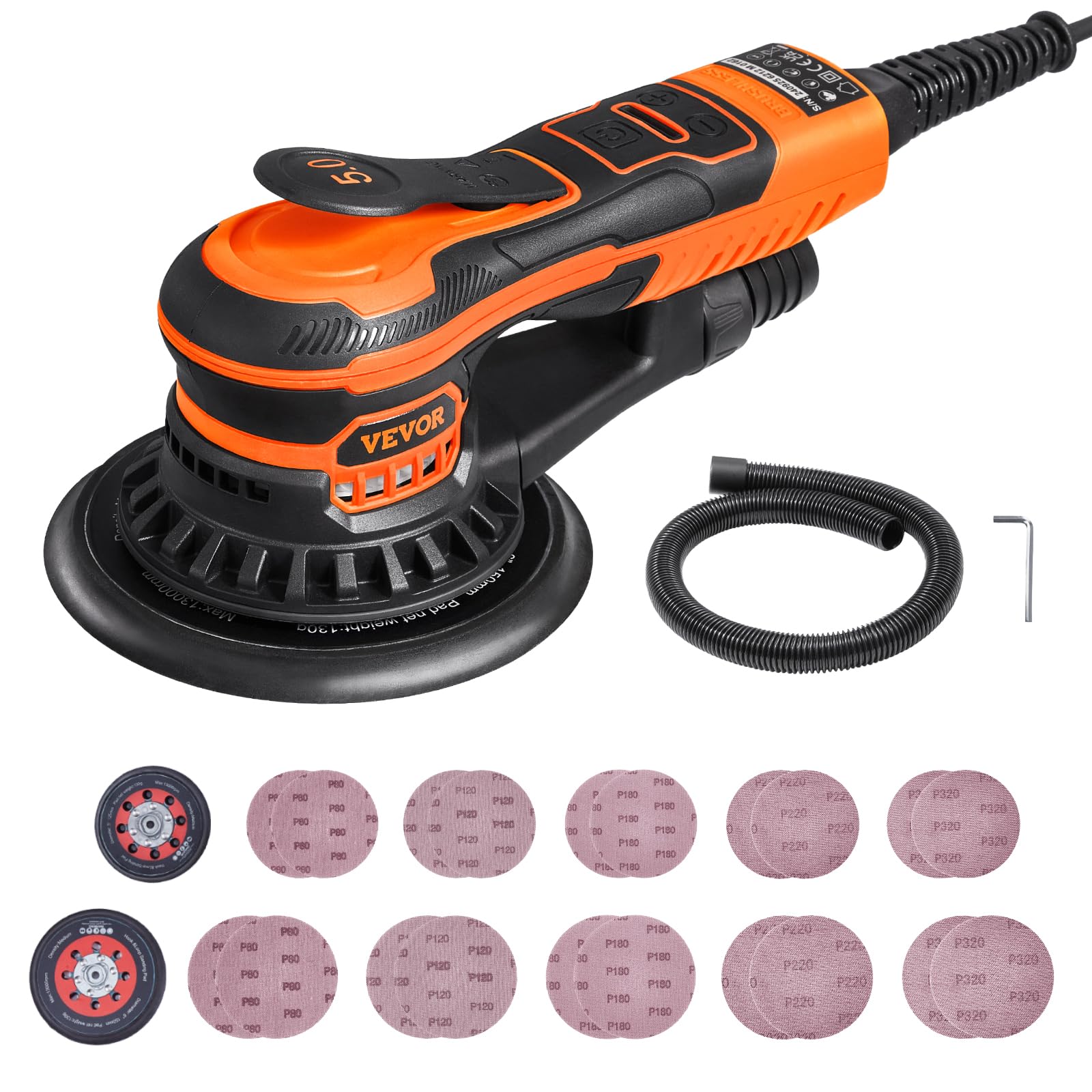
One sander that swaps between a 5-inch and a 6-inch pad, so it covers two tools’ worth of work.
The brushless 350W motor is the headline, and brushless design is the reason it can run cooler and last longer than a brushed motor. It spins at a maximum of 10,000 rpm with a 5mm large orbit diameter — that larger orbit sweeps a wider path, which speeds up material removal on a rough panel. Six speeds run from 4,000 to 10,000 rpm, so you can drop down for a delicate polish pass or open it up for fast flattening.
The kit is thick with accessories: interchangeable 5-inch and 6-inch sanding pads, 20 sandpapers in grits from 80 to 320, a dust connector and a hose so you can connect a vacuum directly. An instant-stop function halts rotation when you release the handle, adding a measure of safety. The symmetrical body grips comfortably in either the left or right hand, and the design is designed to keep vibration low for a steadier hold.
The verdict splits between the motor and the pads. Owners are impressed with the power and smoothness, and the speed settings and value read well. The honest caveats are the backing pads and the dust system — the pads can wear sooner than you’d like, and dust collection isn’t the strongest part of the package. Weigh that against getting two pad sizes and 20 papers up front.
What you’re really buying: the interchangeable pads and 80-to-320 grit spread mean you can go from shaping to finishing without a second tool.
The fair caveat: pads wear faster than the motor, and the dust port works best paired with a vacuum rather than trusting the connector alone.
Pick it for: versatile two-pad sanding on wood, metal, walls and car putty, with papers included.
Consider another if: pristine dust collection is your top priority.
Know the Specs
OPM, RPM and FPM explained
These three numbers all describe speed, but they measure different motions. OPM means orbits per minute — how many times the pad circles under your hand. RPM means revolutions per minute, the speed of a spinning disc or motor. FPM means feet per minute, the travel rate of a belt. A belt sander quoted in FPM works differently from an orbital quoted in OPM, so don’t compare the numbers head to head — compare tools of the same type.
Amperage, watts and horsepower
Corded sanders list amperage or wattage, and stationary combos list horsepower. All three measure power draw or output, and more means more torque under load. A 3-amp palm sander and a 3/4 HP benchtop motor live in different worlds: the palm sander is held and guided, while the benchtop motor drives a fixed belt. Match the power figure to the work, not to the biggest number on the page.
Hook-and-loop versus PSA pads
Hook-and-loop pads hold paper with a Velcro-style surface, so you can pull a disc off and press a new one on in seconds. PSA pads use pressure-sensitive adhesive — you stick the disc down and peel it off. Hook-and-loop is faster for grit changes; PSA suits buyers who sand one long pass with a single grit and want a flat, consistent contact.
Dust ports and micron filtration
Clean dust keeps your shop breathable and your tool running longer. A dust port is the connector that lets you attach a vacuum hose, measured in inches or fractions of an inch. A micro filter captures fine particles, sometimes down to a fraction of a micron (a micron is one millionth of a meter). A filter rated to trap particles as small as a 1/2-micron in diameter catches the fine dust that stays airborne longest, so filtration matters for a clean shop as much as for the tool’s life.
Common Questions
Will a random orbital sander leave swirl marks on a tabletop?
Is a belt sander better than an orbital sander for stripping paint?
Can I hook any of these sanders to my shop vacuum?
What grit sandpaper should I start with on rough lumber?
Do I need variable speed on a wood sanding machine?
How heavy is too heavy to hold for a long sanding session?
What is the difference between a PSA pad and a hook-and-loop pad?
Can a cordless sander match a corded one for power?
What is a belt and disc sander combo used for?
The Bottom Line
For most people the wood sanding machine winner is the DEWALT DWE6421K because it pairs a 3.0 amp motor with 12,000 OPM, a separate counterweight to calm vibration, and a dust port that connects straight to DEWALT collectors — a do-everything orbital for cabinets, trim and furniture. If you strip paint and shape boards, add the WEN HB321V belt sander and let it do the heavy cutting before the orbital finishes. And for a final surface with no swirl marks, reach for the BOSCH ROS20VSK and its dampening pad. Pair any of them with a vacuum hose; the corded models here are built to last, and clean dust is what keeps them running.
How we choose
We do not accept paid placement. Every pick is matched to a real buyer and a real use-case; we do not hands-on test units.
Sources
Specifications: manufacturer listings and product documentation. Review insights: verified customer reviews, as of November 2026. Pricing: not shown on this page (it changes often); check the current price via the retailer link.
As an Amazon Associate, Tactical Gear Guy earns from qualifying purchases. This does not affect which products we feature.