Specs are compiled from manufacturer listings and verified buyer reviews and can change over time — please confirm the key details on the product page before buying.
A wood threshold ramp only works if the rise matches your step and the platform is wider than your chair’s track. If your doorstep or threshold has a 4-inch rise, you already know how much trouble that small lip causes every single day. The short answer is that the pine ramp rated to 800 pounds with 35.4 inches of usable width is the safer buy for most homes — provided you go in knowing the slope is steep and the grip strips are something you install yourself. This guide breaks down the two wood ramps worth your attention, in plain terms, so you can measure once and order correctly.
This guide is built by comparing the manufacturers’ published specifications and the patterns across verified customer reviews, so you get each pick’s real strengths and trade-offs instead of marketing spin.
Wood ramps are simple objects, but the numbers that matter are the ones most listings bury. Load rating, platform width, board thickness, and how much rise the ramp actually has to cover decide whether your chair rolls up easily or fights you. Below you get the exact figures for both options, what buyers discovered after they got them home, and the measurements to check before you click buy on wood ramps for wheelchairs.
Quick Picks
- yeezoo 4″ Rise Wooden Door Threshold Ramp — Best Overall
- THOOUM 4″ Rise Solid Wooden Threshold Ramp — Best Surface Grip
How to Choose the Best Wood Ramps for Wheelchairs
Buying a wood threshold ramp is mostly a measuring job. Get the rise and the doorway width right, and the ramp does its work quietly for years. Get the rise or width wrong and you own a 25mm pine plank that jolts at the top or crowds the chair. Here is what to check, in the order that saves you the most trouble.
Measure the rise, not the doorway
The rise is the vertical height you need to climb — the height of the step, sill, or threshold lip. Both ramps here are built for a 4-inch rise, meaning the top surface sits at that height once the ramp is in place. A ramp meant for a 4-inch step laid against a 5-inch lip leaves a jolt at the top. Lay a straight edge across the step and measure down to the floor before you order anything.
Check the width against the chair, plus a margin
The platform width is what your chair’s wheels and casters actually cross. A chair that barely fits the ramp width leaves no room for a slight drift, so aim for a ramp noticeably wider than the chair’s track. One option here gives you 35.4 inches across, the other 31.4 inches — that difference decides a lot for larger chairs and for anyone steering one-handed.
Understand the load rating as your safety margin
The load capacity is how much weight the board is built to carry — the chair plus the person plus anything on their lap. Pine is a soft wood, so the rating depends on the board thickness and the support bar underneath. Thicker board means less flex under a rolling wheel, and a support bar underneath stops the plank from sagging in the middle over time. Both ramps use 25mm-thick pine with that support bar.
Decide how much grip you want built in
Pine loses grip when it gets wet, so the traction surface matters most at an exposed doorway. The two traction approaches differ: one ramp has non-slip grooves cut into the surface, the other ships with adhesive grip strips you apply yourself. Grooves are permanent and weather the surface; stick-on strips can be replaced when they wear but need to go on straight and clean. If your doorway sits out in the rain, this is the spec to weigh hardest.
Side-by-Side Comparison
| Model | Best For | Load Capacity | Width x Length | Surface Grip | Amazon |
|---|---|---|---|---|---|
| yeezoo 4″ Rise Wooden Door Threshold Ramp, 2PCS | Wider doorways and heavier chairs | 800 Pounds | 35.4″W x 27.9″L | Adhesive non-slip strips | Amazon |
| THOOUM 4″ Rise Solid Wooden Threshold Ramp with Grooves | Permanent outdoor entrances | 600 Pounds | 31.4″W x 29″L | Cut non-slip grooves | Amazon |
Detailed Reviews
1. yeezoo 4″ Rise Wooden Door Threshold Ramp, 2 Count

Two pine ramps rated to 800 pounds, wide enough to roll a chair across without a wobble.
Start with the number that decides this pick: 800 pounds of load capacity on a 25mm-thick solid pine board. That is the heaviest rating in this pair — the THOOUM below carries 600 pounds. For a heavier power chair, a tall rider, or a household where a caregiver also steps onto the ramp while pushing, that extra margin is the whole reason to choose it. The board is reinforced with a support bar underneath so the pine does not deform as wheels roll over the middle.
The footprint is the other selling point. You get 35.4 inches of width and 27.9 inches of length, which is 4 inches wider than the THOOUM’s 31.4-inch platform — the difference between a chair that rolls on cleanly and one you have to line up twice. And this listing ships as a 2 count, so two ramps arrive together. Each has pre-drilled holes and connecting screws, letting you bolt them side by side and customize the overall width to your doorway rather than being stuck with one fixed span. In a garage, patio, porch, or shed setting, that flexibility saves you from ordering the wrong size twice.
What buyers consistently respond to is how straightforward it is to put together and how well it does its actual job — wheelchair and walker traffic over a threshold is exactly the use case owners describe working. The honest catch is the slope. A 4-inch rise over a 27.9-inch run is steep, and some buyers find it very steep in practice, which matters if the person pushing the chair has limited strength. The second thing to know: you stick the non-slip strips on yourself, so apply them straight and press them down hard. The bottom has rubberized pads to keep the ramp from sliding, and pine plus paint will not survive years of standing water.
Where it pulls ahead
- 800-pound load capacity — the sturdier of the two ratings here
- 35.4-inch width gives the widest roll-on margin in this pair
- Two ramps per order, joinable with pre-drilled holes and screws
- One-piece design, no assembly beyond fitting the grip strips
- Rubberized pads underneath resist sliding on smooth floors
What to weigh first
- The 4-inch rise over 27.9 inches of run feels steep to roll up
- Grip strips are applied by hand, not factory-fitted
- Solid pine needs shelter if it sits outside year-round
Right call for: wider doorways, heavier chairs, and households that want two ramps to join into a custom span.
Think it over if: the person doing the pushing has limited strength — the short, steep run is the part to plan around.
2. THOOUM 4″ Rise Solid Wooden Threshold Ramp with Grooves
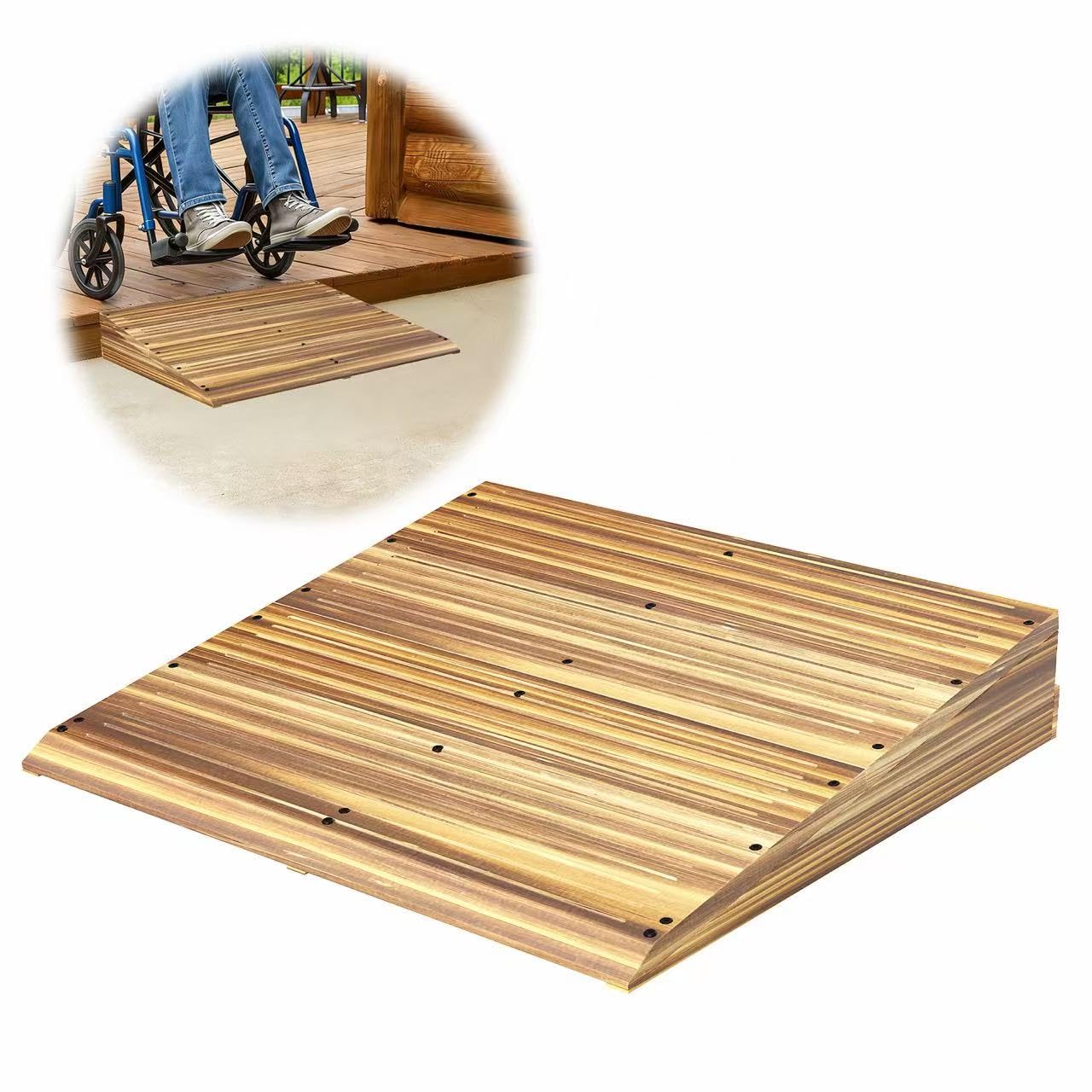
Grooves cut straight into the board mean the traction is part of the wood, not a strip you stick on.
Traction is where this ramp stakes its claim. Instead of adhesive strips, the non-slip grooves are machined into the pine surface, so grip does not peel off after a season of weather. The board itself goes through a deliberate finishing process — ground smooth first, then burned for color, then sprayed with a safe paint that gives basic water resistance for daily use. That finish is why it looks the part on a front porch as well as a back shed, and it is the pick if the ramp will live outdoors and you want the surface to hold up on its own.
The dimensions run 31.4 inches wide by 29 inches long with a spec height of 5 inches, so it is the slightly narrower and slightly longer of the two. That extra 1.1 inches of run, 29 against 27.9, slightly reduces the climb angle. The trade is width — 31.4 inches versus the yeezoo’s 35.4 inches — and load rating, which sits at 600 pounds on the same 25mm pine board against the yeezoo’s 800. It also arrives as a single 1 count with expansion screws included, so you secure it to the landing rather than building out a wider span.
Owners describe it doing the job it was bought for, solving a front-entrance step for a wheelchair, and looking good while it does. The recurring honest note is fit and stability: it can creep out of position on a smooth surface, so use the expansion screws rather than trusting it to sit still. Assembly and overall quality draw a wider spread of opinion than you might expect, with some finding it excellent and others saying it only just clears the bar — worth knowing before you commit. Check the listed 5-inch height against your actual step carefully, because a mismatch there is the fastest route to a return.
The traction argument: machined grooves plus a burned-and-painted surface make this the smarter pick for a doorway exposed to rain, where a stick-on strip would eventually lift.
The honest trade: it gives up 200 pounds of load rating and 4 inches of width to the yeezoo, so heavier chairs and tighter steering angles belong with the other pick.
Buy this one when: the ramp stays outdoors and you want grip that is part of the wood, not applied to it.
Look elsewhere when: the chair is heavy or the doorway is wide — the 600-pound rating and 31.4-inch platform are the limits here.
Know the Specs
Load Capacity (the safety margin)
Load capacity is the total weight the board is built to carry — chair, person, and whatever is on their lap. It is not a target to reach; it is headroom you stay under. On pine ramps the number comes from board thickness plus the support bar underneath. Both ramps here use 25mm-thick pine, and the rating difference (800 pounds versus 600 pounds) reflects how each maker builds and tests the span. A 600-pound rating covers a standard manual chair and rider with margin to spare. A power chair with a heavy battery pack is where the higher figure earns its keep.
Rise and Run (the slope you actually climb)
The rise is the height the ramp climbs; the run is the length it takes to get there. A 4-inch rise over a 27.9-inch run is a short, steep pitch, and over 29 inches it eases slightly. Steepness matters because whoever pushes the chair has to hold it on that pitch for the whole climb. A weaker pusher does better with a longer run, which is where the THOOUM’s 29-inch length edges out the yeezoo’s 27.9. Measure the rise at your threshold before ordering, since both ramps are built around a 4-inch step.
Common Questions
Will a 4-inch ramp work on a 5-inch step?
Can I join two wooden ramps to make one wider ramp?
Are the non-slip strips already attached?
How much weight will a 600-pound pine ramp hold?
Can I leave a wood ramp outside in the rain?
Do these ramps need assembly?
What is the difference between grooves and stick-on grip strips?
Will a wooden threshold ramp stop my chair from sliding sideways?
Is pine wood strong enough for a wheelchair ramp?
Which ramp suits a heavier power wheelchair?
The Bottom Line
The winner for most homes is the yeezoo 4″ Rise Wooden Door Threshold Ramp, because 800 pounds of load capacity and 35.4 inches of platform width give you the most margin on both the weight and the steering side — and you get two ramps to join if your doorway is wide. If your entrance sits out in the weather and you want traction built into the wood, the THOOUM grooved ramp is the one to reach for, with its cut-in grooves and sprayed water-resistant finish. Measure the rise at your threshold and your chair’s track width, then match both to the ramp’s specs before ordering.
How we choose
We do not accept paid placement. Every pick is matched to a real buyer and a real use-case; we do not hands-on test units.
Sources
Specifications: manufacturer listings and product documentation. Review insights: verified customer reviews, as of November 2026. Pricing: not shown on this page (it changes often); check the current price via the retailer link.
As an Amazon Associate, Tactical Gear Guy earns from qualifying purchases. This does not affect which products we feature.