Specs are compiled from manufacturer listings and verified buyer reviews and can change over time — please confirm the key details on the product page before buying.
Wood power tools live or die on one thing: whether the motor holds its speed when the bit hits the grain. A router that bogs halfway through a dado, a drill driver that stalls on a 2×4, or a planer that leaves a washboard surface all cost you a board you already paid for. This guide sorts nine real machines by the job they do — shaping, cutting, planing, drilling — and tells you plainly which one earns a spot in your shop and which you can skip.
This guide is built by comparing the manufacturers’ published specifications and the patterns across verified customer reviews, so you get each pick’s real strengths and trade-offs instead of marketing spin.
The shapes below range from a plunge-and-fixed combo kit to a spiral-head benchtop planer, with plain-English notes on every motor, collet size, and depth adjustment you will meet along the way. Use it to match a machine to the boards you actually cut, and you will get far more life out of wood power tools that are properly sized for the work.
Top Picks


How To Choose The Best Wood Power Tools
Before you buy anything, match the tool to the board. A trim router shapes edges and cuts hinges; a miter saw crosscuts lumber to length; a thickness planer turns rough stock into a flat, even board. Buying the wrong class of tool is the most expensive mistake a woodworker makes.
Routers: corded power versus cordless freedom
A corded router pulls its power straight from the wall, so the motor stays strong through a heavy cut in hardwood. A cordless router runs on a battery pack, which means free movement across a bench top and no cord dragging under the wood. Check the RPM range and whether the tool has a soft start (a gradual spin-up that keeps the machine from jumping when you pull the trigger).
Collet size matters too. A 1/4″ collet fits the slim bit shanks most trim work uses, while a 3/8″ collet lets you run a stouter shank on deeper cuts. Plunge base versus fixed base is the other fork: a plunge base lets you drop the bit into the middle of a board, while a fixed base is lighter and better for edge work.
Saws: blade size, bevels, and where the cut sits
A compound miter saw handles crosscuts and angled cuts in one machine. Look at the miter range left and right and the bevel range — those numbers decide whether you can crown and trim without rolling the workpiece. Blade diameter sets your maximum cut depth, and a carbide blade (tungsten carbide teeth brazed onto a steel body) cuts smoother and lasts longer than plain steel.
Planers: width, thickness, and the cutter head
Planer capacity tells you the widest and thickest board the machine will take. The cutter head is the real differentiator: a fixed two-knife head is simple and durable, while a spiral head with staggered rotatable blades cuts more quietly and gives a smoother surface on figured wood. Also check whether the bed is precision-machined cast iron, which helps keep a long board flat through the cut.
Side-by-Side Comparison
| Model | Best For | Power Source | Max Speed | Weight | Amazon |
|---|---|---|---|---|---|
| DEWALT 20V Max XR Cordless Router (DCW600B)★ Best Overall | Trim and edge routing without a cord | 20V Lithium-Ion battery (tool only) | 25500 rpm | 4.2 pounds | Amazon |
| TEENO Wood Router 6.5 AmpKit Value | Full router kit with bits on a budget | Corded, 6.5 A / 710 W | 33000 rpm | — | Amazon |
| JORGENSEN Corded Oscillating Multi ToolTight-Spot Cutter | Flush cuts, scraping, and sanding in tight spots | Corded | 16,000 OPM | 4.71 pounds | Amazon |
| WORKPRO 6.5 Amp Compact Router Combo Kit | Fixed and plunge routing in one kit | Corded, 6.5 A | 30000 rpm | — | Amazon |
| CRAFTSMAN V20 Cordless Router (CMCW400B) | Flexible cordless routing on a bench | 20V battery (bare tool) | 30000 rpm | 4.1 pounds | Amazon |
| DEWALT 20V MAX Drill and Impact Driver (DCK240C2) | Driving, fastening, and drilling pilot holes | 20V Lithium-Ion (2 batteries included) | 1500 rpm | 3.6 pounds | Amazon |
| Metabo HPT 10-Inch Compound Miter Saw (C10FCG2) | Crosscuts and miter trim work | Corded, 15 A | 5,000 RPM | 24.2 pounds | Amazon |
| VEVOR 13″ Two-Blade Thickness Planer | Flattening rough stock on a bench | Corded, 15 A / 2000 W | 23500 rpm | 54 pounds | Amazon |
| WEN PL1326 13-Inch Spiral Benchtop Planer | Smooth finish with a spiral cutter head | Corded, 15 A | 10000 rpm | — | Amazon |
Detailed Reviews
1. DEWALT 20V Max XR Cordless Router DCW600B
Our pick — 4.5+★ from 10,500+ verified ratings; the strongest balance of quality and price.
The cordless trim router that keeps its speed through hardwood instead of bogging down.
A brushless motor (a design with no carbon brushes to wear out) is the whole reason this router punches above its size class. It maintains speed during a cut through full-time electronic feedback, so the bit does not slow when it meets a knot. The soft start keeps the machine from jumping when you pull the trigger, and the electronic brake slows the bit after you shut off, which means you are not waiting with your hands near a spinning cutter.
The speed here tops out at 25500 rpm, and the variable-speed dial lets you dial that down for a wide bit or a delicate edge. Depth adjustment runs through a ring that turns quickly for fast height changes between passes. Dual LEDs sit on the work surface so you can see the cut line under a bench or inside a cabinet. At 4.2 pounds it is portable enough to carry to the board rather than the other way around.
The catch is the battery. This is a tool-only listing, so you need a DEWALT 20V pack on hand, and a fresh pack adds weight that the bare tool does not show. Worth knowing: it is slower at the top end than the corded TEENO, which spins to 33000 rpm against this router’s 25500 rpm. Where it pulls ahead is control — brushless feedback, a brake, and a soft start that the budget corded router simply does not match. It is the crowd favorite for a reason: 4.5+ stars across 10,000+ owners.
What earns the top spot
- Brushless motor with electronic feedback holds speed through a cut
- Soft start and electronic brake make it calm to handle
- Dual LEDs light the cut line in tight spots
- 4.2 pounds travels easily to the job
Where it asks something of you
- Battery and charger are not in the box — you supply the pack
- 25500 rpm top speed trails the fastest corded option
Built into the DEWALT 20V line: This is the router to choose if you already own DEWALT 20V batteries and want trim routing free of a cord.
Bring your own power: Without a 20V pack, the bare tool will not run, so factor that pack in before you commit.
2. TEENO Wood Router 6.5 Amp
Fifteen carbide bits, a dust hood, and a canvas bag arrive in the same box as the router.
Wire money into a first router and you quickly find the bits cost as much as the machine. This kit sidesteps that trap: a 6.5-amp, 710-watt all-copper motor inside a solid aluminum body, plus 15 carbide 1/4″ bits covering straight, V-groove, dovetail, and round profiles. There is also a dust hood and a canvas bag for storage, and the external carbon brush port lets you swap brushes without opening the housing.
Speed is the standout number. The dial covers six steps between 13000 and 33000 rpm, and that top figure beats every other router here — 33000 rpm versus the DEWALT’s 25500 rpm ceiling. That headroom matters when you spin a small bit for a clean edge on softwood. The aluminum alloy base is built to resist deformation under heavy load, and the rubber shock-absorbing handle keeps your grip steady on a long pass.
Where the kit shows its budget build is the accessories. The bits are a starter set, fine for softwood and plywood, not the bits you would buy for figured hardwood on a paying job. The soft start helps avoid an overcurrent jump, but the cord still rules your bench layout. For a hobbyist stocking a first shop, the complete package is hard to argue with.
Best for the first shop: If you are buying your first router and have no bits, this kit gets you cutting the same day with six speeds and a 33000 rpm ceiling.
What you trade: Treat the included bits as starter stock and upgrade them once you move to dense hardwood.
Reach for this if: You want one box that covers routing, bits, dust control, and storage for DIY furniture and trim.
Look elsewhere if: You need the fastest bit changes and the smoothest control of a brushless name-brand motor.
3. JORGENSEN Corded Oscillating Multi Tool
A flush-cut specialist for the spots a router and a saw cannot reach.
Not every cut in wood happens on a clean bench edge. Trimming a door casing flush to a floor, undercutting a jamb for new flooring, scraping old adhesive off a board — that is oscillating-tool work, and this one comes ready. The 5° oscillating angle (the side-to-side sweep the blade makes each cycle) is claimed to cut four to five times faster than a standard oscillating tool. The speed runs 8,000 to 16,000 OPM (oscillations per minute, the blade’s back-and-forth rate) across seven positions.
Blade changes need no separate tool, and a locking bracket shields your fingers during the swap. The 16-piece set covers the real jobs: flush-cut wood and bi-metal blades, a scraper, a sanding pad, and ten sanding sheets in 60, 80, 120, 180, and 240 grit. The universal fit system accepts most brands of blades. At 4.71 pounds it is heavier than the DEWALT cordless router’s 4.2 pounds — a difference you feel after a long overhead session.
The honest trade-off is durability and noise. The build quality is what wins people over, but a hard, continuous run in thick stock can shorten its life, and the motor is loud with noticeable vibration. That is a tool meant for short, surgical cuts, not for hour-long sessions. Kept to that job, it is a genuine problem-solver.
Why it has a place in the shop
- Handles flush cuts and undercuts a router cannot reach
- 16 accessories cover cutting, scraping, and sanding
- Tool-free blade changes with a finger guard
Honest limits
- Long continuous runs can wear the motor
- Loud with noticeable vibration
Made for the awkward cut: Pick it up for trim, flooring prep, and renovation cuts where no other tool fits.
Not your production tool: If you plan hour-long sanding sessions, a dedicated sander will outlast it.
4. WORKPRO 6.5 Amp Compact Router Combo Kit

Two bases in one kit means a fixed edge cut and a mid-board plunge without a second purchase.
Most routers force a choice: a fixed base for edges, a plunge base for dropping a bit into the middle of a board. This combo kit includes both, plus 1/4″ and 3/8″ collet cones so you can run a stouter bit shank when a deep cut calls for it. The 6.5-amp motor carries six speed steps from 12,000 to 30,000 rpm, and the rack-and-pinion depth knob (a geared knob that moves the motor smoothly up and down) makes height changes repeatable for cabinetry work.
Build quality is what buyers point to first, and it pairs with a transparent dust hood that keeps chips from flying while you watch the cut. The kit is generous: six router bits, straight guide, trimming guide, two template guides, two dust collectors, two wrenches, and a guide holder. Rubber-wrapped handles reduce hand pressure on long passes.
The plunge base draws some mixed notes — it is the part of the kit that takes the most patience to set up smoothly. Durability also lands in mixed territory, so this is a kit for the hobbyist and around-the-house jobs rather than a production shop. For a homeowner cutting grooves, trimming edges, and chamfering in the garage, the two-base range covers an enormous span of work for one purchase.
Range over polish: A fixed base, a plunge base, two collet sizes, and bits cover shaping jobs that would otherwise need two separate machines.
The catch is the plunge base: It needs more care to dial in than the fixed base, so expect to spend time learning it.
Choose it if: You want one kit that handles both edge cuts and mid-board plunge routing.
Pass if: You only ever cut edges and would rather spend on a single, simpler base.
5. CRAFTSMAN V20 Router Tool CMCW400B

The cordless router that runs smooth enough to feel like a corded machine.
Cordless routers usually feel like a compromise until you try this one. The brushless motor (the design that stretches runtime by cutting wasted energy) runs from 16000 to 30000 rpm on a variable-speed dial, so you can ease off for a wide bit or open it up for a small round-over. The depth adjustment knob turns fast for height changes between passes. At 4.1 pounds it is the lightest router on this list, and the LED light shines on the cut line under a cabinet or a bench overhang.
Steady control is where owners cheer, and the smooth-spinning brushless motor lives up to it — plenty of torque for edging a board without bogging down, in the words of the review pages. That steadiness matters more than raw top speed when you are guiding a router by hand. An edge guide and a dust port adapter are both in the box, so you can follow a straight line and keep chips moving away from the cut.
As a bare tool, the battery and charger come separately, so budget for a V20 pack if it is not already in your shop. That is the real cost of the cordless freedom. The fix is simple if you are already in the CRAFTSMAN V20 system. If you are not, weigh the pack against the fact that the corded options on this list need no battery at all.
Why owners call it corded-like: A brushless motor with torque for edging, wrapped in a 4.1-pound body with a 30000 rpm top end.
Battery not included: Bare-tool listing, so the V20 pack is a separate line item.
Best fit: A CRAFTSMAN V20 owner who wants trim routing without a cord dragging across the bench.
Think twice if: You do not own V20 batteries — the pack purchase changes the real total.
6. DEWALT 20V MAX Cordless Drill and Impact Driver (DCK240C2)
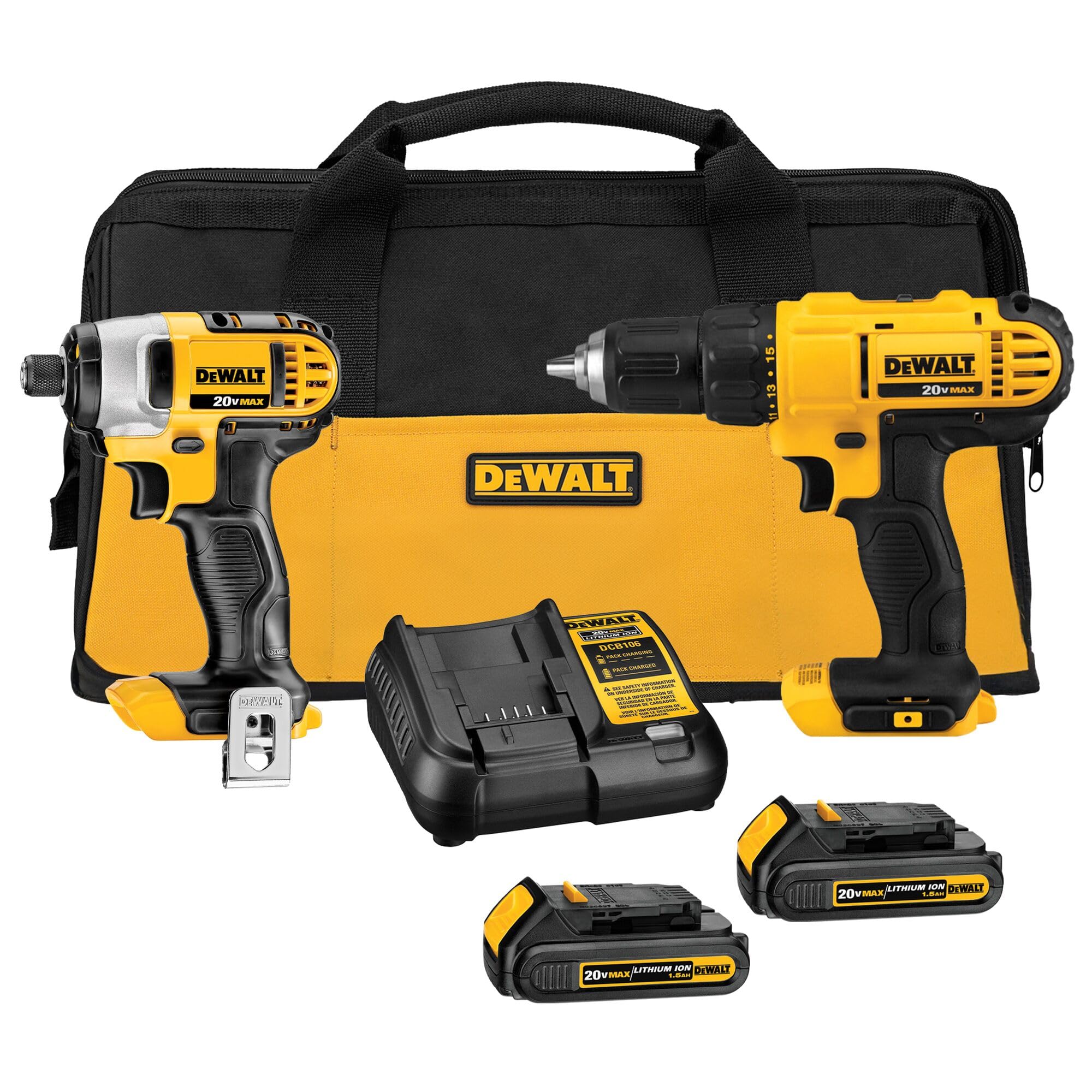
Two batteries, a charger, and a bag — the kit that keeps the whole shop moving.
Every woodworking project starts with a hole and ends with a screw. This pair covers both: the drill driver spins to 1500 rpm with up to 300 UWO (unit watts out, a measure of real working power), and the impact driver delivers up to 1,400 in-lbs of torque, which is enough to sink a long screw into hardwood without cam-out. The 1/4-inch hex chuck loads bits one-handed so your other hand stays on the workpiece. LED lights with a 20-second delay stay lit after you release the trigger, which helps in a dim cabinet or under a bench.
Compact bodies get into tight corners where a bigger tool will not fit. At 3.6 pounds for the set, it is light enough to hold overhead for a run of shelf brackets. Two 1.3Ah batteries and a charger are in the box, plus a contractor bag.
The recurring gripe is battery life — some packs fade faster than owners expect, so treat the pair as a starting set and plan for a larger pack down the road. It is still the most useful purchase in this whole guide for anyone who works in wood, because almost every project passes through a drill and a driver before a router ever touches it.
What makes it the backbone
- Two batteries and a charger included — ready to work
- Impact driver delivers up to 1,400 in-lbs of torque
- 20-second LED delay lights dim work areas
What to plan around
- Battery life described as mixed in owner feedback
- Compact 1.3Ah packs suit light-to-medium work
Every shop needs one: If you are starting or re-stocking, this kit covers drilling and driving with batteries in the box.
Upgrade the packs later: Heavy daily use will want a bigger battery than the included 1.3Ah units.
7. Metabo HPT 10-Inch Compound Miter Saw C10FCG2
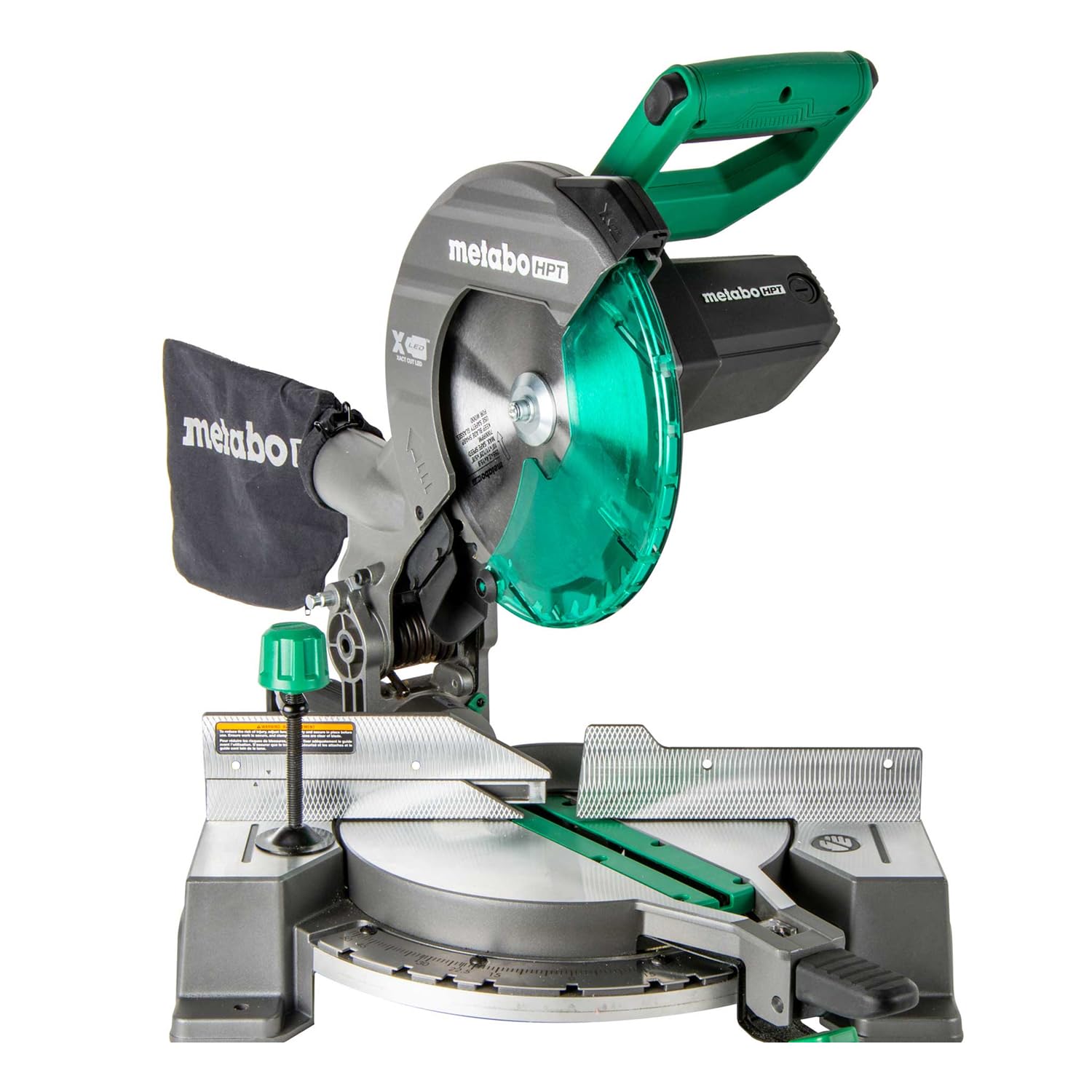
A 10-inch bench saw that crosscuts trim and lumber without hauling a heavy machine around.
The blade is a 10-inch tungsten carbide-tipped round, and the 15-amp motor drives it to a no-load speed of 5,000 rpm. That combination cuts clean through trim, baseboards, and studs. The miter range runs 0-52° left and right, and the bevel range runs 0-45° left, with adjustable stops so you can return to common angles reliably. The large 10-inch table supports longer stock, and a vice clamping system locks the workpiece down for precise, safer cuts.
Portability is the other strength: at 24.2 pounds it is light enough to lift onto a bench or into a truck bed. The design is compact for storage. Straight and beveled cuts both perform well in owner reports, with the saw handling 4x4s and 2x6s without complaint. For a first miter saw, it is easy to set up and forgiving to learn on.
Adjustability and durability land in mixed territory — the stops are good, but fine-tuning the angle takes some patience. The 5-year warranty is the safety net worth noting. Expect to spend a little time tramming the fence to your square before your first precision cut.
Light but capable: A 24.2-pound body, 15 amps of power, and a 5,000 rpm blade that handles trim and framing stock alike.
Give it a tune-up: Fine angle adjustment rewards patience, so square the fence before cutting joinery.
Suits the trim carpenter: Pick this if you need repeatable crosscuts and 45° bevels on a bench that moves around.
Skip if: You need a sliding saw for wide stock — this one is not a slider.
8. VEVOR Thickness Planer Two-Blade 12″
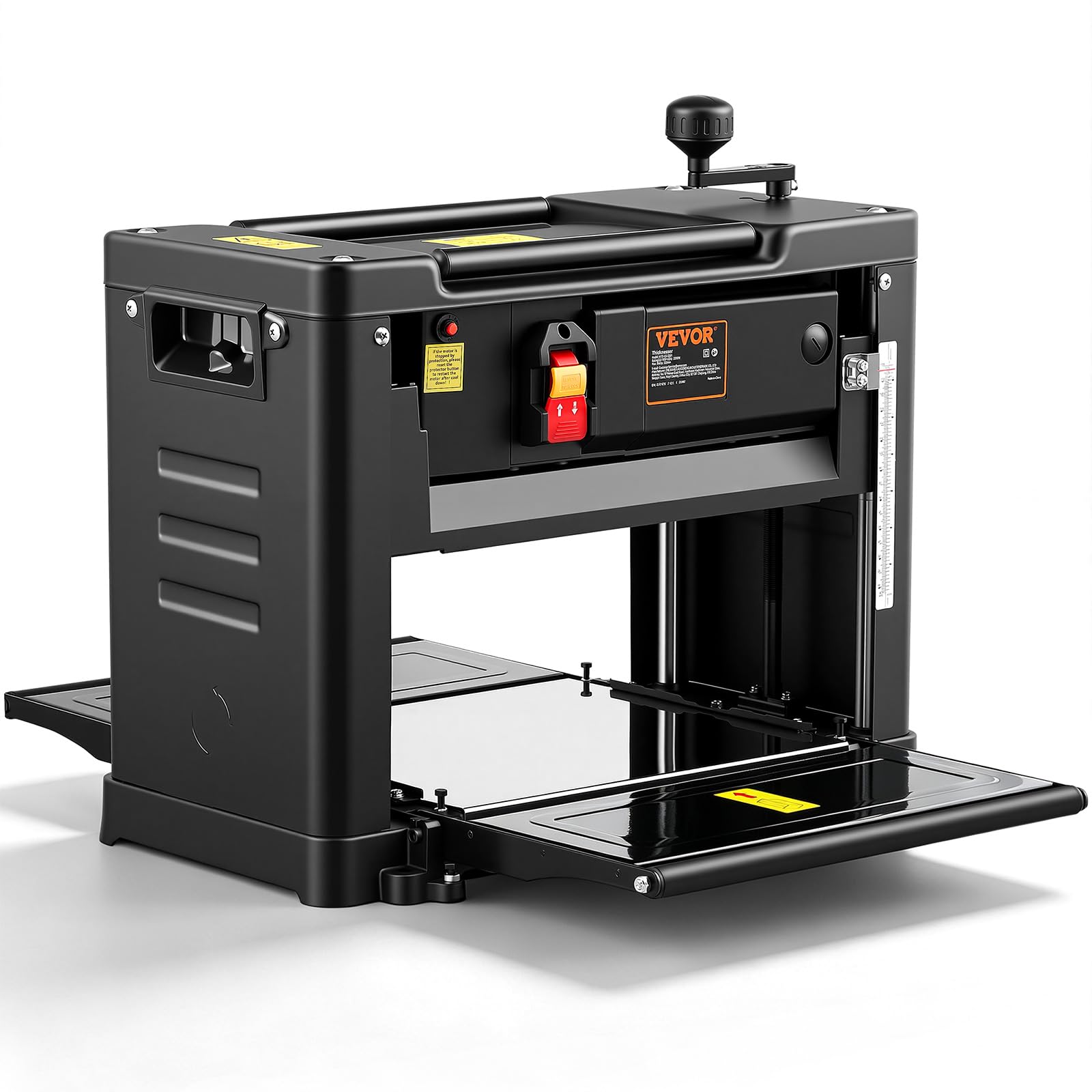
Rough lumber goes in and a flat, even board comes out — on a bench, not a floor stand.
Planing turns twisted, rough-sawn stock into a board you can actually build with. This machine takes boards up to 6 inches thick and 13 inches wide, and the pull-out extensions add up to 35 inches of total table length so a long board does not tip off the end. The precision-machined cast iron bed and steel plate keep the board flat through the cut. The 23500 rpm two-knife cutter head runs blades hardened to HRC55-60, a measure of steel hardness that holds an edge through long runs.
The 15-amp, 2000-watt motor does the heavy material removal, and a built-in 20A over-current protector cuts power if the load climbs too high. A vacuum port connects to a shop vac to carry chips away from the cutter head.
The honest note is material removal — it draws mixed feedback, so take shallow passes rather than forcing a thick cut. That is normal for a two-blade benchtop planer, and patience here gives you a far better finish. At 54 pounds it stays put on the bench, so find it a permanent home.
Real capacity on a bench: 13-inch width and 6-inch thickness with 35 inches of supported table, driven by a 2000W motor.
Take light passes: Material removal is where expectations and reality meet, so set a shallow depth and let the machine work.
For the rough-stock builder: Choose it if you buy sawn lumber and need to flatten it before building.
Not a finish-planer: If you want glass-smooth surfaces in one pass, a spiral head will serve you better.
9. WEN PL1326 15-Amp 13-Inch Spiral Benchtop Thickness Planer

Twenty-six staggered blades turn a rough board into a smooth one without a fight.
The cutter head is the story. Instead of two knives, this planer runs 26 staggered, rotatable HSS blades (high-speed steel, a hard alloy that holds an edge) arranged around a spiral. Each blade takes a small slice, which spreads the cutting load and leaves a cleaner surface. It takes boards up to 6 inches thick and 13 inches wide, with an onboard gauge that tells you the cut depth of each pass so you know exactly how much you are removing.
The 15-amp motor produces 10,000 rpm at a 26 feet per minute feed rate, so the board moves through at a steady pace. Owners describe the operation as smooth and even, and the finish reflects that — smooth, flat surfaces come off the bed. It is ready to use right away, and it handles four 2x4s at once without complaint. Snipe resistance gets specific praise, which is a real concern on a benchtop planer where the board can dip at the entry and exit. A depth stop and an adjustable dust port are included.
This is the premium planer here, and the price reflects the spiral head. The cast iron base and 15-amp motor put it in a different class than the two-knife VEVOR. If you plane a lot of figured or expensive hardwood and want a clean surface without sanding forever, the extra spend pays back in finish quality. For occasional rough-stock flattening, the two-blade machine covers the job.
Why the spiral head wins
- 26 staggered HSS blades for a smooth, even surface
- Handles boards to 6 inches thick and 13 inches wide
- Onboard depth gauge and strong snipe resistance
What it costs you
- Premium tier compared with a two-knife benchtop
- Cast iron base is heavy for a bench-top machine
For the finish-focused woodworker: Reach for it if you plane figured or pricey hardwood and want a clean surface straight off the bed.
Overkill if: You only occasionally flatten rough stock — a two-blade planer handles that job for less.
Know the Specs
RPM vs OPM: what the number measures
RPM means revolutions per minute — how fast a router or planer cutter spins. OPM means oscillations per minute — how many back-and-forth sweeps an oscillating multi tool makes each minute. A router spinning at 25500 rpm turns a bit far faster than a multi tool sweeps a blade at 16,000 OPM, because the two tools cut in completely different ways. Match the number to the tool: a high-speed router needs a controlled feed, while a multi tool works best at moderate speed with a light touch.
Collet size and bit shank
A collet is the collar that grips the bit shank. A 1/4″ collet takes the slim shank most trim bits use; a 3/8″ collet takes a stouter shank for deeper cuts. The WORKPRO kit ships with both, while the DEWALT and CRAFTSMAN routers use the common 1/4″ size. On a deep cut in hardwood, a thicker shank flexes less, which keeps the cut cleaner.
Soft start and electronic brake
Soft start ramps the motor up gradually instead of jolting it to full speed, so the tool does not jump when you pull the trigger. An electronic brake slows the cutter after you release it. Both make a router calmer to handle, especially on a small trim bit where control matters most.
Planer capacity and cutter head
Capacity tells you the widest and thickest board the planer will accept. A two-knife head is simple and durable, while a spiral head with many staggered blades takes lighter cuts and gives a smoother finish. The bed matters too — a machined cast iron bed helps a long board stay flat all the way through.
Common Questions
Can a cordless router replace a corded one for regular shop work?
Will the TEENO router bits fit other 1/4-inch routers?
Is a spiral-head planer worth it over a two-knife planer?
Can the Metabo HPT miter saw cut a 2×6 or a 4×4?
What is the difference between RPM and OPM on a multi tool?
Do the cordless tools come with batteries and a charger?
How much board can the thickness planers take in one pass?
What does a plunge base do that a fixed base cannot?
Why is a brushless motor better in a cordless router?
Do I need a router and a miter saw and a planer for a home shop?
The Bottom Line
The strongest all-round pick for the wood power tools shelf is the DEWALT 20V Max XR Cordless Router — 4.5+ stars from a deep base of owners, a brushless motor that holds speed, and a soft start and brake that make it calm to handle. If you want the most kit for the money, the TEENO router bundles 15 bits and hits 33000 rpm. And for flattening rough lumber, the WEN PL1326 spiral planer gives you the smoothest finish of the two planers here.
The honest nudge: if you are building a shop from scratch, buy the DEWALT drill and driver kit first with the included batteries and charger, then add the router.
How we choose
We do not accept paid placement. Every pick is matched to a real buyer and a real use-case; we do not hands-on test units.
Sources
Specifications: manufacturer listings and product documentation. Review insights: verified customer reviews, as of November 2026. Pricing: not shown on this page (it changes often); check the current price via the retailer link.
As an Amazon Associate, Tactical Gear Guy earns from qualifying purchases. This does not affect which products we feature.