Specs are compiled from manufacturer listings and verified buyer reviews and can change over time — please confirm the key details on the product page before buying.
You want one stove that keeps a whole floor warm without you babysitting a hopper every few hours. The short answer: the Freedom Stoves Independence PS21 is the pick that gets the most right for most homes — it heats up to 1,800 sq ft at 34,700 BTUs (British thermal units, a measure of heat output) and still runs when the power lines go down. The next question every pellet buyer asks is how big the hopper should be, and the answer depends entirely on how many rooms you are trying to hold at temperature.
This guide is built by comparing the manufacturers’ published specifications and the patterns across verified customer reviews, so you get each pick’s real strengths and trade-offs instead of marketing spin.
Below you will find the venting layouts, hopper sizes, BTU ratings and blower designs that actually change how a stove lives in your home, ranked so the right one is easy to spot. Every pick here is a genuine wood pellet burner, chosen and ordered to make your shortlist of the best Wood Pellet Heating Stoves genuinely simple.
Top Picks
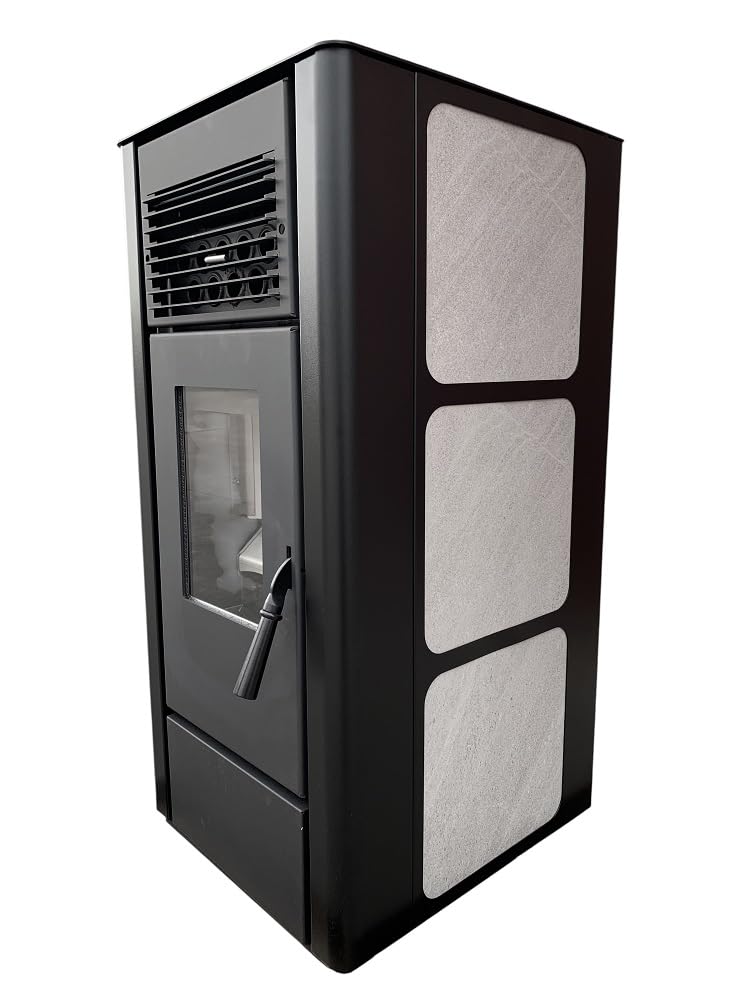
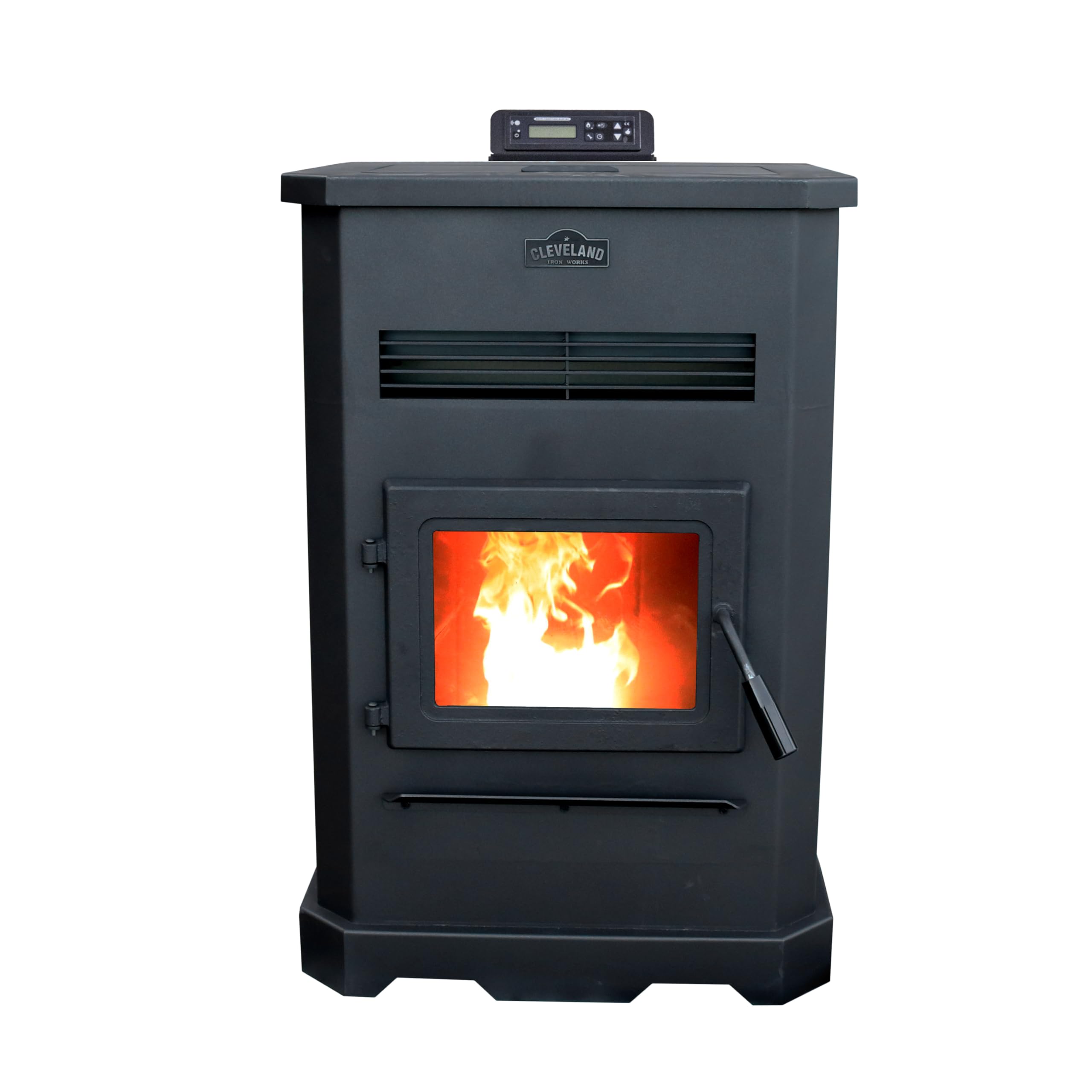
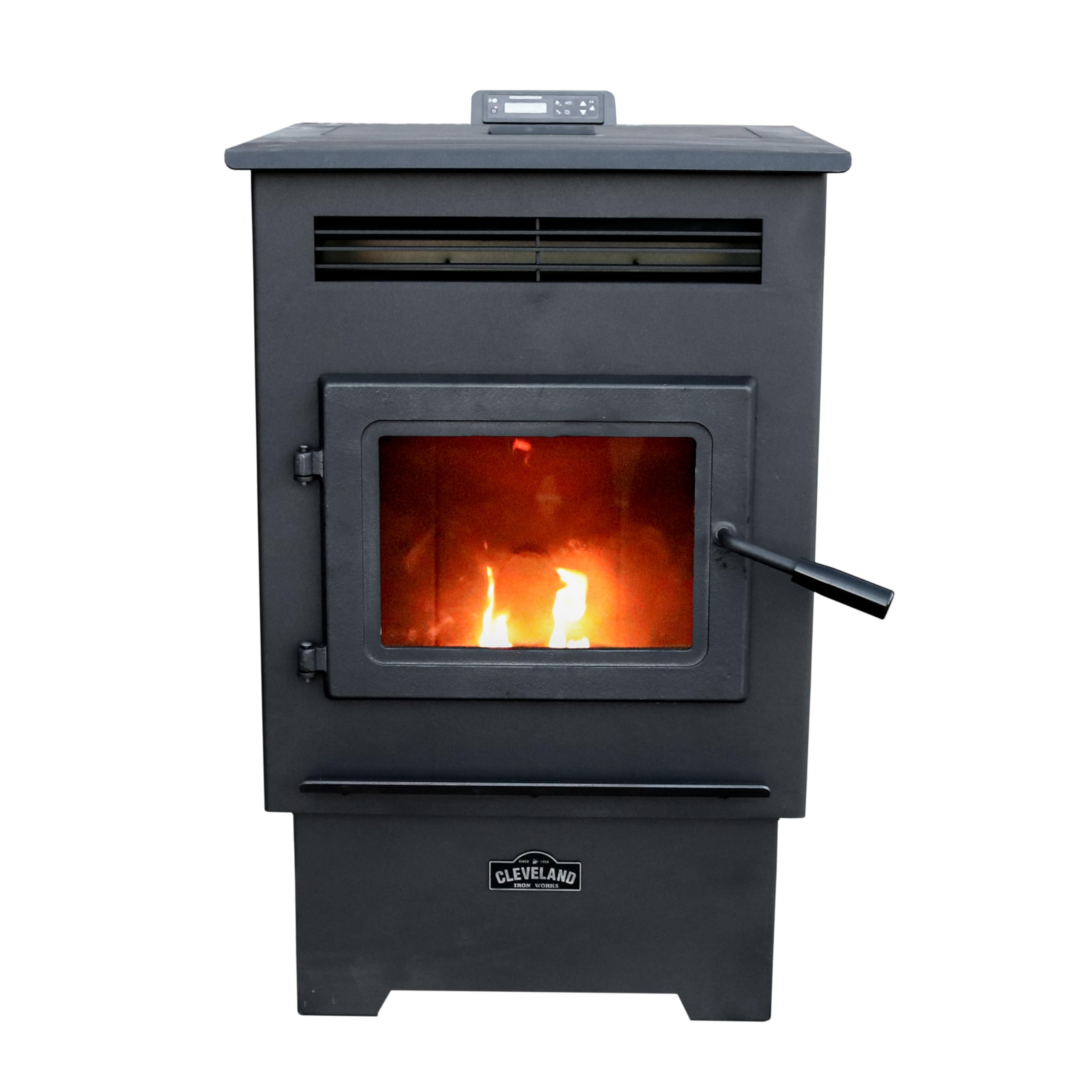
How To Choose The Best Wood Pellet Heating Stoves
A pellet stove is a space heater that feeds itself. You fill a hopper with bagged wood pellets, an auger screws them into a burn pot, and a blower pushes the heat into the room. That single sentence explains almost every buying decision you are about to make. The real work is matching three numbers to your house: how much heat you need, how long you want between refills, and how the unit behaves when the electricity cuts out.
Match BTU output to the rooms you actually heat
Manufacturers rate stoves in BTU per hour, which is simply a measure of heat energy delivered per hour. A stove rated at 42,370 BTU per hour is built for a large open floor plan. One rated at 26,224 BTU per hour suits a cabin, sunroom or workshop. Square-footage claims assume normal outside temperatures and reasonable insulation, so treat them as a ceiling rather than a promise. An open stairwell or a vaulted ceiling will eat into that coverage quickly.
Hopper size sets your daily routine
This is the spec that most changes how the stove feels in your life. A 25 lb hopper is a constant chore on cold days. A 130 lb hopper swallows roughly three bags of pellets at a time, which is the difference between topping up once a day and topping up every few hours. If you work long shifts or travel, buy the biggest hopper your budget reaches.
Venting and power outage behavior
Most auto-ignition stoves use 3-inch pellet venting, a standard metal pipe system that exits through a wall or roof. Non-electric designs like a gravity-feed stove need no blower at all, which means no power draw and no fan noise. Battery-backup models run an internal 24V DC (direct current, low-voltage power) system so the auger (the screw that feeds pellets into the fire) and blower keep working during an outage. None of these choices is universally better — it depends on whether silence, independence or hands-off control matters most to you.
Side-by-Side Comparison
| Model | Best For | Heat Output | Coverage | Hopper | Amazon |
|---|---|---|---|---|---|
| Freedom Stoves Independence PS21★ Best Overall | Whole-home heating with outage backup | 34,700 BTU | 800–1,800 sq ft | — | Amazon |
| Cleveland Iron Works PS130WBiggest Hopper | Long burn times in a big space | 29,501 BTU | 2,000–3,000 sq ft | 130 lb | Amazon |
| Cleveland Iron Works PS60WSmart Mid-Size | Mid-size homes on Wi-Fi control | 30,124 BTU | 1,500–2,200 sq ft | 60 lb | Amazon |
| Castle Serenity 41278 | Scheduled, programmable warmth | 32,000 BTU | 1,500 sq ft | 40 lb | Amazon |
| Canyon Lodge C130W | Quiet operation in a large room | 29,501 BTU | 2,000–3,000 sq ft | 130 lb | Amazon |
| ComfortBilt HP42 Alpine | Maximum coverage from one unit | 42,370 BTU | 2,800 sq ft | 120 lb | Amazon |
| ProPel PP70 | Best stated fuel efficiency | 42,500 BTU | 2,000 sq ft | 70 lb | Amazon |
| ComfortBilt HP50S | Slim footprint, long burn | 41,000 BTU | 2,200 sq ft | 47 lb | Amazon |
| Cleveland Iron Works PSBF66W Bay Front | Fireplace-style looks with Wi-Fi | 30,173 BTU | 1,800–2,500 sq ft | 66 lb | Amazon |
| ComfortBilt HP40 Alpine | Small cabins and workshops | 26,224 BTU | 1,500 sq ft | 25 lb | Amazon |
| US Stove GW1949 Wiseway | No-electricity, silent operation | 40,000 BTU | 2,000 sq ft | 60 lb | Amazon |
Detailed Reviews
1. Freedom Stoves Freestanding Independence PS21 Pellet Stove
Our pick — 4.0+★ from 60+ verified ratings; the strongest balance of quality and price.
The one stove here that keeps feeding pellets when the grid goes dark.
Storm season is the reason this stove sits at the top. It runs on two 12V batteries (sold separately) through a 24V DC system that delivers over 40 hours of runtime, so your heat source does not quit the moment the power does. That is a different class of resilience from a stove that simply restarts itself when the electricity returns. It also pushes 34,700 BTUs through a stacked tube heat exchanger, a finned metal core that pulls more warmth out of the exhaust before it leaves the flue.
Everyday control is unusually thorough for this bracket. There is a built-in touchscreen, a mobile app and a remote, plus the option to swap the side panels for any standard 12×12 tile if you want the Sandstone Grey finish to match a hearth wall. Owners describe it lighting in about four minutes, fast enough to make a morning fire feel like flipping a switch. The do-it-yourself angle is real too: it is designed for easy cleaning and repair, and it carries a 5-year limited warranty with U.S.-based support.
The catch is power independence costs you. Two batteries are extra, and the 800-to-1,800 sq ft coverage range means a wide-open great room sits right at the edge of what it can hold. If your home is genuinely large, the ComfortBilt HP42 covers 2,800 sq ft at 42,370 BTU per hour — a full tier above this stove on paper. For a normal house with a storm-prone winter, though, the trade favors the Freedom.
What earns it first place
- Over 40 hours of battery runtime through the 24V DC system
- 34,700 BTUs across 800 to 1,800 sq ft
- Touchscreen, app and remote all included
- Swappable 12×12 tile panels for a custom surround
- 5-year limited warranty with U.S. support
Where it asks more of you
- Batteries are sold separately, so budget for two 12V units
- Large open floor plans push past its coverage ceiling
Reach for this if: you lose power often and want heat that survives the outage without a generator.
Look elsewhere if: you are heating more than 1,800 sq ft in one open space.
2. Cleveland Iron Works Large Pellet Stove – 130lb Hopper
Three full bags of pellets disappear into this hopper and you go back to your life.
A 130 lb hopper is the whole story here, and it is a big one. Owners talk about loading three whole bags at once and walking away, which is the difference between a stove that fits a working schedule and one that demands attention twice a day. Set that against the ComfortBilt HP40’s 25 lb hopper and you are looking at a 130 lb versus 25 lb gap — a 5.2x difference in how much fuel sits ready. The 2,000 to 3,000 sq ft coverage and 29,501 BTU rated output put it firmly in whole-floor territory.
The build is cast iron, which gives the firebox some mass and a more traditional hearth look than thin steel. Wi-Fi is built in rather than bolted on as an accessory, so scheduling lives on your phone. Buyers talk most about how well it works day to day and how fast it warms a cold house.
One thing to plan for: cast iron is heavy machinery. At 209.4 lb you will want a second set of hands and a clear path to the hearth before delivery day. It is not a stove you move around on a whim.
The daily-routine payoff: fewer refills than almost anything in this lineup, at a lower BTU rating than the big ComfortBilt units.
Weight to plan around: 209.4 pounds of cast iron needs a proper delivery plan and a solid floor.
Best matched to: a busy household heating a large, semi-open floor where the stove sits as the main heat source.
Think twice if: you want a light unit you can reposition seasonally.
3. Cleveland Iron Works Medium Pellet Stove – 60lb Hopper
The middle child that quietly does the whole-house job at 30,124 BTUs.
This is the sensible size for a normal suburban home. It covers 1,500 to 2,200 sq ft at 30,124 BTU, which lands between the small-cabin ComfortBilt HP40 and the oversized HP42. The 60 lb hopper is a step down from the 130 lb monster above, but it is still roughly double what a compact stove holds. Cast iron construction and built-in Wi-Fi round out the package.
Buyers report it running well even on soft wood pellets, a practical detail if your local supplier stocks a softer blend. They also mention it holding a steady temperature rather than swinging hot and cold, and the installation reads as straightforward on most accounts. That consistency matters more than peak output once the novelty of a new stove wears off.
The honest limit: 60 lb is a middle-ground hopper, not a long-weekend hopper. If you leave for a few days in deep winter, someone needs to top it up or you come home to a cold house.
What it gets right: a genuine mid-size coverage band and steady temperature control from a cast iron body.
The reminder: at 60 lb you are still refilling every day or two in hard cold.
A good fit for: a 1,500-to-2,200 sq ft home where the stove is one of two heat sources.
Not the one if: you need a hopper that stretches across a week away.
4. Castle 41278 Serenity Pellet Stove

Manual, thermostat, weekly and eco modes — a stove that works a schedule like you do.
The programming here is the standout. You get manual, thermostat, weekly and eco operating modes, all reachable from the included remote. Eco mode does something genuinely useful: it toggles the stove between on and off to hold your target room temperature rather than burning at a fixed rate. If your week has a predictable shape — up at six, out by eight, home by six — the weekly mode lets you write that pattern once and stop thinking about it.
Cleaning is designed to be simple, with no tubes, corrugations or hidden chambers tucked behind the firebox. It heats 1,500 sq ft at 32,000 BTU, so it sits comfortably in the mid-size bracket, and owners mention the installation is easy and the heat output is serious enough to make a room feel properly warm. It runs on 77 watts at 120 volts, which is a modest draw.
The auger is the one part worth watching. The feed mechanism cycles to drop pellets into the burn pot, and at least one report flags it cycling only 3-4 times, which points to a feed hiccup rather than a design flaw. Keep the burn pot and auger clear as part of your routine and the rest of the stove rewards you.
Where it shines: four real operating modes and a remote that controls all of them.
Worth knowing: the auger feed cycle is the component that occasionally needs attention.
Ideal for: anyone who wants set-and-schedule heating rather than manual tinkering.
Skip the schedule idea if: your routine changes daily and thermostat mode is all you need.
5. Canyon Lodge Large Pellet Stove
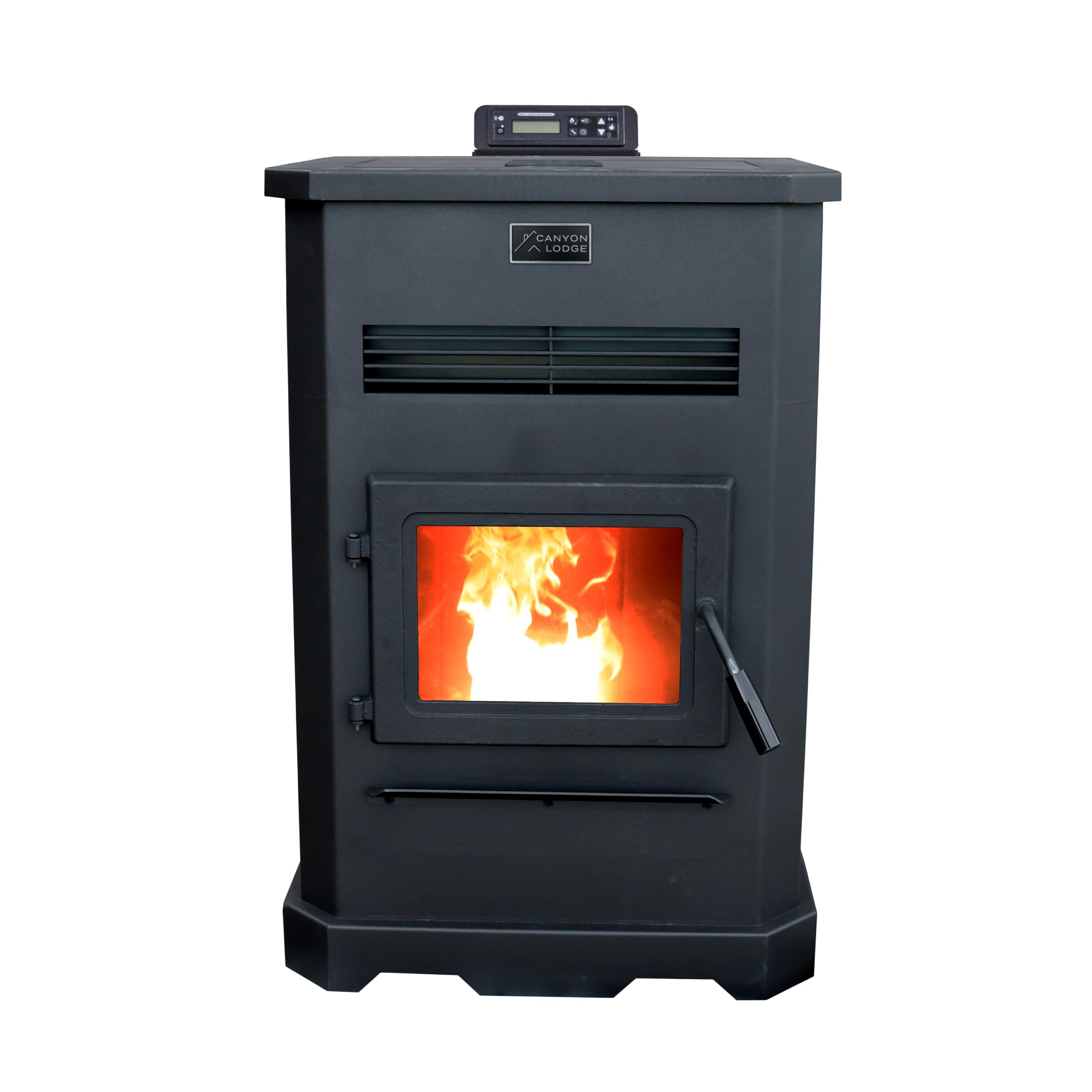
A 130 lb hopper paired with a blower you can sit next to without raising your voice.
Whisper Quiet Blower Technology is the phrase worth circling. Most pellet stoves work fine but hum along with a constant fan whine, which matters if the unit lives in the room where you watch television or read. This one is built around a quieter blower, and it holds a 130 lb hopper and 2,000 to 3,000 sq ft of coverage alongside that. It also has a steel fire pot, a large air-washed viewing glass, automatic ignition and EPA approval.
Mobile home approval and an included fresh air kit are practical bonuses that widen where it can legally go. The air wash system is the little detail that keeps the glass clear by directing air across the inside of the door, so you are not scraping soot off to see your fire. Owners call it good quality that functions exceptionally well, with enough heat to warm a whole house from a basement install.
Note the weight: at 209.4 lb it is a serious piece of equipment to move into place. Plan the delivery and the path before it arrives.
Its strongest card: a quiet blower in a large-capacity stove — a combination that is not common at this size.
The setup cost: 209.4 lb of steel needs muscle and a planned install route.
Built for: living spaces where the stove shares the room with conversation and the TV.
Worth a second look if: your priority is the lowest BTU-per-dollar rather than quiet operation.
6. ComfortBilt HP42 Alpine Pellet Stove
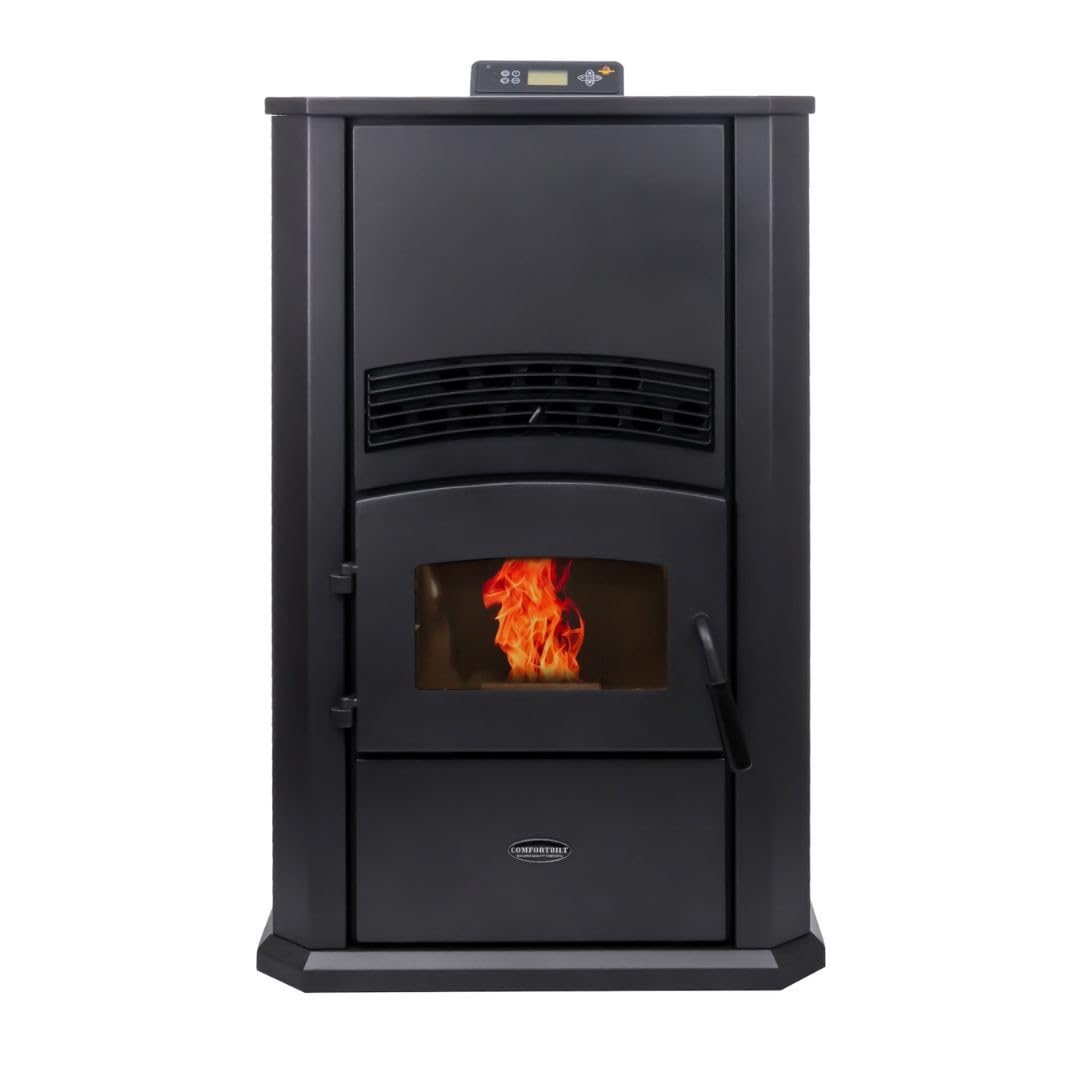
The biggest number on this page: 2,800 sq ft at 42,370 BTU per hour.
On paper nothing here heats more space. The HP42 covers 2,800 sq ft at 42,370 BTU per hour, which is 87% more coverage and 62% more heat than the smaller ComfortBilt HP40’s 1,500 sq ft and 26,224 BTU. Its 120 lb hopper supports up to 24 hours of continuous operation at 87.5% efficiency, and there are five power settings, a programmable thermostat, a remote and auto ignition. The oversized firebox means a substantial 30″D x 30″W x 46″H footprint, so measure your hearth before you commit.
Here is the honest part. The spec sheet is impressive; the reliability record is not as clean. Reports describe units that will not run for more than 12 hours, and there are accounts of breakdowns within the first few months. That is the trade-off with a stove pushed to this output — more moving parts under more stress. Weigh it against the 2,800 sq ft coverage that almost nothing else here matches.
If you need this much heat and want the smoother reliability story, the Cleveland Iron Works 130 lb stove covers 2,000 to 3,000 sq ft at a lower 29,501 BTU. If raw ceiling coverage is the goal, the HP42 is the one that delivers it — with the caveat that you should buy from a seller with a clear return path.
Why the spec sheet reads so strong
- 2,800 sq ft coverage at 42,370 BTU per hour
- 120 lb hopper with up to 24 hours of continuous run
- 87.5% efficiency and EPA plus CSA certification
- Five settings, programmable thermostat and remote included
The trade you accept
- Reliability reports are mixed — some units fail to run a full day
- A 30″D x 30″W x 46″H footprint demands real hearth space
Worth it for: a large open home where coverage is the deciding spec and you can accept some risk.
Less suited to: buyers who want the calmest reliability story and can trade away coverage to get it.
7. ProPel PP70 Pellet Stove
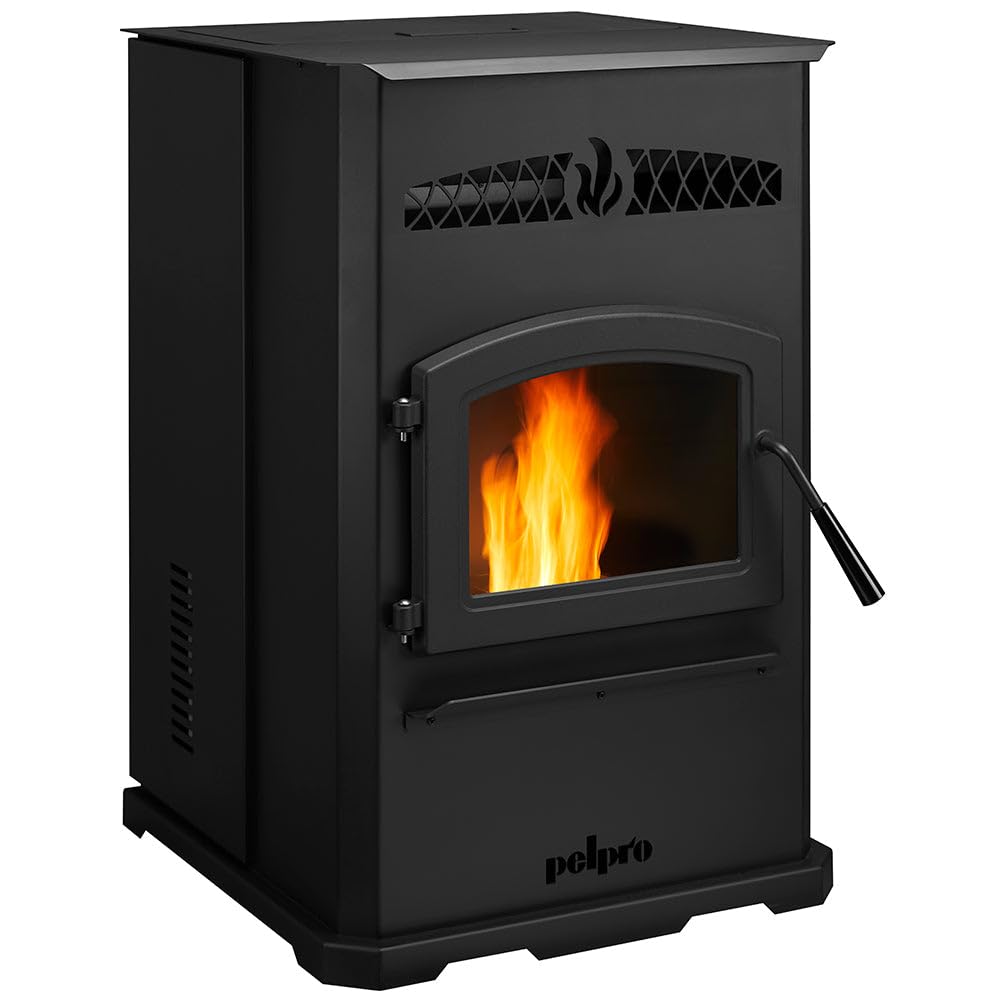
88.5% efficiency is the number that turns pellets into heat instead of exhaust.
Efficiency is where this stove makes its case. The PP70 is EPA-certified at 88.5% efficiency, which literally means more of the fuel’s energy ends up in your room and less goes up the vent. It delivers 42,500 BTU across up to 2,000 sq ft, so it handles an older home, a shop, a garage, a cabin or a mobile home — a fresh air kit is included for that last case. The 70 lb hopper holds up to two days of fuel, which cuts your refill trips in half compared with a small hopper.
Controls are refreshingly physical. There is a built-in thermostat and an easy dial with 10 variable heat settings, plus a 300W auto-igniter that lights the fire for you and a quiet variable-speed blower that scales its fan speed to the heat setting. It measures 22″ wide, 33″ high and 22″ deep, which is a compact footprint for this output class, and it is made in the USA.
The note to weigh: a high-efficiency stove is tuned for consistent fuel, so feed it clean, dry, quality pellets and it will reward you. Cheap damp pellets are the usual reason efficiency numbers slip in the real world.
The efficiency argument: 88.5% EPA-certified at 42,500 BTU, with a dial that gives you 10 heat settings instead of a menu.
The fuel caveat: high efficiency depends on dry, consistent pellets — keep your stash covered.
Pairs well with: a shop, cabin or older home where squeezing heat from every bag matters.
Consider another pick if: you want a larger hopper than 70 lb for longer unattended runs.
8. ComfortBilt HP50S Pellet Stove
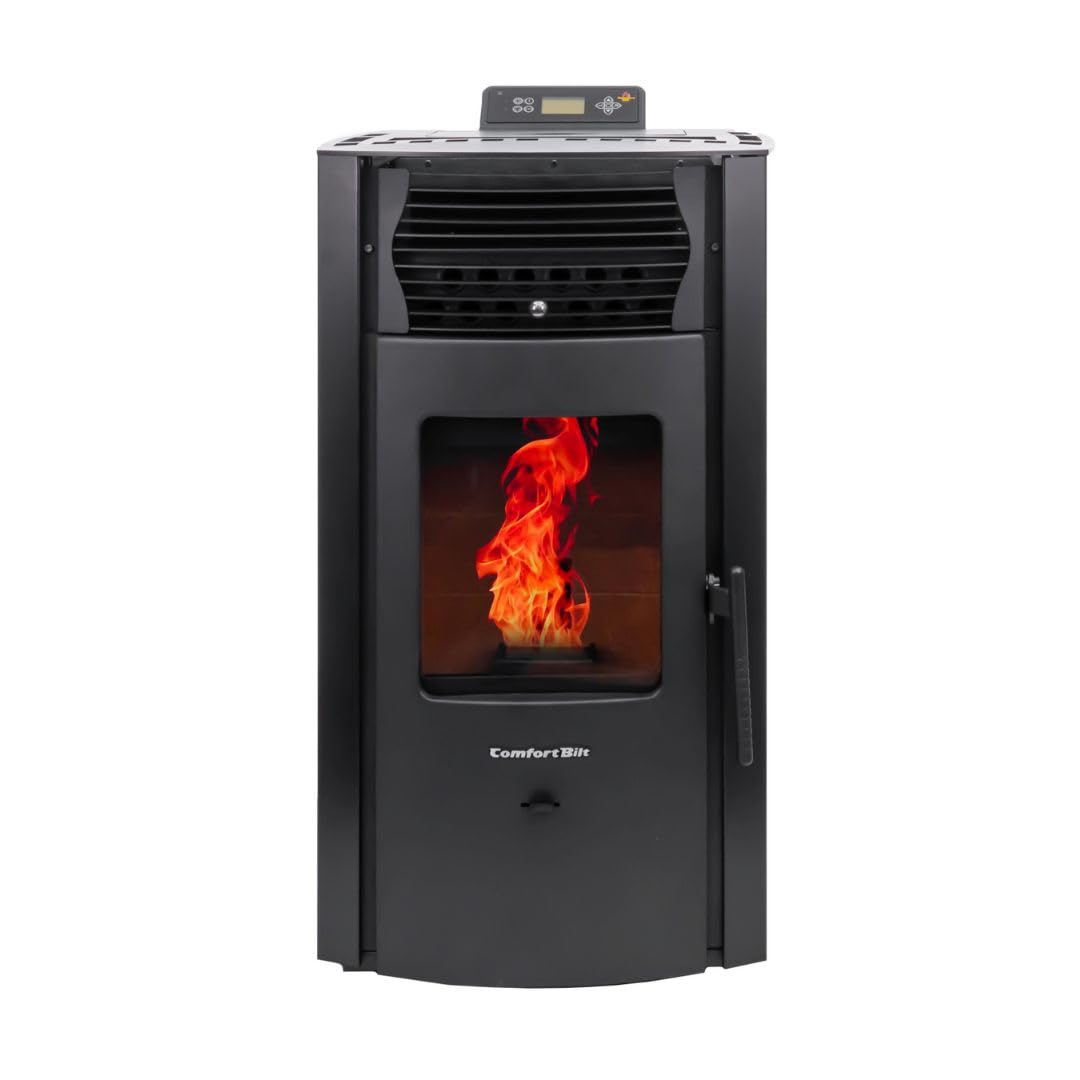
A narrow footprint that still manages 23 hours of burn on one fill.
The HP50S is built for tight spaces. It heats up to 2,200 sq ft at 41,000 BTU per hour, and its 47 lb hopper stretches to up to 23 hours of burn time. That burn-time figure is the one to focus on — nearly a full day of heat from a hopper barely more than half the size of the 120 lb units. The slim, space-friendly design fits homes, cabins, basements and workshops where a wide stove would crowd the room.
You get five power settings, a programmable thermostat, a remote and auto ignition, plus EPA and CSA certification and a powerful room blower with a removable ash pan. Customers note real measurable warmth: a jump from 54 F to 64 F in three hours on the low setting. On the flip side, the durability story is mixed, with the auger feed stopping in at least one account — the same component to keep an eye on with any auger-fed stove.
For a basement or workshop where space is tight and you want a long unattended burn, this is a strong fit. For a large main living area, the wider Canyon Lodge covers more floor.
The space-saving win: 41,000 BTU and up to 23 hours of burn in a deliberately slim body.
Keep an eye on: the auger feed is the part that needs occasional attention.
Made for: basements and workshops where a narrow stove earns its floor space.
Not the best match for: a broad living room needing maximum radiant coverage.
9. Cleveland Iron Works Bay Front Pellet Stove

The bay-front glass makes this the one you would actually want on show.
Bay-front glass angles the fire view outward, so the flame reads as a feature rather than a furnace door. Cast iron construction backs that up. It heats 1,800 to 2,500 sq ft at 30,173 BTU with a 66 lb hopper, and it qualifies for the 30% IRS Biomass Stove Tax Credit — a paperwork detail worth chasing if you are installing this year. Wi-Fi is built in, and there is a digital control panel plus a remote in the box.
What owners notice first is how quietly it runs and how well it holds temperature — it comes on automatically when the room drops below your set point. Installation gets mixed reports, with some finding it simple and some wishing the instructions were clearer, so plan for a professional if you are not comfortable with venting work. Value and cleaning ease are the other two points buyers split on.
Flame control is the item that draws the least love, and it is worth accepting that this stove is more about comfort and looks than fine-tuning a dramatic fire picture. For the room you actually sit in, that is usually the right trade.
The visual hook: a bay-front glass window plus built-in Wi-Fi and cast iron construction.
Be ready for: instructions that some find thin, and a thermostat-first flame rather than an artful one.
Choose it if: the stove sits in your main living space and you want it to look the part.
Pass over it if: you demand complete DIY documentation or precise flame manipulation.
10. ComfortBilt HP40 Alpine Pellet Stove

Small stove, small hopper — the one built for a cabin, sunroom or shop.
This is the entry point to the ComfortBilt line and it makes no apology for being compact. Coverage is 1,500 sq ft at 26,224 BTU per hour with a 25 lb hopper and 81% efficiency. The Alpine design fits into a cabin, sunroom, garage or workshop where a full-size stove would dominate the floor. It is also the lightest of the ComfortBilt pair at 167 lb, against the HP42’s 275 lb — and much smaller at 21″D x 17″W x 30″H versus 30″D x 30″W x 46″H.
You still get five power settings, a programmable thermostat, a remote, auto ignition and EPA plus CSA certification with a powerful room blower and removable ash pan. Reviewers point out it heats the house effectively. Trust the spec for what it is: at 26,224 BTU this is a space heater for a defined area, not a whole-home furnace.
The real limitation is the 25 lb hopper. That is a refill every few hours in cold weather, so if you want the stove to run overnight unattended you will quickly wish for the 130 lb Cleveland Iron Works instead. For a cabin you visit in weekends or a workshop you heat in bursts, the smaller hopper is a fair trade for the cost and footprint.
The size advantage: 167 lb and a compact 21″D x 17″W x 30″H body that tucks into a corner.
The hopper reality: 25 lb means frequent top-ups during a cold snap.
Right for: a defined single space like a cabin, sunroom or workshop where the stove does one job.
Wrong pick if: you expect overnight unattended burns without checking on it.
11. US Stove GW1949 Wiseway Non-Electric Pellet Stove

No blower, no auger motor, no power cord — just a gravity feed and a fire.
This stove sidesteps electricity almost entirely. A natural gravity feed system drops pellets down through the burn chamber using nothing but physics, so there is no auger motor to fail and no blower to hum. The result is genuinely silent operation, and at 131 lb it is roughly half the weight of the 275 lb ComfortBilt HP42. It is EPA-certified, throws 40,000 BTU at up to 2,000 sq ft, and runs a 60 lb hopper for up to 30 hours.
Venting is the practical plus: it uses standard 3-inch pellet venting, so the installation hardware is common and widely available. Buyers consistently praise how easy it is to assemble and run day to day. It uses steel construction and a modern vertical profile that stands 52 inches high.
Then the honest caveats, and they are meaningful here. Heat output is questioned by some owners who say it does not cover the full 2,000 sq ft, and smoke is the reported gripe rather than fan noise. Reliability and value also split opinion, with some saying it works great and others finding it does not suit their plans. This is a stove to buy only if you understand gravity feed: it needs a proper draft and a straight flue to draw correctly.
What it does that others can’t
- Runs with zero electricity — no auger motor, no blower
- Silent operation and 131 lb total weight
- 60 lb hopper with up to 30 hours of burn
- Takes standard 3-inch pellet venting
Where it gets complicated
- Some owners question whether it truly covers 2,000 sq ft
- Smoke is the recurring complaint when the draft is imperfect
- Opacity on reliability and value for some installs
Suits you if: you want heat with no power draw, no noise, and a straightforward gravity setup.
Skip the idea if: you cannot get a clean, tall vent run — draft is everything here.
Know the Specs
BTU Per Hour and Square-Foot Coverage
BTU stands for British Thermal Unit, a measure of heat energy. Manufacturers list a stove’s output in BTU per hour and pair it with a square-foot rating. The pair matters more than either number alone: the ComfortBilt HP42 lists 42,370 BTU per hour and 2,800 sq ft, while the HP40 lists 26,224 BTU per hour and 1,500 sq ft. A stove with a high BTU rating but a small blower may still struggle in a vaulted room, so treat the coverage claim as the ceiling under normal temperatures.
Hopper Capacity and Burn Time
The hopper is the fuel bin that sits above the auger. Its capacity in pounds tells you how long the stove can run before you refill it. The Cleveland Iron Works 130 lb hopper holds roughly three bags of pellets, while the ComfortBilt HP40’s 25 lb hopper runs through fuel in a few hours of hard cold. Burn time also depends on heat setting — the US Stove Wiseway advertises up to 30 hours from 60 lb, while the ComfortBilt HP42 states up to 24 hours from 120 lb. More fuel capacity almost always means less daily work for you.
Efficiency Ratings Explained
Efficiency is the percentage of fuel energy that becomes room heat instead of exhaust. Higher numbers mean you get more warmth from the same bag of pellets. The ProPel PP70 is EPA-certified at 88.5%, and the ComfortBilt HP42 states 87.5% efficiency. These are measured figures under controlled conditions, so your own results depend on pellet quality, venting and how well the room holds heat.
Venting, Auto Ignition and Battery Backup
Most modern pellet stoves use 3-inch pellet venting, a metal pipe system that carries exhaust out through a wall or roof. A fresh air kit brings combustion air in from outside, which matters for tight modern homes and mobile homes. Auto ignition uses a heated element to light the pellets for you. Battery backup is different again: the Freedom Stoves PS21 runs a 24V DC system on two 12V batteries for over 40 hours, so the auger and blower keep working during an outage. Decide which of these three really matters for your setup before you buy.
Common Questions
How many square feet will a pellet stove actually heat?
How long does a 60 lb hopper last on a pellet stove?
Do these pellet stoves work during a power outage?
What venting does a pellet stove need?
Is a gravity-feed pellet stove better than an auger-fed one?
How much does it cost to run a pellet stove compared with other heat sources?
Can I put a pellet stove in a mobile home or basement?
What is a biomass stove tax credit and do any of these qualify?
How do I stop smoke coming back into the room?
Do I need to clean the glass and firebox often?
The Bottom Line
For most buyers, the wood pellet heating stoves winner is the Freedom Stoves Independence PS21. It balances 34,700 BTUs and 800 to 1,800 sq ft of coverage with a battery backup that keeps heat running through an outage, and it adds touchscreen, app and remote control for good measure. If you want the biggest fuel bin on the list, grab the Cleveland Iron Works 130 lb stove, which swallows three bags at once. And for the largest single-unit coverage, the ComfortBilt HP42 reaches 2,800 sq ft at 42,370 BTU per hour — just weigh its mixed reliability reports before you commit. The Freedom remains the pick that gets the everyday balance right, which is why it holds the top spot.
How we choose
We do not accept paid placement. Every pick is matched to a real buyer and a real use-case; we do not hands-on test units.
Sources
Specifications: manufacturer listings and product documentation. Review insights: verified customer reviews, as of November 2026. Pricing: not shown on this page (it changes often); check the current price via the retailer link.
As an Amazon Associate, Tactical Gear Guy earns from qualifying purchases. This does not affect which products we feature.