Specs are compiled from manufacturer listings and verified buyer reviews and can change over time — please confirm the key details on the product page before buying.
You want your screen higher, your neck straighter, and your keyboard hidden underneath — and the one thing that ruins a wood monitor riser is a shelf that sags or a leg that slides. The picks below all solve that, sorted by what they actually hold and how much desk they eat. Top of the pile is a 150-pound panel that swallows a 55-inch TV without a creak, and there are smaller, cheaper boards here for tight desks and bedroom setups.
This guide is built by comparing the manufacturers’ published specifications and the patterns across verified customer reviews, so you get each pick’s real strengths and trade-offs instead of marketing spin.
A riser only works if the load rating beats your gear and the height puts the top of your screen near eye level. That is the whole test, and every pick here clears it at a different size and budget. These are the wood monitor riser options worth putting on your desk.
Top Picks
How To Choose The Best Wood Monitor Riser
Start with what sits on top. A single monitor and a laptop need far less board than two 27-inch displays or a small TV. The load capacity printed on each riser tells you the ceiling — 44 pounds is fine for one screen, 150 pounds is TV territory.
Load Capacity Is The First Number You Check
A monitor riser holds weight in the middle of a panel, so the load rating is the spec that decides whether it stays flat. Engineered wood paired with steel legs handles far more than a thin board on short feet. Match the rating to your gear with room spare, then stop worrying about it.
Height And Inner Clearance Decide Your Posture
Riser height is the lift you get, and inner clearance is the gap underneath for your keyboard and mouse. A 5.5-inch riser with 4.1 inches of clearance clears a keyboard but not a stacked notebook. Measure from your desk to the top of your screen, then pick the height that closes that gap.
One Tier Or Two?
A single-tier board raises the screen and leaves one open slot below. A two-tier shelf adds a second level for a laptop, printer, or notebook, which matters on a small desk. Two tiers also mean more parts and more assembly, so weigh the storage against the setup time.
Side-by-Side Comparison
| Model | Best For | Load Capacity | Height | Material | Amazon |
|---|---|---|---|---|---|
| TEAMIX 31.5 inch Dual Monitor Stand Riser★ Best Overall | Full-width dual-monitor or TV setups | 150 pounds | 5.5 in | MDF Wood, Metal Leg | Amazon |
| Computer Monitor Stand with Drawer and 2 Pen HoldersBest Storage | Small desks that need drawer storage | — | 5.9 in | Alloy Steel, Plastic, Wood | Amazon |
| BONTEC Wooden Monitor Stand Riser 2-TierMost Reviewed | Two-tier storage with cable routing | 66 lbs | 5.6 in | Wood | Amazon |
| KIRIGEN Wood Monitor Stand Riser 15.39 Inch | No-tools setup in a bedroom or study | 44 pounds | 3.35 in | Solid Wood | Amazon |
| Gugsey Wood Metal Monitor Stand Riser | Height adjustability plus a drawer | — | 5.6 in | Engineered Wood, Metal, Plastic | Amazon |
| Fenge Monitor Stand Riser, Wooden & Metal | Compact workstations with a sound bar | 55 pounds | 3.9 in | Alloy Steel, Wood | Amazon |
| ROCDEER Bamboo Monitor Stand Riser with Drawer | Eco bamboo finish with hidden storage | 100 pounds | 4.4 in | Bamboo | Amazon |
| Fenge 42.5 Inch Dual Monitor Riser, Oak | Dual monitors and ultrawide screens | 99 pounds | 5.5 in | Acrylic, Engineered Wood | Amazon |
| IVE Design XL Walnut Wood Monitor Stand | Walnut finish for a two-screen studio desk | — | 4.2 in | Walnut Wood | Amazon |
Detailed Reviews
1. TEAMIX 31.5 inch Dual Monitor Stand
Our pick — 4.5+★ from 400+ verified ratings; the strongest balance of quality and price.
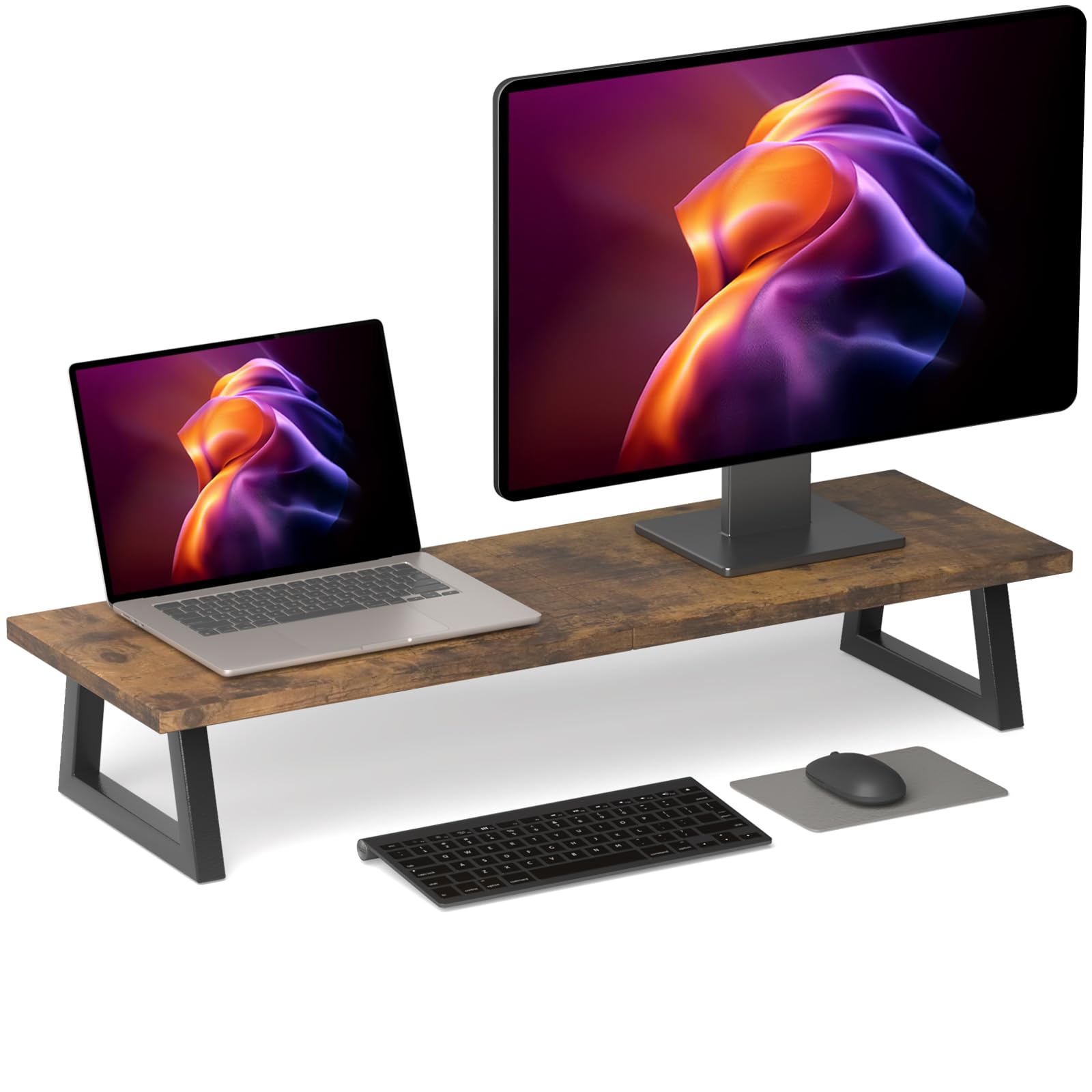
A 31.5-inch slab of wood and steel that will hold a small television without flinching.
This is the riser you buy when your gear is heavy or wide. The 31.5-inch panel gives you room for two monitors side by side, and the 150-pound load capacity means a 55-inch TV sits on it without bowing. The panel itself is MDF wood, and the legs are steel — a pairing that keeps the whole thing at 2.8 kg while still carrying that weight.
The 4.1 inches of inner clearance under the 5.5-inch rise is what you use every day. A standard keyboard slides underneath and disappears, which is exactly what owners lean on it for. Assembly takes around ten minutes with the included hardware, and the reviews back that up — the recurring theme is a stand that goes together quickly and feels solid once it is up. What wins people over is the build, with assembly close behind as the second thing they bring up.
Compare it to the KIRIGEN in this list and the gap is real: 150 pounds against 44 pounds, and 2.8 kg against 0.83 kg. That extra weight is the price of holding a TV. Think of it as a small furniture piece rather than a desk accessory — it is 31.5 x 9.45 x 5.51 inches, so it wants a desk with some length to it.
Where it earns the top slot
- 150-pound load capacity — enough for a 55-inch TV or two monitors
- 4.1 inches of inner clearance swallows a full keyboard
- Steel legs plus MDF wood keep it steady at 2.8 kg
- Assembles in about ten minutes with the included hardware
Before you commit
- 31.5 inches wide — it needs a long desk, not a corner nook
- Single tier, so storage is the one slot underneath and nothing more
Buy this one if: you are raising two monitors or a TV and want the lift to be the last thing you think about.
Look elsewhere if: your desk is short — the 31.5-inch footprint will overhang a compact station.
2. Computer Monitor Stand with Drawer and 2 Pen Holders, Wood
The one that turns the dead space under your screen into a desk drawer.
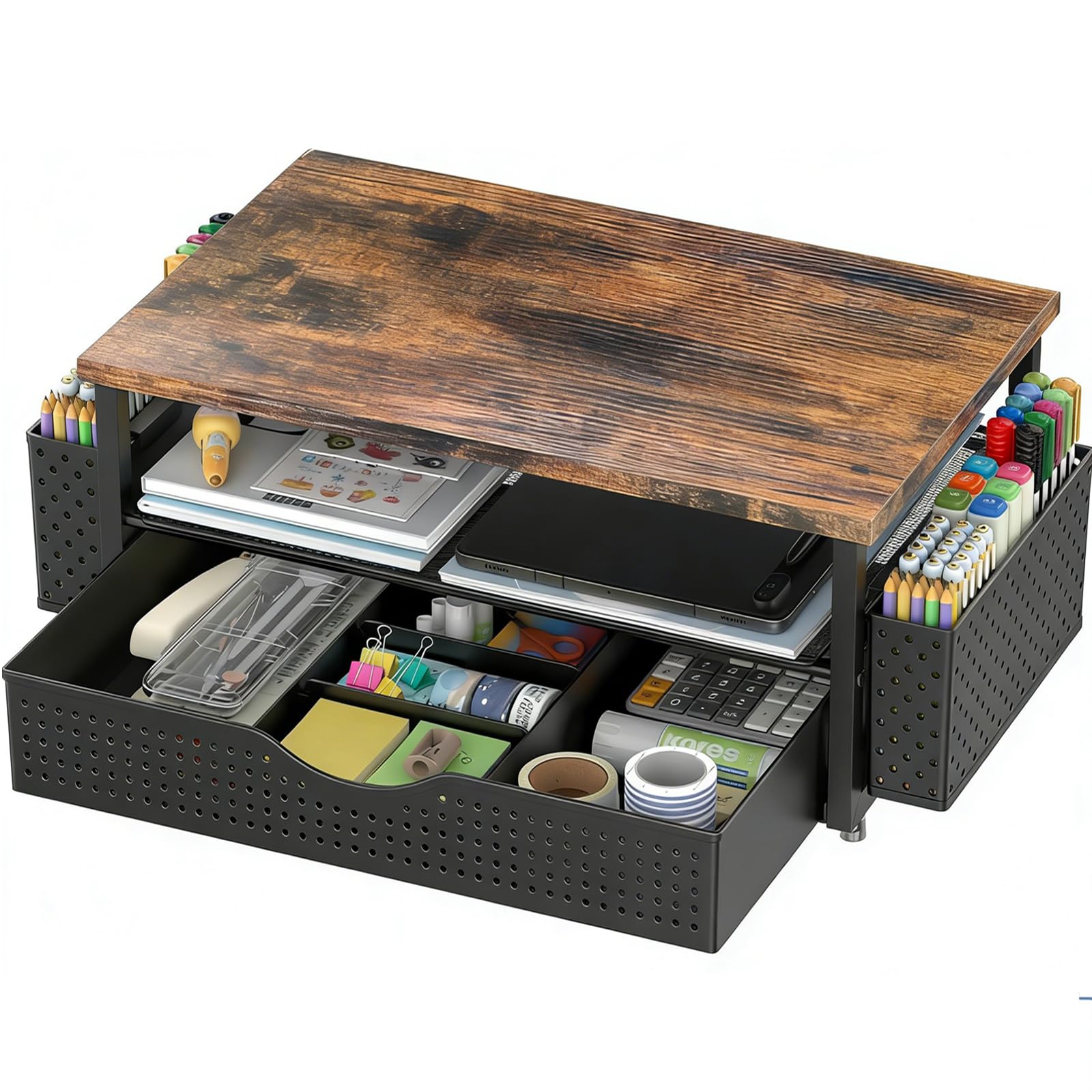
Most risers give you a gap and leave it at that. This one gives you a gap plus a pull-out drawer and two hanging pen holders, all tucked into a 14.2 x 9.64 x 5.9-inch frame. On a small desk, that is the difference between a tidy surface and a pile of clips, sticky notes, and a spare charger rolling around.
The structure is a steel pipe frame under a wood top, with the drawer and holders in thick plastic. That mix keeps the cost down and the whole thing light enough to move with one hand. Buyers report it goes together easily with clear instructions, and the gap between the shelf and the desktop is generous. What people notice first is how little desk it actually uses once everything is stowed.
At 5.9 inches it is the tallest riser on this list, so it lifts your screen the most. Pair that with the drawer and you have a compact workstation that works in a dorm or a shared office. It will not take a heavy TV — this is a monitor-and-laptop stand, not a load-bearing shelf.
The real draw: that drawer. It is the single reason to pick this over the plainer boards here, and it fits a 15-inch laptop on the top shelf while still leaving the cubby below for a keyboard.
Worth it for: small-desk users who want their supplies off the surface, not just their screen off the desk.
Keep looking if: you are raising a TV or a very heavy monitor — this one is built around a lightweight monitor and laptop setup.
3. BONTEC 2-Tier Computer Monitor Stand
Two levels, a phone slot, and a cable channel — the desk-tidying version of a riser.
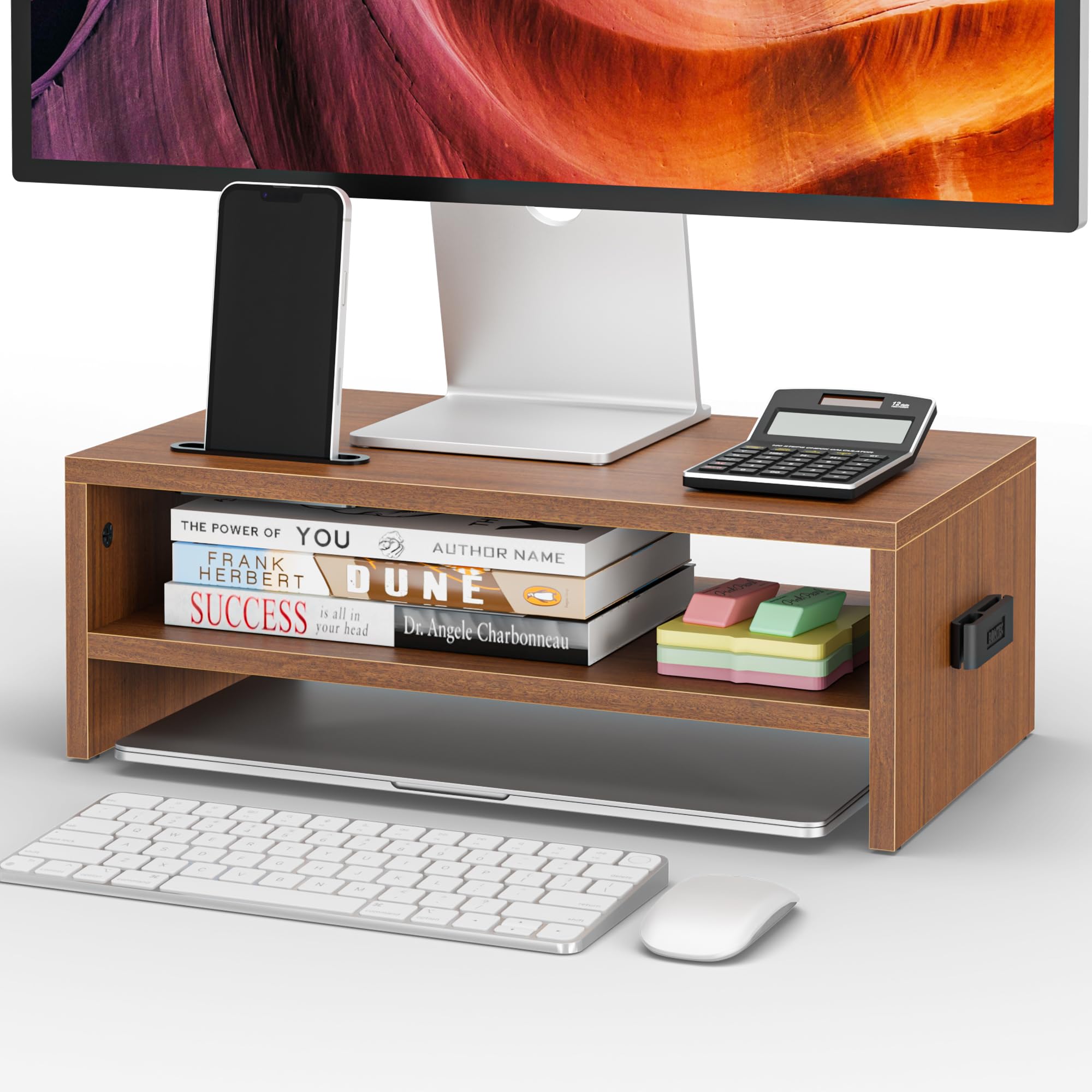
The 5.6-inch lift here is the ergonomic part, but the second tier is the reason to pick it. The top shelf takes a monitor, laptop, or small printer, and the lower space holds a keyboard, mouse, and notebook within reach. That is two levels of storage in a 16.5-inch footprint, and it is the only riser here that is genuinely two-tier at that width.
Look closely at the detail work: a built-in slot for your phone, and channels that guide charging cables and a keyboard cord away from your work area. Anti-slip pads under the base protect the desktop. The reviews praise the quality and the straightforward build, and full-size keyboards fit underneath without a fight. One thing the size counts flag as mixed is exactly what you would expect — some find it perfect for a 34-inch monitor, others find it small. Measure your screen before you click.
Against the TEAMIX, this is the storage-first choice: two levels instead of one, and a lighter 66-pound capacity instead of 150. If you are raising a single screen and want the keyboard and supplies organized rather than just hidden, this is the smarter buy.
What makes it earn its spot
- Genuinely two-tier — upper shelf plus a full lower storage level
- Phone holder and cable management built into the design
- 66-pound capacity suits a monitor, laptop, or small printer
- Anti-slip pads keep the walnut finish off your desktop surface
Where it asks you to check
- 16.5 inches wide — a 34-inch monitor fits, but measure first
- The size question splits opinion; it is compact by design
Reach for this if: you want a single riser to organize the whole workspace — screen up top, keyboard and supplies below.
Pass it over if: you are lifting a big television, where the 66-pound rating runs out.
4. KIRIGEN Wood Monitor Stand Riser for Desk, 15.39 Inch, Brown
Solid wood, straight onto the desk, no screwdriver in sight.
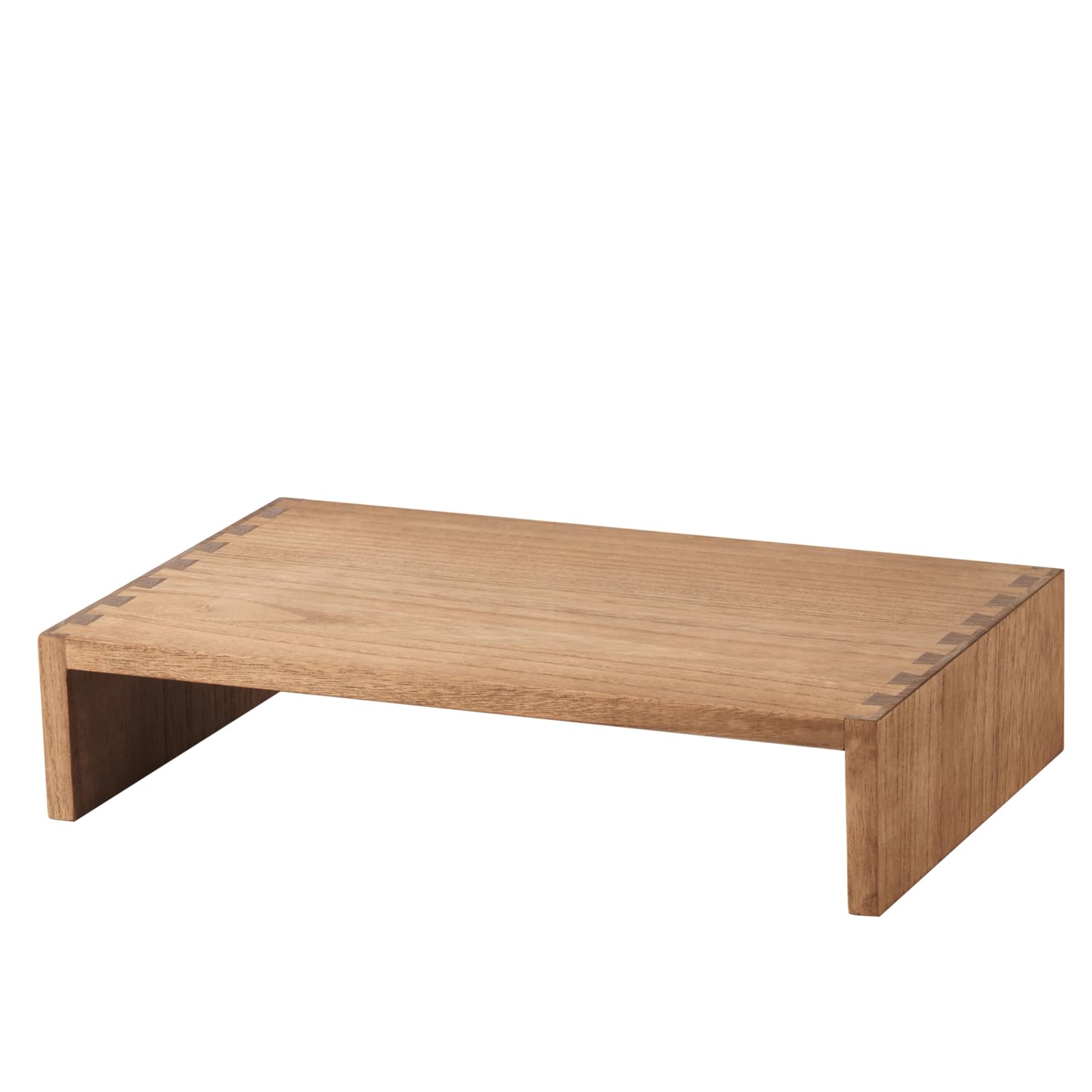
This one arrives fully assembled. No hardware, no instructions, no ten-minute build — you lift it out and set it down. The frame is solid wood with visible grain and an oil-rubbed finish, and it weighs just 0.83 kg, so it moves between a desk, a study table, and a media console without effort.
The trade for that convenience is height. It lifts your screen 3.35 inches, the lowest lift here, which is a modest nudge rather than a full ergonomic raise. If your monitor already sits close to eye level, that is enough. If it is well below, you will want more. The 44-pound load capacity covers a monitor, laptop, or small TV, and it is sized to hold a keyboard or notebook in the open space below.
Set it beside the TEAMIX and the contrast is sharp: 0.83 kg versus 2.8 kg, and 44 pounds versus 150. That lightness is the point — this is a riser you can pick up with two fingers and move to another room.
Where it shines: the wood itself. Real grain and an oil finish give it a warmth the engineered-wood boards here do not match.
The honest catch: a few find the material feels less than the price suggests, and 3.35 inches of lift is gentle — great for a screen that only needs a nudge, not a full raise.
Ideal for: a bedroom or study desk where you want a good-looking wooden lift with zero setup.
Not the one for: deep corrective height — look to a 5-inch-plus riser instead.
5. Gugsey Wood Metal Monitor Stand
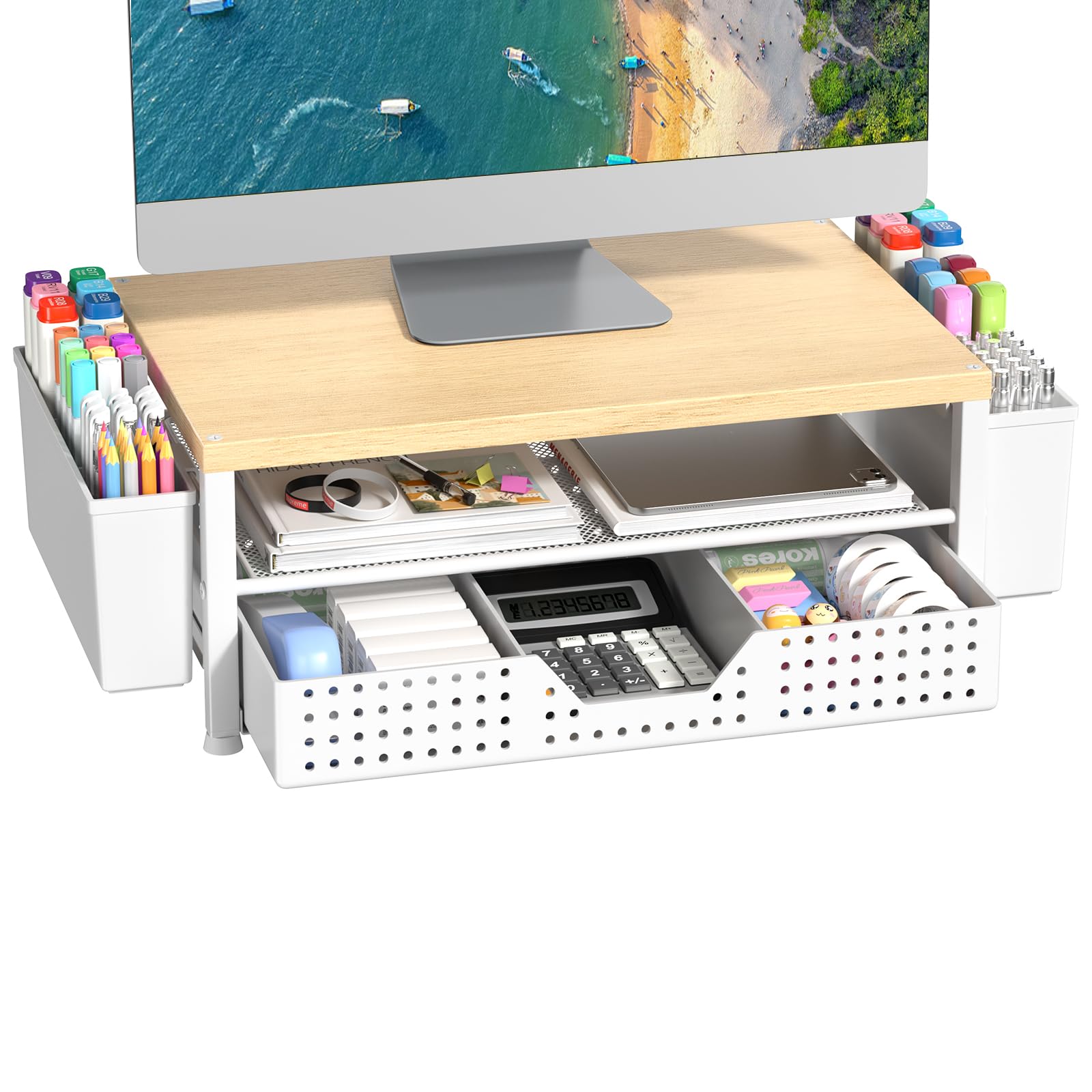
Wood on top, magnetic metal underneath, and a drawer that actually slides.
The adjustable feet are the feature that separates this one from the pack. You can fine-tune the height in the 14 x 10 x 5-inch frame to land your screen at the angle your neck wants, rather than accepting a fixed lift. The top is engineered wood, the stand is metal, and that metal is magnetic — so it holds magnets, which is a small thing that owners end up liking more than they expected.
The storage side is just as practical: a sliding plastic drawer and a pen holder take sticky notes, clips, a spare charger, and a mouse. The frame is light at 1.45 kg, and assembly is quick with the provided parts. Where it shines in the reviews is quality and easy setup, and buyers use it well beyond the office — a classroom, a coffee nook, a cosmetics shelf.
One honest wrinkle shows up in the stability comments. On some surfaces the platform can let items slide, so if your desk tilts or you are stacking heavy gear, add a grip pad. Otherwise it is steady for a monitor or a laptop.
The detail that sells it: adjustable feet plus a drawer, a combination almost nothing else here offers in one frame.
Worth knowing: a handful of buyers find the platform can shift under a load — a thin desktop and heavy monitor is the one setup to double-check.
Choose it when: you want to dial in the exact height and still have drawer storage built in.
Think twice if: your main screen is heavy and your desk surface is slick — you will want extra grip underneath.
6. Fenge Wooden & Metal Monitor Stand
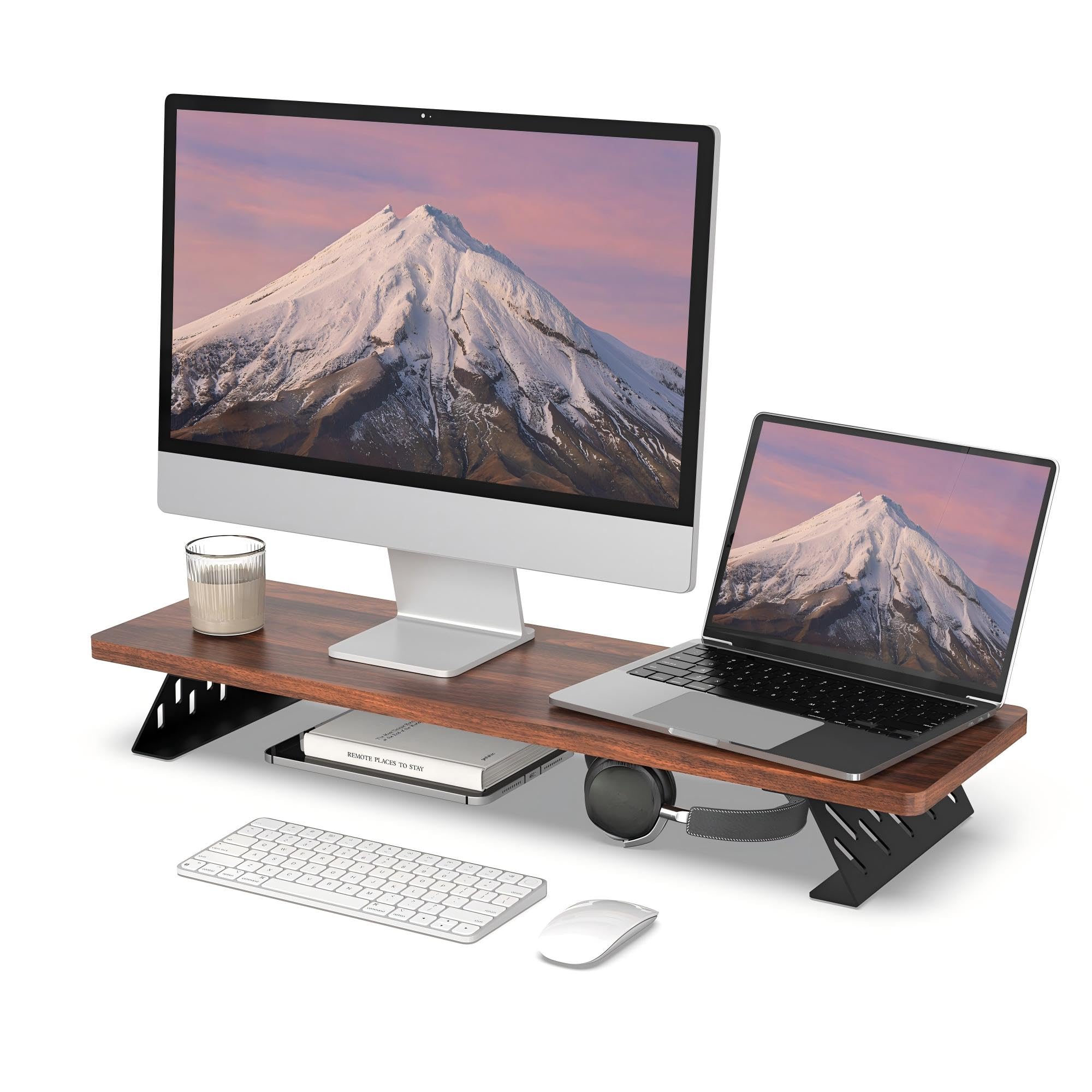
Four screws, two minutes, and a 31.5-inch board of wood and steel on your desk.
This is the assembly-light option for a wide desk. The brackets screw into pre-drilled holes on the panel, and the maker claims it goes up in about 2 minutes. The 31.5 x 9.5 x 3.9-inch panel is wide enough for a single monitor with room to spare, and the 55-pound load capacity covers a monitor, laptop, or printer comfortably.
The 3.9-inch lift is a middle ground — higher than the KIRIGEN’s 3.35 inches, lower than the taller 5-inch-plus risers. The base is heavy-duty steel with a non-slip pad on each leg, so it stays put and protects the finish beneath. Details come through in the reviews: owners mention it is well made and sturdy, and one use worth pinning down is placing a sound bar in front of the screen, which the height and width happen to suit.
What you pay for here is width and a wide, flat working surface. At 31.5 inches, it suits a compact single-monitor station that wants a long shelf rather than a tall one.
What you get: a 31.5-inch steel-and-wood shelf that assembles with a screwdriver, not a toolkit.
The limit: 55 pounds and 3.9 inches — not the pick for a TV or a deep screen raise.
The right buy for: a single-monitor station that wants a long, low shelf and a fast build.
Skip if: you need to lift a screen well above desk level — reach for a taller riser.
7. ROCDEER Bamboo Monitor Stand Riser with Drawer

Natural bamboo, a drawer, and enough lift to clear a full keyboard underneath.
Bamboo is the story here. Every component is wood from FSC-certified stock with an odorless, water-based varnish — a natural matte finish rather than a lacquered shine. The 4.4-inch lift raises your screen to a comfortable eye level, and you can drop it lower by removing the legs if a sitting desk wants a gentler angle.
The storage is unusually specific. The lower space fits keyboards up to 18 inches and mice up to 1.4 inches, and the semi-enclosed shelf holds laptops up to 16 inches or A4 files. A T-shaped slot at the back routes your cables out of sight. Its 23.63-inch width and 100-pound capacity let it take most 24–32-inch monitors, curved displays, or a home printer. Build quality is the thing buyers bring up most — the rounded corners and mortise-and-tenon joints read as careful work.
One part draws mixed feedback: the drawer attachment. Some find it faultless, others less so, so treat that drawer as a handy extra rather than the reason to buy. The shelf and shelf space are the primary draw.
Why people pick it: eco bamboo and honest storage sizing — keyboards to 18 inches, laptops to 16 inches.
One thing to note: the drawer is a bonus, not the headline. Judge it on the shelf.
Pick it for: a natural-finish desk where you want a real keyboard-width cubby and an eco bamboo board.
Hold off if: a drawer is your main priority — this one shines on the shelf, not the pull-out.
8. Fenge Monitor Stand with Frosted Storage Drawer
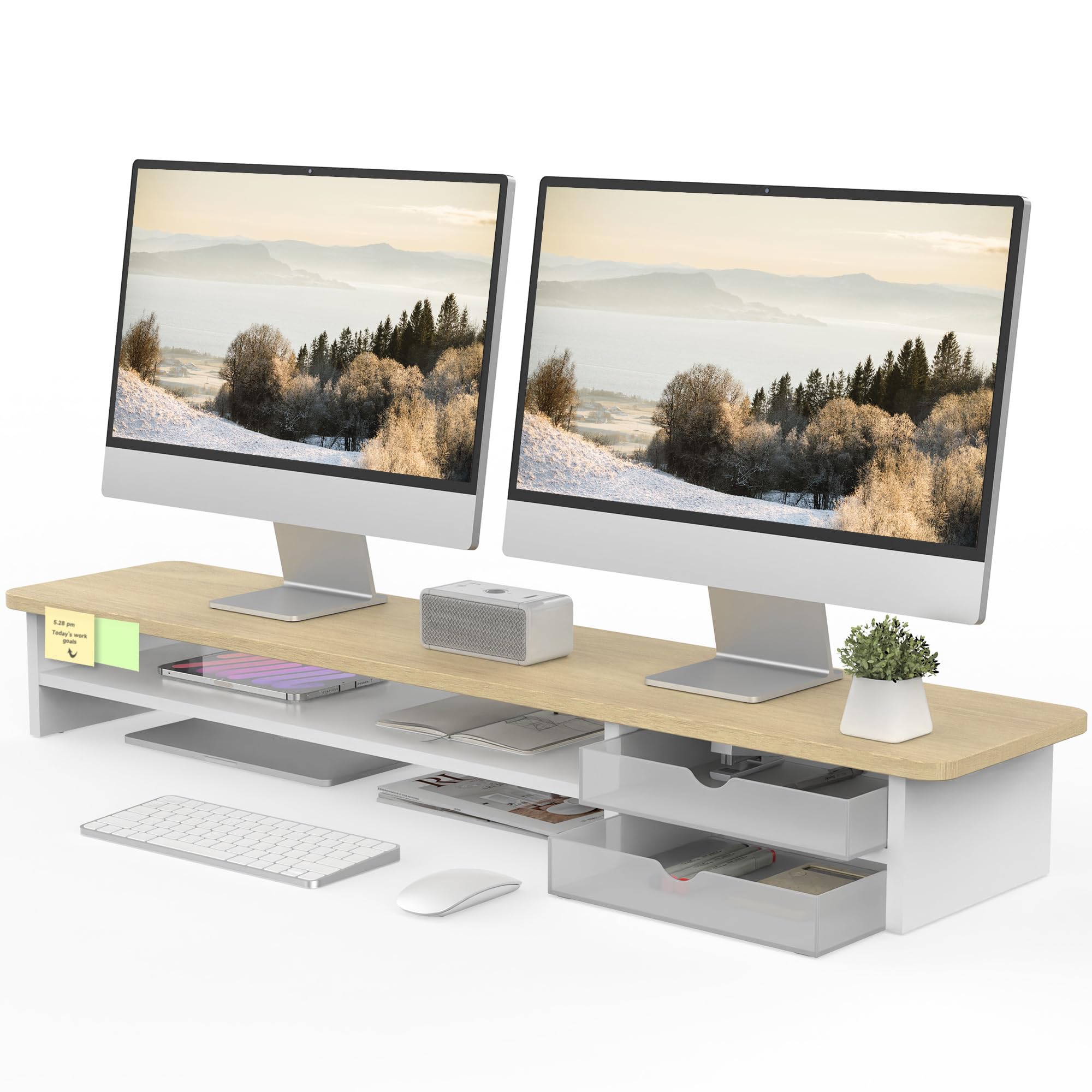
A 42.5-inch oak deck built to sit two monitors or one ultrawide.
Size is the whole argument for this one. At 42.5 x 9.3 x 5.5 inches, it is wide enough for two monitors or an ultrawide screen side by side, and the 15mm (0.59-inch) panel rated to 99 pounds means it holds that spread steady. The base is a pedestal, and non-slip rubber pads keep all of it from sliding on your desk.
Two semi-transparent frosted acrylic drawers sit underneath, and they can be swapped left or right to suit your layout. The 5.5-inch height places your screens at eye level, and the tabletop is FSC-certified wood. Owners find it goes together fast — around 5-8 minutes in the maker’s notes — and note it stays put. The stability and storage are the things they lean on it for.
There is one practical note. Only the upgraded black version carries cable management on the back; other colorways do not have that metal plate yet. If hiding your cables is a must, factor that in before you order the oak.
The case for it: 42.5 inches of oak, 99 pounds of capacity, and two frosted drawers that rearrange to suit you.
The caveat: back cable management comes only on the black version — check the finish you choose.
Made for: a two-monitor or ultrawide desk that wants real storage underneath.
Caveat noted: expect 5.5 inches of lift and no rear cable plate on the oak colorway.
9. IVE Design XL Walnut Wood Monitor Stand

The walnut showpiece — 44 inches of real grain for a two-screen studio desk.
This is the upgrade buy. The frame is walnut plywood with a rich grain finish, and the slim metal mid-shelf is felt-lined so the small stuff does not rattle. Protective pads sit under the legs to keep your desktop scratch-free. At 43.6 x 9 x 4.2 inches, it spreads wide enough for dual monitors while staying low-profile on the desk.
There is a 5.38 kg frame under all of that, and the assembly is set up to be painless — pre-drilled parts, all the tools, and step-by-step instructions. Customers note it goes together easily and instantly declutters the desk. It is a look-first riser, and the walnut is what you are paying for. It is also 44 inches across, so it takes a full-width desk, not a compact one.
The honest catch lands on durability. A small set of comments raise the durability question, so treat the finish with a little care and keep it out of direct sun. What you get in return is a walnut shelf that looks like furniture rather than an accessory.
For the desk that shows: buy this when the walnut grain is half the reason you are upgrading, and you have 44 inches to fill.
The trade-off: 4.2 inches of lift and a walnut finish that rewards a gentle hand — ruggedness is not what you are paying for here.
Know the Specs
Load Capacity
The maximum weight a riser is built to hold, printed in pounds. It is the one number that must clear your monitor plus anything else you stack on top. A 44-pound rating suits a single screen; a 150-pound rating takes a TV. Ignoring this is how panels bow in the middle.
Inner Clearance
The open gap between the underside of the shelf and your desktop — the space for a keyboard, mouse, or notebook. A 5.5-inch riser with 4.1 inches of clearance clears a keyboard but not a tall stack. Measure what you plan to slide underneath before you buy.
Material: Solid Wood vs Engineered Wood vs Bamboo
Solid wood is a single piece with visible grain. Engineered wood is a composite panel, often paired with steel legs for strength. Bamboo is a grass, pressed and finished as a natural board. Each flexes differently under load, and the panel-to-base pairing matters as much as the material name.
Height And Eye Level
Riser height is the lift you get — 3.35 inches on the low end, 5.5 inches and up on fuller raises. Set the top of your screen around eye level when you sit. A taller riser is not always better — it depends on your chair height and how low your monitor sits now.
Common Questions
Will a wood riser hold my dual monitor setup?
How much height do I need to get my screen to eye level?
Can I fit a full-size keyboard under a monitor riser?
Does a two-tier riser leave room for a laptop and a monitor?
Is bamboo as strong as solid wood for a riser?
Will the riser scratch my desk?
Should I remove the legs to lower my monitor?
Do I still need cable management with a riser?
Will a 31.5-inch or 44-inch riser fit my desk?
The Bottom Line
For most desks, the wood monitor riser winner is the TEAMIX 31.5 inch Dual Monitor Stand Riser because its 150-pound load capacity and 4.1 inches of inner clearance handle a TV or two monitors without bowing. If you want two-tier storage and cable routing, reach for the BONTEC. And for a compact desk that needs a drawer, the Spacrea drawer stand keeps supplies off the surface. Match the load rating to your gear and the height to your eye level, and any of these will hold up.
How we choose
We do not accept paid placement. Every pick is matched to a real buyer and a real use-case; we do not hands-on test units.
Sources
Specifications: manufacturer listings and product documentation. Review insights: verified customer reviews, as of July 2026. Pricing: not shown on this page (it changes often); check the current price via the retailer link.
As an Amazon Associate, Tactical Gear Guy earns from qualifying purchases. This does not affect which products we feature.