Specs are compiled from manufacturer listings and verified buyer reviews and can change over time — please confirm the key details on the product page before buying.
Here is the short answer: if you want to turn a fallen trunk into usable boards, you need two things working together — a sawmill attachment that clamps onto your chainsaw bar, and a rail guide that gives the first cut a straight line to follow. Miss either one and your first slab comes out wedge-shaped. This guide covers the five wood mill chainsaw setups worth your attention, from a bare attachment to a full rail-and-mill bundle.
This guide is built by comparing the manufacturers’ published specifications and the patterns across verified customer reviews, so you get each pick’s real strengths and trade-offs instead of marketing spin.
Match bar length, cutting depth and rail length to the logs you actually own, not the biggest log you dream about cutting. The picks below are the best wood mill chainsaw setups for turning your own logs into lumber.
Top Picks

How to Choose a Wood Mill Chainsaw Setup
A chainsaw mill is not a saw. It is a metal frame that clamps to your chainsaw’s guide bar and holds the bar at a fixed height above a log, so the chain slices off a slab of even thickness instead of diving or drifting. Buy the frame alone and you still need a flat reference surface for the opening cut. That is what a rail guide is for, and it is the piece most first-timers forget.
Start with your bar length, not the log pile
The guide bar is the long steel blade that carries the chain. Every mill in this category lists a bar range, and that range is the hard ceiling on your work. A mill rated for bars up to 24 inches mills boards up to 18″ wide, while a 14″–36″ mill runs on a much wider spread of saw sizes. Measure your bar tip to tip with the chain on before you buy anything.
Cutting depth and cutting thickness are not the same thing
Depth is how deep into a log the bar can bite; thickness is how tall the slab that comes off can be. A mill that cuts slabs from 1/2″ to 13″ deep handles beams and thick mantel pieces. One that cuts 0.2″–11.81″ thick is built for planking rather than heavy beams. Pick by the finished lumber you want, not by the log you have.
Weight matters when you are carrying it to the tree
An aluminum rig like the Granberg at 16.2 lbs rides in a truck bed without a second pair of hands. A 26.5 lbs bundle with a rail included is a two-trip carry. Neither is wrong — just decide whether your logs are near the driveway or a quarter mile into the timber.
Expect to snug hardware as you cut
These frames vibrate. Anti-loosening nuts, large washers and a habit of checking bolts between passes are what keep your cuts square. Budget five minutes of setup per log and your slabs will be flatter for it.
Side-by-Side Comparison
| Model | Best For | Bar Range | Cut / Capacity | Weight | Amazon |
|---|---|---|---|---|---|
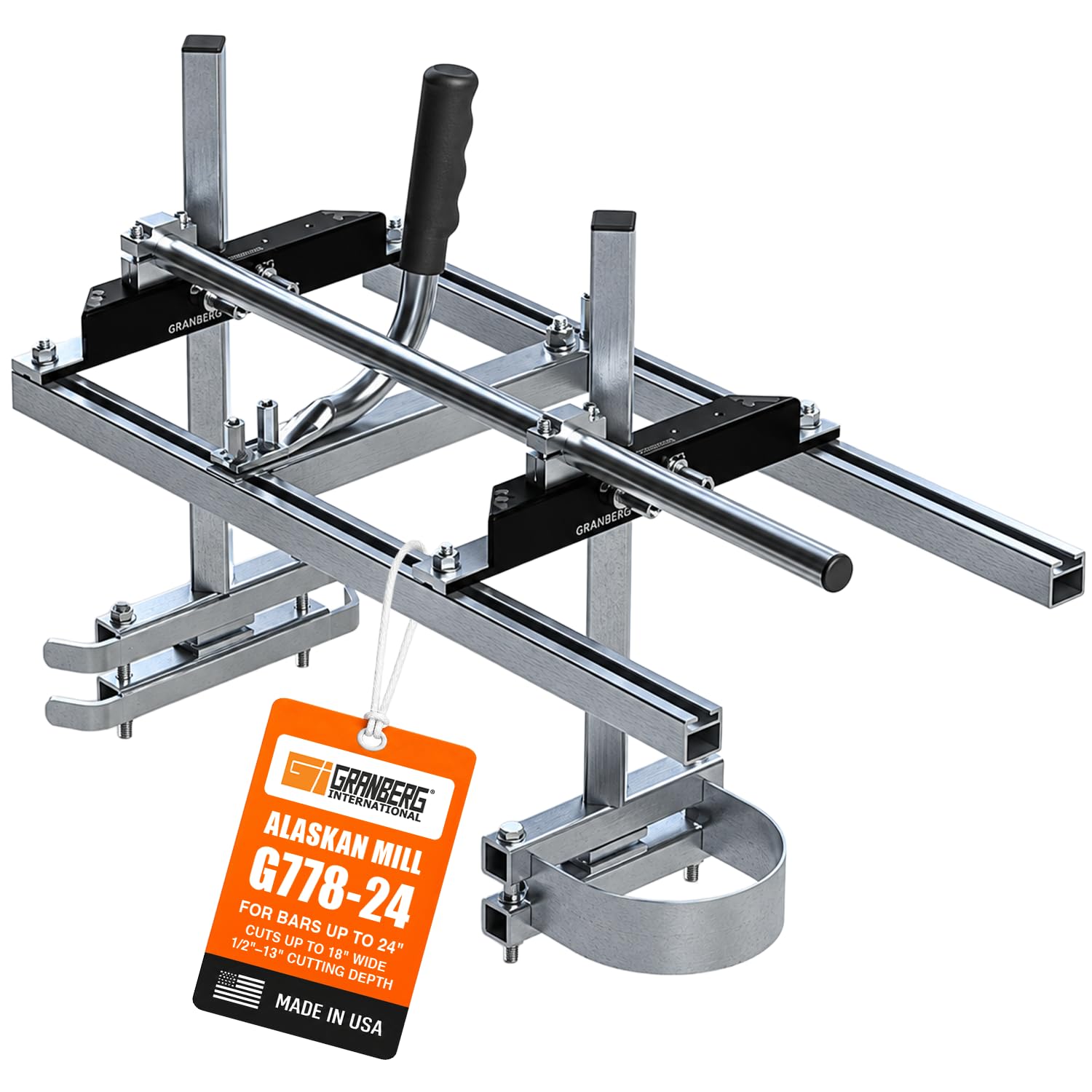
| Granberg G778-24 Alaskan MKIV★ Best Overall | All-round first mill | Up to 24 in | Up to 18″ wide, 1/2″ to 13″ deep | 16.2 lbs | Amazon |
| VEVOR 14″–36″ Chainsaw MillBest Value | Big-bar planking on a budget | 14–36 in | 0.2″–11.81″ thickness | 13 lbs | Amazon |
| RCTEC 9 FT Rail Mill Guide System | Straight first cuts | Rail guide only | 108″L x 10″W x 4″H | — | Amazon |
| Zozen Chainsaw Mill with Brackets | Small logs, home milling | 14–36 in | 1/2″ to 12″ thick | 20.8 lbs | Amazon |
| VEVOR Mill + 9ft Rail Bundle | Complete one-box setup | 14–36 in | 9 ft rail, 4 fixed plates | 26.5 lbs | Amazon |
Detailed Reviews
1. Granberg G778-24 Alaskan MKIV Chainsaw Mill
Our pick — 4.5+★ from 950+ verified ratings; the strongest balance of quality and price.
The one that turns a 24-inch bar into a board mill without drilling a single hole.
Here is the number that tells you what this mill is for: it mills boards up to 18″ wide. That is the width of a finished bench seat or a wide shelf, straight off a log where the tree dropped. It fits bars up to 24 inches, and the depth range runs from 1/2″ to 13″ — deep enough that you can chain several passes and build up a thick beam instead of stopping at planking.
What wins people over is the clamp system. The frame anchors to the saw bar without any drilling, so your chainsaw goes back to firewood duty in the time it takes to unbolt one assembly. The build is aircraft-grade aluminum with zinc-plated steel plates, which is why it holds its alignment cut after cut rather than flexing loose. Owners also note the economics: it mills boards like a portable sawmill for a fraction of the cost.
The honest trade-off is that no rail guide comes in the box. This is the mill only — there is no guide rail in the box — so your first cut needs a ladder or a separate rail guide to ride on. Add the RCTEC rail below and you have a complete system that still weighs 16.2 lbs total for the mill. If you plan to mill on a slope or a muddy site, factor that rail purchase in from day one.
What earns it top spot
- No-drill clamping means the chainsaw stays a chainsaw between milling jobs
- Adjustable rail design handles boards up to 18″ wide and cuts from 1/2″ to 13″ deep
- American-made frame in aircraft-grade aluminum and zinc-plated steel holds alignment
- At 16.2 lbs it is still a one-person lift onto a truck bed
Where it asks more of you
- No rail guide included, so the opening cut needs a separate straight edge
- 24-inch bar cap rules out the widest saws in a big-bar lineup
Buy it if: you own a 24-inch-bar saw and want the frame that owners rank highest in this category — 4.5+ stars across 900+ ratings and the one to judge the rest against.
Plan for this: a separate rail guide for your first straight cut.
2. VEVOR Chainsaw Mill 14″-36″
Thirteen pounds of galvanized steel that swallows any bar from 14 to 36 inches.
This is the pick for the person whose saw collection keeps changing. The bar clamp runs 14″–36″, so a small limb saw and a big felling saw both fit the same frame. At 13 lbs it is the lightest full mill setup here, and you can shoulder it into the woods without a cart. It cuts slabs from 0.2″ to 11.81″ thick, which is planking range rather than heavy-beam range.
The rail mill sizing is where the numbers get blunt. This frame measures 36″L x 12.3″W x 18.6″H against the RCTEC rail’s 108″L x 10″W x 4″H — a full three-foot rail reach versus a compact three-foot frame. In practice: the VEVOR is the mill you clamp to the saw, not the guide the saw rides on. The galvanized steel pipes and air-gun-carved scales do the job they are meant to, and owners consistently describe the cuts as running straight.
The catch is that hardware needs babysitting. A recurring theme in buyer feedback is that the assembly is fiddly and the lower bracket can bend under load, and adjusting two ends at once takes patience. That is a design-tolerance story, not a reason to write the mill off — treat it as a budget frame you snug up before every log and it cuts well. If you want a set-and-lock feel, the Granberg is the stiffer build.
What buyers notice: it functions as advertised and the steel feels substantial for the tier. The adjustability and the bend-prone bracket are the rub.
How to get the best from it: assemble it once on a bench at home, mark the bolts, and check them between slabs.
Reach for this if: you want the widest bar compatibility in the lineup for the smallest outlay.
Look elsewhere if: you need hardened adjustability that holds its setting through a whole tree — this frame wants attention.
3. 9 FT Rail Mill Guide System

A nine-foot straight edge in aircraft-grade aluminum — the piece that stops your first cut wandering.
Every mill above needs a flat reference for the opening pass, and this is that reference. It measures 108″L x 10″W x 4″H, so nine feet of rail laid along the log. The first pass sets the flat surface the mill locks onto for every slab after it. Get this cut right and the rest of the tree behaves; get it wrong and every board inherits the wobble.
The connector kit is the quiet feature that matters most. Any combination of 9 ft or 5 ft guide systems can be joined, so one length of rail becomes the equivalent of a much longer log rigging. Aircraft-grade aluminum keeps the whole thing manageable to drag alone across a clearing. It pairs directly with a mill attachment and a chainsaw frame for the wood-chip side of the cut.
Buyer experience splits here, and honestly so. The quality ratings land in mixed territory — some units arrive with rough welds, and the instructions leave gaps you have to fill with a bit of patience and common sense. That is a rough-edges story on an otherwise sound rail, not a reason to skip the category. Read the assembly notes twice, lay the rail on flat ground to check it, and you get the straight cut you came for.
The value read: you are buying straightness, not finish quality. The aluminum is right; the welds and the manual are where corners were shaved.
Skip the headache: if you are going to run a long rail across big timber, plan on additional joinery hardware sooner rather than later.
Best for: anyone who owns a mill attachment but keeps fighting a wavy first cut.
The caveat: inspect the welds on arrival and set expectations on the instructions — this rail rewards the careful buyer.
4. Zozen Chainsaw Mill
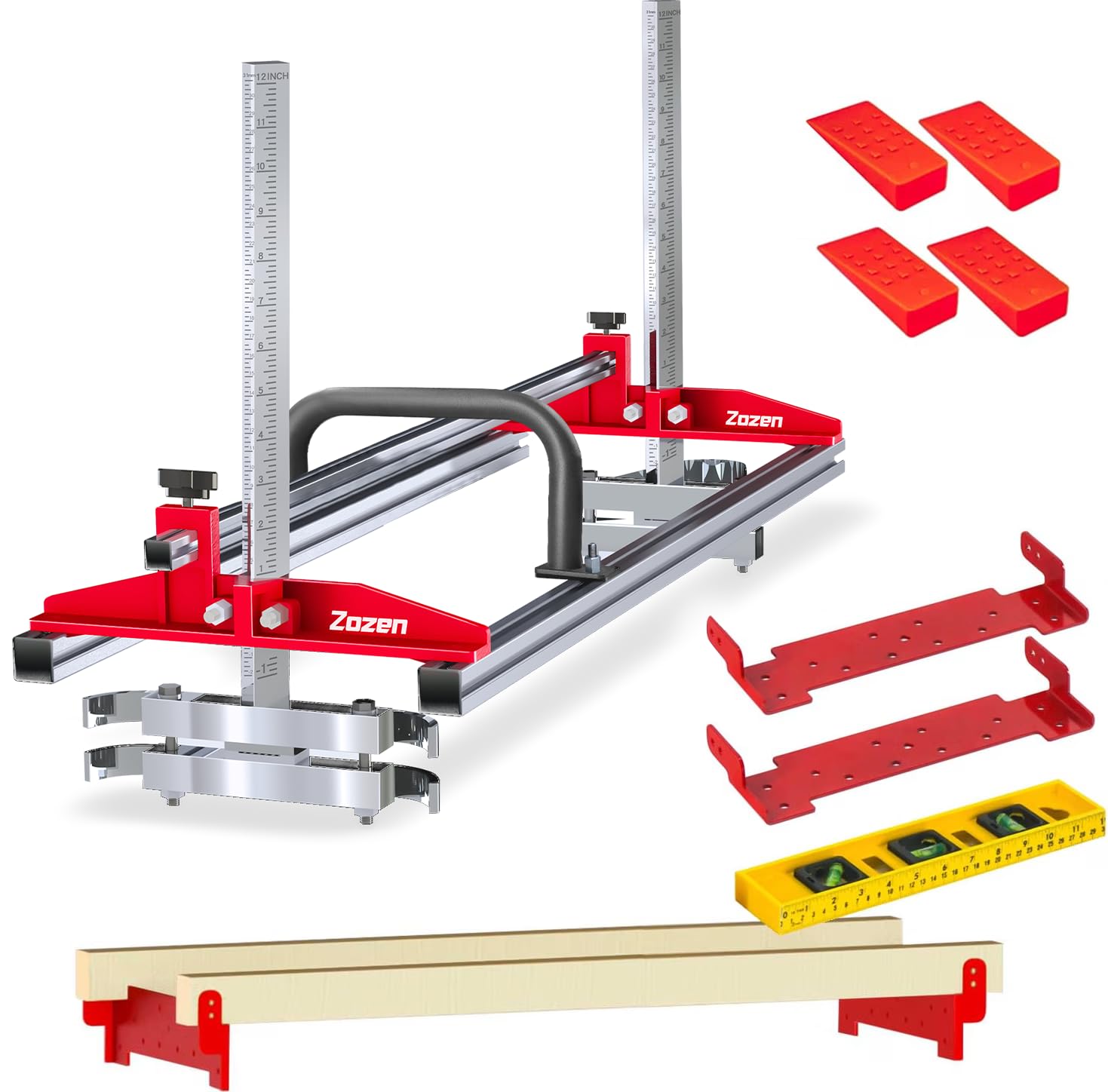
The spliced frame that shrinks to a small-log mill and grows to a 36-inch bar rig.
Most mills are one size. This one breaks into sections, so you can use it as three separate sizes and only assemble the full rig when a big trunk demands it. The full setup runs bars from 14″ to 36″ and mills slabs from 1/2″ to 12″ thick. For a homeowner with a stack of small cedar rounds, that modularity means you are not lugging a full frame for a six-inch log.
The package throws in lumber guide brackets rated for 6–36 inch diameter logs, plus a level, screws and a spare set of four felling wedges. That is a real time-saver if you have not built a rail from scratch before. Weight lands at 20.8 lbs against the Granberg’s 16.2 lbs — about four and a half pounds heavier, but you are carrying a bracket kit with it.
What wins people over is the build quality and the value the buyers see in it. Neither is a dealbreaker on a frame that earns high marks for the money — it is a snug-it-up habit. If a single-piece frame is your style, the Granberg is the simpler build.
What stands out: the spliced three-size design genuinely lets you downsale the mill for small timber instead of fighting a full frame.
The rough edge: nuts back off as the saw vibrates, so a torque check between slabs is part of the routine.
Pick this if: your logs come in sizes and you want one attachment that scales down as well as up.
Think twice if: you hate checking fasteners mid-job — this frame wants periodic tightening.
5. VEVOR Chainsaw Mill and Rail Mill Guide System

Mill and rail in one box — the setup for someone who wants to start cutting the day it arrives.
This is the only bundle here that includes both halves of the system. You get the same 14″–36″ planking mill as the VEVOR above, plus a 9 ft aluminum rail guide with four fixed plates you adjust to the diameter of the log. Set the plates, lay the rail, clamp the mill — the first cut runs level because the guide is doing the steering. No separate ladder or improvised straight edge.
At 26.5 lbs the whole bundle is the heaviest rig in the lineup, which makes sense when you are hauling a full rail alongside the mill. The rail is aluminum and iron for wear and corrosion resistance, and the mill frame is galvanized steel. If your logs stay near the driveway, that weight is a non-issue. If you are packing in on foot, the mill alone plus a foldable rail is the easier carry.
Assembly is where the buyers split. Some describe it as straightforward once the pieces are laid out; others call the instructions bad enough to slow an afternoon. The smart play is to assemble the whole system at home on a flat surface first, label the plates, then move it to the log. The hardware — anti-loosening nuts and large washers — is the part that decides whether your cuts stay square.
Why the bundle works
- Mill plus 9 ft rail in one purchase — no second order to finish the setup
- Four adjustable fixed plates let the rail follow different log sizes
- Galvanized steel mill frame for rust resistance
- Runs the same 14″–36″ bar range as the standalone VEVOR mill
What you trade for the completeness
- 26.5 lbs is a two-trip carry to a distant stump
- Instructions are hit or miss, so plan a bench assembly before heading out
Go for the bundle if: you want a mill and a rail on the same order and your logs are within carrying distance.
Go separate if: you already own a rail, or you are hiking everything into the timber.
Know the Specs
Bar length and cutting width
The guide bar is the blade your saw already runs on, and its length in inches caps everything the mill can do. A 24-inch mill like the Granberg cuts boards up to 18″ wide because the clamp eats some of the bar. When you see a 14″–36″ spec, that is the spread of saws the frame will fit — not a promise that any one saw cuts 36″ boards. Match the mill to the saw you own today.
Cutting thickness and cutting depth
Thickness is how tall the slice that comes off the log can be. A 0.2″–11.81″ range is planking territory; a 1/2″ to 12″ or 1/2″ to 13″ range gets you into thick slabs and beam work. Deeper cuts aren’t always better — the deeper the bite, the slower each pass and the harder the saw works.
Rail length and connector kits
A rail guide in feet sets how long a log you can open in one straight run. Nine feet covers most trouble-free trunks, and a connector kit lets you link multiple 9 ft or 5 ft sections for longer timber. Without a rail, your opening cut rides on whatever flat thing you can find, and straightness becomes luck.
Weight and portability
Mills run from 13 lbs up to 26.5 lbs for a full mill-and-rail bundle. If you mill in the yard or the driveway, a 26.5 lbs bundle barely matters. If the tree is down a slope, every pound per trip gets old — which is why the 13 lbs and 16.2 lbs aluminum frames exist.
Common Questions
Can I use a chainsaw mill with any chainsaw?
Do I need a rail guide on its own or can I mill without one?
What is the difference between a 24-inch mill and a 14″–36″ mill?
Can I mill slabs thicker than my saw’s bar can reach in one pass?
How long will a chainsaw mill last?
Do these mills work with an electric chainsaw?
Can I connect multiple rail guides to mill a long log?
What wood types can I mill with these setups?
Why do the bolts on my chainsaw mill keep loosening?
Is it worth buying the mill and rail as a bundle?
The Bottom Line
For most people, the wood mill chainsaw setup worth buying is the Granberg G778-24 — the no-drill clamp, the 18″ cutting width and the aircraft-grade build make it the frame to beat, and its 4.5+ star record backs that up. If you want the widest bar compatibility for the smallest outlay, the VEVOR 14″–36″ mill is the value play. And for a single-order start with the rail included, the VEVOR mill and 9 ft rail bundle is the one to reach for.
One last nudge: whichever you pick, buy the rail on day one. The mill cuts the slab, but the rail decides whether it comes out straight.
How we choose
We do not accept paid placement. Every pick is matched to a real buyer and a real use-case; we do not hands-on test units.
Sources
Specifications: manufacturer listings and product documentation. Review insights: verified customer reviews, as of November 2026. Pricing: not shown on this page (it changes often); check the current price via the retailer link.
As an Amazon Associate, Tactical Gear Guy earns from qualifying purchases. This does not affect which products we feature.