Specs are compiled from manufacturer listings and verified buyer reviews and can change over time — please confirm the key details on the product page before buying.
Your joint will only be as good as the line you cut first — and a wobbly pencil line means a gappy dovetail, a wandering saw kerf, and a lot of sanding to hide the damage. That is the whole reason wood marking tools exist: a knife, a wheel gauge, or a scribing ruler lays a crisp, repeatable line right where the cut belongs. Below you get nine real options, sorted by what each one actually does at the bench, so you can pick the one that matches the way you work.
This guide is built by comparing the manufacturers’ published specifications and the patterns across verified customer reviews, so you get each pick’s real strengths and trade-offs instead of marketing spin.
Some tools here slice a knife wall your chisel can register against, while others slide along an edge to repeat the same width all afternoon. Either way, the goal is a mark you trust before the saw starts moving.
Top Picks


How To Choose The Best Wood Marking Tools
You are choosing between three jobs, and the fastest way to waste money is buying a tool built for the wrong one. A marking knife cuts a wall for chisels and saws. A wheel or pin gauge transfers a set distance from an edge over and over. A scribing ruler measures and marks in the same pass. Decide which of those three you actually need most, then look at the spec that controls it.
Knife, Gauge, or Ruler — Pick Your Primary Job First
If your joints are hand-cut, a marking knife is the tool that does the most work for you. The blade severs wood fibers along the line so your chisel has a clean shoulder to sit in. A pencil line leaves the fibers intact, and the chisel tends to follow the grain rather than the line. That severed line is what lets a chisel seat cleanly instead of tearing past the mark.
If you are laying out ten rails to the same width, a gauge is faster than a ruler and pencil. You set the head once, lock it, and drag. Wheel gauges cut a fine line rather than scratching a scratch-awl groove, and most people find the wheel easier to steer along a straight edge.
Blade Steel and Hardness — What Actually Keeps an Edge
Blade steel hardness is the number that predicts how long a knife stays sharp. Look for high carbon steel or stainless with a stated hardness in the range the maker publishes on the listing. A harder blade holds its tip longer but is more brittle if you drop it. Softer steel sharpens faster but dulls sooner. Neither is wrong — it depends on whether you would rather sharpen often or replace a chipped blade.
Where a Sliding Stop Saves You Real Time
A sliding stop on a scribing ruler is the quiet hero of repetitive work. Set the stop to your offset, put a pencil in the notch, and every board gets the identical line without re-measuring. Without that stop you are reading a scale and hoping your eye is consistent on the twentieth board as it was on the first.
Side-by-Side Comparison
| Model | Best For | Type | Blade / Head Material | Working Reach | Amazon |
|---|---|---|---|---|---|
| Woodworking Ruler, 3Pcs Precision Pocket Metal Slide Rule★ Best Overall | Repeated marking across many boards | Scribing ruler set (3 pieces) | Aluminum alloy body, alloy steel | 6-inch, 8-inch, and 12-inch rules | Amazon |
| KAKURI Wood Marking Gauge 3.5″Traditional Pick | Edge-parallel lines in a traditional style | Japanese KEBIKI scribe | Japanese carbon steel blade | Maximum width 90 mm | Amazon |
| RUITOOL Woodworking Marking KnifeSharpest Value | Cutting knife walls for joinery | Fixed double-bevel knife | High carbon steel at 58 HRc | 1.8-inch blade | Amazon |
| iGaging Wheel Marking Gauge | Depth checks and quick measurement transfers | Wheel gauge / depth gauge | Solid brass body | 8-inch steel rod | Amazon |
| Narex Unhandled Dual Bevel Marking Knife Kit | Hands who want to shape their own handle | Unhandled knife kit | AISI 420 stainless at HRC 57 | 5-7/8 inch blade | Amazon |
| YOSELIN Dovetail Marking Jig Wheel Gauge Set | Dovetail layout plus gauge work in one kit | Dovetail jig and wheel gauge set | Aluminum billet, anodized | 8-inch precision ground rod | Amazon |
| Clarke Brothers Marking Knife | A sharp knife with a handle and sheath | Fixed double-edged knife | Carbon steel blade | 5.5 cm blade | Amazon |
| Taytools 465494 Wheel Marking Gauge | Heavier, precise gauge work in both unit systems | Wheel gauge / depth gauge | Solid brass machined head | 8-inch beam, up to 7-inch depth | Amazon |
| Taytools 464763 Brass Wheel Gauge | Micro-adjust layout with spare cutters | Wheel gauge with micro adjust | Solid brass head | 7-inch beam | Amazon |
Detailed Reviews
1. Woodworking Ruler 3Pcs T-Type
Our pick — 4.5+★ from 900+ verified ratings; the strongest balance of quality and price.
Three scribing rules in one set, each with a sliding stop that repeats a line for you.
The reason this set lands on top is simple arithmetic: you get three rules — 6 inch/160mm, 8 inch/210mm, and 12 inch/300mm — instead of buying them one at a time. Each one is made from aluminum alloy machined by a CNC process, so the body stays flat and the edges stay true. That flatness is what stops a scribed line from wandering halfway down a board.
The star of the design is the fine notch cut into the end of each rule. Set the beefy stop where you need it, drop a pencil into the notch, and you have an instant marking gauge. Two thumb screws hold that stop locked to the rule, which is what keeps your repeated offsets identical from the first board to the twentieth. Slide the stop off and push it through the slot in the blade, and the rule stands upright on its own for vertical marking — the side is marked with 1/4, 1/2, and 3/4 depth units for that job.
Engraved laser numbering means the graduations do not rub off, and the anodized surface resists rust and wear. The scale reads in 1/32-inch steps, so fine offsets are covered. Quality is clearly the thing that wins people over here, with functionality close behind — the tool does the two jobs a marking tool has to do, and does them without fuss. The honest catch is scope: this is a measuring and marking aid, not a cutting tool, so it will not give you the knife wall that a chisel registers against. It marks the line; something else has to cut it.
Why the bench likes it
- Three rules in 6-inch, 8-inch, and 12-inch lengths cover small parts and full panels
- Thumb-screw stop locks an offset so repetitive marking stays consistent
- Laser-engraved numbers on an anodized surface hold up to daily shop wear
- Stand-up vertical mode with 1/4, 1/2, and 3/4 depth markings
Where it stops short
- Marks only — it does not score or sever fibers for joinery
- Needs a pencil in the notch to function as a gauge
The one to grab: Buy this if you lay out rails, stiles, and shelves and want the same offset repeated without re-measuring.
Keep looking if: Your work is hand-cut joinery and you need a blade to score the line, not a rule to draw it.
2. KAKURI Wood Marking Gauge 3.5″
A bamboo-bodied Japanese scribe that draws parallel lines and hides its blade when you are done.
This is a SUJI KEBIKI — a Japanese carpenter’s tool built for one job: drawing a line parallel to the edge of a board at a width you choose. You set the width, lock the jig with hand-turnable screws, then drag the tool along the edge and the blade scores the line for you. No ruler reading, no pencil wobble.
At 90 g it is light enough to steer with two fingers, and the natural bamboo body fits comfortably in the hand. That matters when you are pulling a line down an eight-foot board — a heavy gauge tires your wrist and the line drifts. The cutting edge retracts into the wooden body when not in use, so it travels in a toolbox without slicing your fingers or dulling itself.
Where it divides people is the accuracy of the line. Some find it dead-on repeatable; others find it hard to hold a consistent result, and the value question comes up too. It is also a marking device, not a cutting gauge. What it does not do is reach the micro-precision of a machined brass head with a fine adjustment thread.
The bamboo factor: A natural bamboo body with a Japanese carbon steel blade, a 90 mm maximum width, and a hand-turned screw lock — this is the traditional approach done properly, and it costs less than the machined brass gauges without asking you to give up much for edge-parallel work.
What to expect: Setup precision is on you. You dial the width by eye against a rule, so your line is only as accurate as your setting.
Suits the hand-tool bench: Reach for it if you want a light, traditional gauge that scores parallel lines down long boards.
Think twice if: You expect a set-and-forget micro adjustment — this one is dialed by hand.
3. RUITOOL Woodworking Marking Knife
A 58 HRc double-bevel blade that cuts a knife wall from either direction, at 50 g in the hand.
Start with the number that decides whether this knife earns its place: the blade is heat-treated and tempered to a minimum hardness of 58 HRc. That is a hard blade, so the tip keeps its shape through repeated sharpening instead of rounding off. The steel is 100% high-carbon, precision ground on a CNC machine, with a 1.8-inch double-sided blade in a spear point shape.
Because the bevel runs both sides, left-handed and right-handed woodworkers both get a working edge without adjusting their grip. At 50 g it is light in the hand, and the hardwood handle is riveted on with a flat profile — a flat handle means the knife does not roll off the bench when you set it down. A leather sheath comes included, which protects the edge between cuts and gives you somewhere safe to park it.
Weigh that against the KAKURI above, which runs 90 g — the RUITOOL is the lighter tool and the only one of the two with a hardened hardness figure published. The catch a buyer should know is that a 58 HRc edge is hard, and hard edges chip if they meet a knot or a floor. Keep it in the sheath and on wood, and it stays sharp. Length is 7.6 inches overall, so it stows easily in an apron pocket.
Edge-holding read: The hardness figure is the whole pitch — this is a knife designed to be sharpened repeatedly without losing its tip, and the double bevel makes that edge usable from both sides.
Care note: Store it sheathed. A hard blade is a brittle blade at the very tip, and a drop onto concrete is how these get damaged.
For the joinery hand: This is the knife to buy first if you cut dovetails and tenons and want a score line your saw can follow.
The trade-off: No micro-adjustment and no measuring scale — it marks the line, you set the offset.
4. iGaging Wheel Marking Gauge with 1/32nd & 1mm scale
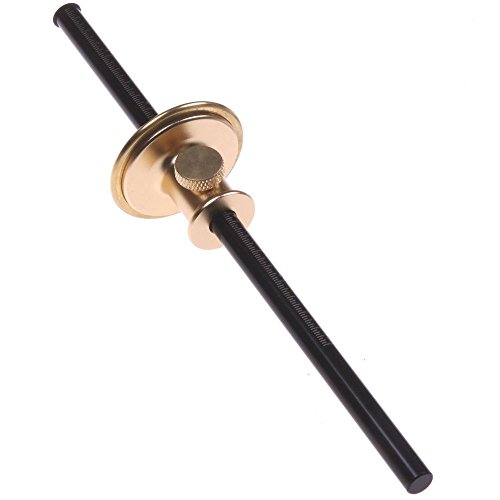
A brass-headed wheel gauge that also measures depth, so one tool covers two layout jobs.
The head is solid brass, precision machined, with a knurled lock nut you can tighten by hand. The rod is steel and 8 inches long, graduated in 1 mm and 1/32-inch increments so you can read the setting straight off the shaft instead of laying a rule against it. That saves a step on every single setup.
Two jobs for one tool is the practical appeal. As a wheel gauge it marks a parallel line from an edge. As a depth gauge you can reach into a mortise or a groove and measure how far down you are, or transfer a measurement quickly from one spot to another. Functionality carries the day here, with value running close behind — this does a lot for a mid-range outlay.
Here is where an honest buyer should pay attention. The wheel has to stay tight for a consistent line, so check that the small screw holding it is snug before you start a run. Accuracy is fine when the setup is right, but durability and sharpness are the split points in owner experience — keep the cutting wheel clean and the tool lasts. At 4.96 ounces it has enough heft to sit steady on the wood without feeling heavy.
What it does well
- Solid brass machined body with a knurled lock nut that tightens by hand
- 8-inch steel rod graduated in 1 mm and 1/32-inch steps
- Doubles as a depth gauge for grooves and mortises
Setup habits that matter
- The wheel screw can work loose — snug it before each run
- Cutting wheel needs care; it is the wear point on the tool
Two jobs, one tool: Good pick if you want to mark parallel lines and check depths without buying two separate gauges.
The upkeep: It rewards a quick screw check and a clean wheel — treat it as a setup routine, not a chore.
5. Narex Unhandled Dual Bevel Marking Knife Kit
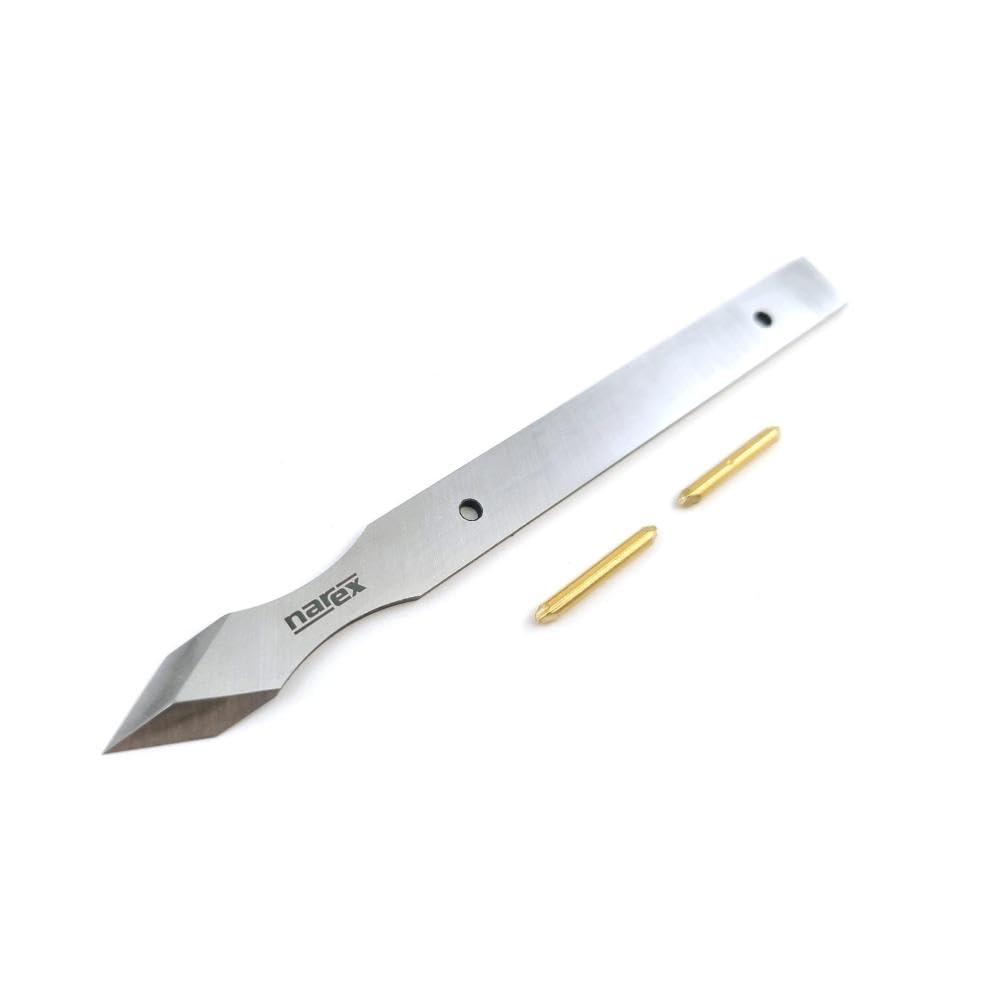
The blade blank, not the finished knife — you cut and fit your own handle to it.
This is the pick for the woodworker who wants the knife to match their hand rather than the other way around. What arrives is the blade: AISI 420 corrosion-resistant stainless steel hardened to HRC 57, 5-7/8 inches long, 1/2 inch wide, with finger indents above the edge and a dual bevel. You supply the handle, turn it or shape it, and end up with a knife no catalog sells.
Thickness is where the choice lives. The listing offers the blade in 0.030″, 0.060″, and 0.100″ — a thin blade slices cleanly into fine work, while the 0.100″ version is the one you want if you plan to pry a chip loose now and then. Stainless means it resists rust in a shop where humidity moves with the weather, and HRC 57 is hard enough to keep a working edge through sustained use.
Length is 5.88 inches, which sits between the RUITOOL at 7.6 inches and the KAKURI at 5.91 inches — so it handles close, controlled cuts without feeling stubby. What wins people over is the blade itself, with a two-sided design that suits both left- and right-handed cuts. The catch is obvious and worth saying plainly: no handle and no sheath come with it. If you do not have the time or the tools to fit a handle, this knife stays a blade in a drawer.
For the shop tinkerer: Buying a Narex blade blank with finger indents is how you get a marking knife that fits your grip exactly, in the steel hardness you pick.
What it is not: It is not a ready-to-use tool. Budget your own handle material and an evening of shaping.
For handle makers: Choose this if shaping a custom handle is the fun part and you want AISI 420 stainless at HRC 57 in the frame.
Wrong pick if: You want to mark a joint tonight — this one needs a handle built first.
6. YOSELIN Dovetail Marking Jig Wheel Marking Gauge Tool Set

One box that lays out dovetail slopes and marks parallel lines — with the spares to actually finish the job.
A dovetail joint has two marking problems, and this set solves both. The jig marks the slope — the angled ratio line — on softwood and hardwood so your tails and pins line up. The wheel gauge handles the straight parallel lines. Doing both with separate tools means switching setups and losing your reference; doing both from one kit keeps the layout consistent.
The gauge side is an 8-inch precision ground steel rod with a scale in 1 mm and 1/25 inch, adjusted by a knurled knob and running along the edge of your workpiece. The body is machined from solid aluminum billet and anodized, so it stays light and resists wear. It also works as a depth gauge and for transferring a measurement quickly.
What makes this kit worth the shelf space is the extras: a pencil, a pencil holder, and an M6 hand-tightening screw, plus a protective case and screwdriver. Quality is the aspect that carries it — solid build quality comes up more than anything else, and the value lands as well. A beginner will find it takes little practice to make a joint; an experienced hand gets a fast layout tool. The catch is that this is layout and marking only — the jig marks the slope, your saw still has to cut it.
Dovetail-first thinking: If dovetails are the joint you keep attempting and keep spoiling, buying the jig and gauge together removes the guesswork from the slope line and the baseline in one purchase.
Weight and feel: At 9.6 ounces the set has enough mass to sit steady while the anodized aluminum keeps it from feeling like a brick.
Best for the dovetail learner: Start here if you want the slope and the parallel lines marked from one consistent setup.
Not the tool for: Cutting knife walls — there is no blade here, so pair it with a marking knife.
7. Clarke Brothers Marking Knife

A carbon steel blade in a Padauk handle — sharp on arrival, comfortable for long marking sessions.
The blade is 100% high-quality carbon steel with a double edge, so you can use it with either hand and get a better grip and more control. It scribes the lines your saw or chisel will follow, which is the whole point of a marking knife: create joints and designs that close up tight.
The handle is a simple, vintage Padauk wood shape with the brand name and logo on it. That handle is where a lot of the long-session comfort comes from — a 5.5 cm blade on a 16 cm overall tool sits in your hand as a controlled extension rather than something you grip hard. It comes with a real leather sheath, so the edge stays protected in a toolbox.
Sharpness on arrival is the standout. The blade cuts clean recessed lines, which means the edge is ready to work rather than needing a session on the stones first. Blade durability and the sheath quality are the split points in owner experience — a carbon blade needs a wipe-down after use to keep rust off it, and the sheath does its job without being a hard case. Neither is a defect, but both shape how the knife ages in your shop.
Long-session comfort: A shape designed to sit in your grip for hour-long marking runs, with a carbon edge that cuts a clean recessed line from the first joint.
One shop habit: Wipe the carbon steel after use. Wipe it dry after each session and the carbon edge stays rust-free.
The comfortable choice: Pick this if you mark for long stretches and want a knife that feels right in the hand from the first cut.
A fair caution: The sheath protects the edge but is not a rigid case — store it somewhere it will not be crushed.
8. Taytools 465494 Wheel Marking Gauge

Six ounces of solid brass and hardened steel, built to hold a setting and stay put.
Mass is the design idea here. At 6 ounces this gauge settles onto the wood and stays there, which is what lets the hardened high-speed steel cutting wheel leave a sharp, distinct line in softwood and hardwood, both with and across the grain. A light gauge drifts off the line; this one stays planted and cuts.
The head is 1-9/16 inches in diameter and 1-3/16 inches tall, machined from solid brass — the listing is explicit that it is not plated. That matters because a plated head eventually flakes where a solid one just wears in. The knurled thumb screw is solid brass too, and it locks the head to the beam to hold your measurement. The beam is hardened steel,.310 inches in diameter and 8 inches long, black chrome plated so the mm and SAE graduations stay readable.
Reach is generous: maximum cutting depth of the gauge is a full 7 inches, with graduations extending to 150 mm or 6 inches. When you are not cutting, the head has a countersink so the cutter fully retracts and stays protected. Accuracy is stated at +/-0.001 inches by the maker. Marking quality is what buyers single out, alongside the value — this is a lot of machined brass for the money. The catch is that the cutter is small at 7/16 inch in diameter, so it is easy to lose track of how worn it is; resharpening is a matter of rubbing the flat face on any sharpening media, and replacements are available.
Built to hold a line
- 6-ounce solid brass head that sits steady for a clean cut
- Hardened high-speed steel wheel marks softwood and hardwood across and with the grain
- Countersunk head retracts the cutter for safe storage
- Max cutting depth of a full 7 inches with mm and SAE graduations
Worth knowing
- The 7/16-inch cutter is small and easy to overlook as it wears
- Resharpening is manual — a flat rub on sharpening media, no jig included
The steady hand: Best for woodworkers who want a gauge with real weight so the line stays true down a long board.
Plan for upkeep: Treat the cutter as a consumable you maintain — the flat-face rub is simple, but it is a step.
9. Taytools 464763 Solid Brass Wheel Gauge

A brass micro-adjust head that dials a setting finely — and two spare cutters in the box.
Fine adjustment is what you pay for at the top of this list, and this gauge is built around it. The head is solid brass at 1.625 inches in diameter, with a lockable micro-adjust and a knurled adjustment knob and tail. You can nudge a setting by fractions rather than fighting a sliding head into position, and then lock it so it stays.
The cutter is a hardened 3/8-inch diameter round wheel that slices across the grain, and two additional cutters come with it — so you start with a spare already in hand. The head retracts the cutter into a countersink when not in use, protecting the edge between jobs. The beam is 7 inches long and 5/16 inch in diameter, hardened steel, and grooved to stop the head rotating while you adjust it. That groove is a small detail that saves a lot of annoyance mid-setup.
The thing buyers praise most is how well it works in daily use, with build quality right behind — this is a heavy, solid-feeling tool at 8.8 ounces. The honest trade-off is in the adjustment: some find the threads are not as fine as they expected for a gauge billed as micro adjust. Set your expectation there — it is precise enough for real joinery work, but it is not a machinist’s instrument.
Where the money goes: Solid brass, a lockable micro-adjust head, a grooved beam to stop rotation, and two spare cutters — the premium buys repeatable setups and spares instead of a one-and-done tool.
The nuance to know: “Micro adjust” here means fine but not ultra-fine. If you demand machinist-grade threads, set that expectation before you buy.
For the repeat-setup shop: Buy this if you re-dial the same joint width often and want a lockable, finely adjustable brass head.
What to weigh: The spare cutters and solid brass carry the value; the adjustment thread is good, not extraordinary.
Know the Specs
Blade Hardness (HRc)
HRc is a hardness scale for steel, and a higher figure means the edge resists dulling longer. It also means the tip is more brittle, so a hard blade wants a sheath and careful handling. On a marking knife, this figure predicts how many joints you cut before you reach for the stones.
Wheel Gauge Graduations
Graduations are the little tick marks on the beam. A gauge marked in both 1 mm and 1/32-inch steps lets you set a width in whichever system your plans use, and read the setting straight off the shaft instead of laying a ruler against it.
Sliding Stops on Scribing Rules
A sliding stop is a block that clamps onto the rule at a set distance. With a pencil in the end notch, it turns the rule into a repeat marking gauge — the same offset every time, without re-reading a scale.
Maximum Cutting Depth
Cutting depth is how far the cutter can reach in from the edge of a board. On a wheel gauge it is set by the beam length, so a longer beam means deeper layout work for tenons and wide rails.
Common Questions
Is a marking knife better than a pencil for woodworking?
Can a left-handed woodworker use a double-bevel marking knife?
What does an unhandled marking knife mean?
Will a wheel marking gauge work on hardwood as well as softwood?
How long does a marking knife blade stay sharp?
Do I need both a marking knife and a marking gauge?
What is a dovetail marking jig used for?
Can I use a scribing ruler to mark instead of a tape measure?
How do I keep a carbon steel marking knife from rusting?
Are the spare cutters on a wheel gauge replaceable?
The Bottom Line
For most woodworkers, the wood marking tools winner is the Woodworking Ruler 3-piece set, because three rules in 6, 8, and 12 inches with a locking stop cover the widest range of marking jobs and keep your offsets identical from board to board. If your work is hand-cut joinery, grab the RUITOOL marking knife — its 58 HRc double-bevel blade gives you a knife wall from either hand. And for dovetail layout paired with parallel marking, the YOSELIN jig and gauge set is the one to reach for, extras and sleeve case included.
There is one more way to look at this list. If your bench already has a good knife and you just need to transfer measurements accurately, the brass-headed Taytools 464763 is the pick that rewards careful setup with a finely adjustable head and two spare cutters. Buy for the marking job you do most — knife walls, edge-parallel lines, or repeated offsets — and that tool will earn its bench space.
How we choose
We do not accept paid placement. Every pick is matched to a real buyer and a real use-case; we do not hands-on test units.
Sources
Specifications: manufacturer listings and product documentation. Review insights: verified customer reviews, as of November 2026. Pricing: not shown on this page (it changes often); check the current price via the retailer link.
As an Amazon Associate, Tactical Gear Guy earns from qualifying purchases. This does not affect which products we feature.