Specs are compiled from manufacturer listings and verified buyer reviews and can change over time — please confirm the key details on the product page before buying.
Buying a marking knife is really one decision: single bevel or double. A single-bevel knife has a flat back that sits tight against your square or straightedge, so the line lands exactly where your rule sits. A double-bevel knife cuts on both sides, so it works in either hand and from either direction. Get that one choice right and almost any knife on this list will serve you for years.
This guide is built by comparing the manufacturers’ published specifications and the patterns across verified customer reviews, so you get each pick’s real strengths and trade-offs instead of marketing spin.
You want a knife that cuts a crisp shoulder for your chisel to sit in, not one that tears the fibers and leaves a fuzzy line. The picks below cover Japanese kiridashi blades, Czech striking knives, and budget scribes that all do that job — and this breakdown of the best Wood Marking Knife separates the right bevel for your workbench.
Top Picks


How To Choose The Best Wood Marking Knife
Start with the bevel, because it decides how the knife registers against a rule. Then decide how thick a kerf you want, and only then worry about steel and handle.
Single bevel versus double bevel
A single-bevel knife is ground on one face only, so the flat back lies flush against your square. That flat registration is why layout stays accurate over a long board. A double-bevel knife is ground on both faces, which lets you cut toward yourself or away, and use it left- or right-handed. The trade-off is that the point sits centered rather than flush, so some woodworkers find it slightly harder to index against a straightedge.
Blade thickness and the groove you leave
Thin blades leave a narrow kerf that a fine dovetail saw and a small chisel follow easily. Thick blades feel stiffer in the hand and survive striking with a mallet, but the groove is wider. The Narex 813800 runs.090″ thick, while the Narex 822302 thins down to.055″ for finer layout work.
Steel hardness and what HRc actually tells you
HRc is a hardness scale for steel — the higher the number, the longer the edge resists dulling, but the more brittle it becomes. The Narex 822302 is heat treated to HRc 61, the Narex 813800 and the Kimting knife to HRc 58, and the Mikov blade to HRC 57. Cherry and ash will chew a soft edge quickly, so hardwood work rewards the harder steels.
Side-by-Side Comparison
| Model | Best For | Blade Length | Bevel | Handle | Amazon |
|---|---|---|---|---|---|
| KAKURI Kiridashi 18mm★ Best Overall | All-round marking and carving | 1.9 in | Single | One-piece steel | Amazon |
| Kimting Heavy Duty Scribing KnifeBest Value | Ambidextrous striking work | — | Double | Hardwood, riveted | Amazon |
| RUITOOL Double-Bevel Marking KnifeMost Versatile | Beginners wanting a sheath | 1.8 in | Double | Hardwood, riveted | Amazon |
| Mikov V2003014 Kit | Making your own handle | 5.88 in | Dual | Unhandled | Amazon |
| Clarke Brothers Marking Knife | Daily scribing on hardwoods | 5.5 cm | Double | Padauk wood | Amazon |
| KAKURI Kiridashi 15mm | Curves and fine detail | 1.5 in | Single | One-piece steel | Amazon |
| Narex 813800 | Striking with a mallet | 2.75 in | Dual | European Beech | Amazon |
| Narex 822302 | Fine dovetail layout | 2 in | Dual | Hornbeam | Amazon |
Detailed Reviews
1. KAKURI Kiridashi Knife 18mm
Our pick — 4.5+★ from 950+ verified ratings; the strongest balance of quality and price.
One flat back, one honed face, and a line that lands exactly where your square sits.
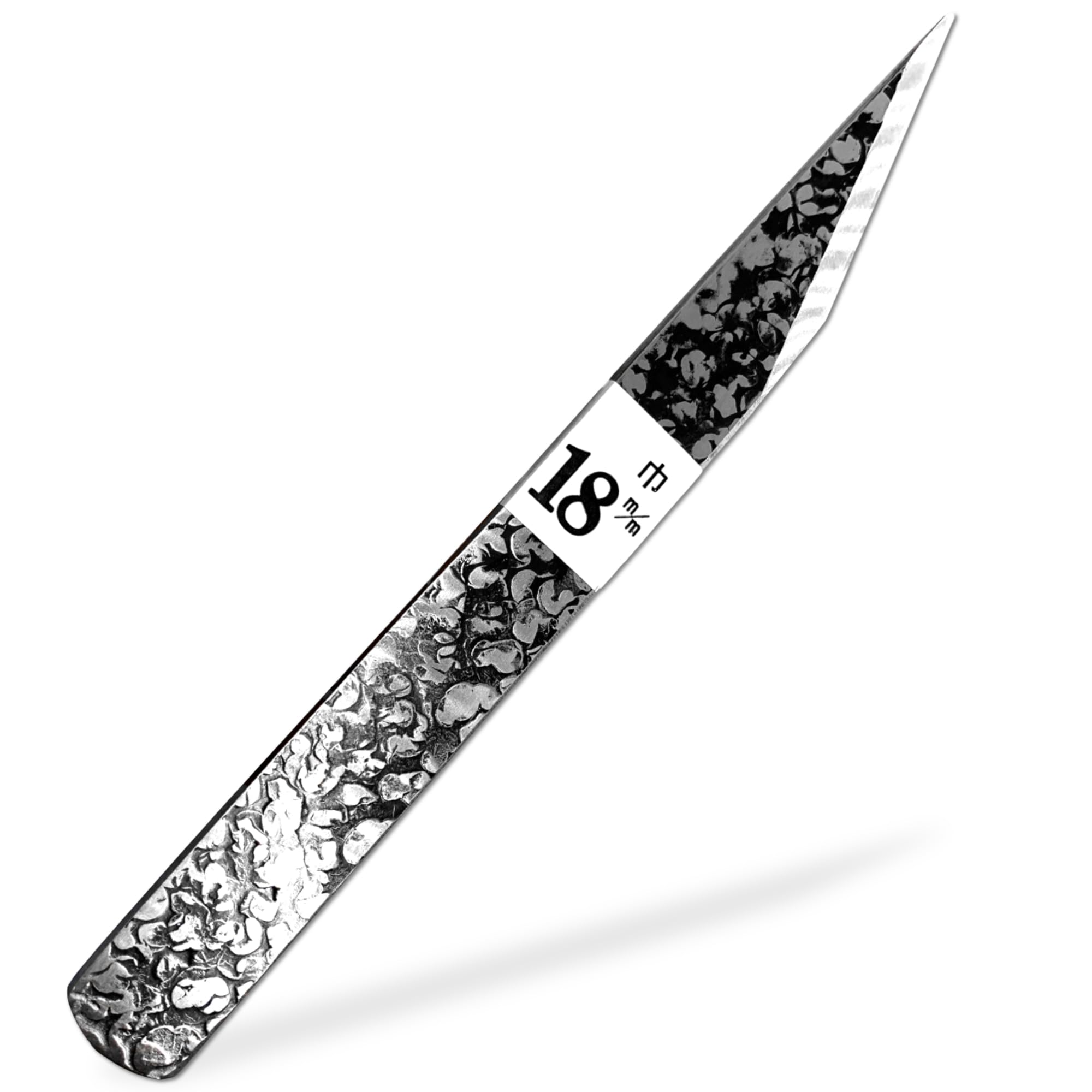
If you lay out dovetails, the flat back is the whole point. This kiridashi is ground on a single face, so the unbeveled side can sit flush against your square and the cut begins right at the rule’s edge — not a hairline off to one side. Cutting width is 1.9″ and the blade is 18 mm wide, which is plenty of hardened edge to scribe a shoulder in one pass.
The blade is hand-forged from laminated steel: a hard high-carbon core bonded to soft iron. That construction is what the Japanese traditio
n is built on, and it pays off at the sharpening stone — the soft iron backing grinds away fast so you can refresh the bevel without fighting the steel. Each knife is individually hand-hammered, so the tsuchime pattern on yours will not look identical to anyone else’s. The one-piece steel body means there are no loose parts to work free over years of use.
What wins people over is the edge itself, straight from the start. Owners describe it as sharp enough to shave leather, and it earns more owner praise for sharpness than anything else on the knife. The honest catch is the nature of thin, hard Japanese steel at a single-bevel tip: a couple of buyers have snapped the point off, usually by prying or dropping it. This is a marking knife, not a chisel — treat the tip as a delivery system for a line, not as a wedge.
Where it earns its keep
- Single bevel with a flat back registers tight against a square
- Laminated high-carbon steel and soft iron sharpens quickly on a stone
- One-piece forged body with no fasteners to loosen
- Hand-hammered finish means a genuinely individual tool
What to watch
- Right-handed orientation only
- Thin single-bevel tip demands care — no prying or levering
- At 3.52 ounces it is heavier than the Narex 822302, which drops the same job onto a thinner blade
Best for: anyone laying out joints with a square who wants the line to start exactly at the rule.
Look elsewhere for: left-handed work — the bevel is ground for the right hand only.
2. Marking Knife Woodworking Heavy Duty
A budget striking knife that still hits 58 HRc and ships with a leather sheath.
This is the value play on the list, and it does not skimp where it counts. The blade is 100% high-carbon steel hardened to a minimum of 58 HRc — the same hardness figure the Narex 813800 hits, at a lower entry point. It is a striking knife built to be tapped with a mallet to set a deep shoulder line, with a fine tool tip rather than a broad blade.
The double-sided blade is the practical choice for a shared bench. Left- or right-handed, you can scribe toward yourself or away, and the edge holds up on both softwoods and hardwoods. The hardwood handle is riveted to the tang, giving a flat, solid grip that sits steady in the hand rather than rolling around.
Buyers keep coming back to one point: this is a good tool that arrives very sharp. The included leather sheath is a safety feature, not just storage—a bare striking knife on a bench is a hazard, and this sheath covers a blade that is genuinely sharp on both faces. Because it is a young listing on this site, its long-term record is shorter than the KAKURI’s or the Clarke Brothers’. That is a fair reason to buy with the lifetime in mind and expect to touch up the edge more often.
Where the money goes: high-carbon steel at 58 HRc and a riveted hardwood handle is a lot of working tool for a budget spend, and the ambidextrous double bevel makes it a natural shared-bench knife.
The honest caveat: at 4.2 ounces it is the heaviest knife here and one of the lengthiest, so it feels substantial in a small hand. The KAKURI 18mm at 3.52 ounces puts a thinner blade in a more compact package.
Reach for this if: you strike your marking lines with a mallet and want a knife that will take the tap.
Leave it if: you want a knife that disappears in the palm for fine layout work — the RUITOOL at 50 g is the lighter tool.
3. RUITOOL Woodworking Marking Knife
The light knife that works in either hand and does not roll off the table.
At 50 g this is the featherweight of the group, and the difference shows up in use. There is no mass fighting your fingertips when you cut a fine line, and the blade is just 1.8 inches long — shorter than the Mikov kit’s 5.88-inch blade — so it is nimble in tight layout work. The flat handle profile is a small design detail with a real payoff: it stops the knife rolling off the bench after you set it down.
The steel is 100% high-carbon, heat-treated and tempered to a minimum of 58 HRc, with the blade precision ground on a CNC machine. That means a spear-point double bevel sharpened by machine rather than by hand, so the angle is consistent from tip to heel. The double-sided blade works in either hand and cuts through softwoods, hardwoods like cherry and ash, and for fine carving and chipping alike.
Owners call it a great-quality tool that arrives extremely sharp, and one reviewer noted it can be sharpened for a lifetime. The included leather sheath keeps a hard, sharp blade covered between cuts. Two honest notes: the factory sheath gets mixed reports—a few buyers find the fit sloppy—and the double bevel means the tip sits centered, so it does not lie flush on a square the way a single bevel does. The sheath is a storage accessory, not a core feature.
Pick this one if: you are adding a first real marking knife to a bench and want a light, ambidextrous blade with a sheath.
Think twice if: you are a left-hander who wants to index the flat of the blade against a rule every cut — a single bevel like the KAKURI does that better.
4. Mikov V2003014 Marking Knife Kit
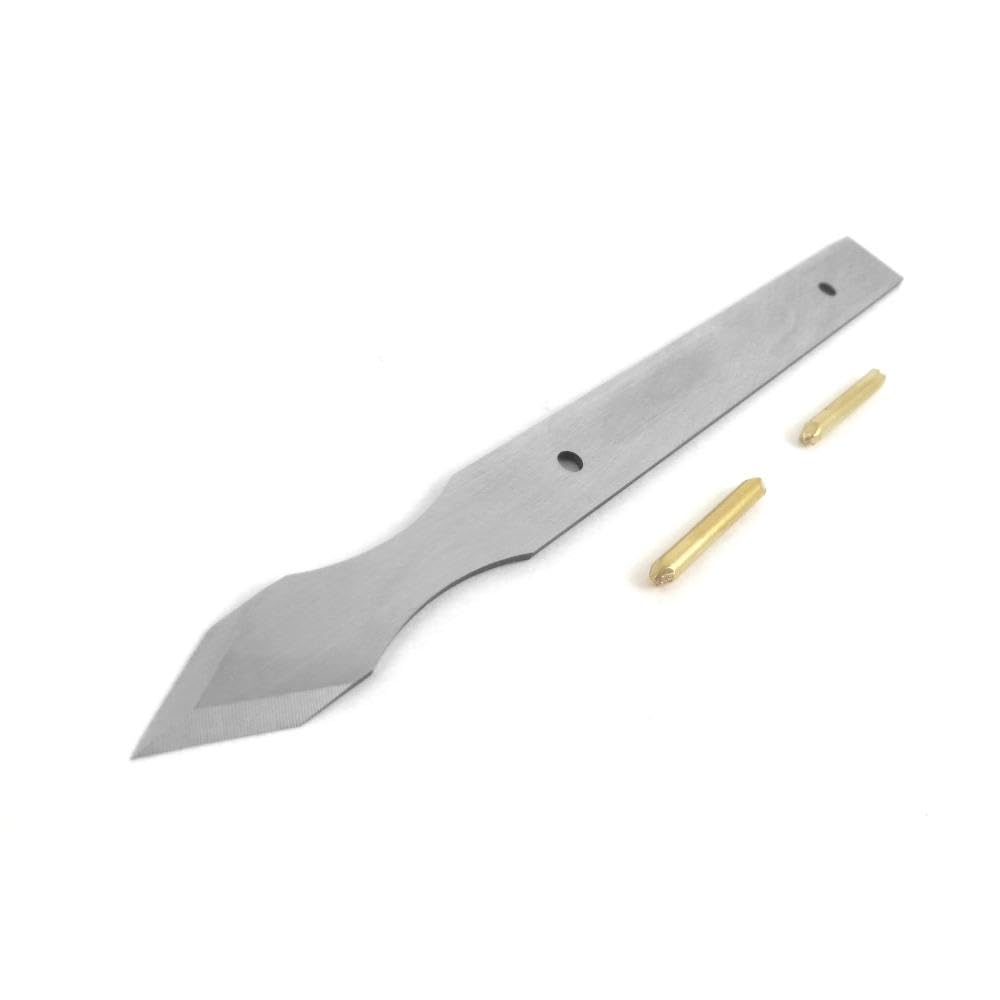
A bare blade and two brass pins — the knife you finish on your own bench.
This is a kit, not a finished knife, and that is precisely the appeal. The blade arrives at 5.88 inches long, 0.060 inch thick and 1/2 inch wide, with two brass pins included to rivet on wood scales of your own choosing — walnut, exotic stock, whatever offcut you have been saving. Compared with the finished knives here, you are trading the handle work for a blade of notable length: the KAKURI 15mm kiridashi, by contrast, is 1.5 inches of cutting width.
The blade resists rust because it is AISI 420 corrosion-resistant stainless steel, hardened and tempered to HRC 57 (a measure of steel hardness). That is softer than the Narex 822302’s HRc 61, but it is stainless, which matters if your shop stays damp. Laser-cut finger indents let you choke your grip closer to the tip for pressure where it counts. The dual bevel is ground on CNC machines with a 55-degree tip and a 25-degree angle on both faces, so it scribes a crisp line on the right or left side of a part, with the grain, against it, and on end grain.
One honest heads-up: this blade may need a light stropping to remove a small wire edge before it is razor sharp. That is not a defect — it is what a freshly ground stainless edge asks for, and five minutes on a strop settles it.
The angle of it: for a maker who enjoys the handle as much as the cut, this is a rare chance to shape a Czech-forged blade to your own hand.
What to expect: it arrives sharp but not necessarily shaving-sharp — plan on a strop before your first joint.
Worth it for: woodworkers who want to handle their own blade with brass pins and a bit of hardwood.
Not for you if: you want to take it from the start and cut — the finished knives here save you the step.
5. Clarke Brothers Marking Knife with Leather Sheath

A double-edged blade in a Padauk handle that looks as good as it cuts.
Owners talk about build quality here more than anything else, and it starts with the 100% high-carbon double-edged blade. It is 100% high-carbon steel ground double-edged, so it works with both hands for a better grip and more control, and it performs on hardwoods like cherry and ash as readily as on softwoods. The blade sits at 5.5 centimeters long and the handle is a 16-centimeter Padauk piece — the brand’s subtle logo inlay is a nice touch without shouting.
The edge is sharp right from the start and stays that way through the sort of work most people actually do — scribing a line for a hand saw or chisel to follow. Owners find it cuts cleanly on recessed cuts and leaves a clear line along the grain. The high-carbon steel holds its edge across repeated scribing sessions, so the sharpening stone sees less of the blade than you might expect.
The carbon steel blade does what carbon steel does: it will take a patina and it wants to be wiped down after work, which is a small routine, not a problem. The wood-handled knife in the nice sheath also makes a thoughtful gift, and the shell-like finish on the Padauk handle keeps the whole tool looking sharp on a bench or in a tool roll.
The case for it
- Double-edged high-carbon blade works in both hands
- Padauk wood handle with a comfortable grip
- Sharp from the start and holds it through repeated sessions
- Sheath included for safe transport and storage
The catch
- A double bevel centers the point, so it will not index flush against your square
- Carbon steel needs wiping down after contact with moisture
- A few report the sheath is a little loose on the blade
The right fit: someone who wants a sharp, handsome bench knife for everyday scribing who does not mind a quick wipe-down.
A mismatch if: you cut dovetails all day and need the flat registration of a single bevel.
6. KAKURI Kiridashi Knife 15mm

Two millimetres of edge trimmed away to reach the tight curves.
The 15 mm version of the KAKURI kiridashi is the finer knife of the pair. Where the 18 mm blade gives you broader cutting width, this narrows to 0.6 inches — 15 mm — and a 1.5-inch cutting edge on a 7.3-inch overall length. That slimmer profile is what you want for curves, inlay, and the inside corners of a half-lap where a wider blade will not reach.
The construction is identical stock: hand-forged laminated steel, a hard high-carbon core bonded to soft iron, hand-hammered for the tsuchime finish, and the blade and handle formed as a single piece. What owners value is how far that thin, razor-sharp point can travel — the fine tip is what allows a clean cut around a curve rather than a series of straight chops.
The trade-off you accept here is the same one as its 18 mm sibling, amplified by the narrower blade: the tip is delicate. The single bevel means right-hand use, and the flat back means it registers against a rule beautifully when you mark a shoulder. If you want one kiridashi for both heavy shoulder-work and detail, the 18 mm covers more ground; pick this one when detail is the job.
Where it shines: leatherwork and curved work both benefit from the fine point, and owners say the thin tip cuts curves cleanly instead of dragging.
The honest limit: that same thin point is what you must protect — no levering, no dropping, and keep the blade guard on when it leaves your hand.
balance for: model makers, leatherworkers, and anyone doing inlay or inlay-style curves who needs a very fine edge.
Skip if: you want one knife for everything — the 18 mm carries more general weight.
7. Narex Czech Steel Marking Knife 813800

Thick enough to take a mallet tap, ground for a dead-straight shoulder.
Where the thin blades on this list feel like fine pens, this Narex is a working striking knife. It is made by a small, respected tool maker in the Czech Republic, and the blade comes from Cr-Mn steel — chrome-manganese alloy — heat-treated to HRc 58 and ground.090″ thick and.380″ wide. It is beefier than the Narex 822302’s.055″, which is what lets you tap the spine with a mallet to deepen a shoulder line.
The blade is 2.75 inches long on a 4.125-inch European Beech handle. The edge is single-bevel sharpened and ground at 25 degrees, with dual bevels at 5 degrees on each face — a combination grind that is versatile across marking, carcing, and the heavier side of layout work. Owners find it marks true in hard maple, including the dovetail that made one woodworking task go right the first time.
The one consistent note about this knife is sharpness. The consensus is that it is well-built and comfortable, sometimes described as equal to the buyer’s finest Japanese marking blade — but a subset find it less sharp than expected from the start. That is a sharpening-stone step, not a reason to write off the tool. If you keep a stone and a strop on the bench, the hardness treats you well and the thick blade stays steady under a tap.
Go for this if: you strike lines and want a Czech-made blade that hands your mallet the work.
Look elsewhere if: you want a razor edge straight out of the wrapping — plan on honing it first.
8. Narex Thin Blade Dual Bevel Striking Marking Knife 822302
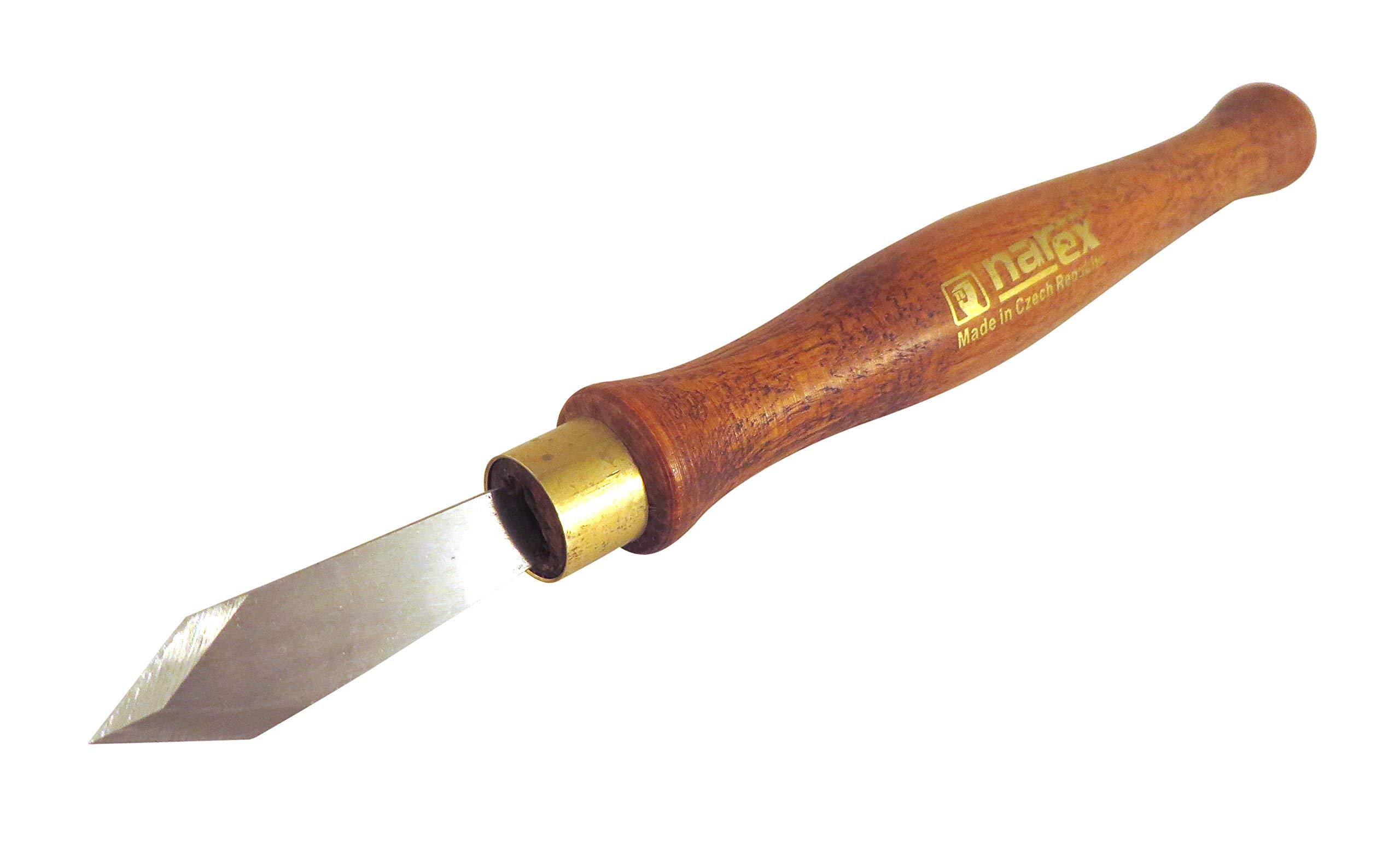
The hardest steel here and a line thin enough to vanish under the saw.
This is the finest knife on the list for a reason. The blade is.055″ thick and.410″ wide — thinner than the Narex 813800’s.090″ — which leaves a narrow kerf that a fine saw and a small chisel follow without chattering. The Mn-V alloy steel is heat-treated to HRc 61, the hardest figure in this lineup and the one most likely to hold an edge through a long run of dovetails.
The overall length is 6.75 inches, with a 5.25-inch hornbeam handle that lets you lay your whole hand on it for control. The double bevel is sharpened at 20 degrees with the tip ground to 55 degrees, making it a true striking knife — the kind you tap with a mallet rather than just draw across a board. Owners find the hornbeam handle well-made and comfortable, and the thin blade clean in the cut.
What it does best is mark dovetail tails through the pin boards with a depth you can see before the saw touches wood. The trade-off of an HRc 61 edge is what the steel gives up: at that hardness the edge is more brittle than a softer alloy, so it rewards a light touch rather than horsing it around. Keep the tip out of levers and pries, and the HRc 61 edge will outlast the softer steels on this list.
Why it leads the dovetail pack
- Hardest steel of the group at HRc 61 for edge retention
- Thin.055″ blade makes a narrow, accurate kerf
- Long hornbeam handle gives plenty of grip
- Double bevel with a 55-degree tip suits striking work
The honest other side
- High hardness asks for a light touch — no levering the tip
- Premium pick, so it costs more than the entry-level kits above
Worth the step up for: dovetail and fine-joint work where the finest possible kerf matters most.
Not necessary if: you are happy to sharpen more often and prefer a broader, softer blade on the bench.
Know the Specs
Bevel geometry
A single bevel means the blade is ground on one face only, leaving a flat back that sits flush against a square or rule. That flat registration is what keeps a line true. A double bevel is ground on both faces; it works left- or right-handed and marks from either direction, but the point sits centered so it does not register flat against a straightedge.
HRc hardness
HRc is a steel hardness scale. Higher numbers (HRc 61 vs HRc 57) mean the edge stays sharp longer under hardwood, but the steel becomes more brittle. The Narex 822302 at HRc 61 leads here, with the Narex 813800 and the Kimting knife at HRc 58 close behind.
Common Questions
Will a double-bevel marking knife work for left-handed use?
What HRc number should I look for in a marking knife?
Can I use a marking knife on end grain and across the grain?
Is a striking knife different from a marking knife?
How long does the Mikov unhandled kit take to finish?
Do these knives come with a sheath?
What blade thickness should I want for dovetails?
Which knife is best for carving rather than just marking?
Can I mark leather and paper with these knives?
Do I need to sharpen a new marking knife before use?
The Bottom Line
For most woodworkers, the wood marking knife winner is the KAKURI Kiridashi 18mm — the flat back registers against a square and the laminated steel sharpens fast on a stone. If you want a striking knife you can tap with a mallet, the Narex 822302 leads on hardness at HRc 61. And for a budget entry into fine layout, the Kimting scribing knife holds 58 HRc with a double bevel and a leather sheath. Match the bevel to how you work — single for square-registered layout, double for ambidextrous striking — and you will be marking clean joints this weekend.
How we choose
We do not accept paid placement. Every pick is matched to a real buyer and a real use-case; we do not hands-on test units.
Sources
Specifications: manufacturer listings and product documentation. Review insights: verified customer reviews, as of November 2026. Pricing: not shown on this page (it changes often); check the current price via the retailer link.
As an Amazon Associate, Tactical Gear Guy earns from qualifying purchases. This does not affect which products we feature.