Specs are compiled from manufacturer listings and verified buyer reviews and can change over time — please confirm the key details on the product page before buying.
A good board keeps your knife edge sharp, stays put on the counter, and doesn’t split within a year. That narrows the field fast: you want real maple, the right thickness, and a size that matches the food you actually cut. Below are eight maple boards that hold up, sorted by what each one is genuinely best at — the little 12-inch square for cheese and herbs, the big end-grain slab for breaking down a roast, and the value boards in between.
This guide is built by comparing the manufacturers’ published specifications and the patterns across verified customer reviews, so you get each pick’s real strengths and trade-offs instead of marketing spin.
Maple is the standard for a reason: it’s dense, it’s gentle on a blade, and it refuses to stain. The eight boards here split cleanly into serving pieces, everyday prep boards, and heavy carving slabs. This breakdown of the wood maple cutting board covers which size fits your counter and how to keep the grain from drying out.
Top Picks

How To Choose The Best Wood Maple Cutting Board
The mistake most people make is buying a board by how it looks on the shelf. A maple board is a working surface, and it lives or dies on three things: grain orientation, thickness, and whether you’ll actually oil it. Get those right and a board can serve you for a decade. Get them wrong and it cups, splits, or chews up your knives.
Edge Grain Versus End Grain
Edge grain means the wood fibers run sideways along the board, which gives you a firm, flat, easy-to-clean surface — this is what most kitchen boards use. End grain stands the fibers on end like a bundle of straws, so a knife edge slips between them instead of slicing across them. End grain is gentler on your blades and shows fewer marks, but it’s heavier, thirstier for oil, and generally pricier.
Thickness And Weight Decide Stability
A thicker board resists warping and stays put while you chop, but it also gets heavy to lift and harder to store. Boards here run from 1.25 inches up to 1.75 inches thick, and weight scales right along with that. If you plan to leave it on the counter, go heavy and thick; if you need to move it to the sink or a cabinet, a lighter board wins.
Juice Grooves, Handles, And Feet
A juice groove is a channel routed near the edge that catches runoff so it doesn’t reach your counter — worth having if you carve roasts, whole chickens, or juicy fruit. Invisible inner handles let you lift a heavy board without scraping your fingers. Raised feet or rubber pads stop the board from sliding and let air move underneath, which helps the wood dry evenly.
Care Is Part Of The Purchase
Every board here is hand-wash only. No dishwasher, no soaking. Maple needs periodic oiling to stay sealed and flexible, and the manufacturers specify their own intervals. Skip the oil and the wood dries, the grain opens, and cracks follow. Budget a few minutes a month for oiling and these boards last.
Side-by-Side Comparison
| Model | Best For | Size (L x W) | Thickness | Weight | Amazon |
|---|---|---|---|---|---|
| John Boos B Series Square 12″x12″★ Best Overall | Cheese and charcuterie display | 12″ x 12″ | 1.5″ | 6 pounds | Amazon |
| CONSDAN Hard Maple 16″x12″Mid-Size Workhorse | Everyday prep on a mid-size board | 16″ x 12″ | 1.5″ | 8.9 pounds | Amazon |
| John Boos Prestige Grooved 16″x10″Grooved And Reversible | Meat and fruit with a juice groove | 16″ x 10″ | 1.25″ | 5.4 pounds | Amazon |
| CONSDAN Hard Maple 20″x15″ | Large-volume batch cooking | 20″ x 15″ | 1.5″ | 13.3 pounds | Amazon |
| Sonder Los Angeles Winsome | Charcuterie and two-sided prep | 17″ x 13″ | 1.5″ | 8 pounds | Amazon |
| Bevel & Bond End Grain Maple | Knife-edge care and heavy carving | 17″ x 13″ | 1.75″ | 10 pounds | Amazon |
| JK Adams Carving Board | Holiday turkeys and big roasts | 20″ x 14″ | 1.25″ | 6 pounds | Amazon |
| DuraSteel Solid Wood Table Top | Countertop and workbench surface | 30″ x 18″ | 1.5″ | 18.96 pounds | Amazon |
Detailed Reviews
1. John Boos B Series Square Wooden Maple Cutting Board 12”x12”
Our pick — 4.5+★ from 900+ verified ratings; the strongest balance of quality and price.
The board that earns its counter space by doing two jobs — prep and presentation — without ever looking out of place.
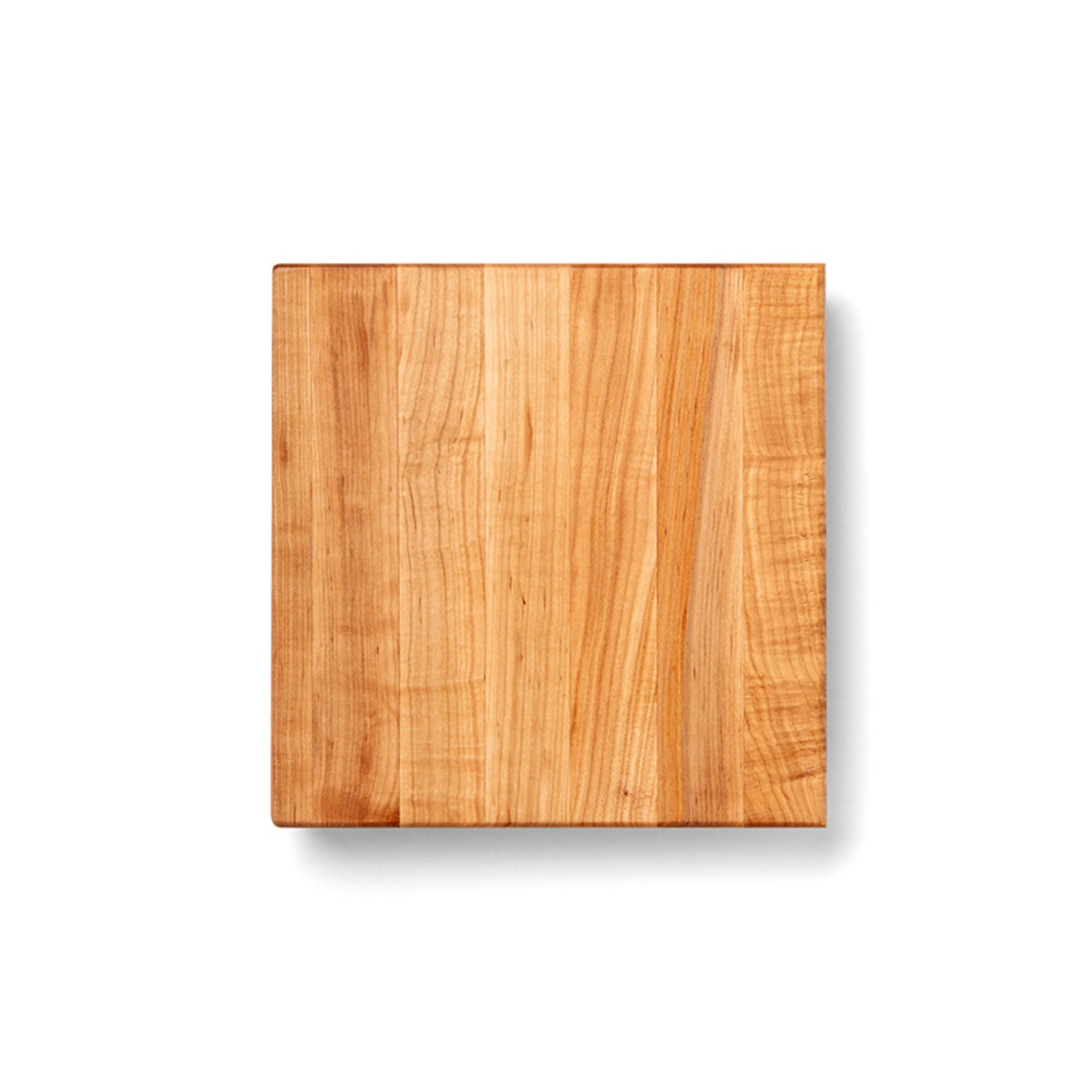
Here’s the winner, and it’s a compact one. This is a 12″ x 12″ square maple block, 1.5 inches thick, weighing 6 pounds. That footprint is small for a full meal but exactly right for cheese, fruit, bread, and pastry — and it’s the board most people end up reaching for because it looks good enough to leave out. The raised bun feet (about 1 inch tall) lift it off the counter so it doubles as a serving piece instead of getting tucked in a drawer.
What wins people over is the build. Owners describe it as sturdy and well-built, and the consensus is that it handles fruit and herb chopping without a wobble. The nonreversible design and oil finish mean the top face is your cutting surface and the whole thing stays put. Compare its 1.5-inch thickness to the John Boos Prestige at 1.25 inches and you can feel the difference in heft — the square block sits flatter and resists the little rock a thinner board develops.
The catch is capacity and care. At 12 inches square you’re not breaking down a chicken on this; it’s a garnish-and-charcuterie board. It’s also hand-wash only, and John Boos wants its Mystery Oil and Board Cream used to keep the surface sealed. So the honest read: superb for serving and small prep, not your one-and-only board for a Sunday roast.
Where this board delivers
- 1.5-inch edge-grain maple with a genuinely flat, level cutting surface
- Raised bun feet make it a display piece, not just a prep tool
- Nonreversible design keeps one clean face for the knife
- 6 pounds — easy to lift from counter to table
Where you’ll feel the limits
- 12″ x 12″ is tight for large cuts of meat
- Hand wash only, and the brand’s oil and cream are sold separately
- Its serving role means you’ll want a second board for heavy prep
Reach for this if: you want a handsome maple board that lives on the counter for cheese, bread, and herbs.
Look elsewhere if: all your cutting happens on whole chickens and big roasts — you need more square inches.
2. CONSDAN Hard Maple Wood Cutting Board 16″x12″
This board hits the size and thickness balance for daily cooking, and its juice groove keeps runoff off your counter.
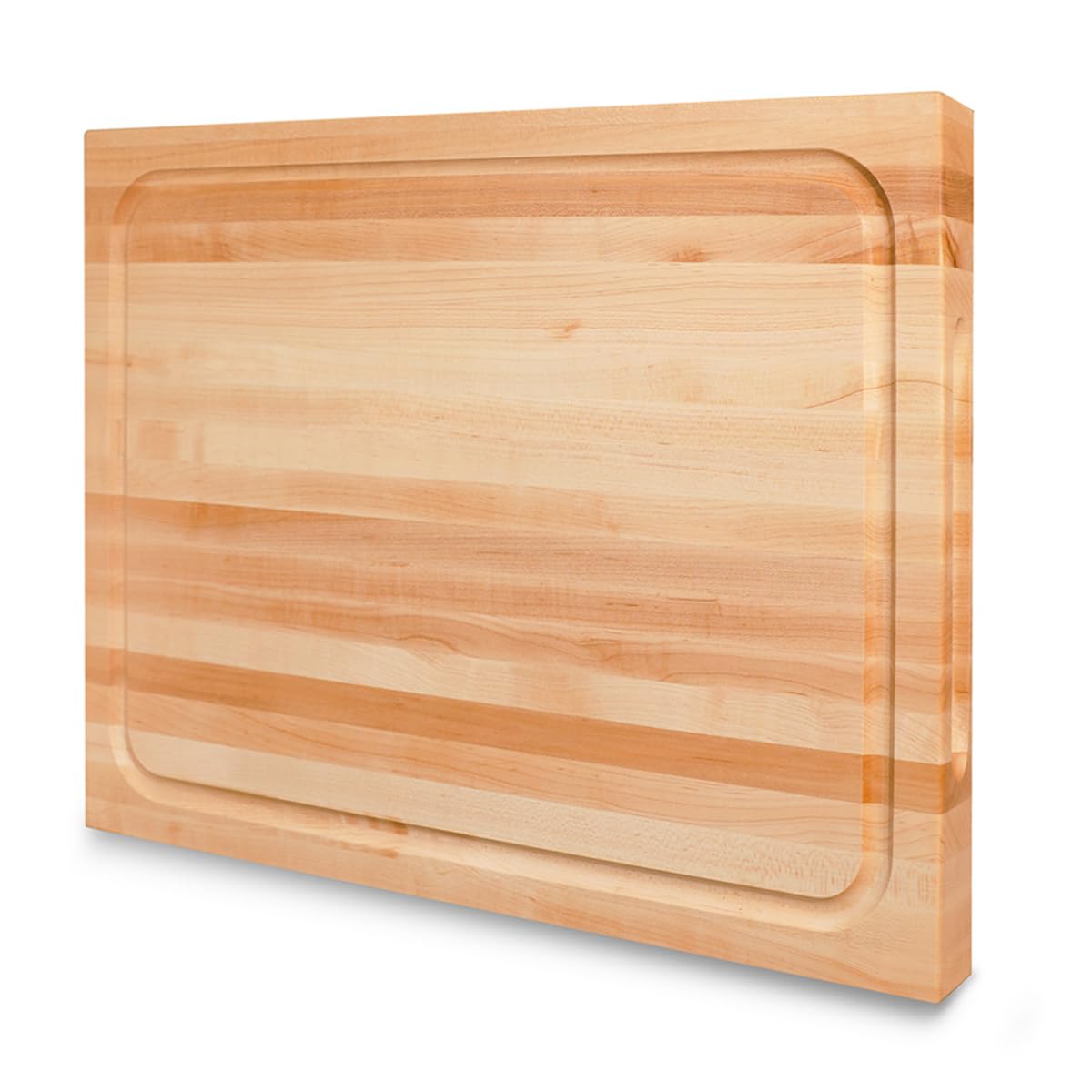
Cook most nights and a 16″ x 12″ board at 1.5 inches thick stops feeling cramped while still fitting beside the sink. This CONSDAN packs 8.9 pounds of solid maple into that footprint. Two features matter more than they sound: a deep juice groove that traps runoff from meat and fruit, so your counter stays dry, and invisible inner handles polished smooth, so you can lift a heavy board without scraping a knuckle.
The maple itself is light cream to tan with a tight, closed grain, and the surface is gentle on your knife edge. It arrives prefinished with a food-safe wax oil, so you can chop on day one — just wash it with mild soap and water after.
The honest note here is durability reports. A few buyers describe the board breaking into pieces, so this isn’t a board to toss in the sink or drop on a tile floor. The 8.9 pounds of mass keeps it from sliding under normal use, though. Give it the hand-wash treatment it asks for and it behaves.
Why it earns second place: solid maple, a true juice groove, and polished inner handles in one mid-size board — a practical do-it-all for weekday prep.
The trade-off to know: some buyers report splitting, so treat it gently and never soak it. If you want a board you can be rough with, an end-grain option or a thicker slab is the safer call.
Fits best when: you want one mid-size maple board for onions, chicken, and fruit — handled with care.
Think twice if: you tend to leave boards soaking in the sink; this one wants dry, prompt care.
3. John Boos Block Prestige Grooved Reversible Board 16″x10″
A lighter John Boos with two usable faces, a juice groove, and a finger hole that actually helps you lift it.
This is the Boos board for people who want one surface for meat and another for produce. It’s reversible, so you flip it — one side carries the juice groove for carving, the other gives you a flat face for vegetables. At 16″ x 10″ x 1.25 inches and 5.4 pounds, it’s noticeably lighter than the 1.5-inch CONSDAN 20″x15″ above, which matters if you move your board to the sink after every meal.
The size earns real praise. It’s big enough to chop an onion and garlic on the same surface without the pieces wandering off the edge, per the way buyers talk about it. The sturdiness and function also come up positively, and the finger-hole grip makes that flip-and-lift routine easy. The oil finish means it’s ready to use, hand-wash only thereafter.
Where it differs from the square Boos at the top of this list: it gives up 0.25 inches of thickness (1.25″ versus 1.5″) and trades the bun feet for a low, flat profile. That’s a fair swap for a board you slide and flip daily. The trade-off is that at 10 inches wide, it’s the narrowest full-size board here — great for two-hand chopping, less so for spreading out a whole meal’s prep.
Two faces, one board: reversible with a juice groove on one side and a finger hole for lifting — genuinely useful, not a gimmick.
The caveat: 10-inch width and 1.25-inch thickness make it nimble but less roomy than the bigger slabs here.
Good call for: a daily board you flip for meat versus veg and rinse by hand.
Pass if: you want a thick, heavy slab that stays planted on the counter full time.
4. CONSDAN Hard Maple Cutting Board 20″x15″
Thirteen-odd pounds of hard maple that finally gives a whole turkey somewhere to sit.
Twenty by fifteen inches, 1.5 inches thick, and 13.3 pounds — this is the CONSDAN for people who cook in volume. Pictures of whole turkeys and hams fit on it, the way owners describe using it, and the deep juice groove catches what a big roast throws off. The surface is prefinished with food-safe oil, and the invisible inner handles are polished so you can haul the thing from counter to table without scraping your grip.
The mass is the point. Durability is what owners praise most, and the thickness and size back that up — a board this heavy doesn’t skate while you bear down on a cleaver. It’s a genuine step up in real estate from the quarter-sheet Boos and the 16″x12″ CONSDAN above. If your old board was always just slightly too small, this ends that argument.
But 13.3 pounds is 13.3 pounds. It’s the heaviest board here short of the DuraSteel slab, so it lives on the counter rather than in a drawer — plan a permanent home for it. And it’s hand-wash only, like every board in this list. This is the one to pick when capacity beats convenience.
What makes it worth the counter space
- 20″ x 15″ surface handles turkeys and hams in one pass
- 1.5-inch hard maple with a food-safe oil finish
- Deep juice groove keeps big-cut runoff off the counter
- Polished inner handles make the weight manageable
The honest downside
- 13.3 pounds — not a board you tuck into a cabinet
- Hand wash only, no dishwasher
- Oversized for small kitchens or tight counters
Made for: cooks who break down big cuts and want one board that keeps up.
skip it if: your counter is short on space or you like to stow your board away after use.
5. Sonder Los Angeles Winsome Maple Cutting Board 17″x13″
A maple board built to be seen as much as used, with a cracker well that turns prep into a spread.
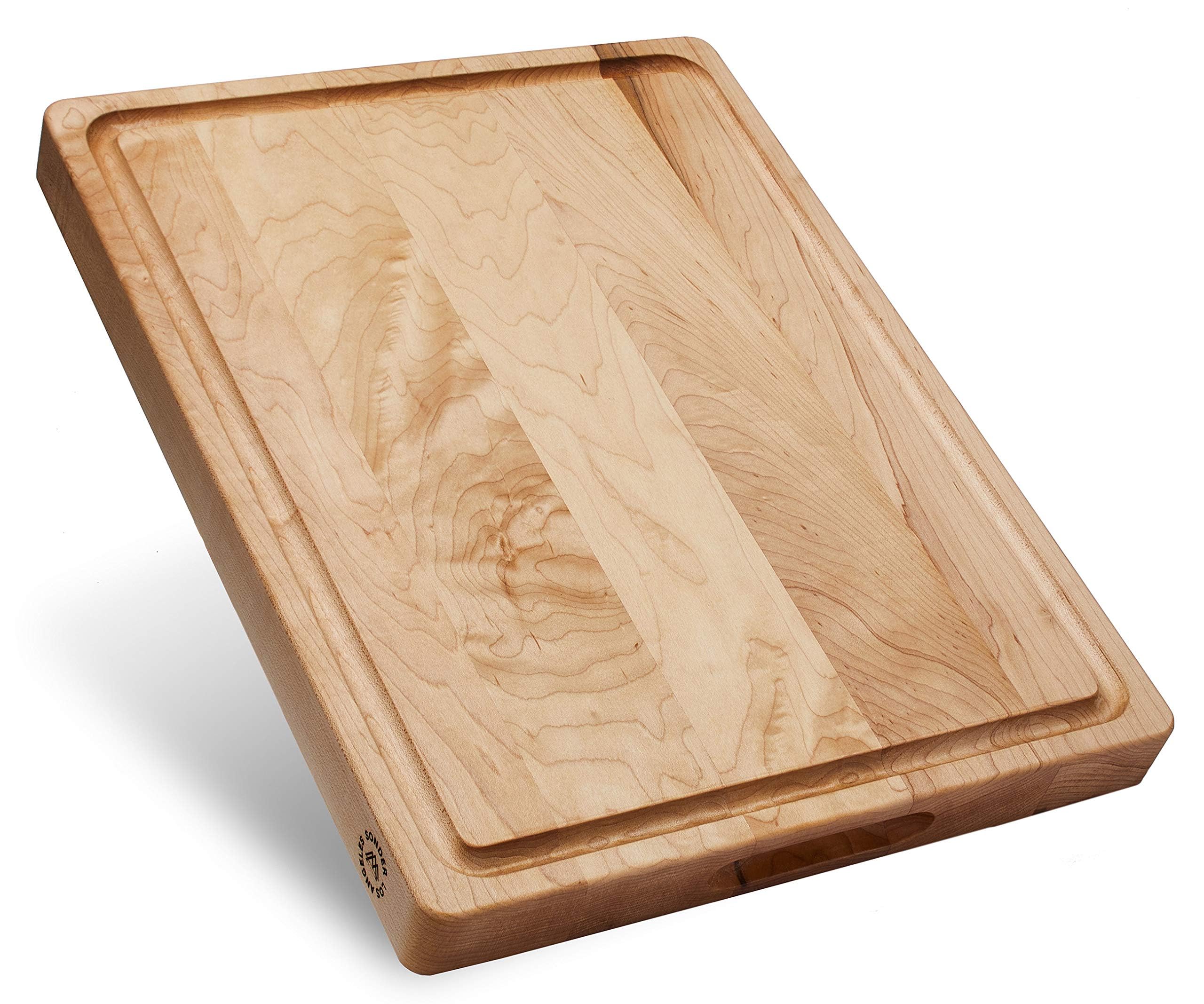
Here’s a board that does something specific: it’s designed to go from cutting board to charcuterie display in one motion. The Winsome carries a signature cracker well — a routed groove sized for crackers, sliced baguette, nuts, or olives — plus a deep 3.5 fl oz juice groove that catches liquid from the juiciest meat or fruit. At 17″ x 13″ x 1.5 inches and 8 pounds, it’s a comfortable size to fill and carry.
The build is where it earns its keep. Owners consistently call it a luxurious piece of equipment with beautifully finished appearance and real durability, and the craftsmanship discussion runs deep. It’s edge-grain American maple with horizontal fibers that resist stains and scoring, and it’s reversible, so you get a different function on each face. Gift-box included if you’re buying for someone else.
The upkeep is the one real trade-off, and Sonder spells it out: oil it every 2-3 weeks and hand wash only. That’s more frequent conditioning than some boards demand, so it wants a buyer who’ll actually keep up with the oil. Do that, and this is the board you leave out for company.
The cracker well is the difference: a built-in groove for crackers and olives plus a deep juice groove make it a true serving board, not just a prep surface.
Fair warning on care: it needs oiling every 2-3 weeks to stay sealed — skip that and the finish suffers.
Buy it for: hosting — you want a maple board that looks the part on the table.
Not your board if: you won’t keep up with a recurring oiling routine.
6. Bevel & Bond Maple End-Grain Cutting Board 17″x13″
The one that treats your knife edge like it matters — end grain, 1.75 inches thick, planted on rubber feet.
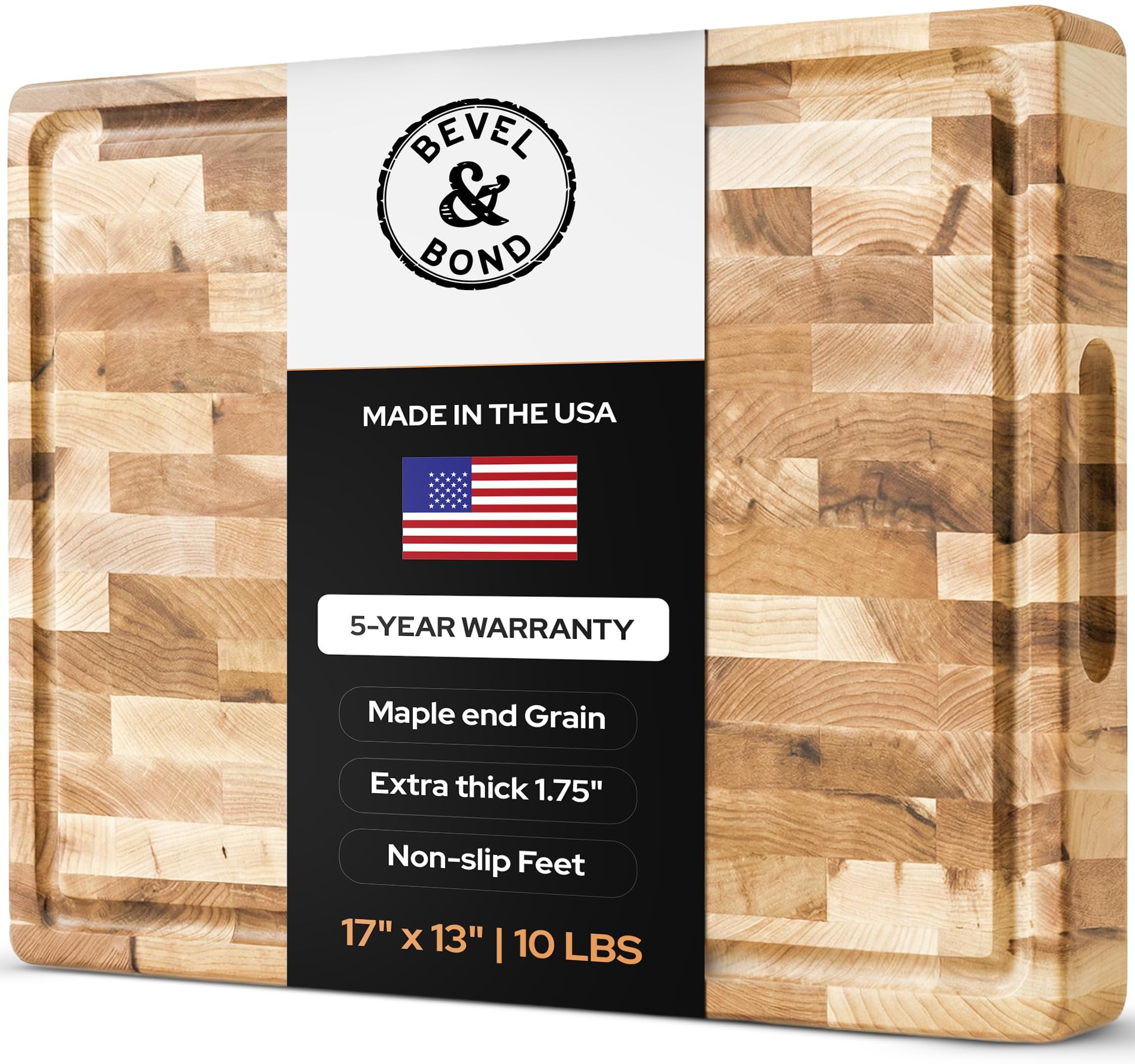
End grain is the upgrade worth understanding. Because the fibers stand on end, your knife edge slips between them instead of cutting across them, so the surface marks less and forgives your edge. Bevel & Bond builds this one at a full 1.75 inches — thicker than the 1.5-inch boards that dominate this list — on a 17″ x 13″ footprint at 10 pounds. The extra mass and rubber non-slip feet keep it locked to the counter while you bear down on a roast.
Owners call it well-made with a smooth surface, and the stability and hardness come up as strengths. It’s handcrafted in the USA from American hard maple, arrives pre-conditioned in mineral oil, and ships in a gift box. The deep juice groove catches runoff from whole chickens, and finger grips on both sides make it moveable for carving at the table. A 5-year warranty backs it against defects.
Durability is the split point in the data — most say it’ll last for years, while a minority report splitting. End grain is thirstier than edge grain, so it wants regular conditioning to stay tight. Treat that as a commitment, not a flaw, and it’s the most knife-friendly board here.
The case for end grain
- 1.75-inch end-grain maple — the thickest build on this list
- Rubber feet stop it sliding and let air flow underneath
- 5-year warranty and a pre-conditioned mineral oil finish
- Gift-boxed and made in the USA
What you sign up for
- End grain needs regular conditioning or it can dry and split
- 10 pounds and hand-wash only
- A few owners mention splitting, so keep up the oil
Right choice when: knife-edge care tops your list and you’ll keep up with conditioning.
Hold off if: you want a zero-maintenance board — end grain demands the oil.
7. JK Adams Maple Wood Carving Board 20″x14″

Built for the one meal a year when the turkey is bigger than the board — and the juice can’t touch your counter.
A carving board lives or dies on its channel, and this one is purpose-built for runoff. The 20″ x 14″ x 1.25-inch solid maple board has a routed channel meant to harness runaway juices, so the drippings land in the groove instead of on your table. The size is big enough for a big turkey — owners describe it holding drips from a bird far heavier than the board itself. Handcrafted and finished in Vermont from 100% North American hardwood, it’s a board with a single job and no distractions.
Owners are extremely pleased with the quality, and appearance comes up right behind. Deep grooves and drainage are recurring praise, because the channel keeps counters clean through the messiest carve. At 6 pounds it’s manageable to lift onto the table for serving, and it comes with a manufacturer’s lifetime warranty per the listing — hand wash and air dry is all it asks.
The honest trade-off: this is a carving and serving board, not your everyday prep surface. It gives up the flat uncluttered face a chopping board wants, and at 1.25 inches it’s on the thinner side for heavy cleaver work. If you already own a prep board, this is the holiday companion. If you want one board for everything, look at the thicker slabs above.
Its single purpose is its strength: a deep juice channel and 20-inch length make it the turkey-day board, full stop.
The limit to weigh: the channel and thinner 1.25-inch profile make it less ideal as a daily all-purpose chopper.
Bring it out for: roasts, birds, and holiday dinners where the juice is the enemy.
Not a fit if: you’re shopping for one board to chop everything on — this one’s a specialist.
8. DuraSteel Solid Wood Table Top 30″x18″ Butcher Block
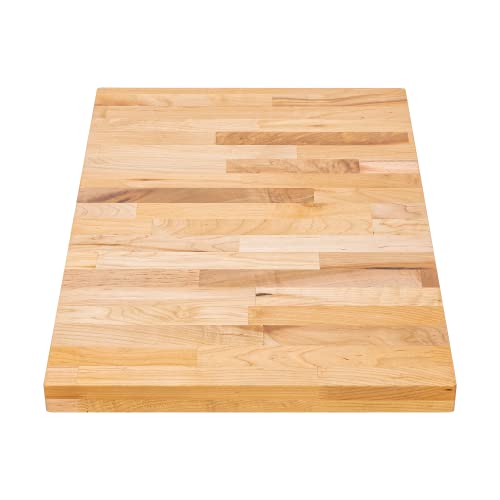
The thirty-inch slab that works as a countertop, a desk, or the most serious cutting surface you’ll own.
This isn’t a board you put away — it’s a 30″ x 18″ x 1.5-inch solid maple slab at 18.96 pounds, designed to sit permanently as a countertop, workbench top, or oversized cutting surface. It features recessed finger grips so you can shift it, an oil finish, and a level cutting surface. The US maple grain is the star: rich wood that owners call a quality piece of solid wood, worth the money, and versatile enough for a bread-making station or a desk.
Because of its size it does things no other board here can. It gives you a continuous 30-inch prep run, which for a serious cook means spreading out a whole batch of vegetables without shuffling. It’s a genuine furniture-grade piece as much as a cutting board. Hand wash only, and it wants cutting board wax and oil applied regularly to keep the fibers sealed.
The honest caution is stability over the long haul. Some customers note warping and bowing on this large a slab, so it wants a flat, dry home and consistent oiling — this is the one product here where durability draws real mixed feedback. Over a large unsupported span wood can move; keep it on a solid surface and it stays put. It’s the least “portable” board and the most “installed” one.
The big-surface payoff: a 30-inch solid maple run turns a counter into a prep station, ideal for batch cooking or a permanent bread station.
What to plan for: at 18.96 pounds it stays put, and large slabs can warp without regular waxing and a flat, dry base.
Worth it for: a permanent countertop or workbench surface that doubles as a giant prep board.
Walk past if: you need a board you can carry to the sink — this one gets installed, not hauled.
Know the Specs
Edge Grain vs End Grain
Edge grain lays the wood fibers sideways for a firm, flat, easy-clean surface that resists stains — most boards here use it. End grain stands the fibers upright, so a knife edge slips between them rather than slicing across, which is gentler on blades and shows fewer marks. The Bevel & Bond at 1.75 inches is the end-grain pick; the rest are edge grain. Choose end grain for knife care, edge grain for a firm flat surface and easier upkeep.
Thickness and Weight
Thicker boards resist warping and stay planted, but get heavy. Boards here range from 1.25 inches up to 1.75 inches thick, and weight tracks right along with it — from 5.4 pounds up to 18.96 pounds on the DuraSteel slab. A 1.25-inch board is nimble and easy to move; a 1.5-to-1.75-inch board is stable and heavy. Match thickness to how you’ll use it: leave it out, go thick; move it daily, go lighter.
Juice Grooves and Channels
A juice groove is a channel routed near the edge that catches runoff from meat, fruit, and vegetables before it reaches the counter. Deeper grooves hold more, and carving-specific boards like the JK Adams use a dedicated channel to harness juices from a whole bird. If you carve roasts or juicy fruit, a groove is worth having; for dry chopping it just reduces surface area.
Handles, Feet, and Reversibility
Invisible inner handles let you lift a heavy board without scraping your knuckles. Raised feet (the Boos square’s bun feet) or rubber pads (the Bevel & Bond’s non-slip feet) stop the board sliding and let air under it so it dries evenly. Reversible boards like the Boos Prestige and Sonder Winsome give you two faces — often a grooved side for meat and a flat side for veg. These features decide how the board actually feels to live with.
Common Questions
Should I buy edge grain or end grain maple for my first good board?
How often does a maple cutting board need oiling?
Can I put a maple cutting board in the dishwasher?
What size maple board fits a whole turkey?
Is end grain actually better for my knives than edge grain?
Why did my maple board split and how do I prevent it?
Do I need a juice groove on my cutting board?
Are these maple boards heavy enough to stay put while chopping?
What is a cracker well and do I want one?
How long does a well-cared-for maple board last?
The Bottom Line
For most kitchens, the wood maple cutting board winner is the John Boos B Series Square 12″x12″. Its 1.5-inch edge-grain maple and raised bun feet turn a prep tool into a board you’ll happily leave on the counter. Cook most nights and want a mid-size workhorse with a real juice groove? The CONSDAN 16″x12″ is the practical pick. For breaking down big roasts or chasing knife-edge care, reach for the 1.75-inch Bevel & Bond end-grain board — its thicker build is the most knife-friendly surface here.
The 4.5+ star Boos square is the crowd favorite, backed by more owners than any other full-size pick here, and its compact 12-inch footprint is what earns it the top spot rather than raw size. Match your board to the way you actually cook, commit to the oil, and any of these will outlast the trend.
How we choose
We do not accept paid placement. Every pick is matched to a real buyer and a real use-case; we do not hands-on test units.
Sources
Specifications: manufacturer listings and product documentation. Review insights: verified customer reviews, as of July 2026. Pricing: not shown on this page (it changes often); check the current price via the retailer link.
As an Amazon Associate, Tactical Gear Guy earns from qualifying purchases. This does not affect which products we feature.