Specs are compiled from manufacturer listings and verified buyer reviews and can change over time — please confirm the key details on the product page before buying.
Buying lathe parts goes wrong in one place far more often than any other: the thread on your spindle. A chuck, insert, or rest that does not match your lathe’s spindle size is scrap metal on arrival, no matter how good the machining is. So start there. Get the thread right and almost everything else on this list will serve you well.
This guide is built by comparing the manufacturers’ published specifications and the patterns across verified customer reviews, so you get each pick’s real strengths and trade-offs instead of marketing spin.
Below you’ll find nine wood lathe parts broken out by what they actually fix — gripping a blank, steadying a long spindle, or holding your tool at the right height. Every pick here threads onto a real lathe spindle, and the top pick holds 4.5+ stars across 200+ owners. Here is how to sort real wood lathe parts from the ones that will sit in a drawer.
Top Picks


How To Choose The Best Wood Lathe Parts
Every part on a lathe does one of three jobs: it holds the wood, it steadies the wood, or it gives your chisel a place to ride. Figure out which job you’re missing before you spend anything. If your blanks slip, you need a chuck. If long spindles whip and bow, you need a steady rest. If your chisel chatters or dives, a better tool rest often fixes it.
Match the thread before anything else
A chuck screws onto the spindle at the end of your lathe headstock. That spindle has a thread size, and it must match exactly. The common size is 1″ x 8TPI — one inch diameter, eight threads per inch. Chucks in this category also ship with adapters that convert 1″ x 8TPI to 3/4″ x 16TPI. If your lathe is neither of those, the chuck won’t thread on, and the makers say so plainly on the listing. Check your spindle first; it saves a return.
Jaw capacity tells you what you can grip
Chucks grip in two directions. Internal jaws close around the outside of a workpiece. External jaws spread inside a pilot hole. The numbers for both are published for each chuck, and they define your real working range. A chuck whose internal jaws span 1-1/2″ to 3″ holds a very different set of projects than one that spans 1-1/4″ to 2-1/2″. Read those ranges against the bowls, cups, and spindles you actually plan to turn.
Tool rests are sized by post, not by wishful thinking
A tool rest slides into a banjo — the clamp on the lathe bed that holds the rest. The post diameter has to fit that clamp. A 5/8″ post and a 1″ post are not interchangeable, and neither is a 4″ post with a 2-3/4″ post. Bar length matters too, because it sets how far your chisel can travel before you have to reposition the rest. Bigger bars are not automatically better for small work.
Steady rests are for spindles, not bowls
Long, thin workpieces bend while you cut them. A steady rest adds support points along the length of the spindle, which cuts the bowing and the vibration. That makes it a specialist tool for baseball bats, chair legs, and table legs — not something a bowl turner needs. Check whether it mounts to a split bed or double rail lathe before you commit, since that’s the fit the maker specifies.
Side-by-Side Comparison
| Model | Best For | Mounting / Thread | Grip Range | Body Size | Amazon |
|---|---|---|---|---|---|
| NOVA 48293 PREMIER PRO-TEK G3 Chuck Bundle★ Best Overall | All-round chuck with the widest jaw kit | 1″ x 8TPI direct thread | 2″ PRO-TEK jaws plus 3 jaw sets | 1 inch | Amazon |
| 8″ Tool Rest with 1″ Dia 4″ PostSteadiest Grip | Small projects on a 1″ banjo | M10x1.5 top thread | — | 8″ bar, 1″ post | Amazon |
| NOVA ILNS Chuck Insert/AdaptorThread Translator | Fitting a NOVA insert chuck to a 1-1/4″ spindle | 1-1/4″ x 8TPI external, M38 x 3.5 | — | 1.25 inches | Amazon |
| PSI CLTSET58 Straight Bar 3pc Toolrest Set | Three bar lengths for one setup | 5/8″ post, 2-3/4″ long | — | 0.63 inches | Amazon |
| PSI Woodworking LSR3 Steady Rest | Long spindles that bow and vibrate | Fits split bed or double rail lathe | Down to 1/2″ spindle | 8.5 pounds | Amazon |
| VINWOX SCR4-4 4″ 4-Jaw Chuck | Big-batch turning on a budget | 1″ x 8TPI with 3/4″ x 16TPI adapter | 1-1/2″ to 3″ internal | 4 inches | Amazon |
| VINWOX SCK4-3.75 Gear Chuck | One-handed key operation | 1″ x 8TPI with 3/4″ x 16TPI adapter | 1-1/2″ to 2-7/8″ internal | 3.75 inches | Amazon |
| WEN LA4374 3.75″ Chuck Set | Dovetail grip on a mainstream spindle | 1″ x 8TPI thread | 1-1/4″ to 2-1/2″ internal | 3.75 inches | Amazon |
| DEEFIINE 8 Pcs M2 HSS Chisel Set | Cutting tools to pair with your rest | Fits most bench and floor lathes | — | 11.6″ handles | Amazon |
Detailed Reviews
1. NOVA 48293 PREMIER PRO-TEK G3 Chuck Bundle
Our pick — 4.5+★ from 200+ verified ratings; the strongest balance of quality and price.
One chuck body, four jaw sets, and a storage case — the bundle that covers bowls and spindles.
If you are going to own one chuck, the sensible shape for it is this one. The G3 ships with a 2″ PRO-TEK jaw set, a JSPIN 1″ pin jaw set, and a JS100N 4″ bowl jaw set, plus a woodworm screw and a case to keep the loose jaws from vanishing into the shavings. That’s three jobs covered by one purchase: pin jaws for narrow spindles, bowl jaws for wide rims, and the PRO-TEK set for everything between.
The jaws themselves use a dovetail profile alongside a serrated one. The dovetail pulls the blank down into the chuck as it tightens, so round and square blanks seat firmly instead of skating. The fasteners are 6-point star heads driven with the included T-bar wrench, built to take torque without rounding out.
Threading is 1″ x 8TPI direct, with no insert required. That simplicity is the point, but it is also the constraint: if your spindle is not 1″ x 8TPI, this chuck is the wrong part for your lathe. Turning action is standard righty-tighty, so nobody has to relearn which way the jaws move.
What makes it the anchor pick
- Three jaw sets plus a woodworm screw arrive in one case, so you are not buying jaws one at a time
- Dovetail and serrated profiles together pull blanks in and hold round or square stock
- Laser-etched numbering takes the guesswork out of jaw changes
- Nickel plating holds up against rust and green wood
Where it stops being the answer
- Direct thread only — 1″ x 8TPI or nothing
- It is the heftiest spend on this list, which is fair for four jaws and a case but hard to justify if you only turn one style
Worth it when: your spindle reads 1″ x 8TPI and you want one chuck that can follow you from pens to bowls without a second purchase.
Look past it when: your lathe runs a different thread — no insert is offered here to bridge the gap.
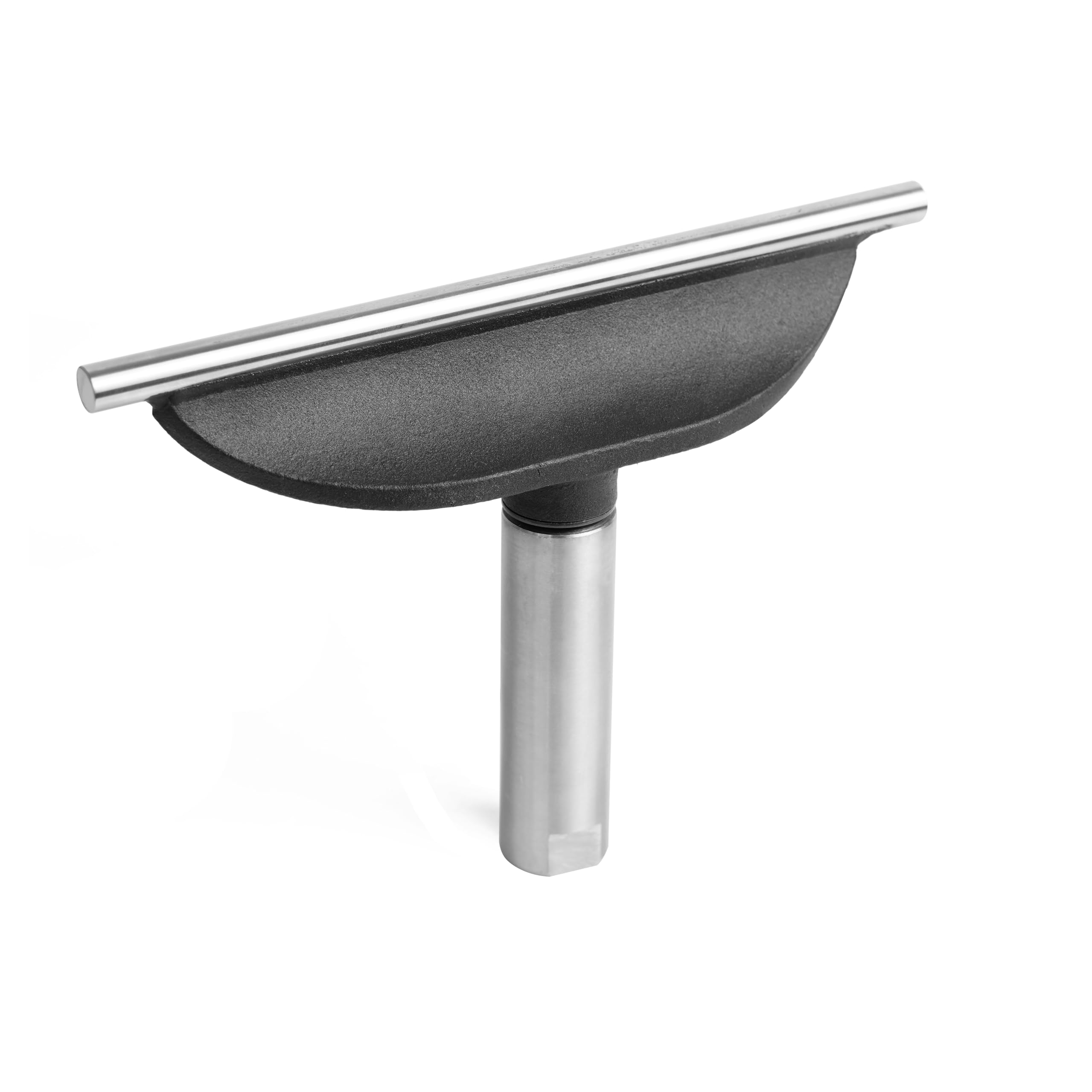
2. 8″ Tool Rest with 1″ Diameter Post
A short bar with a fat post — the rest that gets right up to the cut on small work.
At 1.92 pounds, this rest is the lightest way to put a smooth steel bar under your chisel. For scale, the PSI steady rest further down the list runs 8.5 pounds — this is the opposite kind of part, small and meant to drop straight into a banjo. The 8″ bar suits boxes, pens, and small bowls where a long rest just gets in the way.
The post is 1″ in diameter and 4″ long, which is the number to check against your banjo clamp. The radius is shaped so your hand sits comfortably whether you come over the top or under it. That lets you park the rest close to the work, below or above center height, so the chisel has support right where it meets wood. The round bar is polished enough that tools slide across it, and the one thing people keep returning to is how smoothly the cutting tool rides. That slick surface holds up over years of turning because the bar is solid steel, not a coated one.
The top thread is M10x1.5, a metric thread that matches most brands’ tool rest fittings — including NOVA. So you can swap this bar onto an existing NOVA post if that’s the hardware you already own. The catch is the post sizing. A 1″ post and a 5/8″ post are different animals, and the 4″ length is fixed, so a shallow banjo or a different post diameter will rule this out.
The support angle: small-project turners get a bar close enough to the work that chisel control stops being a fight, and the radius keeps your hands comfortable through long sessions.
Measure twice: confirm your banjo takes a 1″ diameter, 4″ long post before ordering — this rest does not adapt.
Reach for this if: you turn small round stock and want a bar that hugs the work on a 1″ banjo.
Take a pass if: your banjo takes a 5/8″ post — the PSI three-piece set is your direction instead.
3. NOVA ILNS 1-1/4 Inch x 8TPI Thread Insert/Adaptor
The small adapter that lets a NOVA insert chuck ride a bigger spindle.
This is not a chuck. It is the ring that goes between your NOVA insert-type chuck and a spindle threaded 1-1/4″ x 8TPI. The adapter uses an M38 x 3.5 thread on the chuck side — a metric thread that matches the NOVA insert system — and the 1-1/4″ x 8TPI thread on the lathe side. Because it is a 1.25 inch diameter insert, it is built for lathes with a larger spindle than the standard 1″ x 8TPI crowd. Compare it to the NOVA G3 above, which is direct-threaded and offers no insert path at all: this piece is the bridge for the other kind of lathe.
Get the fit right and it disappears into the setup. Fit is its strength: buyers report it threads cleanly onto Powermatic lathes and seats exactly as expected. Installation is the honest variable. Some chucks take it easily, while others fight when you thread it onto the spindle. Value lands mixed too — it’s a small ring of chromium vanadium steel with a chuck key and spanner in the box rather than a whole chuck, and the 2-Year Full Replacement warranty takes some of the sting out of that if the thread does misbehave.
If your NOVA chuck is a direct-thread model, this adapter has nothing to thread into. It fits insert-type chucks only, which the listing makes clear once you’re looking for it.
Where it earns its keep: the chromium vanadium steel body and the included chuck key and spanner let you take a NOVA insert chuck onto a 1-1/4″ x 8TPI lathe you already own.
The honest snag: threading it onto the spindle is the step people struggle with, so check your chuck model is insert-type before anything else.
Built for: owners of a NOVA insert-type chuck whose lathe runs a 1-1/4″ x 8TPI spindle.
Not your part if: your chuck is direct-threaded — there’s no thread on the chuck to receive it.
4. PSI Woodworking CLTSET58 Straight Bar 3pc Toolrest Set

Three bars, shortest to longest, swapped in a moment on one 5/8″ post.
The point of this set is that your tool rest should change with the job, not stay the same from a pen blank to a 12″ bowl. Three top bars come in the box at 6″, 9″, and 12″ long, all riding a 5/8″ diameter post that runs 2-3/4″ long. Every bar is 5/8″ diameter round. The alloy steel is dense and smooth enough that the chisel glides rather than drags, which is what kills vibration in a cut.
The check you must make is the post. 5/8″ is 15.875mm, and that is a narrower post than the 1″ rest above. If your banjo takes 5/8″, this set gives you more flexibility for the spend than any single rest here. Buyers single out its value and its real-world performance, citing the solid construction and smooth operation.
The caveat lives on the small end. Some turners find the 6″ bar too small for their work, and a few expected stainless steel rather than the alloy they got. The 12″ bar is also where length becomes a trade-off rather than a benefit. The last bar reaches further but gives less rigid support on a long cut, so the set will not feel generous on a big bowl.
Three jobs, one purchase
- 6″, 9″, and 12″ bars cover small spindles through wide bowls without buying three rests
- Smooth dense alloy steel keeps the chisel sliding instead of chattering
- Consistent 5/8″ post means all three bars drop into the same banjo
The size question
- The 6″ bar feels undersized for some work
- Alloy steel, not the stainless some buyers assumed
- Longer bars flex more, so the 12″ is the least rigid of the three
Suits you if: your lathe takes a 5/8″ post and you want one set to cover pens, spindle work, and bowls.
Wrong direction if: you turn only large-diameter work — a single longer, stiffer rest will serve better than three bars.
5. PSI Woodworking LSR3 Wood Lathe Steady Rest

The cast iron frame that stops a long spindle from whipping the chisel out of your hand.
Long spindles bow. A 30″ chair leg turning at speed will flex under the tool, and that flex is what turns a clean cut into a vibration-filled fight. The LSR3 attacks that directly: three ball-bearing wheels apply support along the length of the work, and the mount holds the frame in the channel of a split bed or double rail lathe. That head-to-head with the tool rests above matters — a tool rest steadies your hand, a steady rest steadies the wood.
The frame is cast iron and it weighs 8.5 pounds. That mass sits 12-3/4″ high from the top of the lathe bed when mounted, which is the number you want to check against your longest tooling clearance. Wheel placement adjusts to support workpieces down to 1/2″ diameter, so bat blanks and fine spindle work both fit the same frame. It even takes grease as its compatible lubricant on the bearings.
Three non-marking wheels mean the support points shouldn’t leave tread marks in softer woods. Installation into the bed channel is genuinely simple. Setting the wheels for a spindle is where patience runs out for some, and the frame is not an easy thing to tweak mid-project. That’s the honest shape of it: a sturdy, versatile support that wants tuning the first time and then left alone.
What it fixes: bowing and vibration on long spindles, with adjustable wheel placement down to 1/2″ and cast iron mass that stays put.
Fit note: it mounts in a split bed or double rail channel — a solid-bed lathe has nowhere to seat it.
Choose this when: your lathe has a split bed or double rail and you turn bats, chair legs, or any slender spindle that whips.
Keep going when: you turn bowls, or your bed is one solid piece with no channel for the frame.
6. 4INCH 4-Jaw Self-Centering Wood Lathe Chuck

A 4″ body that holds more blank than anything else at its tier.
Four inches of chuck body gives you a working range that stretches from 1-1/2″ up to 3″ on the internal jaws, with external jaws opening into pilot holes from 2″ to 3-5/8″. That 3″ internal capacity is the biggest number on this list, and it’s why the crowds come to it: quality leads the counted praise by a wide margin, and value-for-money is right behind it. For a first chuck that can grow with the projects, this is the entry point that does not ask for patience.
The body is machined from K1045 steel with electric nickel plating for rust resistance, and both sides of the jaw teeth are ground so the slides stay true. There’s a set of 2″ dovetail jaws, tightening levers, a T-handle Allen wrench, a screw chuck, AND an adapter that converts 1″ x 8TPI to 3/4″ x 16TPI — plus a spring-loaded center punch. That dual-thread adapter is the reason it works on lathes the other chucks on this list can’t touch, from Jets to Grizzlies.
The honest limit sits in the holding force. Some turners report the jaws loosen in use, and a few find the durability falls short of what they expected. That doesn’t sink the whole tool — construction quality holds its footing overall — but it does mean you shouldn’t treat a heavy square blank like a bowl blank and expect the same bite. The maker’s own guidance is worth repeating: if your spindle is not 1″ x 8TPI or 3/4″ x 16TPI, do not order it.
The capacity case
- 1-1/2″ to 3″ internal range is the widest span here
- Adapter converts 1″ x 8TPI to 3/4″ x 16TPI, gaining a whole second spindle size
- Dovetail jaws plus screw chuck and center punch arrive in the box
- K1045 steel body with nickel plating stands up against rust
Where to slow down
- Tightness is the recurring gripe — heavy blanks can slip
- Only 3/4″ x 16TPI or 1″ x 8TPI spindles will thread it
Good pick for: a first 4-jaw chuck on a 1″ x 8TPI or 3/4″ x 16TPI lathe, especially if your blanks sit in the 2″ to 3″ band.
Think twice if: you plan to hog out large square blocks, where the gripping force is the weaker link.
7. 3-3/4INCH 4-Jaw Self-Centering Wood Lathe Chuck

A single gear key, one hand, and the jaws close while you hold the blank.
The difference between this chuck and a plain T-handle model is right there in the tightening. A gear key turns the whole mechanism with one hand, so you can hold a vase or a bowl blank in place with your free hand while the jaws come in. That matters most on unwieldy projects where you’d otherwise be juggling wood and wrench at the same time. Body size is 3.75″, so the internal jaw range lands between 1-1/2″ and 2-7/8″ — a touch tighter than the 4″ model above, and external jaws run 2-5/32″ to 3-5/8″.
Steel is K1045 with nickel plating here too, and the jaw teeth and guides are ground on both sides. Like its 4″ sibling, this one ships with the 1″ x 8TPI to 3/4″ x 16TPI adapter, plus a screw chuck and a spring-loaded center punch. Build quality is the most-praised trait, with functionality close behind — the reputation that makes this brand a sensible first chuck for a mid-sized lathe. The included screw chuck gives you a way to hold a piece that isn’t quite right for the jaws.
Grip is the number to watch. The counted feedback has grip landing on the negative side, and it is the one flaw that keeps this from being a straight recommendation for heavy work. Durability splits as well — some owners find it built to last, others not so much. On bowls up to 12″ and lighter spindles it does fine; on thick green blanks the gear chuck needs a careful hand.
What the gear key buys you: one-hand tightening on a chuck that also carries the 1″ x 8TPI to 3/4″ x 16TPI adapter, a screw chuck, and a center punch in the box.
The bit to respect: grip strength is the weak point in the feedback, so this is a chuck for smaller blanks rather than heavy ones.
Fits you if: you want one-handed jaw control on a mid-sized lathe and mostly turn bowls, cups, and vases.
Not your chuck if: your projects weigh enough that grip strength is the deciding trait.
8. WEN LA4374 3.75-Inch 4-Jaw Self-Centering Lathe Chuck Set

Dovetail jaws and a mainstream thread, aimed straight at the most common lathes.
WEN’s scroll chuck keeps it simple. It threads straight onto 1″ x 8TPI spindles — that’s the standard the majority of wood lathes on the market use, as the listing itself states — so most turners won’t need an adapter at all. Body is 3.75″, with internal jaws covering 1-1/4″ to 2-1/2″ and external jaws spreading inside pilot holes from 1-3/4″ to 3-1/8″. Compared to the VINWOX 4″ above, the internal range starts slightly lower and tops out a half-inch below; if you want max diameter, the 4″ model wins that number.
The jaws are dovetail, which gives the blank a shaped seat rather than a straight squeeze. Turners who use one regularly note that profile provides better grip than a flat jaw would. Build quality is the most-cited strength by a solid margin, with functionality following. The keyed mechanism adds grip strength as you tighten, not just a clamping motion.
What tightens the story is stability. Some owners find the chuck wobbly at speed, and a few report failure after a few uses. That’s not the common experience — build quality holds up as the overall headline — but it’s the reason not to run a big out-of-balance blank through this chuck and expect it to hold true. On balanced spindle and bowl work the dovetails do their job.
Straightforward threading, shaped grip: the dovetail jaws seat a blank rather than just clamp it, and the 1″ x 8TPI thread fits most lathes without an adapter.
The balancing act: stability is a mixed story — balanced blanks run true, but a heavy off-center piece can wobble.
Pick this up if: your spindle is the standard 1″ x 8TPI and you want dovetail grip without adapter fuss.
Prefer the 4″ VINWOX if: a 3″ internal capacity matters more to you than the dovetail profile.
9. 8 Pcs Wood Lathe Chisel Set, M2 HSS Wood turning Tools

Eight pre-sharpened M2 blades that let you pair any rest with a full cutting set.
A tool rest with no chisels is a bar waiting for something to do. This eight-piece set covers the shapes a beginner needs to start: roughing gouge, spindle gouge, bowl gouge, scraper, parting tool, and skew chisel, along with the rest of the set. The blades are M2 high speed steel — that grade resists heat and holds a sharp edge, which matters because a dull chisel on a spinning blank is a hazard. They arrive pre-sharpened, so the first cut is not a sharpening session.
The handles are where this set separates itself. Each is 11.6″ of polished beech wood with a brass ferrule — the metal ring that keeps the handle from splitting where the blade meets it — and the length gives leverage that short handles don’t. On a lathe, leverage is control, and control is what stops a kickback. The M2 blades take repeated sharpening without losing their shape, so the set lasts for years rather than wearing out.
These fit most bench and floor lathes, so they’ll ride any of the tool rests above. The catch is that an eight-piece kit is a starting kit, not a finishing one. On exotic woods and heavy bowl work you’ll likely want one or two dedicated gouges on top of the set later — this is the foundation, not the whole workshop.
What’s in the box
- Eight shapes covering roughing, spindle, bowl, scraping, parting, and skew work
- M2 high speed steel blades that hold an edge through softwood and hardwood
- 11.6″ beech handles with brass ferrules give leverage and control
- Pre-sharpened from the start so you cut on day one
Where it meets its ceiling
- It’s a starting set — specialized bowl and detail gouges will come later for serious work
Start with this if: you have your rest and chuck sorted and need a full set of cutting shapes to actually turn.
Already stocked if: you own dedicated gouges — one kit like this won’t replace custom tooling for heavy bowl work.
Know the Specs
Spindle Thread and Inserts
Your lathe’s headstock spindle has a thread. The machine end of a chuck has to thread onto exactly that. A 1″ x 8TPI chuck will not screw onto a 1-1/4″ x 8TPI spindle, and vice versa. Chucks come two ways: direct-threaded, like the NOVA G3, which bears the thread in its body, or insert-type, which takes a removable adapter like the NOVA ILNS. The insert route costs a little more but lets you swap the chuck between lathes with different spindles. An adapter is not a fix for a wrong spindle — it is a specific match for one spindle size.
Jaw Capacity and Profile
Chucks grip from two directions. Internal jaws close around the outside of a blank; external jaws spread inside a pilot hole. Both ranges are published, and together they define the projects the chuck can hold. A 4″ chuck with 1-1/2″ to 3″ internal range takes on larger stock than a 3.75″ chuck with 1-1/2″ to 2-7/8″. The jaw profile matters as much as the numbers: a dovetail shape pulls the blank into the chuck as it tightens, where a straight jaw only squeezes. Serrated dovetails add bite, which is useful on square stock that wants to skate.
Tool Rest Posts and Bars
A tool rest lives in the banjo, the clamp that slides along the lathe bed. The post diameter decides fit: 5/8″ and 1″ posts are not interchangeable. Post length matters too — a 2-3/4″ post and a 4″ post grip differently in the clamp. Bar length sets how far your chisel can travel before you reposition the rest; a short bar gets in close to small work, while a long bar spans larger diameters but flexes under a heavy cut. The top thread, such as M10x1.5, lets you swap the bar onto an existing post from another brand.
Steady Rest Sizing and Mounting
A steady rest has to mount to the lathe before any of its numbers matter. Most attach through the channel of a split bed or double rail lathe, so a solid-bed machine has nowhere to seat them. Once mounted, the height from the top of the bed and the wheel placement define the work they support. Wheels that adjust down to smaller diameters let one frame handle thin spindles and thicker blanks. Three wheels give multi-point support that reduces bowing and vibration along the work, which is the entire reason the part exists.
Common Questions
How do I find my wood lathe’s spindle thread size?
Will a 1″ x 8TPI chuck fit a Jet or Rikon lathe?
What is the difference between a steady rest and a tool rest?
How do I know which jaw range a chuck can actually hold?
Can I use a 5/8″ post tool rest in a banjo built for 1″ posts?
Do I need an insert to put a chuck on my lathe?
How long do M2 HSS chisels stay sharp?
Will a steady rest fit my lathe if the bed is not a split bed?
Can I turn a bowl with a chuck built for spindles?
Is a keyed chuck or a T-handle chuck easier to use?
The Bottom Line
For most woodturners, the wood lathe parts winner is the NOVA 48293 PREMIER PRO-TEK G3 Chuck Bundle, because it covers pin jaws, bowl jaws, and everything between in one direct-threaded chuck — and it holds 4.5+ stars across 200+ owners. If your spindle is the standard 1″ x 8TPI and you want the widest jaw range for the money, the VINWOX SCR4-4 4″ Chuck stretches to 3″ internally with the 3/4″ adapter included. And for long spindles that bow and chatter, the PSI LSR3 Steady Rest is the part that actually steadies the wood while you cut.
How we choose
We do not accept paid placement. Every pick is matched to a real buyer and a real use-case; we do not hands-on test units.
Sources
Specifications: manufacturer listings and product documentation. Review insights: verified customer reviews, as of November 2026. Pricing: not shown on this page (it changes often); check the current price via the retailer link.
As an Amazon Associate, Tactical Gear Guy earns from qualifying purchases. This does not affect which products we feature.