Specs are compiled from manufacturer listings and verified buyer reviews and can change over time — please confirm the key details on the product page before buying.
Buying your first lathe is really a question of swing and sturdiness, not brand names. The machine has to spin a bowl blank without shaking across your bench, and it has to let you start slowly while you learn where the gouge goes. Below you will find eight bench lathes that each handle that job differently, sorted by what they actually do well.
This guide is built by comparing the manufacturers’ published specifications and the patterns across verified customer reviews, so you get each pick’s real strengths and trade-offs instead of marketing spin.
Start with swing and spindle taper before you look at anything else. The wood lathe for beginners that fits your shop is the one sized for the blanks you plan to turn this year.
Top Picks


How To Choose The Best Wood Lathe for Beginners
A beginner lathe has one job above all others: stay still while the wood spins. Everything else — the motor size, the speed dial, the included accessories — matters only after the machine is rigid enough to cut cleanly. Get the frame and the sizes right and the rest falls into place.
Swing And Distance Between Centers Set Your Project List
Swing over bed (the largest diameter the machine can spin without the work hitting the bed) decides whether you turn pens or salad bowls. Distance between centers (the longest spindle that fits between the headstock and tailstock) decides whether you can make a table leg or a wand. A small mini lathe with an 8-inch swing and 13-inch centers is a pen, cup and chess-piece machine. A 14-inch swing with 40 inches of bed is a whole different category of work.
Variable Speed Versus Fixed Pulley Steps
An electronic variable-speed dial lets you dial the spindle up and down while the machine runs, which is what you want when you are nervous about a lopsided blank. A fixed-speed model makes you stop, open a pulley cover, and move the belt to change gears. Both work. The dial is simply friendlier while you are learning, and the lower the bottom of the range, the safer a rough green blank feels.
Spindle Taper And Thread Decide Your Accessory Future
The spindle taper is the shaped hole in the headstock that centers and chucks lock into. MT2 is the common standard, so chucks, faceplates and centers are easy to find. MT1 is smaller and appears on compact mini lathes. Before you buy, check both the taper and the spindle thread, because a chuck that does not fit your spindle is money spent on a shelf ornament.
Motor Power And How Much Machine You Can Bench
A half-horsepower motor handles pens and small bowls without strain. Three-quarter and one horsepower motors hold speed better when a big gouge bites into a heavy blank. Then check the shipping weight against your bench, because a lathe that walks across the table is worse than a smaller one that sits still. Bolting the feet down with proper fasteners is normal practice on every model here.
Side-by-Side Comparison
| Model | Best For | Swing | Speed Range | Spindle Taper | Amazon |
|---|---|---|---|---|---|
| JET JWL-1015VS★ Best Overall | Best overall first lathe | 10 in | 200–3600 RPM | MT2 | Amazon |
| WEN LA3421 MiniTool-Light Starter | Small-shop pen turning | 8 in | 750–3200 RPM | MT1 | Amazon |
| VEVOR 14 x 40Big-Bed Value | Long-bed budget reach | 14 in | 885–2425 RPM | — | Amazon |
| hightall MC1218 | Cast iron on a budget | 12 in | 680–2770 RPM | MT2 | Amazon |
| WEN LA3424 | Bowls and small spindles | 12 in | 520–3400 RPM | MT2 | Amazon |
| PSI KWL-1018VS | Precision midi turning | 10 in | 500–3600 RPM | #2MT | Amazon |
| Delta 46-460 | Quiet shop powerhouse | 12-1/2 in | 250–4000 RPM | #2 MT | Amazon |
| JET JWL-1221VS | Long-term serious upgrade | 12-1/2 in | 60–3600 RPM | MT2 | Amazon |
Detailed Reviews
1. JET JWL-1015VS Wood Lathe
Our pick — 4.5+★ from 100+ verified ratings; the strongest balance of quality and price.
Three speed ranges in one dial, and a cast iron frame that stays put.
The dial is what makes this lathe the one to start on. A beginner can spin a lopsided bowl blank at 200 RPM in the low range, then move into the 600–3600 RPM band to finish a slim pen blank — and the speed adjustment happens electronically instead of by shifting a belt. That spread of 200-3600 RPM is the widest working range in this group outside the big JET, and it covers rough shaping and fine finishing on the same machine.
Rigidity is the other half of the story. The bed, headstock and tailstock are all cast iron, not folded sheet metal, so a gouge biting into end grain does not set the whole machine ringing. The 24 indexing positions lock the spindle for fluting and evenly spaced drilling. And a 1″ x 8 TPI spindle with MT2 taper means faceplates and chucks are easy to find later. It ships with a live center, spur center, 6″ tool support, 3″ faceplate and knockout rod, so there is nothing extra to buy before your first cut. JET backs it with a 5-year warranty, which drops to 2 years if you use it commercially.
Owners lead with build quality — it feels like a lifetime tool — and the variable-speed dial is the next thing they mention. It holds 4.5+ stars across 100+ owners, the highest rating in this group. The honest catch is durability: most machines run for years without trouble, but a small number have needed service, so treat the belt and electronics with the care you would give any benchtop machine. Also plan around a 10-inch swing and 15-1/2 inches between centers — this is a pen, bowl and short-spindle lathe, not a floor model for long table legs unless you add the bed extension.
What earns its keep
- 200-3600 RPM across three belt-selected ranges with an electronic dial inside each
- Cast iron bed, headstock and tailstock keep cuts clean as a gouge engages
- MT2 taper and 1″ x 8 TPI spindle accept common chucks and faceplates
- Ships with live center, spur center, 6″ tool support and 3″ faceplate
- 24 indexing positions for fluting and evenly spaced holes
Where it asks more of you
- 10″ swing and 15-1/2″ between centers limit long work without a bed extension
- 72.6 pounds needs a real bench and proper fastening
- A minority of machines have needed service; durability is the mixed topic
Reach for this if: you want one benchtop lathe that covers pens, bowls and short spindles with a dial instead of a belt swap.
Look elsewhere if: your first project is a set of long table legs — the 15-1/2″ centers will stop you short.
2. WEN LA3421 Mini Benchtop Wood Lathe
A small-frame lathe that eases into speed instead of jolting the blank.
The soft-start motor is the detail that makes this lathe friendly to a nervous first-timer. It ramps up gradually rather than snapping to speed, which keeps a slightly off-balance blank from flying out the moment you hit the switch. The range runs from 750 to 3200 RPM, and the low end is where you will spend your first sessions learning how a skew chisel behaves.
Compare it to the long-bed VEVOR: the 13-inch distance between centers versus that machine’s 40 inches tells the whole story of what each is built for. This one is a pens, cups and chess-piece machine with an 8-inch swing over the bed. It also uses MT1 tapers rather than the larger MT2, so accessory shopping needs a little more care. Two interchangeable tool rests come in the box alongside a 2.3-inch face plate, and WEN covers it with a two-year warranty.
Small-shop owners rate value second only to overall quality, citing how much lathe fits in a modest footprint. The recurring gripe is the speed control, which has failed on some units; keep the dial clean and don’t force it. Motor life is the other place to watch. If you are turning bowls bigger than 8 inches or plan years of daily work, size up to a 12-inch machine instead and save yourself the second purchase.
Small frame, careful start: Under 30 pounds of bench-space commitment with a soft-start motor that makes first cuts far less intimidating than a snap-on switch.
Plan for the taper: MT1 is not the standard MT2, so check every chuck and center you buy actually fits this spindle before checkout.
Built for: the woodworker with a small bench and a plan to turn pens, cups and small bowls.
Trade-off to accept: the speed control and motor life are the two weak points a small number of owners have hit.
3. VEVOR 14 in x 40 in Wood Lathe
A 40-inch bed on a beginner budget — the size numbers are the draw here.
If you want the most bed length for the least commitment, this is the pick to look at. A 40-inch distance between centers dwarfs the WEN Mini’s 13 inches, and a 14-inch swing tops the WEN Mini’s 8 inches. That means table legs, long spindles and wider bowl blanks are on the table — sizes that the small minis simply cannot take. Weight is 50.6 pounds, so a sturdy bench handles it without heroic effort.
The trade-off living inside those numbers is speed. The four settings are 885, 1245, 1715 and 2425 RPM, and the top of that range is well below the 3600 RPM that the front-runners in this list reach. There is also no electronic dial — you pick one of four settings. That is fine for spindle work and simple bowls, but it takes away the fine control a nervous beginner leans on when starting a rough blank. A 0.5 HP motor on a 14-inch swing is also modest when the blank is heavy.
Owners describe the machine as reasonable for small projects and beginner work, and the four speeds do the job within their range. Quality and value are the split topics — some owners are happy, others feel the fit and finish show the budget roots. Watch the top speed and the four-setting range before you commit; this is not the lathe for a serious bowl turner who wants to dial down to a crawl.
Where the size math wins: 40 inches of bed and 14 inches of swing on a bench-friendly 50.6-pound frame — a lot of reach for a starter budget.
The honest limitation: 885-2425 RPM with no dial, and quality control is the recurring note, so inspect your unit on arrival.
Ideal when: long bed length is the deciding factor and your turning stays in the mid-speed bands.
Think twice when: you need the slow crawl and dial control of a variable-speed machine, or you plan heavy bowl work.
4. Wood Lathe Machine 12 x 18 inch

A cast iron bed and an MT2 spindle on the lower end of the price ladder.
Cast iron at this price band is the reason to take a look. The bed is solid cast iron, which keeps the machine rigid and quietens the vibration that shakes a lighter frame during a bowl cut. The spindle is MT2 with an M33x3.5 thread, so standard chucks and centers fit — the same family of accessories the JET machines take. Five fixed speeds span 680, 1000, 1420, 2000 and 2770 RPM.
Three-quarter horsepower (550W) gives more grunt than the half-horse motors on the entry options, and the aluminium alloy housing is built to shed heat. That is a bench-and-bolt machine, not one you tuck away after each session. The 12-inch swing and 18-inch centers put it comfortably above the mini lathes and in pen-and-bowl territory.
Owners point to the construction as the strong point, though quality and value get a mixed read — some buyers consider it good value, others feel it is simply what the money buys. With a small review base it is still early days for this model, so treat the long-term track record as unproven and lean on the 5-year warranty as your backstop. Also budget for M8 bolts, since mounting hardware is not included.
Why it holds its own
- Cast iron bed for vibration control at an entry-tier point
- 550W (3/4HP) motor outmuscles the half-horse competition
- MT2 taper and M33x3.5 thread take common chucks and faceplates
- Five speeds from 680 to 2770 RPM for a range of blank sizes
- 5-year warranty on core components with lifetime support
Before you commit
- 82.8 pounds demands a fixed bench and M8 mounting bolts you supply yourself
- Thin review history, so long-term durability is still unproven
- Fixed speed steps with no electronic dial for delicate finishing
Suits you if: cast iron rigidity and an MT2 spindle matter more to you than a dial or a light frame.
Leave it if: you need to move the lathe around or you want variable-speed fine control.
5. WEN LA3424 Benchtop Wood Lathe

Bigger swing than the mini machines, with a faceplate for real bowl work.
Twelve inches of swing and 18 inches between centers put the LA3424 in a useful middle spot. It takes work pieces up to 18 inches long and 12 inches wide — enough for a genuine bowl, not just a pen blank. A 3-1/8 inch faceplate comes included for turning bowls, cups and other non-spindle pieces, and the MT2 headstock and tailstock tapers accept a wide spread of accessories. The 4.5-amp motor spins the spindle at one of five speeds: 520, 900, 1400, 2150 or 3400 RPM.
Compared to the JET JWL-1015VS, the LA3424 gives up the electronic dial but gains a wider working diameter. The JET’s 10-inch swing sits below this lathe’s 12 inches, so bigger blanks fit the WEN. Where the JET lets you fine-tune the dial, this WEN requires you to pick one of five fixed steps — that trade-off is the clearest difference between the two at a similar beginner level.
Owners praise quality first and functionality second, noting it handles pen turning and small bowls and vases without fuss. The recurring frustration is the speed adjustment, which a push toward the awkward side on some units. Durability also reads mixed, with a few machines needing attention. Also be careful with the belt and pulleys during speed changes, since that is the fiddly part of owning this machine.
The bowl-work angle: 12 inches of swing and an included 3-1/8 inch faceplate lift this above pen-only territory.
Set-up reality: 70.3 pounds needs a solid bench, and the fixed five-speed change takes more fiddling than a dial.
For the woodworker who: wants a mid-size bench lathe to turn bowls and cups without moving up to a premium machine.
Not for you if: a smooth electronic speed dial is the feature you are chasing, or you want a lathe you can move easily.
6. PSI Turncrafter KWL-1018VS Midi Lathe
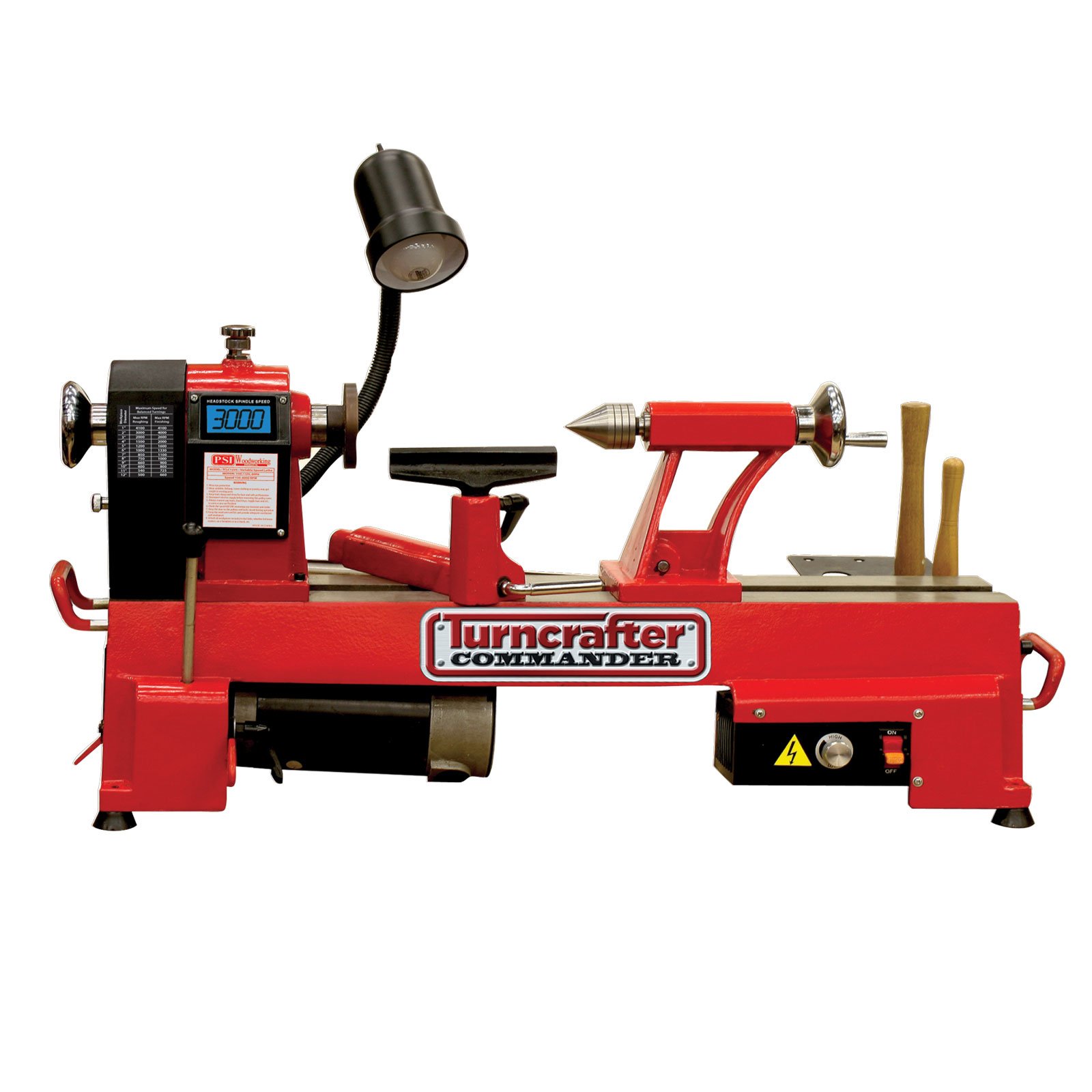
A midi lathe built for turners who already know their way around a gouge.
Two belt positions and a variable-speed dial give this lathe a range of 500-2000 RPM and 1500-3600 RPM — wide enough for both rough shaping and fine finishing. A 3/4 HP motor on 110V power drives it, and an SBC microprocessor smooths the electronics. The 10-inch swing and 18-inch centers suit pens, bowls and mid-length spindles. A cast iron base keeps it planted, and 24 indexing positions hold the spindle for fluting and layout work.
The distance between centers tells the story of the size — 18 inches here versus the WEN Mini’s 13 inches. That extra reach matters when your project grows past a pen. The headstock thread is 1″ x 8 TPI with a #2MT taper, so the standard aftermarket chucks and centers fit. Convenient built-in handles make belt changes easier than on some competitors. ETL Listed and certified by Intertek, and covered by a 3-year warranty.
Owners praise build quality above all, with value a close second. The honest caveat is reliability: functionality gets a mixed read and a handful of machines arrived with parts broken on first use. That makes checking the unit carefully on arrival worthwhile, and it means this is a lathe best suited to a buyer who is comfortable with basic setup and troubleshooting rather than a complete novice who wants zero fuss.
The turning-range argument: 500-3600 RPM split across two belt positions covers both ends of most beginner projects.
The caveat to weigh: a small number of units arrived with broken parts, so inspect on arrival and lean on the 3-year warranty.
Best for: a turner with some experience who wants a midi lathe with a real speed spread and standard MT2 accessories.
Consider another if: you want the smoothest possible arrival experience or you are brand new and not keen on troubleshooting.
7. Delta 46-460 MIDI Lathe
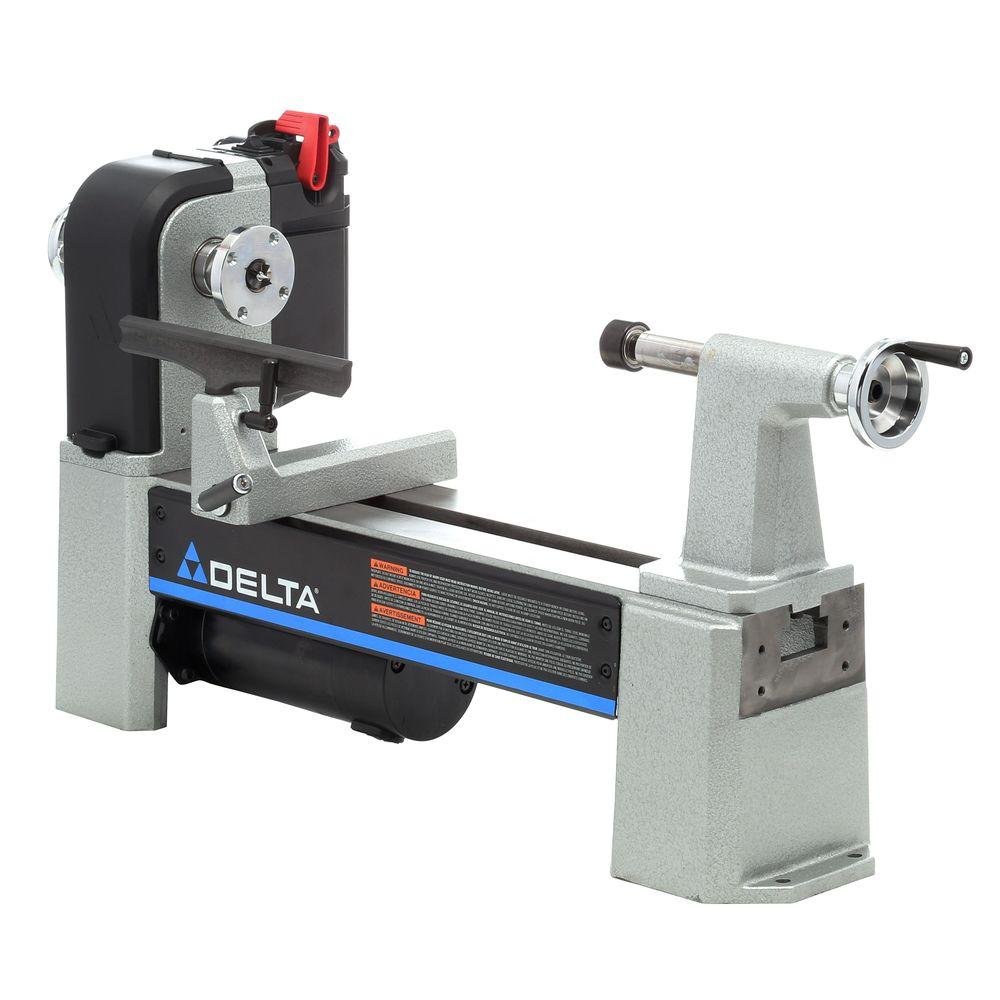
One horsepower and a three-pulley speed system that barely whispers.
The headline for the Delta is the motor and the quiet. A 1 HP, 120V motor with three speed ranges — 250-700, 600-1800 and 1350-4000 RPM — covers everything from a rough bowl blank to a delicate final pass. A patented belt tensioning system sets the belt at the correct tension every time you change speed, which is the kind of detail that saves wear on the motor over years. The all-cast-iron construction and steel knockout bar back that up with rigidity.
Then there is the swing, and this is where the Delta leads. A 12-1/2 inch swing over bed beats the JET JWL-1015VS’s 10 inches and the WEN LA3424’s 12 inches — enough that a large bowl blank fits without fighting the tool rest. Distance between centers comes in at 16-1/2 inches, and with the optional extension you can stretch that all the way to 42 inches. The 5-year warranty is generous, and both a 6-inch and a 10-inch tool rest ship in the box.
Owners single out quality — a sturdy, satisfying, quiet-running lathe. Speed control and belt adjustment draw a mixed response — a few owners find the change-over fiddlier than expected. The trick is to treat the belt change as a habit rather than a chore. Where it really shines is in a small shop where noise matters, because the operation stays quiet even at speed.
The case for the Delta
- 1 HP motor on a 12-1/2 inch swing gives real bowl capacity
- Three pulley ranges span 250-4000 RPM for shaping and finishing
- All cast-iron construction with a patented belt tensioning system
- Quiet operation that keeps a small shop pleasant to work in
- 5-year warranty, plus a 6-inch and a 10-inch tool rest in the box
The honest trade-offs
- 16-1/2″ between centers needs the optional extension for long spindle work
- Belt changes for each speed range take more effort than a single dial
- A minority of units have needed durability attention
Best fit for: a bowl-focused turner who wants horsepower and quiet on a mid-size bench.
Weigh against it: 16-1/2 inch centers limit long spindles, and each range change needs a belt step.
8. JET JWL-1221VS Woodworking Lathe

Sixty RPM at the low end is what makes this the safest roughing machine here.
That 60 RPM floor is the number to remember. When an out-of-round blank first goes on the spindle, sixty revolutions per minute lets you true it up without the machine trying to walk off the bench. A dial then moves you through three belt ranges — 60-900, 110-1800 and 220-3600 RPM — with a digital readout showing spindle speed. A 1 HP DC motor runs on standard 115V household power (6 A; a dedicated 10 A circuit is recommended), and the machine is CSA certified to UL 987.
The body is cast iron across the bed, tool support and tool support base, with cast iron and steel headstock and tailstock, all adding up to a 121-pound lathe that soaks up vibration. A removable safety key stops unauthorized starts, and the lathe will not restart on its own after a power outage. It turns 12-1/2 inches over the bed and 20-1/4 inches between spindle faces, with a forward/reverse switch you can flip while it is running for sanding. MT2 tapers, a 1″ x 8 TPI spindle, a 3/8″ spindle bore and 24 indexing positions round out the specification.
Owners praise the build, speed control and quiet operation, and many single out the forward/reverse switch for sanding and finishing. Stability is the split topic — a few machines have wobbled from the start, so give it a good bolt-down on a flat bench. The 121-pound weight is a fair complaint if you plan to move it. It also has the largest rating pool in the group at 650+ owners while holding 4.0+ stars. In short, one honest sentence captures it: the JET JWL-1221VS gives a beginner 60 RPM of slow-start safety and 3600 RPM of finishing speed on one cast iron frame. It includes 6-inch and 10-inch tool supports, a spur center, live center, 3″ faceplate and knockout rod, backed by JET’s 5-year warranty.
The long-game choice: a machine you can grow into rather than out of, with 60-3600 RPM and a 12-1/2 inch swing.
The catch: 121 pounds means a permanent bench spot, and a few units have arrived needing bolt-down care to stop wobble.
Know the Specs
Swing Over Bed Versus Distance Between Centers
Swing over bed is the largest diameter the machine can spin — measured from the spindle center down to the bed. It decides bowls and platters. Distance between centers is the longest spindle that fits between the two ends. It decides pens, tool handles and table legs. A beginner should pick the pair that matches the first three projects on the list, not the biggest machine in the catalog.
Spindle Taper and Thread
The taper is the machined cone that centers and chucks lock into, and the thread is what a chuck screws onto. MT2 with a 1″ x 8 TPI thread is the standard combination on most mid-size lathes, which makes accessories easy to find. MT1 appears on compact mini lathes. Buy accessories that match your spindle, or they will not fit.
Variable Speed Versus Fixed Speeds
An electronic dial lets you change RPM while the machine runs, inside one of several belt-selected ranges. Fixed-speed models require a belt move between preset gears. For a beginner, the slower the low end and the smoother the dial, the less intimidating the first rough blank. Speeds near 3000-4000 RPM are for finishing small spindles.
Motor Power, Weight and Bench Fit
A half-horsepower motor turns pens and small bowls without strain. Three-quarter and one horsepower motors hold speed better as the gouge loads up on a heavy blank. Weight plays into it too — a 50-pound lathe and a 121-pound lathe both need a solid bench, but the heavier one resists walking and vibration. Bolt any lathe down through its mounting holes before you run it.
Common Questions
What swing and distance between centers do I need for a first bowl?
Is MT1 or MT2 better for a beginner lathe?
How slow should the low speed be on a beginner lathe?
Can I turn a table leg on a benchtop lathe?
How much horsepower does a beginner need?
Do I need to bolt a benchtop lathe to my workbench?
What tools and accessories come with these lathes?
Is a variable-speed dial worth it over fixed speeds?
Can I sand and finish on the lathe itself?
How long should a beginner lathe last?
The Bottom Line
For most beginners, the wood lathe for beginners winner is the JET JWL-1015VS because its 200-3600 RPM dial and cast iron frame give you both the slow-start safety and the rigidity you need on a first machine. If you want to turn larger bowls without stepping to a floor model, the Delta 46-460 takes the win on 1 HP and a 12-1/2 inch swing. And for a slow-start machine you can grow into over years, the JET JWL-1221VS at 60-3600 RPM is the one to reach for. Whichever you pick, bolt it down and start with a pen blank before a bowl — the machine will teach you far more than any manual.
How we choose
We do not accept paid placement. Every pick is matched to a real buyer and a real use-case; we do not hands-on test units.
Sources
Specifications: manufacturer listings and product documentation. Review insights: verified customer reviews, as of November 2026. Pricing: not shown on this page (it changes often); check the current price via the retailer link.
As an Amazon Associate, Tactical Gear Guy earns from qualifying purchases. This does not affect which products we feature.