Specs are compiled from manufacturer listings and verified buyer reviews and can change over time — please confirm the key details on the product page before buying.
Buying a wood greenhouse kit is mostly a decision about two things you cannot change later: how much snow and wind the frame is rated to survive, and how thick the glazing is that keeps your plants warm. Get those two right and everything else is detail. This guide walks through six cedar-framed kits that actually publish those numbers, so you can match one to your climate instead of guessing from a photo.
This guide is built by comparing the manufacturers’ published specifications and the patterns across verified customer reviews, so you get each pick’s real strengths and trade-offs instead of marketing spin.
A cedar frame and multi-wall polycarbonate panels carry the price here, so the differences come down to bracing, vent count, and panel thickness. Below you will find the honest breakdown of each one, framed so that wood greenhouse kits stop looking identical and start sorting themselves by climate.
Top Picks
How To Choose The Best Wood Greenhouse Kits
Start with your weather, not with the pretty picture on the box. A kit rated for 30 inches of snow and 100 mph winds behaves very differently from one rated for 6 inches of snow and 60-70 mph winds. That single difference decides whether your frame survives February or folds.
Match the frame rating to your actual climate
The climate ratings published for these kits range widely, from a 625-pound load capacity on one cedar model up to 2,800 pounds or 30 inches of snow load on another. If you get heavy drifting snow, you want a tested figure you can point to — not a vague promise that the frame is strong. Wind ratings matter just as much, since panels pulling loose in a gust is the fastest way to lose a season.
Panel thickness drives warmth retention
Multi-wall polycarbonate panels trap air between layers, which slows heat loss and diffuses light so leaves do not scorch. Some kits publish a heat-retention gain over standard double-wall panels; others list only a thickness, such as 6mm. Thicker multi-layer panels generally mean better insulation, but they also mean more cost and a heavier box on delivery.
Count your vents before you commit
A sealed glass box in July becomes an oven. One adjustable roof vent is the minimum, and two is better for cross-flow. Look for a vent that adjusts through a real angle range — the kits here list openings up to 45 degrees — because a vent that barely cracks open will not drop the interior temperature much on a hot afternoon.
Assembly scope is the hidden cost
Some kits arrive pre-cut, pre-drilled and pre-stained with an interactive app walkthrough; others ship as raw cedar pieces with a printed manual and variable instructions. Neither is wrong, but assembly time and difficulty swing hard between them, and a walk-in structure is not a one-person Saturday job in every case.
Side-by-Side Comparison
| Model | Best For | Footprint | Vents | Weight | Amazon |
|---|---|---|---|---|---|
| Backyard Discovery Willow 9′ x 6′ White Cedar★ Best Overall | Year-round growing with power and shelving built in | 114.25″L x 72.75″W x 94″H | 2 | 571 pounds | Amazon |
| Aoxun 6×8 FT Wooden GreenhouseBudget Entry | Budget-conscious first cedar greenhouse | 6×8 FT | 2 | — | Amazon |
| MUPATER 6’x10′ Wooden Greenhouse | Straightforward walk-in growing space | 6′ x 10′ | — | 282.4 pounds | Amazon |
| VEIKOU 8’x8’ Cedar Frame Greenhouse | Square footprint with even light spread | 96.69″L x 96″W x 90.6″H | 1 | — | Amazon |
| Yardenaler 6×12 FT Greenhouse Kit | Long-run growing on a narrow plot | 143.4″L x 74″W x 83.5″H | 2 | — | Amazon |
| Jocisland 8 x 9.5-Ft Wooden Greenhouse | Fast setup with pre-assembled walls | 9.5″L x 8″W x 7.5″H (as listed) | 2 | 206 pounds | Amazon |
Detailed Reviews
1. Backyard Discovery Willow Greenhouse Kit
Our pick — 4.5+★ from 100+ verified ratings; the strongest balance of quality and price.
The only kit here with a tested 2,800-pound, 30-inch snow load and a 100 mph wind rating.
This is the only kit in the group that states it is Pro-Tect tested to withstand up to 2,800 pounds or 30 inches of snow load, plus winds up to 100 mph when anchored as the manual specifies. That is the number that matters if your winters drift. It is also the heaviest build here at 571 pounds, and that heft is part of why the frame feels as solid as owners describe it.
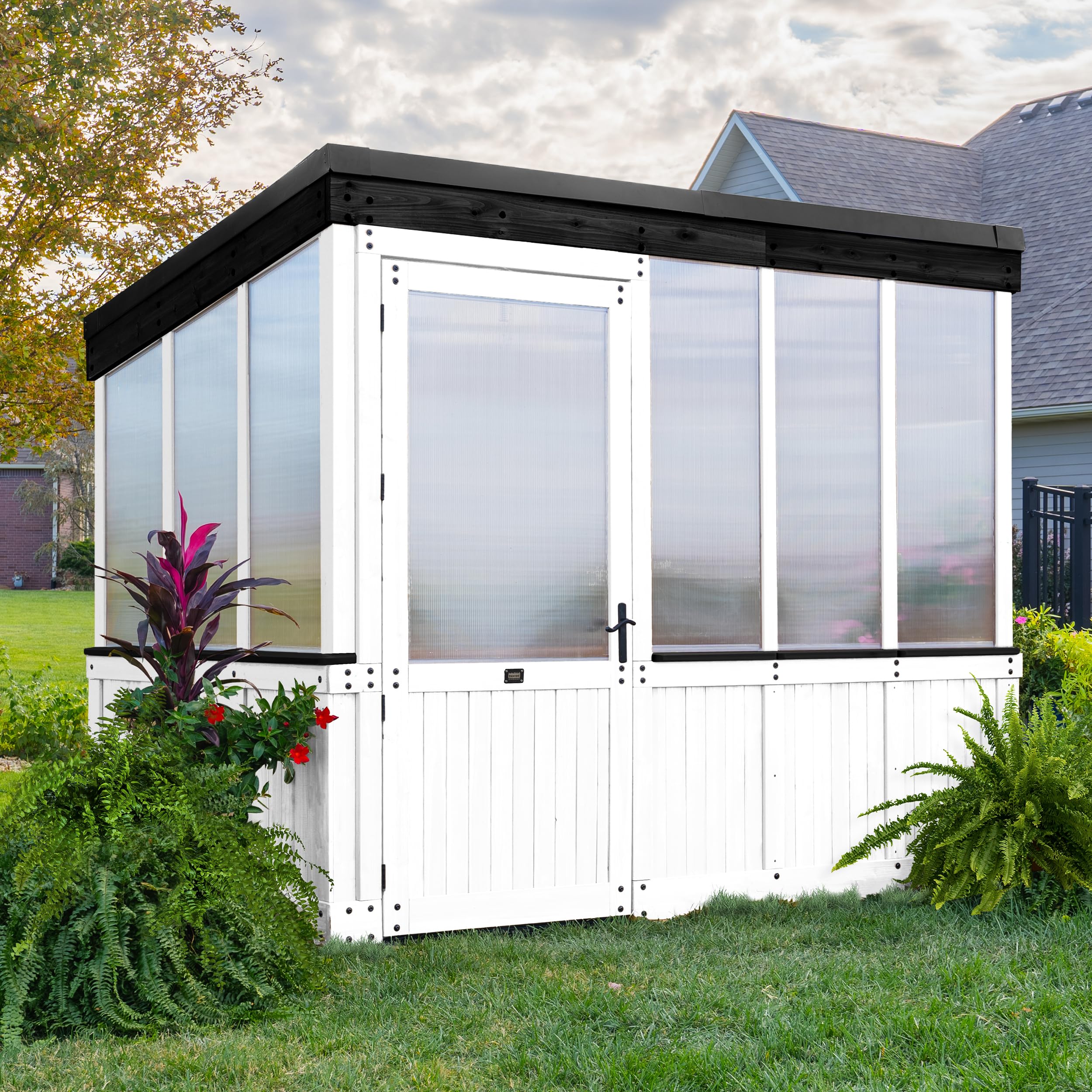
Where it pulls away from the pack is the interior prep. You get 54 square feet of floor with a built-in workstation and 13 linear feet of fixed staging shelving, so pots are not stacked on the ground. There is a patented PowerPort with 3 electrical outlets and 3 USB ports for heat mats and grow lights, plus both exterior and interior hose hook-ups. No other kit here lists either feature. Its 4-wall polycarbonate roof and window panels are rated to improve heat retention by 30% over standard double-wall panels, which matters if you grow through cold months.
The assembly story is friendlier than the poundage suggests. Pieces arrive pre-cut, pre-drilled and pre-stained, and the interactive BILT app walks you through the steps. Two ventilation paths are covered: a temperature-activated exhaust fan for forced airflow and 1 easy-open window for natural circulation and pollination. What wins people over is the build — quality is the clear standout in how this kit is received — and the hardware package arrives complete enough that nothing stalls the build. The catch is the colour: the white stain is noted to vary in saturation from unit to unit, so expect a slightly different tone than the listing photo.
Where the Willow Earns Its Place
- Tested to 2,800 pounds or 30 inches of snow load and winds up to 100 mph when anchored correctly
- 3 electrical outlets and 3 USB ports on the PowerPort keep heat mats and lights running
- 13 linear feet of fixed staging shelves plus a built-in workstation
- Temperature-activated exhaust fan and an easy-open window handle forced and natural airflow
- 4-wall polycarbonate panels rated 30% better heat retention than standard double-wall
What To Plan Around
- At 571 pounds it is the heaviest kit here, so plan the delivery path and a helper crew
- The PowerPort needs a power source, which is not included
- Stain saturation can vary between units
Reach for this if: you garden through real winters and want forced ventilation, powered accessories and shelving already sorted.
Think twice if: you have no outdoor power run to the site, since the exhaust fan and outlets both depend on it.
2. Aoxun 6×8 FT Wooden Greenhouse for Outdoors
The cheapest way into a cedar walk-in that still hangs a light from the frame.
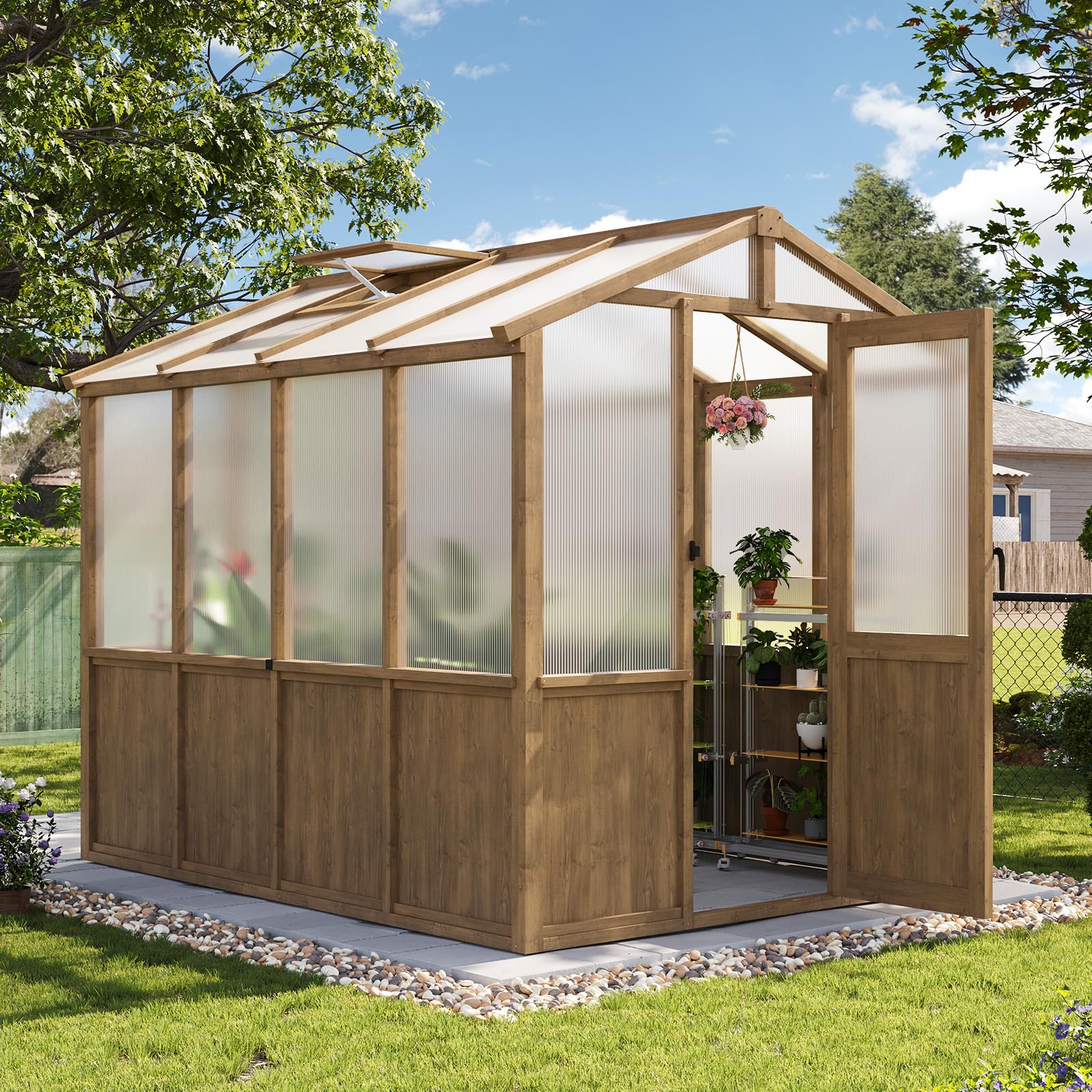
Six by eight feet is a compact footprint, and the cedar here is pitched at insect resistance and stability without severe cracking or distortion. The listing sets a snow depth limit of 6 inches and winds of 60-70 mph once the anchoring stakes and expansion bolts are in — modest numbers, and you should treat them as the ceiling rather than a target. The roof adjusts through a single connecting rod, letting you set the window angle manually up to 45 degrees.
One detail lifts it above bare-bones: each heavy-duty hook is rated to support up to 55 lbs, which covers a hanging light, a chlorophytum, or a few decorations without drilling into the cedar.
The recurring story in the reviews is the build quality versus the paperwork. The structure itself is well regarded and comes across as sturdy enough to take wind, but the assembly directions draw mixed feedback and the wood quality splits opinion too. Set your expectations accordingly: this is a good kit at the entry point, and finishing touches like sanding and careful sealing will do a lot of the work the manual may not explain.
Honest read on the wood: cedar at this tier varies board to board, and the mixed notes on wood quality are the trade-off for the lower outlay. Give yourself time to sort and reject any twisted pieces before you start bolting.
Who it beats: anyone priced out of the larger kits but still set on a real cedar frame with an adjustable roof vent.
The caveat: the assembly instructions are the weak link, so budget patience or a helper who can improvise.
3. MUPATER 6’x10′ Wooden Greenhouse for Outdoor

Ten feet of cedar walk-in, and one of the lighter frames in this lineup.
At 282.4 pounds, this is a genuinely different animal from the 571-pound Backyard Discovery Willow — 282.4 pounds against 571 pounds — and the lighter build makes the MUPATER easier to move into a back garden and stand up with a small team. The six-by-ten footprint gives you a long walk-in corridor, and the multi-layer polycarbonate panels are rated for up to 99.99% UV protection while still passing sunlight through and holding heat.
Ventilation comes from adjustable roof windows you set to different opening sizes, which lets you tune airflow and temperature across the seasons rather than flicking a single open-or-shut latch. The front door locks, which matters if you keep tools and pots inside a structure sitting in an open yard. Assembly is the other strong suit: the instructions make the build genuinely easy going in, and the cedar and hardware are described as reaching a rugged standard for wind and rain.
Durability is the one point that splits opinion rather than settles it, so treat long-term toughness as something you protect through careful anchoring and seasonal checks rather than something the kit guarantees outright. For a gardener who wants a long, bright, walk-in growing aisle without a builder’s crew, that trade is reasonable.
What the lighter frame buys you: easy delivery and a one-afternoon setup with a helper. What it costs you is the brutal-weather headroom of the heavier premium kits.
Best fit: a mild-to-moderate climate and a gardener who would rather plant than pour footings.
Not the pick if: you need a published snow-load figure to lean on — this listing does not give one.
4. VEIKOU 8’x8’ Walk-in Wood Greenhouse with Cedar Frame
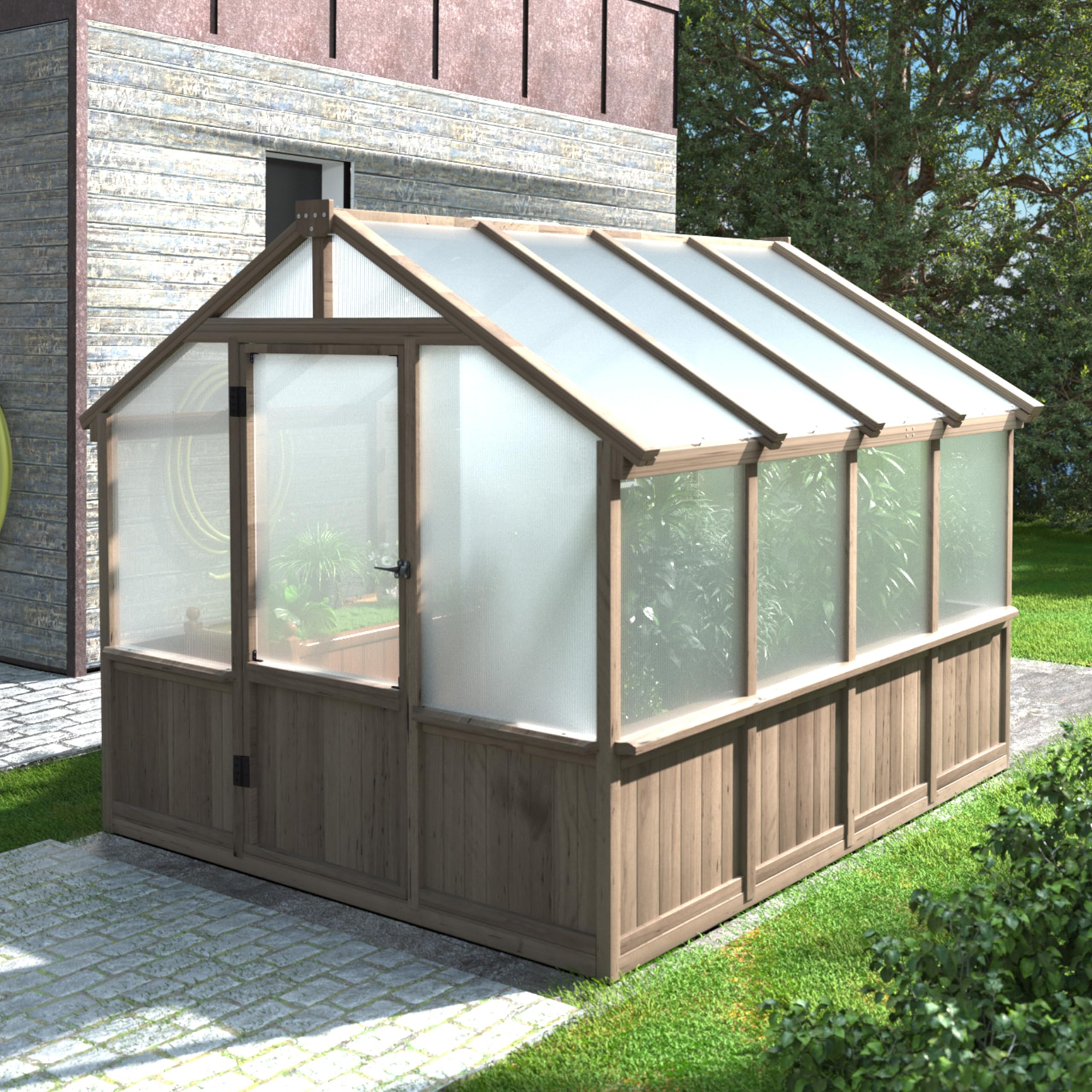
A near-square footprint built to spread light evenly into every corner.
The diffusion spec is the headliner: the 6mm multi-layer polycarbonate panels are listed with a luminous uniformity above 98%, which is why light reaches plants from all angles instead of dropping a hard shadow line at one end. Panels also carry scratch resistance and impact strength claims. Footprint comes in at 96.69″L x 96″W x 90.6″H, a near-square shape that suits a square garden bed.
The cedar frame is a thickened design that absorbs daytime sun and releases that heat at night. Ventilation is a single adjustable opening — 1 vent, the fewest in this group — that swings up to 45 degrees, and the door is hinged with reinforced hinges and an actual lock. The door opening measures 29.1″ W x 71.4″ H, so it is a proper walk-in entry rather than a duck-through.
Be ready for a staggered delivery. The greenhouse ships in four boxes that may arrive at different times, and with only one vent you may want to prop the door on still, hot days to keep air moving. Buyers looking for the widest possible venting will find the Aoxun and Jocisland kits both offer 2.
Pick this for: a square plot where even light distribution and a full-height door matter more than maximum vent count.
Go elsewhere if: you garden in a hot climate and want two roof vents — this kit gives you one.
5. Yardenaler 6×12 FT Greenhouse Kit

Twelve feet of walk-in aisle for anyone growing along a fence line.
The 143.4″L x 74″W x 83.5″H footprint is the longest run here, and space is exactly what buyers respond to most on this kit. Two adjustable roof vents work off a joint to swing open to a maximum of 45 degrees, giving airflow and UV protection together. The 6mm multi-layer polycarbonate panels pass light for growth while blocking harmful UV rays, and the frame is backed by a sturdy base support with reinforced construction for sunny, snowy and rainy days alike.
Two numbers here deserve attention before you buy. The door measures 23.6″W x 68.9″H, which is narrower and shorter than the VEIKOU door at 29.1″ W x 71.4″ H, so check that width against a wheelbarrow or your own shoulders. And the greenhouse ships in 5 boxes — the most in this lineup — so you need a clear staging spot and a check that installation is allowed in your area before ordering.
Assembly and instructions are the honest split: some buyers find it easy to put together and the instructions great, while others hit difficulty and unclear labeling. The locking mechanism is the recurring gripe that shows up in the feedback, so treat the latch as the part to test and adjust first. For the footprint you get, the value is what people keep coming back to.
What Long-Bed Growers Get
- 143.4″L x 74″W x 83.5″H gives the longest continuous growing run in this group
- 2 adjustable roof vents opening to 45 degrees
- 6mm multi-layer panels for light transmission with UV blocking
- Sturdy base support and reinforced frame for mixed weather
Where It Wants Attention
- A 23.6″W x 68.9″H door is the narrowest and shortest entry here
- 5-box delivery means staged arrivals and a big staging area
- Instructions and the locking mechanism draw the mixed notes
Go for it if: you have a long, narrow bed and want the most linear growing space in this lineup.
Look elsewhere if: you need a wide, tall doorway for hauling equipment in and out.
6. Jocisland 8 x 9.5-Ft Wooden Greenhouse
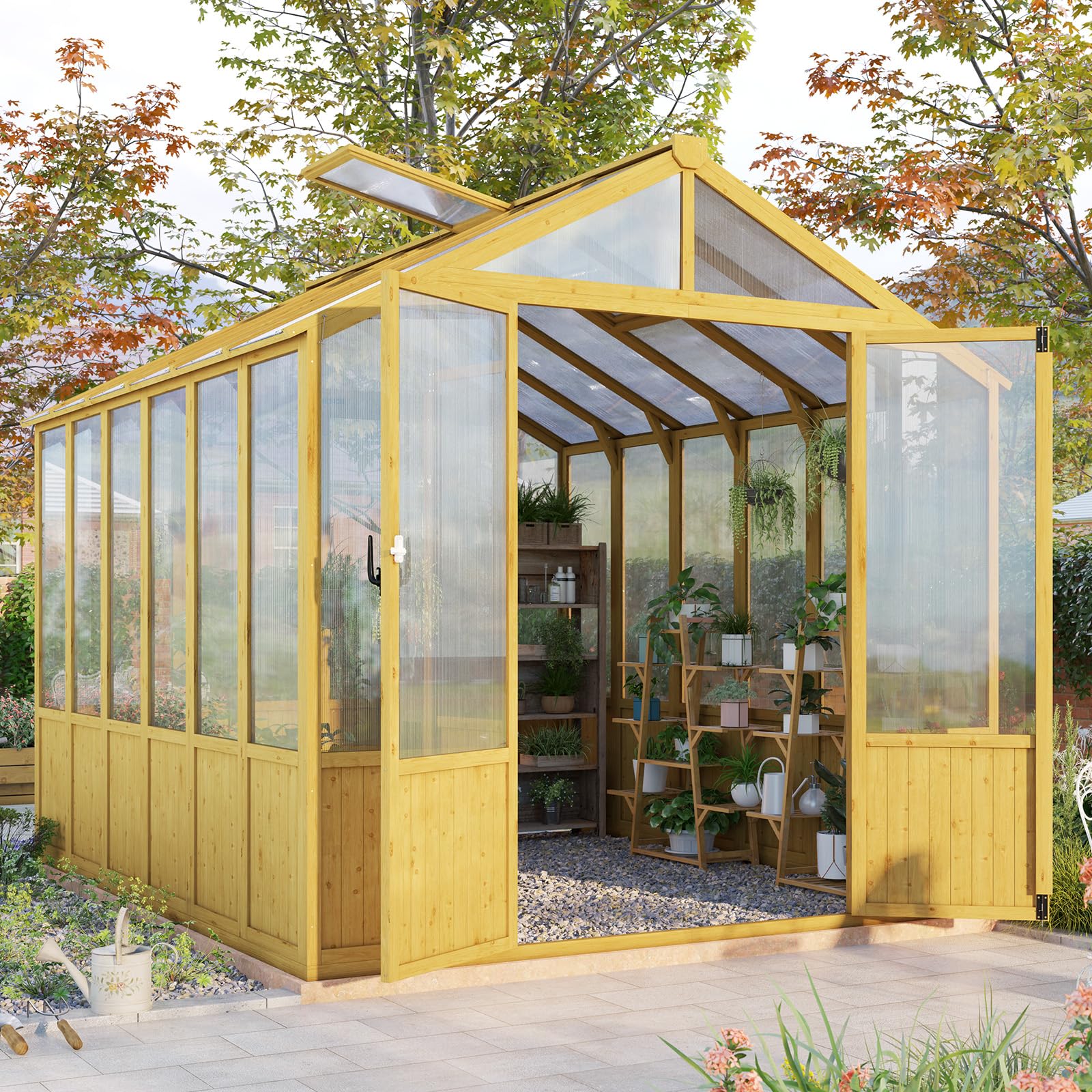
Walls, doors and windows arrive already built — you just bolt them together.
Assembly is the defining feature here, and it is what the feedback keeps returning to. The walls, doors and windows come pre-assembled, so setup is a matter of connecting hardware rather than building panels from scratch. At 206 pounds it is also the lightest kit in this lineup, which makes the whole thing manageable without a crew. Cedar frame with reinforced metal hardware sits underneath, rated for winds of 38-46mph and a maximum load capacity of 625lbs.
Interior headroom is generous for its class: a 5.38ft wall height rising to a 7.45ft peak gives room to walk and work without stooping. Two adjustable windows plus the door let you steer temperature and humidity, and the sunboard panels offer heat insulation and UV protection to keep the space comfortable while shielding plants.
The framing is worth a note of comparison: the Aoxun kit publishes a 6-inch snow depth and 60-70 mph wind figure, while this Jocisland lists 38-46mph winds and a 625 lbs load — different measures, so read them against your own weather rather than assuming one simply beats the other. The one specification quirk is the listed item dimensions, which read 9.5″L x 8″W x 7.5″H and clearly do not match an 8 x 9.5-foot greenhouse, so rely on the wall and peak heights instead of that line.
Why it earns a spot: pre-assembled panels remove the hardest part of any wood greenhouse build, and the light 206-pound shipping weight means two people can handle it.
Choose it when: you want a cedar greenhouse up in a day and prefer not to wrestle individual wall panels.
Weigh it against: the wind rating of 38-46mph is on the modest side, so an exposed, gusty site may suit a heavier-rated kit better.
Know the Specs
Snow Load and Wind Rating
These are the two figures that decide whether your frame survives a bad winter. A snow load is stated either as a weight in pounds or a depth in inches — the Backyard Discovery kit lists 2,800 pounds or 30 inches, while the Aoxun lists 6 inches. A wind rating tells you the gust speed the structure is meant to handle, and every one of these figures assumes you anchored the kit exactly as the manual says. Ignore the anchoring step and the rating is meaningless.
Multi-Wall Polycarbonate Panels
Polycarbonate is the clear plastic glazing used in place of glass. Multi-wall or multi-layer means the sheet has hollow channels running through it, which trap air and slow heat loss. Panel thickness in millimeters is the shorthand for how much insulation you get — 6mm is the common figure across these kits. Some manufacturers publish a heat-retention gain over standard double-wall panels, the figure to compare if you want to grow into cold months.
Vent Count and Adjustable Roof Windows
A vent is an opening that lets hot air escape. Adjustable roof windows let you set the opening angle, and the kits here list a maximum of 45 degrees. More vents mean better cross-flow and less risk of cooking your plants in summer. One vent is workable in a mild climate; two makes a real difference in a hot, still garden. Check whether the vent is on the roof, where heat collects, rather than only in a wall.
Cedar Frame Construction
Cedar is a softwood chosen for outdoor structures because it resists decay and holds up to moisture better than many other woods. A thicker cedar frame adds stability and heat mass, warming in the day and releasing that heat at night. Frame quality still varies between manufacturers, so if wood quality is your concern, sort the boards on arrival and reject anything cracked or twisted before assembly.
Common Questions
Do I need a foundation or base for a wood greenhouse kit?
What snow depth can these cedar greenhouses handle?
How many roof vents should a wooden greenhouse have?
Is 6mm polycarbonate thick enough to insulate a greenhouse in winter?
Can one person assemble a wood greenhouse kit?
Will a cedar greenhouse crack or warp over time?
Do these greenhouse kits include electricity for lights and heat mats?
How much garden space does a 6×8 or 8×8 greenhouse actually use?
What if my greenhouse kit arrives across multiple deliveries?
The Bottom Line
For most gardeners weighing up wood greenhouse kits, the Backyard Discovery Willow is the one worth the space — 2,800 pounds or 30 inches of snow load, 100 mph wind rating, powered outlets and 13 linear feet of shelving make it the most complete kit here. If snow and wind matter less and assembly speed matters more, the Jocisland 8 x 9.5-Ft arrives pre-assembled for a fast build. And for a long, narrow bed, the Yardenaler 6×12 gives you the longest growing run in the group. Match the climate rating to your worst winter first; everything else follows.
How we choose
We do not accept paid placement. Every pick is matched to a real buyer and a real use-case; we do not hands-on test units.
Sources
Specifications: manufacturer listings and product documentation. Review insights: verified customer reviews, as of November 2026. Pricing: not shown on this page (it changes often); check the current price via the retailer link.
As an Amazon Associate, Tactical Gear Guy earns from qualifying purchases. This does not affect which products we feature.