Specs are compiled from manufacturer listings and verified buyer reviews and can change over time — please confirm the key details on the product page before buying.
Most people stripping a wood floor quit on the wrong tool, not the wrong technique. A thin steel blade dulls against old adhesive, you lean harder, and the edge starts gouging the grain you are trying to save. The fix is picking a scraper whose blade holds an edge and whose handle lets you push from a position your back can survive. That is what this list covers: nine real scrapers, sorted by what each one actually does well on wood.
This guide is built by comparing the manufacturers’ published specifications and the patterns across verified customer reviews, so you get each pick’s real strengths and trade-offs instead of marketing spin.
Blade material, blade width, and handle length decide almost everything here, and the picks below split cleanly along those three lines. Here is the honest shortlist of the best Wood Floor Scraper for the job in front of you.
Top Picks


How To Choose The Best Wood Floor Scraper
Wood is the one surface in your house that punishes a careless scraper. Concrete forgives a steep angle; oak does not. So the buying decision is really three decisions: what the blade is made of, how wide it is, and how far your hands sit from the floor.
Carbide versus steel, and why it matters on wood
Carbide is a much harder blade material than steel, so it keeps a working edge far longer when you are dragging it through glue, varnish, or dried caulk. On a hardwood floor that means fewer blade changes mid-panel and less chance of a dull edge skating across the grain. Steel blades cut fine and cost less to replace, which makes them the practical choice for softer residues, wallpaper paste, and jobs where you expect to nick an edge on a hidden nail.
Blade width: speed against control
A 4-inch blade is the working standard — wide enough to clear a strip of adhesive in a few passes, narrow enough to steer. A 2-1/2-inch head is what you reach for around door casings, stair nosings, and the last few inches along a baseboard. Wider heads, in the 8-inch range, are demolition tools: they clear floor covering fast but give you far less control over a delicate wood surface.
Handle length decides how your back feels tomorrow
A short hand scraper puts you on your knees, which is fine for a small patch and miserable for a whole room. A long handle — 3 to 6 feet on the adjustable models, a fixed 4 feet on others — lets you work standing up and push with your legs. The catch is that every telescoping handle adds a joint, and the joint is the weakest point on the tool.
Side-by-Side Comparison
| Model | Best For | Blade Width | Blade Material | Handle | Amazon |
|---|---|---|---|---|---|
| Bahco BAH665 Carbide Scraper★ Best Overall | Fine work and heavy adhesive alike | 2.5 inches | Carbide | Two-hand ergonomic grip | Amazon |
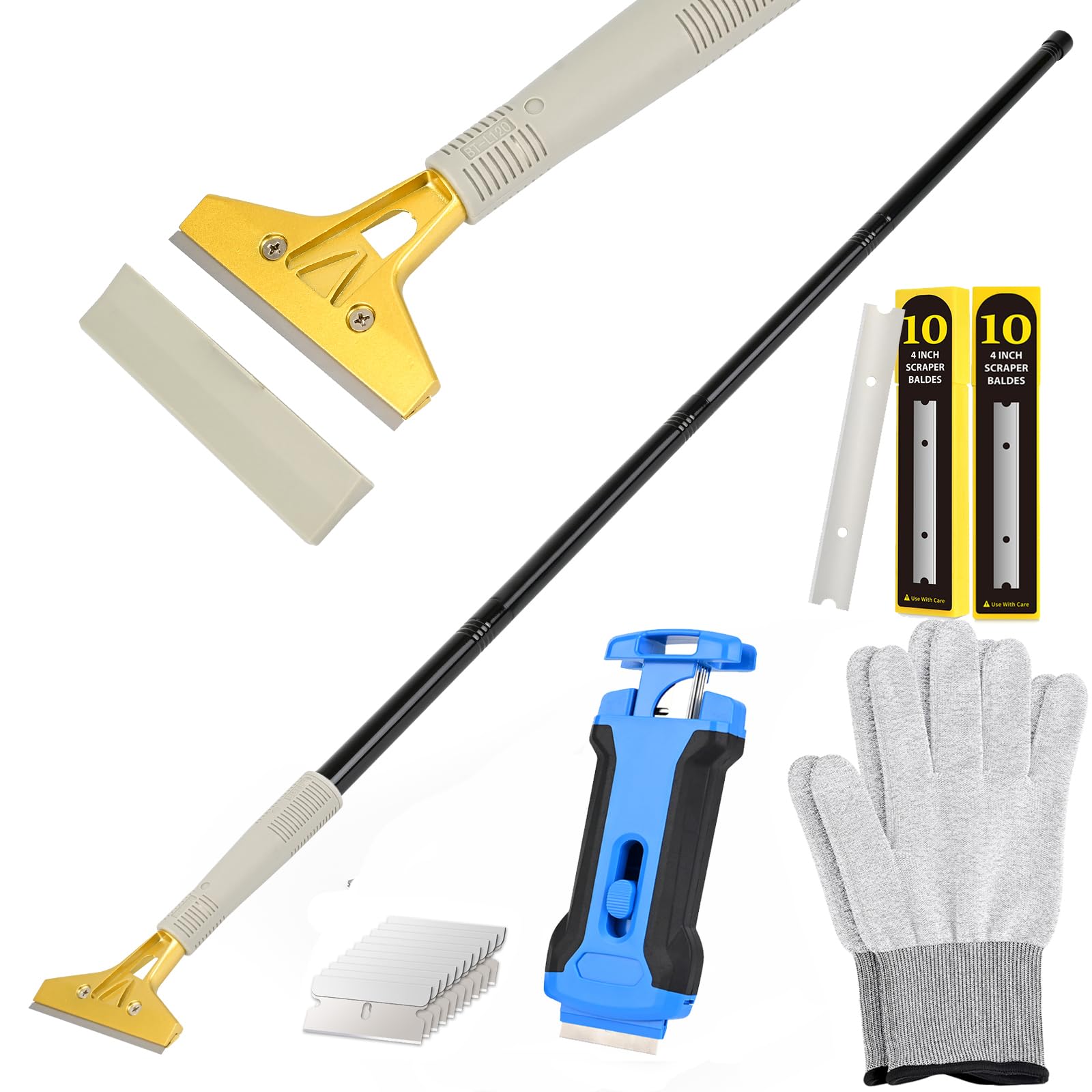
| EHDIS Long Handle Adjustable ScraperBest Reach for Less | Standing-up reach on a budget | 4 inches | Carbon Steel | 15”–58” extendable | Amazon |
| Warner 792 4″ Floor ScraperHandle-Ready Workhorse | Handle-mounted reach | 4 inches | Carbon Steel | Accepts long handle attachments | Amazon |
| UNGER LH12C Floor Scraper | Light debris, long sessions | 4 inches | Carbon Steel | 4-foot aluminum | Amazon |
| QEP 62909Q Razor Floor Stripper | Pulling up old floor covering | 8 inches | — | 3 ft. to 6 ft. telescoping | Amazon |
| MARSHALLTOWN Crain Razor Scraper | Jobsite all-rounder | 4 inches | — | 12 or 18 inch, aluminum | Amazon |
| ABN Floor Razor Scraper | Large demolition jobs | 8 inches | — | 3 ft. to 6 ft. telescoping | Amazon |
| Kraft Tools CC222 Floor Scraper | Clearing old glue fast | 22 inches | Stainless Steel | — | Amazon |
| Red Devil 2108 Long Handle Scraper | Tile, linoleum, and carpet tear-out | 4 inches | Steel (double edge) | 4-foot steel, cushioned | Amazon |
Detailed Reviews
1. Bahco BAH665 Carbide Scraper
Our pick — 4.5+★ from 8,500+ verified ratings; the strongest balance of quality and price.
A carbide edge small enough to steer and tough enough to ignore old glue.
If you are scraping a wood floor by hand rather than tearing up carpet, this is the one to start with. The blade runs 2-1/2 inches wide and is made of carbide — a blade material hard enough that it holds a working edge through cured adhesive and dried varnish instead of skating over them. At 7.4 ounces in a 10 x 2 x 3.54 inch body, it is light enough to control one-handed in tight spots.
What wins people over is the scraping itself. Scraping is the single most praised thing about this tool by a wide margin across thousands of owners — paint and caulk come up cleanly, and the carbide blade keeps cutting long after a steel edge would have given out. Cleaning performance ranks right behind it. The two-component handle gives both hands somewhere to sit, so the leverage comes from your shoulders rather than your wrists.
The blade system is the quiet advantage. It takes four different carbide blade styles, so you can swap the cutting angle and profile to suit the material in front of you — a flat edge for glue lines, a narrower profile for corners. The slim head reaches along baseboards and into stair corners where a wide floor scraper simply cannot go. Here is the honest catch: this is a hand tool. There is no long handle here, so a whole-room strip means working on your knees or off a low stool.
extra-wide carbide blade
- Carbide edge keeps cutting through paint, glue, varnish, and caulk where steel dulls
- 2-1/2 inch slim head slips into corners, stair nosings, and along baseboards
- Two-component handle gives both hands grip for long scraping sessions
- Accepts four carbide blade styles so you can match the edge to the material
- 7.4 ounces keeps it controllable for detail work
short handle grip
- Hand-held only — no long handle, so full-room work means kneeling
- Costs more than a basic steel-blade scraper
- Narrow blade clears floor more slowly than a 4-inch or 8-inch head
wide scraping jobs: you are stripping adhesive, varnish, or paint off wood by hand and want an edge that stays sharp through the whole panel.
narrow tight spots: your job is a whole room of flooring and you want to stay standing — go for a long-handle model instead.
2. EHDIS Adjustable Razor Blade Scraper Tool
Three extension tubes take you from countertop height to full standing reach.
The kit is the story here. You get the 4-inch glass scraper body, three detachable extension tubes that stretch the handle from about 15 inches out to 58 inches, 20 carbon steel replacement blades, a small metal cooktop scraper with 10 blades of its own, and a pair of gloves. For someone stripping a floor and a backsplash in the same weekend, that covers both jobs from one box.
Push the tubes out and you are scraping a vinyl or tile floor while standing, which is the whole point of a handle this long. Pull them back in and it becomes a handheld tool for edges and tight corners. The 4-inch blade width clears a wider strip per pass than a mini scraper, so the work goes faster. The plastic handle has a shaped grip that keeps hand fatigue down on longer sessions, and swapping a blade is straightforward — note when you have 20 spares sitting in the box.
Set your expectations on the blade material. Carbon steel is the softer option, so it sharpens up fast and cuts cleanly but will not hold an edge through abrasive floor adhesive the way carbide does. Plan on burning through a few blades on a tough strip job — which is exactly why the spares are included. The extension joints are also where any adjustable handle flexes, so keep your push steady rather than leaning your weight on the end of the tube.
adjustable long reach: 20 spare 4-inch carbon steel blades plus a bonus mini scraper and gloves means the consumables are handled before you start.
blade flexes: best suited to wallpaper, light adhesive, and surface residue; heavy cured glue will eat through the steel edge faster.
stand-up scraping: you want standing reach without paying premium money, and you would rather have a stack of spare blades than one expensive carbide edge.
heavy glue removal: the floor is covered in thick, rock-hard adhesive — that job wants a carbide blade.
3. Warner 792 Floor Scraper
A 4-inch carbon steel head built to mount on a pole and get you off your knees.
Buy this one for the attachment point. The scraper head is designed to take a long handle floor scraper pole, which converts it from a hand tool into a standing-up floor tool without buying a second unit. The blade is 4 inches wide and made of carbon steel, aimed at paint, adhesive, and debris on both walls and floors.
Warner ships it with #793, #794, and #795 blades, so you have a few profiles to work through before you need to reorder. It is one pound, so the head itself adds almost nothing to the pole once mounted. The grip is shaped for control during extended sessions, and the whole thing is backed by a limited lifetime warranty from the manufacturer.
The trade-off is the blade material. Carbon steel does not hold an edge like carbide, so on a floor covered in hard old adhesive you will be changing blades more often. That is the price of a head this versatile at this level. The flip side is that replacement blades are cheap and the warranty covers the tool itself.
Where it really separates from the Bahco above is coverage. This head is 4 inches wide against the Bahco’s 2-1/2 inches, so you clear a wider strip each pass — at the cost of the Bahco’s corner-reaching slim head.
flat floor work: you already own a pole handle, or you plan to buy one and want a single head that handles paint, adhesive, and wall scraping.
overhead reach: you want a carbide edge that survives brutal adhesive without swapping blades — this one is carbon steel.
4. UNGER LH12C Floor Scraper

Eight ounces of aluminum that keeps your hands off the floor for the whole job.
Weighing 8 ounces against the Bahco’s 7.4 ounces, this one carries its mass in the handle rather than the head — a 4-foot aluminum shaft that puts you upright and keeps you there. The reversible 4-inch metal blade head handles gum, stickers, and wax buildup, and the blade material is carbon steel.
Build quality is the most-discussed strength of this scraper, with floor cleaning next in line. Owners run it on garage floors and report it does not scratch the surface underneath. The lightweight build is genuinely the point: a long handle you can hold at arm’s length for an hour without your shoulders burning.
Now the part you should hear straight. This is explicitly a light-duty scraper, and the durability feedback is mixed — some owners find the blade chips or breaks under hard use. Value reviews split the same way, with some feeling it is priced high for a light-duty scraper. Treat it as a tool for adhesive, gum, and light debris, not for prying up nailed flooring, and it does its job well.
four-foot aluminum handle: reach and weight. A 4-foot aluminum handle at 8 ounces means scooping up stickers and wax all afternoon without crouching.
light-duty only: light-duty is the honest label — heavy prying is outside what the blade is built for.
quick floor passes: garages, shops, and rental turnovers where you are clearing gum, stickers, and light adhesive off a hard floor from a standing position.
thick adhesive layers: you need to break up thick, bonded flooring — that calls for an 8-inch demolition head instead.
5. QEP 62909Q 8″ Adjustable Razor Floor Stripper

An 8-inch angled blade for lifting old tile, vinyl, and carpet off the subfloor.
This is a demolition stripper, not a finish scraper. The 8-inch blade head sits at a 15-degree angle — that tilt keeps the edge flat against the floor so you are lifting material rather than digging into it. A twist-lock telescoping handle runs from 3 feet to 6 feet, and the deluxe cushioned grip keeps your hands comfortable while you work standing.
Use it for old tile, adhesive, vinyl, carpet, and other floor covering. A canvas blade guard ships in the box to protect the head between jobs. The whole unit is 2.25 x 9.25 x 41 inches in its collapsed state, so it stores against a wall or in a truck bed without taking up much room.
The honest weakness is the handle joint. The lock that holds the extension at length is the part that draws complaints — it can slip under load, so you end up re-tightening it mid-job. Set the length, check the lock is seated, and push steadily rather than hammering through a stubborn strip. The blade is a powerful lever once it is set, so a little patience at the joint goes a long way.
wide strip runs: pulling up a whole room of vinyl, carpet, or old tile where you want to work standing and clear material fast.
precision corners: delicate wood finishing work — an 8-inch head has far less control than a 2-1/2 inch carbide blade.
6. MARSHALLTOWN Crain Razor Scraper
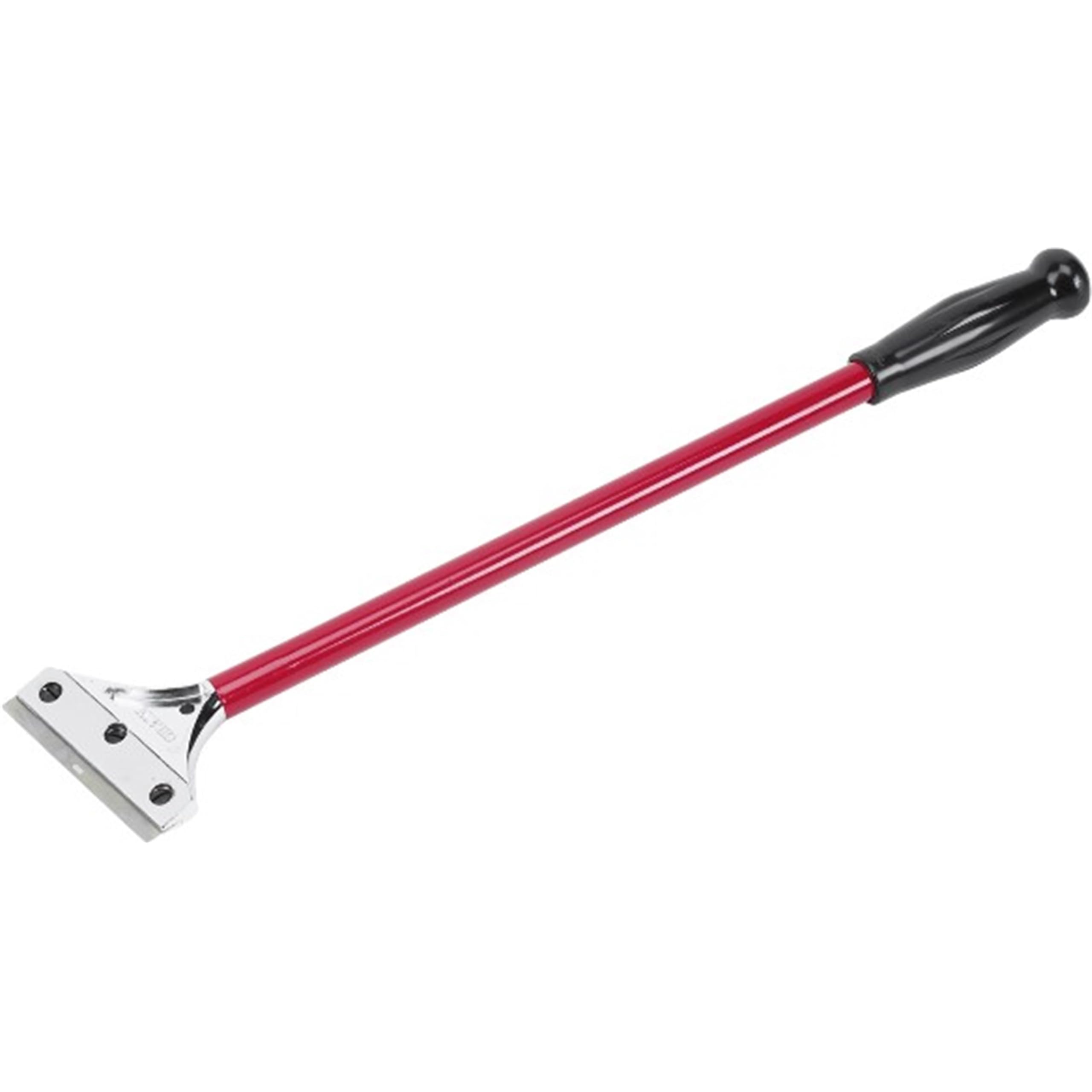
A cast aluminum head that pulls triple duty as a floor, carpet, and paint scraper.
One scraper, three jobs. The 4-inch blade sits in a cast aluminum head, and the tool is built to work as a floor and tile scraper, a carpet scraper, and a paint scraper — genuinely useful if you are stripping flooring and prepping trim on the same project. The aluminum handle comes in a 12-inch or 18-inch length depending on which you order, so you can pick the reach that fits how you work.
At 8 ounces, the head is heavy enough to hold its line against adhesive without feeling clumsy. The aluminum construction gives it the kind of solidity that suits site work, and the assembled-in-USA build is part of the pitch for anyone who cares where a tool comes from. It is aimed squarely at surface preparation and maintenance.
The limit is right there in the design. A 12 or 18 inch handle is a hand tool, not a standing reach — good for leaning into a scrape at counter height, not for a full floor you want to clear upright. If standing reach is the priority, the UNGER’s 4-foot handle above does that better. Pick this for the versatility of the head instead.
flooring tear-outs: mixed site work where one tool needs to scrape tile, pull carpet, and clean paint off walls.
large open floors: full-room floor stripping where a 4-foot handle or telescoping reach saves your back.
7. ABN Floor Razor Scraper, 8in – Heavy-Duty Adjustable Handle

A dual-sided 8-inch blade and a handle you can stand behind, all 3.64 pounds of it.
For heavy demolition, this is the serious option. The 8-inch dual-sided blade sits at a 15-degree angle for leverage, and the twist-lock telescoping handle stretches from 3 feet to 6 feet so you can work upright. At 3.64 pounds it has real heft — the kind that stays planted against bonded flooring and stubborn residue instead of bouncing off it.
Owners call out the heavy-duty build most, with versatility close behind. It handles old flooring, tile, vinyl, carpet, and adhesives, and the owner comment that sticks is simple: it saves you crawling around on your knees. A replaceable blade and an included blade guard and canvas cover keep it usable and safe between jobs.
The twist-lock adjustability is the most-discussed issue with this tool. The twist-lock joint can fail to stay locked in the extended position, and the weight is more than some expect once the handle is fully out. Simple maintenance — replacing the blade to keep performance up — is straightforward once you get past the joint. Set the length, confirm the lock, and push with steady force.
stubborn adhesive: your job is demolition-grade floor removal and you want a heavy head and a full-length handle to stand behind it.
delicate surfaces: you only need to clear light adhesive — this much weight works against you on a soft surface.
8. Kraft Tools CC222 22″ Heavy-Duty Floor Scraper
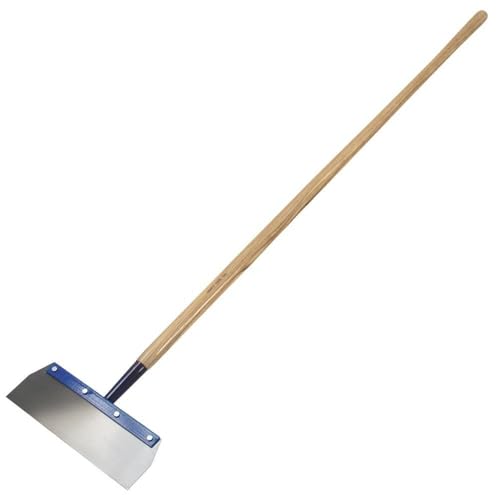
Twenty-two inches of stainless blade that clears old glue in one long sweep.
Nothing else on this list covers floor like this. The 22-inch stainless steel blade is firm but flexible, so it follows the floor instead of digging into it, and it is built for scraping old glue off floors, concrete off forms, and excess material off messy jobs. A replaceable blade keeps it working for the long haul, and the unit weighs 5.4 pounds.
Push a blade this wide and you clear a strip in one pass that would take three with a 4-inch head. That is the whole reason you buy it — bulk coverage on a floor covered in adhesive. Stainless steel construction resists the corrosion that comes with wet glue and damp subfloors, and the blade can be swapped when the edge eventually wears.
The trade-off is precision and comfort. At 22 inches wide and 5.4 pounds, this is a two-handed push tool, and steering it around a doorway or a corner is not what it is for — you would want a narrow scraper for those tight spots. It is also built for bulk material removal, not for delicately lifting a thin coat off a finished wood surface. Pick it when area coverage matters most.
big floor areas: clearing large open floors of old glue or excess material fast, where coverage beats fine control.
small rooms: corners, stairs, and finish work on wood — that width and weight are working against you there.
9. Red Devil 2108 Floor Scraper

One blade, two edges — a sharp side for tearing out and a blunt side for cleanup.
The clever part is the 4-inch double-edge steel blade. One edge is sharp for biting into tough materials; the other is blunt so you can clear residue without gouging the surface underneath. That means you do not swap blades to shift from pulling up tile to finishing the cleanup — you flip the head.
A 4-foot steel handle with a cushioned grip keeps the work at standing height and takes the strain off your back and hands over long projects. At 2.8 pounds it stays manageable when you are swinging between a corner and a wide floor pass. The 4-inch head is nimble enough to reach along baseboards and into corners where a rotary floor sander cannot go, which makes it a genuinely useful partner to a sander on a refinishing job.
It is built for hard jobs — tile, linoleum, carpet, roofing, and other adhesive materials — and the steel construction is meant to stand up to commercial use and intensive DIY renovation. The one honest note is cost: owners praise the quality and durability most, but value reviews split, with some feeling it is priced high for a hand tool.
tall stand-up work: you are pulling up tile or linoleum and want one long-handle tool that scrapes hard and then cleans up without swapping blades.
budget scraping: a fixed 4-foot handle is all you need and you would rather spend less on a shorter-reach tool.
Know the Specs
Blade Material: Carbide vs Carbon Steel vs Stainless
Carbide is the hardest of the three, so it holds an edge through abrasive material like cured adhesive and dried varnish. Carbon steel is softer — it sharpens quickly and cuts cleanly but dulls faster on hard flooring and suits wallpaper, light glue, and surface residue. Stainless steel, like the 22-inch blade on the Kraft, resists corrosion on damp subfloors and works well on wide bulk-coverage heads.
Blade Width in Inches
The width of the blade is a speed-versus-control trade. A 2-1/2 inch head steers into corners and along baseboards. A 4-inch blade is the all-round standard for adhesive and paint. An 8-inch head is a demolition tool for pulling up tile and carpet, and a 22-inch blade is for clearing wide, open floor in a single sweep. Match the width to the surface, not to the price.
Handle Length and Reach
Short handles put you on your knees; long ones let you work standing up. Fixed 4-foot steel or aluminum handles give a set reach. Adjustable models telescope from around 3 feet out to 6 feet, or as short as 15 inches out to 58 inches, so you can reel them in for countertop work and extend them for floors. Every extension joint is a weak point, so check the lock seats before you push.
The 15-Degree Angled Head
An angled head tilts the blade so the edge sits flatter against the floor. That flat contact lifts material cleanly instead of digging in, and it lets you apply more leverage from a long handle. On wood, that flat angle is what keeps you from scoring the grain.
Common Questions
Will a wood floor scraper damage the grain of my hardwood?
Is carbide better than steel for scraping old adhesive off wood?
How long should a floor scraper handle be for whole-room work?
Why does my telescoping handle keep slipping when I push?
What blade width should I choose for scraping a wood floor?
Can I use a razor floor scraper to pull up tile and carpet, or do I need a dedicated stripper?
Do I need to replace the blades on a floor scraper?
What is the difference between a hand scraper and a long handle scraper?
Can a wide floor scraper get into corners and along baseboards?
Do I need a long handle attachment, or does a fixed handle work?
The Bottom Line
For most wood floor work, the wood floor scraper that earns the top spot is the Bahco BAH665, because a carbide edge in a 2-1/2 inch head does what wood demands — it stays sharp and steers into the corners where a wide blade cannot reach. It is the crowd favorite, with a strong score across thousands of owners. If you would rather stay off your knees and pay less, the EHDIS long handle scraper gives you standing reach and 20 spare blades in the box. And for pulling up a whole room of old tile or carpet, reach for the QEP 62909Q with its 8-inch angled head.
How we choose
We do not accept paid placement. Every pick is matched to a real buyer and a real use-case; we do not hands-on test units.
Sources
Specifications: manufacturer listings and product documentation. Review insights: verified customer reviews, as of November 2026. Pricing: not shown on this page (it changes often); check the current price via the retailer link.
As an Amazon Associate, Tactical Gear Guy earns from qualifying purchases. This does not affect which products we feature.