Specs are compiled from manufacturer listings and verified buyer reviews and can change over time — please confirm the key details on the product page before buying.
You are about to lay tongue-and-groove hardwood, and one question decides whether the job goes smooth or sideways: which nailer actually drives the cleat flush, every time, without splitting the tongue. A flooring nailer is an air-powered tool that fires L-shaped cleats or staples through the tongue of each board, then the next plank hides the hole. Get the tool right and each course seats flush in one steady pass. Get it wrong and you fight jams, bent nails, and scuffed boards all afternoon.
This guide is built by comparing the manufacturers’ published specifications and the patterns across verified customer reviews, so you get each pick’s real strengths and trade-offs instead of marketing spin.
The picks below split into three jobs, so start by deciding which one you are: a full 3-in-1 nailer/stapler for a whole-house job, a lighter dedicated cleat tool for a single room, or a palm-sized nailer for starting rows and tight gaps against the wall. Stick around, because the rest of this page breaks down each machine’s fasteners, weight, flooring range, and jams so you can match the tool to the square footage in front of you, and the right wood floor nailer keeps a 500-square-foot install to a weekend instead of a week.
Top Picks


How To Choose The Best Wood Floor Nailer
Buying a flooring nailer is really a matching exercise: the tool has to match your fastener, your floor thickness, and the way you work. Most bad purchases come from ignoring one of those three. Here is how to sort it out before you commit.
Match the fastener type to the floor you are installing
Solid hardwood and most engineered planks take L-cleats or T-cleats, while some floors call for 15.5-gauge crown staples. A 3-in-1 tool handles all three fastener types from one body, so you buy once and stay covered across jobs. A dedicated cleat nailer is simpler and often lighter, but it only fires cleats. If you already know you are installing cleats and nothing else, that simplicity can be worth it. If you might tackle a floor that wants staples later, the 3-in-1 design saves you from owning two tools.
Check the flooring thickness range your tool covers
Most flooring nailers adjust for floors anywhere from 1/2″ to 3/4″ thick using interchangeable base plates. Those plates are the no-mar kind, meaning they sit between the metal tool and your finished surface so the wood does not get scratched or dented. Confirm the plates match the flooring you bought, because a nailer set up for 3/4″ solid oak will not seat correctly on a thinner engineered plank without the right foot adjustment.
Weigh mallet-actuated against trigger-pull designs
Mallet-actuated tools sit on the floor, and you strike the bumper with a rubber mallet to fire each cleat. That keeps your body upright and your face off the ground, which matters over a long run. Trigger-pull and palm tools fire when you squeeze, so they reach starting rows, final rows, and tight corners near a wall. Many installers end up owning one of each, because the big tool cannot fit where a compact one goes.
Look at weight and compressor demand
These tools get heavy by the end of the day, so the body weight in pounds matters more than it sounds. Lighter aluminum-bodied models reduce arm and shoulder fatigue on long shifts. Also check the air demand: some nailers run fine on smaller compressors, which means you do not need a workshop-grade unit to drive cleats cleanly.
Side-by-Side Comparison
Every row uses the same three comparable specs — fastener/capacity, tool weight, and flooring thickness range — so you can scan the trade-offs at a glance.
| Model | Best For | Fastener / Capacity | Weight | Flooring Thickness | Amazon |
|---|---|---|---|---|---|
| Freeman PFL618BR 3-in-1★ Best Overall | Full 3-in-1 floor installs | 120 fasteners, full strip | 11.5 lb | 1/2″ – 3/4″ | Amazon |
| 3PLUS HFSNSP 2-in-1Best Value | Budget-conscious single room | 15.5-ga staples / 16-ga L-cleats | 3.28 kg | Interchangeable plates, all sizes | Amazon |
| NuMax S18GLCNDH Dual HandleBest for Flexibility | Kneel-or-stand flexibility | 18-ga L-cleats, 1-1/4″ – 1-3/4″ | 7.8 lb | 1/2″ – 3/4″ | Amazon |
| Powernail PALM001 PowerPalm | Tight spots and starting rows | 16-ga and 18-ga L/T cleats | 16 oz | — | Amazon |
| Valu-Air 9800RC 3-in-1 | Three fastener types on a budget | 16-ga T/L cleats, 15.5-ga staples | 13.3 lb | 1/2″ and 5/8″ plates | Amazon |
| BOSTITCH BTFP12569 2-in-1 | Long-handle mallet driving | 15.5-ga staples / 16-ga L-cleats | 14.7 lb | 1/2″ – 3/4″ | Amazon |
| DEWALT DWFP12569 2-in-1 | All-day hardwood runs | 15.5-ga staples / 16-ga L-cleats | 14.7 lb | 1/2″, 5/8″, 3/4″ plates | Amazon |
| Freeman PDX50C Lightweight 3-in-1 | Lightweight full installs | 12 fasteners, full strip | 10 lb | 1/2″ – 3/4″ | Amazon |
| Powernail 2000F 20-Gauge | Compact trigger-pull in tight corners | 20-ga L-cleats | 7.59 lb | Adjustable FLEX foot | Amazon |
| Powernail 50F Trigger Pull 18-Gauge | Thick solid hardwood and exotics | 18-ga L-cleats | 14 lb | 3/8″ – 3/4″ | Amazon |
| Powernail 50PFLEXW 18-Gauge | Pro-grade mallet-actuated precision | 18-ga L-cleats | 11.4 lb | Adjustable FLEX foot | Amazon |
Detailed Reviews
1. Freeman Pneumatic 3-in-1 2″ Flooring Nailer | PFL618BR
Our pick — 4.5+★ from 950+ verified ratings; the strongest balance of quality and price.
The three-fastener workhorse that swallows a full strip without stopping the job.
If you are installing a whole floor and you want one tool that covers every fastener type, this Freeman is the pick to beat. It handles 16-gauge T-cleats, 16-gauge L-cleats, and 15.5-gauge 1/2″ crown staples, all in the 1-1/2″ – 2″ length range, so you are not switching machines when the job shifts. The magazine holds a full strip of 120 fasteners — the biggest count on this list and roughly eight times the 15-fastener capacity of the Valu-Air 9800RC. Fewer reloads means you keep your rhythm on long runs instead of stopping to feed the gun.
The 11.5-pound aluminum body with an anodized magazine and heat-treated steel parts is built to shrug off job-site knocks. Two interchangeable no-mar base plates let you switch between 1/2″ and 3/4″ flooring without scuffing a finished surface. The extended-reach handle and light-strike bumper cut fatigue, and the semi-quick jam release gets you back to work fast when a fastener does hang up. A long-reach fiberglass mallet with a padded grip and a blow-molded case come in the box, so you are ready to lay floor the day it arrives. This is the crowd favorite of the group at 4.5+ stars across 900+ ratings, and it earns the top spot by combining the widest fastener range with the largest strip capacity here.
The honest trade-off: durability is the one aspect reviewers treat with mixed feelings, so treat this as a tool for steady homeowner and light-contractor use rather than daily commercial pounding. It is also the heavier end of the mid-range group at 11.5 pounds, so a full day overhead or on your knees will remind you of the weight. What wins people over, though, is the performance — the thing buyers praise most — because it just keeps driving cleats and staples cleanly. If your job is one big install and you want maximum fastener flexibility, this is the safest bet in the lineup.
Where it earns its keep
- Fires 16-ga T-cleats, 16-ga L-cleats, and 15.5-ga crown staples from one body
- 120-fastener full strip means far fewer reloads mid-run
- Two no-mar base plates cover 1/2″ – 3/4″ flooring without scuffs
- Semi-quick jam release clears a stuck fastener fast
- Comes with mallet and blow-molded case
What to weigh first
- 11.5 lb gets heavy over a long shift
- Durability is the one mixed note in reviews
- Biggest body of the mid-range group to store
Go for it if: you want one tool for cleats and staples across a whole-house install.
Look elsewhere if: you need a light tool for a single tight room — the palm nailer fits that better.
2. 3PLUS HFSNSP 2-in-1 Pneumatic Flooring Nailer/Stapler
Two fastener types and a removable long-reach handle for the price of an entry-level kit.
For a single room of hardwood or engineered flooring, this is the value play of the bunch. It fires both 15-1/2 gauge staples and 16 gauge L-cleats from 1-1/2″ to 2″, so you can match the fastener to the plank instead of buying a second tool. The magazine uses a slot on the side to seat the head of an L-cleat, and the interchangeable flooring plates let you square it up to the thickness you are working with. The removable long-reach handle keeps you upright while you drive, then comes off when you want a more compact grip.
Performance is what carries this one — it is the aspect buyers praise most, and the note that keeps recurring is that it works like the pricier machines. The included white-rubber mallet means you have the driving tool in the box. It is designed for both hardwood and engineered flooring, so a weekend install of either goes smoothly.
Where you should set expectations: jamming is the mixed note, with some runs clean and a few needing the occasional clear, so keep your air pressure dialed and your fasteners straight. That is a fair knock for an entry-tier tool, not a reason to pass. If your job is one room and you want two fastener types without a big outlay, this is the smart spend.
Two fasteners, one gun: 15.5-ga staples and 16-ga L-cleats in one body keep you flexible without buying twice.
Watch the air: occasional jams show up when pressure runs low, so feed it a steady line for clean seating.
Reach for this if: you are laying one room and want cleats and staples covered on a tight budget.
Think twice if: you plan to run it all day at commercial pace — a heavier mallet tool holds up better.
3. NuMax S18GLCNDH Flooring Nailer
A 7.8-pound dual-handle tool that lets you kneel or stand as the floor run changes.
The dual handle is the story here. It lets you work kneeling or standing during installation, which is a real comfort difference once you are a few hundred square feet into a room. At 7.8 pounds it is the lightest full-size flooring nailer on this list — the BOSTITCH BTFP12569 is 14.7 pounds by comparison, so this one is far easier to haul up a ladder and swing along a run. That weight cut is the kind of spec you feel by the end of the day, not just on paper.
It runs 18-gauge glue-collated L-cleats from 1-1/4″ to 1-3/4″, and it includes three interchangeable no-mar base plates that adjust for 1/2″ to 3/4″ flooring. The aluminum body with heat-treated steel parts is built to take hits, and a long-reach fiberglass mallet with a padded grip comes in the box. Buyers report firing over 1500 cleats without issues, and one finished over 1600 square feet of work with it — real coverage that tells you it keeps pace on a genuine install. It is backed by a one-year limited warranty and a 30-day wearable-parts warranty.
The catch to plan around: jamming is the mixed note, so it may need an occasional clear if a cleat seats crooked. Treat it as a reliable homeowner-grade tool rather than a commercial puncher. At 7.8 pounds with a two-position handle, it is the lightest dedicated cleat nailer here for solo work.
Why the weight wins
- 7.8 lb — lightest full-size nailer on this list versus 14.7 lb on the BOSTITCH
- Dual handle lets you kneel or stand mid-run
- Three no-mar plates cover 1/2″ – 3/4″ flooring
- Long-reach padded mallet included
- Backed by a one-year limited warranty plus a 30-day wearable-parts warranty
The honest caveats
- 18-ga L-cleats only — no staples or T-cleats
- Jamming is the mixed note; feed straight cleats at steady pressure
- Fewer fastener options than the 3-in-1 models
Best fit: solo installers who want the lightest dedicated cleat nailer and the option to stand.
Not for you if: your floor spec calls for staples or T-cleats — you need a 3-in-1 body for that.
4. Powernail PALM001 PowerPalm Flooring Cleat Nailer

The palm tool that blind-nails the rows a full-size nailer physically cannot reach.
This is not a whole-floor machine — it is the closer. The PowerPalm fires both 16-gauge and 18-gauge L-style and T-style cleats, and it can also countersink unset cleat nails. Its reason for existing is the spots the big tools skip: starting rows, final rows, and tight spaces where a full-size body will not fit. A specially angled, magnetic tip seats into the nail pocket and holds the cleat securely, and the tip rotates so you can angle it into awkward corners.
At 16 ounces it sits in your palm and is pressure-activated, so you push down to fire rather than swing a mallet. It blind-nails both hardwood and engineered tongue-and-groove flooring, which is exactly the technique that hides every fastener under the next board. For the row against the wall and the last course before the trim, it saves you from face-nailing and filling holes.
Set expectations on two things. First, it takes some getting used to — the pressure-activation has a technique to it, so practice on scrap before you commit to a finished row. Second, nail flexibility is the recurring gripe; cleats can bend if the wood is dense and the angle is off, so align the tip carefully. Treat it as a companion to a full-size nailer, not a replacement.
What it nails: 16-ga and 18-ga L- and T-cleats, plus countersinking unset cleats — the tight-row finisher.
Give it practice: the pressure trigger rewards a steady hand; bent cleats come from rushing the angle on dense wood.
Pick it up if: you already have a main nailer and need to blind-nail starting rows and last courses.
skip it if: you are expecting to lay a whole floor with one handheld tool — this is a companion, not the anchor.
5. Valu-Air 9800RC 3-in-1 Flooring Cleat Nailer and Stapler

A long-handled 3-in-1 that keeps you upright and covers cleats and staples.
Here is your second route to a three-fastener tool. The Valu-Air runs 16-gauge T and L cleats plus 15.5-gauge flooring staples from 1-1/2″ to 2″, so it matches the Freeman on fastener flexibility. The longer handle is designed for easy operation, letting you drive from a more upright stance, and the 1/4″ NPT fitting matches most air hose couplers, so it connects to standard shop air without an adapter hunt.
The interchangeable 1/2″ and 5/8″ base plates square it up to your floor thickness, and a no-mar rubber mallet comes in the box along with base plates and oil. At 13.3 pounds it is a substantial tool built on heat-treated material, and the quality is what carries the most weight here — the thing that keeps buyers coming back is how well it holds up as a working tool. It is a no-frills 3-in-1 for anyone who wants cleat-and-staple coverage without the top-tier price.
The catch: air leakage is the recurring complaint, so check your fittings and hose connections and keep the seals clean. It is also a heavier body, so expect some arm fatigue over a long run. For a homeowner running a big job with standard air and both fastener types needed, it does the work — just tend to the air line.
What it brings
- 16-ga T and L cleats plus 15.5-ga staples in one tool
- 1/4″ NPT fitting matches most air hose couplers
- 1/2″ and 5/8″ interchangeable base plates
- No-mar rubber mallet, base plates, and oil included
- Long handle favors an upright stance
What to watch
- Air leakage is the recurring note — check fittings and seals
- 13.3 lb gets tiring over a long shift
- Base plates top out at 5/8″, not 3/4″
Worth it when: you want three fastener types and standard air hookup without the top-tier price.
Look to the Freeman instead if: you need 3/4″ flooring coverage or the biggest fastener strip.
6. BOSTITCH Flooring Nailer, 2-in-1 (BTFP12569)

The long-handle mallet driver that keeps your knees off the floor for the whole run.
The first thing you notice is the reach. The ergonomically designed long handle with a rubber grip means you drive 15.5-gauge flooring staples and 16-gauge L-cleats from 1-1/2″ to 2″ while standing more upright — the routine refrain is that it does not require getting down on your knees. That posture change adds up on a big floor. It is mallet-actuated, so it uses pneumatic driving action that fires when you strike the bumper, and the non-marring interchangeable base plates adjust for 1/2″ (12.7 mm) through 3/4″ (19.1 mm) flooring.
This is a heavy, sturdy machine at 14.7 pounds — noticeably heftier than the 7.8-pound NuMax, which is the trade-off for a long-handle design built to be leaned on. The quality and performance are what sellers lean on hardest, and the durability holds up, with no surface damage to prefinished flooring being a recurring win. It comes with a 1-7 year limited warranty, so you are covered well past the first install.
The honest catch is handling: the weight and length make it a two-hand, deliberate tool, and jamming shows up as the mixed note, so keep fasteners straight and air steady. It is not the tool for tight corners — that is the palm nailer’s job. But for a main-floor run where you want to stay off your knees, this is a proven performer that holds up to real mileage.
The posture payoff: the long rubber-grip handle drives 15.5-ga staples and 16-ga L-cleats from a stand, sparing your knees.
Heft is the tax: at 14.7 pounds it demands two hands, and jamming is the mixed note — align fasteners and keep pressure steady.
Choose it if: you want a proven long-handle mallet tool and value staying upright over a big floor.
Reconsider if: you are chasing the lightest possible body — the NuMax saves weight.
7. DEWALT Flooring Stapler, 2-in-1 Tool (DWFP12569)
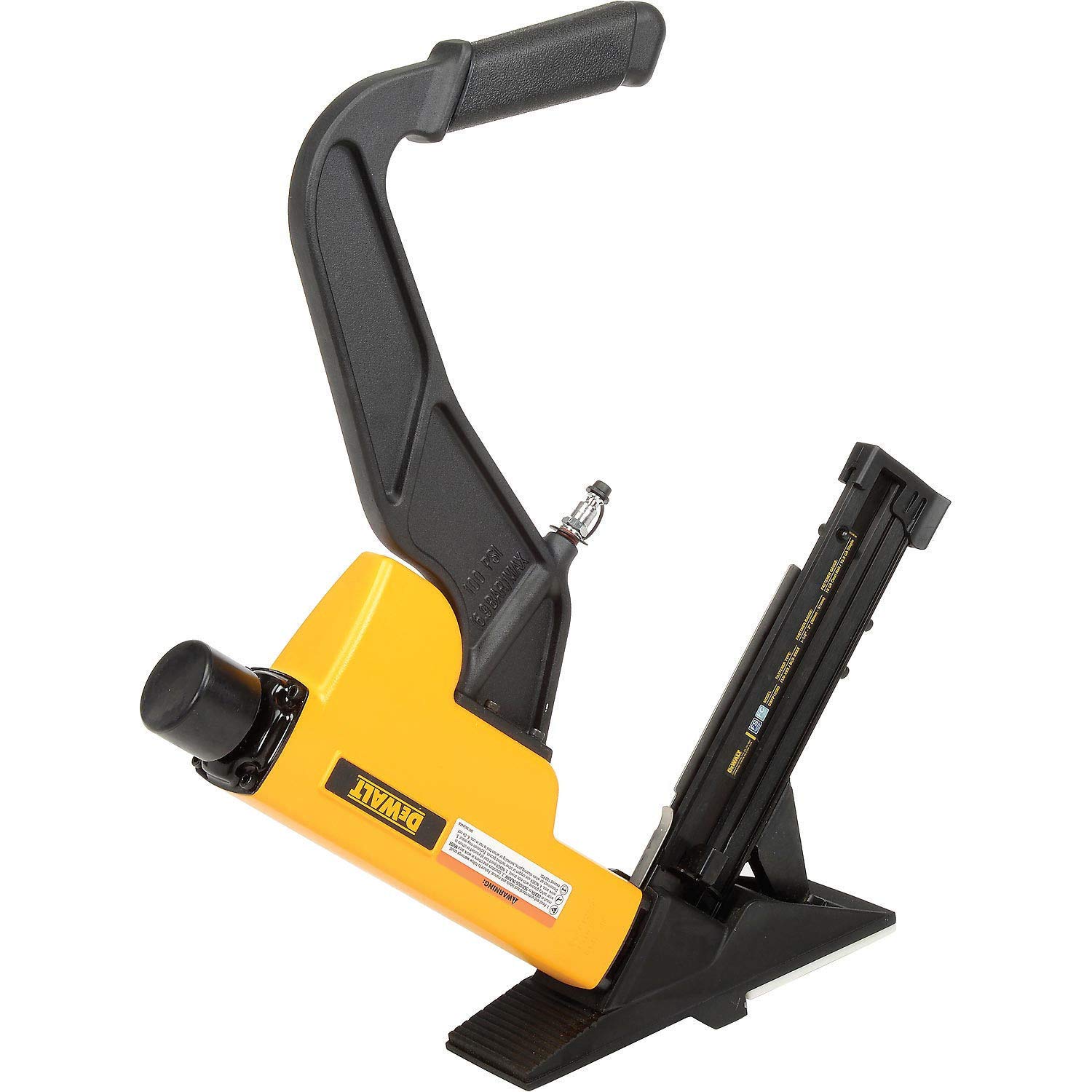
Built for zero-jam hardwood runs and easier on your compressor than most.
The DEWALT’s pitch is straightforward: tune for the standard solid-flooring fasteners — 15.5-gauge staples and 16-gauge “L” cleat nails — with lower CFM requirements so your compressor runs less. That lower air demand is a real-world win if you are working off a smaller compressor, because the tool cycles without draining the tank as fast. It ships with three interchangeable non-marring base plates (1/2 in, 5/8 in, 3/4 in), a mallet, wrenches, and a 1/4 in air fitting, so you can set it up for the floor you have.
Reliability is where it shines. The consensus is zero jams through real installs, including one 1000-square-foot job completed without a hiccup, and the quality and reliability are the aspects that carry the most weight with owners. The ergonomically designed longer handle with a rubber grip keeps operation comfortable, and the non-mar plates keep prefinished boards blemish-free.
Two things to weigh: the spec sheet lists it at 14.7 pounds, so it is a substantial two-hand machine despite the “lightweight” framing in the marketing; and durability is the mixed note, with some units holding up well and a few not surviving heavy use. Run it at homeowner and light-contractor pace and it delivers clean, jam-free driving — a solid pick if reliable, low-CFM operation matters more to you than trimming weight.
The jam story: zero-jam runs through a full finished room are the headline, powered by tune 15.5-ga staple and 16-ga L-cleat feeding.
Weight reality check: at 14.7 pounds it is no featherweight, so plan on two hands and steady air for the cleanest seats.
Best for: installers on smaller compressors who want proven jam-free driving and three base plates.
Not ideal if: you need a one-hand lightweight body for overhead or awkward work.
8. Freeman PDX50C Flooring Nailer/Stapler

A 10-pound 3-in-1 that trims the weight without giving up a single fastener type.
If the Freeman PFL618BR felt like too much tool to swing, this is its lighter sibling. The PDX50C weighs 10 pounds — the maker rates it 20% lighter than comparable flooring nailers, thanks to a cut-away handle and a light-strike bumper. The three fasteners carry over: 16-gauge T-cleats, 16-gauge L-cleats, and 15.5-gauge 1/2″ crown staples, all from 1-1/2″ to 2″. It is built for tongue-and-groove hardwood across cherry, oak, maple, and walnut.
The 12-fastener full strip is smaller than the PFL618BR’s 120, so you feed it more often — the price you pay for the lighter body. The aluminum body, anodized magazine, and heat-treated steel parts keep it tough, and two interchangeable no-mar base plates adjust for 1/2″ to 3/4″ flooring so finished boards stay clean. Air tool oil, adjustment tools, and a long-reach fiberglass mallet with a padded grip come in the box, ready to work.
Reliability is what owners lean on — owners mention it running perfectly at 95 psi, and it makes hardwood installation feel far easier than muscle-powered tools. The catch is jamming: some runs are clean, others need a clear, and durability is the mixed note. For a homeowner installing a full room who wants 3-in-1 flexibility in a lighter carry, it is a fine middle path between the two Freemans.
Lighter without losing options
- 10 lb body — maker rates it 20% lighter than comparable nailers
- Still fires 16-ga T-cleats, 16-ga L-cleats, and 15.5-ga staples
- Runs on standard pressure (customers note 95 psi working fine)
- Two no-mar plates cover 1/2″ – 3/4″ flooring
- Oil, tools, and padded long-reach mallet included
Weigh these against it
- 12-fastener strip means more reloads than the big-strip Freeman
- Jamming is the mixed note
- Durability split between long-lived and short-lived runs
Go here if: you want one 3-in-1 tool that is genuinely easier to swing for a full room.
Go to the PFL618BR if: reload count matters more than body weight on your job.
9. Powernail 2000F L-Cleat Nailer

A compact trigger-pull that slips against walls and dials in floor height with a lever.
Where the full-size tools are too bulky, this one goes. The compact design gets you close to walls and into tight spaces, and it fires 20-gauge L-cleats — a finer cleat for engineered and hardwood planks. The adjustable FLEX foot is lever-activated and needs no tools, so you can tune the height to your flooring thickness in seconds, and the nose shape is built to fit a range of profiles, including tongue-and-groove and interlocking plank.
At 7.59 pounds it is one of the lighter bodies here, and it comes as a kit with a carrying case and a tapping block, so you can move it job to job cleanly. Reliability is the strength — reviewers point out no misfires, and one notes it works perfectly with 3/8-inch engineered hardwood. For the rows along the wall and the odd tight corner, the trigger-pull action lets you place each cleat precisely.
The trade-off is fastener scope: 20-gauge L-cleats only, so it is a specialty tool rather than a whole-floor anchor. The FLEX foot is a genuine convenience, but you still need a steady hand to keep the finer cleat seating on denser planks. It is built for finish work and confined spaces, and it handles both.
The reach and the foot: a compact nose plus a tool-free lever foot means it fits walls and adjusts to thickness on the fly.
Scope limit: 20-gauge L-cleats only — a specialty finisher, not your whole-floor anchor.
Best match: engineered and hardwood installs that need tight-corner and wall-row reach with quick height changes.
Wrong tool if: you need staples or heavier cleats for a full solid-wood floor.
10. Powernail 50F Flooring Nailer

The trigger-pull built for solid hardwood, exotics, bamboo, and engineered plank alike.
This is a professional-grade 18-gauge L-cleat nailer for the widest wood range on this list: solid hardwood, exotic species, bamboo, and engineered flooring, from 3/8″ to 3/4″. The patented lever-actuated FLEX foot fine-tunes to various wood profiles and thicknesses and eliminates the need for shims or pads — no extra tools required. The no-mar material protects even delicate finishes, and the lever uses a ratcheting design so you can reposition it as you move along a run.
It is a trigger-pull machine, so you squeeze to fire each cleat, and the extra features keep it workable: directional exhaust pushes air away from your face, a handle-mounted safety trigger guards against accidental fires, and an easy-access gate plate speeds clearing a stuck fastener. Buyers like the adjustability, noting the non-marring nose plate is easy to dial in, and the tool stays clear of the glue line during installation.
Set expectations honestly: reliability is the mixed note here, with some runs firing clean and others needing attention, so it rewards careful setup and steady air. At 14 pounds it is a hefty body. For thick solid hardwood and exotics that need a fine 18-gauge cleat and a precise, shim-free foot, it is the specialist to reach for.
Range and foot control: the 3/8″ – 3/4″ span and ratcheting FLEX foot handle exotics and bamboo without shims.
The reliable caveat: reliability is the mixed note, so dial it in carefully and feed it steady air for consistent seats.
Reach for it if: you are installing thick solid hardwood, bamboo, or exotics and want an 18-gauge trigger-pull with shim-free adjustment.
Look at the 50PFLEXW instead if: you prefer mallet-actuated firing on the same footprint.
11. Powernail 50PFLEXW Flooring Nailer

A mallet-actuated pro tool with serviceable internals built to be rebuilt, not replaced.
This is the top-tier of the group, and the build explains why. It is a pneumatic mallet-actuated 18-gauge L-cleat nailer for tongue-and-groove solid hardwood, exotic, bamboo, and engineered flooring, made in the USA. The FLEX adjustable foot fine-tunes to various wood profiles and thicknesses, so you skip the shims and pads, and the no-marplate protects even delicate finishes. The body is aircraft-grade aluminum, and Powernail fits each tool with a replaceable steel cylinder sleeve that shields the body from wear caused by the internal moving parts — so the machine can be serviced rather than thrown away.
The sealing design matters too. It uses u-cup lip seals that increase sealing effectiveness and longer life compared with traditional o-rings. At 11.4 pounds it is a manageable mallet tool, and the iron mallet with a white rubber cap plus pneumatic tool oil come in the box. Coverage is honest here: one-year warranty on all parts and labor, and a ten-year warranty on the tool body — an unusually long body guarantee that signals how the maker rates the frame.
The catch is straightforward: it is a premium mallet tool with a small, focused audience, so if you are laying one room, the mid-range picks do the same job for far less. It earns its place for pros who want a USA-made body with a replaceable cylinder sleeve they can rebuild instead of replace.
Built for the long haul
- Made in the USA with a replaceable steel cylinder sleeve
- U-cup lip seals for stronger sealing and longer life than o-rings
- FLEX adjustable foot eliminates shims and pads
- No-mar plate protects delicate finishes
- One-year parts-and-labor plus ten-year tool-body warranty
Who should think twice
- Premium-tier outlay is overkill for a single room
- 18-gauge L-cleats only
- 11.4 lb mallet tool demands deliberate two-hand work
Made for the pro bench: installers who want a serviceable, USA-made body that takes a rebuild over its lifetime.
Overkill for: a one-room homeowner job where the mid-range picks cover the same ground.
Know the Specs
Fastener gauge and cleat type
Gauge is the wire thickness of the cleat — a lower number means a thicker, stronger fastener. A 16-gauge L-cleat is heavier than an 18-gauge cleat, and 15.5-gauge crown staples are a different fastener entirely, used where a floor spec calls for staples. Match the gauge and cleat style to what your flooring manufacturer specifies, because a nailer built for L-cleats will not run staples and vice versa. A 3-in-1 body covers T-cleats, L-cleats, and staples so you are not locked into one fastener.
Flooring thickness and base plates
Flooring thickness runs commonly from 1/2″ to 3/4″, and the interchangeable no-mar base plates are how a nailer adapts to that range. The plate sits between the metal tool and the finished board to prevent scratches and dents. Some tools adjust with a lever-actuated FLEX foot instead of swapping plates, which lets you fine-tune to wood profiles without shims or pads. Confirm the tool covers the exact thickness you bought before you commit.
Actuation: mallet versus trigger-pull
Mallet-actuated tools fire when you strike the bumper with a rubber mallet — this keeps you more upright and is the standard for main-floor runs. Trigger-pull and palm tools fire when you squeeze, so they reach starting rows, final rows, and tight corners a full-size tool cannot. Many installers keep one of each, using the big tool for the field and the compact one for the edges.
Air demand, weight, and PSI
Flooring nailers run on compressed air, and the CFM (air volume the tool consumes) determines how hard your compressor has to work. Lower CFM tools run without draining a smaller tank as fast. One Freeman model is reported working at 95 psi, and some tools are built to run on smaller compressors. Weight in pounds matters just as much: a lighter aluminum body reduces fatigue on long shifts, while heavier mallet tools trade portability for a sturdier feel.
Common Questions
What is the difference between a flooring nailer and a flooring stapler?
Will an 18-gauge flooring nailer work on solid hardwood?
Do I need a separate tool for the first and last rows of flooring?
How much floor thickness can a flooring nailer handle?
What size air compressor do I need to run a floor nailer?
Why do floor nailers jam and how do I reduce it?
Is a mallet-actuated nailer better than a trigger-pull model?
Can a floor nailer damage prefinished flooring?
What does the CFM rating mean on a flooring nailer?
Do I need fasteners included or do I buy them separately?
The Bottom Line
For most people laying a full floor, the wood floor nailer winner is the Freeman PFL618BR because it fires 16-gauge T-cleats, 16-gauge L-cleats, and 15.5-gauge staples from one body and swallows a 120-fastener strip, so you cover the whole job with one tool. If staying off your knees matters most, grab the NuMax S18GLCNDH at 7.8 pounds with its dual handle. And for the tight rows along the wall that no full-size nailer reaches, the Powernail PALM001 is the tool to keep in your pouch. The Freeman’s 4.5+ stars across 900+ ratings make it the confident first buy — start there and add a specialist only when a specific corner of your install calls for it.
How we choose
We do not accept paid placement. Every pick is matched to a real buyer and a real use-case; we do not hands-on test units.
Sources
Specifications: manufacturer listings and product documentation. Review insights: verified customer reviews, as of November 2026. Pricing: not shown on this page (it changes often); check the current price via the retailer link.
As an Amazon Associate, Tactical Gear Guy earns from qualifying purchases. This does not affect which products we feature.