Specs are compiled from manufacturer listings and verified buyer reviews and can change over time — please confirm the key details on the product page before buying.
Your floor boards are stacked in the hallway and the rental clock is already running. The tool that decides whether this job goes smoothly or eats your weekend is almost never the saw — it’s the fastener driver, the jack, and the cutter working in sequence. Get those three right and planks close up tight. Get them wrong and you spend Sunday afternoon prying apart a gap you created yourself.
This guide is built by comparing the manufacturers’ published specifications and the patterns across verified customer reviews, so you get each pick’s real strengths and trade-offs instead of marketing spin.
Below you’ll find pneumatic nailers for tongue-and-groove hardwood, a hand-powered cutter that eliminates dust entirely, and the small support tools that stop finished planks from getting scarred.wood floor installation tools decide the pace of the whole job, so the picks are grouped by what each one actually does on a subfloor.
Top Picks


How To Choose The Best Wood Floor Installation Tools
The single most common mistake is buying the nailer first and checking plank thickness later. Flooring fasteners are sized to the board, not the other way around, so the floor you bought decides the tool you need. Work backward from the material and the rest falls into place.
Match the fastener gauge to your plank thickness
Solid hardwood and thicker engineered boards typically want a dedicated flooring nailer driving 15.5-gauge staples or 16-gauge L-cleats (L-shaped nails that grip the tongue at an angle). Thinner engineered and floating floors usually call for 18-gauge brads or narrow crown staples, which leave a smaller hole. A 3-in-1 or 4-in-1 tool covers more of that range with one body, but each tool still has a stated fastener window — read it before you commit.
Check compressor CFM, not just PSI
Pneumatic flooring tools are air-hungry in bursts. CFM (cubic feet per minute) is the airflow your compressor can sustain, and it matters more than the peak pressure number on the tank. A nailer with lower CFM requirements runs on a smaller compressor and cycles less, which means fewer stalls in the middle of a row. If your compressor is a compact pancake unit, favor the tool with the lower demand.
Decide if you need a jack at all
A flooring jack pulls a stubborn board tight against the previous course where a mallet alone will not close the gap. It’s the tool that saves a run when boards arrive slightly bowed. If you are laying a small room with straight material, a jack and a tapping block may never leave the case. On a long nail-down run, it earns its place in the first hour.
Side-by-Side Comparison
| Model | Best For | Tool Type | Fastener / Cut Capacity | Weight | Amazon |
|---|---|---|---|---|---|
| Freeman PFL618BR★ Best Overall | Full nail-down hardwood runs | 3-in-1 pneumatic nailer/stapler | 1-1/2″–2″ fasteners, 120 capacity | 11.5 lb | Amazon |
| BOSTITCH HFM-4Simplest Upgrade | Setting board ends without dents | Flooring mallet | 59-ounce head | 1 lb | Amazon |
| WELLHOME DT002Gap Closer | Closing stubborn plank gaps | Ratcheting flooring jack | 200 lb load capacity | 5.8 lb | Amazon |
| 3PLUS HFS509040SP | Thin engineered and 3/4″ hardwood | 4-in-1 pneumatic stapler/nailer | 3/4″–2″ brads, 5/8″–1-1/2″ staples | 3.5 lb | Amazon |
| CUTTEREX BLC-330 | Dust-free cutting indoors | 13″ hand-powered cutter | 5 cutting angles, 0°–45° | 14.57 lb | Amazon |
| WEN 61741K | Light flooring on a small compressor | 4-in-1 18-gauge pneumatic | 5/8″–2″ brads, 100 capacity | 3.37 kg | Amazon |
| DEWALT DWFP12569 | Long solid-hardwood installs | 2-in-1 pneumatic nailer/stapler | 15.5ga staples / 16ga L-cleats | 14.7 lb | Amazon |
| BOSTITCH BTFP12569 | Nail-down without kneeling | 2-in-1 pneumatic nailer/stapler | 1-1/2″–2″ staples or L-cleats | 14.7 lb | Amazon |
| ROBERTS 10-94 | Wide planks and heavy duty cycles | 13″ guillotine cutter | Up to 13″ wide, 5/8″ thick | 33.8 lb | Amazon |
Detailed Reviews
1. Freeman Pneumatic 3-in-1 2″ Flooring Nailer | PFL618BR
Our pick — 4.5+★ from 950+ verified ratings; the strongest balance of quality and price.
One body that fires cleats, staples, and nails, so you stop swapping tools mid-row.
The number that carries this tool is three: it fires both 16-gauge T-cleats and L-cleats plus 15.5-gauge 1/2″ crown staples, all from 1-1/2″ to 2″ long. In plain terms, you buy one gun and it covers most tongue-and-groove hardwood jobs without a second purchase. The 120-fastener magazine (a full strip, so you reload less often) keeps a long row moving.
At 11.5 pounds with a high-strength aluminum body and anodized aluminum magazine, it stays manageable on a long run. The extended-reach handle and light strike bumper cut down the fatigue that builds over hundreds of strikes. Two interchangeable no-mar base plates (protective pads that won’t scratch the surface) switch it between 1/2″ and 3/4″ flooring — so you can finish on prefinished boards without leaving a mark.
Two things to know before you order. It includes a long-reach fiberglass mallet with a padded grip and a blow-molded case, which softens the startup cost, but the semi-quick jam release still means you clear the drive blade by hand when a fastener misfires. Owners also note you can add the Freeman PFNRB Roller Base Converter separately if you want less manual positioning. The hammer side of this tool sits on a mixed note — most report it holds up, a few see wear sooner than expected.
What earns it the top slot
- Fires three fastener types — 16ga T-cleats, L-cleats, and 15.5ga 1/2″ crown staples — from a single body
- Two no-mar base plates cover 1/2″ through 3/4″ flooring without scratching finished surfaces
- 120-fastener full-strip capacity keeps long runs moving with fewer reloads
- 11.5 lb aluminum body with extended-reach handle reduces fatigue on long shifts
- Mallet and blow-molded case included, so you can start the job without buying extras
Where you’ll want to plan ahead
- Jam release is semi-quick, so a stuck fastener means manual access to the drive blade
- The roller base that helps positioning is a separate add-on piece
- Tool wear shows earlier for some owners than others
Worth owning for: anyone nailing down 1/2″ to 3/4″ tongue-and-groove hardwood who wants one gun instead of three.
Plan around: budget for the roller base if you want maximum control on wide rooms.
2. BOSTITCH Flooring Mallet, 59-ounce (HFM-4)
A 59-ounce head with soft faces, so board ends seat without the wear layer peeling.
Weight is the whole story here, and the spec is right in the name: a 59-ounce head. That heft does the work — a heavier swing seats a plank with less effort repeated over a whole room. The jacketed graphite handle keeps the strength of wood in feel while arresting the sting that a straight wooden handle passes back into your palm. The flared comfort-fit grip limits slippage on the backswing.
The design detail that saves finished floors is the beveled face. It angles slightly so it sets board ends and protects the wear layer instead of mashing a sharp edge into it. A second soft replaceable face protects both flooring and tool. When that face wears flat, you swap it rather than buying a whole new mallet — though the replacement faces are sold separately, so remember to order one before you need it.
At 1 pound, this is the lightest pick in the lineup by a wide margin — that is roughly a fourteenth the heft of the 13″ CUTTEREX cutter at 14.57 pounds. It is also the item you will find hardest to substitute with anything from a hardware bin, because a standard rubber mallet dents tongues instead of seating them.
The everyday reality: Buy it once and the replaceable faces keep it in service for years.. If you are already running a pneumatic nailer, this mallet keeps your finished boards clean at the ends.
Reach for this if: you are doing any strike-assisted flooring work and want the board ends to stay pristine.
Also note: faces are not included as spares, so buy a replacement set with the mallet.
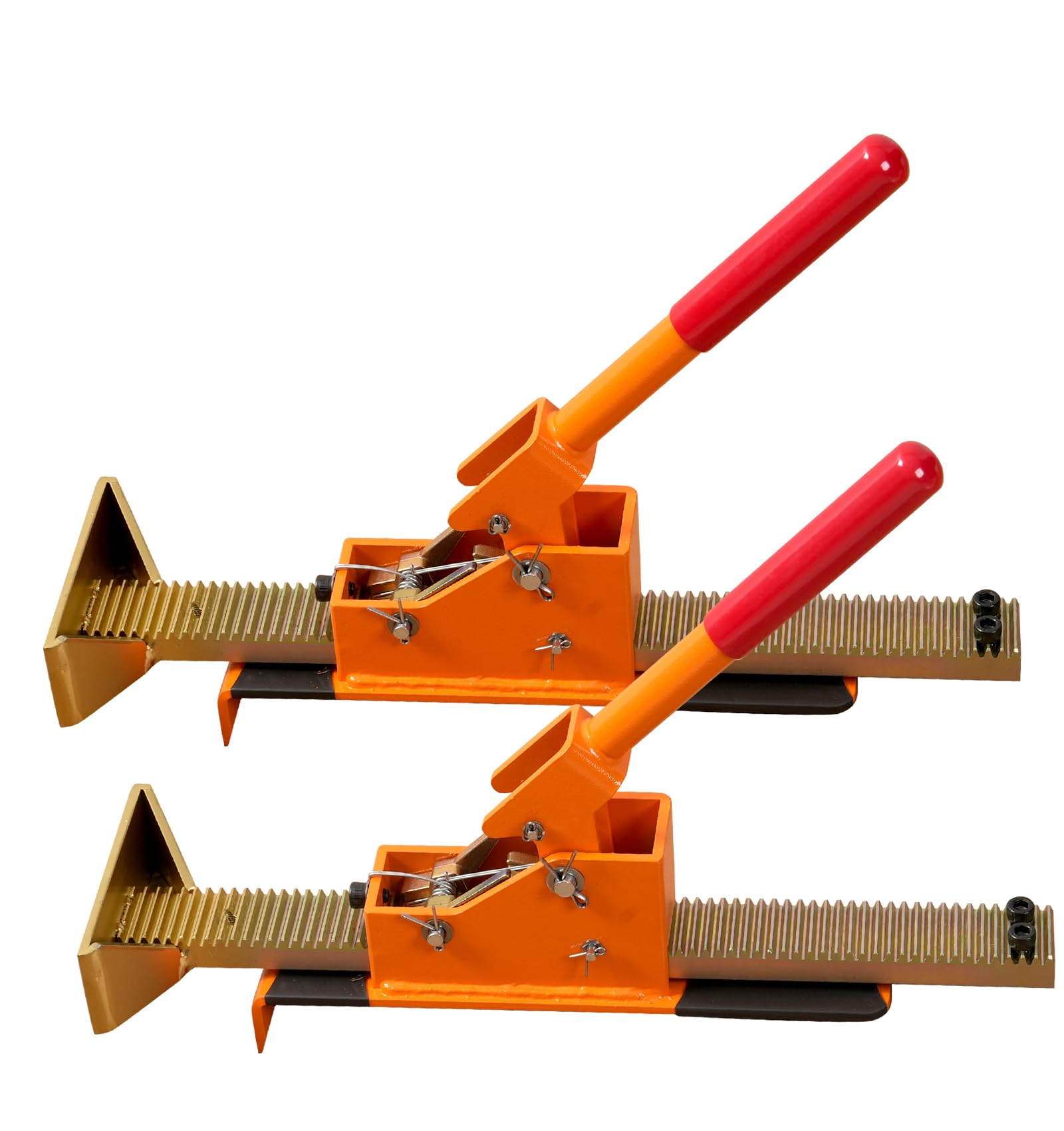
3. WELLHOME Hardwood Flooring Jack
The ratcheting jack that pulls a bowed board tight when a mallet alone will not close the gap.
Flooring jacks exist because planks are not always straight. This one ratchets a board into position instead of hammering it, which matters when a course has drifted and you need controlled pull rather than blunt force. The 200-pound load capacity tells you it will handle hardwood without groaning, and the alloy steel body at 5.8 pounds gives it substance without being a burden to carry around the room.
Two details make it genuinely useful on varied jobs. It works with any floor thickness, and the maker lists hardwood, laminate, LVP, and vinyl among the materials it suits — so you are not buying a tool that only handles one plank type. That range makes it a companion to a tapping block and spacers rather than a replacement for them. The orange color is a small thing, but you will spot it on a chaotic subfloor.
Where this earns its place is tongue-and-groove planks that will not seat by hand. The ratcheting action lets you apply steady pressure and back it off, instead of risking a crushed tongue with a hammer. Its footprint of 14.17 x 3.94 x 3.94 inches keeps it compact enough to tuck into a tool bag. For contractors who install a lot of nail-down hardwood, this sits alongside the DEWALT and BOSTITCH nailers rather than competing with them.
Why it stays in the bag
- Ratcheting action applies controlled pressure so tongues seat without crushing
- 200-pound load capacity handles solid hardwood comfortably
- Works across hardwood, laminate, LVP, and vinyl regardless of plank thickness
- Alloy steel construction with a compact footprint for tight work areas
The limit to know
- It is a positioning aid, not a one-tool solution — pair it with spacers and a tapping block
- Ratcheting tools need a clear angle to engage, so tight corners take extra fiddling
The match for: anyone fighting bowed boards on a nail-down hardwood run and tired of hoping a mallet does the job.
Not needed for: small rooms where straight boards seat by hand.
4. 3PLUS HFS509040SP Pneumatic Flooring Stapler/Nailer

A 3.5-pound gun that fires 18-gauge brads and narrow crown staples through thin engineered planks.
For an 18-gauge tool, this one runs a broad fastener window. It drives brad nails from 3/4″ up to 2″ and narrow crown staples with a 1/4″ crown from 5/8″ to 1-1/2″. The manufacturer rates it for 1/4″ to 5/8″ engineered or solid hardwood flooring — the thinner layers where a big 15.5-gauge flooring nailer would split the tongue. Buyers report putting it through 3/4″ hardwood too, and one phrase from the review pages sums it up: owners routinely install thousands of square feet on one tool.
The 3.5-pound frame is the lightest pneumatic choice in this group — compare it to the 14.7-pound DEWALT and BOSTITCH nail-down tools, and you see how much easier it is to swing overhead or in a tight closet. That weight also means less shoulder fatigue over a long day. A multi-directional exhaust cover rotates 360° to blow spent air away from your face, and tool-free depth control sets nail heads flush without a wrench.
The trade-off is real and worth telling you plainly. Jamming has drawn mixed feedback — plenty of owners run it clean while some wrestle with repeated stops. There is also a quick-clear jam release for when it does happen. Choose this when you want the versatility of a 4-in-1 with a lighter body; if a single-minded nail-down gun is all you need for thick solid hardwood, go up to the Freeman or the DEWALT instead.
Where it fits: a great middle-ground unit for the DIYer working across engineered, solid, and thinner floors who wants one tool that adapts. Its ability to convert to a conventional combination stapler/brad nailer extends its use well past flooring day.
Grab it if: you install thinner engineered or 3/4″ hardwood and want a light, adaptable gun.
Weigh carefully: the jam history means you should expect to clear the nose now and then.
5. CUTTEREX 13″ Vinyl Floor Cutter
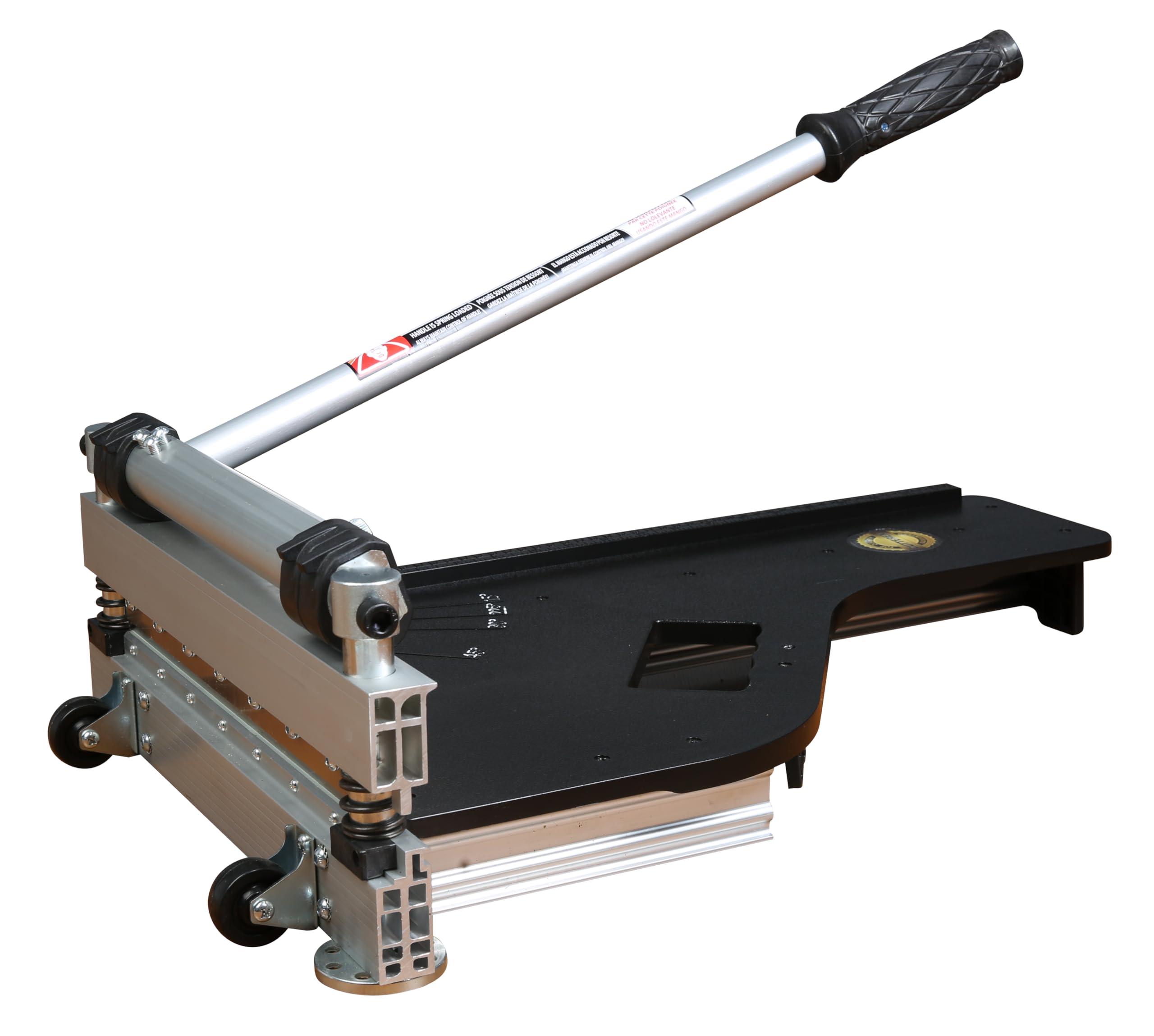
No dust, no noise, no power cord — a hand-powered 13″ cutter that trims planks to length indoors.
Five cutting angles is the detail that turns a cutter into a design tool, not just a trimming aid. This one cuts at 0°, 15°, 22.5°, 30°, and 45°, so diagonal and angled plank layouts become possible without dragging a miter saw into the room. An integrated imperial and metric ruler with clear marking lines on the support table gives you the measurement right where you cut. The 23.5″ aluminum lever provides the extra leverage to push through laminate without a wrestling match.
At 14.57 pounds it has enough mass to stay steady on the floor while you work, and a table handhole makes it easier to lift and reposition. The steel and aluminum frame paired with an ABS support table means it takes a knock. The high-speed steel blade is rated for over 20,000 cuts on laminate, vinyl, and WPC, so a whole-house job won’t wear it out. Extra nylon cushions and a whetstone come in the box and extend the blade’s service life.
Here is the honest limit. It is not suitable for cutting porcelain tile, which is a hard boundary for anyone finishing a room with a tile border. And the 14.57-pound body is a far cry from the 1-pound BOSTITCH mallet — this is a stationary station, not a handheld snip. What wins people over is the no-dust operation: you cut where you install, so planks never travel out of the room and back. For most buyers laying their own vinyl or laminate, that single convenience justifies the room it takes up.
What makes it a keeper
- Five angle settings (0°, 15°, 22.5°, 30°, 45°) handle diagonal layouts
- HSS blade rated for 20,000+ cuts on laminate, vinyl, and WPC
- No dust, no noise, no electricity — ideal for indoor installs
- Integrated imperial and metric ruler with clear marking lines
- Nylon cushions and whetstone included to extend blade life
Boundaries to respect
- Not suitable for cutting porcelain tile
- 14.57 pounds and a 24 x 15 x 3.5 inch frame mean it takes floor space
- Blade edge dulls eventually and needs re-sharpening to stay clean
Best used by: the installer working indoors on vinyl, laminate, LVP, or engineered planks who wants accurate angle cuts without dust.
Know going in: leave it in the case if any part of your layout includes porcelain tile.
6. WEN 61741K Pneumatic Flooring Nailer and Stapler

A spring-loaded 45-degree shoe flips this 18-gauge nailer between flooring duty and finishing work.
What separates this from the other 4-in-1 on the list is the removable spring-loaded flooring shoe. It angles fasteners at 45 degrees, the traditional approach for tongue-and-groove hardwood. Pop the shoe off and the same tool runs as a standard 18-gauge brad nailer for trim and cabinet work. It drives brads from 5/8″ to 2″ and 1/4″ narrow crown staples from 1/2″ to 1-5/8″, giving you a broad fastener range in a 100-nail magazine.
For a job on a compact compressor, this is an easy unit to run — 18-gauge tools draw less air than their larger flooring cousins, so a small tank keeps up without stalling constantly. The quick-release nose makes clearing a jam a matter of flipping a latch, and the adjustable air exhaust keeps spent air off your face. A 3.37 kg body is manageable to swing through a full room of planks.
The catch to weigh honestly: capacity has drawn mixed feedback, so treat the 100-nail magazine as adequate for the job rather than boundless, and reload when the row slows. It ships with a hard carrying case, two hex keys, a removable non-mar tip for finishing applications, and oil — a complete start-up kit rather than the bare tool. For a hybrid installer who does floors and trim, that coverage is hard to match at this build level.
The value read: a two-duty tool that covers both flooring and finishing without changing guns. If your project involves trim after the floor, this saves you from buying a separate brad nailer — one of the more useful trades in the group.
Pick it for: a hybrid remodel where the same gun handles flooring, trim, and finishing tasks.
But note: magazine capacity is finite, so plan for reloads on wide runs.
7. DEWALT Flooring Stapler, 2-in-1 Tool (DWFP12569)
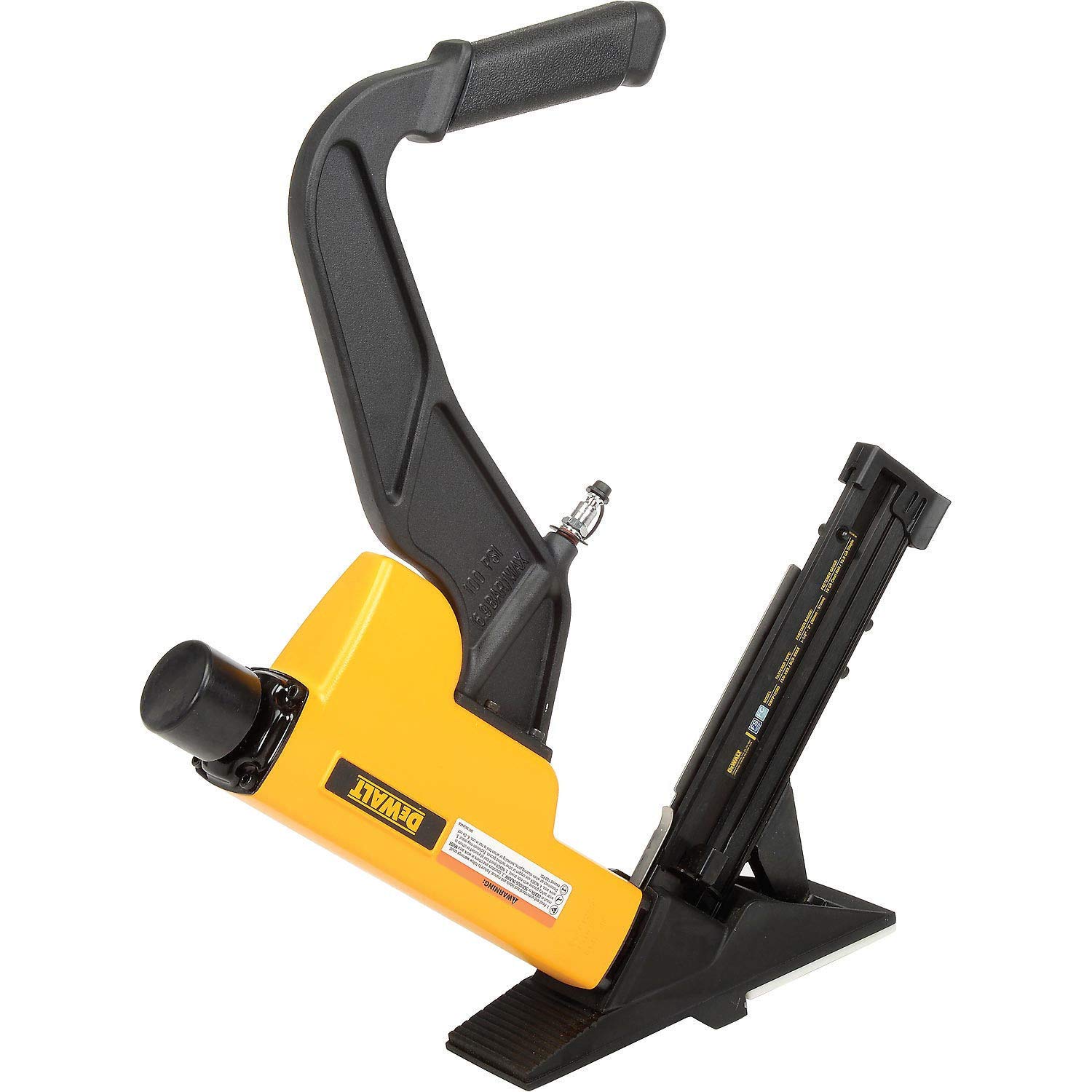
For solid hardwood runs, the lower CFM demand means fewer compressor cycles under your work.
A pneumatic nailer is only as good as the air feeding it. This DEWALT is built around lower CFM requirements, which means your compressor runs less and recovers faster between strikes. On a long solid-hardwood run, that shows up as fewer stalls and a steadier rhythm. The tool is tune for the most popular solid flooring fasteners — 15.5-gauge staples and 16-gauge L-cleat nails — the pair that most nail-down planks take.
The interchangeable non-marring base plates adjust to all sizes of flooring, so the same body handles 1/2″, 5/8″, and 3/4″ boards. The kit includes those plates, a mallet, wrenches, and a 1/4″ air fitting — enough to get going without a shopping trip. At 14.7 pounds, the longer handle and comfortable rubber grip are what make it workable, letting you reach across a row instead of bending over each plank.
What owners point to again and again is reliability — one owner reports 1,000 square feet with no jams. Reviewers consistently report zero jams. Durability shows a mixed note, with most seeing years of service while a few report trouble during use. This is the pick for a serious weekend warrior or a pro who wants one nailer that handles the bulk of solid flooring without fussing over compressor size.
Why it holds up
- Lower CFM requirements mean less compressor run-time and fewer stalls
- Interchangeable non-marring base plates fit 1/2″, 5/8″, and 3/4″ flooring
- tune for 15.5ga staples and 16ga L-cleat nails — the standard solid-flooring fasteners
- Long handle with rubber grip eases reach across a row
- Full kit includes plates, mallet, wrenches, and 1/4″ air fitting
Weigh before you commit
- Durability feedback splits — most are happy, some see earlier wear
- 14.7 pounds is a sustained shoulder load over a long day
Built for: solid hardwood installers who want a proven nailer that cooperates with a modest compressor.
Think twice if: you are laying thin engineered planks — the bigger 15.5-gauge fasteners can split the tongue.
8. BOSTITCH Flooring Nailer, 2-in-1 (BTFP12569)

Mallet-actuated and floor-standing, so you lay hardwood without kneeling for every plank.
The design detail that separates this from a hand-nail approach is the mallet-actuated pneumatic action. You strike the tool with a mallet to trigger the driver, which means you work standing over the row rather than bent at the waist for every board. Owners single out exactly that benefit — the ability to install without getting on their knees. And with non-marring interchangeable base plates spanning 1/2-inch (12.7 mm) through 3/4-inch (19.1 mm), the same body spans most solid flooring thicknesses.
It drives 15.5-gauge flooring staples or 16-gauge L-cleats from 1-1/2-inch to 2-inch in length. The long ergonomic handle with a rubber grip gives you reach to stand comfortably over each plank. At 14.7 pounds, it matches the DEWALT number for the same class of tool, so neither saves you shoulder strain through weight — the difference comes from how you operate it. This one rewards good mallet strikes; the DEWALT works at a lower air demand.
Jamming shows a mixed side in the review pages, so treat occasional stops as a normal part of running this tool — quick clears keep a job moving. What earns it a premium spot is the clean finish it leaves: owners note no surface damage on prefinished flooring. It also costs less than renting a nailer for a multi-weekend job. If you want to keep the work at standing height on solid hardwood, this is the pick that delivers.
Why it earns a premium slot: the standing operation is the whole point — you save your back and your knees over a long install. Owners mention no surface damage on prefinished flooring, which is exactly what you want from a nail-down run.
Worth it for: solid hardwood projects where you want to stand while you fasten and keep finished boards clean.
One caveat: clear jams promptly — seating a course with a stuck fastener slows everything down.
9. ROBERTS 10-94 Multi-Floor Cutter, 13″

A guillotine cutter that swallows 13-inch planks up to 5/8-inch thick and cuts at 45 degrees.
If you are laying wide planks, the 13-inch throat matters more than anything else on this cutter. It cuts up to 13″ wide and 5/8″ (16mm) thick, so broad laminate and engineered boards fit without being trimmed first. A movable guide lets you set 45-degree angle cuts for borders and corners. The extruded aluminum base with a solid plastic surface gives you a stable working area, and the long handle adds leverage for extra cutting power with less effort.
What makes this hold up over a big job is the replaceable tungsten-steel blade. It provides a long-lasting working life and a sharp, clean cutting edge — customers note cutting panels “like butter” and finishing a 500 sq ft room in under 6 hours. That savings comes from skipping the saw dust and the setup at every cut. It also means no dust flying around the room you are living in.
The number to respect is 33.8 pounds. That mass keeps the cutter planted but makes it a fixed station rather than something you carry from room to room; do your measuring and markup in the room, then bring the planks to the cutter. Build quality shows a mixed note in the review pages — the functional result is praised, but a few see less than ideal long-run durability. For a large install where the cut count climbs, the replaceable blade keeps the tool in service rather than sidelined.
The trade you are making: a stationary unit that replaces a saw and its dust for wide-plank work. Its cutting speed and mileage come at the cost of floor space and a heavier lift to move.
Settle on this if: you are running wide planks and want a stationary guillotine that handles the volume.
Not for: anyone who wants a cutter light enough to carry up and down stairs.
Know the Specs
Fastener Gauge and Length
Gauge is a wire thickness rating — lower numbers mean a thicker fastener that holds harder but takes a bigger bite from the plank’s tongue. A 15.5-gauge staple and a 16-gauge L-cleat are the heavyweights of solid hardwood, which is why solid-flooring nailers are built around them. An 18-gauge brad is thinner and less obtrusive, better for engineered or thin flooring where a thicker fastener risks splitting the tongue. Match the gauge and the stated fastener length window to your plank thickness before choosing a tool.
Flange, Chamber, and Cut Capacity
On a floor cutter, width and thickness capacity decide what planks you can handle without a saw. A cutter rated for 13″ wide and 5/8″ thick swallows most wide planks, but a thicker plank will not pass through. Throat width is the limiting spec — measure your widest plank before you buy. A replaceable blade also matters: cutting hundreds of feet dulls any edge, so a tool with a swap-in blade stays accurate on a large job.
Common Questions
Will a 15.5-gauge flooring nailer work on engineered hardwood?
Do I need a flooring jack if I already have a mallet?
What size compressor does a pneumatic flooring nailer need?
Can a floor cutter replace my miter saw for plank cuts?
How long does a flooring nailer last?
Do I need to be on my knees to install hardwood?
What is the difference between an L-cleat and a staple for flooring?
Can I use these tools on laminate and vinyl planks?
Is a heavier mallet better for seating floor planks?
What is the best way to clear a jammed flooring nailer?
The Bottom Line
If you’re laying tongue-and-groove hardwood (planks that lock together with a ridge and groove), the Freeman PFL618BR is the one to buy first. It fires three fastener types and comes with two no-mar base plates (pads that protect the wood surface), so one gun handles most of the job. The mallet and case are in the box, so you start without buying extras. On a long solid-floor run, the BOSTITCH BTFP12569 lets you stand while you work and keeps your back out of it. And for indoor cutting with zero dust, the CUTTEREX 13″ cutter saves you dragging planks out of the room.
How we choose
We do not accept paid placement. Every pick is matched to a real buyer and a real use-case; we do not hands-on test units.
Sources
Specifications: manufacturer listings and product documentation. Review insights: verified customer reviews, as of November 2026. Pricing: not shown on this page (it changes often); check the current price via the retailer link.
As an Amazon Associate, Tactical Gear Guy earns from qualifying purchases. This does not affect which products we feature.