Specs are compiled from manufacturer listings and verified buyer reviews and can change over time — please confirm the key details on the product page before buying.
Buying a wood end grain cutting board is mostly a decision about weight and upkeep, not about looks. The end grain itself — the wood fibres standing straight up so your blade sinks between them instead of slicing across them — is what keeps a knife edge alive. Everything else is a trade-off between a board that stays planted and a board you can actually lift. Below are nine boards that genuinely use that construction, ranked so you can pick by how you cook.
This guide is built by comparing the manufacturers’ published specifications and the patterns across verified customer reviews, so you get each pick’s real strengths and trade-offs instead of marketing spin.
Weight, thickness and juice-groove design decide far more about daily use than any brand name on the edge. This breakdown of the best Wood End Grain Cutting Board covers what stays put, what stays kind to your knives, and what you will actually have to oil.
Top Picks
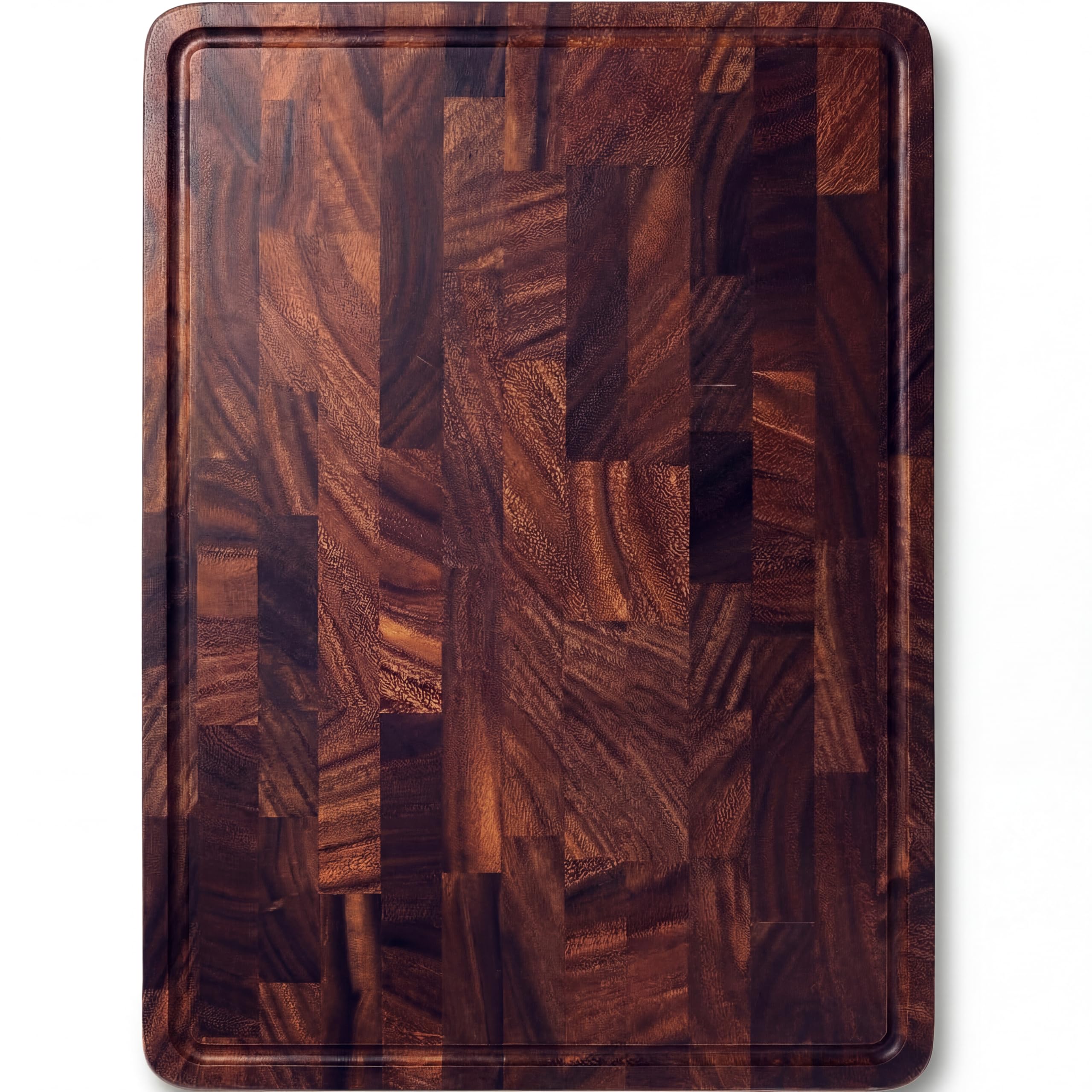
How To Choose The Best Wood End Grain Cutting Board
The first thing to get straight is that end grain is a construction method, not a species. Walnut, teak, maple, acacia and suar all show up here, and each behaves differently under a knife and under a tap. The second thing is that a heavier board is not automatically the better board — it is the better board for someone who leaves it on the counter.
Read the thickness before the wood species
Thickness is what gives a butcher block its planted feel. These boards run from 1.1 inches up to 2.5 inches, and that range is the difference between a board you can move with two fingers and one you brace against your hip. A thicker board also has more material to absorb moisture swings, which is one reason the extra-thick picks here tend to get described as stable rather than springy.
Decide if you want a juice groove
A juice groove is a channel routed around the perimeter that catches liquid before it reaches your counter. It earns its keep when you carve roasts, brisket or a whole bird. The catch is that a groove removes usable surface. A flat, groove-free board gives you every square inch for chopping, which is why boards built for dough and pizza prep often skip the groove entirely.
Weigh the board against your storage
End grain boards are dense, and density is weight. The heaviest board in this group is 5.58 kg, and the lightest walnut pick is 2.55 kg. If your board lives on the counter, heavy is a feature. If it has to go into a cupboard after every meal, a mid-weight board with side handles will get used far more often.
Plan for oil, because every board here needs it
Wood moves with moisture, and a dry board is a cracking board. Some of these arrive pre-oiled and some even ship with a bottle of oil, but the routine is the same afterwards: hand wash, towel dry, stand it upright, and re-oil when the surface starts looking thirsty. None of these boards belongs in a dishwasher, no matter how convenient that seems.
Side-by-Side Comparison
| Model | Best For | Material | Size (L x W x Thick) | Stated Weight | Amazon |
|---|---|---|---|---|---|
| BABILONIA Large Walnut End Grain★ Best Overall | All-round daily chopping | Walnut | 20″ x 16″ x 1.4″ | 5.58 kg | Amazon |
| Nomsters Teak Butcher BlockBest for Carving | Carving and brisket | Teak | 20″ x 15″ x 1.25″ | — | Amazon |
| Artistic Chef’s Kitchen WalnutBest Looking | Countertop display | Walnut, Ebony, Beech | 15.5″ x 11.5″ x 1.1″ | 2.55 kg | Amazon |
| BABILONIA American Walnut 3-in-1 | Small kitchens, two people | Black Walnut | 15.7″ x 10.2″ x 1.7″ | 3.08 kg | Amazon |
| SHUMARU XL Suar Block | Dough, pizza and big prep | Suar heartwood | 20″ x 13″ x 1.6″ | 11 lb | Amazon |
| All-Clad Acacia End Grain | Serving and carving | Acacia | 19.02″ x 14.02″ x 1.5″ | — | Amazon |
| New M Way Teak XL | High-volume meat prep | Teak | 20.08″ x 14.96″ x 1.5″ | 5.44 kg | Amazon |
| Bevel & Bond Maple | US-made gift pick | American Maple | 17″ x 13″ x 1.75″ | 10 pounds | Amazon |
| BACKLEY Pyrowood | Thick reverse-side prepping | Pyrowood | 17″ x 13″ x 2.5″ | — | Amazon |
Detailed Reviews
1. BABILONIA Large Walnut Wood End Grain Chopping Board
Our pick — 4.5+★ from 300+ verified ratings; the strongest balance of quality and price.
A 20-inch walnut block that lets you chop, then walk the whole thing to the stove.
The number worth starting with is 5.58 kg. That is a genuinely heavy slab of walnut, and it is the reason this board does not skate around when you are rocking a chef’s knife through a pile of onions. At 20″L x 16″W x 1.4″Th you get the largest walnut surface in this group, with room to prep a full dinner without shuffling food into a second bowl. The built-in handle and recessed groove mean you can grip it and move it one-handed, which is more than most blocks this size allow.
Compared with the Artistic Chef’s Kitchen walnut at 2.55 kg, this BABILONIA board is a two-hands-or-commit situation — and that is the honest trade. It stays put because it is heavy, not because it has rubber feet. Walnut is the wood that wins people over here; it is dense, closed-grained and takes on a deep finish as it ages, and it will show its first scratches rather than hide them. The board arrives seasoned and pre-oiled with a bottle of organic oil in the box, so it is usable the day it lands.
To keep this board usable for years, hand wash it only and never put it in the dishwasher. Store it somewhere cool and dry, not pressed against a hot appliance. The 2-year warranty and the Italian-designed branding mean nothing if you leave it soaking. Buyers report one recurring point: the walnut end grain picks up visible cut marks with steady use. That is the wood doing its job, not a defect. Plan to re-oil it every few weeks to keep the surface sealed.
What Wins People Over
- 20″ x 16″ x 1.4″ gives you the biggest walnut workspace of the group
- 5.58 kg of mass keeps the board planted through heavy chopping
- Ships pre-oiled with an organic oil bottle, ready on arrival
- Built-in handle makes a heavy board movable
The Honest Trade-Off
- At 5.58 kg it is not a board you tuck into a drawer
- End grain will show cut marks over time despite the density
- Hand wash only — a dishwasher will ruin it
Reach for this if: you keep your board on the counter and want the largest walnut prep surface you can get without a custom block.
Look elsewhere if: you need to stow it after every meal — the 2.55 kg walnut pick further down is the lighter answer.
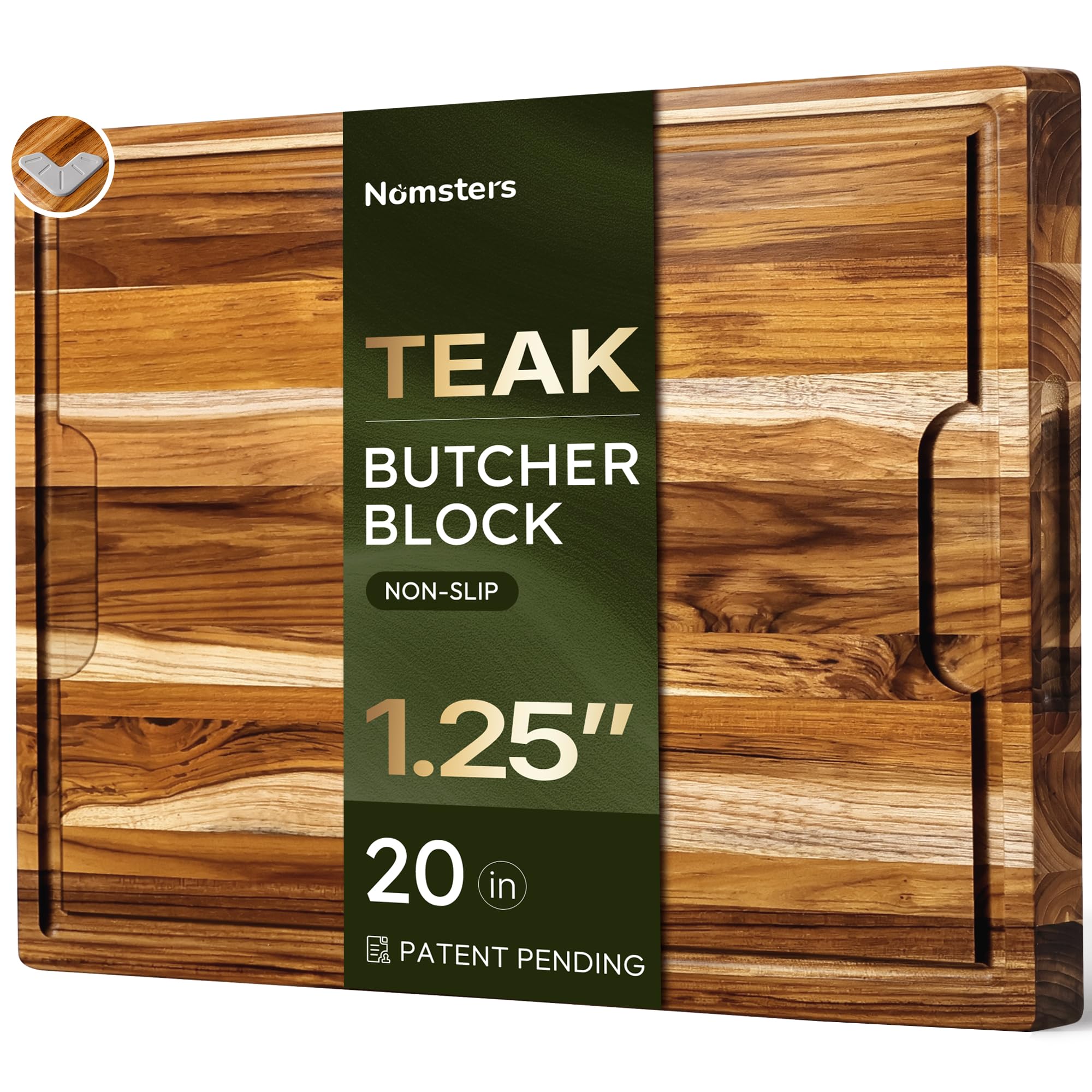
2. Nomsters 20 x 15 in Teak Cutting Board with Juice Groove
The carving board that treats juice like a problem to be solved, not wiped up later.
Teak brings its own natural oils to the party, which is why this board is pitched at moisture resistance and long-term stability rather than raw heft. At 20″L x 15″W x 1.25″Th it is a full-size prep surface, and the four corner feet lift it off the counter so the board stays put while you carve. The groove is the headline: a deep perimeter channel with an enlarged centre drainage area, designed to catch runoff from a roast rather than let it find your countertop.
Carving a brisket on a flat board means juice pools at your knife and runs off the edge. Here it collects in the channel, and the enlarged drain area handles volume a narrow groove would spill. The same 20 x 15 footprint that gives you room for a whole bird also gives you a board that will overhang a compact counter — measure before you buy, because there is nothing compact about it.
Where the design earns its place: corner feet and a deep groove (a channel that catches juices) make this the board to put out on a holiday table. Hand grips let you carry a loaded roast from kitchen to dining room without a second platter.
The catch worth knowing: teak is dense and needs the same hand-wash-and-oil routine as everything else here. It is not dishwasher-safe, and a 1.25-inch profile is steadier on its feet than it is light in the hand.
The carving specialist: this one belongs to anyone who cooks big cuts of meat and is tired of mopping the counter afterwards.
Skip if: you mostly chop vegetables and want every inch of surface — the groove eats into usable area.
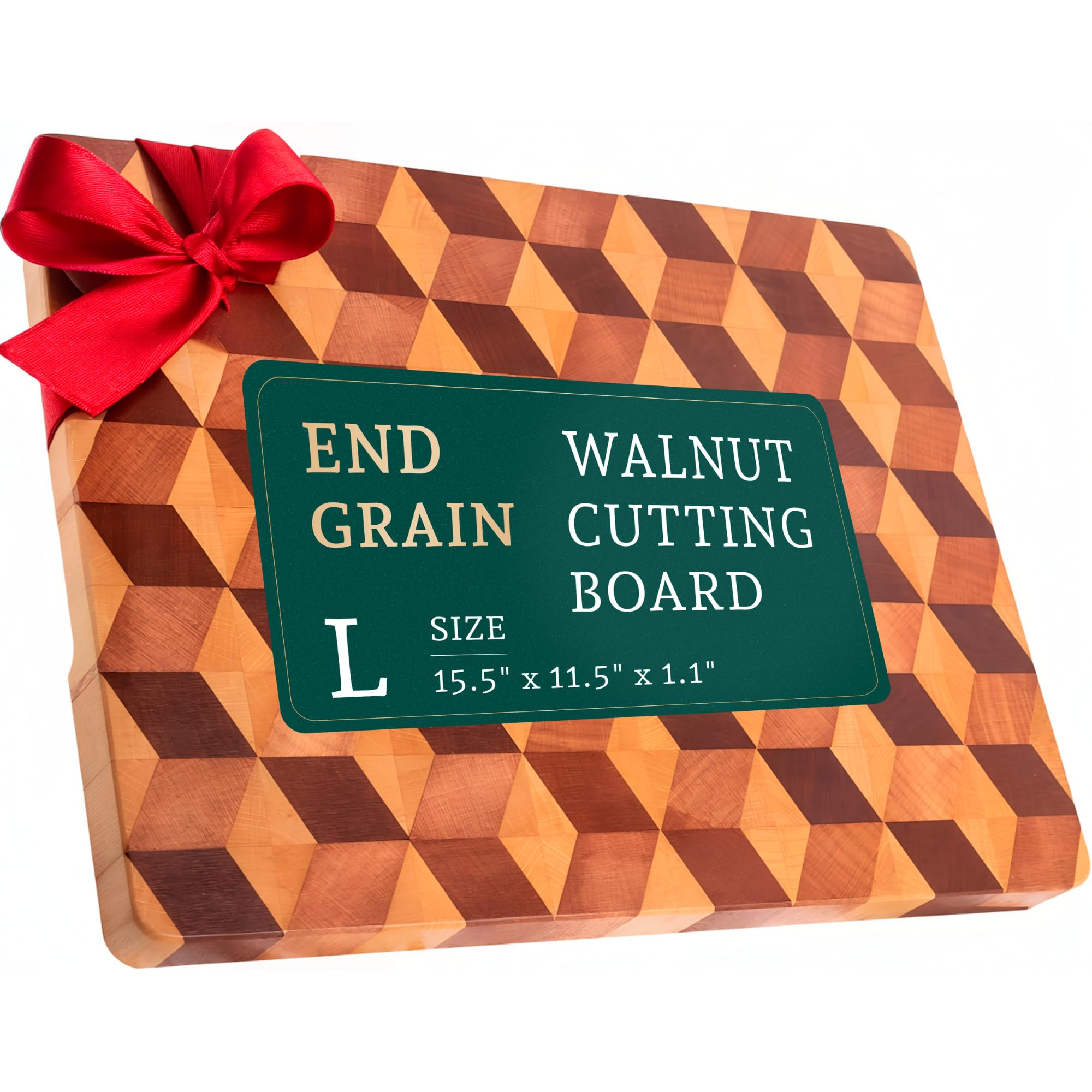
3. Artistic Chef’s Kitchen End Grain Board, 3D Pattern
Three woods, a checkerboard pattern, and the lightest carry in the walnut lineup.
This board is built from walnut, ebony and beech laid into a checkerboard pattern that reads almost three-dimensional, and it is the pick for anyone who wants the board itself to be part of the room. At 15.5″L x 11.5″W x 1.1″Th and 2.55 kg it is the lightest walnut board here — meaningfully easier to lift and store than the 5.58 kg BABILONIA up top. Two side handles and four non-slip rubber feet do the practical work of carrying and stability.
The honest caveat is durability: owner feedback on this board is mixed, with reports of splitting and bowing after a month of steady use. At 2.55 kg the board is the lightest walnut board here, and the durability feedback on this one is genuinely mixed, with reports of splitting and bowing after a month of steady use. That is worth taking seriously if your board lives in a wet sink area or you routinely soak it. Treat it kindly and it holds; treat it like a plastic board and it will not. For presentation duty — cheese, charcuterie, sliced fruit on a table — the pattern carries the whole job.
The look is the function here: nobody buys a checkerboard walnut-eony-beech block just to hide it in a cupboard, and as a serving platter it doubles as a centerpiece.
Made for: small kitchens and hosts who want a board they can carry straight to the table with food still on it.
Think twice if: you want a heavy, heirloom-grade block — this one is about lightness and looks, and sustained heavy chopping is not its strongest suit.
4. BABILONIA American Walnut 3-in-1 End Grain Butcher Block
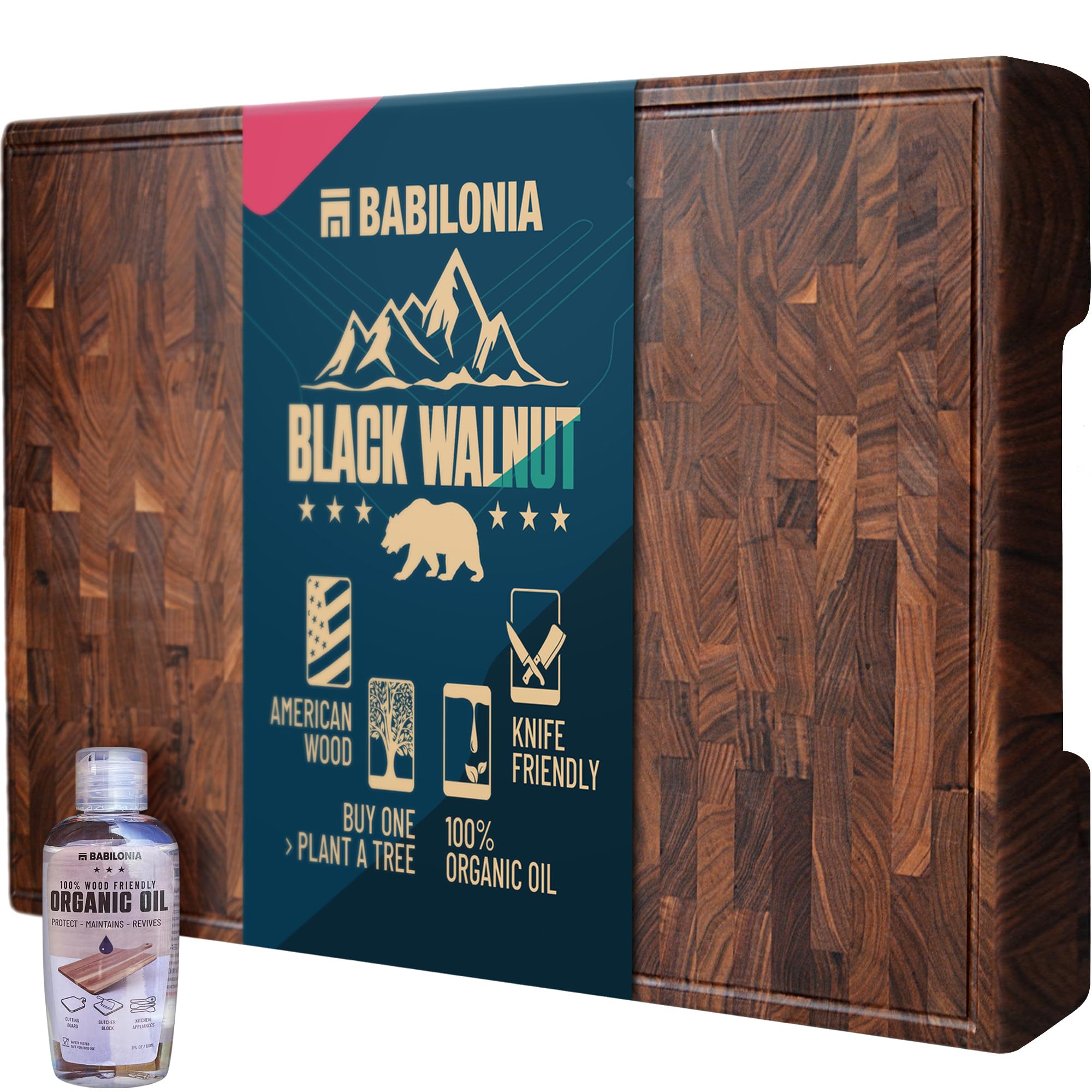
A compact black walnut block with a notch that slides chopped food straight into the pot.
Most boards make you lift the whole thing to move an onion. This one gives you a notch and a slide plate so the chopped pile goes off the edge and into your pan without the lift. That single design choice is why this is the pick for a small kitchen where the board gets used twice a day. At 15.7″L x 10.2″W x 1.7″Th it fits on a tight counter, and at 3.08 kg it is heavy enough to feel solid without demanding two hands.
The 1.7-inch thickness is unusual for a board this small, and it is what makes the block feel like a piece of furniture rather than a prep tool. It is also reversible, with a hidden handle for flipping it into serving duty. American-grown black walnut gives it a deep, tight grain, and it ships pre-oiled with an organic oil bottle and a 2-year warranty behind it. Owners consistently describe the black walnut surface as smooth and the block as rock-solid.
Where it gives ground is size. The 15.7″ x 10.2″ surface is genuinely for one or two people, and a full holiday spread will send you looking for a bigger board. If you are buying this as a gift, it arrives giftable and ready to use — but check you are not buying a prep surface someone will outgrow.
Convincing Details
- The notch-and-plate slide saves lifting a loaded board
- 1.7″ thickness on a small footprint gives it real heft
- Reversible, with a hidden handle for serving
- Arrives pre-oiled, with a 2-year warranty
Where It Falls Short
- 15.7″ x 10.2″ is a two-person prep surface, not a family one
- Hand wash only, like every board on this list
The small-kitchen answer: buy this if your counter is short and you want a board that feels substantial without swallowing the workspace.
Not for: anyone prepping for a crowd — the 20-inch boards further up the page are the ones you want for volume.
5. SHUMARU XL End Grain Cutting Board, 20 x 13 x 1.6″
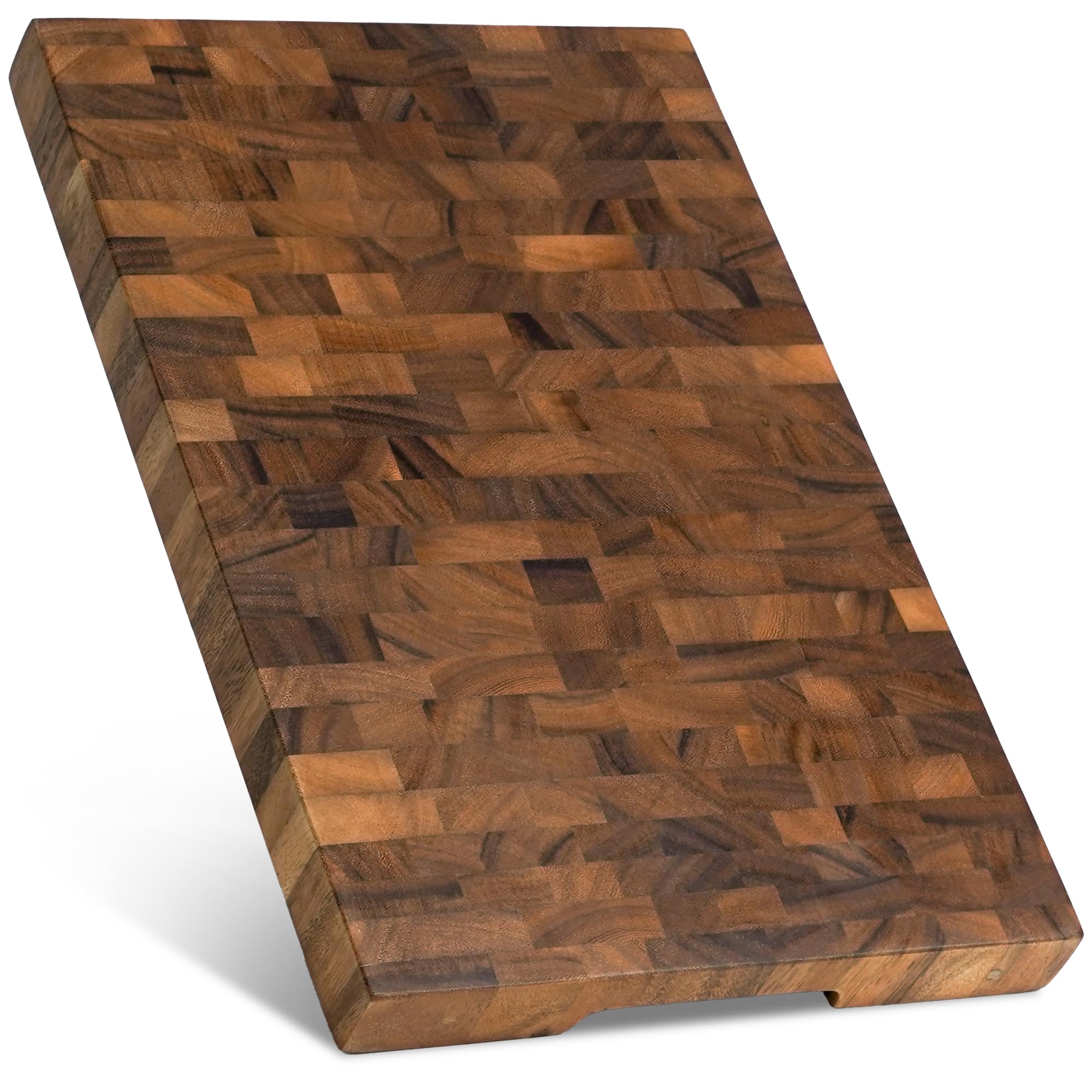
Eleven pounds of suar heartwood with no groove at all — every inch is yours to use.
No groove means no wasted surface, and this board makes the argument plainly: 260 square inches of uninterrupted prep space on a 20″L x 13″W x 1.6″Th block. That flat face is what makes it the dough and pizza board of this group, because a groove would catch your rolling pin at the edges. It is cut from exotic suar heartwood, so the grain runs warm and no two boards look alike.
The weight is the other half of the story. At 11 lb it stays put while you work, and the end grain fibres stand up so your blade sinks between them rather than slicing across. The All-Clad acacia board below comes in at 1.5 inches thick; this one is 1.6 inches thick. That is exactly the point if you are kneading or rolling rather than carving. Owners mention the suar colour holding up and the block staying solid with regular oiling. The wobble concern is a mixed bag: some report no warping at all, others mention buckling.
Maintenance is explicit here: hand wash only, and apply food grade mineral oil every 3-4 weeks. That is a stated rhythm rather than a vague suggestion, and it is the routine that keeps a board this size from drying and splitting at the seams.
Why bakers like it: a flat 260-square-inch face with no groove to trap flour or interrupt a rolling pin is exactly what dough work wants.
Before you commit: 11 lb is a permanent countertop resident, and the no-groove design means carving a juicy roast is messier than it would be on the Nomsters teak board above.
Best for: pizza nights, bread baking and meal-prep sessions where you need one big flat surface and no interruptions.
Wrong pick if: you carve a lot of meat — you want a groove for that, not a flat face.
6. All-Clad End-Grain Acacia Wood Cutting Board, 19 x 14
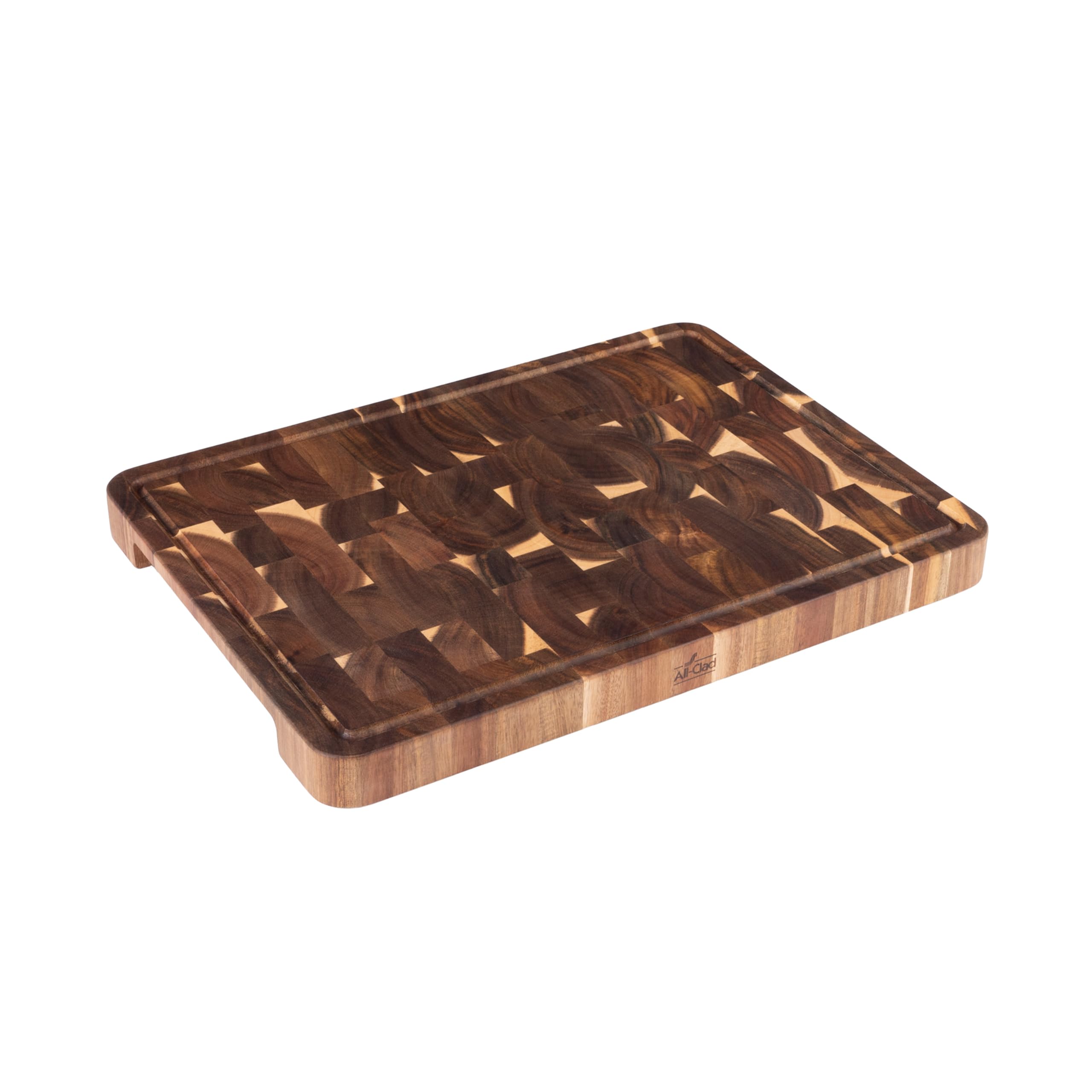
The dinner-party board: acacia grain, deep groove, and handles built into the wood.
Acacia brings a busy, warm grain that makes this board look good enough to carry to the table with cheese still on it, and the integrated handles mean you can actually do that. The measurements read 19.02″L x 14.02″W x 1.5″Th, with a 1-inch board body and rubber feet underneath for grip. Designed in Canonsburg, Pennsylvania and made in China, it comes backed by the All-Clad name and a build that prioritises serving as much as chopping.
The deep perimeter juice groove is the practical feature that earns it a spot for carving, containing liquid before it reaches the counter. At 1.5 inches thick it sits between the thin decorative boards and the heavy butcher blocks — stable on its rubber feet, but nothing like the 11 lb SHUMARU above for sheer planted weight. If your evenings lean toward a roast chicken carved at the table rather than a full meal prep, the geometry here suits the job.
The serving advantage: integrated handles plus acacia grain plus a groove make this the board that goes from kitchen to table without a second trip for a platter.
What to weigh: the 1.5-inch profile and rubber feet keep it stable, but this is not a board designed for pounding or heavy cleaver work — it is a serving and carving surface first.
Suits: hosts who want one board that goes from prep to presentation and looks good doing both.
Look past it if: you want raw mass for heavy chopping — the suar and walnut blocks here deliver far more weight.
7. New M Way Premium Teak XL End Grain Board, 20 x 15
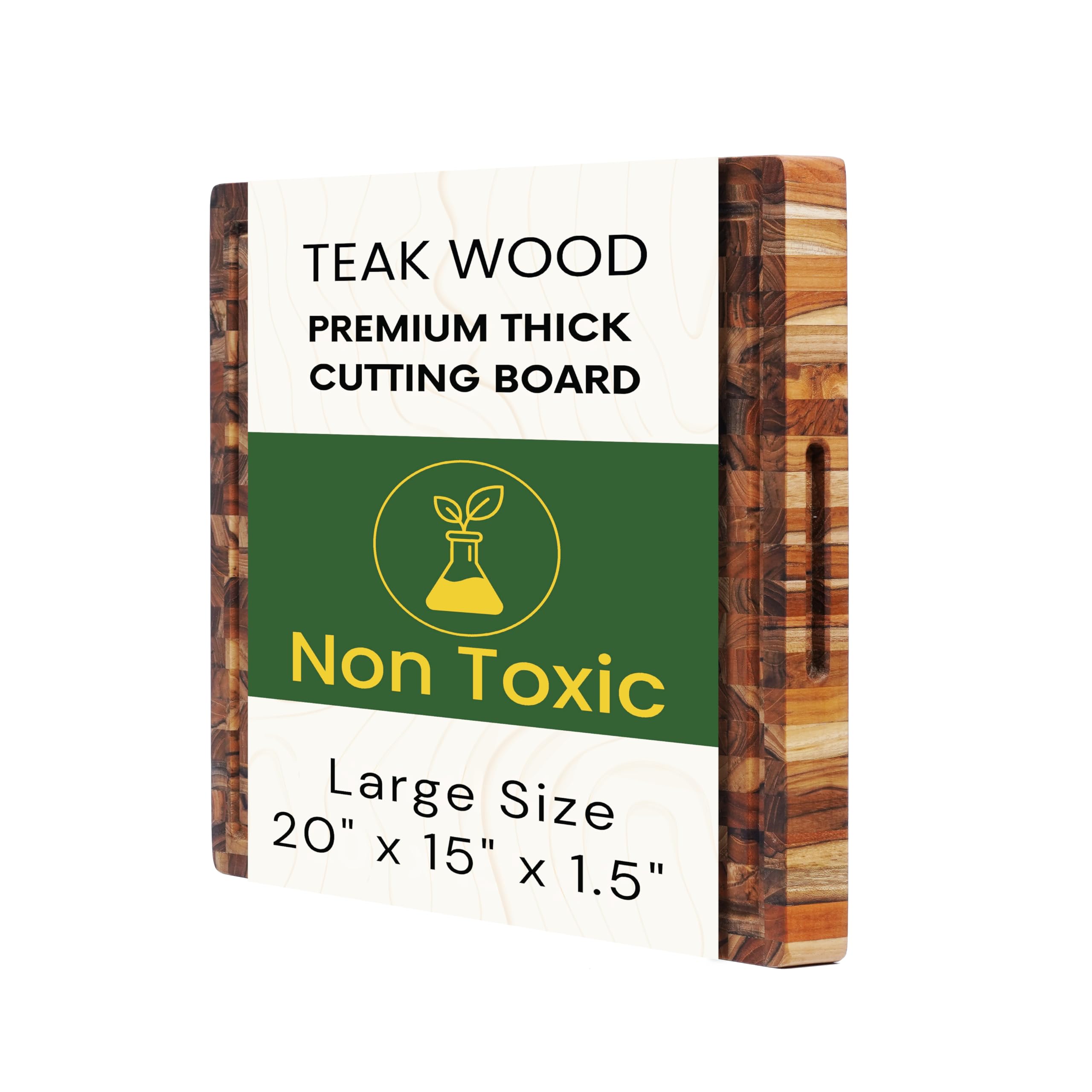
A 5.44 kg teak block built to take a brisket trim without shifting an inch.
This is the board for the person who trims a brisket on the counter and needs the board to stay exactly where it started. The 20.08″L x 14.96″W x 1.5″Th surface gives you a full-size prep area, the 38mm thickness puts real material under your blade, and the 5.44 kg weight keeps the block planted through long carves. Teak’s natural oils are pitched at moisture resistance here, so the wood holds up against the wet side of meat prep in a way softer species do not.
The deep perimeter groove handles what a BBQ session throws at it — juice from a turkey, a roast, or a pile of high-moisture vegetables — and keeps the counter clear while you work. As a serving board it doubles as a steak platter or a holiday carving station, which matters if you host. The honest note is that teak at this weight and thickness is a countertop fixture. You are not putting a 5.44 kg board away after each use, so commit to a spot for it before you buy.
Why It Belongs Here
- 20.08″ x 14.96″ x 1.5″ with a substantial 38mm body
- 5.44 kg keeps it planted during long carving sessions
- Deep groove controls juice on big cuts
- Doubles as a serving platter for steak and holiday dinners
The Caveat
- Heavy enough that storage becomes a planning decision
- Teak needs the same oiling routine as the rest of the group
Built for: BBQ cooks and holiday hosts who want a big teak carving surface that will not slide under a knife.
Not the one if: counter space is tight — the compact BABILONIA 3-in-1 above covers a small kitchen far better.
8. Bevel & Bond Maple End-Grain Cutting Board, Made in USA
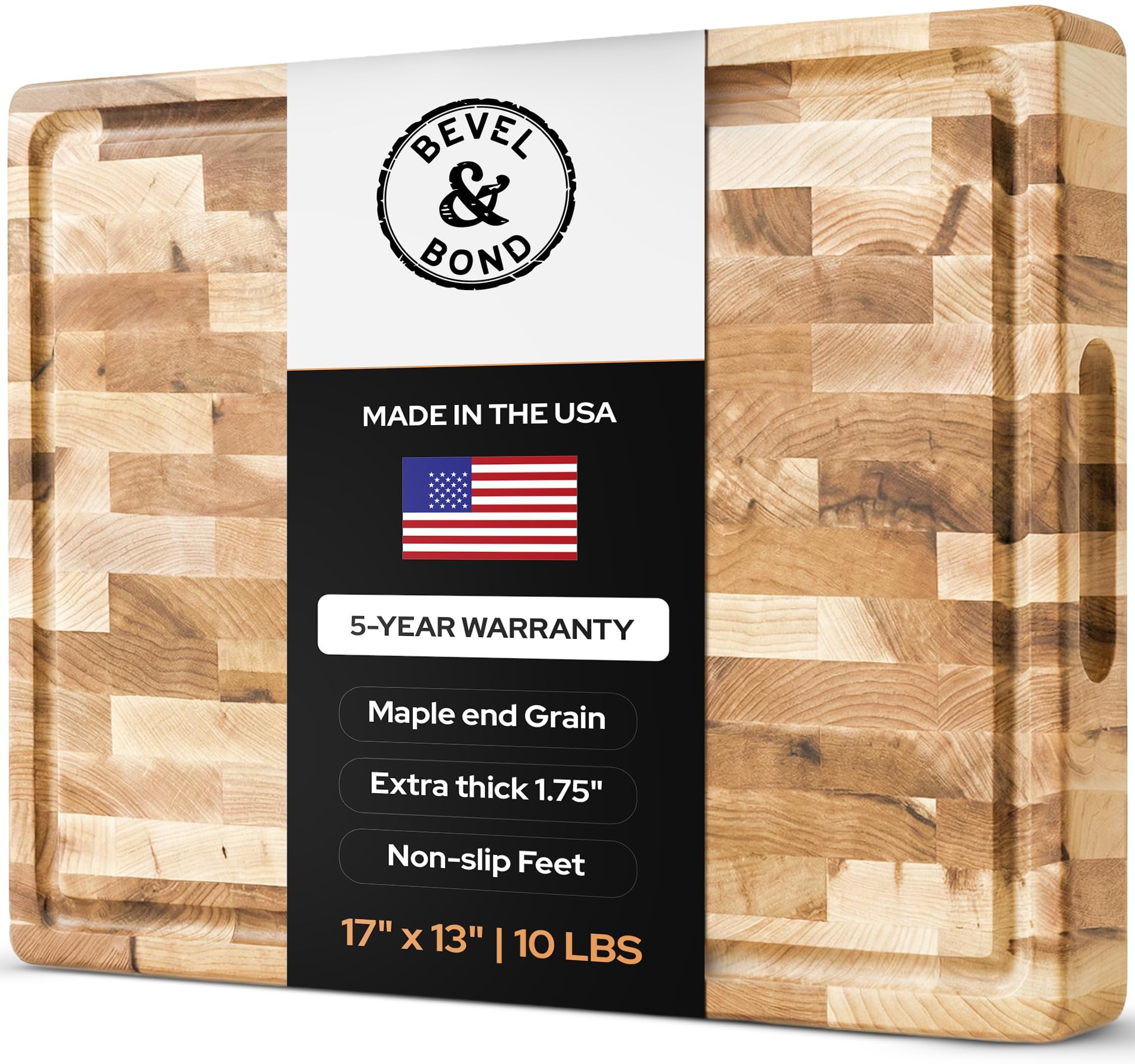
Ten pounds of American maple, handcrafted here, and boxed to be given away.
Maple is the wood that gets named when professional kitchens talk about butcher blocks, and this board leans into that with North American hard maple cut thick. At 17″L x 13″W x 1.75″Th and 10 lb it is a genuinely heavy block, and the 1.75 inches is a deliberate answer to thinner boards that crack over time. Rubber feet keep it planted while letting air move underneath, and deep finger grips on both sides let you move it from counter to table for carving.
What lands it as a gift pick is the packaging plus the backing. Every board ships in a designed gift box, arrives pre-conditioned with a mineral oil finish, and carries a 5-year warranty against manufacturing defects — register it and they send a tin of Board Balm. The deep juice groove catches runoff from large cuts, and the end grain surface is designed to let small cut marks close back up. Owners describe the 10 lb maple block as sturdy without feeling over-heavy, and report it staying put while chopping.
Two things to go in with your eyes open. Hand wash only, never soak, and a monthly conditioning with the board balm is the routine it wants. And while some owners say it will last for many years, others report warping starting in — which for a 1.75-inch maple block is usually a sign of moisture mismanagement rather than a bad board.
The US-made case: 1.75 inches of hard maple, handcrafted by local woodworkers, with a 5-year warranty and a gift box — that combination is hard to find on a single listing.
Pick it for: a wedding or housewarming gift where you want the recipient to open something that looks considered.
Second thoughts if: you want a big flat prep surface — 17″ x 13″ is a mid-size footprint and the groove cuts into it further.
9. BACKLEY Pyrowood End Grain Non Toxic Cutting Board
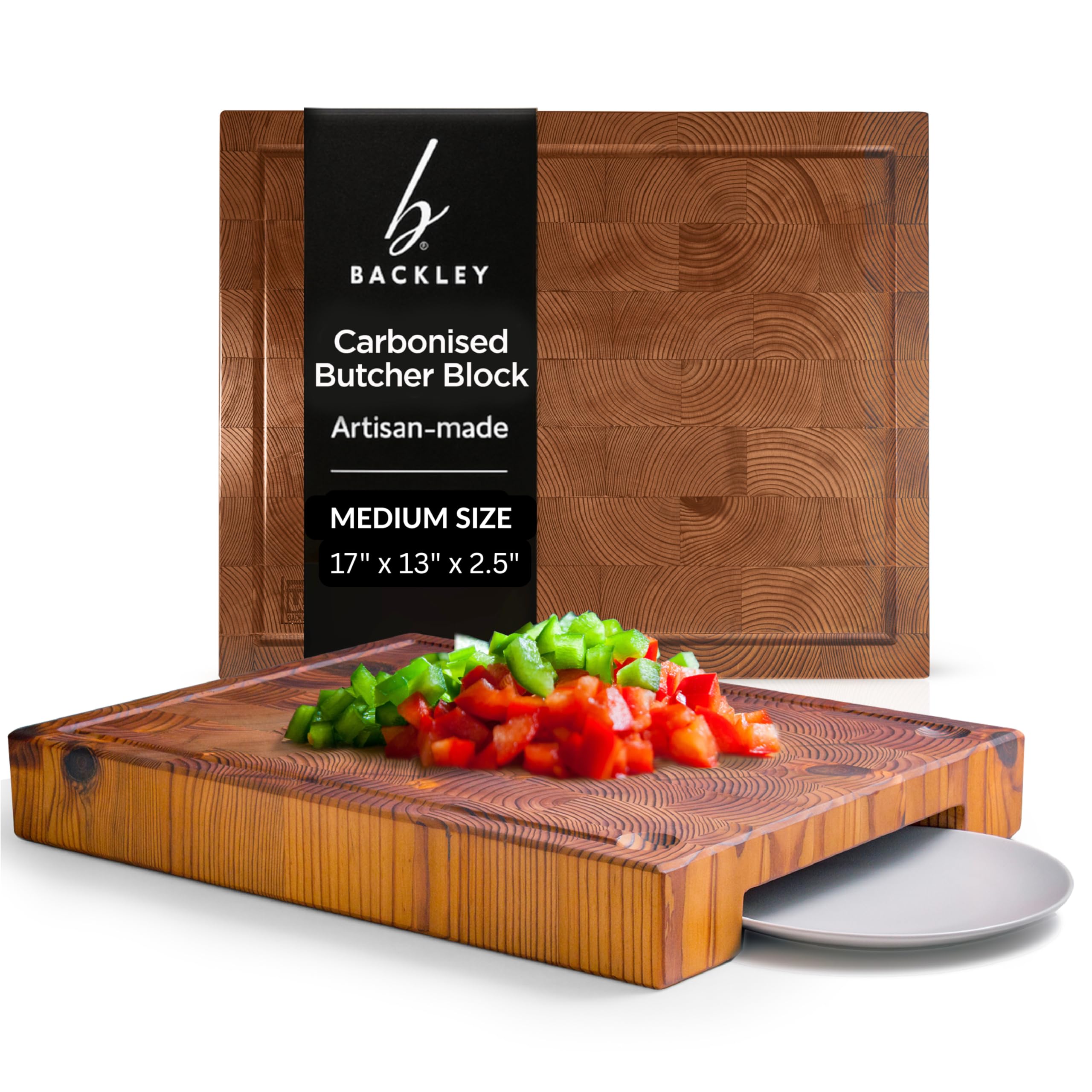
The 2.5-inch outlier: a heat-treated wood block with a notch that slides food into the pan.
Nothing else here comes close to 2.5 inches thick. This board is 17″L x 13″W x 2.5″Th built from pyrowood — wood heat-treated all the way through, which darkens it to a warm caramel and makes it more stable and less thirsty than untreated wood. That treatment is why the maker can pitch it as holding its shape and resisting moisture, and it is reversible so you can prep on one face and serve on the other.
Solid hardwood with a food-grade mineral oil and beeswax finish is the whole material story: no plastic, no microplastics, just wood. The chop-and-slide notch on the edge lets you push chopped food straight off into a pan or bowl, and it doubles as a handle for lifting and hanging. End grain fibres face up so your blade sinks between them, and small cut marks are designed to close over time.
The thickness is the whole pitch: at 2.5 inches it is heavy enough to stay put carving a brisket or breaking down a chicken, and the reversible faces give you one for prep and one for serving.
Plan for the upkeep: hand wash, dry it upright, and oil once a month — the instruction is specific and worth following, because a block this thick has a lot of wood to keep sealed.
One for the carvers: if you want maximum thickness and a reversible board that doubles as a charcuterie platter, this delivers both.
Not for you if: 17″ x 13″ feels small for your prep — the 20-inch teak boards above cover more counter.
Know the Specs
End Grain vs Flat Grain
End grain means the wood fibres point up at your blade like the bristles of a brush, so the knife sinks between them instead of slicing across them. That is why these boards are described as kind to knives and why small cut marks can close back up. A flat-grain board presents the fibres sideways and takes the full force of the edge on the surface.
Thickness and Weight
Thickness is measured in inches or millimetres, and on these boards it runs from 1.1 inches to 2.5 inches. Heavier, thicker boards stay put under a knife and resist flexing, which is why the 5.58 kg walnut and 11 lb suar picks feel so planted. Lighter boards are easier to move and store but need more care with a rocking chop.
Juice Groove vs Flat Face
A juice groove is a channel routed around the board’s edge to catch liquid from meat, fruit and high-moisture vegetables. It is a genuine help when carving. A flat, groove-free board gives you 100 percent of the surface for chopping, dough and rolling — which is why pizza and bread boards often skip the groove entirely.
Wood Species and Oiling
Walnut, teak, maple, acacia, suar and pyrowood all appear here, and each has its own density and oil content. Teak brings natural oils, maple is dense and tight-grained, and pyrowood is heat-treated for stability. Whatever the species, the routine is hand wash, towel dry, stand upright, and re-oil with a food-grade mineral oil when the surface looks dry.
Common Questions
Is end grain actually better for my knives than a regular board?
Can I put a wood end grain cutting board in the dishwasher?
How often do I need to oil an end grain board?
Should I choose a board with a juice groove or a flat one?
Is walnut or maple better for a butcher block?
How heavy is too heavy for a cutting board?
Can I carve a turkey on an end grain board without ruining it?
What is pyrowood and is it safe for food?
Why does my end grain board show scratches so quickly?
Is a thicker board really more stable than a thinner one?
The Bottom Line
For most home cooks, the wood end grain cutting board worth owning is the BABILONIA Large Walnut End Grain Board. It gives you 20 x 16 inches of walnut at 1.4 inches thick, pre-oiled and ready to use. At 5.58 kg it is heavy enough that it does not move while you chop. If carving is your priority and you want the juice contained, the Nomsters Teak board has the deeper groove and corner feet for it. For dough, pizza and big flat prep, the SHUMARU XL gives you 260 square inches of uninterrupted surface with no groove in the way.
The one nudge worth making: every board here rewards the same small habit — hand wash, dry upright, oil it when it looks thirsty. Pick the weight and thickness that match how you store it, and that oiling routine will keep it in service for years.
How we choose
We do not accept paid placement. Every pick is matched to a real buyer and a real use-case; we do not hands-on test units.
Sources
Specifications: manufacturer listings and product documentation. Review insights: verified customer reviews. Pricing: not shown on this page (it changes often); check the current price via the retailer link.
As an Amazon Associate, Tactical Gear Guy earns from qualifying purchases. This does not affect which products we feature.