Specs are compiled from manufacturer listings and verified buyer reviews and can change over time — please confirm the key details on the product page before buying.
A wood duck box has to do three things at once: stay dry inside, keep raccoons and snakes off the eggs, and give day-old ducklings a way to climb out. The boxes below are the ones where those three jobs get done properly, and the Woodlink WD1 Cedar Duck House is the safest single bet for most pond and marsh owners because of how it is built and how consistently it works.
This guide is built by comparing the manufacturers’ published specifications and the patterns across verified customer reviews, so you get each pick’s real strengths and trade-offs instead of marketing spin.
You’ll see which boxes come fully assembled, which woods survive wet ground, and where each one falls short, so you can match a box to your pond bank rather than guessing. Each box below handles those three jobs, so a nesting pair has a real chance of committing to your water this season.
Top Picks


How To Choose The Best Wood Duck Box
A wood duck box is not a birdhouse in the decorative sense. It is a working piece of habitat hardware that sits over water or wet ground, takes rain and sun year-round, and has to keep a clutch of eggs dry and safe from climbing predators. Getting the basics right matters far more than the paint color.
The entrance hole is the whole ballgame
Wood ducks need an oval opening roughly 3 by 4 inches or a 4-inch oval, which is wide enough for a hen to slip through but tight enough to discourage larger birds. A hole that is too big lets starlings and other cavity nesters move in first. The boxes here that publish their opening size all sit in that working range, so check this number before anything else.
Duckling escape grooves
Day-old ducklings cannot fly. They climb to the opening using small horizontal cuts, often called kerfs or a fledgling ladder, then jump to the water below. A box with smooth interior walls can leave young birds stuck. Look for wording like “grooves below the opening” or “kerfs” in the listing, because that detail separates a real wood duck box from a generic birdhouse.
Rot resistance in wet ground
Cedar and cypress are the two woods that show up again and again on boxes built for marsh edges, because both handle moisture better than pine or thin plywood. Pine can work if it is treated with a penetrating oil finish. A box made from untreated softwood and screwed together loosely will swell, warp, and open gaps at the seams.
Inspection access and mounting
You will need to open the box to clean out old nesting material and check on the clutch. An easy-open front panel or side access doors turn that from a wrestling match into a thirty-second job. Pre-drilled holes and a heavy-duty hanger make mounting simpler, and a predator guard or baffle on the post is what keeps raccoons from reaching in from below.
Side-by-Side Comparison
| Model | Best For | Material | Entrance | Weight | Amazon |
|---|---|---|---|---|---|
| Woodlink WD1 Cedar Duck House★ Best Overall | Most pond owners | Kiln-dried red cedar | 4 x 3 in oval | 12.8 lb | Amazon |
| Amcortn Wood Duck HouseBest Value | Tight budgets and easy assembly | Wood | 3 x 4 in | 2.5 kg | Amazon |
| Forestry Suppliers Nesting Box | Easy nest checks | Cypress | 4 in oval | 14 lb | Amazon |
| Applewood Outdoor Pine House | Treated-pine durability | Oil-finished pine | 3 x 4 in | 12.5 lb | Amazon |
| Audubon Wood Duck Nest Bird House | Bigger interior footprint | Kiln-dried cedar | Oval entry | 13 lb | Amazon |
| JCs Wildlife Cedar House | Built-in predator protection | Cedar with poly roof | 4 in oval | 11.5 lb | Amazon |
Detailed Reviews
1. Woodlink WD1 Cedar Duck House, 1
Our pick — 4.5+★ from 250+ verified ratings; the strongest balance of quality and price.
The box that shows up finished, hangs fast, and gets claimed by wood ducks quickly.
The starting point for this pick is the material: re-forested, kiln-dried inland red cedar (cedar that has been dried in an oven so it resists swelling and rot), held together with chromate screws (coated screws that resist rusting at the joints). That combination is why the box holds its shape through wet springs instead of warping open at the seams. It arrives fully assembled, so you are hanging a finished box rather than laying out boards on a tailgate.
The opening measures 4 inches by 3 inches in an oval — wide enough for a hen, tight enough to make larger birds work for it. The front panel opens for cleaning and checking the nest, and the box ships with wood shavings already in it plus a fledgling ladder for the ducklings. Placement near a marsh or pond is the whole point, and the box is built for exactly that spot. What wins people over most is the build itself: the construction quality is the thing owners talk about above everything else, followed by how much box you get for the outlay.
Where does it land against the other boxes here? It is the heaviest solid-wood option in this list at 12.8 pounds, well past the 11.5 pounds of the JCs Wildlife house, so plan on a helper when you are muscling it up a pole. Cedar also means you accept the odd natural check or crack in the grain — that is normal for the wood, not a defect. Buyers report wood ducks claiming this box readily, with one case of nesting within days of installation.
What earns it the top slot
- Kiln-dried red cedar construction with chromate screws — built for wet ground and repeats seasons.
- Ships fully assembled with wood shavings and a fledgling ladder already inside.
- 4 x 3 inch oval entrance plus an easy-open front for nest checks.
Where it asks a little of you
- At 12.8 pounds it is the heaviest box on this list — bring help for pole mounting.
- Cedar grain can show natural checking over time.
Go with this one: pond and marsh owners who want a finished, ready-to-hang cedar box that ducks claim fast.
Worth noting: the heft that signals real wood is also the reason mounting solo is awkward.
2. Amcortn Wood Duck House for Outside
A flat-packed box that goes together fast and leaves budget for a proper predator guard.
This one arrives as six wooden boards, seventeen screws, two longer screws, a screwdriver, and instructions. Put plainly: it is a kit, not a finished box, and for a lot of first-time box hangers that is fine — the assembly is the part buyers bring up most often, and they describe it as straightforward. The payoff is that you are not paying for something already built. Dropping it onto a post takes one afternoon and tools you probably already own.
The working numbers hold up. The entrance is 3 by 4 inches, in the same range as the bigger cedar boxes here. There are drainage holes in the floor to let water out and keep the inside dry, and the grooves under the opening give ducklings a ladder to climb when it is time to leave. It is made from wood with no chemicals or solvents used, and it measures 17 inches deep by 10 inches wide by 10 inches high. At 2.5 kg (roughly 5.5 pounds) it is light enough for one person to hang.
Here is the honest trade-off: this is the smallest-bodied box in this group, and the lighter build will not match a cedar box over a decade of wet seasons. Assembly also means the seams are only as tight as your own screw work. If you want a box that needs nothing but a post and five minutes, this is not it. If you want to hang two or three boxes around one pond without a big outlay, this is the smart move.
Value read: easiness of assembly is what defines this pick, and the low weight plus predrilled holes make a solo install realistic. A duckling ladder and floor drainage at this price are why it stays on the shortlist.
Who it asks patience from: anyone who wants to bolt a box to a post the moment it lands on the porch.
Reach for this if: you are putting up several boxes on a tight budget and do not mind spending an hour with a screwdriver.
Look elsewhere if: you want a box built to outlast a decade of wet weather without maintenance.
3. Forestry Suppliers Wood Duck Nesting Box
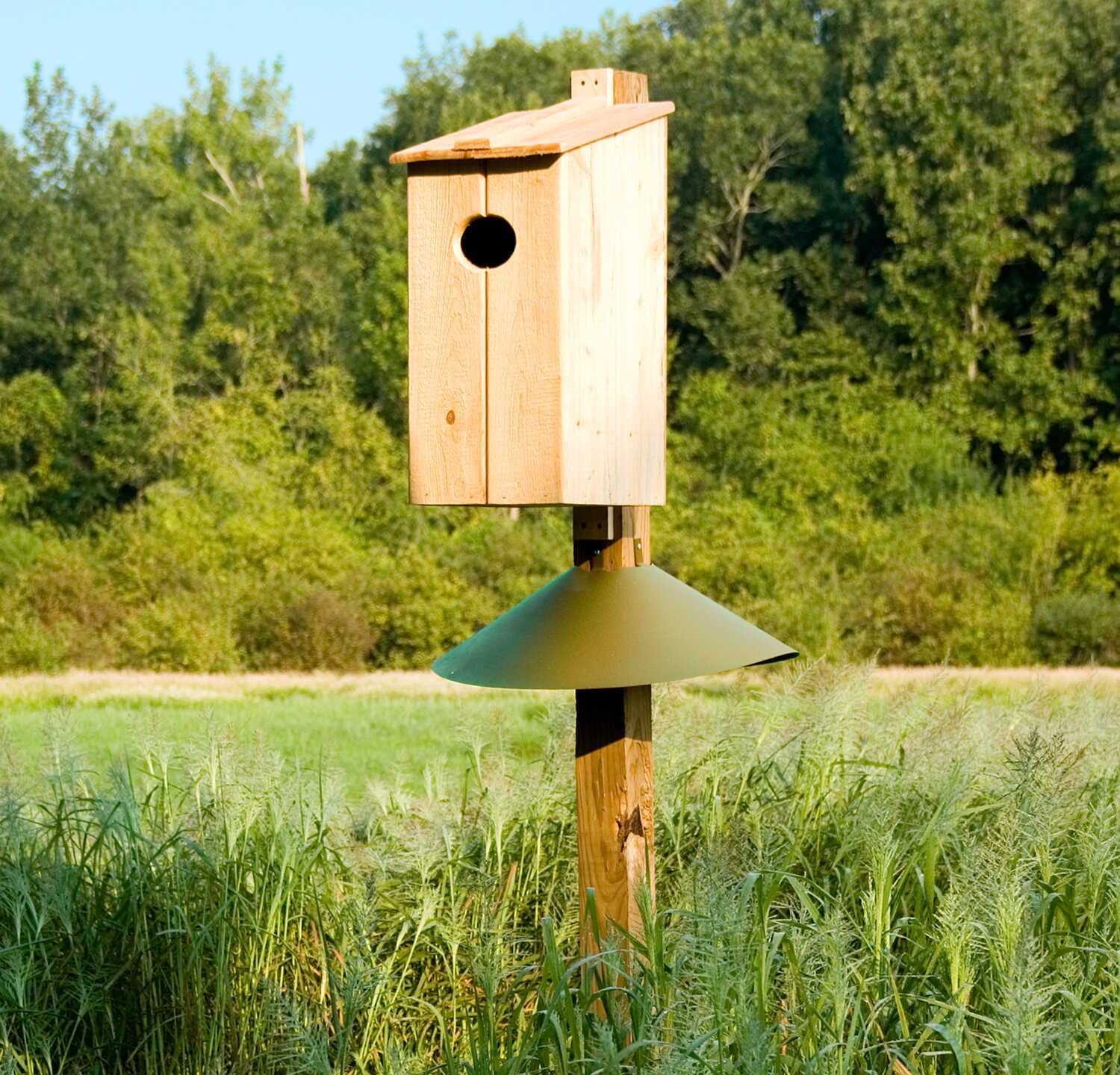
Side doors on brass hinges turn cleaning and nest checks into a two-minute job.
Most boxes make you reach in through the entrance hole or pull the whole front off. This one gives you side access doors hung on solid brass hinges, so you open up the box, scoop out old nesting material, and close it again without disturbing the mounting. If you manage several boxes along a marsh, that difference adds up over a season.
The body is cypress with smooth sanded edges, and it is a substantial piece of wood — the hand-built box measures 24 by 11 by 12 inches and weighs 14 pounds. For scale, that is heavier than the Woodlink at 12.8 pounds, and 1.5 pounds over the 12.5-pound Applewood Outdoor pine house. The 4-inch-wide oval entrance sits in the working range for wood ducks, and the box comes predrilled for mounting so you are not guessing where to drill.
Cypress is the draw here — it handles wet ground well, which is why the box is aimed at pond and marsh placements. Weigh that against the side access, which no other box on this list offers.
The standout detail: dual side doors on brass hardware are a maintenance advantage you will notice every single season, especially on a box mounted over water.
Sizing reality: at 14 pounds with a 24-inch height, plan the mount before you climb — this is not a one-hand lift.
This suits: pond managers and habitat volunteers who check and clean multiple boxes and want the fastest route inside.
Think twice if: you want a mountain of owner feedback to lean on before buying.
4. Applewood Outdoor Premium Pine Wood Duck House

Pine boards sealed with a penetrating oil, drilled and screwed for a quick hang.
The wood choice is the first thing to understand. This box is built from high-grade pine boards treated with a natural, environmentally safe grain-penetrating oil finish — meaning the sealer soaks into the wood rather than sitting on top as a film. The maker claims this pine build is sturdier than cedar, though pine is normally the softer wood. Treat it as the manufacturer’s own comparison rather than a tested fact.
Fit and finish come through in the details. Everything is handcrafted in a small woodworking shop in Wisconsin using North American sourced materials, with a heavy-duty steel hanger at the back and three 2 1/2 inch screws included. You get pre-drilled mounting holes, floor drains to keep the interior dry, an entrance opening of 3 by 4 inches, and grooves under the opening as a ladder for ducklings. The footprint is 9.5 inches deep by 10.25 inches wide by 20.75 inches high — noticeably more compact than the Audubon box at 15.35 inches deep by 11 inches wide by 22.75 inches high, and lighter too, at 12.5 pounds versus the Forestry Suppliers box at 14 pounds.
Most buyers end up talking about how well-made it feels and how ready it is to hang, whether that is on a post or bolted to a 4×4 structure. The honest caveat is the pine itself: oil-finished pine needs occasional re-oiling to keep that finish working, where bare cedar simply ages. Buy it for the tidy Wisconsin craftsmanship and the included hardware, and plan on a little upkeep.
Reasons it earns a spot
- High-grade pine with a natural grain-penetrating oil finish — sealed against wet conditions.
- Heavy-duty steel hanger plus three 2 1/2 inch screws included, so mounting starts immediately.
- Floor drains, duckling grooves, and a 3 x 4 inch entrance all accounted for.
The follow-up question
- Oil-finished pine typically wants re-oiling over the years to stay sealed.
- Smaller interior footprint than the Audubon box if you want maximum floor space.
Pick it for: the finished, USA-made craftsmanship and a mount that is ready the moment it arrives.
Be ready for: a light maintenance routine on the oil finish each season or two.
5. Audubon Wood Duck Nest Bird House
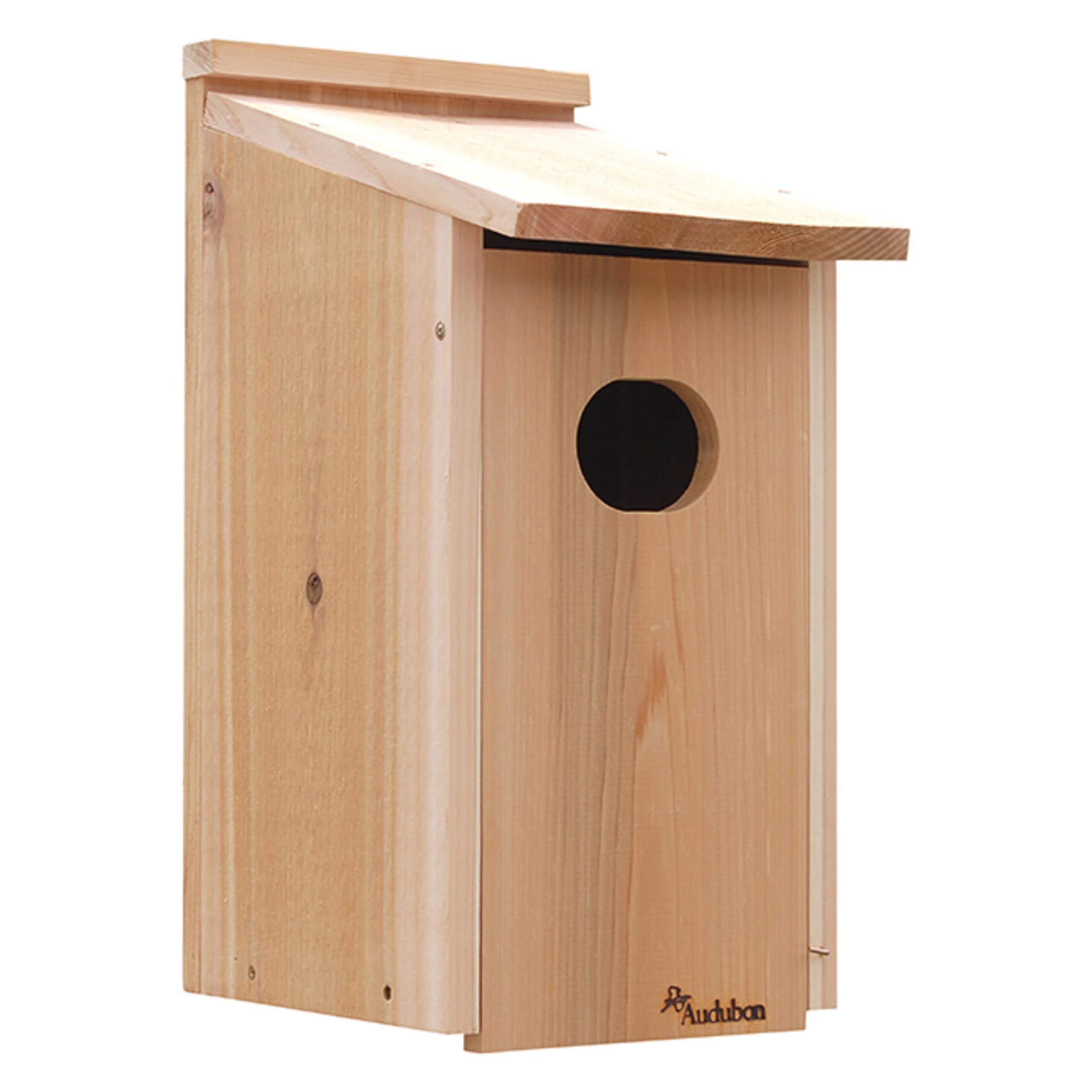
A bigger cedar box with a sloped roof that sheds rain off the nesting area.
Size is the lead here, and it is not subtle. This house measures 15.35 inches deep by 11 inches wide by 22.75 inches high — 5.85 inches deeper than the Applewood Outdoor pine house at 9.5 inches, and 4.35 inches deeper than the JCs Wildlife box at 11.75. More floor space means a roomier nest, and the sloped roof is shaped to push rainwater off the top instead of letting it pool and work its way down through the lid.
It is built from hardy kiln-dried inland cedar, 13 pounds of it, with an oval entry that makes it easier for a hen to get in. The front panel opens for nest checks, so you can monitor and clear the box through the season. Mounting can be done to a post or pole, and the suggested placement is near marshes, ponds, or lakes — the same waterside spots the other boxes on this list are built for.
Anyone who has wrestled a big box onto a pole will tell you the extra footprint cuts both ways. It is more shelter for the clutch and more surface for wind to grab, so position it thoughtfully and brace the post well. Cedar again means natural grain checking over time. If your bank has room for a braced post, the deeper floor plan beats the tighter boxes here.
Where it wins: the deepest floor plan in this group plus a sloped roof designed for runoff, which matters most in a wet climate.
Plan for: a bigger sail area on windy banks and a heft that wants a sturdy post.
Best for: property owners on open water who want maximum interior room and a roof that sheds weather.
skip it if: your mounting spot is exposed to strong wind and you need the smallest possible profile.
6. JCs Wildlife Cedar Wood Duck Nesting Box
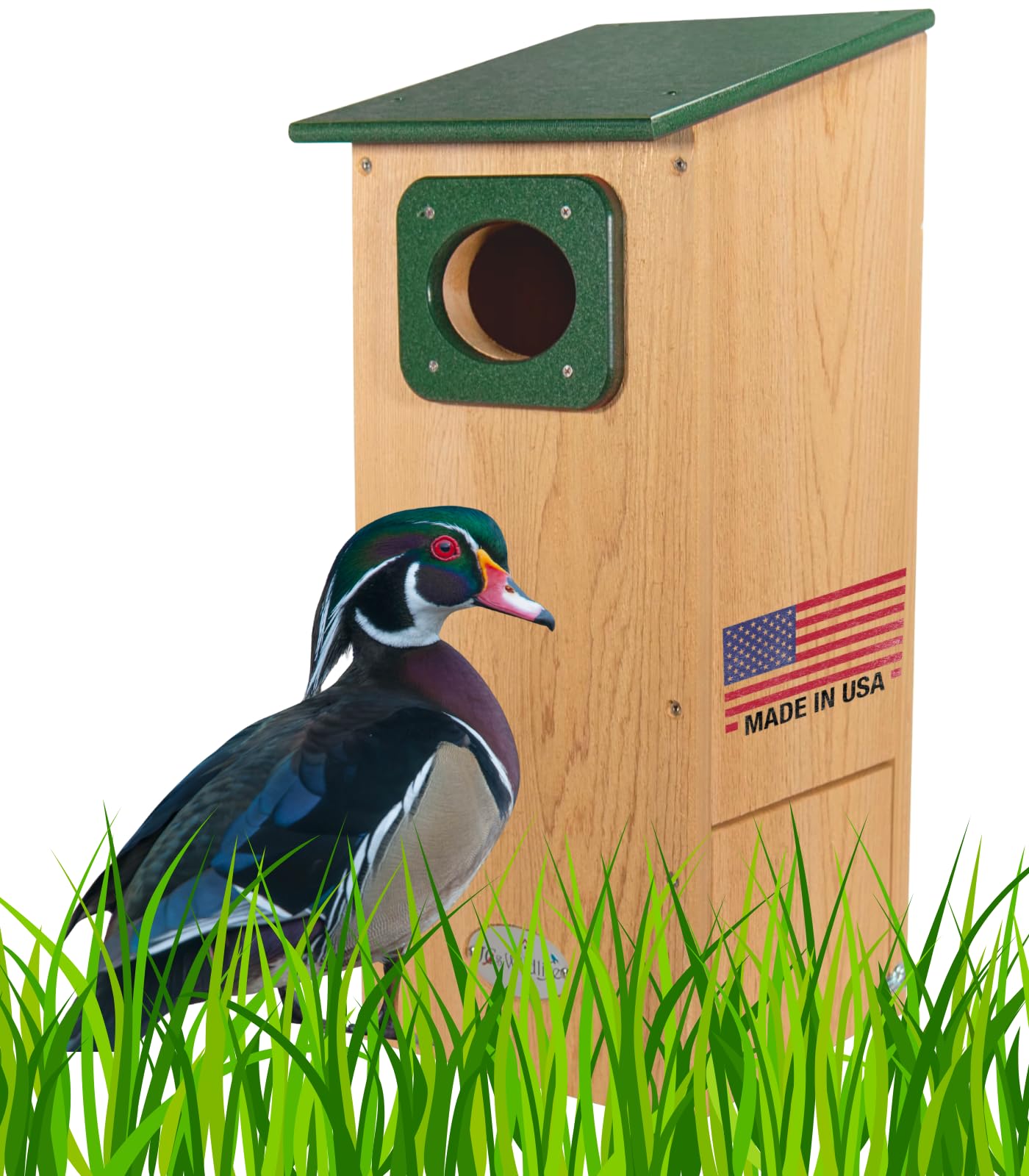
The box that already has a predator guard and a poly roof built in.
Most boxes make you solve raccoons and rain yourself. This one ships with a built-in predator guard around the 4-inch oval entrance, so a reaching paw gets stopped before it clears the hole. That is the single most valuable detail on the box, because losing a clutch to a raccoon or snake is the most common way a wood duck season ends badly. Add the poly lumber roof — plastic-and-wood composite that handles weather better than bare timber — and you have protection on top and at the front.
Cedar makes up the body, and there are kerfs (small cut grooves) below the opening so ducklings can climb out. The clean-out door opens to let you empty and replace the nesting material, and drainage holes keep the floor from holding water. It arrives fully assembled with pilot holes already drilled, and nesting material is included to help attract a pair. At 11.5 pounds it is the lightest of the solid-wood boxes here, below the Applewood pine house at 12.5 pounds, and the footprint is 11.75 inches deep by 9.75 inches wide by 24.5 inches high.
Owners describe it as nicely made and well-built, with the sturdiness side of things coming up almost as often as the construction itself. It is the most expensive box in this group by a wide margin, so the question is whether the built-in predator guard and poly roof are worth it to you. If raccoons work your bank or your last box lost a clutch, the built-in guard is usually worth the premium.
The deal-sealer: a built-in predator guard plus a poly roof means this box handles two of the three big failure points before you add anything.
The honest catch: it carries the highest outlay in this list, so you are paying up front for protection you would otherwise add yourself.
Head this way if: predators are a real threat at your pond and you want the guard built in rather than bolted on.
Hold off if: your budget is the deciding factor and you can add a baffle to a cheaper box instead.
Know the Specs
Entrance openings (oval and 3 x 4 inch)
The entrance size is measured across the oval opening, and it controls who can get in. Wood ducks need an opening in the 3 by 4 inch to 4-inch-oval range — wide enough for a hen to pass but tight enough that bigger cavity nesters have a harder time. Check the listed entrance size on any box before you buy, because a box built for a different bird will not serve wood ducks the same way.
Kerfs and fledgling ladders
A kerf is a thin cut grooved into the inside wall, and a run of them under the opening forms a ladder. Ducklings hatch on a surface with no natural grip, so these grooves give their claws something to hold. A box that lists “grooves below the opening,” “kerfs,” or a “fledgling ladder” has solved that. A smooth-walled box usually has not.
Cedar, cypress, and treated pine
The wood drives how long the box survives wet ground and repeated rain. Cedar and cypress both handle moisture well and show up on most boxes built for marsh use. Pine can work, especially when the boards carry a penetrating oil finish, but it usually asks for occasional re-oiling. Look at the seams and the fasteners together: coated screws and tight joins matter as much as the species.
Predator guards and mounting height
A predator guard is a physical barrier around the post or entrance that keeps climbing animals from reaching the eggs, and it is the difference between a box that produces ducklings and one that keeps getting raided. Many boxes do not include one, so budget for a guard or pick a box with it built in. Mounting height and a stable post matter too — a box over water with a swaying mount is harder for a hen to commit to.
Common Questions
Will a wood duck box work if I do not have a pond or marsh?
How high should I mount a wood duck box?
Do I need to add nesting material to the box?
How do ducklings get from the start once they hatch?
What keeps raccoons and snakes out of a wood duck box?
Is cedar better than pine for a wood duck box?
How big should the entrance hole be for wood ducks?
How often do I have to clean out a wood duck box?
Do wood duck boxes come fully assembled?
Will one box be enough to attract a nesting pair?
The Bottom Line
For most pond and marsh owners, the wood duck box winner is the Woodlink WD1 Cedar Duck House because it combines kiln-dried red cedar, a finished assembly, a 4 x 3 inch oval entrance, and a fledgling ladder in one box that ducks take to readily. If predator pressure is your worry, the JCs Wildlife Cedar House is the one to reach for, with its built-in predator guard and poly roof. And if you want several boxes around a pond without a big outlay, the Amcortn Wood Duck House is the practical pick.
Whichever box you choose, a solid mount and a predator guard do as much for your success as the box itself, so budget time for both before the season starts.
How we choose
We do not accept paid placement. Every pick is matched to a real buyer and a real use-case; we do not hands-on test units.
Sources
Specifications: manufacturer listings and product documentation. Review insights: verified customer reviews, as of November 2026. Pricing: not shown on this page (it changes often); check the current price via the retailer link.
As an Amazon Associate, Tactical Gear Guy earns from qualifying purchases. This does not affect which products we feature.