Specs are compiled from manufacturer listings and verified buyer reviews and can change over time — please confirm the key details on the product page before buying.
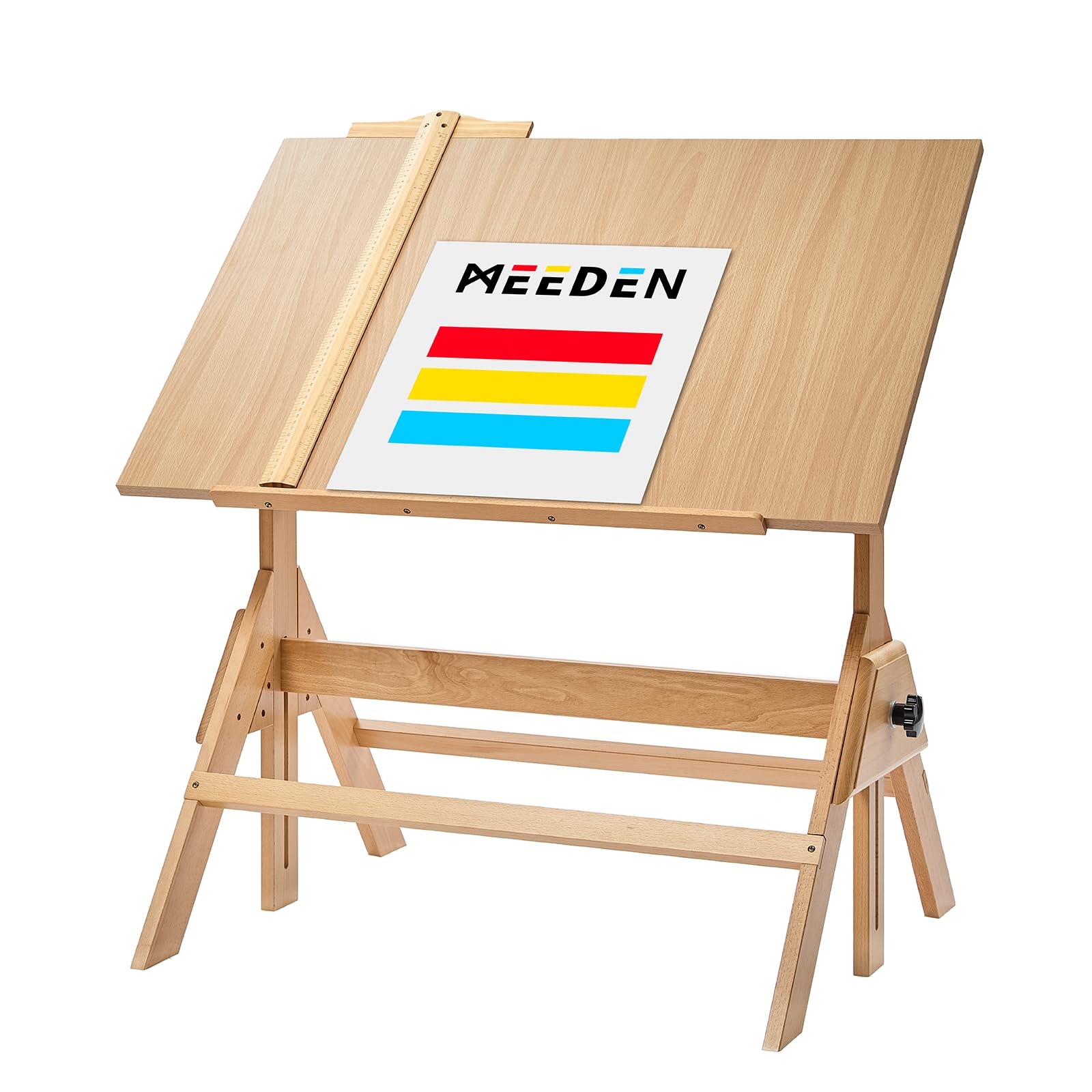
A wood drafting table lives or dies on one thing: whether the surface stays still while your hand moves. If the frame shivers every time you press down on a pencil, the angle and the finish do not matter. The picks below are all built on solid wood tops and wood or steel frames, and each one is here because its geometry actually holds. Start with the MEEDEN adjustable model at the top if you want the safest all-round bet — it has the strongest combination of owner satisfaction and working surface in this group.
This guide is built by comparing the manufacturers’ published specifications and the patterns across verified customer reviews, so you get each pick’s real strengths and trade-offs instead of marketing spin.
You will see tilt ranges measured in degrees, height ranges in inches, and tabletop sizes in inches, all explained in plain terms so you can match a table to how you actually work. The short version: a wood drafting table is only as good as its frame, so check the tilt limit and the leg bracing before anything else.
Top Picks


How To Choose The Best Wood Drafting Table
The mistake most first-time buyers make is shopping by tabletop size alone. A big board on a shaky frame is worse than a smaller board that never moves, because every line you draw inherits the wobble. Work through the four points below in order and the shortlist narrows itself.
Tilt range: match the degrees to your medium
Tilt is measured in degrees from flat. A table that stops at 45° or 60° is fine for sketching and writing. If you paint on stretched canvas or work standing, you want a top that reaches 70° or even 90°, because the steeper the board, the less you lean over it. Check the top of the range first, then confirm the surface locks at the angle you need rather than sliding.
Frame material and bracing
Look at the legs and the cross support, not the finish. Beech, pine, and powder-coated steel all appear in this group, and each behaves differently. A cross-brace or H-frame design is what stops lateral movement — the side-to-side shimmy you feel when your forearm rests on the board. Solid wood legs with traditional joints tend to hold adjustment settings better than thin metal legs bolted at a single point.
Tabletop material: particle board, MDF, and pine
All the tops here are wood, but they are not the same wood. Particle board and MDF give you a flat, low-glare, budget-friendly surface that holds pencil line well. Solid pine is heavier and takes knocks better over time. Neither is wrong — just know that a smooth manufactured top is easier to keep clean, while solid wood resists dents from heavy tools.
Height adjustment and who is using it
Height range in inches decides whether the desk suits a seated adult, a standing session, or a teenager. A range that starts low and climbs high covers the most bodies and postures. If the table will serve one person at one chair, a narrower range is perfectly fine and often more stable.
Storage and tool ledges
A pencil ledge runs along the bottom edge of the tilted top and stops pens and brushes from sliding off. A pencil groove is a shallow channel cut into the surface itself. Side trays, sliding shelves, and under-table storage are extras that help in a small studio — just weigh them against how much floor space you can spare.
Side-by-Side Comparison
| Model | Best For | Tabletop Size | Tilt Range | Height Range | Amazon |
|---|---|---|---|---|---|
| MEEDEN Wood Adjustable Drafting Table★ Best Overall | All-round studio work | 35.5″ W x 23.5″ D | Flat to 60° | 29.7″ to 38.4″ | Amazon |
| Athena Collection Wooden Drafting TableBest Starter Set | Small spaces with included stool | 34″ W x 23.5″ D (plus 23.5″ x 15″ slide-out) | 0° to 65° | 28″ to 36″ | Amazon |
| conda Wood Drafting TableEasiest Build | Fast assembly, modest tilt needs | 35.4″ W x 23.6″ D | 0° to 45° | 31.5″ to 37″ | Amazon |
| MEEDEN Vintage Wooden Drafting Table | Steep-angle painting | 35.5″ W x 23.5″ D | Flat to 90° | 32.7″ to 38″ | Amazon |
| VISWIN Pine Wood Drafting Table (35″ x 24″) | Supply storage and looks | 35″ W x 24″ D | 0° to 70° | Height adjustable (range not published) | Amazon |
| Studio Designs Vintage Drawing Table | Living-room styling, flat to upright | 36″ W x 24″ D | Flat, 23°, 46°, 70°, 90° | 36″ H at full tilt | Amazon |
| DJAR 42×30 Adjustable Wooden Drafting Table | Oversized boards and rotation | 42″ x 30″ | 25° increments, 330° rotation | 34″ to 38.9″ | Amazon |
| VISWIN Pine Wood Drafting Table (42″ x 30″) | Large format drafting | 42″ W x 30″ D | 0° to 70° | 34″ to 38″ | Amazon |
Detailed Reviews
1. MEEDEN Wood Adjustable Drafting Table
Our pick — 4.5+★ from 900+ verified ratings; the strongest balance of quality and price.
Solid beech legs and a cross-braced frame that keeps the 35.5-inch top from shimmying under your forearm.
This is the one to buy if you want a working surface that behaves like furniture rather than a folding stand. It carries a 4.5+ star rating from 900+ owners, and what earns that score is build quality first and assembly second — the two things that go wrong on cheap drafting desks. The top measures 23.5 inches deep by 35.5 inches wide, which fits a large sketchpad or a wide canvas with room beside it for brushes. The frame is beech, joined with traditional wood joints rather than single bolts, and a cross support runs underneath to stop the side-to-side movement you feel when your forearm lands on the board.
For height, you get a range of 29.7 inches to 38.4 inches, so it works from a standard desk chair and still climbs high enough to stand at for short stretches. The tabletop tilts from flat to 60°, and that ceiling is the honest limit here. Sixty degrees is plenty for sketching, drafting, and writing at a slope. It is not a painting board for upright canvas work — the MEEDEN vintage model below reaches 90° if that is your medium. On the flat setting, it doubles as a writing or computer desk without complaint.
The extras are genuinely useful rather than filler. A 25-inch built-in pencil ledge runs the bottom edge and keeps your stationery from sliding off once you tilt the board. MEEDEN also throws in a 24-inch T-square with both inch and metric calibrations, which saves a separate purchase on day one. On assembly, the box includes a tool and bags every small part separately. In the word of the buyers who have built it: “The assemble takes two people about 20 minutes to complete.” Budget for a second pair of hands and the job is quick.
Where It Earns Its Rating
- Beech frame with cross support holds steady under arm pressure.
- Height spans 29.7″ to 38.4″ for seated and standing work.
- Ships with a 24-inch dual-scale T-square and a 25-inch pencil ledge.
- Particle board top with a smooth natural finish that takes pencil line cleanly.
- Separated hardware bags make the build straightforward for two people.
What To Know Before Buying
- Tilt stops at 60°, so upright canvas painting is out.
- Needs two people for a painless assembly.
- Non-adjustable height feel is the recurring knock in owner feedback.
Reach for this if: you want one wood drafting table that handles drawing, drafting, and writing at a slope without wobbling.
Look elsewhere if: you paint standing at steep angles — the 60° ceiling will stop you short.
2. Athena Collection Wooden Drafting Table W/Stool
One order covers the 34-inch table, a padded stool, a 23.5-inch slide-out side shelf, and two fabric drawers.
The reason to look at this one is that it removes three separate purchases. You get a 34-inch wide by 23.5-inch deep main top, a matching padded stool, and a 23.5-inch by 15-inch sliding side table that tucks underneath when you are done with it. The stool is the part most buyers underrate — sitting at the right height is what keeps you from hunching over an angled board for an hour. The desk is rated 4.0+ stars, and the table is the piece that carries the score: owners call it good quality and sturdy, and several buy it specifically for a child’s art work.
Compared with the MEEDEN above, this top tilts a little further — 0° to 65° instead of a 60° ceiling — and its height range starts lower, from 28 inches up to 36 inches. That lower floor is why it suits younger artists and seated work so well. The MEEDEN, by contrast, reaches up to 38.4 inches for standing sessions. Width is where the Athena gives ground: its main top is 34 inches against the MEEDEN’s 35.5 inches, though the slide-out shelf recovers that space whenever you need it for paints and brushes.
A detachable side tray with honeycomb pen holders and slots keeps pencils and brushes upright, and two fabric drawers plus an under-table shelf swallow sketchbooks and supplies. Two honest notes. The assembly instructions are unclear for some buyers, so expect to work some of it out by eye. And there is a mixed thread on the top: a few owners say it cannot be laid completely flat, and a handful describe the material as pressed wood. Read that as a fit note — if you need a guaranteed dead-flat writing surface, check that setting the moment it is built.
The storage angle: for a small room, the combo of two fabric drawers, a honeycomb side tray, and a pull-out auxiliary top keeps supplies off the main board and off the floor.
The frame caveat: a powder-coated steel frame with non-slip rubber feet gives it its footing, but this is a lighter-duty build than the all-wood picks — treat the stool and drawers as the value, not the joinery.
The case for it: a gift or first studio setup where you want seat, storage, and surface in a single order.
Set expectations on: the pressed-wood top and the vague instructions — both show up in owner feedback.
3. conda Wood Drafting Table
Separately bagged hardware and a straightforward flat-pack build that owners finish in one sitting.
Assembly is the single thing buyers talk about most with this desk, and it is the good kind of talk — well-made construction and a straightforward build. That matters if you have ever spent a Saturday evening decoding a furniture diagram. The frame is solid beech wood, the top is natural wood at 35.4 inches by 23.6 inches, and the finish is a natural wood tone that sits quietly in a room. Height adjusts from 31.5 inches to 37 inches, and the top tilts from 0° to 45°.
That 45° stop is the number to weigh. It is the shallowest tilt in this group, so it is a drafting and writing desk first and a painting easel never. Set against the MEEDEN vintage model’s 90° swing, it simply does not go as far. For architectural line work, graphic design, and long writing sessions, 45° is a comfortable slope and nothing is lost. If you paint on upright canvas, keep scrolling.
A built-in pencil ledge and a ruler are cut into the surface for tool storage and quick measurement, which is a nice touch for plan-table work. Owners also mention it moves and adjusts easily, so if you shift your studio setup around, that helps. The brand promises a customer service reply within 24 hours if a part turns up missing or unclear.
Who it fits: a drafter or designer who wants to spend an hour building and then leave it alone.
The honest limit: 45° of tilt and only 5.5 inches of height travel (31.5″ to 37″) — this is a seated desk, not a standing one.
Take this one if: you dread flat-pack and want a solid beech desk up and working in one sitting.
Pass if: your work needs a steep board or a standing height — this top maxes out well short of both.
4. MEEDEN Vintage Wooden Drafting Table

A walnut-toned particle board top that tilts from flat to 90° across seven working angles.
If you paint on canvas, this is the pick. The tabletop tilts from flat all the way to 90°, giving you seven working angles, against the 60° ceiling on the MEEDEN adjustable model and the 45° stop on the conda. That difference is the whole argument for the vintage piece: an upright board lets you work without leaning your neck down. The 90° swing is the sort of range you see on proper studio easels. Height moves from 32.7 inches to 38 inches across six settings, spaced 1-1/5 inches apart. The MEEDEN adjustable table above spans a similar band but reaches 38.4 inches at the top.
The vintage build is the strong point. A walnut-colored particle board top sits on thickened beechwood legs in an H-frame, and the semicircle iron sheet and mortise-and-tenon joints give it that industrial-studio look. A 24-inch T-square with inch and metric markings comes in the box. There is a single drawer and a built-in pencil ledge. The thing that wins people over is the design — the clear grain and the old-world detailing earn far more praise than anything else in owner feedback, with the finish and the overall look right behind it.
Now the catch, and it is worth hearing clearly. Adjustability is the mixed thread on this table: buyers split between finding it easy to move and finding it fiddly to reset. Size and material also draw a few mixed notes, and given the walnut-tone particle board top, treat it as a flat board on a strong frame rather than a hand-carved heirloom. None of that dents the finish quality or the 90° range — just expect to settle on one angle you like and leave it there.
Owner-verified strength: design and appearance — the walnut tone and iron detailing are what people notice and praise in a room.
The trade-off: a top that is a joy to look at but a two-hands job to readjust, so it favors one chosen setup over constant changing.
Best if: you paint or work at a steep board and want the furthest tilt in this group at 90°.
Think twice if: you change angles several times a day — the reset motion draws mixed reviews.
5. VISWIN Pine Wood Drafting Table (35″ x 24″)

Two open shelves under the 35-by-24-inch pine top hold canvas, brushes, and sketchbooks off the floor.
Here is a table built for people with a lot of stuff. Under the 35-inch by 24-inch top sit two open shelves, sized for canvas, brushes, paint, sketchbooks, or whatever else clutters your studio floor. That storage is the reason to pick it, and it is the detail almost no other desk in this lineup offers at this level. The frame is solid pine with an H-frame and thickened legs for load-bearing, and the top tilts from 0° to 70° — steeper than the MEEDEN adjustable model’s 60° and the conda’s 45°.
The finish is a professional oil treatment that leaves the pine smooth enough to wipe clean, which is the sort of thing you notice on the third week of a painting project. Hand-polished corners mean no burrs or sharp edges where the frame meets the board. Owner feedback on this desk is short but consistently warm: good-looking, easy to build, and sturdy. It is a newer listing compared with the big-review tables here, so the sample size is thinner — a fair point to weigh if you rely heavily on crowd verdicts.
One spec to note before ordering: the listing describes the height as adjustable without publishing the inch range. If exact standing height matters to you, confirm the travel with the seller first. What it does state clearly is the 70° tilt and the pine frame. Set against the Studio Designs table below, this one gives you more tilt but no built-in angle detents — it is a smooth adjust rather than a click into fixed stops.
Where the value sits: two open shelves turn a drafting surface into a full studio station and keep the floor clear.
What to verify: the unpublished height range — worth a quick check if you plan to stand and work.
Bring it home if: your supplies outnumber your space and you want shelves built into the desk itself.
Look past it if: you need a documented standing height — that number is not in the listing.
6. Studio Designs Vintage Drawing Table

A distressed coastal whitewash finish that reads antique, with tilt stops at flat, 23°, 46°, 70°, and 90°.
This table is the one you leave in the living room rather than the back studio. The coastal whitewash finish with a distressed, turn-of-the-century look draws far more praise than any other trait in owner feedback — buyers routinely say it looks more expensive than it is. 1,500+ owners have it, and the appearance is a big reason why. The surface is 36 inches by 24 inches, slightly wider than the MEEDEN adjustable model’s 35.5 inches, and it has a 24-inch pencil groove plus a pencil ledge to keep brushes and pens from rolling off.
The tilt here is a fixed ladder rather than a free slider: it clicks into a flat surface, then 23°, 46°, 70°, and 90°. If you like a setting you can trust and return to, those detents are a plus. If you want infinite adjustment between stops, the MEEDEN vintage table’s seven free angles suit better. Full tilt puts the whole unit at 36 inches high and 36 inches wide by 24 inches deep. Four floor levelers correct for an uneven floor, and the solid wood frame is built with mortise-and-tenon joints.
Real wood construction and overall sturdiness earn steady praise, and owners call it excellent value. The adjustability is the mixed note — some find the detent mechanism fussier than a smooth glide. Worth sizing honestly: 36 inches wide is a comfortable sketch or writing board, but if you draft on full 24-inch sheets with tools beside you, the 42-inch tables below give your arms more room. For home use and light creative work, this width is right.
The Wins
- Five fixed tilt stops up to 90° make a favorite angle repeatable.
- Coastal whitewash distressed finish is styled like an antique.
- 36″ x 24″ solid-wood top with 24″ pencil groove and ledge.
- Four floor levelers handle an uneven studio floor.
- Mortise-and-tenon joints on a real wood frame.
The Caveats
- Detent tilt feels fussier than a smooth slider to some owners.
- 36″ width is modest for large-format drafting spreads.
Why you would choose it: you want furniture that looks like a vintage find but tilts and holds like a working drafting table.
Why you would not: you need step-free angle adjustment or a wider board for big sheets.
7. DJAR 42×30 Adjustable Wooden Drafting Table

A 42-by-30-inch walnut-finished pine top that rotates 330° on its double semicircular frame.
Size and rotation are what separate this from the smaller desks above. The top runs 42 inches by 30 inches — the largest surface in this group alongside the VISWIN 42-inch model. That footprint fits an 18×24 sheet with room to spare, and buyers report it is exactly the format that suits that paper size. Height adjusts from 34 inches to 38.9 inches, and the double semicircular frame tilts in 25° increments while rotating 330°. That spin means you can swing the board around to face you from a different chair or corner rather than moving the whole desk.
Set against the 36-inch Studio Designs table, the extra six inches of width is the difference between a board you sketch on and a board you draft large layouts on. The frame is a solid pine H-frame with a walnut-finished top and durable hardware meant to reduce tabletop shake. The brand notes the wood is FSC-certified, which is worth knowing if sourcing matters to you. It pulls together as a drafting, craft, study, or computer desk, and buyers find it sturdy and well-made with simple assembly and clear instructions.
The catch is the adjustment mechanism. It is the mixed thread on this table — several owners find the tilt and rotation harder to adjust than expected, which is the trade for that 330° range. Treat it as a table that rewards settling on a working setup and then mostly leaving it. On the other side of the ledger, the walnut finish and sleek design draw steady praise, so it earns its place in a visible studio as well as a working one.
The headline spec: 42″ x 30″ top with 330° rotation and 25° tilt increments — the most movement of any desk here at this size.
The honest friction: that range adds adjustment steps that some owners find awkward; a big board also needs the wall space to match.
Pick it for: large-format drafting on 18×24 sheets and a board you can swing toward you.
Weigh the trade: the biggest tilt-and-spin range comes with the fussiest adjustment.
8. VISWIN Pine Wood Drafting Table (42″ x 30″)

A 42-by-30-inch pine top with a published 34-to-38-inch height range and 0° to 70° tilt.
For a big drafting surface that will not leave you guessing on the numbers, this pine desk spells everything out. The top is 42 inches wide by 30 inches deep, and height runs from 34 inches to 38 inches — the tallest range here, and unlike the 35-inch VISWIN model, the figures are published. Tilt goes from 0° to 70°, which beats the MEEDEN adjustable model’s 60° and the conda’s 45° while matching the smaller VISWIN. The base is a pine H-frame with thickened legs for load-bearing and hand-polished corners, finished with an oil treatment that keeps the surface smooth and easy to wipe down.
Against the DJAR above, the two agree on 42 by 30 inches, but this one gives you a cleaner tilt story: a stated 0° to 70° range instead of 25° increments and a 330° spin. If you want the big board without the rotation mechanism, this is the simpler tool. Assembly is described as labeled parts, tools, and a detailed manual. The design is the thing buyers talk about most — it earns more praise than any other feature, with assembly close behind, and the retro look wraps a modern build.
There is one genuine fit issue with this table, and it is about height. Several owners find the desk runs high, and it was called too tall to pair with a computer chair. That is the trade for a 34-inch to 38-inch range: it is sized for drawing rather than typing. If you plan to use it as a writing or study desk from a standard office seat, measure your chair first, or drop to the Athena, whose range starts at 28 inches and sits lower.
Spec confidence: a stated 34″–38″ height range and 0°–70° tilt — you know what you are getting, unlike adjustable desks that hide the numbers.
The height warning: that same generous range runs high, so it fits a drafting stool better than a low desk chair.
Grab it if: you want a wide 42-inch drafting board with a clearly published standing range.
skip it if: you work seated in a standard office chair — the tall range suits a stool, not a low seat.
Know the Specs
Tilt Range in Degrees
The tilt number tells you how far the top can lean back from flat. A 45° board is a slope for writing and drafting. A 70° board lets you paint without craning your neck. A 90° board works like an easel and suits upright canvas. The higher the ceiling, the more types of work the desk covers — but a very steep board also means loose tools slide, which is why a pencil ledge matters on the tall-tilt models.
Height Range in Inches
Height travel decides who the desk fits and whether you can stand at it. A range starting near 28 inches suits seated work and younger artists. One climbing to 38 inches or beyond lets you stand for a few minutes and stretch. The wider the range, the more bodies and postures it serves. Just match the range to your chair: a table meant for a drafting stool feels too tall from an office seat.
Common Questions
What is the difference between a drafting table and a regular desk?
Can I use a wood drafting table as a computer desk?
How steep should the tilt be for painting?
What does a pencil ledge actually do on a drafting table?
Is particle board or MDF good enough for a wood drafting table?
How long does assembly take on these tables?
Will a 42 by 30 inch table fit a small studio?
Can I lay the top completely flat on every model?
Do I need two people to assemble a wood drafting table?
What is the advantage of a rotating or tilting top with fixed stops?
The Bottom Line
For most buyers, the wood drafting table winner is the MEEDEN Wood Adjustable Drafting Table, because a beech frame with cross support, a 29.7-to-38.4-inch height range, and a flat-to-60° top covers drawing, drafting, and writing without a wobble — and it ships with a T-square and pencil ledge already included. If you paint at steep angles, the MEEDEN Vintage Wooden Drafting Table is the one to reach for, with its flat-to-90° swing. And if large-format work is the day job, the VISWIN 42″ x 30″ Pine Wood Drafting Table gives you the widest documented working surface with a stated 34-to-38-inch height range. Whichever you choose, the deciding number is the one that keeps your hand steady — lock in the frame and the tilt, and the rest follows.
How we choose
We do not accept paid placement. Every pick is matched to a real buyer and a real use-case; we do not hands-on test units.
Sources
Specifications: manufacturer listings and product documentation. Review insights: verified customer reviews, as of November 2026. Pricing: not shown on this page (it changes often); check the current price via the retailer link.
As an Amazon Associate, Tactical Gear Guy earns from qualifying purchases. This does not affect which products we feature.