Specs are compiled from manufacturer listings and verified buyer reviews and can change over time — please confirm the key details on the product page before buying.
If you need to shave the edge of a sticking door, the pick that suits most people is the JORGENSEN NO.60-1/2 block plane. It is small enough to hold in one hand at 1.5 pounds, its blade is O1 tool steel (a hard, long-wearing steel that stays sharp through repeated shavings), and it takes a thin, controlled cut off a door edge without needing an extension cord or a power outlet. Electric planers are the faster tool when you are hogging off a lot of material, but a block plane gives you far more control over the last half-millimeter that decides whether a door swings free or still rubs the frame.
This guide is built by comparing the manufacturers’ published specifications and the patterns across verified customer reviews, so you get each pick’s real strengths and trade-offs instead of marketing spin.
Door trimming is not really one job — it is three: taking a hair off a swollen edge, easing a corner so it clears a frame, and chamfering a door bottom that scrapes a rug. Match the tool to the cut you are actually making, and this comparison of the best wood door trimmer options covers all three jobs.
Top Picks


How To Choose The Best Wood Door Trimmer
A door that rubs the frame is usually only off by a millimeter or two, so you want a tool that removes a little at a time and lets you check the swing as you go. The wrong choice is a big, aggressive cutter that takes a deep bite and leaves you with a door that now has a visible gap.
Hand plane or electric planer first
A block plane is a small hand tool you push across the edge — no cord, no noise, and total control over how much comes off. It suits the final fitting pass. An electric hand planer spins a cutter head with a motor, so it removes material fast, which is what you want when a door is badly swollen or you are trimming several doors. If you can only buy one, pick a hand plane for a door you have already hung and an electric planer for a door you are fitting from scratch.
Cutting width and cutting depth, explained
Cutting width is how wide a shaving the tool takes per pass — the JORGENSEN block plane covers 1.38 inches, while the WEN 6530 electric planer covers 3.25 inches. Cutting depth is how thick a shaving you can set it to take. On a door edge you want a shallow depth and repeat passes, because a door face is thin and a deep gouge is hard to hide. A planer with positive stops, meaning notched settings that click to a known depth, makes this repeatable.
Blade material and body weight
O1 tool steel is a hard, wear-resistant steel that holds an edge well; several picks here use it. Ductile iron and cast iron bodies add mass that keeps the plane steady in the cut, while aluminum bases keep an electric planer lighter. Weight cuts both ways: at 6 pounds the SKIL and WEN corded planers are heavier to hold overhead, but that weight helps them track flat on a long door edge.
Side-by-Side Comparison
| Model | Best For | Power / Type | Cutting Width | Weight | Amazon |
|---|---|---|---|---|---|
| JORGENSEN NO.60-1/2★ Best Overall | Best overall for fitting a hung door | Manual block plane | 1.38 inches | 1.5 pounds | Amazon |
| TEENO Wood RouterMost Powerful | Best for routing and edging cuts | 6.5 A / 1.25 hp corded | — | — | Amazon |
| WEN 6530Best Value | Best value electric planer | 6 A corded | 3.25 inches | 6.5 pounds | Amazon |
| JORGENSEN Chamfer Plane | Best for rounded door edges and corners | Manual edge plane | 6 millimeters | — | Amazon |
| Anesty Compact Router | Best for variable-speed trimming | 6.45 A / 0.95 hp corded | — | — | Amazon |
| DNTI Corded Handheld Planer | Best for fast stock removal | 6.6 A corded | 3-1/4 inches | — | Amazon |
| JEXUGK Brushless Router | Best cordless option | 21V brushless cordless | — | — | Amazon |
| SKIL PL201201 | Best for dust control on site | 6.5 A corded | 3.25 inches | 6 pounds | Amazon |
| Bosch PL1632 | Best premium planer for door edges | 6.5 A corded, 16,500 RPM | 8 centimeters | 6.3 pounds | Amazon |
Detailed Reviews
1. JORGENSEN NO.60-1/2 Wood Planer
Our pick — 4.5+★ from 600+ verified ratings; the strongest balance of quality and price.
A one-hand block plane that takes a whisper off a door edge, not a chunk.
Fitting a door that already hangs in its frame is fiddly work, and this is the tool built for exactly that pass. The JORGENSEN NO.60-1/2 cuts a 1.38-inch wide shaving, which is enough to work the thickness of a standard door edge without wandering onto the door face. It weighs 1.5 pounds, so you can hold it one-handed and check the door swing between passes.
What wins people over is the construction. The blade is professional-level O1 tool steel — a hard, wear-resistant steel that keeps its edge through repeated trimming — and it can be sharpened and re-set rather than replaced. The body is ductile iron, a tough cast iron that resists cracking, and Jorgensen says it is drop-tested. The lever cap is zinc alloy and the remaining parts are stainless steel. The review pages are full of people impressed by how sharp it arrives and how fine the shavings come off.
Where it gives you control is the adjustable mouth and the cutting-depth knob. You turn the knob to set how thick a shaving the blade takes, and you widen or narrow the mouth to suit. That combination lets you go from a slightly heavier cut on a swollen door down to a paper-thin finishing pass as the door starts to swing free. The flat, polished bottom keeps it running smooth along the edge instead of chattering. It holds 4.5+ stars across 600+ owners, the most-rated hand plane on this list.
Where it earns its keep
- O1 tool steel blade arrives sharp and can be resharpened for long service life
- Ductile iron body takes knocks and drop-tests without cracking
- Adjustable mouth plus depth knob gives you fine control over shaving thickness
- At 1.5 pounds it is light enough to steer one-handed along a door edge
Where you feel the trade-off
- Depth and blade adjustment split opinions — expect to spend time dialing it in before the first clean cut
- A manual plane removes material slowly, so a badly swollen door takes several passes
- The blade is sharp and exposed — read the manual before the first pass
Reach for this one if: you are fitting a door that already hangs and you want to shave the edge a hair at a time.
Look elsewhere if: the door is badly swollen and you need to hog off a lot of material fast — that job wants an electric planer.
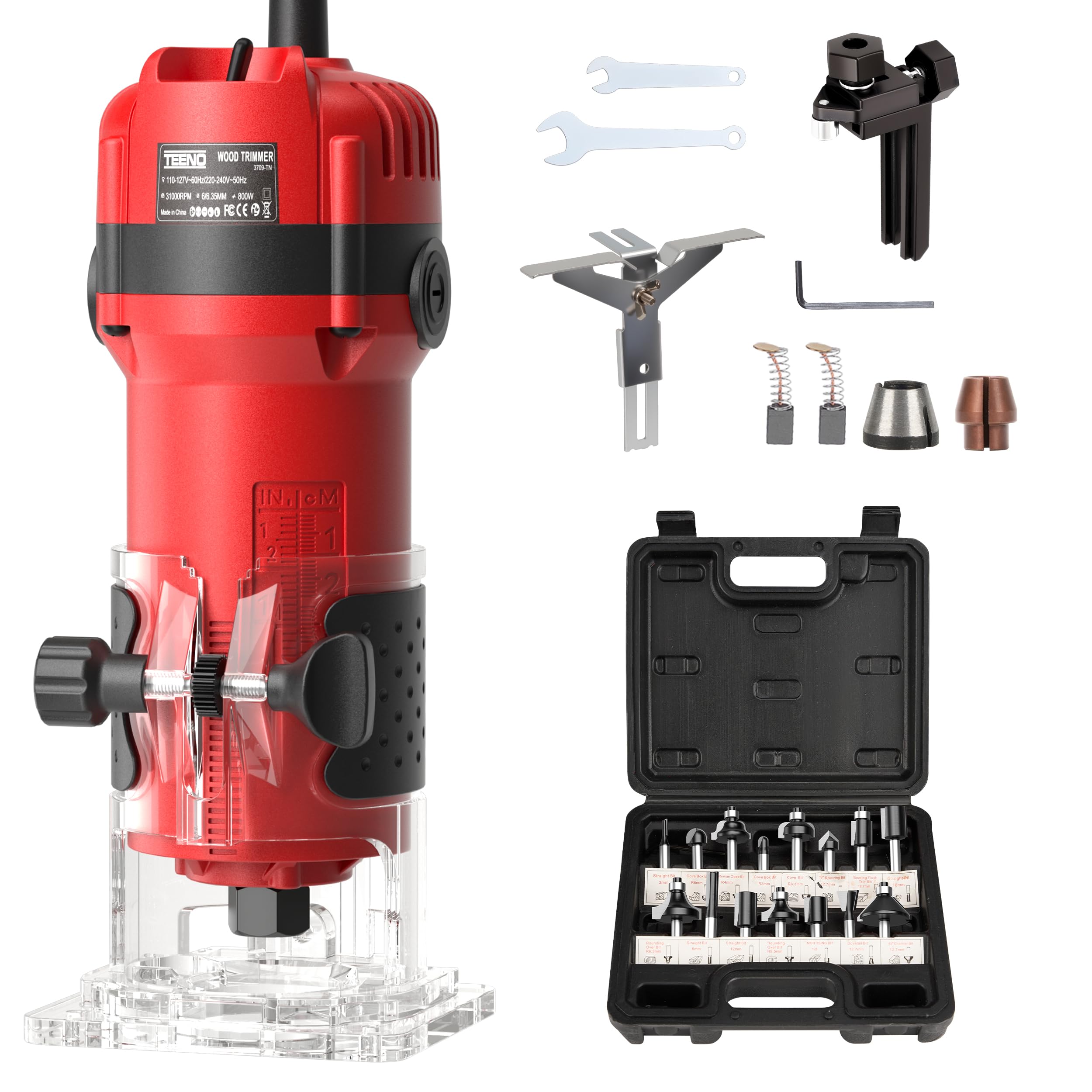
2. TEENO Wood Router 800W
A palm router with real motor muscle and a bit set that covers most door-edge jobs.
If you want to round over or groove a door edge rather than just shave it, a router does that job and a planer does not. The TEENO runs a 6.5-amp, 1.25 hp motor up to 31,000 RPM — more horsepower than the Anesty Compact Router’s 0.95 hp, so it holds speed better in harder woods. It also outmuscles the WEN 6530 electric planer on amperage, 6.5 amps against 6 amps.
The kit is the draw. You get 15 router bits with 1/4-inch shanks (the shaft that drops into the collet), plus a straight guide and a trimming guide. The clear base and transparent dust cover let you see the cut line while the chips fly. Depth adjusts with a knob, no tools needed, which makes repeat passes against a door edge quicker to set. The 6.5-amp motor and the included bits are why it lands as the most powerful pick here.
The honest caveat is the collet and bit-tightening routine. The bit-tightening mechanism is the most-discussed gripe on this router, and durability comes up as a concern too. Treat it as a light-to-medium-duty router: it handles home projects comfortably, but do not ask it to run all day in a cabinet shop. Functionality is the thing it gets praised most for — it works, and it works without drama on small jobs. The bundled manual is thinner than ideal for a first-time router user.
The value read: one purchase covers the router, 15 bits, and two guides — enough to ease a door edge, cut a shallow groove, or chamfer a corner without buying anything else.
Set your expectations here: a 31,000 RPM fixed-base router with a light body wants two hands and a firm grip, so practice on a scrap offcut before you touch the door.
Best matched to: the woodworker who wants to profile a door edge with a round-over or groove, not just plane it flat.
The limiting factor: the bit-tightening routine and long-run durability are the weak spots — keep it to home-scale jobs.
3. WEN 6530 6-Amp Electric Hand Planer, 3-1/4-Inch
A corded planer that takes off material fast and tells you exactly how deep each pass cuts.
When a door has swollen into the frame and a hand plane would have you shaving for an hour, this is the shortcut. The WEN 6530’s 6-amp motor turns out up to 34,000 cuts per minute and takes a 3.25-inch wide shaving — the same width as the SKIL and Bosch planers, so it covers a full door edge in one pass. Compare that to the 1.38-inch hand plane above and it is more than twice the coverage per stroke.
The feature that makes it usable on fine work is the 16 positive stops. Those are notched depth settings that click into place from 0 to 1/8 inch, so each pass is repeatable rather than guessed. A 5/16-inch rabbeting guide lets you cut a 1-inch rabbet, the dust bag catches the chips, and a kickstand holds the blade off your bench when you set it down. At 6.5 pounds it is heavy enough to track flat down a long edge. It carries far more owners than the JORGENSEN block plane, and 2-year warranty coverage backs it up.
The recurring gripe is the sheer material removal rate — it is quick, and quick is unforgiving. Set the depth shallow and sneak up on the final fit, because one deep pass on a door face leaves a step you cannot sand out. For anyone fitting a door from scratch rather than shaving a hung one, this is the time-saver.
Pick it when: the door is still off its hinges and you need to bring a rough edge down to size quickly.
Know before you buy: 16 depth stops reward patience — use them shallowly, because this planer removes wood faster than you expect.
4. JORGENSEN Chamfer Plane
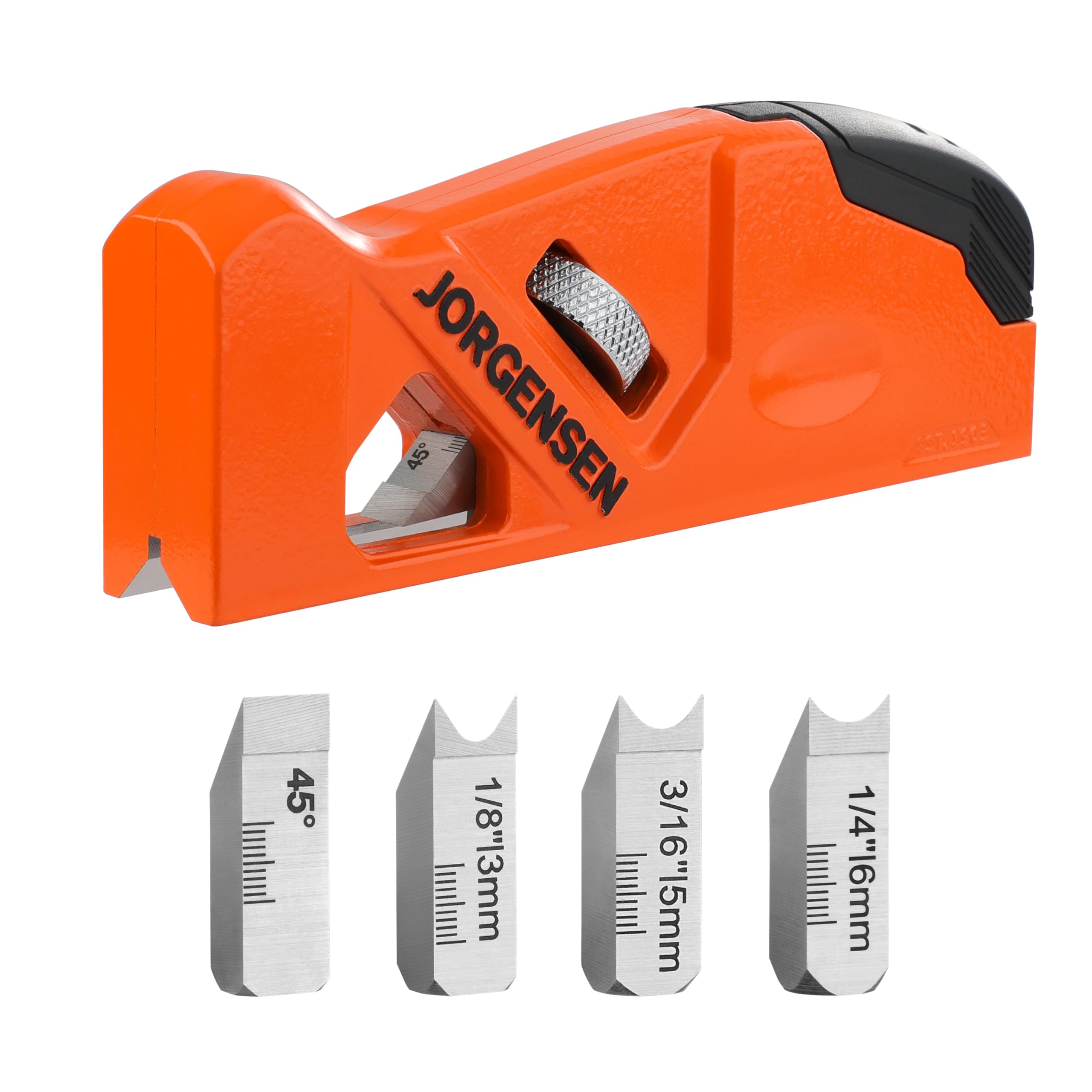
The door-edge tool for breaking a hard corner into a clean chamfer or round.
A block plane flattens an edge; this one shapes the corner of it. The JORGENSEN chamfer plane cuts a 6-millimeter wide band along the edge, and you get four cutter heads to choose from: a 45° flat cutter for a straight chamfer, plus 1/4-inch, 3/16-inch and 1/8-inch round heads for easing a corner to different radii. On a door that catches a frame, a small round on the edge lets it clear without opening a visible gap.
The build is the same family as the block plane above. The blade is O1 tool steel — hard, wear-resistant, resharpened rather than replaced — and the bottom is polished flat so it glides without leaving color on light woods. There is a small groove along the body for your fingers, and the exterior is curved to sit in the hand. What people praise most is the overall quality of the tool: it feels solid and makes clean cuts.
The blade-adjustment side is the fiddly part. Blade adjustment is the most-discussed issue, and sharpness and depth adjustment split opinion — expect to set each cutter head carefully the first time before the cut is clean. The built-in storage at the end of the body keeps the spare heads together so you do not lose them, and the cover clasp holds firmly. There is a knob to adjust cutting depth. On a door with several edges to ease, this is the piece that finishes the job the planer started.
The real-world payoff: four cutter heads in one compact hand tool mean you can match the round to the edge, which is exactly the call a door fitter makes at the frame.
Budget for setup time: each head needs its blade set before first use, and that is the step buyers find slowest.
Built for: easing and chamfering a door’s leading edge so it clears the frame cleanly.
One real catch: the blade adjustment takes patience — set it on scrap before you commit to the door.
5. Anesty Compact Router 710W

The router that lets you slow the bit down for a clean cut on a door’s finished face.
Speed control is the reason to pick this one over a fixed-speed router. The Anesty’s 0.95 hp motor runs from 10,000 to 30,000 RPM across 6 adjustable speed settings, so you can drop the RPM for a bit that wants to burn a light wood and raise it for hogging out a groove. The TEENO above is the more powerful motor at 1.25 hp; the Anesty trades some of that muscle for the ability to dial speed to the job.
The trimmer base adds stability and cuts vibration, which matters when you are working a door edge that shows. Fine depth adjustment runs on a rack-and-pinion system with a clear scale, so shallow passes are repeatable. In the box you get 15 bits with 6.35mm shafts, a straight guide, a roller guide, a template guide, a dust-extraction attachment and both 1/4-inch and 3/8-inch collets. Functionality is what earns it its praise — it does the job and it is simple to use.
Two honest notes. Overheating is the most-discussed complaint, and durability draws mixed feedback, so give the motor a break between long passes rather than running it hot. Noise is also on the loud side. Used in short bursts on a door edge, it stays well within its comfort zone.
Choose this if: you want the ability to slow the bit down and keep a door’s finished face clean.
Watch the heat: the motor runs warm under sustained load, so work in short passes.
6. DNTI 6.6amp Handheld Planer

The highest-amp planer here, built to flatten a stubborn door edge in long passes.
This one leads the group on raw motor rating. The DNTI’s 6.6-amp motor is the highest amperage in this comparison — a step above the 6.5-amp SKIL and Bosch and clearly above the 6-amp WEN — and it runs at 17,000 RPM with a 3-1/4-inch cut width. That is a lot of material coming off per pass, which is what a door that has swelled through a wet season needs. It is also rated 4.5+ stars, level with the JORGENSEN block plane.
Depth is set at 2 millimeters per pass, so you work down to the fit in measured steps. The aluminum base keeps the body stable and the controls are laid out for easy use, which is why ease of use and value both come up positively in feedback. The dust removal is a real plus on interior work: it takes a vacuum attachment so you are not trailing shavings across a finished floor. Quality is the thing it is praised most for. It handles heavier stock too — 2×4 projects come up as a task it takes in stride.
The trade-off is on the two things a planer buyer relies on longest. Sharpness and durability both get mixed feedback, so expect to keep an eye on the blade and budget for sharpening or replacement over time. Treat it as a strong value corded planer for home projects, not a shop tool worked daily.
Why it sits high in the premium tier: the 6.6-amp motor is the most powerful single unit here, and the vacuum attachment keeps an interior door job clean.
The honest follow-up: blade sharpness and long-term durability are the parts buyers question, so keep a spare blade in mind.
Suits you if: you are flattening a swollen door and want the most motor for the money.
Go in with eyes open: sharpness and durability draw mixed reports, so this rewards light-to-medium use.
7. JEXUGK Brushless Cordless Wood Router 21V
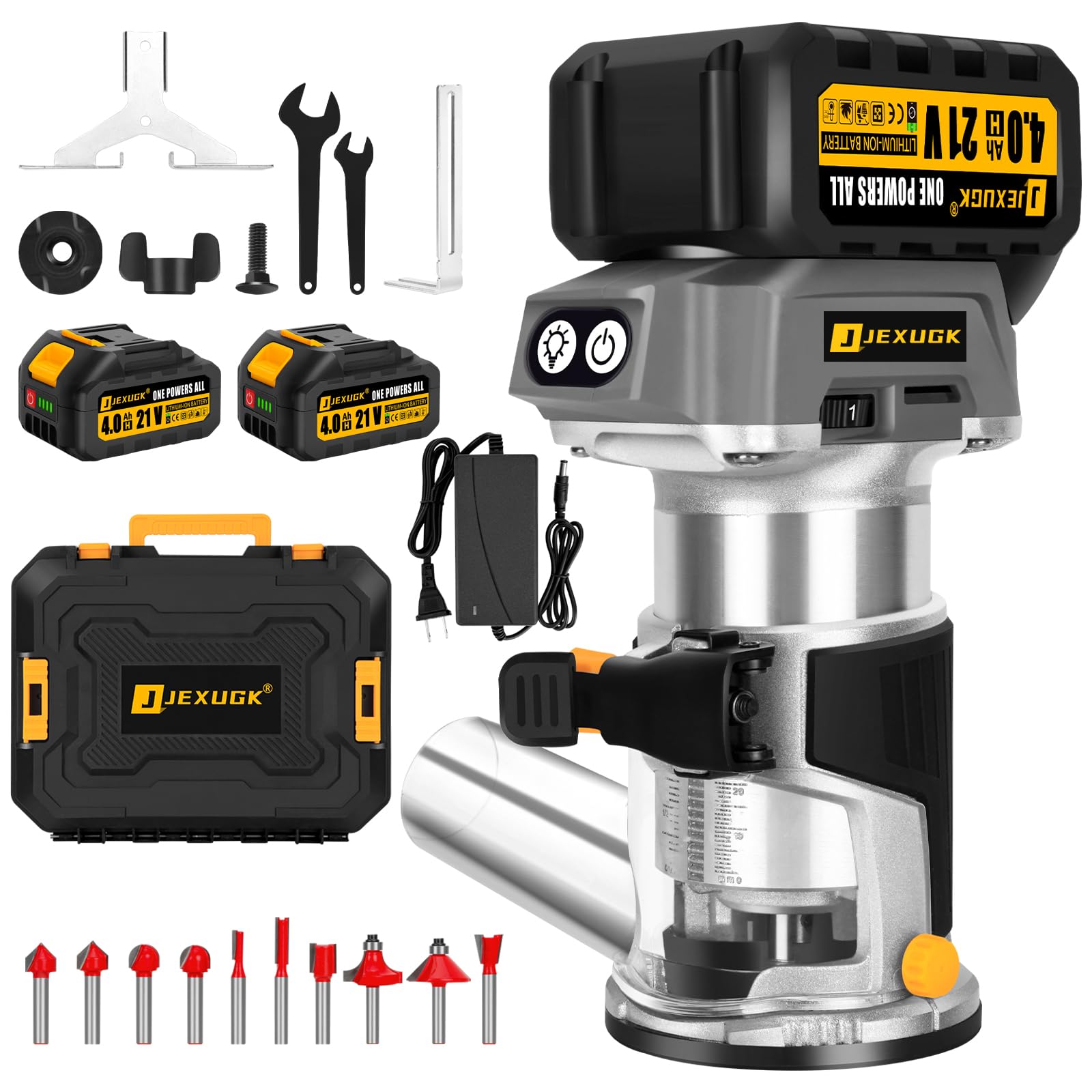
No cord to drag around a door frame — the only battery router in this lineup.
Every other router here needs an outlet. This one does not, which matters when the door you are trimming is in a hallway with no free socket or you are working outside. The JEXUGK’s brushless motor reaches 35,000 RPM — the highest speed in this comparison, above the TEENO’s 31,000 RPM and the Anesty’s 30,000 RPM — and JEXUGK claims the brushless motor cuts operating noise by 30% and is 40% more efficient than a brushed motor. The aluminum base resists knocks and holds steady at speed.
You get two 4.0Ah batteries so one can charge while the other works, and the tool is compatible with Makita batteries. Six speed settings let you match the bit to the wood. The kit includes 10 bits for dovetail, circular, straight and V-shaped cuts, plus guide plates and a dust-collection hood. Owners find it performs well and calls it strong value for the money. Quality is the aspect it earns the most praise on.
The battery life is the thing to plan around. Mixed reports on runtime come up, with several owners finding a battery drains quickly under load — so for a big job, have both charged and take breaks. Build quality also draws some mixed comments. For a handful of edge trims and a bit of rounding, though, the freedom from a cord is worth it. With a small pool of owners behind it still, it is the newest tool here.
The right fit for: trimming doors where there is no handy outlet, or working outdoors.
Size the runtime first: the batteries drain under sustained load, so plan short sessions and keep both charged.
8. SKIL 6.5 AMP Electric 3-1/4 Inch Corded Planer – PL201201
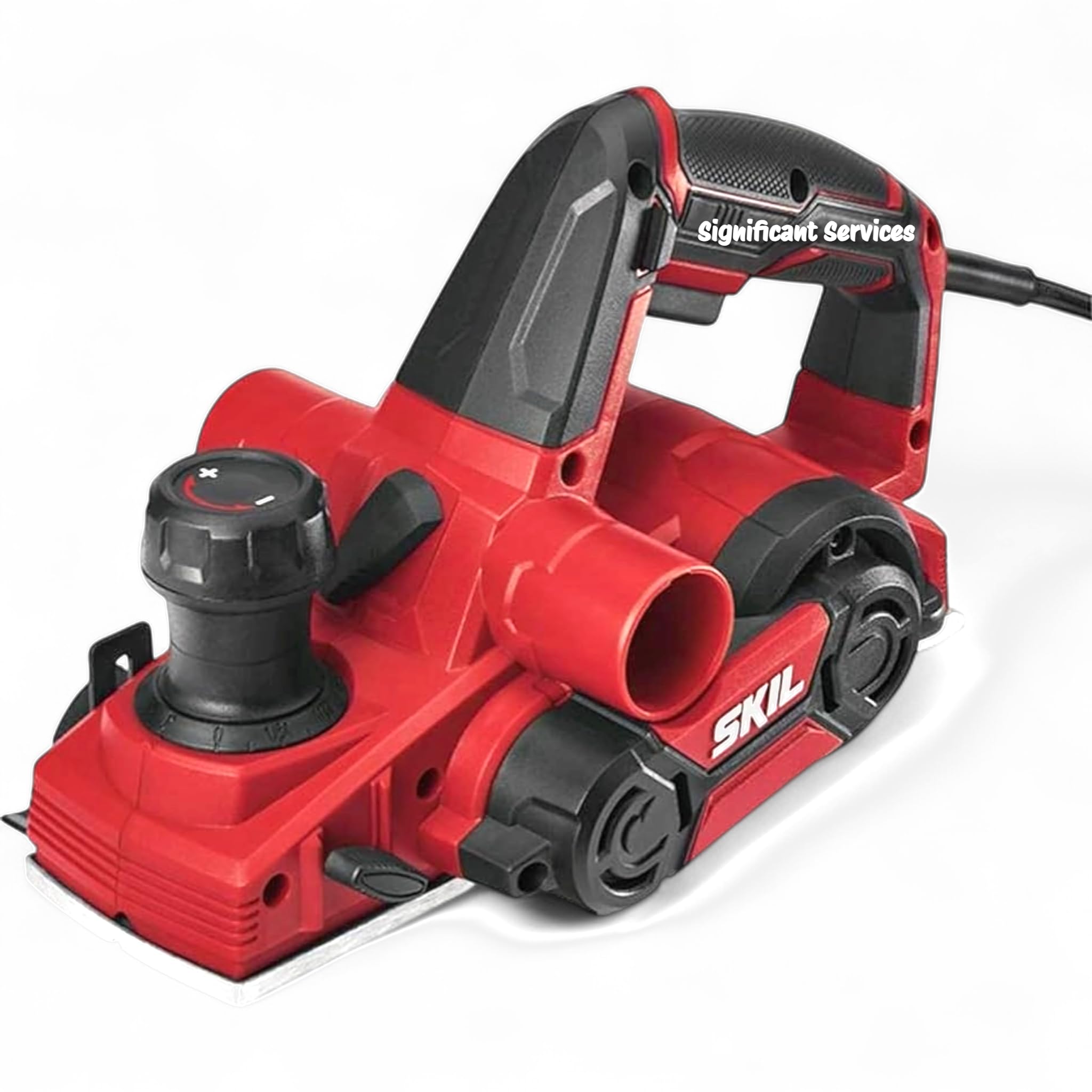
A 6.5-amp planer built around keeping the cut line clear and your fingers safe.
Two things set this corded planer apart for door work: sightlines and safety. The dual chip exhaust throws sawdust out of the way so you can actually see where the cut is going, which is the difference between a clean pass and a gouge on a door face. The 6.5-amp motor matches the Bosch and sits above the 6-amp WEN, and it cuts 3.25 inches wide across a 2-millimeter depth setting — a full door edge per pass.
The details show the tool was thought through. A smooth kickstand keeps the blade off finished surfaces when you set the planer down, so you are not scratching a door you just fitted. The lock-off switch prevents an accidental startup, and there is on-tool storage to keep the wrench where you can find it. At 6 pounds it is light for a corded planer. It ships with a dust bag, parallel guide, rebate fence and spanner. Owners call it well-built and easy to use, and it shines on cleanup jobs like rough sawn lumber.
Depth adjustment is the most-discussed point, and opinions split there — set your depth on scrap and check before you commit. Quality is what it is praised most for, and the lock-off switch alone makes it a sensible choice for anyone who has ever set a power tool down carelessly. For homeowners doing a handful of doors, this covers the job cleanly.
What stands out: dual chip exhaust plus the kickstand and lock-off switch make this the tidiest corded planer to use on a finished door.
Worth knowing: the depth adjustment is the setting to double-check each time, so test on an offcut first.
Made for: homeowners cleaning up rough lumber or popping an edge off a door, who want to see the cut and stay safe doing it.
Check before you cut: depth adjustment needs confirming on scrap, since it splits opinion.
9. Bosch PL1632 6.5 Amp Hand Planer, 3-1/4″
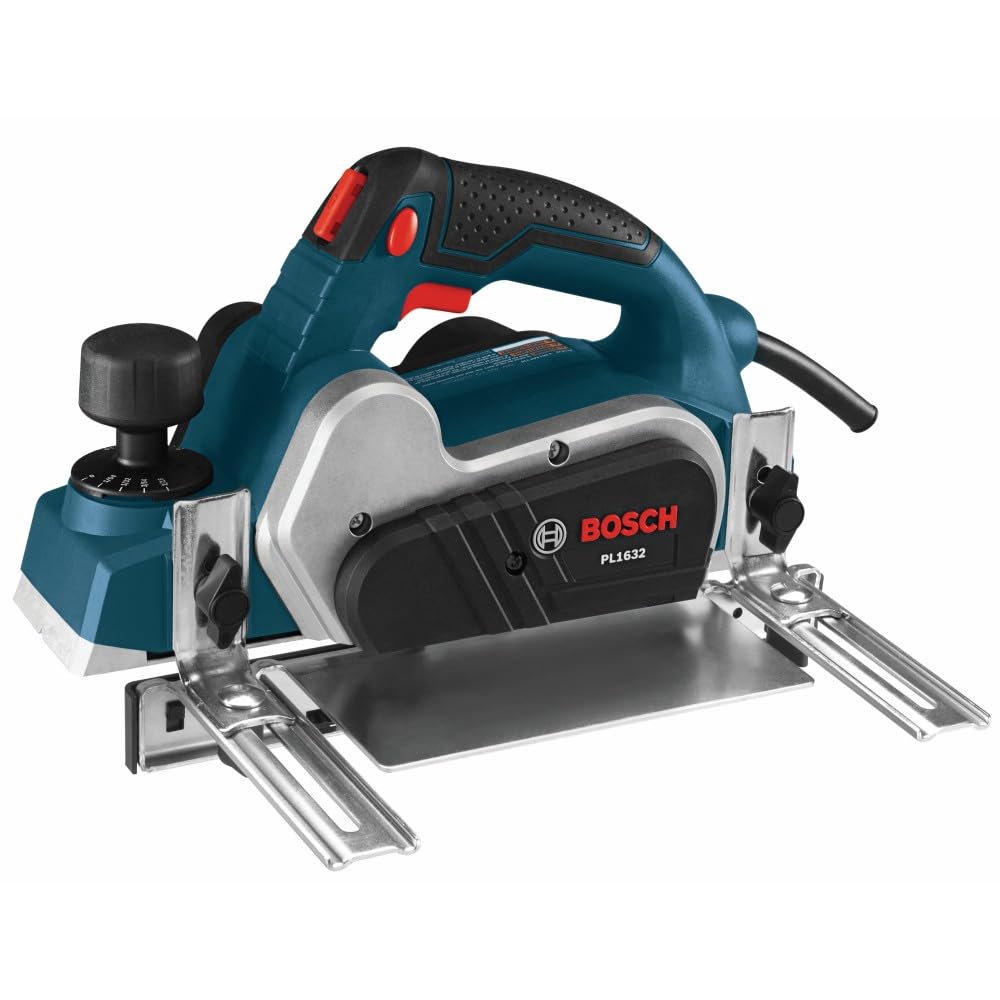
The planer designed for door edges from the start, with a fence that shields the face.
Most planers can trim a door; this one was laid out for it. The Bosch PL1632’s dual-mount guide fence comes with a protective shield and a plastic overshoe that rides the door face to prevent marring, so you can run the tool along an edge without scarring the surface beside it. A 6.5-amp motor drives the cutter at 16,500 RPM through soft and hard woods, and the 8-centimeter cut width is the widest here. Separate inch and metric depth scales make the settings easy to read.
The spring-loaded stand lifts the tool so the blade stays clear of the resting surface — protection for both the blade and the door. Its special body shape lets you start a cut in the middle of a workpiece, useful when you need to take a dip out of a door edge rather than start from the end. The handle is angled for forward motion with a soft grip, so long passes down a door edge stay comfortable. Owners value it highly: buyers report trimming a heavy door in under 5 minutes with it, and it levels uneven boards with ease. Cutting performance is what earns it the second-most praise.
The dual-mount fence is the head-to-head edge over the SKIL: both run 6.5 amps, but only the Bosch adds the protective overshoe and shield specifically for door faces. The catch is the fence setup — it is the part you need to align carefully. Durability and adjustability both draw mixed feedback, and clogging is the most-discussed complaint, so clear chips as you go on long passes.
Why it is the premium choice
- Dual-mount fence with protective shield and plastic overshoe guards the door face
- Spring-loaded stand protects the blade and the surface it rests on
- Special body shape lets you start a cut mid-door
- Separate inch and metric depth scales speed up setting the cut
What to plan around
- Clogging is the most-discussed issue — empty the chips on long passes
- The fence needs careful alignment before it shields the face as intended
- Durability and adjustability draw mixed reports over heavy use
Worth the step up if: you trim doors often and want the fence-and-overshoe setup that protects the door face.
Keep clear: chips clog on sustained passes, so stop and clear rather than pushing through.
Know the Specs
Cutting width (inches or millimeters)
Cutting width is how wide a shaving the tool takes in one pass. A hand block plane covers a narrow band — the JORGENSEN cuts 1.38 inches — so you steer it along the edge in a controlled strip. A corded electric planer covers a full edge at 3.25 inches (WEN and SKIL), which is why it removes material faster. Wide is not automatically better for a finished door, because a wide cutter that wanders leaves a flat spot you cannot hide.
Amperage and RPM (corded power)
Amperage is the electrical current the motor draws, and RPM is how fast the cutter spins. Together they set how fast material comes off. In this lineup the amperage runs from 6 amps on the WEN up to 6.6 amps on the DNTI, and the routers top out higher in speed — 35,000 RPM on the JEXUGK versus 30,000 on the Anesty. A higher-RPM router gives a smoother cut on a door edge; a planer with positive stops gives you repeatable depth, which is often the more useful feature on a door.
Blade steel and body material
O1 tool steel is a hard, wear-resistant steel used for blades that need to hold an edge through repeated trimming; JORGENSEN uses it on both its hand tools here. Ductile iron and cast iron bodies add stability and take knocks, while aluminum bases keep electric planers and routers lighter and resist deformation at speed. A blade you can resharpen costs less over its life than a fixed blade you must replace.
Depth setting and positive stops
Depth is how thick a shaving the tool takes. On a door edge you want it shallow and repeatable. Positive stops — notched settings that click to a set depth — let you return to the same cut pass after pass, which the WEN offers across 16 stops from 0 to 1/8 inch. A knob or rack-and-pinion fine adjust, like the Anesty’s, serves the same purpose on a router: shallow, measured passes you can repeat.
Common Questions
Will a hand planer or an electric planer be easier for trimming a door edge?
How much can I safely take off a door edge in one pass?
What does a chamfer plane do that a block plane does not?
Can a wood router be used to trim a door edge?
Is a cordless router strong enough for door-edge work?
How long does a wood planer blade stay sharp?
Will a planer damage the face of a door I have already finished?
Do I need dust collection when trimming an interior door?
Is a lower-amp planer still enough for a door?
Can I start a planer cut in the middle of a door edge?
The Bottom Line
Fitting a door is a patience job, and the tool that rewards patience best is the JORGENSEN NO.60-1/2. Its O1 tool steel blade and adjustable mouth let you shave a door edge a hair at a time on a door you have already hung, and it is the most-rated hand plane here at 4.5+ stars across 600+ owners. If the door is off its hinges and swollen, grab the WEN 6530 and use its 16 positive stops to work down in measured passes. And when the edge needs easing rather than flattening, the JORGENSEN Chamfer Plane with its four cutter heads is the piece that finishes the job. Start with one tool, learn its depth setting on an offcut, and the door will swing free without a gap you can see.
How we choose
We do not accept paid placement. Every pick is matched to a real buyer and a real use-case; we do not hands-on test units.
Sources
Specifications: manufacturer listings and product documentation. Review insights: verified customer reviews, as of November 2026. Pricing: not shown on this page (it changes often); check the current price via the retailer link.
As an Amazon Associate, Tactical Gear Guy earns from qualifying purchases. This does not affect which products we feature.