Specs are compiled from manufacturer listings and verified buyer reviews and can change over time — please confirm the key details on the product page before buying.
What you actually want to know is simple: which of these machines will cut your wood cleanly without costing you a weekend of frustration. The answer depends on what you cut. A miter saw rules trim and crosscuts, a table saw handles ripping sheet goods, and a circular saw does both badly enough to be useful anywhere. This guide sorts the whole shelf into those jobs, so you can pick the one machine that fits the work in front of you.
This guide is built by comparing the manufacturers’ published specifications and the patterns across verified customer reviews, so you get each pick’s real strengths and trade-offs instead of marketing spin.
The crowd favorite here is a 12-inch compound miter saw rated 4.5+ stars across 6,000+ owners, and its stainless-steel detent plate with 14 positive stops makes repeatable angle cuts nearly automatic. Below you get the honest read on every machine worth considering, so this wood cutting machine comparison lands you on the right one the first time.
Top Picks

How To Choose The Best Wood Cutting Machine
Start with the cut, not the tool. Decide what a typical day of work looks like for you, then buy the machine built around that cut. Buying a table saw for trim work or a miter saw for ripping plywood is how people end up with a garage full of machines they do not use.
Miter saw, table saw, or circular saw?
A miter saw pivots the blade down through a board, which makes it the tool for crosscuts and angled ends — trim, framing studs, and picture frames. A table saw spins the blade up through a table, which makes it the tool for ripping long boards and sheet goods down to width. A circular saw is the hand-held version that goes to the lumber instead of the lumber coming to it. The compound miter saws here also tilt the blade for bevels, so one machine covers crosscut and angle work together.
Blade size and depth of cut
The blade diameter sets the ceiling on how thick a board you can cut in a single pass. A 10-inch blade on a compound miter saw covers most trim and 2x material. A 12-inch blade opens up thicker stock and wider crosscuts. On a table saw, look at the maximum depth of cut at 0 degrees instead — that number tells you how thick a board will clear the blade in one pass. If you plan to slice thick stock, that figure matters more than horsepower marketing.
Motor amperage and bevel range
Amperage is the current the motor draws, and 15-amp motors show up repeatedly across the compound saws and circular saws here because that is the practical ceiling for a standard household circuit. A wider bevel range lets you tilt the blade further for angled cuts. Check the direction too — a single-bevel saw tilts one way only, while a dual-bevel saw tilts both, which saves you from flipping the workpiece on every other cut.
Side-by-Side Comparison
| Model | Best For | Blade Size | Motor | Weight | Amazon |
|---|---|---|---|---|---|
| DEWALT DWS715 12-Inch Miter Saw★ Best Overall | Trim and everyday crosscuts | 12 inches | 15 A | 42.8 lb | Amazon |
| Metabo HPT C10FCG2 10-Inch Miter SawBest First Saw | First-time saw owners | 10 inches | 15 A | 24.2 lb | Amazon |
| DEWALT DWE575SB Circular SawMost Portable | Cutting lumber on site | 7-1/4 inches | 15 A | 8.8 lb | Amazon |
| VEVOR 8-1/4-Inch 2-in-1 Miter/Table Saw | Two saws in one small shop | 8-1/4 inches | 4,800 RPM | 28.4 lb | Amazon |
| SKIL TS6308-00 8-1/4-Inch Table Saw | Ripping plywood at home | 8-1/4 inches | 15 A | 40 lb | Amazon |
| SKIL MS6305-00 10-Inch Sliding Miter Saw | Dual-bevel accuracy | 10 inches | 15 A | 39.4 lb | Amazon |
| DOVAMAN 12-Inch Sliding Miter Saw | Wide boards and long stock | 12 inches | 15 A | 53.9 lb | Amazon |
| LUNYEE 3018 PRO MAX CNC Router | Carving and engraving | 300 x 180 x 80mm work area | 500 W | 13 kg | Amazon |
| Evolution R10TBLX 10-Inch Table Saw | Multi-material jobsite work | 10 inches | 15 A | — | Amazon |
| Laser Cutter and Engraver 20W | Signs and small-batch craft | 300×300mm work area | 20 W | 16 lb | Amazon |
Detailed Reviews
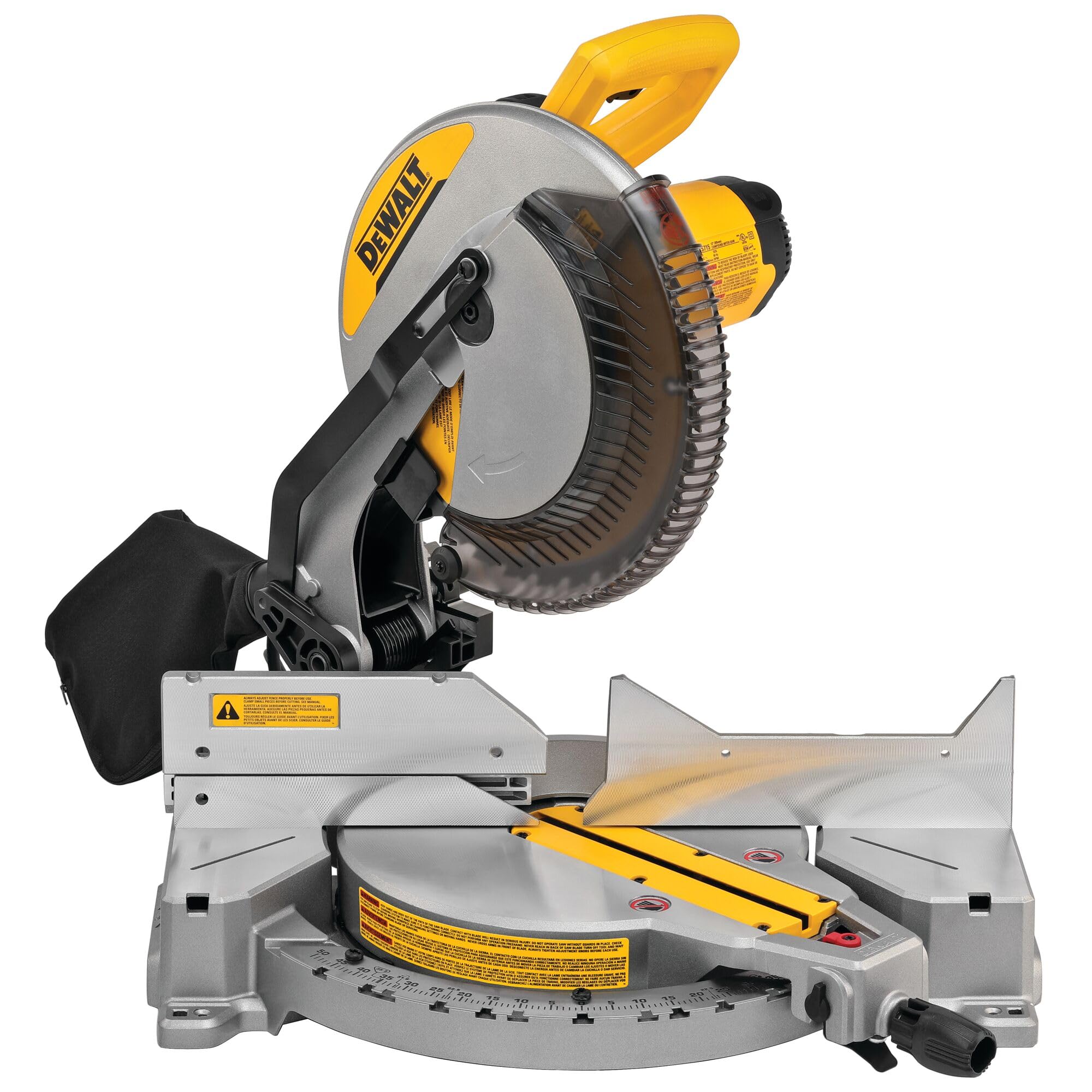
1. DEWALT 12-Inch Miter Saw DWS715
Our pick — 4.5+★ from 6,500+ verified ratings; the strongest balance of quality and price.
The trim saw that hits the same angle twice without you measuring twice
If you cut trim, framing studs, or anything with an angle on the end, this is the machine the rest of the list gets measured against. The 12-inch blade and 15-amp motor cross cut 2-inch by 8-inch dimensional lumber at 90 degrees and 2-inch by 6-inch stock at 45 degrees. That covers the everyday work of a home remodel without you reaching for a second saw.
The part that makes it repeatable is the stainless-steel miter detent plate, which clicks into 14 positive stops so your 45 lands in the same place every single time. The tall sliding fence supports 5-1/2-inch base vertically, which is exactly what you need to stand baseboard up on edge and cope or miter it. Beveling runs 0 to 48 degrees to the left and 0 to 3 degrees to the right. Build quality is what buyers praise most, and the machined base fence support stays put through repeated cuts.
Here is the honest catch: at 42.8 pounds against the DEWALT circular saw’s 8.8 pounds, this is a bench machine, not something you carry up a ladder. It also carves out serious bench space — the footprint runs 26.77 by 21.85 by 18.9 inches, so plan a permanent or semi-permanent home for it. Durability is the one area where feedback splits, so treat the detent plate and fence as precision parts rather than hammering them into alignment.
Where it earns its keep
- 14 positive stops on a stainless-steel detent plate mean repeatable angles without re-checking
- 12-inch blade cross cuts 2×8 at 90 degrees and 2×6 at 45 degrees
- Tall sliding fence holds 5-1/2-inch base vertically for baseboard work
- Single-bevel tilt of 0-48 degrees left covers the angles most trim work needs
What to plan around
- 42.8 pounds keeps it planted on a bench rather than hauled to a job
- 26.77 by 21.85 by 18.9 inches of footprint needs dedicated shop space
- Bevel only reaches 3 degrees to the right, so right-side tilts are limited
Reach for this if: you want one saw that handles trim, framing crosscuts, and angled ends with a fence that holds baseboard upright.
Look elsewhere if: the saw has to travel in a truck bed every day — the circular saw below is the one that goes with you.
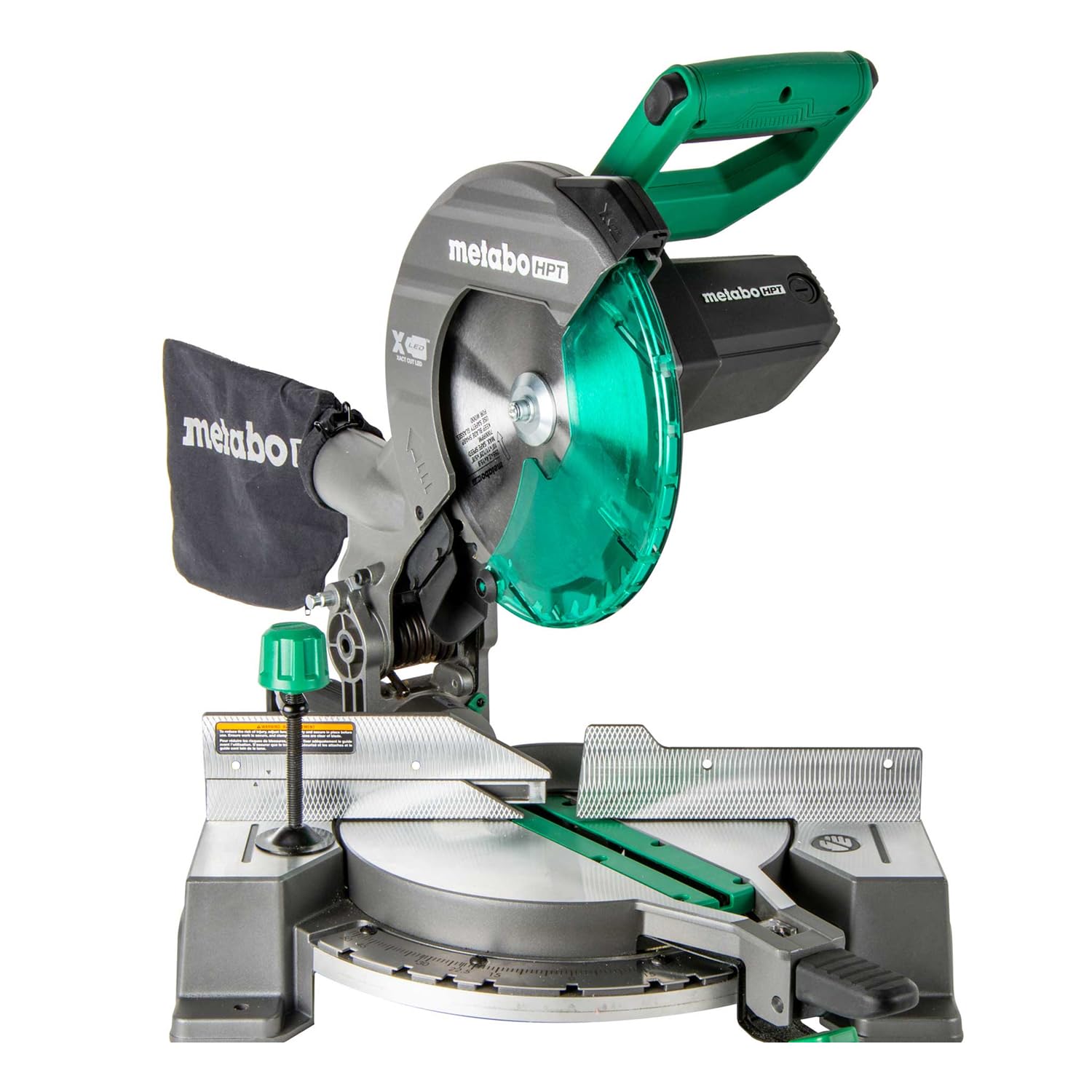
2. Metabo HPT 10-Inch Compound Miter Saw C10FCG2
Twenty-four pounds of saw that a beginner can actually lift onto the bench
For a first compound miter saw, the number that changes your day is 24.2 pounds. That is nearly half the heft of the 12-inch DEWALT above, so one person can pull it out of the garage, set it on a folding table, and put it away again without asking for help. The 10-inch blade is the trade you make for that portability.
The 15-amp motor spins the blade up to 5,000 no-load RPM, which is quick for this blade size. Miter travel runs 0 to 52 degrees left and right, so you get a little more swing than a 45-only saw for wrapping corners. The adjustable bevel goes 0 to 45 degrees left with bevel stops to lock in the common angles, and the large table plus vice clamping system holds the workpiece so your hands stay clear.
Owners praise the overall build quality and the value for the price. It handles 4 by 4s and 2 by 6s without complaint, which is more than most beginners expect from a 10-inch saw. Adjustability draws some mixed feedback, so budget a little time to dial in the bevel stops before you trust them on finish cuts.
The portability payoff: at 24.2 pounds this is a genuine take-it-out, put-it-back machine, and the 0-52 degree miter range plus 0-45 degree bevel covers the angles a home project asks for.
Give the setup a pass: the 10-inch blade is the smaller of the two blade sizes that dominate this list, and the bevel stops need checking before you rely on them for finished work.
Pick this one when: you are setting up a first shop and want a miter saw you can move without a second set of hands, backed by a 5-year warranty.
Think twice if: your work is heavy 2×12 crosscutting — that calls for the 12-inch sliding saw further down.
3. DEWALT Circular Saw DWE575SB
The saw that goes to the lumber instead of the lumber coming to it
At 8.8 pounds this is the lightest cutting tool on the list by a wide margin. Compare that with the 42.8-pound DEWALT miter saw and you see the whole point of a circular saw: you carry it to the sheet of plywood, kneel down, and cut where the material already sits. The 15-amp motor drives a 7-1/4-inch blade through a 2-9/16-inch depth of cut.
The feature that sells this one is the electric brake, which stops the blade once you release the trigger — that is the difference between setting the saw down safely and waiting for it to spin down. Beveling reaches 57 degrees with stops at 45 and 22.5 degrees, so it will handle angle cuts a miter saw cannot reach because the board is too long to bring to a bench. The integrated dust blower clears your line of sight as you cut, and the aluminum base stays flat for accurate tracking.
Owners rate performance highest after build quality, describing a well-balanced saw whose 15-amp motor does not bog down in framing lumber. The ball-bearing lower guard is built for harsh environments, and the Tough cord protection system is designed for durability against pull-out. The honest limit: a 7-1/4-inch blade means thick stock takes two passes, and freehand cuts will never be as clean as a table saw’s fence-guided rip.
Cut anywhere, safely: the electric brake stops the blade on trigger release, the 57-degree bevel with 45 and 22.5 stops covers angle work, and 8.8 pounds means one hand carries it all day.
The fair trade: 2-9/16 inches of depth of cut means thick beams take two passes, and you supply the straightedge yourself for clean rips.
Best fit: anyone who cuts framing lumber, decking, or sheet goods away from a bench and wants the blade to stop the moment they let go.
Not your tool if: you need repeatable, fence-guided rips to a precise width — that is a table saw job.
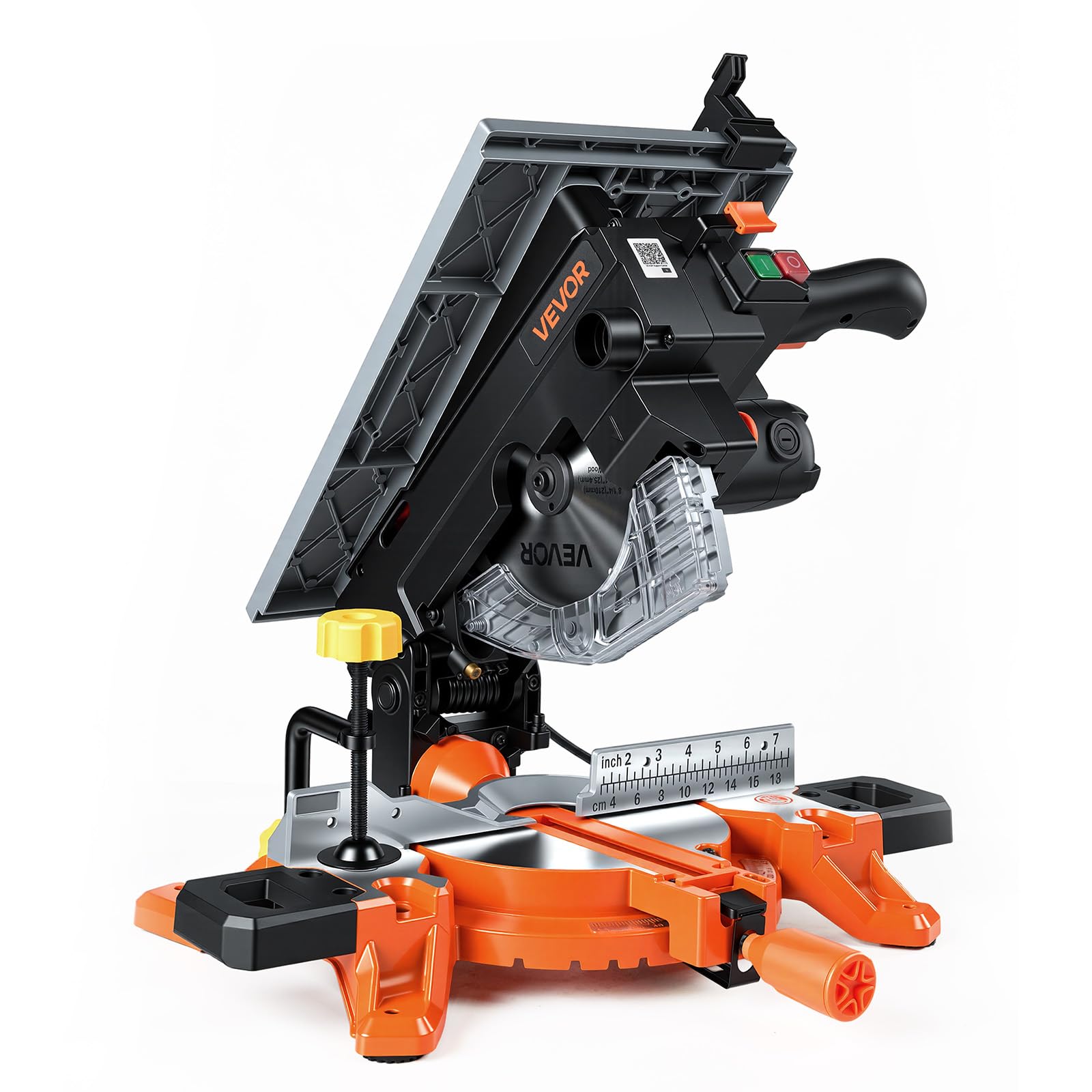
4. VEVOR Compound Miter Saw 8-1/4 inch
One small machine that covers both a rip cut and an angled cut
If shop space is the real constraint, this is the machine designed around that problem. It replaces a table saw and a miter saw in one compact setup, so straight rip cuts and angled cuts both come off the same unit without you buying or storing two machines. The 8-1/4-inch blade is the smallest here outside the circular saw, and the 4,800 RPM spindle keeps cuts moving.
The built-in laser guide marks the cutting path on the workpiece, which takes the guesswork out of aligning a pencil line for detailed trim and framing work. Miter and bevel adjustment runs on a 0.1-degree scale up to plus or minus 45 degrees, which is a fine increment for door frames and skirting boards. The quick-lock miter system lets you swing to an angle and lock it firmly, and the splash guard sits between your hands and the blade.
Buyers praise quality and value, and 90-degree cuts come out accurate with a setup most beginners can follow. The sliding mechanism is where the feedback splits — several buyers describe the slide traveling backward — so try the travel on arrival and adjust before you trust it. Its mobility and the shadow line also draw mixed notes. The 45-degree cutting angle versus the SKIL table saw’s 90-degree setting shows these two machines aim at different cuts, so do not buy this one expecting a true ripping table.
The case for one machine
- Combines rip and angled cutting so you do not buy a second saw
- Laser guide marks the cut path for confident alignment
- 0.1-degree scale up to ±45° suits door frames and trim
- Splash guard and quick-lock miter system suit beginners
Check before you commit
- Slide travel backward is a recurring note — inspect it on arrival
- Shadow line and adjustability get mixed feedback
- The 8-1/4-inch blade limits how thick a board you can take in one pass
The right buyer: a small-shop woodworker who wants rip capacity and angle cuts from a single footprint and does not mind learning a two-in-one machine.
The wrong buyer: anyone who needs dead-simple operation from the start or heavy repeat cutting in thick stock.
5. SKIL 8-1/4-Inch Table Saw TS6308-00

Rip a full sheet of plywood down without dragging out the full-size saw
This is the saw for the person whose projects start with a 4×8 sheet and a pencil line. The 24.5-inch rip capacity to the right of the blade and 12 inches to the left give you the reach to break down sheet goods at home. The 2-1/2-inch maximum depth of cut at 0 degrees lets it slice through up to 3x material in a single pass.
Rack and pinion fence rails keep the fence parallel to the blade as you adjust it, which is the difference between a clean straight rip and a cut that binds halfway through. There is a micro-adjustment for setting blade parallel to the rip fence and miter slot, and a safety switch that shuts the saw down immediately. The 15-amp motor has the power for ripping sheets, cross-cutting 2x4s, and cutting dado joints.
Cutting quality is the star of the feedback: buyers report accurate rips straight off the bench with a fence that tracks true. Value is the second theme — it performs comparably to larger models without the heavier footprint. The 40-pound body still needs a real home in the shop, and durability and adjustability draw some mixed notes, so treat the fence rails kindly and re-check alignment after moving it. One more practical note: the folding stand is sold separately, so budget for a bench or add the stand later.
What it open up: 24.5 inches of right-side rip capacity plus a 2-1/2-inch depth of cut at 0 degrees means full plywood sheets and 3x stock break down on your own bench.
Know before you buy: the SKIL folding stand is a separate purchase, and at 40 pounds this saw wants a permanent spot rather than constant hauling.
Go here if: your work is cabinet parts, shelving, and sheet goods that need a true ripping fence rather than angled ends.
Keep looking if: you mostly cut trim and studs to length — a miter saw does that faster and with less setup.
6. SKIL 10″ Dual Bevel Sliding Compound Miter Saw (MS6305-00)

Slides through a 2×12 and tilts both ways so you stop flipping boards
The sliding rail is the reason to pay attention here. A fixed miter saw is capped by its blade diameter, but this 10-inch sliding head cross cuts lumber up to 2×12 at 90 degrees and 2×8 at 45 degrees. That puts wide stock within reach of a 10-inch blade, which a non-sliding saw simply cannot do.
Dual bevel is the second big advantage. The head tilts to four positive stop positions at 48 and 45 degrees left, 0 degrees, and 45 degrees right, so you can bevel toward either side of the workpiece instead of re-clamping and flipping it. The 15-amp motor delivers 4,800 RPM, and the LED shadow line casts the blade’s own silhouette on the board — the maker describes it as more precise than a laser line. Miter travel reaches 50 degrees left and right with 11 positive stops at the most-used angles.
Buyers talk most about precision and the LED shadow line, and hardwood cuts come out clean with a quick setup. Adjustability is the honest weak spot — the bevel adjustments are convenient but some owners find them tricky to dial in exactly. The 39.4-pound body is light enough to move but heavy enough to stay planted while you feed a long board.
The reason it earns a spot: sliding travel gives 2×12 capacity from a 10-inch blade, and dual bevel with stops at 48°, 45°, 0°, and 45° right means you bevel both directions without flipping stock.
One setup job: the bevel detents need a careful pass before you trust them, and the shadow line is a different aiming method than a laser — give it a cut or two to learn.
The match for you: trim carpenters who cut wide crown and base and need to bevel left and right without re-clamping the board.
Skip the upgrade if: your cuts are all 90-degree crosscuts on narrow stock — a fixed 10-inch saw handles that for less.
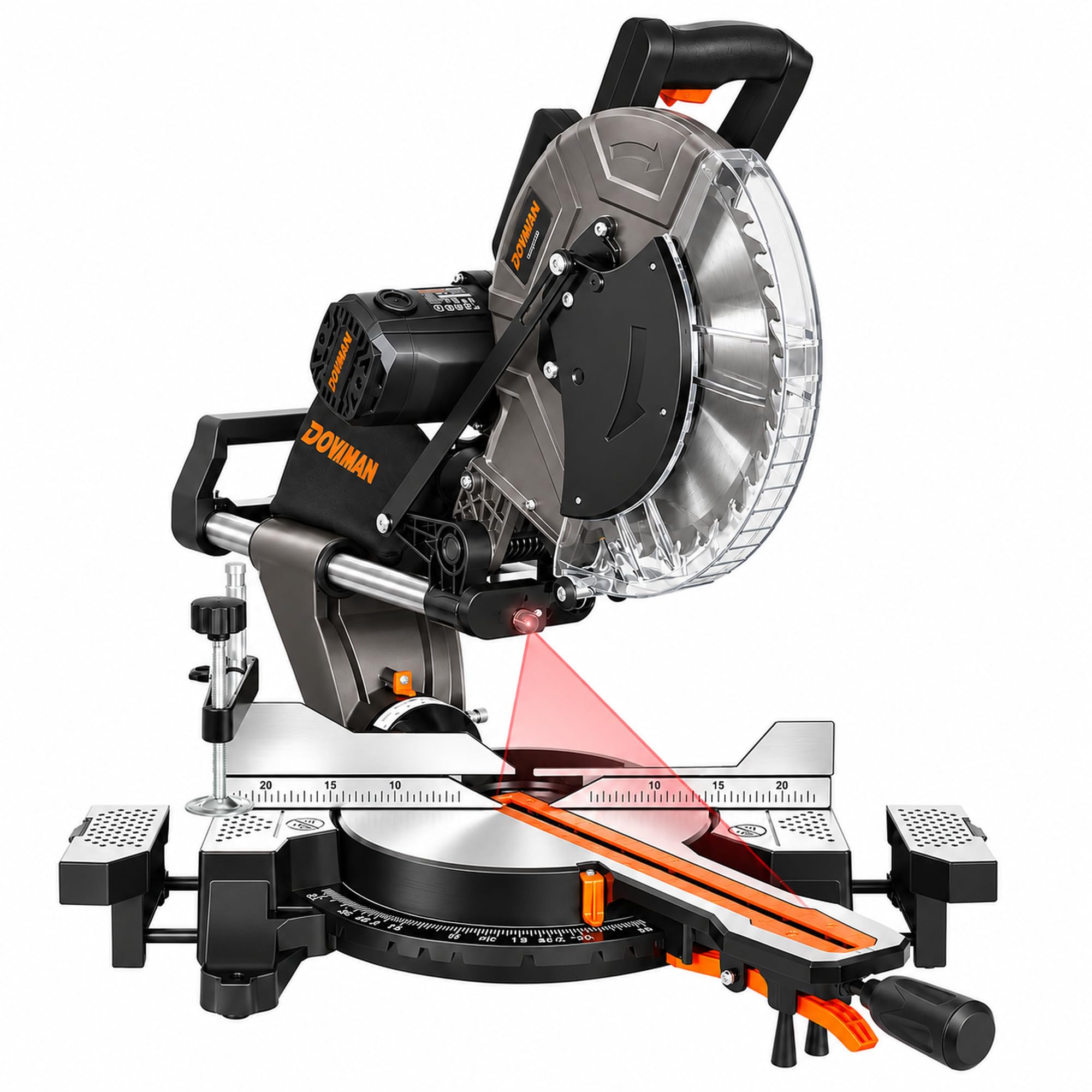
7. DOVAMAN 12-Inch Dual-Bevel Sliding Compound Miter Saw
A 12-inch sliding head with enough reach for stacked 2x material
The headline here is cut capacity. A maximum cut of 4.2 inches by 13 inches means this saw swallows stock that stops a 10-inch fixed saw cold. The 12-inch blade on a sliding rail plus the compound head gives you both horizontal and vertical 45-degree cutting, so thick angled cuts stay on one machine.
Nine common angle presets — 0, 15, 22.5, 30, and 45 degrees on both left and right sides — cover the angles most projects actually use, so you are not hunting a scale for a common corner. The laser guide marks a cut line for consistency across repetitive work. The 15-amp pure copper motor turns up to 3,800 RPM, and the switch design puts the safety lock and integrated switch where either hand can reach them.
With a 53.9-pound body, this is the heaviest bench saw here, and it wants a permanent bench spot. The 24-hour customer support response and the included 40T blade, dust bag, clamp, and spare carbon brushes mean you can start cutting with what ships in the box. Because it is a compound slide, dial in the bevel detents early and check the laser against a test cut before you run a full batch.
Where the size pays off
- 4.2″ x 13″ max cut handles stock smaller saws cannot reach
- Nine presets from 0° to 45° on both sides cover common corners
- Duplicated safety lock and switch work from either hand
- Ships with blade, dust bag, clamp, and spare carbon brushes
The real cost of the capacity
- 53.9 pounds is a fixed bench machine, not a carry-along
- The slide adds moving parts that need checking before a big batch
- No review summary was provided for this model, so rely on the spec sheet and the other picks above for comparison
Reach for this if: your cuts involve thick, wide stock and both-direction bevels, and the saw will live on a bench.
Look elsewhere if: you move between job sites daily — the 24.2-pound Metabo HPT moves a lot easier.
8. LUNYEE 3018 PRO MAX CNC Router Machine, 500W, 3 Axis

A desktop router that cuts shapes a saw blade could never trace
This is a different class of machine from the saws. Instead of pushing wood past a spinning blade, a CNC router — computer numerical control, meaning the tool moves on its own to follow a digital design — carves the shape you drew on a computer. That makes it the pick for sign letters, inlays, and repeatable parts rather than straight cuts.
The work area is 300 x 180 x 80mm, so think small panels and hobby-scale pieces rather than full sheets. The 500W spindle drives the cutter through dense material, the frame is all-metal with reinforced aluminum profiles and no plastic parts except the electrical components, and the 12mm optical axis keeps linear motion true. The Z-axis stroke runs 80mm, and a 0.67 hp rating sits alongside the 500W figure on the spec sheet.
Buyers praise the all-metal build, and beginners rate it a solid first CNC machine with steady, stable operation. The Z-axis travel is an unusual strength for the desktop class. Connectivity and ease of use are the mixed part — some owners get it running smoothly while others hit connection issues and a steep start-up curve. Six limit switches plus an emergency stop button are a real safety plus for a machine that runs on its own, and handwheels on all three axes let you set the origin by hand. Expect to learn the software before you cut anything valuable.
The build is the story: an all-metal frame with reinforced aluminum profiles, a 12mm optical axis, and 500W of spindle power with 0-12000RPM range give this desktop machine real structure.
The learning cost: connection setup and the software side are where new owners struggle, so plan a weekend to get it running before your first paid project.
Made for: hobbyists and small makers who want to carve signs, inlays, and engraved parts from a benchtop footprint.
Not for you if: you need to mill boards to length and width — the saws above do that in a fraction of the time.
9. Evolution R10TBLX 10″ Jobsite Table Saw with Wheeled Stand
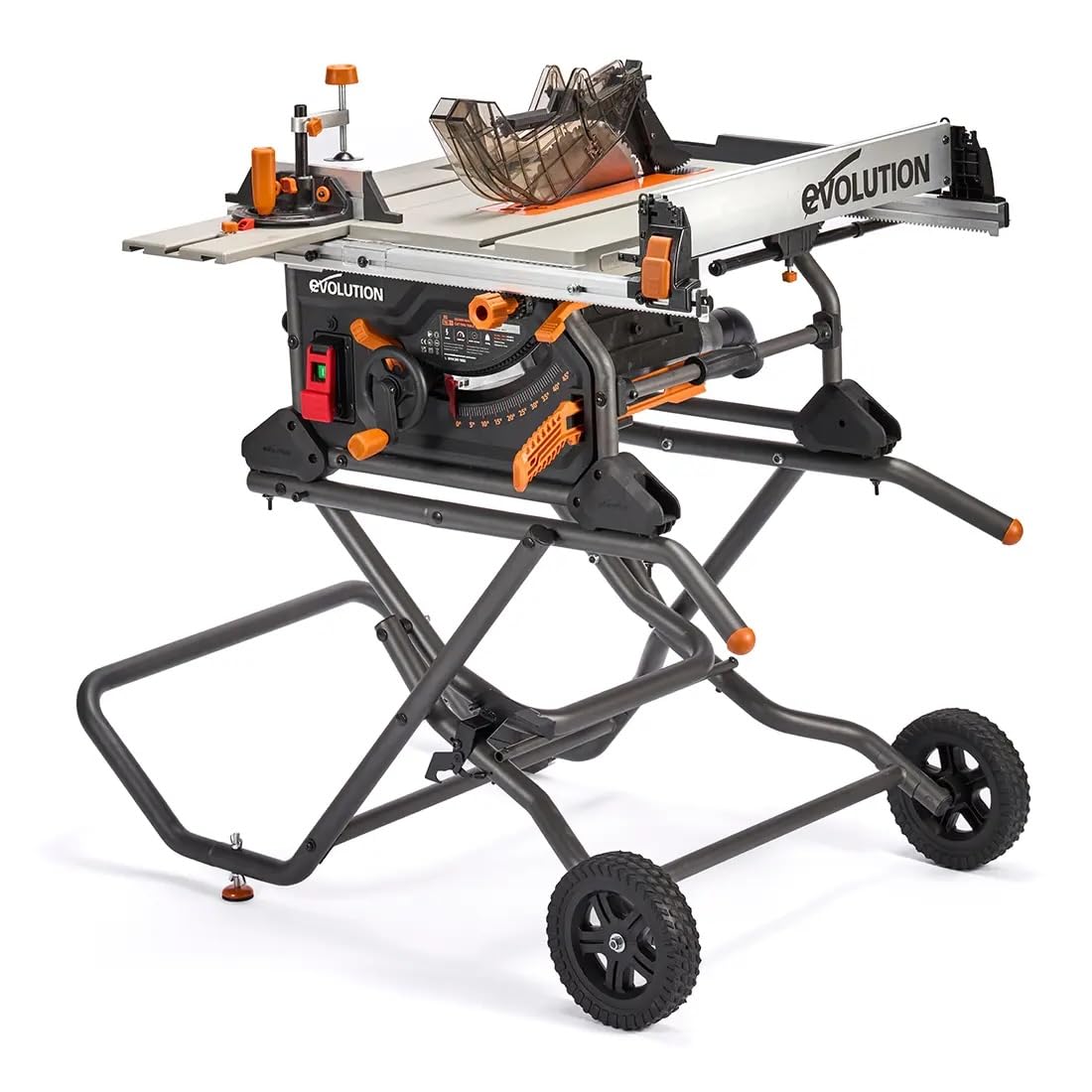
A table saw that leaves the shop and handles wood, steel, and composite
What separates this saw is what it will cut. The 15-amp high-torque motor with soft start is built to cut wood, mild steel, aluminum, and composites — the kind of mixed-material jobsite where a wood-only blade would be the wrong tool. The 10-inch TCT blade that comes with it is fitted for precise, clean cuts on those materials.
The 26-inch rip capacity and 3-3/8-inch maximum cut depth give it genuine table-saw reach for sheet goods and thick stock. A zero-clearance throat plate reduces tear-out, and the dual rack and pinion fence with a cross-cut sled delivers repeatable cuts with a fence that stays parallel. The 0-45 degree bevel has geared adjustment, and the included dado plate lets you cut dados and grooves — an advanced woodworking capability most saws at this size do not ship with.
Owners are clear that the features rock the price point, and the cuts come out precise. The steel frame with carry handles and outfeed support bar makes it a jobsite machine, and the collapsible wheeled stand with all-terrain wheels and a quick-fold system handles transport. The safety package includes an electronic blade brake, anti-kickback pawls, and a riving knife. The caveat that keeps coming up is assembly — the stand instructions are the sticking point — plus a safety guard some call cheaply made. Budget an evening to build it properly. A 3-year warranty backs the machine.
Built to go to work
- 15-amp motor cuts wood, mild steel, aluminum, and composites
- 26″ rip and 3-3/8″ cut depth handle sheet goods and thick stock
- Dado plate included for grooves and dadoes
- Electronic blade brake, anti-kickback pawls, and riving knife
Plan your build time
- Stand assembly instructions are the common frustration
- A safety guard some describe as cheaply made
- The wheeled stand makes it heavy to load without help
The one for: contractors cutting mixed materials on site who want rip capacity, dado capability, and true portability in one machine.
Look past it if: you only ever cut wood on a bench and would rather not assemble a stand.
10. Laser Cutter and Engraver Machine 20W, 300×300mm Work Area

For cutting curves and letters a blade cannot follow, with a sealed work area
This machine cuts and engraves with a laser instead of a blade, which makes it the pick for intricate shapes, logos, and names rather than straight boards. The 20W laser cuts denser materials such as oak and plywood, and it engravings stainless steel and other compatible materials. The 300×300mm work area gives you a fixed bed to lay designs on, and the 0.01mm square focus produces fine detail on artwork and text.
Speed reaches 20,000mm/min, which helps shorten turnaround when you are engraving multiple pieces. The 360-degree fully enclosed cabinet shields users from direct laser exposure while containing fumes, dust, and operating noise. Flame detection, 15-degree tilt protection, automatic shutdown, and an emergency stop are built in for safety. Controls work through LightBurn, LaserGRBL, and CutLabX over Wi-Fi, USB, APP, or TF card, so the design file can come from almost anywhere.
The enclosure is the feature that separates this from an open-frame laser — it makes home-workshop use more practical and keeps the work contained. At 16 pounds it is the lightest powered machine here and easy to move around the bench. The honest trade-off is the learning curve: any laser cutter needs you to dial in power and speed for each material before you get clean results, so start with scrap. The 300×300mm bed is a hard ceiling too — larger designs need to be tiled or split.
Precision where blades fail: the 20W laser with a 0.01mm square focus cuts oak and plywood and engraves fine text, and the 300×300mm bed defines exactly how big a design can go.
Learn on scrap: laser power and speed need tuning per material, and the enclosed cabinet is not a substitute for following the safety setup.
Fits you if: you make signs, ornaments, gifts, and personalized pieces and want engraving detail a blade cannot touch.
Not your machine if: your job is straight cuts and dim
Know the Specs
Blade Size and Depth of Cut
Blade diameter sets the ceiling on how thick a board you can cut in one pass — a 12-inch blade on a miter saw reaches wider and thicker stock than a 10-inch, and an 8-1/4-inch job-site blade trades that reach for a smaller, lighter saw. On a table saw, the number to check instead is depth of cut at 0 degrees. That figure tells you how thick a board clears the blade in a single pass; if it does not, you flip and finish from the other side.
Amperage and RPM
Amperage is how much current the motor pulls, and it is the practical measure of how hard the saw can push through dense stock without bogging. A 15-amp motor appears across most of the saws here because that is the sensible ceiling for a normal household circuit. RPM, meanwhile, is blade speed — higher RPM gives smoother, faster cuts, while a slower motor paired with a bigger blade can still cut thick stock well.
Miter and Bevel Explained
Miter is the saw head swinging left and right to cut an angle across the face of a board — door frames and trim corners depend on it. Bevel is the head tilting sideways to cut an angle through the thickness. A single-bevel saw tilts in one direction only, so you flip the workpiece for the other side; a dual-bevel saw tilts both ways and saves that flip. Look for positive stops, which click and lock the common angles so a 45 repeats.
Rip Capacity and Fence System
Rip capacity is the widest board you can cut down to width with the blade running parallel to a fence — the number that matters when you break down plywood. A rack and pinion fence moves the fence edge in a straight line and keeps it parallel to the blade, which is what keeps a long rip straight instead of wandering. Micro-adjustment lets you fine-tune alignment, and a zero-clearance throat plate reduces tear-out on the cut edge.
Laser and Shadow Line Aiming
A laser guide projects a bright line on the board to show where the blade will travel, which speeds up alignment. A shadow line works differently — a light beside the blade casts the blade’s own shadow onto the wood, so the line you see is the actual blade edge. Both reduce guesswork; which you prefer is a matter of feel rather than a hard spec.
Work Area and Spindle Power for CNC
A CNC router’s work area is the fixed bed the tool can reach — measured in millimeters here — and it is a hard limit on how big a project can be. Spindle power in watts measures how hard the cutter can push through dense material. A 500W spindle with a 12mm guide rail moves the cutter over a programmed path, so it cuts shapes and engraves patterns a table saw or miter saw could never trace.
Common Questions
Should I buy a miter saw or a table saw first?
What is the difference between miter and bevel on a compound saw?
Will a miter saw cut a 2×12 board?
How much depth of cut do I need on a circular saw?
Can a table saw rip a full sheet of plywood?
Is a laser guide more accurate than a shadow line?
Do I need a dual-bevel miter saw for trim work?
What is a dado plate on a table saw for?
Can a CNC router replace a table saw for cutting wood?
How portable is a job-site table saw or miter saw in practice?
The Bottom Line
For most woodworkers, the wood cutting machine winner is the DEWALT DWS715 12-Inch Miter Saw because its stainless-steel detent plate with 14 positive stops makes repeatable angle cuts nearly automatic. If mobility is what you need, the Metabo HPT C10FCG2 gives you a 24.2-pound miter saw that one person can move. And if your work starts with sheet goods, the SKIL TS6308-00 has the rip capacity to break down a full sheet at home. Match the saw to the cut first, and you will not buy twice.
How we choose
We do not accept paid placement. Every pick is matched to a real buyer and a real use-case; we do not hands-on test units.
Sources
Specifications: manufacturer listings and product documentation. Review insights: verified customer reviews, as of November 2026. Pricing: not shown on this page (it changes often); check the current price via the retailer link.
As an Amazon Associate, Tactical Gear Guy earns from qualifying purchases. This does not affect which products we feature.