Specs are compiled from manufacturer listings and verified buyer reviews and can change over time — please confirm the key details on the product page before buying.
Most craft woodwork goes wrong at the same spot: the cut wanders half a millimetre off the line and your miniature chair leg, dollhouse railing or fretwork panel is never quite square. The fix is not more skill — it is matching blade size and table to the stock you actually cut. A full-size circular saw has no business anywhere near balsa, and a dedicated craft saw with a tiny blade and a real fence will turn out clean edges on the first try.
This guide is built by comparing the manufacturers’ published specifications and the patterns across verified customer reviews, so you get each pick’s real strengths and trade-offs instead of marketing spin.
What follows is a shortlist sorted by what each machine is genuinely good at: cutting miniature stock, cutting curves, cutting thick boards, or cutting everything in one afternoon. You will see motor speeds, cutting depths and blade counts spelled out in plain language so you can pick the one that fits your bench — the best wood cutting machine for crafts is simply the one whose blade and table match the work in front of you.
Top Picks


How To Choose The Best Wood Cutting Machine for Crafts
The first decision is not brand or price — it is the shape of your cut. Straight cuts in thin stock want a saw with a fence and a flat table. Curves and interior cutouts want a scroll saw with a throat that lets the workpiece pass through. Thick boards and resawing want a band saw. Buying across that line is the most common mistake, and it is why people end up with a saw that fights their stock.
Match cutting depth to your thickest board
Cutting depth is the maximum thickness of material the blade can pass through in one go. A machine that lists a large depth at a right angle usually lists a smaller one once the blade is tilted. If your project mixes right-angle cuts with bevels, read the tilted figure, not the straight one. Anything you cannot fit through the blade in one pass has to be flipped and re-cut, which is where accuracy dies.
Decide between a table, a throat and a curve
A scroll saw holds a thin blade between two arms and cuts decorative curves, lettering and inside cutouts, with a throat depth telling you how far from the blade edge a workpiece can reach. A table-style saw spins a round blade through a slot and cuts straight lines and chamfers. A band saw runs a continuous loop blade for curves plus thicker stock. Most craft failures come from asking a table saw to cut fretwork or a scroll saw to rip a thick plank.
Read the speed control before the motor size
Variable speed matters more than raw amps when you cut balsa, plastic or acrylic, because a fast blade melts or splinters soft stock. Look for a machine that lets you dial down, whether that is a variable-speed dial or a multi-voltage power supply. Amp ratings and blade speed figures are worth comparing only between machines of the same type, since a scroll saw and a circular saw use those numbers differently.
Side-by-Side Comparison
| Model | Best For | Machine Type | Max Cutting Depth | Weight | Amazon |
|---|---|---|---|---|---|
| WORKPRO 20V 4-1/2″ Cordless Mini Circular Saw★ Best Overall | Cordless straight cuts anywhere | Cordless mini circular saw | 1-11/16″ at 90°, 1-1/8″ at 45° | 4.36 lbs | Amazon |
| MXBAOHENG Mini Table Saw S3Best for Miniatures | Miniature and model woodwork | Mini bench table saw | 0 to 0.59 inches (15mm) | 4.2 pounds | Amazon |
| PROXXON Bench Circular Saw KS 115Quietest Precision | Tiny precision pieces | Bench circular saw | — | 5.2 pounds | Amazon |
| WEN 3923 16-Inch Variable Speed Scroll Saw | First scroll saw, decorative curves | Scroll saw | 2 inches thick | 11.5 kg | Amazon |
| RYOBI 1.2 AMP Corded 16 in. Scroll Saw SC165VS | Simple, low-maintenance scroll work | Scroll saw | — | 27 pounds | Amazon |
| SKIL SS9503-00 16 in. Variable Speed Scroll Saw | Visibility and clean cut lines | Scroll saw | — | 24.7 pounds | Amazon |
| Shop Fox W1872 16″ VS Scroll Saw | Foot-switch control and hardwoods | Scroll saw | 2-1/4″ | 26 pounds | Amazon |
| Woodskil 9-Inch Benchtop Band Saw | Curves plus thicker stock | Benchtop band saw | 3-1/2 inches | 40 pounds | Amazon |
| BUCKTOOL 16-Inch Scroll Saw | Fretwork with angled cuts | Scroll saw | — | — | Amazon |
Detailed Reviews
1. WORKPRO 20V Cordless Mini Circular Saw
Our pick — 4.5+★ from 650+ verified ratings; the strongest balance of quality and price.
One-handed straight cutting with no cord dragging across your workbench.
The reason this one sits at the top is freedom of position. At 4.36 lbs it is light enough to hold steady with one hand and carry out to a deck, a shed or a garage floor, and the 20V battery means there is no cable to snag on the stock as you push through. The motor spins at 4,500 RPM (revolutions per minute — how fast the toothed blade turns), which keeps the teeth biting rather than skidding.
Depth control is where it earns its place in a craft shop. It cuts up to 1-11/16″ deep at a square 90° and 1-1/8″ once you tilt the base to 45° (a bevel, where the blade leans over to slice at an angle). A laser line and a parallel guide (a straight edge that rides the side of your board) let you follow a pencil mark instead of guessing. Three blades come in the bag: a 24T alloy for wood, a 60T for wood and plastic, and a diamond blade for tile.
The honest limit is the 1-11/16″ depth cap. Once a board passes that 1-11/16″ figure you are flipping and re-cutting, and a scroll saw is the better tool for curves since this machine only cuts straight lines and bevels. Buyers report it takes 2″ boards in stride and handles decking material without complaint, and the rubberized handle keeps fatigue down on longer runs. The 4.0Ah battery refills in about 2 hours on the 2.4A charger.
What makes it the headline pick
- Runs on a 20V 4.0Ah Li-ion battery, so no outlet is needed mid-project
- Laser guide plus parallel guide for following a marked line
- Three blades in the kit cover wood, plastic and tile
- Dust hose links to a vacuum adapter to keep the bench clear
Where it stops short
- Straight and bevel cuts only — no curves or interior cutouts
- Depth caps out at 1-11/16″, so thick stock needs two passes
Reach for this if: you want one cordless machine that trims shelving, decking, plastic sheet and tile without hunting for an outlet.
Look elsewhere if: your projects are scribbled curves and lettering — you need a scroll saw’s throat, not a round blade.
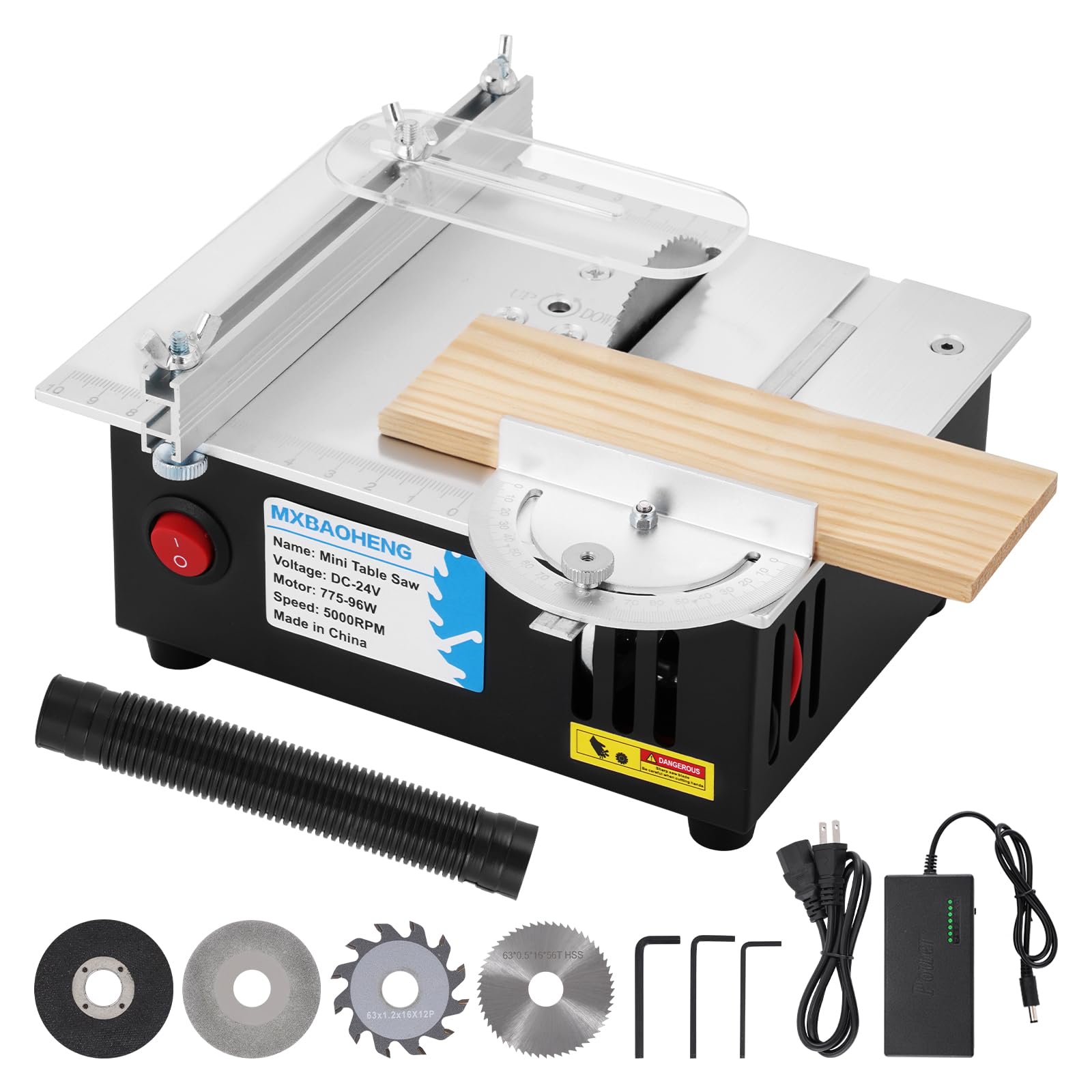
2. MXBAOHENG Mini Table Saw S3
A bench-top saw small enough to sit beside a dollhouse and not swallow it.
This is the pick for anyone whose raw material arrives in a bag of ice cream sticks. The blade height dials from 0 to 0.59 inches (15mm), so you can set a shallow pass through a basswood craft board or a slice through acrylic without the blade chattering. Chopsticks, balsa, thin wood, PCB and plastic all fall inside its job description.
The 7-speed power adapter is the clever part. It offers 12V, 15V, 16V, 18V, 19V, 20V and 24V settings, and dropping the voltage is how you keep fragile stock from splintering. Push it to 24V when you want the most cutting force. At 4.2 pounds and 7″ long, it tucks onto a shelf when the project is done. That tiny footprint is also the constraint: against the RYOBI scroll saw’s 26.57″ length and 27 pounds, this is a different class of machine built for a different scale of work.
Cutting quality splits opinion. Some owners get beautiful, clean slices; others find their results drift off line, which usually points to blade setup and feed speed rather than the machine itself. Crafters who treat it as a precision instrument and take light passes tend to be the happy ones. It ships with an HSS blade, an alloy blade, a PCB blade, a resin grinding wheel cutting disc, a miter gauge and a dust absorption tube.
The miniature advantage: a 2.48-inch round blade and a 15mm maximum depth are exactly what thin craft stock wants — nothing here is oversized for the material.
Set it up carefully: the mixed reports on cut accuracy trace back to alignment and feed rate, so budget ten minutes to square the blade and fence before your first cut.
Fits best: model makers, miniature builders and anyone cutting sticks, thin board or acrylic to length.
Not the tool for: anything thicker than 0.59 inches, or a board long enough to need real infeed support.
3. PROXXON Bench Circular Saw KS 115, 37006, Green
Built for the slivers a full-size saw would fling across the room.
Proxxon designed this for one situation: cutting the smallest pieces when a regular circular saw is impossible or plainly unsafe. The worktable is machined aluminum in a 6 1/4″ x 6 1/4″ size, and it is flat enough that a thin strip sits still while the blade comes down. That fixed 90-degree blade angle keeps the cut square every time without a tilt adjustment to drift out of true.
What wins people over is the size — owners talk about the bench footprint before anything else, and a 5.2-pound machine that leaves the rest of your worktop free is exactly that appeal. The 110–120V motor runs very quietly, which matters if your craft bench shares a room with the rest of the house. It handles wood, non-ferrous metal, plastic and fiberglass-reinforced plastic, and it ships with one Super Cut saw blade.
The catch is scale in the other direction. Tilt cuts are off the table because the blade is fixed at 90 degrees, and build quality draws a mixed reaction — a few owners find it less substantial than the price suggests. Treat it as a bench instrument for tiny stock rather than a site saw and it cuts square without fuss.
Where it shines: small craft and model work, including balsa and FR4 board, with the kind of accuracy that comes from a machined aluminum table.
One angle only: the 90-degree fixed blade rules out bevels, so if your project needs 45-degree edges this is the wrong bench.
Suits: the craftsperson cutting tiny, thin material who wants minimal noise and a table that stays flat.
Pass if: you need tilted cuts or you want a substantial, heavy-duty feel from the frame.
4. WEN 3923 16-Inch Scroll Saw

Opens up for blade swaps and cuts two-inch stock through a sixteen-inch throat.
Scroll saw blades break, and changing them is where beginners lose an evening. WEN solved that with a side panel that flips open for easy access, plus a thumb screw blade adapter that needs no tools. The result is a saw you can re-blade in the middle of a project instead of putting it off until tomorrow.
The numbers that matter here are the 16-inch throat depth (how far in from the edge you can cut) and the 2-inch maximum wood thickness. Speed runs from 550 to 1600 strokes per minute, so you can slow the blade for tight curves and speed it up on long straight runs. A 16-by-10-inch table bevels up to 45 degrees for angled cuts. It ships with a cast iron base, an air pump, a dust port, a foot lock clamp and three 5-inch blades.
Owners describe it as a great first machine that works fantastically, and the value is clearly the draw. The trade-off is that cutting performance and vibration split opinion — a fast-cutting saw on thin stock will buzz, and bolting it to a solid bench tames most of that. A work light rounds out the package for late-evening sessions.
Reasons this earns its spot
- Tool-free blade changes through a flip-open side panel
- Variable speed from 550 to 1600 strokes per minute
- 16-inch throat and 2-inch cut capacity cover most craft stock
The things to plan around
- Vibration on fast settings, so mount it to a solid bench
- Cutting smoothness draws a mixed reaction, so slow down on curves
The right call for: a beginner who wants to learn fretwork and cut curves without fighting the blade clamp.
Think twice if: you need production-grade smoothness at high speed or cuts deeper than 2 inches.
5. RYOBI 1.2 AMP Corded 16 in. Scroll Saw SC165VS

A corded workhorse that swaps blades in seconds and never asks for a battery.
Where the WEN above is all about variable speed, this Ryobi leans on simplicity: a 1.2 amp corded motor, a 16-inch frame and a carbon steel blade setup that owners find genuinely easy to replace. Plug it in and it runs all afternoon without a charger in sight. A hex wrench and a switch key come in the box, so you can remove the blade and lock the machine out safely.
The physical reality of a corded saw is weight, and this one is honest about it. At 27 pounds versus the MXBAOHENG mini table saw’s 4.2 pounds, it stays put on the bench instead of being carried around. That mass is also why the saw feels stable during a long cut — it is not going to walk across the table under its own vibration.
What buyers consistently value here is that it does the job without fuss and the blades come out easily. It is not a machine for bevels beyond the 45-degree table tilt or for anything thicker than a scroll saw handles. If you want a corded scroll saw that starts every time and re-blades in seconds, this is the low-maintenance route.
Reliability over features: performance and functionality are what buyers lead with, and the simple blade replacement keeps the saw in use rather than on a shelf.
The heft is the deal: 27 pounds means this is a permanent bench fixture, not something you pack for a class or a craft fair.
Pick this for: a stationary shop saw you can leave plugged in and re-blade without reaching for a manual.
Weigh the trade-off: corded power ties you to an outlet, and the 27-pound body does not travel.
6. SKIL SS9503-00 16 in. Scroll Saw
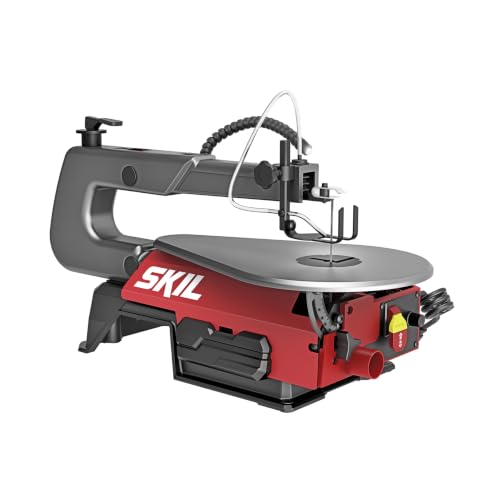
An LED aimed right at the cut line, so you follow the pencil mark not the shadow.
Fretwork lives or dies on whether you can see your line. Skil built the answer in: an integrated LED work light that throws light at a range of angles, plus an integrated dust removal system that keeps the cut line free of debris. Together they mean the blade, the line and your eye stay in the same place.
The rest of the machine is set up for material variety. Electronic variable speed control lets you slow down for thin plastic or speed up on hardwood, and the 16 in. x 10 in. work table tilts from 0 to 45 degrees for angled cuts. Blades swap keylessly without tools, and there is on-tool blade storage so spares are always within reach. It runs on a 1.2 amp corded motor and weighs 24.7 pounds.
Performance is the strongest theme in what owners mention — this one is reported to hold its own against models that cost considerably more. Build quality and blade adjustment draw a more mixed reaction, so set aside time to square the blade before a precision project. At 24.7 pounds it is a bench fixture rather than a portable tool, which is worth knowing if you work in more than one room.
The useful edge: that LED plus the dust system is a genuine advantage over saws with neither, and it shows up in cleaner, more confident cuts.
Check the blade first: mixed notes on the adjustment mechanism mean a few minutes of setup before delicate work saves re-cuts later.
Best matched to: crafters cutting fine detail who need to see the line and keep the kerf clear.
Consider skipping if: you want a saw you can carry between rooms — the corded body wants a permanent spot.
7. Shop Fox W1872 16″ Scroll Saw

Two hands on the work, one foot on the switch — the way scroll work should be.
The foot switch is the feature that changes how you work. Instead of reaching for a power button with a workpiece balanced on the table, you tap your foot and the blade starts. That single detail makes intricate curves far easier to control, and it is the reason this one suits longer sessions on harder material.
Thickness capacity is a slight step up on the scroll saws above: a maximum cutting thickness of 2-1/4″ through a 16-inch cutting width. The motor is rated 1/6 HP at 120V and 0.6A, running blade speeds of 550 to 1600 strokes per minute with a 9/16″ blade stroke. The cast-aluminum table tilts from -5 to 45 degrees, which gives you a bevel range on both sides of flat. A 1-1/4″ dust port and a pin-less blade adapter round out the spec sheet.
Owners cutting hard woods report it handles that material well and see solid value in the package. Quality gets a mixed reaction, with most very satisfied and a few finding it less refined than hoped. The miter gauge, LED light and rotary shaft extras mean fewer aftermarket purchases.
Standout details
- Foot switch keeps both hands on the workpiece
- Table tilts from -5 to 45 degrees in both directions
- 2-1/4″ thickness beats most scroll saws for hardwood
- Pin-less blade adapter broadens blade choice
Worth knowing
- Quality draws mixed reactions, so inspect on arrival
- 0.6 amp motor is modest, so let the blade do the work
Made for: the crafter who wants foot control and a wider bevel range on hardwood.
Look elsewhere if: you need heavy feed rates — the modest motor rewards patience over speed.
8. 9-Inch Benchtop Band Saw
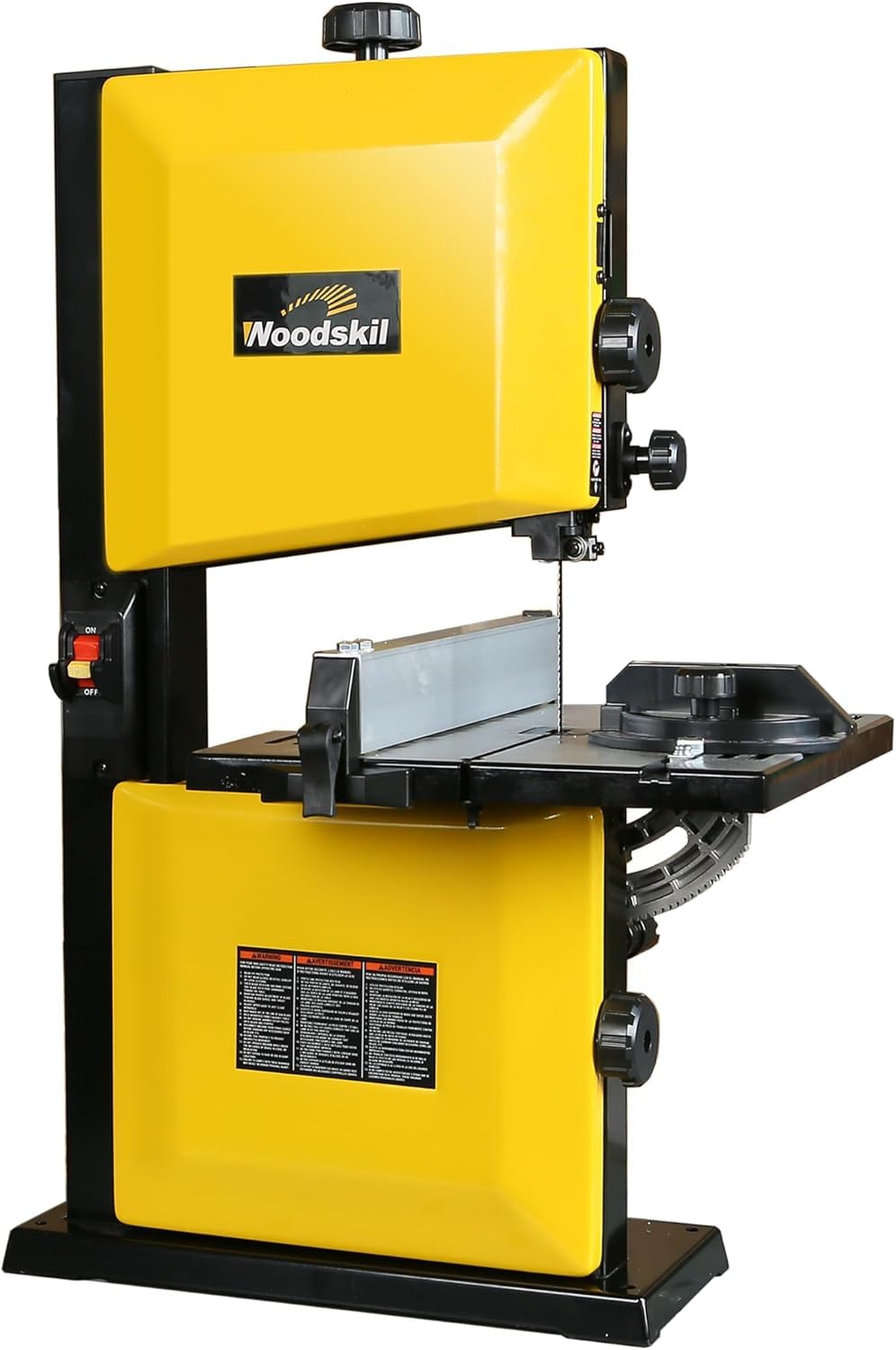
Curves and resawing in one pass, with 3-1/2 inches of blade clearance.
Everything above cuts thin craft stock. This one cuts the blank that everything else is made from. A maximum cutting depth of 3-1/2 inches and a 9-inch cutting width mean a chunk of hardwood goes through in a single pass, and the continuous loop blade cuts curves as happily as straight lines. Blade speed runs at 2500 FPM (feet per minute) off a 1/2HP motor turning at 1720 RPM.
Angles are covered by a cast aluminum table tilting from 0° to 45°, paired with a 120° miter gauge and a rip fence for straight, repeatable cuts. A removable key lets you lock the machine out between sessions. The sturdy steel base is there to hold vibration down, and a 2-1/2″ dust exhaust port plus a dust brush on the saw wheel keep the work area cleaner than most benchtop saws manage.
Quality and value are what buyers praise most, and people cutting 3/4 inch stock find it slips through easily. The one repeated caution is blade durability, so factor in a spare blade and treat this as a machine that rewards correct tension. Adjustability of the table splits opinion; setup matters here.
Capacity you cannot get elsewhere on this list: 3-1/2 inches of depth makes this the only pick that handles a thick block rather than a thin sheet.
The blade is the wear item: durability complaints center on the supplied blade, so plan for a replacement and set tension properly from day one.
The machine for you if you resaw thick blanks: you resaw, cut curves through real lumber, or prep blanks for finer work later.
Not your answer if: everything you cut is thinner than a pencil — a scroll saw will do that with more finesse.
9. BUCKTOOL 16-Inch Scroll Saw
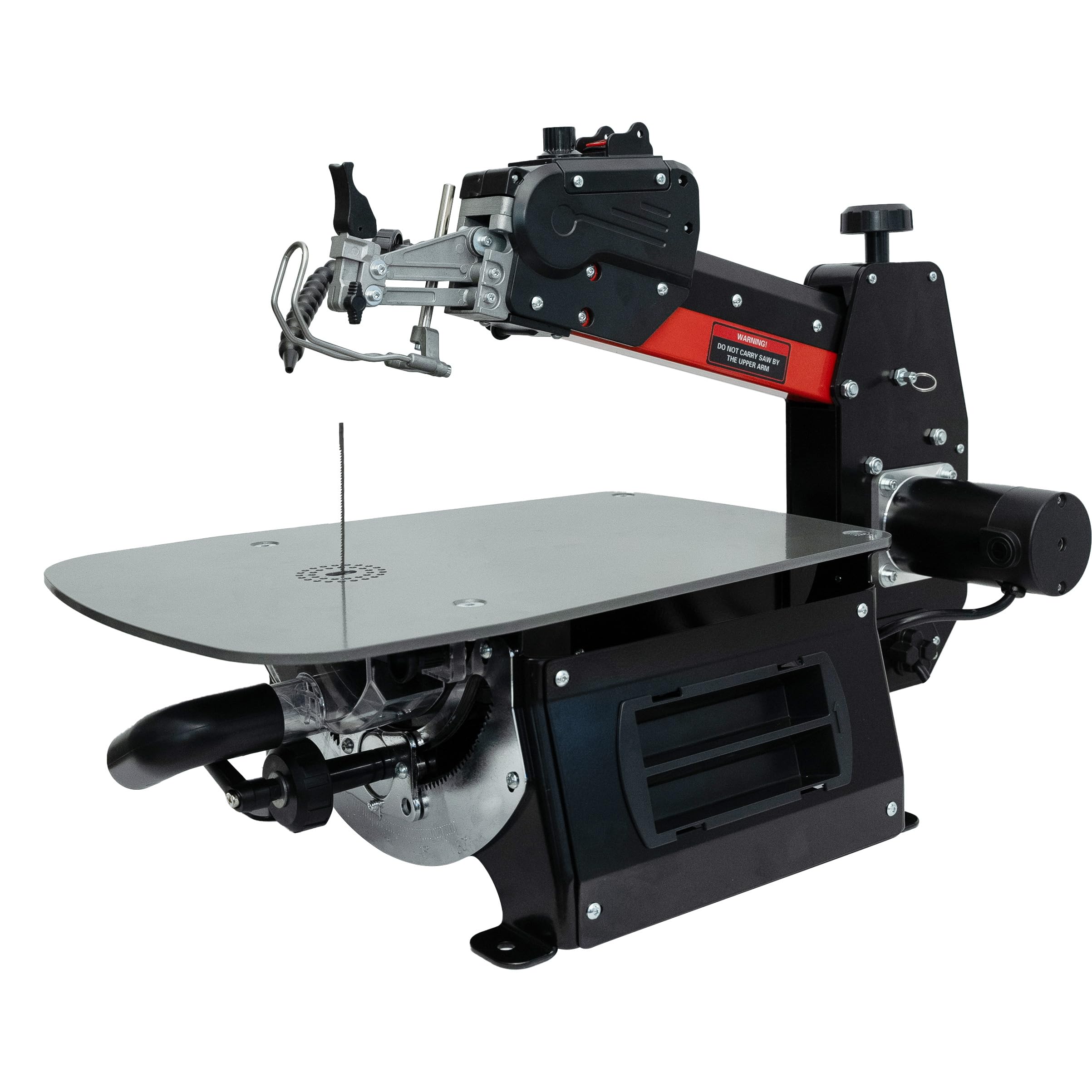
The arm pivots, not the table — so angled cuts stay aligned project after project.
Most scroll saws create an angle by tilting the worktable, and the workpiece shifts while you set it up. Bucktool takes the other route: a rotating saw arm that pivots 30° left and 45° right so you execute precise angled cuts and complex bevels without moving your piece at all. That is a real workflow difference on a multi-piece project where every repeat has to match.
Underneath the arm sits a 1.3 amp motor paired with a double parallel-link drive system, which the maker says keeps torque consistent and vibration low. Variable speed runs from 360 to 1550 RPM. Blade changes are sorted by an upper arm that lifts for top-down insertion, tool-less clamps and a rapid-tension lever, and the box includes one 18 TPI and one 15 TPI pinless blade (teeth per inch — a higher number means a finer cut).
The worktable measures 19-11/16″ x 13-3/8″, which is generous for a 16-inch saw, and the magnetic dust hood plus adjustable sawdust blower keep your line clear. An integrated side toolbox holds the accessories you keep reaching for. Quality, build and sturdiness are the qualities buyers single out, and it carries a 2-year manufacturer warranty. Downsides are few and mostly about scope: this is fretwork and craft territory, not a saw for thick boards.
Why it wins on angles: a pivoting arm that keeps the workpiece still beats a tilting table when you are cutting the same bevel twenty times.
Check your blade supply: the pinless blades included are a starting point — stock a range of TPI counts so the saw can do fine detail and heavier fretwork.
Ideal for: fretwork and decorative projects where repeated angled cuts have to line up exactly.
Skip if: you need to saw thick lumber — the band saw above is the machine for that.
Know the Specs
Cutting Depth at 90° and at 45°
Cutting depth is the thickest board a blade can pass through in a single pass. A saw usually lists two numbers because tilting the blade eats into the available depth: the WORKPRO, for instance, cuts 1-11/16″ at a square 90° but only 1-1/8″ once it is beveled to 45°. Plan your thickest cut against the lower number whenever your project includes an angle, or you will be flipping stock and re-cutting.
SPM, RPM and FPM
Three different ways of describing blade motion. Strokes per minute (SPM) applies to scroll saws, whose blade moves up and down — the WEN runs 550 to 1600 SPM. Revolutions per minute (RPM) applies to spinning blades and motors, like the WORKPRO’s 4,500 RPM. Feet per minute (FPM) applies to band saw blades, with the Woodskil running at 2500 FPM. Higher numbers mean faster cutting, not smoother cutting, so a speed dial matters more than the top figure.
Throat Depth and Table Size
On a scroll saw, throat depth is the distance from the blade to the rear arm — it caps how large a workpiece you can turn as you cut. A 16-inch throat, as on the WEN, RYOBI, SKIL, Shop Fox and Bucktool, suits most craft panels. Table size and wear resistance matter just as much: the PROXXON’s machined aluminum 6 1/4″ x 6 1/4″ worktable is small on purpose, while the Bucktool’s 19-11/16″ x 13-3/8″ table gives large pieces room to sit flat.
Blade Type and Tooth Count
High speed steel handles wood and soft materials well. Alloy blades take a keener edge for cleaner slices, and a diamond blade cuts tile rather than timber. Tooth count controls cut finish: the WORKPRO’s 24T alloy blade removes material quickly for rough dims, while its 60T blade leaves a smoother edge in wood and plastic. On a scroll saw, blades are sold by TPI — the Bucktool includes one 18 TPI and one 15 TPI pinless blade — so keep a range on hand for fine versus fast cutting.
Common Questions
Can a mini circular saw cut curves like a scroll saw?
How thick a board can a scroll saw cut?
Do I need a variable speed saw for cutting plastic or acrylic?
Is a pinless blade better than a pinned blade for fretwork?
Can I cut metal or tile on a craft wood saw?
How do I stop my saw from vibrating across the bench?
What is the difference between a tilting table and a tilting saw arm?
How often should I change a band saw or scroll saw blade?
Which saw should I buy first if I am starting craft woodwork?
Can I hook these saws up to a shop vacuum?
The Bottom Line
For most craft benches, the wood cutting machine for crafts that earns the spot is the WORKPRO 20V Mini Circular Saw, because it cuts straight and bevelled lines in wood, plastic and tile without needing an outlet. If your work is decorative curves and fretwork, pick the WEN 3923 scroll saw for its tool-free blade changes and 2-inch capacity. And if you want to prep your own thicker blanks before any of that detail work, the Woodskil band saw cuts 3-1/2 inches deep in a single pass.
How we choose
We do not accept paid placement. Every pick is matched to a real buyer and a real use-case; we do not hands-on test units.
Sources
Specifications: manufacturer listings and product documentation. Review insights: verified customer reviews, as of November 2026. Pricing: not shown on this page (it changes often); check the current price via the retailer link.
As an Amazon Associate, Tactical Gear Guy earns from qualifying purchases. This does not affect which products we feature.