Specs are compiled from manufacturer listings and verified buyer reviews and can change over time — please confirm the key details on the product page before buying.
If you want the most dependable wood CNC machine for the money, the Twotrees TTC450 Pro is the one to start with — it pairs a genuinely large cutting area with a 3.5-inch touchscreen, a proper metal frame, and room to add a laser or a rotary axis later. The rest of the shortlist splits into two camps: beginner-friendly desktop routers that assemble in under half an hour, and heavier machines built around ball screws and linear rails for people cutting aluminum and hardwood daily.
This guide is built by comparing the manufacturers’ published specifications and the patterns across verified customer reviews, so you get each pick’s real strengths and trade-offs instead of marketing spin.
A clean cut versus chatter depends on how rigidly the gantry rides, so every pick below is judged first on its frame, motion system, and spindle, not its software extras. Here is the honest rundown of the best wood CNC machine, ranked by what actually holds accuracy under load.
Top Picks
How To Choose The Best Wood CNC Machine
Most first-time buyers fixate on cutting area — the footprint in millimeters a job can occupy — and then get surprised when a big-bed machine still leaves fuzzy edges on oak. The real question is how little the gantry deflects while the bit is buried in the wood. A frame that flexes under load chatters, and chatter means an hour of sanding to hide it.
Frame rigidity and the motion system come first
An all-metal frame made from aluminum alloy or steel tubing holds its shape under load; a stamped or lightly braced bed will sag in the middle. Look at what drives each axis. Lead screws and ball screws convert motor rotation into linear travel, and ball screws cost more but reduce backlash — the tiny sloppy gap that shows up as fuzzy corners. Linear rails guide the carriage along hardened track, which stays straighter than wheels rolling on extrusion. If you plan to cut hardwood or aluminum, prioritize ball screws and rails over a larger bed.
Spindle wattage, RPM range, and collet size
The spindle is the spinning motor that holds your bit. Wattage tells you how much material it can hog out before it bogs down, and RPM range (often listed in the thousands) tells you how fast the bit turns. A trim router with an adjustable range handles both slow, deep passes in hardwood and fast, light passes in softwood. The collet is the clamping collar — an ER11 typically grips bit shanks in the 1/8-inch to 1/4-inch class, so match your bit collection before you buy.
Control, software, and the upgrade path
Almost every machine here runs GRBL — an open-source firmware that lets you send G-code (the coordinate instructions that drive the tool) from software like Fusion 360, Easel, or UGS. That means you are not locked into one app. The upgrade ports are the quiet value story: a 4th-axis rotation port lets you carve cylindrical pieces, a laser module port adds engraving, and swappable spindle clamps let you fit a bigger router later. Buying a machine with those ports already fitted costs far less than replacing it later.
Side-by-Side Comparison
| Model | Best For | Working Area | Spindle Power | Motion System | Amazon |
|---|---|---|---|---|---|
| Twotrees TTC450 Pro★ Best Overall | Big-bed value | 460 × 460 × 80 mm | 80 W (775 motor) | Lead screw + dual limit switches | Amazon |
| SainSmart Genmitsu 4040-PRO4th-Axis Ready | 4th-axis upgrades | 4040 series | — | Lead screw + dual Y rails | Amazon |
| FoxAlien Masuter ProFastest Build | Fastest assembly | 400 × 400 × 60 mm | 60 W | Linear rail Z-axis | Amazon |
| Genmitsu 4040-PRO Metal | Mixed materials | 435 × 400 × 80 mm | — | Dual 16mm HSS + lead screw | Amazon |
| LUNYEE 3020 Nova | High-speed spindle | 3020 series | 800 W | 1204 ball screws + HG-15 rails | Amazon |
| Genmitsu 4040-PRO MAX | Tall workpiece clearance | 410 × 405 × 77 mm | 710 W | Linear guideways + GRBL | Amazon |
| AnoleX 4030-Evo Ultra 2 | Wireless control | 4030 series | 800 W | HGH-15 dual rails + 1204 ball screws | Amazon |
| Genmitsu PROVerXL 4030 V2 | Closed-loop motors | 400 × 300 × 110 mm | 400 W | 1204 ball screws | Amazon |
| FoxAlien XE-PRO | Spindle flexibility | XE-PRO series | 400 W | 1204 ball screws + Z-axis dual rails | Amazon |
| Twotrees TTC6050 | Large production bed | 600 × 500 × 100 mm | 500 W spindle listed | C7 ball screws + linear rails | Amazon |
| NymoLabs NBS-6040 | Premium all-axis rails | 610 × 410 × 120 mm | 710 W | Linear rails + ball screws on every axis | Amazon |
Detailed Reviews
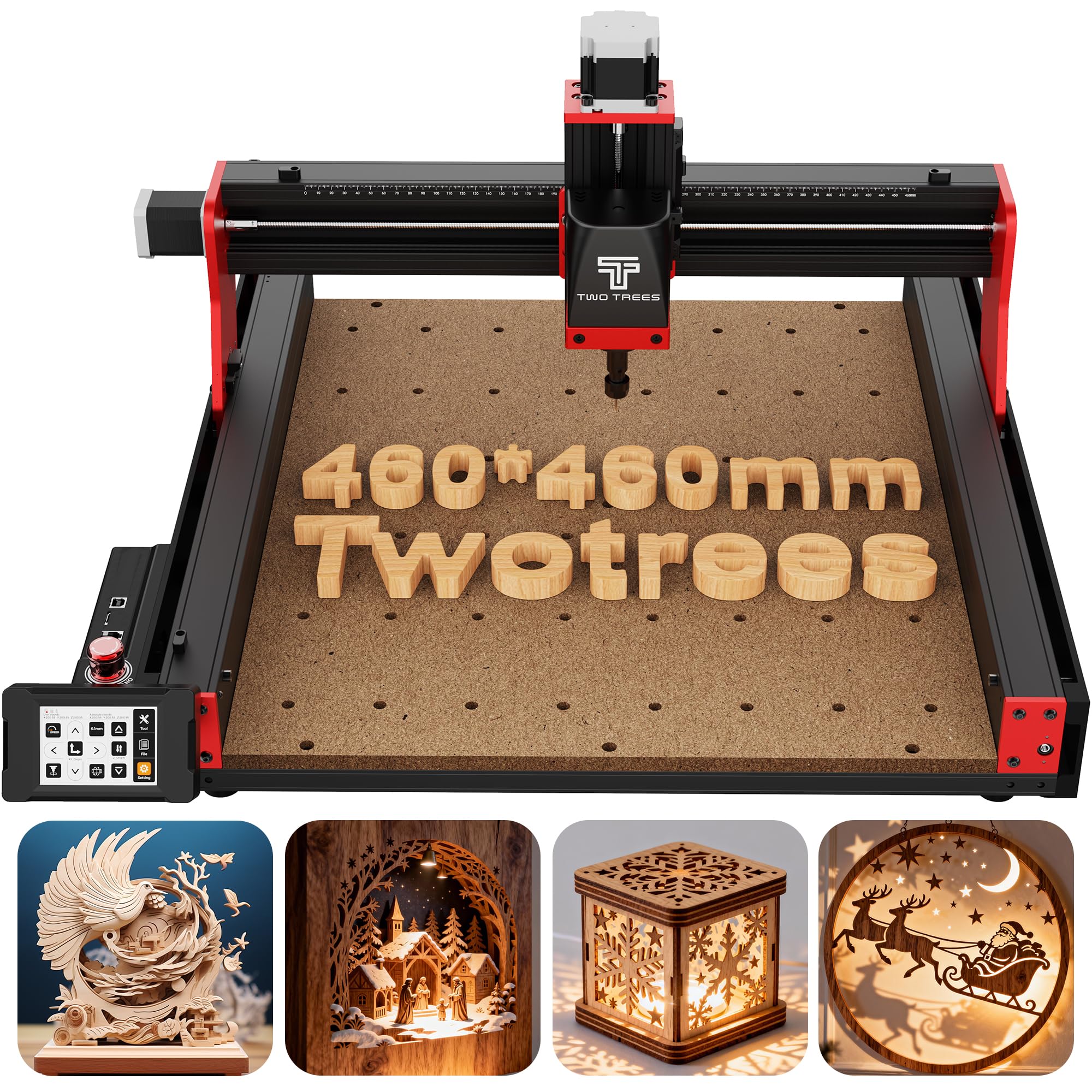
1. Twotrees TTC450 Pro All-Metal CNC Router Machine
Our pick — 4.0+★ from 600+ verified ratings; the strongest balance of quality and price.
The biggest bed here for the least compromise, with a touchscreen so you can cut without a laptop tethered.
Start with the number that changes how you work: a working area of 460 × 460 mm, which means a full furniture panel or a wide sign blank sits on the bed without tiling your job into pieces. That is a wider footprint than the FoxAlien Masuter Pro offers at 400 × 400 mm, and the taller 80 mm Z clearance lets you clamp down thicker stock.
The frame is aluminum alloy and stainless steel, and dual limit switches on all three axes stop the carriage before it slams a rail — a genuine safeguard on long cutting runs. What wins people over most is the build and quality control; this feels assembled rather than improvised, and the included 775 brushed spindle comes with ten cutting tools so you can make chips the day it lands. Setup is genuinely approachable even if you have never flashed a control board before. The 3.5-inch IPS capacitive touchscreen means you can jog, home, and start a file without dragging a laptop into the shop, and the control box carries a 4th-axis rotation port, a laser module port, and a 500W spindle speed control port for later upgrades.
The honest caveat: this ships with an 80W motor and a brushed 775 spindle, which is modest next to the 800W routers further up this list — fine for wood, acrylic, and light aluminum passes, but you will feel it on deep hardwood cuts. Reliability and power draw honest mixed feedback in a crowded field, and a few owners found theirs needed tuning from the start. Budget an afternoon to learn the GRBL workflow and the CH340/CH341 driver step (Windows 11 needs the CH341), and do not expect a plug-and-play appliance.
What earns its keep
- 460 × 460 × 80 mm cutting envelope handles large panels and signs
- 3.5-inch capacitive touchscreen for computer-free control
- Pre-drilled ports for 4th-axis, laser, and a 500W spindle upgrade
- Ten cutting tools and clamping plates included in the box
Where it asks patience
- 80W motor is the entry point, not a power machine
- Driver install step trips up Windows 11 newcomers
Grab this if: you want maximum bed size with an upgrade path and a screen that keeps your shop laptop-free.
Think harder if: your day job is hogging out thick white oak — step up to a trim-router machine with more watts.
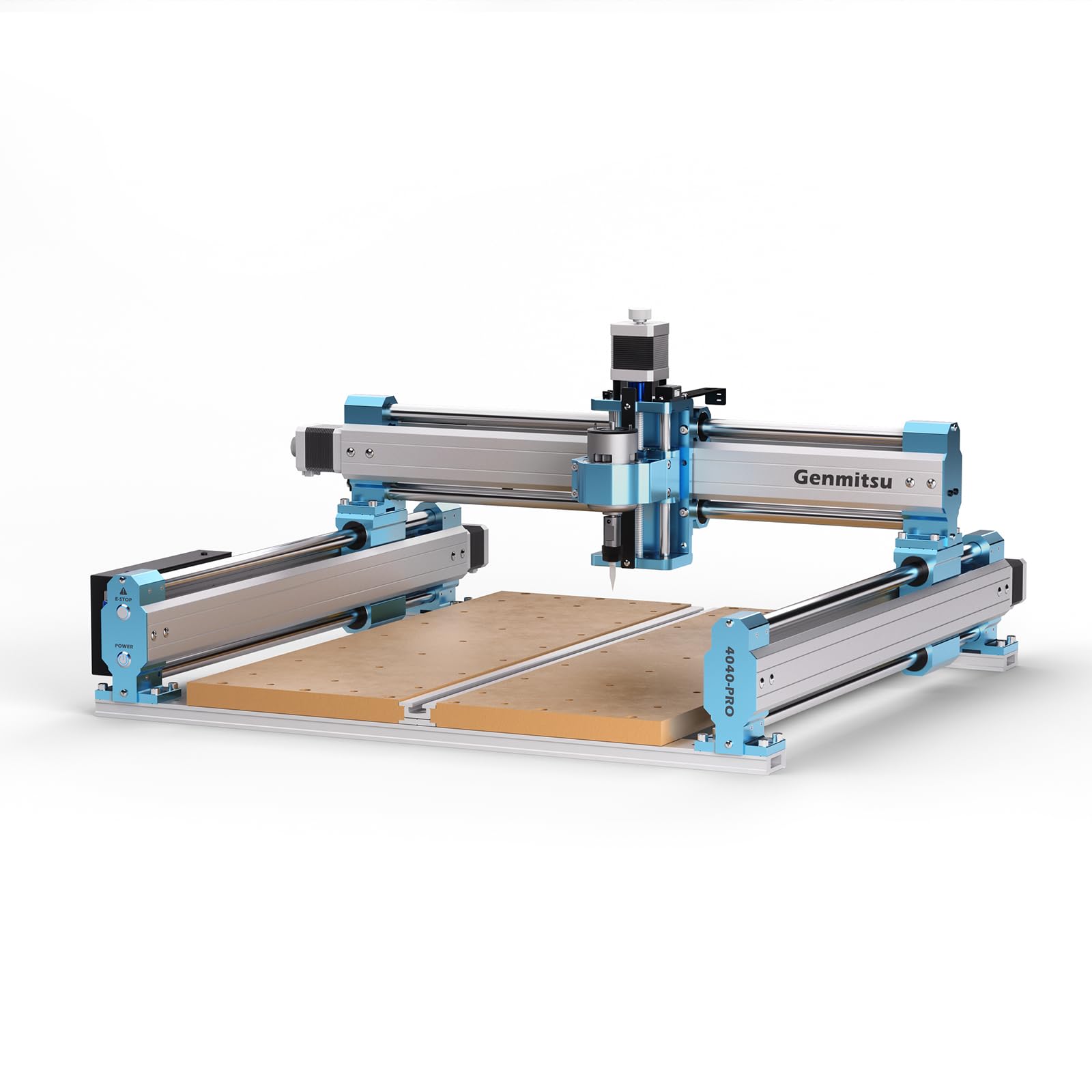
2. SainSmart Genmitsu 4040-PRO CNC Milling Machine
A reinforced steel frame that resists sag, plus the door left open for full 3D rotary carving.
If you plan to turn table legs, chess pieces, or anything cylindrical, the 4th-axis rotary support is the reason to pick this one — add the rotation module and the machine carves from multiple angles or does full 3D rotary work with suitable software. The frame underneath is new steel: 16mm Steel HSS linear tubes, a lead-screw drive, dual Y-axis rails, and a full metal build.
The upgraded spoilboard carries a central aluminum support bar that stiffens the MDF so it does not bow under clamping pressure, and that same bar doubles as a T-slot for fixtures. The control electronics run open-source Grbl v1.1 with Toshiba TB6S109 silent drivers on 32-bit chips, which keeps motion smooth and the noise low. An Air Assistance Pump Port and MPG Port give you places to grow, and the motherboard can be swapped separately for wireless control support.
What you should know before ordering: it arrives with 42mm and 52mm spindle mounts, while 65mm and 69mm mounts are sold separately, so check your router’s collar before you plan a swap. This one is also newer to the market than most of the list, so long-term field reports are thinner — you are trusting the spec sheet and the Genmitsu platform’s track record here rather than a deep review archive.
The rotary argument: a 4th-axis port on a frame this rigid is a rare combination at this tier, and it is what turns a flat-bed router into a lathe-style carver for spindles and bases.
The spindle-mount catch: the taller collars you may want later are optional extras, so add them to your plan from day one.
Worth it for: makers who already know they want cylindrical and 3D rotary work on a stiff steel bed.
Skip the rope-a-dope: if you only cut flat signs, the extra rail weight buys you little over the entry-level twins.
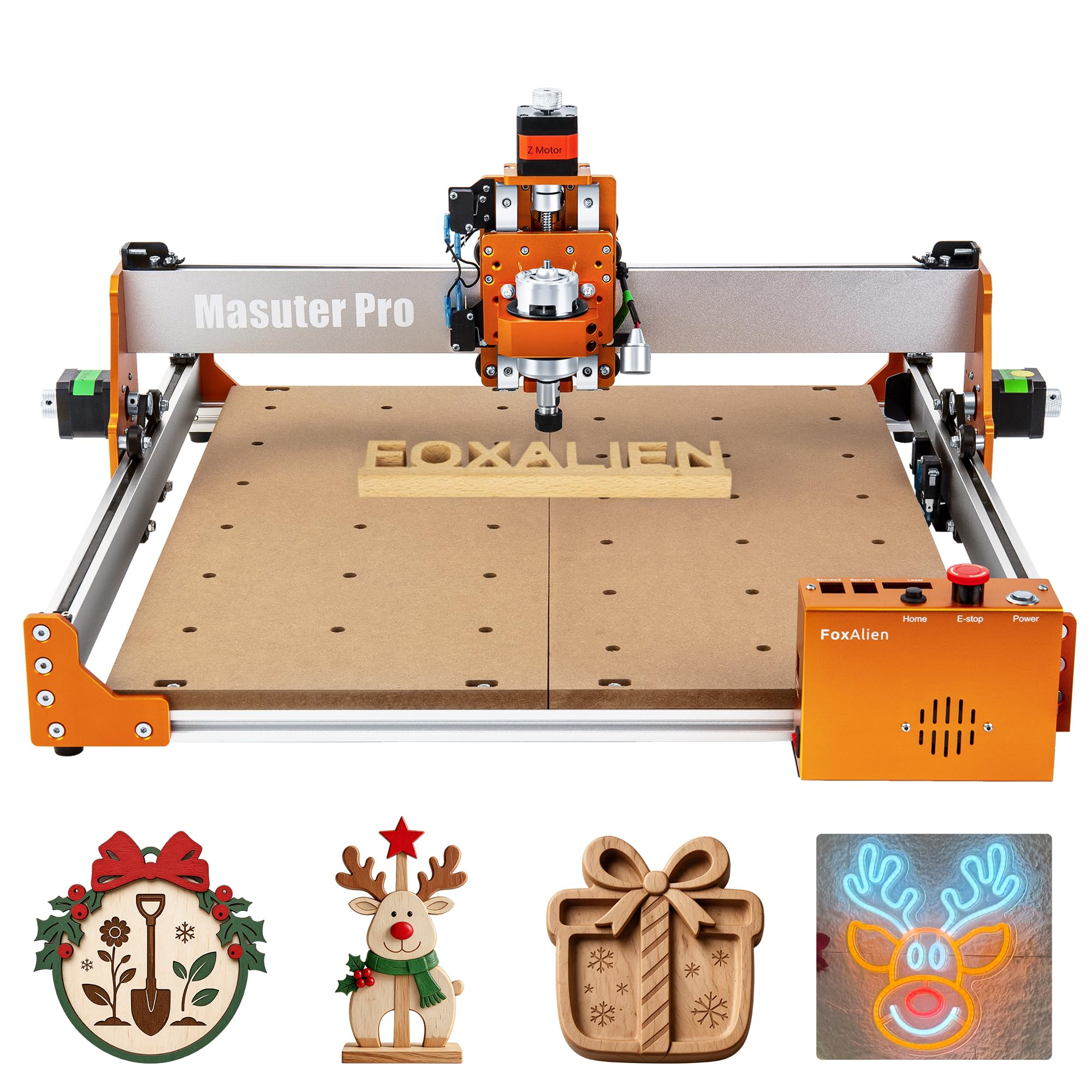
3. FoxAlien Masuter Pro 3-Axis CNC Router Machine
The hobby router that goes from box to first chip in the time it takes to drink a coffee.
Two numbers tell the whole story of this machine: main parts arrive pre-assembled with pre-wired harnesses, so setup runs 10-15 minutes, and the all-metal frame with a linear-rail Z-axis is built for detailed engraving and cutting across wood, acrylic, MDF, and nylon. That combination is exactly why it is the friendliest on-ramp on this list for a newcomer who has never touched a CNC. People keep coming back to the build and the ease of getting it running, and it earns top marks among owners for exactly that.
It ships with two spindle clamps (52mm and 65mm) and supports 60W and 300W spindles, and you can move up to a 65mm trim router or a 1.5KW spindle. The 400 × 400 × 60 mm work surface is the smallest footprint of the group, but an optional Y-axis extension kit expands it later.
Weighing 13 kg, this is 8.5 kg lighter than the Genmitsu 4040-PRO Metal at 20.84 kg — a real perk if you need to shove the machine against a wall between sessions. The trade-off is power: a 60W spindle is the modest end of the scale, and the functionality and value feedback runs mixed because some owners found it underpowered for harder stock. The 2.36-inch Z clearance also caps how tall a workpiece you can fit.
Ticks you’ll notice on day one
- Pre-wired, pre-assembled — running in 10-15 minutes
- Linear-rail Z-axis stays accurate during detailed engraving
- Dust-resistant controller with accessible e-stop
- 13 kg body is easy to store and reposition
Limits to plan around
- 60W spindle is entry power for softwoods and light cuts
- 400 × 400 × 60 mm bed needs the optional extension for big jobs
Start here if: you are brand new and want a solid, quick-to-build machine to learn on without a power surplus you cannot use yet.
Keep looking if: your projects already demand deep hardwood passes or a taller pass height.
4. Genmitsu 4040-PRO CNC Router Machine
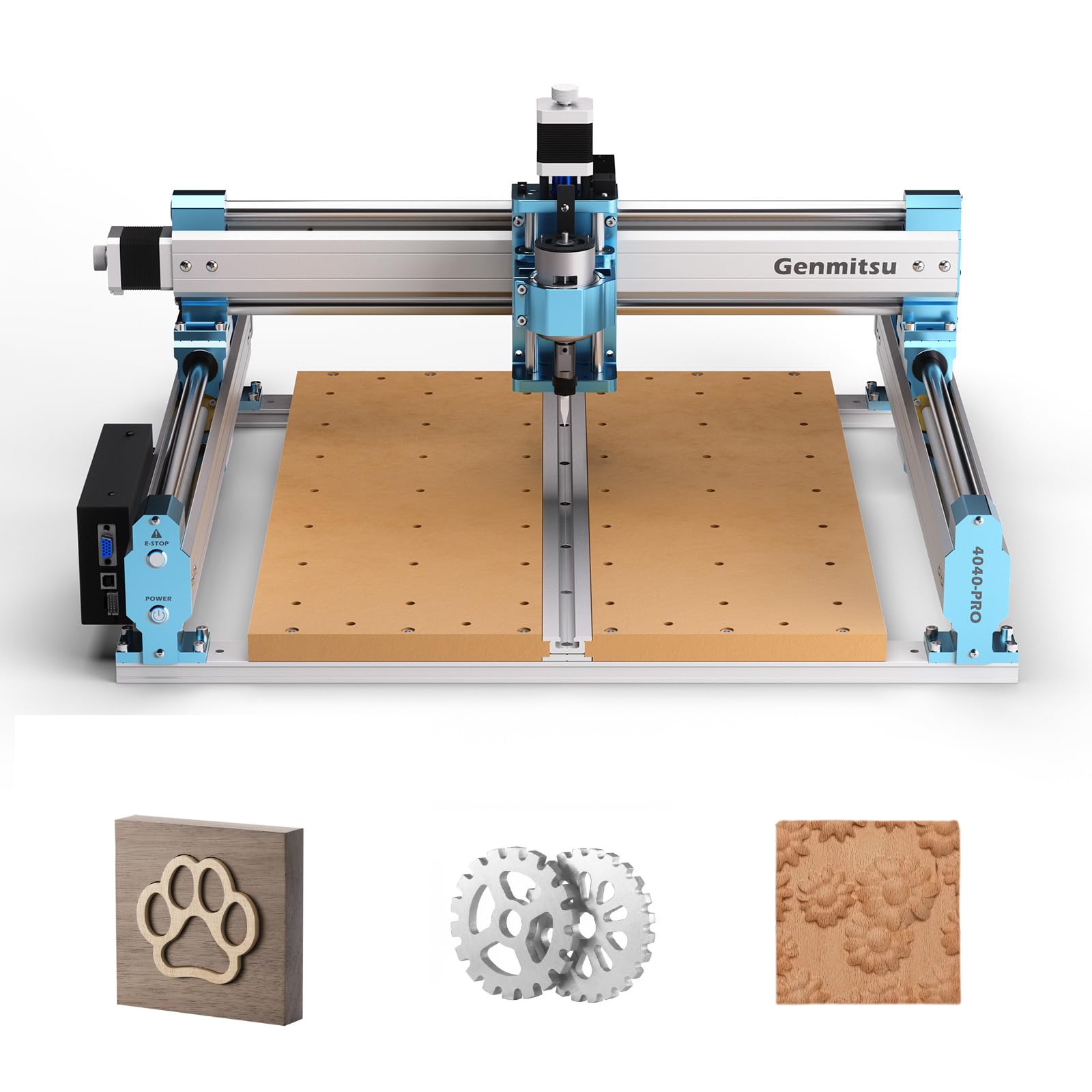
A flatter, stiffer bed that keeps cut depth even — and enough frame to tackle a little metal.
The detail that solves a daily headache: the reinforced hybrid spoilboard has a center aluminum support bar that holds the bed flat, so a long sign carves at the same depth corner to corner instead of drifting as the middle sags. You get 435 × 400 × 80 mm of working area for signs, reliefs, and prototypes, and the machine handles wood, acrylic, MDF, nylon, and carbon fiber composites with the right bits and settings.
Dual 16mm HSS steel tubes on each axis plus lead-screw drives give it rigid motion for detailed engraving, and a 32-bit controller with silent Toshiba drivers keeps the whole thing quiet and steady. Assembly is genuinely quick at around 15 minutes thanks to pre-assembled modules, and buyers report “Customers find the CNC router to be a great starter machine that’s extremely easy to assemble, taking about 20 minutes to set up and get running.” The relocated Z-probe port makes setup day less fiddly, and the redesigned Z-axis carriage accepts 65mm or 69mm mounts with an added mount.
The honest sizing: this is a 4A, 20.84 kg frame that is heavier than the FoxAlien Masuter Pro by a notable margin, so it will not slide around mid-cut — but it also is not a portable machine. Spindle performance draws the loudest complaints, with owners describing the stock spindle as weak, and durability feedback runs mixed. It is also rated 4.0+ stars, the lowest on this shortlist, though the 600+ buyers behind that score largely praise the build and the value.
Why the bed matters: a flat spoilboard is the difference between a job that needs no sanding and one that needs an hour of it.
The power reality: plan on a spindle upgrade if you intend to cut aluminum or dense hardwood regularly.
Suits: makers cutting a mix of wood and soft metals who care more about bed flatness than raw spindle muscle.
Second thought if: you want the stock spindle to carry heavy hardwood work without an upgrade.
5. LUNYEE 3020 Nova CNC Router Machine
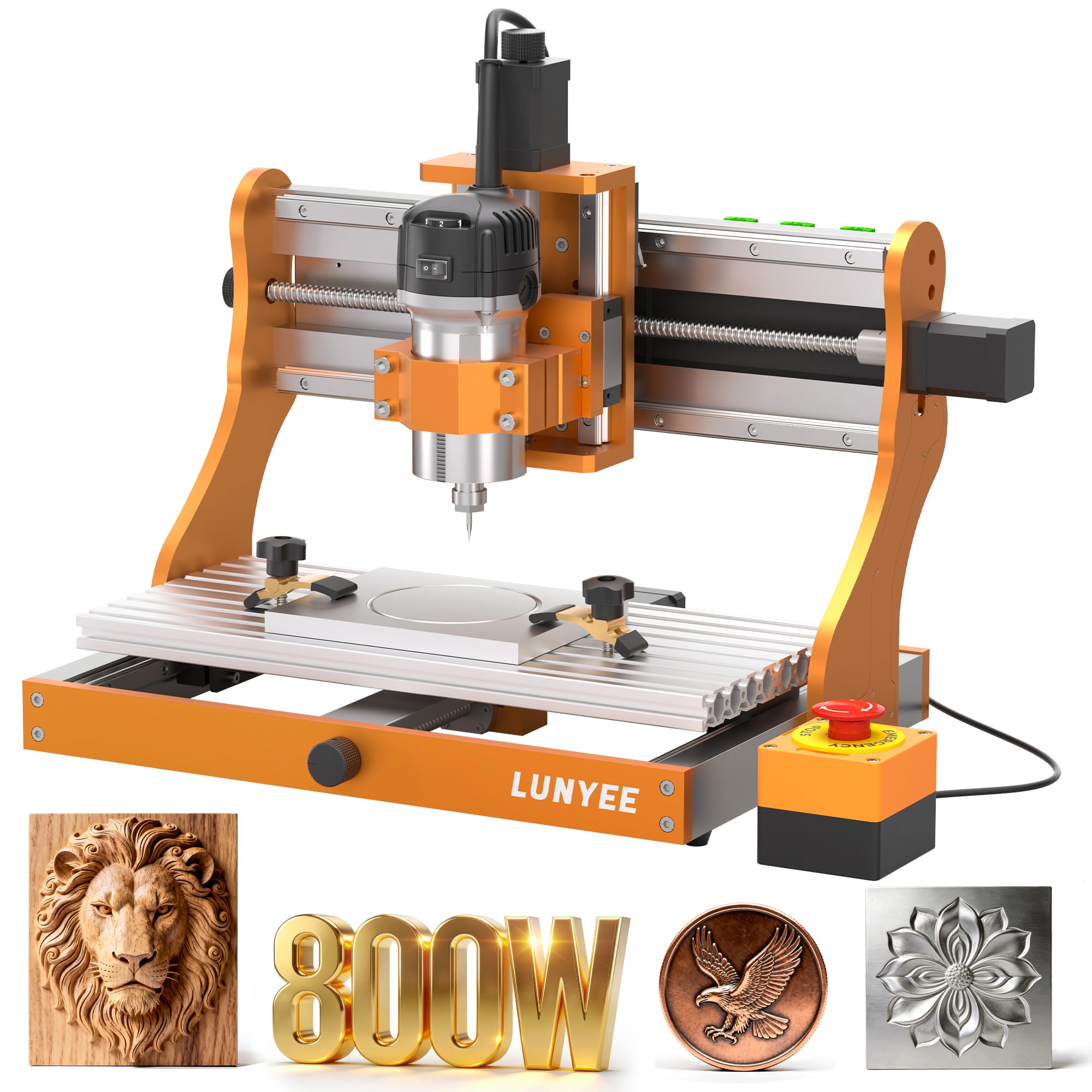
An 800W spindle that spins to 30,000 RPM — a hogs-anything carving head on a compact frame.
The headline here is power and speed together: an 800W spindle with a 6,000-30,000 RPM range, six speed settings, and constant torque control so it holds its cut rate instead of bogging down in a deep pass. That wattage outruns the 60W FoxAlien and the 80W Twotrees by a wide margin, and it means you can take on aluminum, brass, wood, acrylic, MDF, and plastics where the lighter machines have to slow way down.
The drive system is built for precision: 1204 ball screws and HG-15 linear guides on all three axes, which eliminate backlash (the tiny sloppy gap that shows up as fuzzy corners), with a max movement speed of 5000mm/min and accuracy of ±0.05mm. An all-metal frame keeps it durable and stable over time, and it runs GRBL-compatible software including UGS, Fusion 360, Easel, and Candle. It also supports engraving modules and a 20×10 cm CNC vise for desktop projects.
Best of all for the impatient, it arrives fully assembled with wiring pre-connected — unbox it, install the Z-axis module, plug in, and go. What disappoints some owners is dependability over the long haul: reliability and value feedback runs mixed, with complaints about a unit quitting early and some buyers feeling the outlay was high for what arrived. The working envelope is also the compact 3020 class, so this is a detail and small-part machine rather than a panel-sized one.
Power-to-portability: a near-assembled desktop unit with a trim-router-class motor is a rare pairing — you get real cutting authority without a build project.
Size check: confirm your largest workpiece fits the 3020-class bed before you commit; this is not a sign-making footprint.
Reach for this if: you cut small-to-medium parts in mixed materials and want serious spindle power with almost no assembly.
Look past it if: you need a full-sheet table, or you want a long warranty-track record to lean on.
6. SainSmart Genmitsu 4040-PRO MAX CNC Router

Tall clearance for carving thick stock, with a 710W router that spins digital-controlled speed.
Vertical room is what most desktop routers skimp on, and this machine solves it with a 100mm pass height — over 40% higher than the standard PRO model — so you can work taller material or swap in a bigger trimmer without losing carving height. That clearance is the whole pitch: it turns a flat-bed router into one you can feed a deep relief block into.
The cutting side is no slouch either, with a 710W digital-display compact router for engraving and cutting, and X and Z axes on linear guideways for steady motion. A reinforced spoilboard with an integrated T-track stiffens the MDF against sag and gives you clamping slots at once, so fixtures go on and come off fast. Vibration is kept down so precision holds during faster, higher-power passes, and it runs GRBL control for wood, metal, and acrylic work across a 410 × 405 × 77 mm area.
Owners rate the build and the power, with clean assembly instructions and the machine handling common wood types with good precision. The honest catch is the 4A draw and a trimmer that prefers measured passes — and the reliability reputation is still maturing, so treat it as a solid mid-tier pick rather than a proven workhorse. It is also the first jump into trimmer-router territory on this list.
What sets the ceiling high
- 100mm pass height clears tall stock and bigger trimmers
- 710W digital-display router for confident cutting
- Linear guideways on X and Z for stable travel
- Reinforced T-track spoilboard simplifies clamping
Read before you buy
- Trim-router power wants steady, measured passes
- Reliability story still building — less field history than the twins
Pick it for: relief carving and thick-stock work where pass height is the blocker on other machines.
Pass if: you mostly cut thin sheet goods and would rather put the money toward a larger bed.
7. AnoleX 4030-Evo Ultra 2 CNC Router with Ball Screws
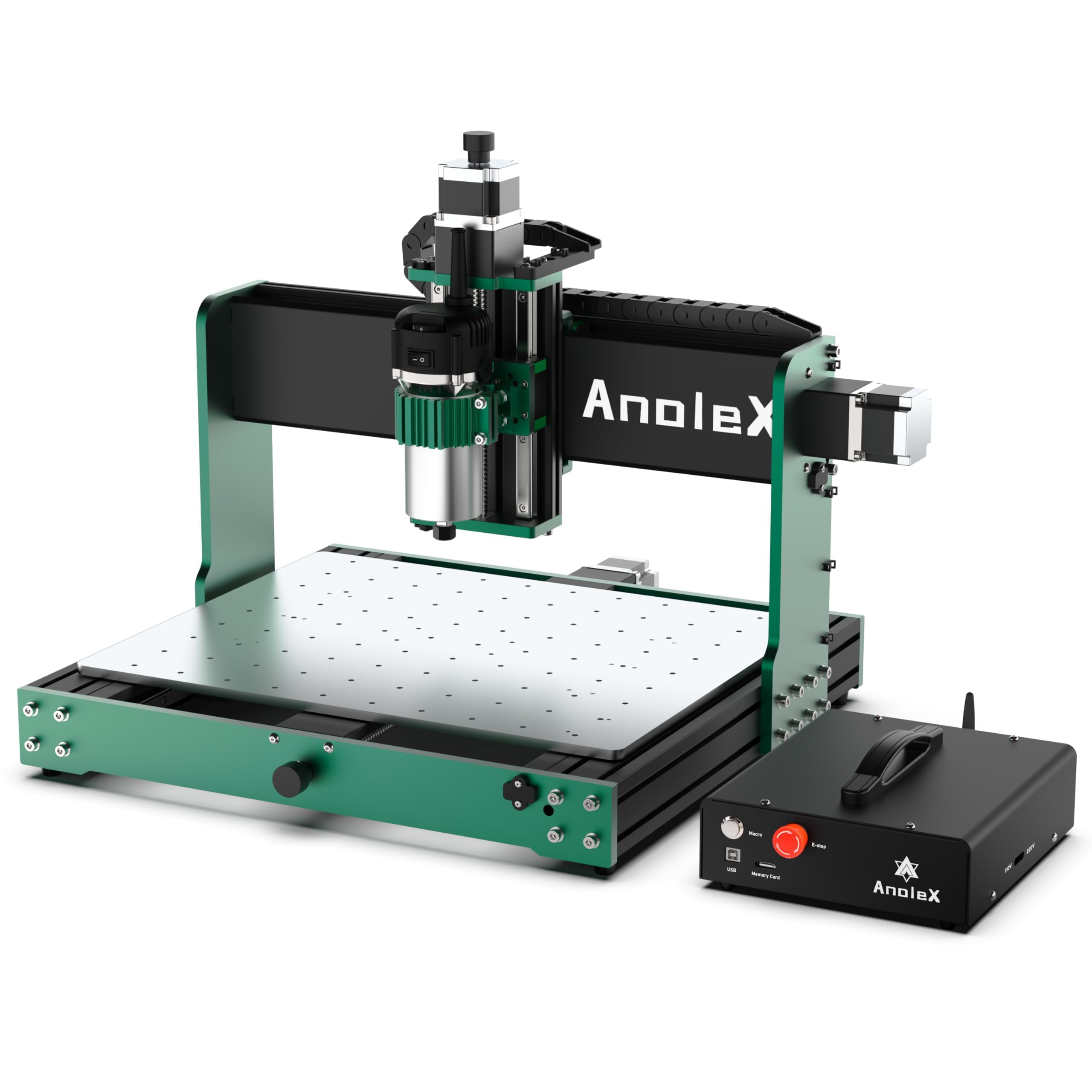
Cut from your phone: WiFi control, macro buttons, and dual rails on every axis.
The feature no other machine here matches is the wireless control — a 32-bit MCU running the ESP3D web interface lets you drive the machine from a PC, smartphone, or tablet without a USB cable. That matters in a dusty shop where you would rather not drag a laptop next to the cutter. A macro button (defaulted to homing) is reprogrammable for pause, stop, reset, or running G-code off an SD card.
Underneath, it is overbuilt in the right places: each axis runs HGH-15 dual linear rails and 1204 ball screws, and the ball screws use a dual-bearing design at both ends to hold precision and cut high-frequency vibration. A 800W trim router with a 6-speed range (8000-24000 RPM) sits up front, with repeatability of ±0.005mm and aluminum engraving accuracy reaching ±0.02mm. Nema 23 stepper motors (2.8A, 1.2N/m torque) drive the axes, and the control board runs GRBL 1.3a on GRBL_ESP32 firmware with support for laser engraving, a 4th axis, coolant control, and closed-loop steppers.
It is heavy at 38 kg — this is a bench-anchor, not a portable unit — and setup is quick thanks to pre-assembled major components and clear cable management. Compatibility is the one mixed note, with a grip about the 3-pin probe port tripping up some owners, so confirm your accessories match before you add them.
Build you can feel: quality and sturdiness are what owners talk about most, and the all-axis dual rails back up that impression.
The cable-free catch: a wireless workflow is a joy until an accessory needs a specific port — verify the probe port before you buy add-ons.
Made for: shops that want cable-free control and dual-rail rigidity on every axis in one machine.
Weigh it against: a lighter unit if you need to move it regularly — 38 kg stays put.
8. Genmitsu PROVerXL 4030 V2 CNC Router Machine
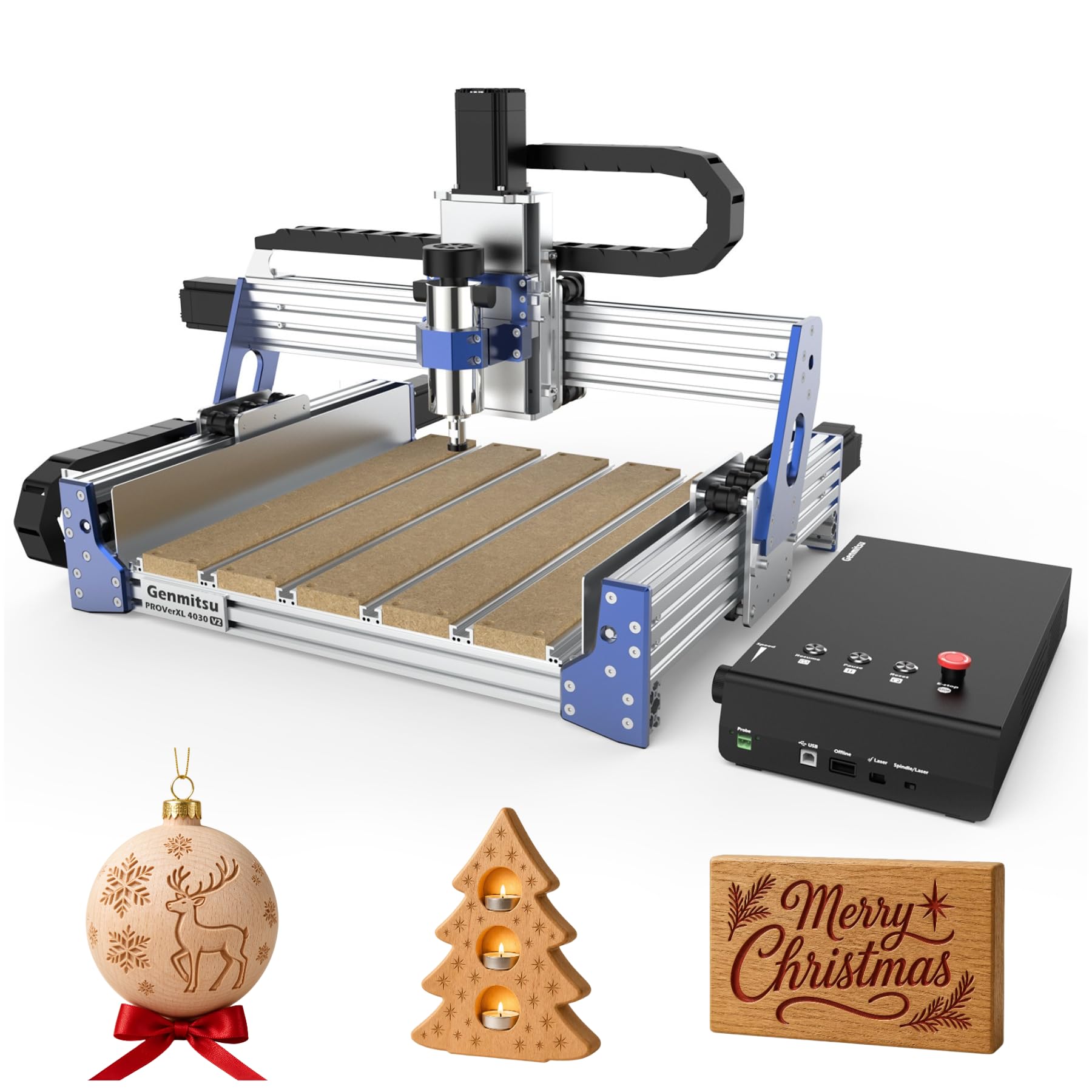
Closed-loop motors that stop losing steps — speed with accuracy that actually sticks.
The upgrade that earns the price is the new closed-loop motor: unlike an open-loop stepper, it checks its position and corrects itself, so you kiss step loss goodbye and get lower noise at the same time. With a maximum travel speed of 5000 mm/min, the PROVerXL 4030 V2 finishes projects fast without sacrificing accuracy — and the 1204 ball screws, improved Z-axis structure, and eccentric-nut roller adjustment give you finer movement control.
The T-slot hybrid table grips your material during machining, and the work area measures 400 mm × 300 mm × 110 mm — that extra depth suits taller parts. A 400W spindle handles wood, plastics, and soft metals, and the GRBL-based board runs from a USB connection via Candle or Universal Gcode Sender. Owners find it highly functional and easy to assemble, especially for milling 1/8-inch aluminum, and it comes recommended for beginners.
The catch is a mixed reliability record: some machines perform great, while others arrive with out-of-the-box failures or durability problems, and the control system draws mixed feedback too. The heavier chassis is built for minimal maintenance once it is right, but do a full test-cut on arrival and keep the one-year warranty in mind. Think of it as a machine to buy with eyes open, not blind faith.
Where it leads: closed-loop feedback plus 5000 mm/min travel is a combination the open-loop machines on this list cannot match for repeatable speed.
What to gate on: that same reputation for the occasional dead-on-arrival unit means a careful unboxing test is smart.
Best for: small shops that need fast, accurate repeatability and are comfortable doing a first-run shakedown.
Not for: anyone who wants zero assembly and zero risk — target the near-ready units instead.
9. FoxAlien CNC Router Machine XE-PRO
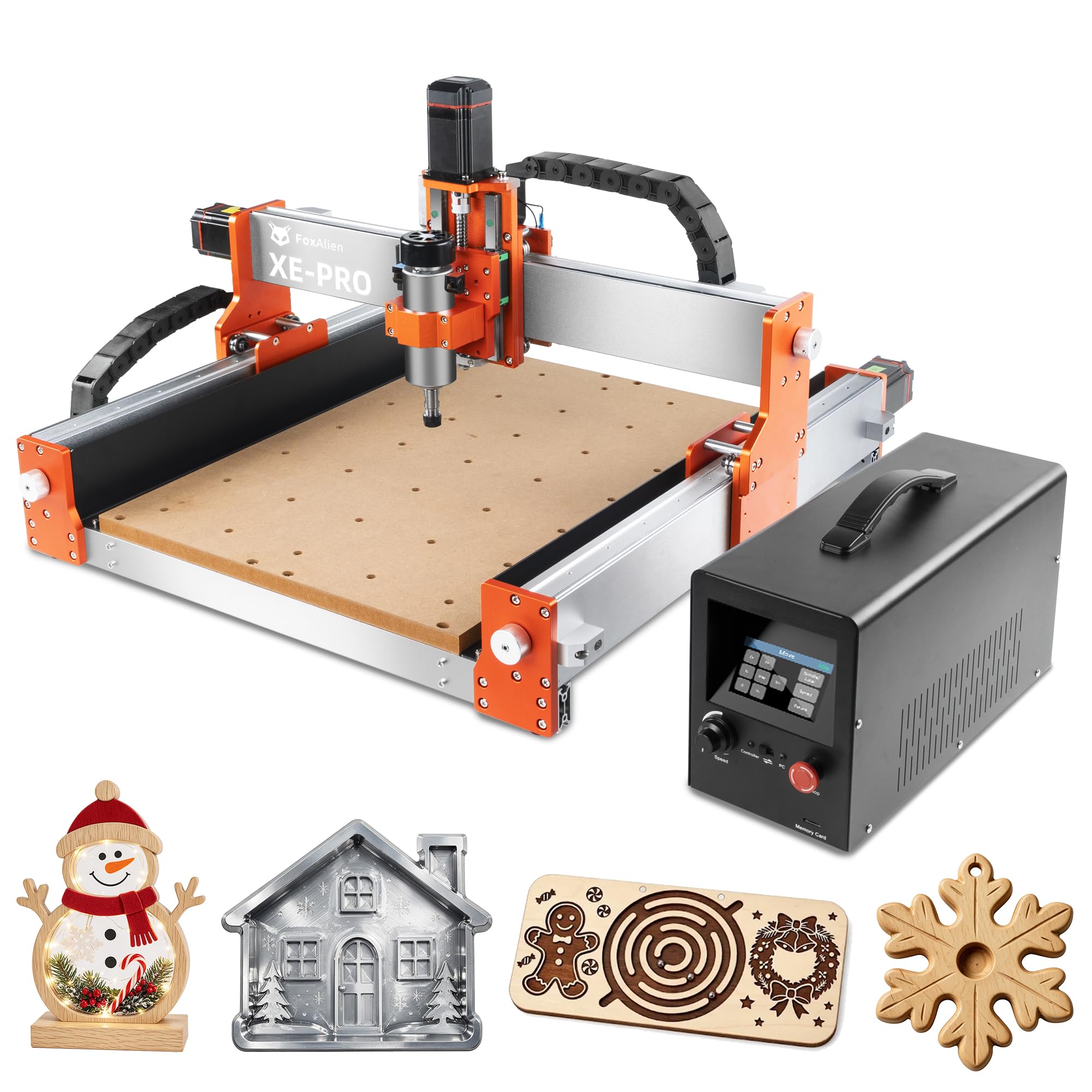
Three spindle clamps and a roadmap to full linear rails — a machine that grows with you.
What makes the XE-PRO stand out is the sheer choice of spindles: three clamps come in the box (52mm, 65mm, and 69mm), so you can fit different spindles or trim routers for different projects and even swap in FoxAlien engraving modules. That flexibility, paired with four closed-loop NEMA23 stepper motors, lets it run fast and smooth at lower noise, with a max moving speed of 5000mm/min — the maker figures it at 2.5 times faster than open-loop steppers.
The drive is 1204 ball screws on the XYZ axes with dual linear rails on the Z-axis for extra rigidity, and there is a unique upgrade path: you can convert the X and Y axes to linear rails and turn it into something closer to an industrial home machine. The stock 400W spindle handles wood and aluminum cutting, and it is fully compatible with a NEMA23 4th-axis rotary module for cylindrical work. Setup runs 25-30 minutes thanks to pre-assembled main parts, and there are plenty of GRBL tutorials online.
On weight, this is a serious 38.46 kg frame, so plan a permanent bench spot. Owners describe it as a great hobby machine that is easy to put together and operate, and praise the build, precision, and value — one buyer described the assembly feel as building a serious piece of equipment — though reliability and durability feedback runs mixed. It tops out at a 12,000 RPM spindle speed, which is fine for wood and light metal but under the 30,000 RPM routers higher on this list.
The growable frame: a spindle-clamp trio plus an XY linear-rail upgrade path is a rare blueprint at this tier — you buy once and expand, not replace.
The RPM ceiling: 12,000 RPM is plenty in wood but a limit if you want tight detail in metal.
Choose it if: you want to experiment across spindle types and plan to upgrade the geometry later.
Consider the alternative: if max RPM for fine metal detail is your priority, look at the 30,000 RPM machines instead.
10. Twotrees TTC6050 CNC Router Machine 600x500mm
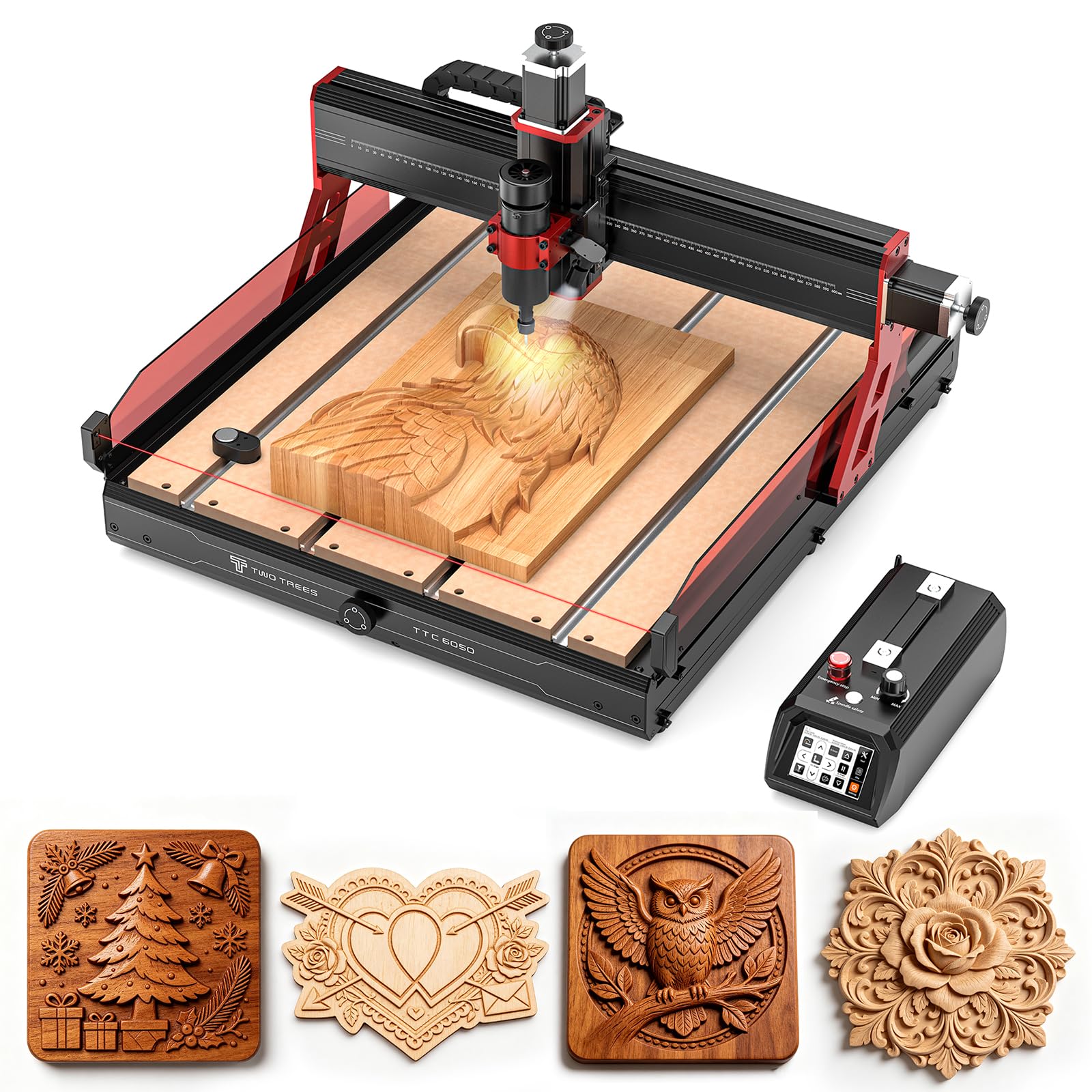
A 600 × 500 mm table that swallows full panels and still carves to 0.1mm.
When your projects are batch panels, furniture parts, or architectural models, the working travel of 600 × 500 × 100 mm is the reason to look here — it is the largest bed on this list short of the premium NymoLabs. C7 ball screws and linear rails on all three axes, plus 57-series stepper motors, hold the carriage steady for an engraving accuracy of 0.1mm and a max speed up to 5000mm/min.
The control side is unusually self-sufficient: a 3.5-inch resistive touchscreen lets you run jobs standalone, with TF-card, USB, and 2.4G WiFi connections, plus a CNC-laser mode switch, auto tool setting, precision calibration, and multi-language options. Safety got real attention — an infrared object sensor guards against accidental injury, built-in lighting improves visibility, and a hidden transmission structure keeps wood chips off the ball screws and guide rails. Dual limit switches on all axes prevent over-travel damage.
The material range is broad: an ER11 collet grips 0.5-7mm tools for plywood, solid wood, MDF, acrylic, carbon fiber, aluminum, copper, and stainless steel, and it runs open-source GRBL firmware with Fusion 360, EASEL, and Carveco Maker. A 500W spindle rating is listed, and it carries CE, FCC, and RoHS certification. At 35.9 kg it is a bench-filler — clear permanent space before it arrives.
Built for volume
- 600 × 500 × 100 mm travel for large panels and batch work
- Standalone touchscreen with WiFi, TF-card, and USB
- Infrared safety sensor and hidden chip-protected rails
- Cut depth held even by C7 ball screws and linear rails
Space and setup notes
- 35.9 kg needs a dedicated, solid bench
- Full assembly and wiring is part of the deal
Built for: small workshops and makers running batch panels who want one big machine to cover the whole job.
Wrong pick if: you work in tight spaces — this one wants a bench of its own.
11. NymoLabs NBS-6040 CNC Router Machine

Rails and ball screws on every axis — the stiffness of a much bigger machine in a desktop frame.
The defining move here is that every axis runs both linear rails and ball screws, hardware normally reserved for larger, heavier industrial machines. That adds rigidity while keeping the rapid movement the 6040 class is known for, so cuts stay clean even when you push the feed. It is rated the highest on this entire list and it shows in the way owners describe it — running like an industrial machine is the recurring theme.
The spindle is NymoLabs’ own custom-designed 710W trim router, with soft start and constant current drive so it ramps from slow to fast without stalling, adjustable across 7000 to 30000 RPM. Control runs open-source Grbl v1.1 with 32-bit driver chips pushing pulse frequency up to 80 KHZ, and it supports moving code files from the offline controller to local memory for more stable engraving. A 2.8-inch TFT touchscreen offline controller lets you run jobs manually or dock it on the controller box.
The work area is a roomy 610 × 410 × 120 mm, and the pre-assembled modular design gets you cutting in about 20 minutes. Expansion ports cover a 4th-axis linkage, MPG, Z-probe tool set, air pump, lighting, air blowing, and dust-boot placement. The one reality to note: it is a premium tier machine, so it rewards someone who will use the rigidity and the ports rather than a casual carver.
Industrial bones: all-axis rails plus ball screws and an 80 KHZ pulse rate put precision and speed in the same frame.
Who it rewards: a maker running dense relief and metal work where every axis needs to hold tolerance — casual users will not tap its ceiling.
The one to buy if: precision and speed on every axis matter more than budget, and you want a machine that acts bigger than its footprint.
Honest pause: it is the top-tier spend on this list — make sure your work justifies the rigidity before reaching for it.
Know the Specs
Working Area (mm)
This is the travel the bit can cover in X, Y, and Z — how big a workpiece fits and how tall it can stand. A larger X and Y lets you cut full panels without tiling; the Z figure decides how thick a block you can clamp down. Size the bed to your biggest realistic project, not your wish list, since a bigger bed usually means a heavier machine that stays put.
Spindle Power (W) and RPM
The spindle is the spinning motor that drives the bit. Wattage says how much material it can remove before bogging down, and RPM range says how fast it spins. Higher wattage (into the hundreds) cuts hardwood and soft metals with more authority. Higher RPM suits fine detail and faster light passes. Set your wattage floor by your hardest material before comparing anything else.
Ball Screws vs Lead Screws
Both convert motor rotation into straight-line travel. Ball screws roll on bearings inside the nut, which reduces backlash — the tiny sloppy gap that shows up as fuzzy corners — and holds precision longer under heavy use. Lead screws are cheaper and fine for softwood and light work, but ball screws are the upgrade that keeps accuracy stable on hard materials and long jobs.
Linear Rails vs Wheeled Carriages
Linear rails are hardened steel tracks that the carriage slides along; wheels roll on aluminum extrusion instead. Rails stay straighter under load and resist deflection during hard cuts, which is why machines built for metal use them on every axis. Wheeled carriages are lighter and cheaper, fine for hobby carving in soft materials but more prone to flex when you push a deep pass.
Common Questions
Can a desktop wood CNC machine cut aluminum or brass?
How long does it take to assemble a CNC router from the start?
Do I need a dedicated computer to run a wood CNC machine?
What is the difference between a 4th-axis port and a rotary module?
Will a bigger working area make the machine less accurate?
What does the Z-axis clearance or pass height control?
Can I add a laser to a wood CNC router later?
Which collet size should I match my bits to?
Do these machines work with Fusion 360 and other design software?
How much space and weight should I plan for?
The Bottom Line
For most buyers, the wood cnc machine that balances bed size, control, and upgrade room best is the Twotrees TTC450 Pro — its 460 × 460 × 80 mm working area, 3.5-inch touchscreen, and 4th-axis and laser ports give you room to grow without repainting the shop. If you want the most precise, stiffest machine on the list and will use every axis, the NymoLabs NBS-6040 with rails and ball screws throughout is the premium reach. And for a first machine you want running in minutes, the FoxAlien Masuter Pro sets up in 10-15 minutes and stays friendly to learn on.
One last nudge that is purely about fit: the TTC450 Pro carries 4.0+ stars across 600+ ratings, so it is well-proven as a starting point — but if your true need is deep hardwood and metal work, spending up on a trimmer-router machine like the TTC6050 or the NBS-6040 will save you an upgrade later. Match spindle wattage and bed size to the material and part dimensions you cut most, and you avoid paying twice for an upgrade.
How we choose
We do not accept paid placement. Every pick is matched to a real buyer and a real use-case; we do not hands-on test units.
Sources
Specifications: manufacturer listings and product documentation. Review insights: verified customer reviews, as of November 2026. Pricing: not shown on this page (it changes often); check the current price via the retailer link.
As an Amazon Associate, Tactical Gear Guy earns from qualifying purchases. This does not affect which products we feature.