Specs are compiled from manufacturer listings and verified buyer reviews and can change over time — please confirm the key details on the product page before buying.
A worn door gasket on a wood stove does quiet damage: it lets uncontrolled air into the firebox, so your fire burns faster, your heat output drops, and smoke drifts where it should not. The fix is cheap and you can do it yourself in about an hour with a pair of scissors and a tube of cement. What matters is buying the right diameter rope, the right length, and a gasket that keeps its seal after heat cycles instead of flattening out. This guide covers eight real gasket ropes and kits, from bare rope you glue yourself to complete kits with pre-measured lengths, and tells you plainly which one suits your stove.
This guide is built by comparing the manufacturers’ published specifications and the patterns across verified customer reviews, so you get each pick’s real strengths and trade-offs instead of marketing spin.
Diameter first, length second, cement third — get those three right and the door closes tight again. Below you’ll find honest picks for every stove door, whether you’re resealing a daily driver or restoring an old cast iron box, all covered in this breakdown of the best wood burning stove gasket options.
Top Picks


How To Choose The Best Wood Burning Stove Gasket
Buying a gasket is mostly a measuring job. Order the wrong diameter and the door will not close flush; order too short a rope and you run out halfway around the frame. Work through these four checks before you click anything.
Match the rope diameter to your door channel
The diameter (the thickness of the round rope) has to fill the groove in your door. Too thin and air slips past; too thick and the door stands proud of the frame. Sizes run from 1/4 inch up to 1 inch, and 3/8, 1/2, 5/8, and 3/4 inch cover most stoves. Pull out your owner’s manual, or measure the old gasket with a ruler before it crumbles in your hand.
Buy enough length, then trim
Rope comes in a fixed length, usually somewhere between 6 and 10 feet for a single door. Extra is fine because graphite-impregnated fiberglass trims cleanly with scissors. Coming up short means a second order and a cold stove in the meantime.
Decide between bare rope and a full kit
A bare rope is the gasket only — you supply the cement. A kit bundles the rope with gasket cement, and sometimes pre-measured lengths for a specific stove model. If you already own a tube of high-temperature cement, the bare rope is the leaner buy. If you are starting from scratch, a kit removes the guesswork.
Check the temperature rating and the graphite
The temperature rating is the heat the gasket material is built to handle. Ratings on this list run from 1000°F to 2000°F. Graphite impregnation (graphite worked through the fiber, not just painted on) gives the rope a slippery, creosote-resistant surface so soot does not glue itself to the seal. That graphite surface is what keeps the door airtight through repeated heat cycles.
Side-by-Side Comparison
| Model | Best For | Diameter | Length | Temp Rating | Amazon |
|---|---|---|---|---|---|
| Midwest Hearth 1/2″ x 84″ Kit★ Best Overall | Complete all-in-one reseal | 1/2 inch | 84 inches | 2000 °F | Amazon |
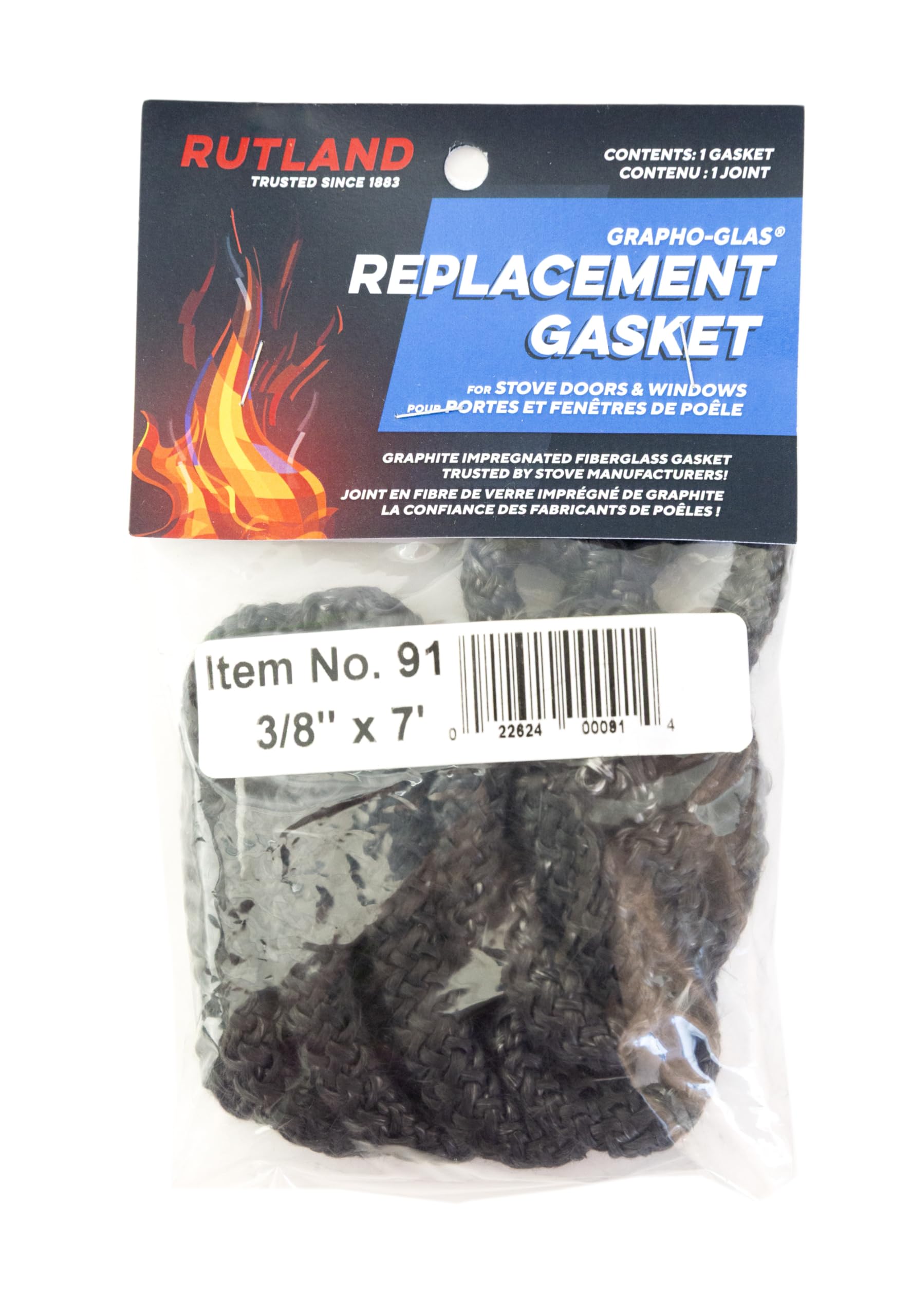
| Rutland Grapho-Glas Rope 3/8″ x 84″Bare Rope Pick | Bare rope for the prepared DIYer | 3/8 inch | 84 inches | — | Amazon |
| Protalwell 3/4″ Grey Gasket, 72″Grey Finish Pick | Grey rope that hides ash | 3/4 inch | 72 inches | 1100 °F | Amazon |
| BSTFLEX Graphite Rope 5/8″ x 84″ | Smokers and multi-use seals | 5/8 inch | 84 inches | 1000 °F | Amazon |
| Liberty Supply 3/8″ x 10 ft. Roll | Bulk rope for several doors | 3/8 inch | 10 ft | 1000 °F | Amazon |
| Rutland 3/4″ x 7′ Kit | Thick doors, tight budget | 3/4 inch | 7 ft | — | Amazon |
| Pellethead 7/8″ x 8′ Kit | Wide channel doors | 7/8 inch | 8 ft | — | Amazon |
| Midwest Hearth Kit 3419 for Vermont Castings | Exact-fit Encore rebuild | Mixed 5/16″ / 3/8″ / 3/16″ | 17 ft + 6 ft + 3.5 ft + 6 ft | 2000 °F | Amazon |
Detailed Reviews
1. Midwest Hearth 1/2″ x 84″ Gasket Kit
Our pick — 4.5+★ from 900+ verified ratings; the strongest balance of quality and price.
A half-inch rope paired with 2,000°F cement, so the whole reseal arrives in one bag.
Here is the number that decides it for most people: 2,000 °F. That is the rating on the professional-strength gasket cement bundled in this kit — the heat it is built to survive without breaking down. Compare that to the 1,000 °F rating on the BSTFLEX rope further down, and you can see why this one earns the top slot. The rope itself is 1/2 inch graphite-impregnated fiberglass, supplied at 84 inches and trimmed to fit with scissors. If your door channel takes a 1/2 inch gasket, you have everything you need in one order.
The graphite here runs through the whole fiber structure rather than sitting on the surface as a coating. In plain terms, that keeps the rope slippery against creosote — the sticky tar that condenses out of wood smoke — so soot does not weld itself to the seal. It also makes the rope more abrasion resistant, so it survives rubbing against the door frame every time you open and close it. The kit covers cast iron and steel stoves, comes in sizes from 1/4 inch to 1 inch, and cuts to fit your specific door.
What wins people over is the material quality and fit — owners resealing a range of stove makes come away with a door that pulls shut tight. Installation is the second thing that gets talked about, and that is really a credit to the included cement and the 84-inch length. The one honest catch is the cement tube. It can arrive clumpy or thicken inside the tube, so knead it well and work in small sections rather than trying to squeeze it cold in one continuous line. Some owners also note the adhesive takes its time to fully grab.
What earns it the top spot
- Professional-strength cement rated to 2,000 °F is included — no separate tube to buy
- 1/2 inch rope at 84 inches trims cleanly with scissors to fit the door channel
- Graphite impregnated through the fiber, not surface coated, for creosote resistance
- Made in the USA and hand-inspected in Minnesota to OEM specifications
Where it needs care
- Cement can arrive clumpy or harden in the tube — knead and use it promptly
- Adhesion varies from stove to stove; clamp the door closed until it sets
- Ordering the wrong diameter is the most common misfire, so measure first
Made for: anyone who wants one order, one evening, and a fully resealed door with no hardware store run.
The honest limit: if your door channel is not a 1/2 inch fit, you need a different Midwest Hearth size, not this one.
2. Rutland Grapho-Glas Gasket Rope 3/8 by 84-Inch
The lean choice: nothing but graphite rope, for the owner who already owns a tube of cement.
If you have already got gasket cement in the toolbox, you are paying for rope only here — which is exactly what you want. This is a 3/8 inch square-section rope at 84 inches long, made of graphite-impregnated fiberglass. That graphite coating is the point: it resists creosote and soot sticking to the surface, so the seal stays intact through a heating season instead of gluing up with tar. At 84 inches it will line one typical stove door with room to trim.
The 3/8 inch diameter is a common one, and it is worth knowing how it stacks up. The BSTFLEX rope further down is 5/8 inch, and the Midwest Hearth Vermont Castings kit uses a mix of 5/16 inch, 3/8 inch, and 3/16 inch for different seals. Measure your own channel — 3/8 inch is right for the many doors built around that size, and wrong for the rest.
Owners come away finding that it works well and fits their door properly, which for a bare rope is the whole assignment. It seals, it holds, and it does not cost much. The durability picture is more uneven — some report the rope holding up well through cycles, while others find it wearing quicker than expected. That makes it a smart buy for a stove you reseal yearly anyway, and less ideal if you are trying to stretch the job out for many seasons.
Right call if: you have cement on the shelf and need 3/8 inch rope for a standard door.
Think twice if: you want the max-lifespan rope or need cement in the box — this one is rope only.
3. Wood Stove Door Gasket, 3/4″ Grey Color, Length 72″
Grey rope that blends into the ash line, so the door frame looks cleaner from across the room.
The grey colour is a practical feature: it hides ash flecks that show on black rope. Black gasket rope shows every fleck of ash and soot against a light stove door. This one is grey, closer to the colour of the ash it sits next to, so the frame looks tidier between cleanings. The rope is 3/4 inch graphite-impregnated fiberglass, rated to 1100 °F and supplied at 72 inches — enough for most single-door stoves and fireplaces with a trim. The graphite work makes it abrasion resistant, and the braided structure can be worked thicker or thinner by hand as you press it into the channel.
What people like most is the quality of the material itself, and it installs without a fight — the braided rope eases into the door groove and seals around the frame well. That adjustable thickness is a genuine advantage during installation: you can coax the rope to sit flush instead of forcing it.
Now the honest part. Thickness draws consistent notes — several find it too thick for their channel, which is a fit issue rather than a bad rope. Size also draws mixed feedback, so measure your door groove carefully before ordering and do not rely on “3/4 inch sounds about right.” Adhesive is mixed too, though that mostly reflects the cement people pair it with rather than the rope itself. Get the diameter right and this seals cleanly.
Where it shines: 3/4 inch rope at 72 inches for the standard-size door, with a grey finish that hides ash better than black.
The fit caveat: the thickness is the recurring point of friction in the review pages — check that your channel actually needs 3/4 inch before you commit.
For the tidy stove owner: you get 3/4 inch graphite rope at 72 inches and a colour that keeps the door looking clean.
Look elsewhere if: your door takes a thinner rope, or you need cement included — this is a rope-only purchase.
4. Graphite Impregnated Fiberglass Rope Gasket 5/8″ x 84″

A 5/8 inch roll that seals a smoker door, a boiler, or a fireplace just as happily as a stove.
The spec worth knowing first is the shape: this is round 5/8 inch rope, 84 inches long, which suits door channels cut for a round profile rather than a square one. The fiberglass is graphite impregnated, so the surface stays slippery against creosote, soft enough to compress into the groove, and elastic enough to spring back after the door clamps shut. The stated rating is 1000 °F, which is the heat the material is built to withstand — a fair bit below the 2,000 °F figure on the Midwest Hearth cement kit if your stove runs hot.
Where this one earns its place is breadth of use. The maker lists it for ovens, chimneys, fireplaces, boilers, industrial ovens, and wood stove doors, so it is the roll to grab when you are sealing something that is not a standard stove. It has shown itself to work on smokers and barbecue pits too, which tells you the seal holds up in a closed, smoky box.
Two things to plan around. First, this product is not sticky — you buy glue or cement separately, so factor that into the job. Second, the quality and fit both come in for solid praise; owners find it seats properly and does what a gasket should. Measure the diameter of your channel before you order, because 5/8 inch is wider than the 3/8 inch rope on several other picks here.
Best fit for: a smoker, boiler, or fireplace door where you want a round 5/8 inch rope that handles more than one job.
Worth knowing: no adhesive is supplied, and the rating tops out at 1000 °F — pair it with cement and match it to a cooler-running appliance.
5. 3/8″ Wood Stove Door Gasket 10 ft. roll

Ten feet of 3/8 inch rope, which is enough to reseal more than one door and still have leftover.
Length is the headline: 10 feet of 3/8 inch braided fiberglass, compared with the 84-inch ropes on most picks here. That extra footage is the whole reason to buy — you can do one stove door now, keep the rest for the next season or the next stove, or line a second door in the same afternoon. The trade-off is bulk that needs somewhere dry to live between jobs. It is 100% fiberglass, white, rated to 1000 °F, and regular density, so it compresses into the channel and seals as the door closes.
Owners find it works and seals well, which is what you want from a rope this simple. The one that sticks with you is the stove that came back to life after a fresh seal went on — old iron box, tight door, fire drawing properly again. Others note it stays put without cement, which is fine for a snug channel but no substitute for proper adhesive on a loose one.
The fibre is plain fiberglass rather than graphite impregnated, so it resists creosote less aggressively than the graphite ropes further up the list. For a stove you reseal every year that is a fair trade for the extra footage. Trim it with sharp scissors, use a proper high-temperature cement, and keep the roll dry.
The real appeal: 10 feet of 3/8 inch rope stretches across multiple doors, and at a 1000 °F rating it handles standard stove heat.
The trade you make: this is plain fiberglass, not graphite impregnated, so creosote clings easier than on the graphite ropes above.
Buy this if: you have more than one door to seal or want spare rope on the shelf.
Skip the extras if: you need graphite impregnation or a heat rating above 1000 °F — this roll keeps it simple.
6. Rutland Gasket Replacement Kit 3/4″ x 7′

The thick-rope kit for a fireplace or a wood, pellet, or coal stove that needs a fresh 3/4 inch seal.
This is the thinnest-wallet route into a complete, named-brand reseal. You get 3/4 inch graphite-impregnated rope at 7 feet, plus a single-use tube of EZ-Spread gasket cement to glue it down. The graphite resists unraveling and stops creosote and soot sticking to the surface, so the rope keeps its grip on the door frame instead of flaking away. It is listed for fireplaces and wood, pellet, or coal stoves, which covers a lot of what people actually have in the room. The kit is sold as one complete unit.
The comparison that matters is length and bulk. At 9.6 ounces this kit is far heftier than the 3.2-ounce Rutland Grapho-Glas rope earlier in the list — that difference is the cement tube and the extra thickness. At 3/4 inch it is also twice the diameter of the 3/8 inch rope, so measure your channel rather than assuming. If your door takes a thick gasket, 7 feet is plenty for one door with slack for trimming.
The installer experience is what this kit is known for: threading the rope, gluing it, and pressing the door shut is a job most people finish without fuss, and the cement is the reason. But sealing is the mixed note, and it is the one to weigh honestly — some setups seal beautifully, and others do not pull tight, often because the gasket is a hair off the channel size. Adhesion and durability also split both ways. If the door does not close snug, check the diameter first, then clamp it while the cement cures.
Why it earns a spot
- Graphite-impregnated 3/4 inch rope plus a single-use tube of EZ-Spread cement in one kit
- 7 feet covers one door with enough slack to trim
- Listed for fireplaces and wood, pellet, and coal stoves
What the pages flag
- Sealing is a mixed report — some doors close tight, others need a re-clamp while curing
- Adhesion and durability split both ways across owners
- 3/4 inch is a thick gasket — confirm your channel needs it
Reach for it when: your door takes a 3/4 inch rope and you want the graphite rope and cement in one tidy kit.
The caveat to own: if your channel is thinner than 3/4 inch, this rope will stand the door proud — size it against the old gasket first.
7. Replacement Rope Gasket Kit 7/8″ x 8′

The widest rope here at 7/8 inch — built for deep door channels that swallow anything thinner.
Most gaskets on this list are 3/8 to 3/4 inch. This one is 7/8 inch, which is the spec that decides the buy: if your door channel is cut deep and wide, a thinner rope rattle-loosens and leaks. The rope runs 8 feet, the maker claims the highest fire rating available in gasket material, and a 1-ounce tube of high-temperature silicone sealant comes in the box — note that is silicone, not the 2,000 °F gasket cement the Midwest Hearth kits ship with, so it suits a cooler-running appliance.
Buyers report the seal seats properly — one that sticks with you is the wood-burning stove door that finally sealed tight after the fresh rope went on. Installation is straightforward when the diameter matches: mark the channel, run the cement, press the rope, close the door, done. The 8-foot length handles one door with room to trim.
The honest catch is the adhesive. How well it grabs is the split point — some owners find it holds, several find it lets go before the job is finished. If yours comes loose, a fresh high-temperature cement fixes it fast. Fit and seal are the stronger notes; the glue is the one to watch. That makes this a solid pick for someone willing to supply a sturdier cement than the tube it arrives with.
The strongest argument: 7/8 inch by 8 feet for wide door channels, plus a tube of sealant to get you started.
The honest catch: the included adhesive is the mixed note — a sturdier high-temperature cement is a smart add-on if yours lets go.
Your pick if: your stove door channel is wide and deep and the standard 3/8 to 3/4 inch rope will not fill it.
Look elsewhere if: you have a standard channel — the 7/8 inch size is overkill and will not seat flush.
8. Midwest Hearth Gasket Kit 3419

Not one length of rope but four, pre-cut for a Vermont Castings Encore rebuild.
If you own a Vermont Castings Encore, this kit skips the measuring entirely. It carries four pre-measured lengths: 17 feet of 5/16 inch graphite fiberglass for the doors and damper, 6 feet of 5/16 inch wire-reinforced rope for the griddle, 3.5 feet of 3/8 inch for the ash pan, and 6 feet of 3/16 inch for the door glass. That is a kit built around a specific stove rather than generic rope, and it fits the Defiant Encore 2190, 2140, 0028, Non Cat 1450, and Encore 2550. It is the same 2,000 °F-rated cement the standard kit uses, made in Minnesota.
The graphite runs through the whole fiber, so the ropes resist abrasion and creosote and keep a consistent seal through heat cycles — the maker states that import kits use plain fiberglass that compresses and fails. The cement is true 2,000 °F gasket cement, not silicone, and installation instructions come in the box.
The honest note is length of the glass gasket: the 6-foot piece is reported as about 6 inches short by several owners rebuilding a full stove, who end up sourcing extra for the glass. The rest of the kit fits as expected and is judged good value for what it includes. If you are only resealing a door, the general Midwest Hearth kit is the simpler buy; if you are doing a full Encore rebuild, this is the one that saves you the measuring work.
Made for: a Vermont Castings Encore owner doing a complete rebuild who wants every length pre-cut and correct.
Plan around this: the 6-foot glass gasket is reported short by several owners, so budget a separate length of 3/16 inch rope for that glass.
Know the Specs
Diameter
The diameter is the thickness of the round rope. It must match the groove in your firebox door — too thin and air leaks past, too thick and the door stands off the frame. Sizes on this list run from 3/16 inch in the Vermont Castings kit up to 7/8 inch in the Pellethead rope. Measure the old gasket with a ruler or check your manual before ordering.
Length
Length is how much rope you get. Most single doors take between 7 and 10 feet; the Vermont Castings kit runs to several measured lengths because it reseals the full stove. Extra rope is fine because it trims with scissors, but coming up short means a second order. The 10-foot Liberty Supply roll is the longest on this list.
Temperature Rating
The temperature rating is the heat a gasket material is built to handle. Lower-rated ropes sit around 1000 °F to 1100 °F; the cement on the Midwest Hearth kits is rated to 2,000 °F. Match the rating to how hot your appliance runs, and never swap gasket cement for silicone on a hot wood stove door.
Graphite Impregnation
Graphite impregnation means graphite is worked through the fiber, not just coated on the surface. It makes the rope slippery against creosote, more abrasion resistant, and better at holding an airtight seal through heat cycles. Plain fiberglass rope works, but it does not resist creosote sticking as well.
Common Questions
How do I measure my old wood stove door gasket before ordering?
Will a 3/4 inch gasket fit if my old one was 3/8 inch?
Can I use silicone sealant instead of gasket cement?
How long does a stove gasket?
What does graphite impregnated mean on a gasket rope?
Do gasket kits come with cement or do I buy it separately?
How do I know if my wood stove door needs a new gasket?
Is 1000 °F enough for a wood stove door gasket?
Can I trim a gasket rope to the length I need?
Will a standard gasket fit both a Vermont Castings and a barrel stove?
The Bottom Line
For most wood stove owners, the winner is the Midwest Hearth 1/2″ x 84″ Gasket Kit because it bundles a 2,000 °F-rated cement with 84 inches of graphite rope — so you get a complete reseal in one order, and it backs that up with 4.5+ stars across 900+ ratings. If you already own cement and just need 3/8 inch rope, the Rutland Grapho-Glas rope is the lean buy. And if you own a Vermont Castings Encore and want every length pre-cut, the Midwest Hearth Kit 3419 is the one to reach for.
How we choose
We do not accept paid placement. Every pick is matched to a real buyer and a real use-case; we do not hands-on test units.
Sources
Specifications: manufacturer listings and product documentation. Review insights: verified customer reviews, as of November 2026. Pricing: not shown on this page (it changes often); check the current price via the retailer link.
As an Amazon Associate, Tactical Gear Guy earns from qualifying purchases. This does not affect which products we feature.