Specs are compiled from manufacturer listings and verified buyer reviews and can change over time — please confirm the key details on the product page before buying.
You want a wooden building kit your kid will actually return to next week, not one that loses half its pieces under the couch by Tuesday. The short answer: buy for the age of the child first, because a 36-block letter set and a 200-plank engineering set are two completely different toys. Match the kit to the child’s hands and attention span. Check whether the pieces are sanded and the paint is water-based (paint thinned with water instead of harsh solvents). Then decide up front: do you want a guided build (cards, blueprints, a screwdriver) or open-ended stacking with no rules at all?
This guide is built by comparing the manufacturers’ published specifications and the patterns across verified customer reviews, so you get each pick’s real strengths and trade-offs instead of marketing spin.
Some kits here teach letters and counting, others teach balance and patience. A few need a parent beside the child for the first build. The rest reward a kid who just wants to stack until the tower falls. Below you’ll find a lineup of wood building kits for kids sorted by age, piece count, and how much adult help each one really asks for.
Top Picks


How To Choose The Best Wood Building Kits for Kids
Most parents pick a wooden kit by the picture on the box and regret it within a week. The pieces turn out smaller than they look, or the build is too fiddly for a four-year-old’s fingers. Get these three things right and the toy stays in rotation.
Match the piece size to the child’s age
A one-year-old needs blocks big enough to grab with a whole fist and too big to swallow. The letter and number blocks here measure 1.7 inch (45mm) per cube, which is a chunky handful for small fingers. A seven-year-old wants thin planks and a challenge instead, so size is the first filter, not the last.
Decide between guided builds and open stacking
Some kits hand your child a blueprint, a screwdriver, or a puzzle card and say “follow this.” That teaches patience and instruction-following. Others are a pile of identical planks with no rules, which teaches balance and invention. Neither is better — but a kid who gets bored following steps will thrive with planks, and a kid who freezes at a blank pile will thrive with cards.
Check the finish before you check the piece count
Wooden toys live in mouths and get dragged across floors. Look for water-based non-toxic paint, rounded edges, and a sanded surface. A 200-piece set with rough corners is a worse buy than a 52-piece set that feels smooth in the hand.
Side-by-Side Comparison
| Model | Best For | Pieces | Age Range | Build Style | Amazon |
|---|---|---|---|---|---|
| Gemileo Wooden ABC Blocks (36 PCS)★ Best Overall | Toddlers learning letters | 36 | 12 months and up | Free stacking | Amazon |
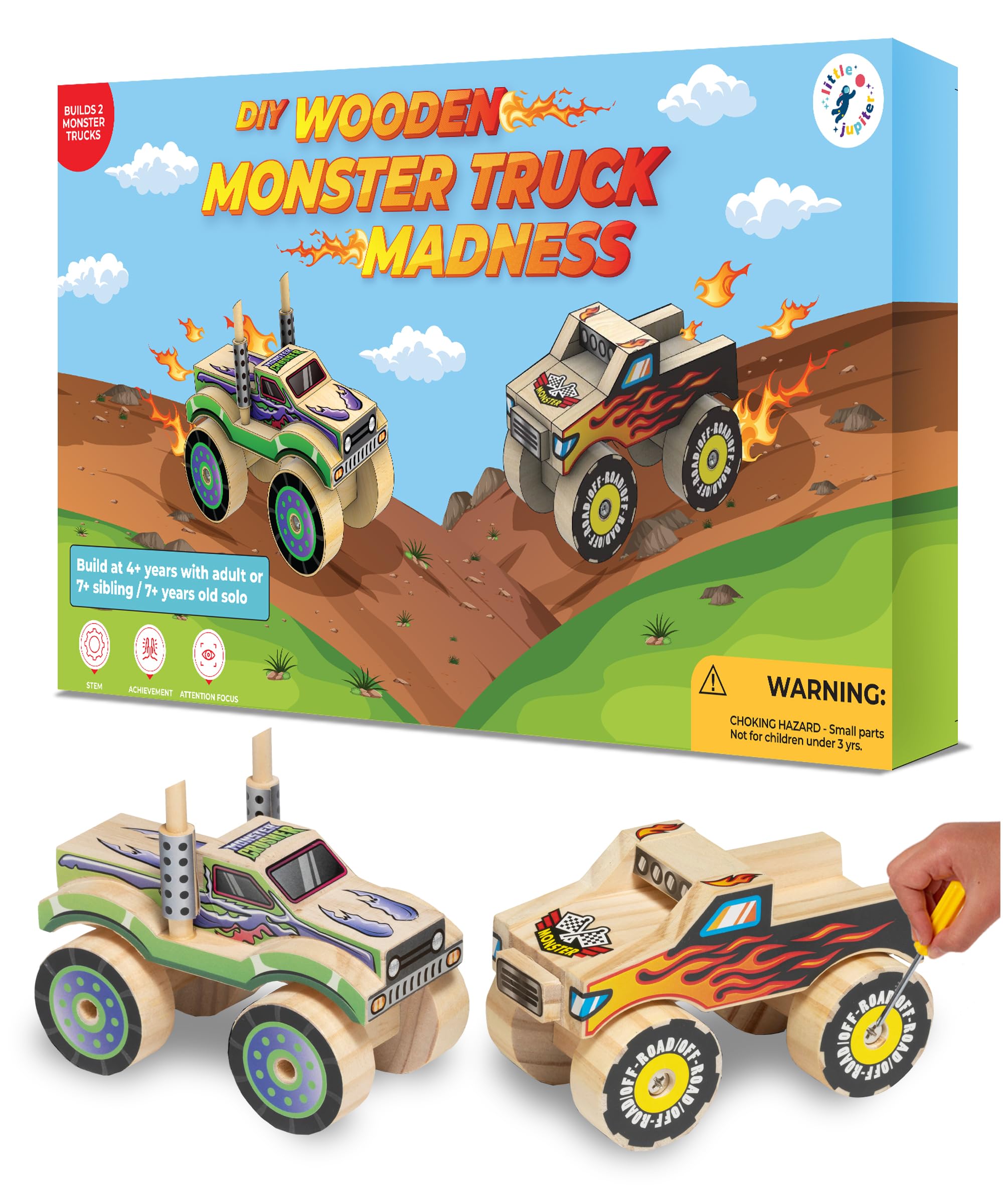
| Little Jupiter DIY Monster Truck KitBest Build-Along Kit | Parent-and-kid build time | 52 | Ages 4-8 | Guided screwdriver build | Amazon |
| SainSmart Jr. 110 PCS Log Cabin SetBest Classic Log Set | Classic log-style construction | 110 | 3+ years | Interlocking logs | Amazon |
| Migargle Large Wooden Building Blocks | Preschool and classroom play | 32 | Ages 3-8 | Open-ended stacking | Amazon |
| MindWare KEVA Brain Builders Deluxe | Puzzle-card challenges | 75 planks + 48 cards | Ages 7 and up | 2D-to-3D card puzzles | Amazon |
| Melissa & Doug Wooden Building Block Set | Big collection, many shapes | 200 | Ages 3-6 | Open-ended stacking | Amazon |
| Melissa & Doug Hammer and Saw Tool Bench | Pretend woodworking play | 32 | Ages 3-5 | Blueprint + toy tools | Amazon |
| Wondertoys 208 Pcs Wooden Log Set | Large log builds on the go | 208 | 3 years and up | Interlocking logs + instructions | Amazon |
| KEVA Structures 200 Wood Planks | Open-ended engineering | 200 | Ages 5 to adult | No-glue plank stacking | Amazon |
Detailed Reviews
1. Gemileo Wooden ABC Toy Building Blocks (36 PCS)
Our pick — 4.5+★ from 750+ verified ratings; the strongest balance of quality and price.
Chunky lettered cubes that survive a one-year-old’s grip and teach the alphabet at the same time.
These are the blocks you hand a toddler who is still learning that things can stack. Each cube measures 1.7 inch (45mm) — a fist-sized wooden square, not a tiny choking hazard — with rounded, sanded edges that feel smooth instead of splintery. The set holds 36 pieces: 26 alphabet blocks and 10 counting blocks, so your child can spell a name and count to ten with the same toy.
What makes the letters worth the money is the double-sided printing. One face shows the uppercase letter, and the other side carries the lowercase of that same letter, so a child sees “A” and “a” as two faces of the same block. Colorful shapes, animals, fruits, and vegetables fill the remaining faces for matching and sorting games. The thermal transfer printing keeps the graphics glossy and clear rather than peeling away after a few months of play.
In the hand, the finish reads as natural wood rather than plastic, and the paint holds up to being chewed and dropped. After months of daily stacking, these are still the first thing pulled off the shelf.
What earns the top spot
- Uppercase and lowercase letters on opposite faces of the same block, so letter pairs are learned together
- 1.7 inch (45mm) cubes are large enough to grip easily and too big to swallow
- Sanded, rounded edges and a natural-wood build that feels substantial in small hands
- Includes a carry bag for tidy storage and easy cleanup
- Counts, colors, animal faces, and shapes add months of games beyond stacking
Where it asks for care
- Only 36 pieces, so it suits one toddler rather than a whole playgroup
- Colors are printed on the surface — avoid soaking the blocks in water
Buy it for: a first birthday or a toddler just starting to stack and name letters.
Look past it if: your child is already past the alphabet stage and wants real construction challenges — the log sets and planks below beat it there.
2. Little Jupiter DIY Wooden Monster Truck Kit
A woodworking kit that hands your kid a real screwdriver and two trucks to build.
Where the letter blocks are a toy, this is a project. The box holds 52 pieces — wood parts, screws, a mini screwdriver, and a sticker sheet — enough to assemble two separate monster truck designs. Build time runs 20-45 minutes per truck, which is exactly the length of a kid’s focused attention before dinner. The pack is compact at 4.38 x 2.38 x 3.75 inches, so it slips into a bag for a restaurant or a long car ride. It also sits far tighter than the big block sets here, which run to roughly 11.8 inches across.
The draw is the process rather than the finished truck. Your child learns to match a screw to a hole and hold a tool steady, then peels stickers onto the cab for the finishing touch. Finished trucks have moving wheels, so the build becomes a toy instead of a display piece. The manufacturer suggests adding acrylic paint for extra customization, though paint isn’t included — that’s a nice second session if your kid wants to keep going.
The honest catch: this is a hands-on-with-a-parent kit, not a quiet solo toy. The screwdriver work and the small screws suit ages 4 to 8 best, and younger kids will need you to start the screws for them. 500+ buyers rate it 4.0+ stars — solid for a kit that leans on adult patience and small screws, and finishers end up with two working trucks plus screwdriver practice.
The real value: tool-handling practice and a completed toy at the end, all in a pack small enough to travel with.
Worth knowing: acrylic paint is suggested but not included, so plan a second craft session if your child wants color beyond the stickers.
Reach for this if: you want a shared weekend project with a 4-to-8-year-old who likes tools and trucks.
skip it if: you need a toy a child can open and play with unsupervised from minute one.
3. SainSmart Jr. 110 PCS Wooden Log Cabin Set
Notched birch logs that build a cabin the way you remember from your own childhood.
This is the retro log toy brought back with modern edges. The 110 pieces are made from natural birch wood and finished with non-toxic water-based paint, with rounded corners instead of sharp ones. The notched logs interlock the old-fashioned way, so a child can raise a frontier fort, a barn, or a ranch without glue, screws, or a single connector piece.
Playability is what sells it — the sheer variety of things a kid can build keeps the set in use well past the first session. The kit includes a large house roof, so the finished cabin looks like a real cabin rather than a stack of sticks. It also works alongside Lincoln Logs and wooden train sets, which means it slots into a playroom that already has a wooden railway running through it. At 3 pounds in the box, it’s light enough to move from room to room.
One fair warning that shows up in the reviews: the pieces don’t always hold firm, and tall towers can wobble while a kid is still building. That’s the trade-off of a friction-fit log system with no connectors — it builds real spatial awareness because the child has to balance it. Keep builds low and wide for younger kids and the wobble stops being a problem. Rated 4.5+ stars across 500+ reviews, it’s the pick for teaching notched-log construction the old-fashioned way.
Why the classic style wins
- Notched birch logs interlock with no glue or connectors
- Compatible with Lincoln Logs and wooden train sets for combined play
- Includes a large roof piece so finished cabins look finished
- Non-toxic water-based paint and rounded, corner-free pieces
The fitting honest note
- Tall builds can wobble because the logs rely on friction, not snaps
- Best for ages 3 and up — younger toddlers will need help seating the logs
Go for it when: you want the nostalgic log-cabin build that doubles as a train-set town.
Think twice if: your child expects pieces to click firmly together — this system balances rather than locks.
4. Migargle Large Wooden Building Blocks Set (32 PCS)

Shapes meant for small groups — cubes, cylinders, arches, and triangles that stack or store in one bag.
The 32 pieces here come in cubes, cylinders, arches, and triangles, which is a smarter starter kit than 300 identical squares. Different shapes force a child to figure out how an arch sits on a column, and that’s where balancing, sorting, and early engineering start. Natural wood with smooth rounded edges and a non-toxic water-based finish keeps it comfortable in a toddler’s hand.
This is the set that earns its keep in a preschool or daycare, not just a living room. The drawstring storage bag makes cleanup fast — one bag, one shelf, done. It’s rated for ages 3 and up, and the pieces are sized with that in mind. Buyers report the wood quality and vibrant colors are what they praise most. On size, opinion genuinely splits: plenty of parents find the blocks large enough to be safe for a toddler, while others expected them bigger than they arrived. If large chunky blocks are your goal, size up your expectations before ordering.
The 4.5+ star showing across 800+ buyers says the four-shape mix and storage bag land with most families. Where it fits best is the playroom with two or three kids, or a classroom shelf that needs a toy that survives daily group play. It won’t build a 200-plank tower, but it will stand up to being dumped, stacked, and dumped again.
What stands out: four distinct shapes (not just cubes) that teach balance and sorting in a single bagged set.
The honest caveat: the size of the pieces divides opinion, so check the listed dimensions against what your toddler currently grabs.
For the playroom or classroom: a durable, mixed-shape starter set with a bag that makes cleanup painless.
Not the pick if: you want a giant collection — this is 32 pieces, not 200.
5. MindWare KEVA Brain Builders Deluxe

A card deck and 75 planks that turn flat pictures into a 3D build your kid has to solve.
This kit flips the usual setup. Instead of a blueprint with steps, your child gets a flat diagram on a card and has to turn it into a real 3D structure out of 75 pine planks. There are 40 puzzle cards and 8 design cards in the box, with the solution printed on the back of each — so the child can check their own work instead of calling for a parent. It’s pitched at ages 7 and up, and the difficulty climbs as they work through the deck.
The gift here is patience and visualization. A kid has to look at a picture of a picnic table and work out how the planks cross in space before their hands move. That’s the skill that transfers to math and engineering later. The builds range from picnic tables and rowboats to swans and snails, so there’s a payoff worth flipping the card over for. No glue and no connectors, just stacked planks and gravity.
If your child likes puzzles, this beats a pile of generic blocks for sustained attention. The set holds the interest of kids who want a goal, and it’s compact at 2.4 pounds, so it travels in a backpack. Rated 4.5+ stars across 300+ reviews, it’s the pick for the child who asks “what’s next?” the moment a tower is finished — because here, “what’s next” is another puzzle card.
The clever bit: a self-checking solution on the back of every card, so kids learn to test and adjust their own builds.
What to expect: this is a solo puzzle toy, not a group play set — one child, one deck, one table.
It shines for: the 7-and-up puzzle kid who needs a goal and a challenge, not just free stacking.
You might pass if: your child is under 7 — the 2D-to-3D puzzle will outpace them.
6. Melissa & Doug Wooden Building Block Set (200 Blocks)

Two hundred painted blocks in nine shapes — enough for a whole castle, then a whole city.
If you want quantity and variety in one box, this is it. The set holds 200 blocks in red, yellow, blue, and green, across 9 different shapes — cubes, arches, columns, and more. That’s the shape variety of the Migargle set scaled up, so one child can build a tower with color patterns while a sibling builds a bridge in the corner of the same table. It promotes hand-eye coordination, color and shape recognition, counting, sorting, and spatial relationships, and it’s aimed at ages 3 to 6.
The blocks arrive in frustration-free packaging designed to open without a box-cutter fight, which is a small win on the first day and a bigger one on a birthday. The colors are bright and the quality of the wood is what the feedback keeps landing on — this is a set that gets dumped, spread, and gathered up repeatedly without the paint flaking off. The generous piece count means a child can actually finish a big structure instead of running out of blocks halfway up.
The honest trade-off is size. A chunk of buyers find the blocks smaller than the pictures suggest, and some find the durability mixed over long use. The easy fix is to know your child’s age range — the recommended ages run 24 months to 5 years, so this is a preschooler’s set, not a toddler’s first chunky grab. The 4.5+ star rating across nearly 700 buyers says the 200-block count and nine shapes deliver for most parents.
Why 200 pieces earns its shelf space
- 200 blocks in 4 colors and 9 shapes for near-endless building combinations
- Bright red, yellow, blue, and green paint that holds up to heavy play
- Frustration-free packaging that opens cleanly
- Multiple kids can build separately from the same set
The catch to weigh
- Blocks run smaller than some buyers expect from the pictures
- Recommended for ages 3 to 6, so it’s a step past the toddler stage
The right call for: a family that wants one big shared set in the playroom for preschoolers.
Give it a miss if: you’re shopping for a one-year-old — the pieces are aimed at older toddlers.
7. Melissa & Doug Hammer and Saw Tool Bench (32 pcs)

A mini workbench where your kid saws, hammers, and follows blueprints to build a robot.
This is the wooden kit for the kid who wants to do what you do at the workbench. The 32-piece set is a kid-sized tool bench with wooden tools and building pieces. The saw actually works — it cuts through self-stick tabs, so your child gets the real sawing motion and the satisfying pop of a cut. The included blueprints show how to build an animal, a house, a robot, or a boat. Every piece stores inside the mini bench, which has handles for carrying.
What keeps parents recommending it is the pretend-play payoff. Kids saw, hammer, and assemble for a long time, and the tool play translates to fine motor skills as they grip a kid-sized hammer and line up a cut. It’s aimed at preschoolers, ages 3 to 5, and it’s all screen-free hands-on play.
The honest limit is durability and difficulty. The feedback splits on how long the pieces last, with some parents reporting parts breaking off after heavy use and others saying it holds up fine. Ease of use divides the room too — some kids find the sawing and tab-cutting genuinely tricky, which for a 3-year-old can tip into frustration. The build quality and the educational value are what most buyers praise, so if your child has the patience for the sawing motion, this becomes a favorite. If they don’t, start with the simpler Little Jupiter screwdriver kit first.
The winning idea: a working toy saw that cuts real self-stick tabs, turning pretend woodworking into an actual hands-on skill.
The fair warning: the sawing takes practice, and the tabs and pieces call for a gentle hand — this suits a patient preschooler better than a rough one.
Pick it for: the 3-to-5-year-old who copies every DIY project you start and wants tools of their own.
Pick something easier if: your child gets frustrated fast when a tool resists — the tab-cutting has a learning curve.
8. Wondertoys 208 Pcs Wooden Log Set

The big-batch log set — 208 real wood pieces with a train engine, a lumber truck, and a carry case.
This is the SainSmart cabin idea scaled up and dressed for a town. The 208 pieces are made of real, high-quality wood with indentations that lock log to log. The set adds a train engine, a lumber truck, trees, doors, and a dog, so your child builds a whole scene instead of one cabin. Everything packs into a carry case with a handle, so it goes to grandma’s house or back on the shelf in one motion.
Two things earn it a spot over the smaller log kit. First, the piece count — plenty of room for a fort with a rail line running through it. Second, the portability — parents report the one-case cleanup makes the mess manageable in a playroom that has to be reclaimed at bedtime. It ships with step-by-step instructions and extra build ideas, and it’s rated for ages 3 and up. The wood is finished with non-toxic paint and rounded edges, and it’s tested to ASTM and CPSIA toy safety standards.
The catch to plan for is the piece mix. Owners mention the ratio of small to large pieces isn’t always ideal — you get a lot of the little logs and fewer of the big ones you need for walls. For a child who wants to build wide and tall, the small pieces run out first. At 4.6 pounds it also sits heavy for a preschooler to carry alone. The 4.5+ star rating across 370+ buyers says the real-wood quality and the price land, especially against the name-brand log sets it undercuts.
Why the big-batch log set earns its case
- 208 real-wood pieces with a train engine, lumber truck, trees, doors, and dog
- A carry case with a handle makes transport and cleanup one step
- Step-by-step instructions plus extra build ideas on the package
- Non-toxic paint, rounded edges, and tested to ASTM and CPSIA toy safety standards
What to size up before buying
- The small-to-large piece ratio leans small, so wide builds burn through the little logs first
- At 4.6 pounds the loaded case is heavier than a young child can carry comfortably
The one to grab for: a family that wants the full log-cabin town experience and easy one-case cleanup.
Consider the smaller cabin set instead if: you need more big wall pieces than small trim pieces.
9. KEVA Structures 200 Wood Building Planks Set

Two hundred identical pine planks and no rules — just gravity, balance, and a tower that reaches the ceiling.
Precision-cut pine planks, all the same size and shape, stacked with nothing but gravity. That’s the whole toy, and it’s enough. Every plank is interchangeable, and the 200 count means a kid can build narrow towers that climb surprisingly high and cantilevers that balance further than you’d expect. No glue, no connectors, no snaps — just the physics of leaning one flat board against another. The set ships with a 24-page full-color idea booklet that shows build-outs if a child wants a starting point.
The fun factor is what the reviews circle back to again and again — open-ended play that a kid can return to for hours, with no wrong answer and no missing piece that stops the build. The planks are also interchangeable with other Kapla or KEVA plank systems, so a child who already owns one of those can combine sets into a bigger build. It’s rated ages 5 to adult, and the “to adult” part is real — plenty of parents end up building alongside the kids. At 200 planks and 2.92 kg, it’s a substantial box, so clear shelf space before it arrives.
The thing to know before you buy: with 200 identical planks, a child who needs a picture to copy will look at the pile and freeze. This is the toy that rewards a kid with their own ideas and punishes one who wants instructions. The idea booklet helps, but there are no step-by-step builds for a robot or a truck the way the tool bench and monster-truck kits have. What wins people over here is the freedom — a set that grows with the child instead of getting outgrown in a month.
The core of it: 200 interchangeable pine planks that teach balance, leverage, and geometry through pure stacking.
The honest fit note: identical planks and no guided builds suit an inventive kid and frustrate one who wants a model to copy — pair it with the idea booklet.
The one for the builder: a 5-and-up kid who invents their own structures and doesn’t want to be told what to build.
Not the starter kit: if your child needs a blueprint in hand, start with the KEVA puzzle cards or the tool bench instead.
Know the Specs
Age Range and Piece Size
The age printed on the box is really a size and safety guide, not a rule. A set rated for 12 months and up, like the ABC blocks at 1.7 inch (45mm) per cube, uses pieces big enough that a toddler can grip them with a whole hand and too big to be a choke risk. A set rated 7 and up, like the KEVA Brain Builders, uses thin planks and puzzle cards that ask for fine motor control (small hand movements) and spatial thinking (judging how shapes fit). Match the age rating to the child’s actual hands, and you avoid both the “too small, gets mouthed” problem and the “too hard, gets abandoned” one.
Guided Builds vs. Open Stacking
A guided kit gives your child a target — a blueprint, a puzzle card, a screwdriver and a set of screws. It teaches following directions and builds confidence because there’s a finish line. An open-stacking kit gives a pile of pieces and no rules, which teaches balance, invention, and self-direction. Neither is superior, but they suit different kids. A child who asks “what do I do with this?” will click with the Little Jupiter truck or the KEVA puzzle cards. A child who ignores the instructions and builds their own thing will get more from the KEVA Structures planks or the log sets.
Paint Finish and Edge Safety
Wooden toys get chewed, dropped, and dragged. The finish matters as much as the wood. Look for water-based non-toxic paint and rounded, sanded edges — the language the better sets here use. Printed graphics (like the thermal-transfer letters on the ABC blocks) hold their color better than paint applied over rough wood, but they should still be kept out of standing water. A set that lists non-toxic paint and tested toy-safety standards is making a promise you can hold it to.
Piece Count vs. Shape Variety
Two hundred identical planks and 200 mixed blocks in nine shapes are different toys. Piece count tells you how big a build can get; shape variety tells you how many kinds of build are possible. The Melissa & Doug set spreads its 200 pieces across 9 shapes, so a child can combine arches and columns. The KEVA Structures set gives 200 planks that are all the same, so every build is about stacking and balance instead of matching shapes. More pieces isn’t automatically better — pick the count that fits the kind of play your child prefers.
Common Questions
Are wooden building blocks safe for a one-year-old?
Do these kits need glue or connectors?
What age is best for a wooden log cabin kit?
Can different wooden building kits be used together?
Is a guided build kit better than open-ended blocks?
How do I keep wooden blocks clean without damaging the paint?
How many pieces do I really need?
Are these wooden kits good for a classroom or daycare?
Do wooden building kits make a good gift for a boy or a girl?
The Bottom Line
For most families, the wood building kits for kids winner is the Gemileo Wooden ABC Blocks because it does two jobs at once — it’s a safe first stacking toy at 1.7 inch per cube and it teaches uppercase and lowercase letters on the same block. Buyers back it too: 4.5+ stars across 700+ ratings. If your child wants a real tool-in-hand project, grab the Little Jupiter Monster Truck Kit, which hands them a screwdriver and two trucks to build.
How we choose
We do not accept paid placement. Every pick is matched to a real buyer and a real use-case; we do not hands-on test units.
Sources
Specifications: manufacturer listings and product documentation. Review insights: verified customer reviews, as of November 2026. Pricing: not shown on this page (it changes often); check the current price via the retailer link.
As an Amazon Associate, Tactical Gear Guy earns from qualifying purchases. This does not affect which products we feature.