Specs are compiled from manufacturer listings and verified buyer reviews and can change over time — please confirm the key details on the product page before buying.
If your boots slide around while your skis turn, the cause is usually the shell size and the last width (the shell’s internal width across the forefoot), not your technique. A 24.5 boot is its own shell size — not a 24 and not a 25 — so a boot that fits perfectly in a 25 can leave a 24.5 foot swimming in extra length with a loose heel pocket. The three boots below all come in that exact 24.5 Mondo size (Mondo is the boot-sizing scale measured in centimetres). Each one solves the fit problem differently: one is the softer, roomier all-day cruiser, one is built for a wider foot with an intermediate motor, and one pairs a high-volume fit with a lightweight shell.
This guide is built by comparing the manufacturers’ published specifications and the patterns across verified customer reviews, so you get each pick’s real strengths and trade-offs instead of marketing spin.
A 102 mm last and a 104 mm last fit very different feet, so the width number decides who each shell suits. Flex numbers (how stiff the boot resists forward lean) mean little without a real foot measurement. Below, you will see which boot earns its place as the best women’s 24.5 ski boots pick for most skiers.
Top Picks
How To Choose The Best Women’s 24.5 Ski Boots
Buying ski boots by the size label alone puts people in the wrong shell more often than any other mistake in the sport. The 24.5 Mondo size is a half size that many shops stock in limited numbers, and it uses a different shell from the 24 and the 25. So if a listing says 25/25.5, that is not your boot, even though the numbers look close.
Start with the last width, not the flex
The last is the internal width of the boot at the widest part of your forefoot, measured in millimetres. A wider last gives your toes and the top of your foot more room, which matters most if you have a broad forefoot or a high instep. A narrower last holds the foot more firmly, so the boot responds the instant you press into the turn. Measure your foot width while standing and compare it to the listed last before anything else — a great flex in the wrong width still hurts by lunchtime.
Match flex to how much of your weight you like driving the ski
Flex is the boot’s forward-stiffness rating, and a lower number bends more easily. A softer boot is easier to flex in cold snow and more forgiving when you are learning to load the front of the ski. A stiffer boot returns more energy into the turn but asks more from your legs. If you are still building confidence on blue runs, a lower flex is easier to bend and gentler on your shins. If you are carving with intent, a stiffer flex returns more energy into the turn.
Check the liner and the sole before you commit
A thermo-adjustable liner is one that softens with heat and then moulds to the shape of your foot, which is a genuine comfort feature rather than a label. Sole compatibility matters too: some shells accept GripWalk soles (sold separately) that make walking across a lodge car park less slippery. Buckle count also affects how quickly you get the boot on and off, and it changes how evenly the pressure is spread across your shin.
Side-by-Side Comparison
| Model | Best For | Last Width | Weight (per boot) | Mondo Size Listed | Amazon |
|---|---|---|---|---|---|
| Rossignol Kelia 50★ Best Overall | All-day comfort on a roomy last | 104 mm | 7.8 pounds | 255 | Amazon |
| Atomic HAWX Magna 75 | Intermediate skiers with a wider foot | 102 mm | 8 pounds | 25/25.5 | Amazon |
| Head Edge LYT RX W HV | High-volume feet wanting a light shell | HV high-volume fit | 3.38 kg | 24.5 | Amazon |
Detailed Reviews
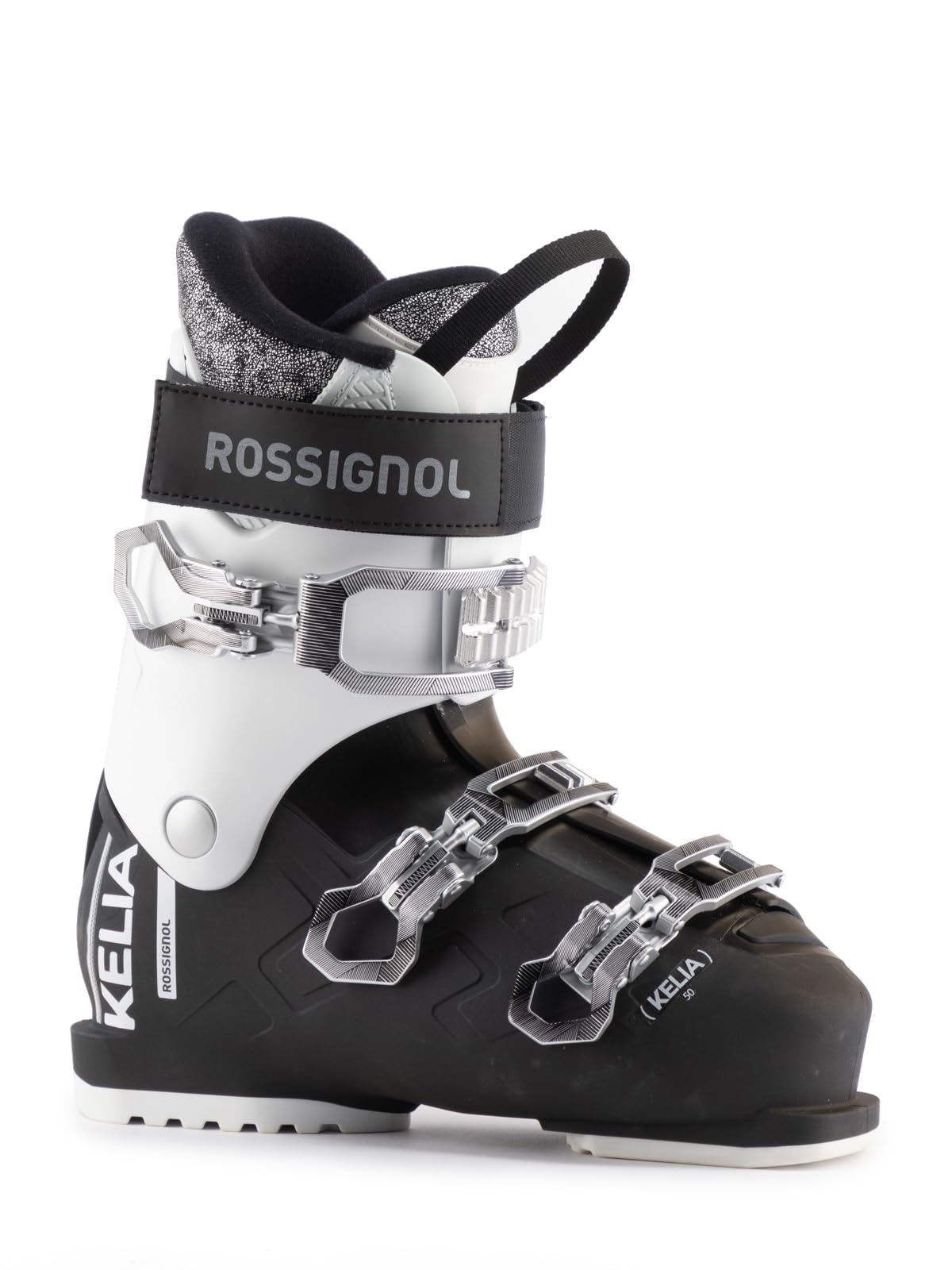
1. Rossignol Kelia 50 Ski Boots
Our pick — 4.5+★ from 40+ verified ratings; the strongest balance of quality and price.
The roomy, soft-flexed cruiser built for women who want to stay out until the lifts stop.
The comfort here comes from geometry, not just soft plastic: a 104 mm last, the widest in this group. The relaxed 104 mm last is the widest internal footprint in this group, which gives a broad forefoot and a high instep real breathing room. Compare that with the Atomic HAWX Magna 75’s 102 mm: the Rossignol is 2 mm wider, so if you have ever felt your toes curl under in a tight shell, this is the boot that stops it.
The women’s-specific build is more than a colourway: the Tulip-shaped cuff is cut to relieve shin and calf pressure. The Tulip-shaped cuff is cut to relieve pressure on the shin and calf, which is the part of a ski boot that determines whether you make it to the last run or quit after two. Soft plastic around the instep lets you pull the boot on and off without a fight, even when cold stiffens the shell.
You get in and out fast because three buckles rather than four make adjustment quick and forgiving — good if you want to get going rather than fiddle. The liner is a thermo-adjustable synthetic (heat it and it moulds to your own foot shape) for support and warmth. At 7.8 pounds, it is the lighter of the two boots with published weights in this guide, against the Atomic at 8 pounds. One honest note on the sizing label: this listing shows Size 255, so confirm with the seller that the shell you receive is the 24.5 Mondo you need before you order.
Where it earns its keep
- 104 mm last gives the widest forefoot room in this lineup
- Tulip-shaped cuff eases shin and calf pressure for longer days
- Soft plastic at the instep makes entry and exit manageable in cold
- Thermo-adjustable liner moulds to your own foot shape
- 7.8 pounds — lighter than the 8-pound Atomic here
Fit notes to weigh
- Relaxed, forgiving flex rewards easy skiing more than hard carving
- GripWalk soles are sold separately, not included
- Listing shows Size 255 — verify the 24.5 Mondo with the seller first
Reach for this if: you want all-day comfort, a wide forefoot, and a boot you can pull on without a wrestling match.
Look elsewhere if: you are chasing a stiff, aggressive flex for hard carving — the relaxed build is not aimed there.
2. Atomic HAWX Magna 75 Women’s Ski Boots

A wide-lasted intermediate boot that turns small leg movements into real ski response.
If you have a broad foot, the Atomic’s 102 mm last gives you a snugger hold than the Rossignol above, which is 2 mm wider. It is still generous, but with a touch more grip around the forefoot for skiers who want the shell to feel connected rather than roomy. The clearest reason to pick it over the softer Rossignol is the Energy Link, a connection between the cuff and the shell that stiffens how your leg movement transfers into the ski. Press your shin forward and more of that force reaches the ski’s edge.
The whole shell is polyurethane, the material that gives a boot its forward stiffness and its rebound. At 8 pounds it sits just above the Rossignol’s 7.8, a difference you will not feel on the hill but that tells you this is the more substantial build of the two. Atomic lists the skill level as intermediate, which lines up with a boot that wants a skier already comfortable loading the front of the ski.
Here is the catch you need to check before you buy: the listed size is 25/25.5, not 24.5. The 24.5 Mondo shell is a separate size, so if 24.5 is your fit, confirm the actual shell you will receive with the seller — do not assume the half-size label covers you. If your foot truly measures into a 25/25.5, this boot is a strong, honest choice for a wider foot and a progressing intermediate.
What the spec buys you: the Energy Link cuff-to-shell link and the all-polyurethane construction are the two features that give this boot its responsiveness. A 102 mm last keeps a wide forefoot from being crushed without going fully roomy.
The honest limit: the 25/25.5 size listing is the thing to verify first. It is a great wide-foot intermediate boot, but it is not automatically the 24.5 shell you searched for.
Best matched to: an intermediate skier with a broad foot who wants a firm, responsive shell rather than a soft cruiser.
Worth a second look: anyone who needs a confirmed 24.5 Mondo shell — check the size with the seller before ordering.
3. Head Edge LYT RX W HV Women’s Alpine Boots

The one listing here that states 24.5 outright, built with extra room through the forefoot.
If you typed 24.5 into the search bar, this is the most straightforward match on the page: the size field reads 24.5, full stop. That stated size matters, because the Rossignol lists 255 and the Atomic 25/25.5, so both need the shell confirmed with the seller.
The fit philosophy is High Volume, which Head defines as extra room through the forefoot and instep for wider feet or skiers who prefer a relaxed hold. That is a different approach from the Atomic’s 102 mm last — Head does not publish a millimetre figure here, so judge it as a high-volume shell built for room rather than a quoted width. The polyurethane outer gives the boot its structure, and Head lists the skill level as intermediate.
The weight is easy to misread, so read it carefully: the specification lists 3.38 kg, which is the package figure — the same 3.38 kg appears in both the item weight and package weight fields. That is a shipping weight, not the weight of a single boot on your foot, so do not use it to compare against the 7.8-pound and 8-pound per-boot figures of the Rossignol and Atomic. What you can trust is the extra forefoot room, the stated 24.5 size, and a shell aimed at a relaxed, comfortable fit.
The size advantage: a listed 24.5 Mondo is the clearest starting point in this lineup for a woman who knows that is her shell.
Read the weight right: the 3.38 kg figure is the package weight — do not read it as a per-boot figure when comparing to the other two.
Pick this one when: a confirmed 24.5 shell and a high-volume forefoot are your top two priorities.
Think twice if: you want a published last width in millimetres to compare — Head does not list one here.
Know the Specs
Last Width in Millimetres
The last is the internal width of the shell at the widest part of your forefoot. A bigger number means more room for a broad foot or a high instep; a smaller number means a firmer hold on the foot. In this lineup the Rossignol runs a 104 mm last and the Atomic a 102 mm last, so the Rossignol is the roomier of the two. Head describes its Edge LYT RX W as a high-volume fit without quoting a millimetre figure, so treat it as built for room rather than as a measured width.
Flex and Shell Material
Flex is how much resistance the boot gives when you push your shin forward — a lower number bends more easily and suits a lighter or less forceful skier. The shell material matters just as much: polyurethane, used on both the Atomic and the Head here, is what gives a boot its forward stiffness and rebound. The Atomic adds an Energy Link between cuff and shell that firms up how directly your leg movement reaches the ski, which is the clearest responsiveness difference in this group.
Common Questions
Is 24.5 the same shell as a 24 or a 25 ski boot?
What does last width mean on a women’s ski boot?
Will a high-volume boot fix pressure across the top of my foot?
Do I need GripWalk soles for walking around the lodge?
What is a thermo-adjustable liner and does it help fit?
Is a lighter ski boot always better for a woman skier?
How many buckles should a relaxed women’s ski boot have?
Is an intermediate flex boot enough for a progressing skier?
Why does the Atomic listing say 25/25.5 when I searched for 24.5?
Which boot suits a wide calf and a wide forefoot together?
The Bottom Line
For most women shopping in this size, the women’s 24.5 ski boots winner is the Rossignol Kelia 50. Its 104 mm last is the roomiest quoted width here, so a wider foot gets room instead of pinch. Its Tulip-shaped cuff eases shin and calf pressure, and its 7.8-pound build is lighter than the 8-pound Atomic. If you have a wider foot and want a firmer, more responsive shell from an intermediate boot, reach for the Atomic HAWX Magna 75 — just confirm the shell size with the seller. And if what you want most is a listing that states 24.5 outright with extra forefoot room, put the Head Edge LYT RX W HV on your shortlist. Whichever you pick, measure your foot in centimetres and confirm the 24.5 Mondo shell with the seller before ordering.
How we choose
We do not accept paid placement. Every pick is matched to a real buyer and a real use-case; we do not hands-on test units.
Sources
Specifications: manufacturer listings and product documentation. Review insights: verified customer reviews, as of November 2026. Pricing: not shown on this page (it changes often); check the current price via the retailer link.
As an Amazon Associate, Tactical Gear Guy earns from qualifying purchases. This does not affect which products we feature.